Edudel Syllabus Class 9 Maths
Finished viewing? Save it for later —
Download Edudel Syllabus Class 9 Maths (PDF · 4 pages)About Edudel Syllabus Class 9 Maths
Edudel Syllabus Class 9 Maths is available here for free download. Published by Delhi School Education for Class 9, this syllabus can be viewed online or downloaded as a PDF (4 pages). Candidates preparing for Class 9 can use Edudel Syllabus Class 9 Maths to understand the exam pattern, the type of questions asked, and the overall difficulty level.
Frequently Asked Questions
How can I download Edudel Syllabus Class 9 Maths?
Open this page and click the Download button to save Edudel Syllabus Class 9 Maths as a PDF. It is completely free on AglaSem Docs.
Is Edudel Syllabus Class 9 Maths free to download?
Yes. Edudel Syllabus Class 9 Maths can be viewed online and downloaded as a PDF free of cost on AglaSem Docs.
How many pages does Edudel Syllabus Class 9 Maths have?
Edudel Syllabus Class 9 Maths contains 4 pages, which you can read online or download together as a single PDF.
Where can I find more Class 9 study material?
You can find more Class 9 question papers, sample papers, syllabus, and answer keys on AglaSem Docs.
Edudel Syllabus Class 9 Maths – Text
Read the full text of this syllabus below — useful to quickly search, copy and reference the content online without downloading the PDF.
📄 View text version (4 pages)
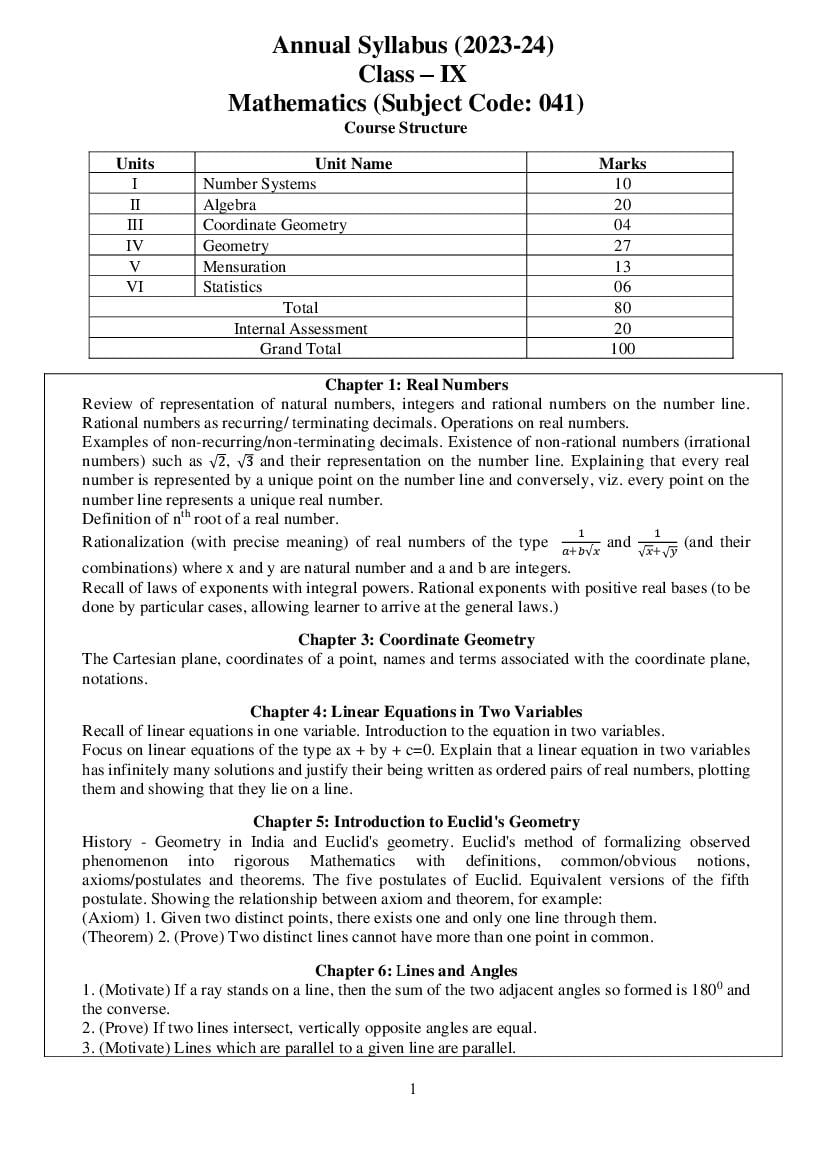
Page 1
Class – IX
Mathematics (Subject Code: 041)
Course Structure
Units Unit Name Marks
I Number Systems 10
II Algebra 20
III Coordinate Geometry 04
IV Geometry 27
V Mensuration 13
VI Statistics 06
Total 80
Internal Assessment 20
Grand Total 100
Chapter 1: Real Numbers
Review of representation of natural numbers, integers and rational numbers on the number line.
Rational numbers as recurring/ terminating decimals. Operations on real numbers.
Examples of non-recurring/non-terminating decimals. Existence of non-rational numbers (irrational
numbers) such as √2, √3 and their representation on the number line. Explaining that every real
number is represented by a unique point on the number line and conversely, viz. every point on the
number line represents a unique real number.
Definition of nth root of a real number.
1 1
Rationalization (with precise meaning) of real numbers of the type 𝑎+𝑏√𝑥 and 𝑥+ 𝑦 (and their
√ √
combinations) where x and y are natural number and a and b are integers.
Recall of laws of exponents with integral powers. Rational exponents with positive real bases (to be
done by particular cases, allowing learner to arrive at the general laws.)
Chapter 3: Coordinate Geometry
The Cartesian plane, coordinates of a point, names and terms associated with the coordinate plane,
notations.
Chapter 4: Linear Equations in Two Variables
Recall of linear equations in one variable. Introduction to the equation in two variables.
Focus on linear equations of the type ax + by + c=0. Explain that a linear equation in two variables
has infinitely many solutions and justify their being written as ordered pairs of real numbers, plotting
them and showing that they lie on a line.
Chapter 5: Introduction to Euclid's Geometry
History - Geometry in India and Euclid's geometry. Euclid's method of formalizing observed
phenomenon into rigorous Mathematics with definitions, common/obvious notions,
axioms/postulates and theorems. The five postulates of Euclid. Equivalent versions of the fifth
postulate. Showing the relationship between axiom and theorem, for example:
(Axiom) 1. Given two distinct points, there exists one and only one line through them.
(Theorem) 2. (Prove) Two distinct lines cannot have more than one point in common.
Chapter 6: Lines and Angles
1. (Motivate) If a ray stands on a line, then the sum of the two adjacent angles so formed is 1800 and
the converse.
2. (Prove) If two lines intersect, vertically opposite angles are equal.
3. (Motivate) Lines which are parallel to a given line are parallel.
1
Page 2
1. (Motivate) Two triangles are congruent if any two sides and the included angle of one triangle is
equal to any two sides and the included angle of the other triangle (SAS Congruence).
2. (Prove) Two triangles are congruent if any two angles and the included side of one triangle is equal
to any two angles and the included side of the other triangle (ASA Congruence).
3. (Motivate) Two triangles are congruent if the three sides of one triangle are equal to three sides of
the other triangle (SSS Congruence).
4. (Motivate) Two right triangles are congruent if the hypotenuse and a side of one triangle are equal
(respectively) to the hypotenuse and a side of the other triangle. (RHS Congruence)
5. (Prove) The angles opposite to equal sides of a triangle are equal.
6. (Motivate) The sides opposite to equal angles of a triangle are equal.
Chapter 12: Heron’s Formula
Area of a triangle using Heron's formula (without proof).
➢ The above content is to be completed for Mid Term Examination by 15th September, 2023.
➢ Mental Maths & Maths Lab Activities
➢ Revision of syllabus for Mid Term Examination.
Mid Term Examination – 2023
Chapter 2: Polynomials
Definition of a polynomial in one variable with examples and counter examples. Coefficients of a
polynomial, terms of a polynomial and zero polynomial. Degree of a polynomial. Constant, linear,
quadratic and cubic polynomials. Monomials, binomials, trinomials. Factors and multiples. Zeros of
a polynomial. Motivate and State the Remainder Theorem with examples. Statement and proof of the
Factor Theorem. Factorization of ax2 + bx + c, a ≠ 0 where a, b and c are real numbers and of cubic
polynomials using the Factor Theorem.
Recall of algebraic expressions and identities. Verification of identities:
(x + y + z )2 = x2 + y2 + z2 + 2xy + 2yz + 2zx
(x ± y)3 = x3 ± y3 ± 3xy (x ± y)
x3 ± y3 = (x ± y) (x2 ∓ xy + y2)
x + y + z – 3xyz = (x + y + z) (x2 + y2 + z2 – xy – yz – zx)
3 3 3
and their use in factorization of polynomials.
Chapter 8: Quadrilaterals
1. (Prove) The diagonal divides a parallelogram into two congruent triangles.
2. (Motivate) In a parallelogram opposite sides are equal, and conversely.
3. (Motivate) In a parallelogram opposite angles are equal, and conversely.
4. (Motivate) A quadrilateral is a parallelogram if a pair of its opposite sides is parallel and equal.
5. (Motivate) In a parallelogram, the diagonals bisect each other and conversely.
6. (Motivate) In a triangle, the line segment joining the mid points of any two sides is parallel to the
third side and is half of it and (motivate) its converse.
Chapter 10: Circles
1. (Prove) Equal chords of a circle subtend equal angles at the centre and (motivate) its converse.
2.(Motivate) The perpendicular from the centre of a circle to a chord bisects the chord and conversely,
the line drawn through the centre of a circle to bisect a chord is perpendicular to the chord.
3. (Motivate) Equal chords of a circle (or of congruent circles) are equidistant from the centre (or
their respective centre) and conversely.
4. (Prove) The angle subtended by an arc at the centre is double the angle subtended by it at any point
on the remaining part of the circle.
5. (Motivate) Angles in the same segment of a circle are equal.
6. (Motivate) If a line segment joining two points subtends equal angle at two other points lying on
the same side of the line containing the segment, the four points lie on a circle.
7. (Motivate) The sum of either of the pair of the opposite angles of a cyclic quadrilateral is 180° and
its converse.
2
Page 3
Surface areas and volumes of spheres (including hemispheres) and right circular cones.
Chapter 14: Statistics
Bar graphs, histograms (with varying base lengths) and frequency polygons.
➢ The whole syllabus is to be completed for Annual Examination by 31st January, 2024.
➢ Mental Maths & Maths lab activities
➢ Revision of syllabus for Annual Examination
➢ The annual examination will comprise the whole syllabus.
ANNUAL EXAMINATION 2024
3
Page 4
Code (041)
Question Paper Design
Class – IX (2023-24)
Time: 3 Hours Max. Marks: 80
S. Typology of Questions Total %
No. Marks Weightage
(approx.)
1 Remembering: Exhibit memory of previously learned material by
recalling facts, terms, basic concepts, and answers.
Understanding: Demonstrate understanding of facts and ideas by 43 54
organizing, comparing, translating, interpreting, giving descriptions
and stating main ideas
2 Applying: Solve problems to new situations by applying acquired
19 24
knowledge, facts, techniques and rules in a different way.
3 Analysing :
Examine and break information into parts by identifying motives or
causes. Make inferences and find evidence to support
generalizations
Evaluating:
Present and defend opinions by making judgments about 18 22
information, validity of ideas, or quality of work based on a set of
criteria.
Creating:
Compile information together in a different way by combining
elements in a new pattern or proposing alternative solutions
Total 80 100
Internal Assessment 20 Marks
Pen Paper Test and Multiple Assessment (5+5) 10 Marks
Portfolio 05 Marks
Lab Practical (Lab activities to be done from the prescribed books) 05 Marks
4
Document Details
| Board / Org | Delhi Board |
| Exam | Class 9 |
| Type | Syllabus |
| Pages | 4 |
| Updated | 09 Jun 2026 |