HBSE Class 12 Sample Paper 2027 Psychology Marking Scheme
Finished viewing? Save it for later —
Download HBSE Class 12 Sample Paper 2027 Psychology Marking Scheme (PDF · 16 pages)About HBSE Class 12 Sample Paper 2027 Psychology Marking Scheme
HBSE Class 12 Sample Paper 2027 Psychology Marking Scheme is available here for free download. Published by Haryana Board for Class 12, this answer key can be viewed online or downloaded as a PDF (16 pages). Candidates preparing for Class 12 can use HBSE Class 12 Sample Paper 2027 Psychology Marking Scheme to understand the exam pattern, the type of questions asked, and the overall difficulty level.
Frequently Asked Questions
How can I download HBSE Class 12 Sample Paper 2027 Psychology Marking Scheme?
Open this page and click the Download button to save HBSE Class 12 Sample Paper 2027 Psychology Marking Scheme as a PDF. It is completely free on AglaSem Docs.
Is HBSE Class 12 Sample Paper 2027 Psychology Marking Scheme free to download?
Yes. HBSE Class 12 Sample Paper 2027 Psychology Marking Scheme can be viewed online and downloaded as a PDF free of cost on AglaSem Docs.
How many pages does HBSE Class 12 Sample Paper 2027 Psychology Marking Scheme have?
HBSE Class 12 Sample Paper 2027 Psychology Marking Scheme contains 16 pages, which you can read online or download together as a single PDF.
Where can I find more Class 12 study material?
You can find more Class 12 question papers, sample papers, syllabus, and answer keys on AglaSem Docs.
HBSE Class 12 Sample Paper 2027 Psychology Marking Scheme – Text
Read the full text of this answer key below — useful to quickly search, copy and reference the content online without downloading the PDF.
📄 View text version (17 pages)
Page 1
HBSE Class 12 Sample
Paper 2027 Psychology
Marking Scheme
EXAM YEAR TYPE SUBJECT
Haryana Class 12 2027 Answer Key Psychology
Notes · Sample Papers · Previous Year Papers · Mock Tests
Page 2
m .co
m .co s e m
se g l a
a
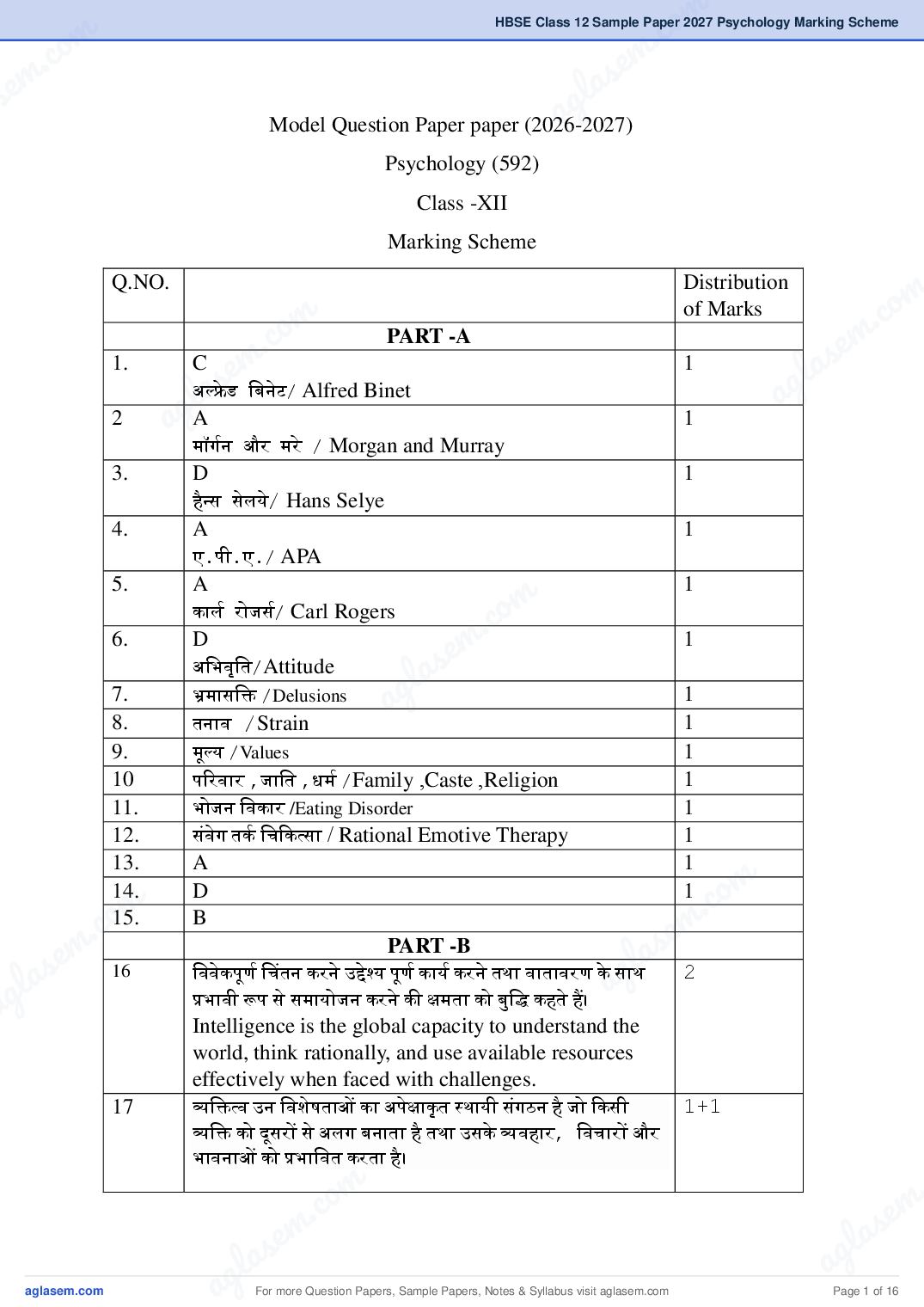
Model Question Paper paper (2026-2027)
Psychology (592)
Class -XII
Marking Scheme
Q.NO. Distribution
m
m of Marks
.co
m.co PART -A
s e m
1. C
s e 1
l a
glAa ड बिनेट/ Alfred Binet
अቝኚरे ag
2 a 1
मॉर्गन और मरे / Morgan and Murray
3. D 1
हैन्स सेलये/ Hans Selye
4. A 1
ए.पी.ए./ APA
5. A 1
कालग रोजसग/ Carl Rogers
. c om
6. D
e m 1
अबिवृबि/Attitude
las
7. ्ቝमासबि /Delusions
ag 1
8. िनाव /Strain 1
9. मूቝኚय /Values 1
10 पररवार ,जाबि ,धमग /Family ,Caste ,Religion 1
11. िोजन बवकार /Eating Disorder 1
12. संवेर् िकग बिककत्सा / Rational Emotive Therapy 1
13. A 1
m
.co
14. D 1
m
.co
m 16
15. B
s em
e la 2
PART -B
las a g
बववेकपूर्ग चििन करने उ्देश्य पूर्ग कायग करने िथा वािावरर् के साथ
ag ्ऺिावी रूप से समायोजन करने की ्षमिा को िुबि कहिे हैं।
Intelligence is the global capacity to understand the
world, think rationally, and use available resources
effectively when faced with challenges.
17 ्िबित्व उन बवशेषिाओं का अपे्षाकृ ि स्थायी संर्ठन है जो ककसी 1+1
्िबि को दूसरों से अलर् िनािा है िथा उसके ्िवहार, बविारों और
िावनाओं को ्ऺिाबवि करिा है।
m .
.co s e m
s em l a
g la ag
a For more Question Papers, Sample Papers, Notes & Syllabus visit Page 1 of 16
Page 3
characteristics that distinguishes an individual from
others and influences their behaviour, thoughts, and
emotions.
18 यूस्रेस : यूस्रेस वह दिाव है जो ्िबि के बलए लािदायक होिा है।
यह ्िबि को ्ऺेररि करिा है, उसकी कायग्षमिा िढािा है िथा ककसी
कायग को िेहिर ढंर् से करने के बलए उत्साबहि करिा है।
Eustress is stress that is beneficial to a person. It
motivates a person, increases their efficiency, and
encourages them to perform a task better.
OR
िायोफीडिैक: यह वह ्ऺकिया है बजसके ्ቛारा दिाव के
शारीरकियात्मक प्षों का पररवी्षर् कर उन्हें कम करने के बलए
फीडिैक कदया जािा है। ्ऺायः इसके साथ बवश्ांबि ्ऺबश्षर् िी कदया
जािा है िायोफीडिैक ्ऺबश्षर् में िीन िरर् शाबमल होिे हैं:
बवशेष शारीररक ्ऺबिकिया के िारे में जार्रूकिा बवकबसि करना,
(जैसे हृदय र्बि) शांि पररबस्थबियों में उस शारीररक ्ऺबिकिया को
बनयंबिि करने के िरीके सीखना; और उस बनयंिर् को रोजमराग की
चजदर्ी की बस्थबियों में स्थानांिररि करना।
Biofeedback: It is a procedure to monitor and reduce
the physiological aspects of stress by providing
feedback about current physiological activity and is
often accompanied by relaxation training Biofeedback
training involves three stages: developing an
awareness of the particular physiological response,
e.g., heart rate, learning ways of controlling that
physiological response in quiet conditions; and
transferring that control into the conditions of
everyday life.
19 अवधान न्यूनिा अबिकिया बवकार (एडीएिडी),बवयोर्ज दुचिंिा 2
बवकार , िौबिक बवकलांर्िा, और बवबश्ቖ सीखने बवकार।
(कोई दो )
Attention-Deficit/Hyperactivity Disorder (ADHD),
separation anxiety disorder (S.A.D.) Autism Spectrum
Disorder, Intellectual Disability, and Specific
Learning Disorder.
Write any two
For more Question Papers, Sample Papers, Notes & Syllabus visit Page 2 of 16
Page 4
m .co
m .co s em
se g la
20 a संिंध के
सेवाथी और बिककत्सक के िीि बवशेष संिंध को बिककत्सीय 2
रूप में जाना जािा है। यह न िो एक ्षबर्क संिंध है,न ही एक स्थायी
संिंध है। एक बिककत्सीय संिंध के दो ्ऺमुख घटक हैं। पहला घटक ररश्िे
की संबवदात्मक ्ऺकृ बि है बजसमें दो इच्छु क ्िबि, सेवाथी और
बिककत्सक, एक साझेदारी में ्ऺवेश करिे हैं ।दूसरा घटक है- बिककत्सा
की सीबमि अवबध।
The special relationship between the client and the
m
m .co
therapist is known as the therapeutic relationship or
.co
alliance. It is neither a passing acquaintance, nor a
m s e m
e
permanent and lasting relationship. There are two
s l a
g l a
major components of a therapeutic alliance. The first
ag
a component is the contractual nature of the relationship
in which two willing individuals, the client and the
therapist.The second component is limited duration of
the therapy.
21 सामान्यिः लोर् बन्ቖ कारर्ों से समूह में सबममबलि होिे हैं- 1+1
सुर्षा- जि हम अके ले होिे हैं िो असुरब्षि अनुिव करिे हैं । समूह इस
असुर्षा को कम करिा है । ्िबियों के साथ रहना आराम की अनुिूबि
और संर्षर् ्ऺदान करिा है। m
.co
्ऺबि्ा या हैबसयि जि हम ऐसे समूह के सदस्य होिे हैं जो महत्वपूर्ग
s em
समझे जािे हैं िो हम सममाबनि महसूस करिे हैं िथा शबि िोध का
अनुिव करिे हैं।
g la
These are the factors a
which motivated people to join
that group:
(i) Security: When we are alone, we feel insecure.
Groups reduce this insecurity. Being with people
gives a sense of comfort, and protection.
(ii) Status: When we are members of a group that is
perceived to be important by others, we feel
m
m recognized and experience a sense of power. Suppose
.co
m .co our school wins in an inter-
s e m
s e institutional debate competition, we feel proud and
g l a
la a
think that we are better than others
ag OR
समूहों के ्ऺमुख ्ऺकार इस ्ऺकार हैं -
•्ऺाथबमक और ब्ቛिीयक समूह
•औपिाररक और अनौपिाररक समूह
•अंिः समूह और िा्ቨ समूह
Major types of groups are enumerated below:
•primary and secondary groups
m .
.co s e m
s em l a
g la ag
a For more Question Papers, Sample Papers, Notes & Syllabus visit Page 3 of 16
Page 5
• ingroup and outgroup
PART-C
22 इस बसिांि का ्ऺबिपादन िाቝኚसग स्पीयरमैन ने ककया था। स्पीयरमैन के 3
अनुसार िुबि मुख्यिः दो ्ऺकार के कारकों से बमलकर िनी होिी है:
1. सामान्य कारक (g)
यह सिी ्ऺकार के िौबिक कायों में कायग करिा है।
यह ्िबि की सम्ष मानबसक ्षमिा को दशागिा है।
2. बवबश्ቖ कारक (s)
यह ककसी बवशेष कायग या बवषय से संिंबधि ्षमिा होिी है।
्ऺत्येक कायग के बलए अलर्-अलर् s-कारक होिा है।
उदाहरर् के बलए, र्बर्ि, संर्ीि, बििकला या िाषा के बलए
अलर्-अलर् बवबश्ቖ ्षमिाएँ होिी हैं। 1+1 अंक )
This theory was proposed by Charles Spearman.
According to Spearman, intelligence is composed
primarily of two types of factors-
General Factor (g)
It works in all types of intellectual work.
It reflects the overall mental capacity of a person.
Specific Factor – (s)
This is the ability related to a particular work or
subject.
Each job has a different s-factor.
For example, there are different specific abilities for
mathematics, music, painting or language.
23 ्िबित्व के अध्ययन के बलए बन्ቖबलबखि उपार्मों का उपयोर् ककया 3
जािा है-
्ऺारूप उपार्म : यह उपार्म ्िवहारपरक बवशेषिाओं के कु छ ्िापक
स्वरूपों का परी्षर् कर मानव ्िबित्व को समझने का ्ऺयास करिा है।
बवशेषक उपार्म: यह उपार्म बवबश्ቖ मनोवै्ञाबनक र्ुर्ों पर िल देिा
है बजसके आधार पर ्िबि संर्ि और बस्थर रूपों में बि्ቐ होिे हैं ।
उदाहरर् के बलए एक ्िबि अबधक मैिीपूर्ग ्िवहार कर सकिा है और
दूसरा कम।
Following are the approaches used in the study of
personality.
Type approach: It focuses on behavioral
characteristics of individuals.
Trait approach: It focuses on the specific
psychological attributes in an individual like for
For more Question Papers, Sample Papers, Notes & Syllabus visit Page 4 of 16
Page 6
m .co
m .co s em
se g la
a
example one person may be less shy in comparison to
others; or one person may be less friendly, whereas
another may be more.
(1-1 Marks)
24 दिाव के कारर् ्ऺबिर्षा िंि की कायग्ऺर्ाली दुिगल हो जािी है बजसके 3
कारर् िीमारी उत्प्ቐ हो सकिी है। ्ऺबिर्षा िंि शरीर के िीिर िथा
िाहर से होने वाले हमलों से शरीर की र्षा करिा है। ्ऺबिर्षा िंि में
m
.co
्ቫेि रि कोबशकाएं िा्ቨ ित्व जैसे वायरस को पहिान कर न्ቖ करिा है
m
.co m
और रोर् ्ऺबिकारकों का बनमागर् िी करिा है। ्ऺबिर्षा िंि में ही टी –
m
कोबशकाएं, िी - कोबशकाएं िथा ्ऺाकृ बिक रूप से न्ቖ करने वाली s e
s e l a
ag
कोबशकाओं सबहि कई ्ऺकार के ्ቫेिार्ु होिे हैं। टी कोबशकाएं हमला
g l a
करने वालों को न्ቖ करिी हैं िथा सहायक कोबशकाएं ्ऺबिर्षात्मक
a कियाओं में वृबि करिी है। ्ऺाकृ बिक रूप से न्ቖ करने वाली कोबशकाएं
वायरस िथा ्ूमर दोनों के बवरुि लडाई करिी हैं। (3 अंक)
Stress can cause illness by impairing the workings of
the immune system. The immune system guards the
body against attackers, both from within and outside.
The white blood cells within the immune system
m
.co
identify and destroy foreign bodies (antigens) such as
viruses. It also leads to the production of antibodies.
e m
s
There are several kinds of white blood cells or
la
g
leucocytes within the immune system, including T
a
cells, B cells and natural killer cells. T cells destroy
invaders, and T-helper cells increase immunological
activity cells produce antibodies. Natural killer cells
are involved in the fight against both viruses and
tumors. (3Marks)
OR
दिाव के ्ቨोि
जीवन की घटनाएँ जीवन कु छ घटनाएं िनावपूर्ग हो सकिी हैं, m
m क्योंकक वे हमारी कदनियाग को िाबधि करिी हैं और उथल-पुथल का .co
m .co कारर् िनिी हैं। यकद इनमें से कई जीवन की घटनाएं जो बनयोबजि हैं
s e m
s e (जैसे एक नए घर में जाना) या अ्ऺत्याबशि (जैसे दीघगकाबलक ररश्िे
g l a
g la का टूटना) थोडे समय के िीिर होिी हैं, िो हमें उनके साथ सामना a
a करना मुबश्कल लर्िा है और िनाव के ल्षर्ों के बलए अबधक ्ऺवर्
होंर्े।
परे शान करने वाली घटनाएं ये ्िबिर्ि िनाव हैं जो हम अपने दैबनक
जीवन में होने वाली घटनाओं के कारर् ्िबियों के रूप में सहन करिे
हैं, जैसे शोर, आवार्मन, झर्डालू पडोसी, बिजली और पानी की
कमी, यािायाि जाम आकद । कु छ नौकररयां ऐसी होिी हैं बजनमें
रोजाना के झंझट िहुि अबधक होिे हैं। इन दैबनक परे शाबनयों के किी-
m
किी उस ्िबि के बलए बवनाशकारी पररर्ाम हो सकिे हैं जो अक्सर
.
.co s e m
s em l a
g la ag
a For more Question Papers, Sample Papers, Notes & Syllabus visit Page 5 of 16
Page 7
अबिघािज घटनाएं इनमें बवबि्ቐ ्ऺकार की िरम घटनाओं जैसे आर्,
रेन या सडक दुघगटना, डकै िी, िूकंप, सुनामी, आकद में शाबमल
होना शाबमल है।
Sources of Stress
Life Events We learn to cope with small, everyday
changes but major life events can be stressful, because
they disturb our routine and cause upheaval. If several
of these life events that are planned (e.g., moving into
a new house) or unpredicted (e.g., break-up of a long-
term relationship) occur within a short period of time,
we find it difficult to cope with them and will be more
prone to the symptoms of stress.
Hassles These are the personal stresses we endure as
individuals, due to the happenings in our daily life,
such as noisy surroundings, commuting, quarrelsome
neighbours, electricity and water shortage, traffic
snarls, and so on.
Traumatic Events These include being involved in a
variety of extreme events such as a fire, train or road
accident, robbery, earthquake, tsunami, etc.
25 मनो्षबस्ि ्िवहार: ककसी बवशेष बविार या बवषय पर चििन को रोक
पाने की असमथगिा। इससे ्षस्ि ्िबि अक्सर अपने बविारों को अब्ऺय
और शमगनाक समझिा है ।
है।(1.5अंक )
िाध्यिा बवकार: ककसी ्िवहार को िार िार करने की आवश्यकिा। -
कई िरह की िाध्यिा में बर्नना, आदेश देना, जांिना, छू ना और धोना
शाबमल है।(1.5 अंक )
Obsessive behaviour is the inability to stop thinking
about a particular idea or topic. The person involved,
often finds these thoughts to be unpleasant and
shameful. Compulsive behaviour is the need to
perform certain behaviours over and over again. Many
compulsions deal with counting, ordering, checking,
touching and washing.
26 मनबिंककत्सा उपिार िाहने वाले ( सेवाथी) िथा उपिार करने वाले 3
(बिककत्सक) के िीि में ऐबच्छक संिंध है।
इस संिंध का उ्देश्य उन मनोवै्ञाबनक समस्याओं का समाधान करना
होिा है बजनका सामना सेवाथी ्ቛारा ककया जा रहा हो यह संिंध
सेवाथी के बव्ቫास को िनाने में सहायक होिा है । (1 अंक )
For more Question Papers, Sample Papers, Notes & Syllabus visit Page 6 of 16
Page 8
m .co
m .co s e m
se g l a
मनबिंककत्सा के उ्देश्य बन्ቖबलबखि हैं - a
1. सेवाथी के सुधार के संकቝኚप को ्ऺिबलि करना।
2.संवेर्ात्मक दिाव को कम करना ।
3. सकारात्मक बवकास के बलए संिा्ििाओं को ्ऺकट करना।
4.आदिों में संशोधन करना।
5. चििन के ्ऺबिरूपों में पररविगन करना।
6.आत्म जार्रूकिा को िढाना।(2 अंक )
m
m .co
.co
Psychotherapy is a voluntary relationship between the
m s e m
s e
one seeking treatment or the client and the one who
l a
g l a
treats or the therapist. ag
a The purpose of the relationship is to help the client to
solve the psychological problems
being faced by her or him.
All psychotherapies aim at following goals:
(i) Reinforcing client’s resolve for betterment.
(ii) Lessening emotional pressure.
(iii) Unfolding the potential for positive growth.
m
.co
(iv) Modifying habits.
em
(v) Changing thinking patterns.
la
(vi) Increasing self-awareness. s
27
g
अबिवृबि बनमागर् को ्ऺिाबविaकरने वाले बन्ቖबलबखि कारक हैं। 3
1. पररवार और स्कू ल का माहौल
2. संदिग समूह
3. ्िबिर्ि अनुिव
4. मीबडया से संिंबधि ्ऺिाव
ककन्हीं िीन को स्प्ቖ कीबजए। (3 अंक )
m
.co
Factors that Influence Attitude Formation The
m
.co m
following factors provide the context for the learning
m s e
s e
of attitudes through the processes described above.
g l a
la a
1. Family and School Environment
ag 2. Reference Groups
3. Personal Experiences
4. Media-related Influences
Explain any three
(3 marks)
(1 अंक )
अबिवृबि ककसी ्िबि, वस्िु, बविार, घटना या समूह के ्ऺबि
m .
.co s e m
s em l a
g la ag
a For more Question Papers, Sample Papers, Notes & Syllabus visit Page 7 of 16
Page 9
है।
अबिवृबि के िीन ्ऺमुख घटक होिे हैं:
1. सं्ञानात्मक घटक
यह ककसी वस्िु या बवषय के िारे में ्िबि के बविारों, बव्ቫासों और
्ञान से संिंबधि होिा है।
2. िावात्मक घटक
यह ककसी वस्िु, ्िबि या घटना के ्ऺबि ्िबि की िावनाओं और
अनुिूबियों से संिंबधि होिा है।
यह ििािा है कक ्िबि कै सा महसूस करिा है।
3. ्िवहारात्मक घटक
यह ककसी वस्िु या बस्थबि के ्ऺबि ्िबि के ्िवहार या कायग करने की
्ऺवृबि को दशागिा है।
(2 अंक)
Attitude is a tendency to react positively, negatively,
or neutrally toward a person, object, idea, event, or
group.
There are three major components of attitude:1.
Cognitive Component
This relates to a person's thoughts, beliefs, and
knowledge about an object or subject.
2. Affective Component
This relates to a person's feelings and emotions
toward an object, person, or event.
3. Behavioural/Conative Component
This reflects a person's behaviour or tendency to act
in a certain way towards an object or situation.
(2 marks)
PART-D
28 अबि्षमिा – यह ककसी ्िबि की कौशलों के अजगन के बलए अंि्ቘनबहि 5
संिा्ििा से है। अबि्षमिा बवशेषिाओं का ऐसा संयोजन है जो ्िबि
्ቛारा ्ऺबश्षर् उपरांि ककसी बवशेष ्षेि के ्ञान अथवा कौशल के अजगन
की ्षमिा को ्ऺद्ቘशि करिा है। (1 अंक)
अबिरुबि -ककसी बवशेष कायग करने की वरीयिा ।
ककसी ्िबि में ककसी कायग को करने की अबिरुबि हो सकिी है परंिु हो
सकिा है की उसे करने की योग्यिा उसमे न हो। इसी ्ऺकार यह संिव है
कक ककसी ्िबि में ककसी कायग को करने की अबि्षमिा हो परं िु उसमे
उसकी कोई अबिरुबि न हो। इन दोनों ही दशाओं मे उसका बनष्पादन
संिोषजनक नहीं होर्ा। (1 अंक )
For more Question Papers, Sample Papers, Notes & Syllabus visit Page 8 of 16
Page 10
m .co
m .co s em
se g la
िुबि - बववेकपूर्ग चििन करने उ्देश्य पूर्ग कायग करने aिथा वािावरर्
के साथ ्ऺिावी रूप से समायोजन करने की ्षमिा को िुबि कहिे हैं।
(1 अंक )
अबि्षमिा परी्षर् दो रूपों में ्ऺा्म होिे हैं -स्विंि अबि्षमिा परी्षर्
िथा िहुल अबि्षमिा परी्षर्
स्विंि अबि्षमिा परी्षर्ों के उदाहरर् -बलबपकीय अबि्षमिा,
यांबिक अबि्षमिा, अंककक अबि्षमिा िथा टंकर् अबि्षमिा।
m
m
िहुल अबि्षमिा परी्षर्ों में एक परी्षर् माला होिी है
.co
.co
उदाहरर्- बविेदक अबि्षमिा परी्षर् (डी.ए.टी.),सामान्य अबि्षमिा
s e m
em
परर्षर्माला (जी ए टी िी) (2 अंक )
s l a
g a
lfield
Aptitude: It refers to special abilities in a particular ag
a of activity. It is a combination of characteristics
that indicates an individual’s potential to acquire skill
after training.
Interest: it is a preference for a particular activity. A
person may be interested in particular job or activity
but may not have the aptitude for it. Similarly, a
person may have the aptitude for performing a job nut
m
.co
may not be interested in doing that. In both the
m
situations outcome will not be the satisfactory.
e
Intelligence: while
las
assessing intelligence
ag
psychologists often found that people with similar
intelligence differed widely in acquiring certain
knowledge or skills.
–Aptitude tests are available in two forms:
independent aptitude test and multiple aptitude test
-Example of independent aptitude tests are: Clerical
aptitude, Mechanical Aptitude, Numerical Aptitude
and Typing aptitude tests
m
m - multiple aptitude tests exist in the form of test
.co
m .co batteries e.g., DAT (Differential Aptitude Test)
s e m
s e GATB (General Aptitude Tests Battery.
g l a
g la OR a
a िुबि की योजना,अवधान -िाव ्ऺिोधन िथा सहकाबलक आनुिबमक
का मॉडल
यह मॉडल जे.पी. दास, जैक नार्बलरी और ककिी (1994) ्ቛारा
बवकबसि ककया र्या है। इस मॉडल के अनुसार, िौबिक र्बिबवबध में
िीन न्यूरोलॉबजकल ्ऺर्ाबलयों की परस्पर बनिगर कायग्ऺर्ाली शाबमल
होिी है, बजन्हें मबस्िष्क की कायागत्मक इकाइयाँ कहा जािा है। ये
इकाइयाँ िमशः िाव ्ऺिोधन /अवधान,कू ट संकेिन या ्ऺिमर् और
m .
.co s e m
s em l a
g la ag
a For more Question Papers, Sample Papers, Notes & Syllabus visit Page 9 of 16
Page 11
िाव ्ऺिोधन: िाव ्ऺिोधन की बस्थबि ककसी िी ्िवहार के बलए
िुबनयादी है क्योंकक यह हमें उिेजनाओं पर ध्यान देने में मदद करिी है।
उिेजना और ध्यान ककसी ्िबि को जानकारी संसाबधि करने में स्षम
िनािे हैं। उिेजना का एक इ्ቖिम स्िर ककसी समस्या के ्ऺासंबर्क
पहलुओं पर हमारा ध्यान कें किि करिा है। िहुि अबधक या िहुि कम
िाव ्ऺिोधन ध्यान में िाधा उत्प्ቐ करे र्ी। उदाहरर् के बलए, जि
आपका बश्षक आपको ककसी परी्षा के िारे में ििािा है बजसे वह
आयोबजि करने की योजना िना रहा है, िो यह आपको बवबश्ቖ
अध्यायों में िार् लेने के बलए ्ऺेररि करे र्ा। िाव ्ऺिोधन आपको अपना
ध्यान अध्यायों की साम्षी को पढने, सीखने और संशोबधि करने पर
कें किि करने के बलए मजिूर करिी है।
सहकाबलक आनुिबमक ्ऺिमर्: आप जानकारी को एक साथ या
िबमक रूप से अपने ्ञान ्ऺर्ाली में एकीकृ ि कर सकिे हैं। एक साथ
्ऺसंस्करर् िि होिा है जि आप बवबि्ቐ अवधारर्ाओं के िीि संिंधों
को समझिे हैं और उन्हें समझने के बलए एक साथगक पैटनग में एकीकृ ि
करिे हैं। िबमक ्ऺसंस्करर् िि होिा है जि आप सिी सूिनाओं को
िबमक रूप से याद करिे हैं िाकक एक सूिना का स्मरर् दूसरे के स्मरर्
की ओर ले जाए। अंक, अ्षर, र्ुर्न सारर्ी आकद सीखना आनुिबमक
्ऺिमर् के उदाहरर् हैं।
योजना िनाना: यह िुबि का एक अबनवायग ल्षर् है। जानकारी पर
ध्यान देने और संसाबधि करने के िाद, योजना सकिय हो जािी है। यह
हमें कारग वाई के संिाबवि िरीकों के िारे में सोिने, लቌኚय िक पहुंिने
के बलए उन्हें लार्ू करने और उनकी ्ऺिावशीलिा का मूቝኚयांकन करने की
अनुमबि देिा है। यकद कोई योजना काम नहीं करिी है, िो उसे कायग
या बस्थबि की आवश्यकिाओं के अनुरूप संशोबधि ककया जािा है।
उदाहरर् के बलए, अपने बश्षक ्ቛारा बनधागररि परी्षा देने के बलए,
आपको लቌኚय बनधागररि करने होंर्े, अध्ययन के बलए एक समय-
सारर्ी की योजना िनानी होर्ी, समस्याओं के मामले में स्प्ቖीकरर्
्ऺा्म करना होर्ा और यकद आप परी्षा के बलए कदए र्ए अध्यायों से
बनपटने में स्षम नहीं हैं, िो हो सकिा है कक आपको अपने लቌኚयों को
पूरा करने के बलए अन्य िरीकों के िारे में सोिना (उदाहरर् के बलए,
अबधक समय देना, ककसी बमि के साथ अध्ययन करना
Planning. Attention-arousal and Simultaneous-
successive (PASS) Model of Intelligence
This model has been developed by J.P. Das, Jack
Naglieri, and Kirby (1994). According to this model,
intellectual activity involves the interdependent
functioning of three neurological systems, called the
functional units of brain. These units are responsible
For more Question Papers, Sample Papers, Notes & Syllabus visit Page 10 of 16
Page 12
m .co
m .co s em
se g la
a
for arousal/attention, coding or processing, and
planning respectively.
Arousal/Attention: State of arousal is basic to any
behaviour as it helps us in attending to stimuli.
Arousal and attention enable a person to process
information. An optimal level of arousal focuses our
attention to the relevant aspects of a problem. Too
m
m
much or too little arousal would interfere with
.co
.co
attention. For instance, when you are told by your
m s e m
s e
teacher about a test which s/he plans to hold, it would
l a
g l a
arouse you to attend to the specific chapters. Arousal ag
a forces you to focus your attention on reading, learning
and revising the contents of the chapters.
Simultaneous and Successive:
Processing: You can integrate the information into
your knowledge system either simultaneously or
successively. Simultaneous processing takes place
when you perceive the relations among various
m
.co
concepts and integrate them into a meaningful pattern
m
for comprehension. Simultaneous processing helps
e
las
you in grasping the meaning and relationship
ag
between the given abstract figures. Successive
processing takes place when you remember all the
information serially so that the recall of one lead to
the recall of another. Learning of digits, alphabets,
multiplication tables, etc. are examples of successive
processing.
Planning: This is an essential feature of intelligence.
After the information is attended to and processed,
m
m planning is activated. It allows us to think of the
.co
m .co possible courses of action, implement them to reach a
s e m
s e target, and evaluate their effectiveness. If a plan does
g l a
g la not work, it is modified to suit the requirements of the a
a task or situation. For example, to take the test
scheduled by your teacher, you would have to set
goals, plan a time schedule of study, get clarifications
in case of problems and if you are not able to tackle
the chapters assigned for the test, you may have to
think of other ways (e.g., give more time, study with a
friend, etc.) to meet your goals.
m .
.co s e m
s em l a
g la ag
a For more Question Papers, Sample Papers, Notes & Syllabus visit Page 11 of 16
Page 13
मूቝኚयांकन करने के बलए ककया जािा है। ये िकनीकें इस अबि्षह पर
आधाररि हैं कक असरबिि उ्दीपक अथवा बस्थबि ्िबियों को उस
बस्थबि पर अपनी िावनाओं, इच्छाओं और आवश्यकिाओं को ्ऺे्षपर्
करने का अवसर ्ऺदान करिा है।
(1अंक)
बवबि्ቐ ्ऺकार की ्ऺ्षेपी िकनीकों का बवकास ककया र्या है
1. रोशाग स्याही धब्िा परी्षर्
2. टी ए टी
3. रोजेनजबवर् का बिि र्ि कुं ठा अध्ययन
4. ्िबि अंकन बवबध
(कोई दो)
(2+2)अंक
The techniques of personality assessment described so
far are known as direct techniques, because they tend
to rely on information directly obtained from the
person who clearly knows that her/his personality is
being assessed. In these situations, people generally
become self-conscious and hesitate to share their
private feelings, thoughts, and motivations. When
they do so, they often do it in a socially desirable
manner. Projective techniques were developed to
assess unconscious motives and feelings. These
techniques are based on the assumption that a less
structured or unstructured stimulus or situation will
allow the individual to project her/his feelings, desires
and needs on to that situation.
(1 mark)
1.The Rorschach Inkblot Test
2.Thematic apperception test
3.Sentence completion test
4.Draw a person test
Explain any two (2+2 marks)
OR
्िबित्व – बवकास की अवस्थाएं :
रायड ने ्िबित्व के बवकास की पाँि अवस्थाएं ििाई है बजसे पाँि
अवस्था बसिांि के नाम से जाना जािा है ।
(1 अंक )
For more Question Papers, Sample Papers, Notes & Syllabus visit Page 12 of 16
Page 14
m .co
m .co s e m
se g l a
मौबखक अवस्था : a
र्ुदीय अवस्था
लैंबर्क अवस्था
काम्ऺसूब्म अवस्था
जननंर्ीय अवस्था
सिी का वर्गन करें
(4 अंक )
m
m .co
.co
Stages of Personality Development
m s e m
e
Freud claims that the core aspects of personality are
s l a
g l a
established early, remain stable throughout life, and
ag
a can be changed only with great difficulty. He
proposed a five-stage theory of personality (also
called psychosexual) development. Problems
encountered at any stage may arrest development, and
have long-term effect on a person’s life. A brief
description of these stages is given here.
1. Oral Stage
m
.co
2.Anal Stage
3.Phallic Stage
e m
4.Latency Stage
las
5.Genital Stage
Explain all ag
(1+4 marks)
30 मनोबवदलिा एक ऐसा वर्गनात्मक शब्द है जो मनस्िापी बवकारों के 5
एक समूह के बलए ्ऺयोर् ककया जािा है बजसमे ्िबि की चििन ्ऺकिया
मे िाधा, बवबिि ्ऺत्य्षर्, अस्वािाबवक सावेंबर्क बस्थबियाँ िथा पेशीय
अपसामन्यिा के पररर्ामस्वरूप उसकी ्िबिर्ि, सामाबजक और m
m .co
.co
्िावसाबयक र्बिबवबधयों में अवनबि हो जािी है। (1अंक)
e m
e m मनोबवदलिा के िीन ल्षर् हैं –
l as
las • सकारात्मक ल्षर्
ag
ag • नकारात्मक ल्षर्
• मन:िाबलि ल्षर्
सकारात्मक ल्षर् – इन ल्षर्ों मे ्िबि के ्िवहार में ‘बवकृ ि
अबिशयिा’ िथा ‘बवल्षर्िा का िढना’ पाया जािा है। मनोबवदलिा
से ्षबसि ्िबियों में ्ቝमासबि,असंर्रठि चििन एवं िाषा, ्ऺव्ቘधि
m
्ऺत्य्षर् और बव्ቝम िथा अनुपयुि िाव पाए जािे हैं।
.
.co s e m
s em l a
g la ag
a For more Question Papers, Sample Papers, Notes & Syllabus visit Page 13 of 16
Page 15
मजिूिी से रटका होिा है । मनोबवदलिा में –
उत्पीडन ्ቝमासबि
संदिग ्ቝमासबि
अत्यहंमन्यिा ्ቝमासबि
बनयंिर् ्ቝमासबि पाई जािी है
2. औपिाररक चििन – मनोबवदलिा में ्िबि िकग पूर्ग ढंर् से नहीं सोि
सकिे िथा बवबिि ्ऺकार से िोलिे हैं।
3. बव्ቝांबि – बिना ककसी िा्ቨ उ्दीपक के ्ऺत्य्षर् करना। जैस-े श्वर्
बव्ቝांबि, स्पशी बव्ቝांबि, दैबहक बव्ቝांबि,दृब्ቖ बव्ቝांबि,रस संवेदी
बव्ቝांबि, ्सार् बव्ቝांबि।
4. अनुपयुि िाव – मनोबवदलिा के रोर्ी बस्थबि के अनुरूप संवेर्
्ऺद्ቘशि नहीं करिे। (4 अंक)
Schizophrenia: it is the descriptive term for a group
of psychotic disorders in which personal, social and
occupational functioning deteriorate as a result of
disturbed thought process, strange perceptions,
unusual emotional states and motor abnormalities.
The symptoms of schizophrenia can be grouped into
three categories,
A. Positive symptoms
B. Negative symptoms
C. Psychomotor symptoms
A. Positive symptoms: Delusions, disorganized
speech and thinking, heightened perception,
hallucination and inappropriate affects are the ones
most often found in schizophrenia.
1.Delusions: a delusion is a false belief that is firmly
held on inadequate grounds
-Delusions of persecution
-Delusions of reference
-Delusions of grandeur
-Delusion of control
2.Formal thought disorders
Extremely difficulty in communication.
Rapidly shifting from one topic to another.
3.Hallucinations:
Perception that occurs in absence of external stimuli.
For more Question Papers, Sample Papers, Notes & Syllabus visit Page 14 of 16
Page 16
m .co
m .co s e m
se g l a
-Auditory hallucinations. a
-Tactile hallucinations
(Explain all)
OR
बवच्छेदन को बविारों और िावनाओं के िीि संिंधों के बवच्छेद के रूप में
देखा जा सकिा है। पृथ्करर् में अवास्िबवकिा, अलर्ाव, ्ऺबिरूपर्
m
m
और किी-किी पहिान की हाबन या िदलाव की िावनाएँ शाबमल
.co
होिी हैं।
m .co s e m
e
बवच्छेदी स्मृबिलोप की िीमारी ्िापक लेककन ियनात्मक स्मृबि हाबन
s l a
g l a
की बवशेषिा है बजसका कोई ्ञाि जैबवक कारर् नहीं है (उदाहरर् के ag
a बलए, बसर की िोट)। कु छ लोर्ों को अपने अिीि के िारे में कु छ िी
याद नहीं रहिा। अन्य लोर् अि बवबश्ቖ घटनाओं, लोर्ों, स्थानों या
वस्िुओं को याद नहीं कर सकिे हैं, जिकक अन्य घटनाओं के बलए
उनकी स्मृबि िरकरार रहिी है। यह बवकार अक्सर अत्यबधक िनाव से
जुडा होिा है।
बवच्छेदी आत्मबवस्मृबि का एक आवश्यक ल्षर् है -घर और कायगस्थान
से अ्ऺत्याबशि यािा ,एक नई पहिान की अवधारर्ा िथा पुरानी
m
.co
पहिान को याद न कर पाना ।
m
बवच्छेदी पहिान बवकार :बजसे अक्सर िहु ्िबित्व के रूप में जाना
e
las
जािा है, बवघटनकारी बवकारों में सिसे नाटकीय है। यह अक्सर
ag
ििपन में ददगनाक अनुिवों से जुडा होिा है। इस बवकार में, ्िबि
वैकबቝኚपक ्िबित्व धारर् करिा है जो एक-दूसरे के िारे में जानिे िी
हो सकिे हैं और नहीं िी।
्िबित्व लोप
इसमें एक स्व्प जैसी बस्थबि शाबमल होिी है बजसमें ्िबि को स्वयं और
वास्िबवकिा दोनों से अलर् होने का एहसास होिा है। ्ऺबिरूपर् में,
आत्म-धारर्ा में पररविगन होिा है, और ्िबि की वास्िबवकिा की
िावना अस्थायी रूप से खो जािी है या िदल जािी है। m
m (5 अंक ) .co
m .co Dissociative Disorders
s e m
s e Dissociation can be viewed as severance of the
g l a
g la connections between ideas and emotions. Dissociation a
a involves feelings of unreality, estrangement,
depersonalization, and sometimes a loss or shift of
identity. Sudden temporary alterations of
consciousness that blot out painful experiences are a
defining characteristic of dissociative disorders. Four
conditions are included in this group: dissociative
m .
amnesia, dissociative fugue, dissociative identity
.co s e m
s em l a
g la ag
a For more Question Papers, Sample Papers, Notes & Syllabus visit Page 15 of 16
Page 17
Dissociative amnesia is characterized by extensive
but selective memory loss that has no known organic
cause (e.g., head injury). Some people cannot
remember anything about their past. Others can no
longer recall specific events, people, places, or
objects, while their memory for other events remains
intact. This disorder is often associated with an
overwhelming stress.
Dissociative fugue has, as its essential feature, an
unexpected travel away from home and workplace,
the assumption of a new identity, and the inability to
recall the previous identity. The fugue usually ends
when the person suddenly 'wakes up' with no memory
of the events that occurred during the fugue.
Dissociative identity disorder, often referred to as
multiple personality, is the most dramatic of the
dissociative disorders. It is often associated with
traumatic experiences in childhood. In this disorder,
the person assumes alternate personalities that may or
may not be aware of each other.
Depersonalisation
Involves a dreamlike state in which the person has a
sense of being separated both from self and from
reality. In depersonalisation, there is a change of self-
perception, and the person's sense of reality is
temporarily lost or changed
(5 marks)
For more Question Papers, Sample Papers, Notes & Syllabus visit Page 16 of 16
Document Details
| Board / Org | Haryana Board |
| Exam | Class 12 |
| Type | Answer Key |
| Pages | 16 |
| Updated | 03 Nov 2026 |