HBSE Class 12 Sample Paper 2027 Chemistry Marking Scheme
Finished viewing? Save it for later —
Download HBSE Class 12 Sample Paper 2027 Chemistry Marking Scheme (PDF · 6 pages)About HBSE Class 12 Sample Paper 2027 Chemistry Marking Scheme
HBSE Class 12 Sample Paper 2027 Chemistry Marking Scheme is available here for free download. Published by Haryana Board for Class 12, this answer key can be viewed online or downloaded as a PDF (6 pages). Candidates preparing for Class 12 can use HBSE Class 12 Sample Paper 2027 Chemistry Marking Scheme to understand the exam pattern, the type of questions asked, and the overall difficulty level.
Frequently Asked Questions
How can I download HBSE Class 12 Sample Paper 2027 Chemistry Marking Scheme?
Open this page and click the Download button to save HBSE Class 12 Sample Paper 2027 Chemistry Marking Scheme as a PDF. It is completely free on AglaSem Docs.
Is HBSE Class 12 Sample Paper 2027 Chemistry Marking Scheme free to download?
Yes. HBSE Class 12 Sample Paper 2027 Chemistry Marking Scheme can be viewed online and downloaded as a PDF free of cost on AglaSem Docs.
How many pages does HBSE Class 12 Sample Paper 2027 Chemistry Marking Scheme have?
HBSE Class 12 Sample Paper 2027 Chemistry Marking Scheme contains 6 pages, which you can read online or download together as a single PDF.
Where can I find more Class 12 study material?
You can find more Class 12 question papers, sample papers, syllabus, and answer keys on AglaSem Docs.
HBSE Class 12 Sample Paper 2027 Chemistry Marking Scheme – Text
Read the full text of this answer key below — useful to quickly search, copy and reference the content online without downloading the PDF.
📄 View text version (7 pages)
Page 1
HBSE Class 12 Sample
Paper 2027 Chemistry
Marking Scheme
EXAM YEAR TYPE SUBJECT
Haryana Class 12 2027 Answer Key Chemistry
Notes · Sample Papers · Previous Year Papers · Mock Tests
Page 2
m .co
m .co s e m
se g l a
a
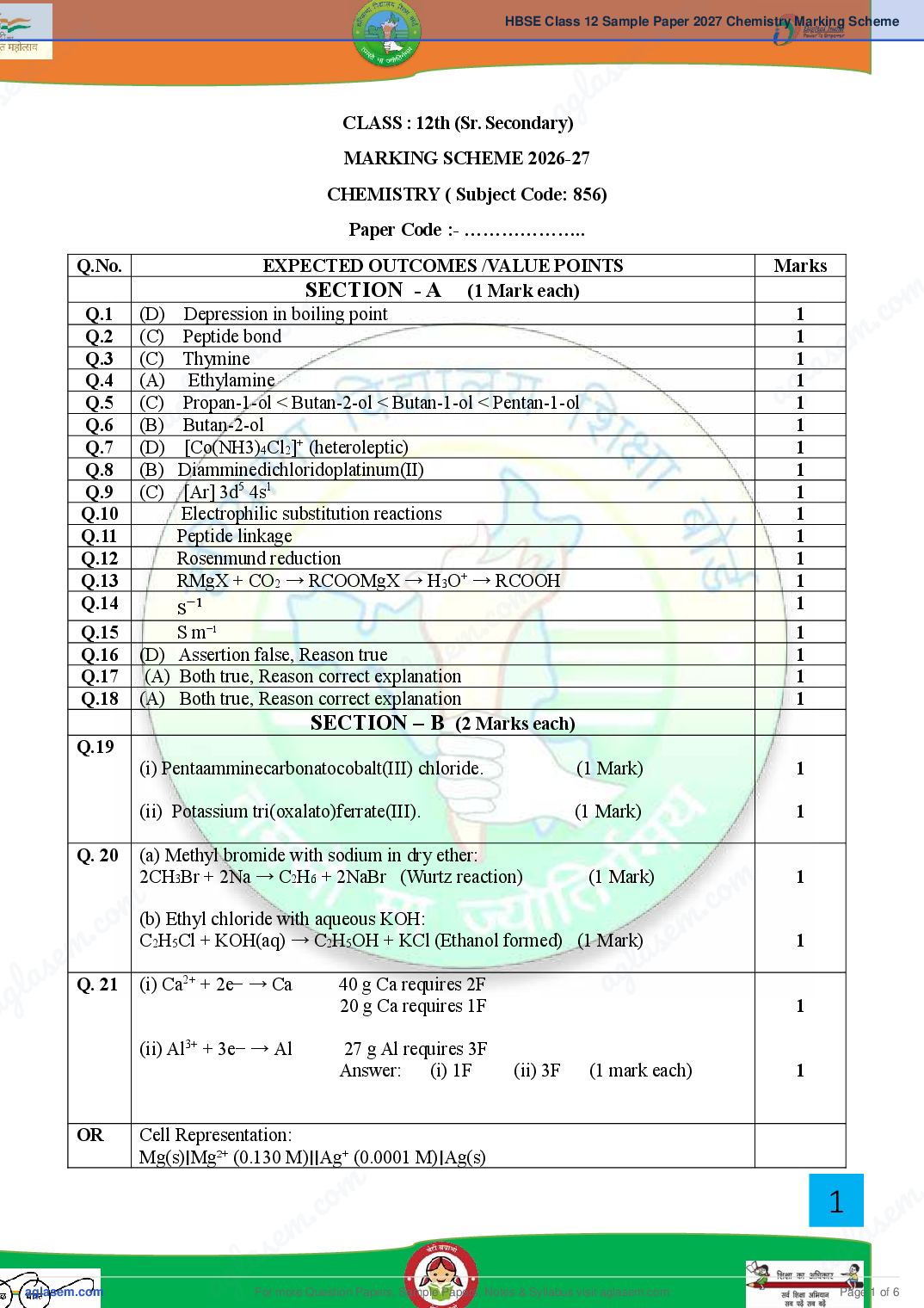
CLASS : 12th (Sr. Secondary)
MARKING SCHEME 2026-27
CHEMISTRY ( Subject Code: 856)
Paper Code :- ………………..
Q.No. EXPECTED OUTCOMES /VALUE POINTS Marks
SECTION - A (1 Mark each) m
Q.1
m
(D) Depression in boiling point 1
.co
Q.2 (C) Peptide bond
m .co 1
s e m
Q.3 (C) Thymine
s e 1
l a
a ag
Q.4 (A) Ethylamine 1
Q.5
g l
(C) Propan-1-ol < Butan-2-ol < Butan-1-ol < Pentan-1-ol 1
Q.6 a
(B) Butan-2-ol 1
Q.7 (D) [Co(NH3)4Cl2]+ (heteroleptic) 1
Q.8 (B) Diamminedichloridoplatinum(II) 1
Q.9 (C) [Ar] 3d5 4s1 1
Q.10 Electrophilic substitution reactions 1
Q.11 Peptide linkage 1
Q.12 Rosenmund reduction 1
Q.13 RMgX + CO2 → RCOOMgX → H3O+ → RCOOH 1
m
.co
Q.14 s⁻¹ 1
Q.15 1
em
S m⁻¹
Q.16
Q.17
(D) Assertion false, Reason true
(A) Both true, Reason correct explanation l as 1
1
Q.18 ag
(A) Both true, Reason correct explanation
SECTION – B (2 Marks each)
1
Q.19
(i) Pentaamminecarbonatocobalt(III) chloride. (1 Mark) 1
(ii) Potassium tri(oxalato)ferrate(III). (1 Mark) 1
Q. 20 (a) Methyl bromide with sodium in dry ether:
2CH3Br + 2Na → C2H6 + 2NaBr (Wurtz reaction) (1 Mark)
m 1
m Ethyl chloride with aqueous KOH: c. o
c. o (b)
C H Cl + KOH(aq) → C H OH + KCl (Ethanol formed) (1 Mark) se
m
em
1
s
2 5 2 5
g l a
la Q. 21 (i) Ca + 2e− → Ca 40 g Ca requires 2F
2+
a
ag 20 g Ca requires 1F 1
(ii) Al3+ + 3e− → Al 27 g Al requires 3F
Answer: (i) 1F (ii) 3F (1 mark each) 1
OR Cell Representation:
Mg(s)∣Mg²⁺ (0.130 M)∣∣Ag⁺ (0.0001 M)∣Ag(s)
m .
.co 1
s e m
s em l a
g la ag
a For more Question Papers, Sample Papers, Notes & Syllabus visit Page 1 of 6
Page 3
= (10⁻⁴)² / 0.130 = 1.3 × 10⁻⁷
Ecell = E°cell − (0.0591 / 2) log Q
= 3.17 − 0.02955 log (1.3 × 10⁻⁷) = 3.17 − 0.210 Ecell = 2.96 V 1
Q. 22 Cannizzaro Reaction:
2HCHO + NaOH → HCOONa + CH3OH (1 Mark) 1
HVZ Reaction:
CH3COOH + Br2/P → CH2BrCOOH + HBr (1 Mark) 1
Q.23 First-order reaction:
k = 2.303/t log(a/(a−x)) ½
k = 2.303/5 × log(0.6/0.2) 1
= 2.303/5 × 0.48
= 0.221 min−1 Answer = 0.221 min−1 ½
OR k = 2.54 × 10⁻³ s⁻¹
For 75% decomposition, 25% remains:[R] 0 /[R] = 4 1
t = 2.303/k log [R]₀/[R] 1
t = 544 s
Q.24 (i) Correct Structure (1 Mark) 1
(ii) Ethanol will be formed , if correct equation (1mark) 1
Q.25. (a) Butanal + H2/Ni → Butan-1-ol (1 Mark) 1
(b) CH3CH=CH2 + H2O/H+ → CH3CH(OH)CH3
Product: Propan-2-ol (1 Mark) 1
OR (a)Boiling point of alcohols increases with increase in molecular mass and
decreases with branching. 1
Methanol<Ethanol<Propan-1-ol<Butan-2-ol<Butan-1-ol<Pentan-1-ol
(b)Boiling point increases with stronger intermolecular forces:n- 1
Butane<Ethoxyethane<Pentanal<Pentan-1-ol
Q.26 1
(i) Phenol → 2,4,6-Tribromophenol Reagent: Bromine water. (1 Mark) 1
(ii) Propene → Propan-1-ol
Reagent: BH3·THF followed by H2O2/OH− (Hydroboration-oxidation). (1 Mark) 1
(iii) Butan-2-one → Butan-2-ol Reagent: NaBH4 or LiAlH4. (1 Mark)
2
For more Question Papers, Sample Papers, Notes & Syllabus visit Page 2 of 6
Page 4
m .co
m .co s e m
se g l a
OR (i) Acid-catalysed hydration of alkene: a
2
Step 1: Protonation of alkene to form carbocation.
Step 2: Attack of water molecule.
Step 3: Deprotonation to form alcohol.
m
.co
Thus, alkene gives the corresponding alcohol.
m
.co
(ii) RCH₂OH (Carboxylic acid is reduced to primary alcohol.).
m
1
s e m
Q.27
e
Moles of ethylene glycol = 45/62 = 0.726 mol
s l a
g l a
Mass of water = 0.600 kg
Molality = 0.726/0.600 = 1.21 m Formula (1 Mark) ag1
a
ΔTf = Kf × m
= 1.86 × 1.21 = 2.25°C Calculation (1 Mark) 1
Freezing point = 0 − 2.25
= −2.25°C Answer (1 Mark) 1
2− 2+ 8
Q.28 [Ni(CN)4] : Ni = 3d
CN− is strong field ligand.
Pairing occurs and dsp2 hybridisation formed.
Square planar and diamagnetic. (1.5 Marks) 1½
m
[NiCl4]2− : Cl− is weak field ligand.
m .co
No pairing occurs. sp3 hybridisation formed.
s e
la
Tetrahedral and paramagnetic. (1.5 Marks) 1½
Q.29 (a) Hydrolysis products: ag
Sucrose → Glucose + Fructose (1 Mark) 1
Lactose → Glucose + Galactose (1 Mark) 1
(b) Vitamin C is water-soluble and excess amount is excreted through urine, 1
therefore it cannot be stored in the body. (1 Mark)
Q.30 k = 1.15 × 10⁻³ s−1 Formula (1 Mark) 1
t = 2.303/k log(a/a−x) m
c om
t = 2.303/(1.15×10−3) × log(5/3) Calculation (1 Mark)
m.co 1
m . = 2002.6 × 0.222 = 444.6 s
s e
s e
Answer ≈ 445 s Answer (1 Mark)
g l a 1
g la OR Given: t = 40 min a
a 30% decomposed ⇒ 70% remains
For a first-order reaction, t = (2.303/k) log (a/(a − x)) 2
40 = (2.303/k) log (100/70) 40 = (2.303/k) × 0.155
k = 8.92 × 10⁻³ min⁻¹
m .
.co 3
s e m
s em l a
g la ag
a For more Question Papers, Sample Papers, Notes & Syllabus visit Page 3 of 6
Page 5
1
t₁/₂ = 0.693/(8.92 × 10⁻³) = 77.7 min Answer: t₁/₂ ≈ 78 min.
Q.31 (a) Complete the following equations:
(i) CH₃CONH₂ ──(i) LiAlH₄ / (ii) H₂O──→ CH₃CH₂NH₂ 1
(ii) p-Nitrotoluene ──Fe + HCl──→ p-Toluidine (p-CH₃C₆H₄NH₂) 1
(b) Primary amines have higher boiling points than tertiary amines because 1
primary amines form stronger intermolecular hydrogen bonds.
(c) Classification of amines:
• C₂H₅NHCH₃ – Secondary amine 1
• CH₃NH₂ – Primary amine
• (CH₃)₂NC₂H₅ – Tertiary amine
OR
(c) Butane-1-ol is more soluble in water than Butane-1-amine because the –OH 1
group forms stronger hydrogen bonds with water than the –NH₂ group.
Q.32 (a) Calculation of mass of CaCl₂
Formula: π = (i nRT) / V
1
n = (πV) / (iRT) n = (0.70 × 2.46) / (2.59 × 0.082 × 300)
n = 0.0271 mol
Mass of CaCl₂: m = n × M
m = 0.0271 × 111 m = 3.01 g 1
Answer: Mass of CaCl₂ = 3.01 g
(b) Endosmosis 1
OR
(b) Osmotic pressure can be measured accurately for very dilute solutions at
room temperature. 1
(c) Reverse Osmosis (RO) 1
4
For more Question Papers, Sample Papers, Notes & Syllabus visit Page 4 of 6
Page 6
m .co
m .co s e m
se g l a
Q,33 (i) Propanone → Propene a
CH3COCH3 → CH3CHOHCH3 → CH3CH=CH2 (2 Marks) 2
(ii) Benzoic acid → Benzaldehyde
Use SOCl2 then H2/Pd-BaSO4 (Rosenmund reduction) (1 Mark) 1
(iii) Benzene → m-Nitroacetophenone
Acetylation followed by nitration. (1 Mark) 1
m
Reactivity toward HCN: m .co
.co
(CH3)3C-CO-C(CH3)3 < CH3COCH3 < CH3CHO (1 Mark) 1
s e m
s em l a
la ag
OR (a) Chemical Tests : (i) Acetophenone and Benzophenone 1
g
a Test:
Iodoform
• Acetophenone → Yellow precipitate of CHI₃ (positive test)
• Benzophenone → No precipitate
(ii) Propanal and Propanone 1
Tollens’ Test:
• Propanal → Silver mirror formed
• Propanone → No reaction m
.co
(iii) Pentan-2-one and Pentan-3-one
s em 1
Iodoform Test:
g la
a of CHI₃
• Pentan-2-one → Yellow precipitate
• Pentan-3-one → No precipitate
(b) (i) Stronger Acid :- CH₂FCOOH > CH₃COOH 1
Reason: F atom shows strong –I effect, which stabilizes the carboxylate ion and
increases acidity.
om
(ii) Increasing order of boiling points: 1
m . c
c. o CH₃CH₂CH₃ < CH₃CHO < CH₃COCH₃ < CH₃CH₂OH s e m
s emQ.34 Given: g l a
g la κ = 1.06×10 S cm −2 −1
a
a Molar conductivity:
Λm = κ ×1000/M
Λm calculation (2 Marks) 2
= 1.06×10−2 ×1000/0.1 = 106 S cm2 mol−1
Λ°m = 50.1 + 76.5 = 126.6 cm2 mol−1 Λ°m calculation (2 Mark) 2
Degree of dissociation:
α = 106/126.6 = 0.837 Degree of dissociation (1 Marks) 1
m .
.co 5
s e m
s em l a
g la ag
a For more Question Papers, Sample Papers, Notes & Syllabus visit Page 5 of 6
Page 7
κ₁ = 1.29 × 10⁻² S cm⁻¹ (for 0.1 M KCl) , R₁ = 100 Ω, R₂ = 300 Ω
1
Cell constant = κ₁ × R₁ = (1.29 × 10⁻²) × 100 = 1.29 cm⁻¹
Conductivity of 0.01 M KCl: κ₂ = Cell constant / R₂
1
= 1.29 / 300 = 4.3 × 10⁻³ S cm⁻¹
Molar conductivity: Λₘ = (κ × 1000) / C 1
= (4.3 × 10⁻³ × 1000) / 0.01 = 430 S cm² mol⁻¹
(b) (i) Any two advantages of H₂–O₂ fuel cell: 1
• High efficiency.
• Environment-friendly; water is the only product.
(ii) Cell potential of mercury cell remains constant because the overall reaction 1
does not involve any change in concentration of reactants or products.
Q.35 Preparation of KMnO4:
1. Pyrolusite (MnO2) fused with KOH in air to form K2MnO4.
2. Oxidation of manganate to permanganate. 2
3. Crystallisation of KMnO4.
Oxalate ion reaction:
2MnO4− + 5C2O4 2− +16H+ → 2Mn2+ +10CO2 + 8H2O 1½
Iodide ion reaction:
2MnO4− +10I− +16H+ → 2Mn2+ +5I2 +8H2O 1½
OR (i) (a) Transition metals form complex compounds because they have vacant d- 1
orbitals and small size with high charge density.
(b) Zn²⁺ salts are colourless because Zn²⁺ has completely filled 3d¹⁰ orbitals, 1
while Ni²⁺ salts are coloured due to partially filled 3d orbitals causing d-d
transitions.
(c) Cr²⁺ is a strong reducing agent because it readily loses an electron to form the 1
more stable Cr³⁺ ion.
(ii) The f-block elements (Lanthanoids and Actinoids) are called inner transition
elements. 1
General electronic configuration: (n − 2) f1-14 (n − 1) d0-2 ns² 1
6
For more Question Papers, Sample Papers, Notes & Syllabus visit Page 6 of 6
Document Details
| Board / Org | Haryana Board |
| Exam | Class 12 |
| Type | Answer Key |
| Pages | 6 |
| Updated | 03 Nov 2026 |