HP Board Class 10 Syllabus 2024
Finished viewing? Save it for later —
Download HP Board Class 10 Syllabus 2024 (PDF · 47 pages)About HP Board Class 10 Syllabus 2024
HP Board Class 10 Syllabus 2024 is available here for free download. Published by Himachal Pradesh Board for Class 10, this syllabus can be viewed online or downloaded as a PDF (47 pages). Candidates preparing for Class 10 can use HP Board Class 10 Syllabus 2024 to understand the exam pattern, the type of questions asked, and the overall difficulty level.
Frequently Asked Questions
How can I download HP Board Class 10 Syllabus 2024?
Open this page and click the Download button to save HP Board Class 10 Syllabus 2024 as a PDF. It is completely free on AglaSem Docs.
Is HP Board Class 10 Syllabus 2024 free to download?
Yes. HP Board Class 10 Syllabus 2024 can be viewed online and downloaded as a PDF free of cost on AglaSem Docs.
How many pages does HP Board Class 10 Syllabus 2024 have?
HP Board Class 10 Syllabus 2024 contains 47 pages, which you can read online or download together as a single PDF.
Where can I find more Class 10 study material?
You can find more Class 10 question papers, sample papers, syllabus, and answer keys on AglaSem Docs.
HP Board Class 10 Syllabus 2024 – Text
Read the full text of this syllabus below — useful to quickly search, copy and reference the content online without downloading the PDF.
📄 View text version (41 pages)
Page 1
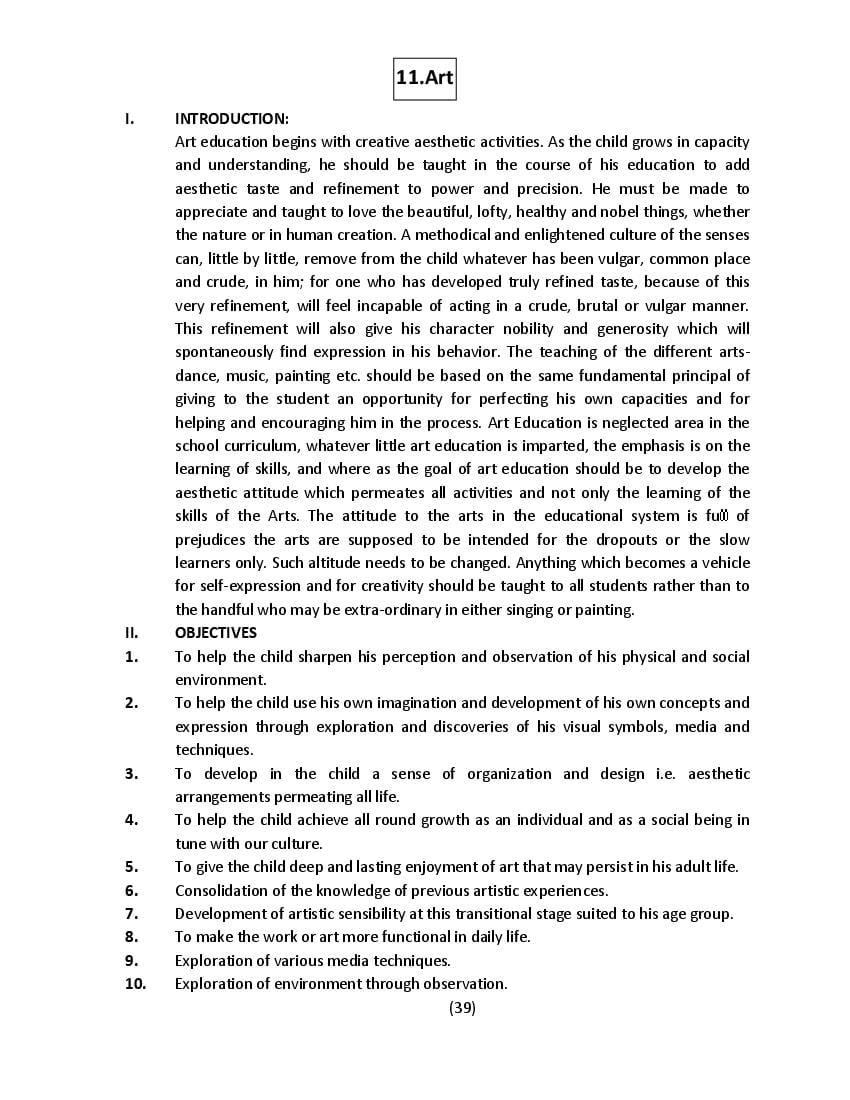
I. INTRODUCTION:
Art education begins with creative aesthetic activities. As the child grows in capacity
and understanding, he should be taught in the course of his education to add
aesthetic taste and refinement to power and precision. He must be made to
appreciate and taught to love the beautiful, lofty, healthy and nobel things, whether
the nature or in human creation. A methodical and enlightened culture of the senses
can, little by little, remove from the child whatever has been vulgar, common place
and crude, in him; for one who has developed truly refined taste, because of this
very refinement, will feel incapable of acting in a crude, brutal or vulgar manner.
This refinement will also give his character nobility and generosity which will
spontaneously find expression in his behavior. The teaching of the different arts-
dance, music, painting etc. should be based on the same fundamental principal of
giving to the student an opportunity for perfecting his own capacities and for
helping and encouraging him in the process. Art Education is neglected area in the
school curriculum, whatever little art education is imparted, the emphasis is on the
learning of skills, and where as the goal of art education should be to develop the
aesthetic attitude which permeates all activities and not only the learning of the
skills of the Arts. The attitude to the arts in the educational system is full of
prejudices the arts are supposed to be intended for the dropouts or the slow
learners only. Such altitude needs to be changed. Anything which becomes a vehicle
for self-expression and for creativity should be taught to all students rather than to
the handful who may be extra-ordinary in either singing or painting.
II. OBJECTIVES
1. To help the child sharpen his perception and observation of his physical and social
environment.
2. To help the child use his own imagination and development of his own concepts and
expression through exploration and discoveries of his visual symbols, media and
techniques.
3. To develop in the child a sense of organization and design i.e. aesthetic
arrangements permeating all life.
4. To help the child achieve all round growth as an individual and as a social being in
tune with our culture.
5. To give the child deep and lasting enjoyment of art that may persist in his adult life.
6. Consolidation of the knowledge of previous artistic experiences.
7. Development of artistic sensibility at this transitional stage suited to his age group.
8. To make the work or art more functional in daily life.
9. Exploration of various media techniques.
10. Exploration of environment through observation.
(39)
Page 2
Time : 3 Hours Paper-A 50 Marks
ART (DRAWING, PAINTING AND APPLIED ARTS)
Scale and Geometrical Drawing
1. Scale Drawing : Almirahs, Stool, Dressing Tables, Drawing Desks, Towel Stand, News
Paper Stands, Pot Stands.
2. Geometrical Drawing : Polygons, Circles, Solid Geometry (Solid Geometry : There should
be solid of squares, Prisms and Pyramids)
Distribution
01 MCQ 20 Marks
02 (i) T;ksesVªh iz”u la[;k 88 ls 126 12 Marks
(ii) fi.M T;ksesVªh iz”u la[;k 13 ls 31
03 ekid Mªkbax 17 ls 32 18 Marks
PAPER-B
Time : 3Hours PRACTICAL 30 Marks
1. Composition or Applied Art (Poster Design or Illustrations)
2. Still Life : Making Drawing of the object placed at a distance to
finish the drawing with light, shade and shadows (Not more than
three objects).
1. One angular shape.
2. Round shape.
3. Fruits and vegetable.
Media Dark Pencils, water colours, postal colours,tempera.
Compositions
Study of natural and made forms of human figures, animals etc. Out door sketching
on daily life subjects like postman, milkman, watchman, folk stories,scenes of
accidents,madari,snake charmers etc.
Applied Art:
Poster Design : based on the topics such as school activities, Drama, Annual function
fete and fair and current issues etc.
lllustrations ; Based on daily life incidents, stories, poems, accidents, social activites etc.
Media Poster colour, water colours, ink and sketch pens etc.
Page 3
question on still life is compulsory.
(40)
IV. METHODOLOGY OF TEACHING.
The principal of "learning by doing" which forms the basis of the liberal methods of
teaching art implies also self discovery through self expression for the child. Art
therefore is training in seeing sensing, feeling and finally in doing. The instruction should
revolve round the relationship of the child with his environment , both within and
without. The teaching approach should be such as to provide to the child the maximum
enrichment materials for developing his liking and understanding about them. At the
middle school stage the art teacher, however, should avoid any direct instruction and
should induce and motivate the pupil enough to let him mobilize his own resources to
find cut appropriate means for self-expression, guidance in techniques should be
indirect and inductive, although the child should be exposed to evaluate and appreciate
works of art in his sphere of interest. More and more media should be introduced for his
exploration and use in self expression. The secondary stage is a transitional period
between the creative expression of childhood and the vocation-based training of the
later period. The adolescent should be induced to acquire them as far as possible
through exploration and discovery.
Teacher should encourage children's own initiatives, independent enquiry,
thoughts and ideas by respecting their humble expressions.
Children should be exposed to variety of situations , materials and media for
keener observation and close analysis.
Teacher being a guide and "adult child" is to help the children to plan their
activities.
Teacher must see that all children participate in art activities in one way or the
other and every child gets recognition of his deeds.
Over-emphasis on one or a few children's work and competition methods
would hamper their imagination and sincere involvement because in order to get
other's approval or appreciation the child would adopt show off tendency instead of
exploring imagining and participating in the creative process.
PRESCRIBED BOOK
dyk ladyu fg] iz] Ldwy f'k{kk cksMZ }kjk izdkf'kr
Page 4
Page 5
Note : Any one of the following three areas can be offered :
I. Elements of Business OR
II. Elements of Book Keeping and Accountancy OR
III. Typewriting-English or Hindi
(I) ELEMENTS OF BUSINESS
Objective : The objective of this paper is to provide elementary knowledge of the different
aspects of business.
One Paper 3 Hours 80 Marks
I. Office Routine: Different departments of Business: establishment, handling inward and
outward mail, Filing and indexing methods, copying and duplication methods. 16 marks
II. Business Correspondence : Essential forms of a good business letter, writing of simple
business letters of enquiry, quotations, order, reference, advice and complaints 16 marks
III. Banks: Functions of a Bank, Kinds of accounts and their operation; bank drafts, traveler’s
cheques, Post Office Saving Bank. 16 marks
IV. Negotiable Instruments: Nature, kinds of cheques, endorsement, crossing, dishonoring of a
cheque. 16 marks
V. Bills of Exchange: Kinds, parties, negotiation, endorsing dishonoring, Promissory notes and
Hundies. 16 marks
OR
(II) Elements of Book-keeping and Accountancy
One Paper 3 Hours 80 marks
I. Final Accounts : Preparation of Trading and Profit and Loss Account and Balance Sheet of a
sole trader with simple adjustments. 16 marks
II. Bank Reconciliation Statement : Utility and Preparation; preparation of Cash Book with
discount and Bank columns 16 marks
III. Bills of Exchange : Nature and use of bills of exchange and promissory notes : Recording
transactions pertaining to drawing, discounting, retiring, dishonoring and renewing of bills
of exchange. 16 marks
IV. Errors and their Rectification : Types of errors and entries for their rectification. 16 marks
V. Depreciation : Objects and methods-Straight line and Diminishing Balance methods 16 marks
(44)
Page 6
(III) Type Writing-(English or Hindi)
Due to speedy industrialization and rapid means of communication, the use of labour saving
devices is on the increase. Typewriting is one of the most commonly used labour saving devices
even in remote towns. Its relevance is more pronounced in developing countries where other
sophisticated labour saving devices are not available. HPBOSE has decided to include the
subject “Typewriting-English or Hindi” as an Elective at the Secondary level. This step has made
the Scheme of Studies job oriented and need based.
Objectives
To help the learner understand the mechanism of the typewriter.
To enable the learner understand methods of typewriting.
To help the learner know the symbols used in proof-correction.
To enable the learner acquire the skills of proper display of mater like margin setting, centering
and tabulation.
To help the learner acquire skills of typing and cutting stencils with speed and accuracy.
One Theory Paper 2 Hours 20 marks
1. Functions of important parts of Typewriter.
2. Elementary knowledge about display of letters and tabulation margin setting, centering,
headings, subheadings.
3. Knowledge of cutting stencils and use of correcting fluid.
4. Simple proof correction symbols.
5. Standard abbreviations.
6. Speed development exercises.
Practical Paper 1 Hours 60 marks
(A) Running Matter-A Speed and Accuracy Test
Marks- 24 Time 10 Minutes
(A Passage of 300 words @ 30 w.p.m. in English and 250 words @ w.p.m. in Hindi. The
same passage to be repeated, if finished before time)
(B) Tabulation Test
Marks 36 Time 40 Minutes
(A Tabular statement having not more than 3-4 rows and columns horizontally and
vertically. The same is applicable for Hindi Typewriting also)
(45)
Page 7
Syllabus
Subject: Computer Science Class: 10th
MARKS
CS-201 Digital Literacy (Advanced): 08 Theory
Handling of Over head Projectors, Digital Screens (LED,
LCD and plasma), and Digital graphic plotters, Different
type of Printers, Fax Machines, and Speakers etc.
CS-202 Network and Internet Concepts: 08 Theory
Introduction to Network, Classification of Networking
(LAN, MAN, WAN, PAN), Differences of Networks.
Introduction to internet, History of Internet, Types of
Web Browsers-Internet explorer, Google chrome, Opera,
Mozilla Firefox and browsing internet through various
search engines such as Google, Yahoo, Bing etc. E-mail.
CS-203 Digital Documentation- Word Processing (Advanced) 12 Theory
:
MS-Word: Introduction to Word Processor, Creating,
Saving, Opening and Print & Print Preview, Closing of
Document. Inserting word art , clip art and pictures ,
pages setting, Super Script and Sub Script, Inserting
Symbols Bullets and Numbering , border and shading ,
format painter , Find and Replace , inserting table,
inserting , deleting , rows and column , merging cells ,
splitting cells using auto format, mail merge.
CS-204 Digital Data Tabulation-Spreadsheet : 12 Theory
MS-Excel: Introduction and Concepts of Spread Sheet
and Workbook. Creating, Saving, Opening and Print &
Print Preview, Closing of Spreadsheet. Entering
Numbers, Text, Date and Time, Series using Auto fill,
Editing and formatting of Worksheet including changing
color ,size, font, alignment of text, inserting and
deleting cells, Row and columns , entering formula in
call using operator (+,-,x,/) etc. Relative referencing ,
absolute referencing and mixed referencing, using
statistical functions :
SUM(), AVG(), MAX(), MIN(), IF() with compound
statements, inserting tables in worksheet , embedding
charts of various types (Lines , pie , bar, column, area)
in worksheet , using macros in worksheet.
CS-205 Practical or Project Work (10% of 200Hrs.)
Page 8
Module Name of Unit Theory Practical Total
Code Hours Hours Hours
CS – 201 Digital Literacy (Advanced) 07 08 15
CS – 202 Network and Internet Concepts 08 12 20
CS – 203 Digital Documentation (Advanced) 10 16 26
CS – 204 Digital Data Tabulation- 15 24 39
Spreadsheet
CS – 205 Practical/Project Work 0 15 15
Total 40 75 115
STRUCTURE OF QUESTION PAPER /DISTRIBUTION OF MARKS
Unit Theory Total
CS-201 08 08
CS-202 08 08
CS-203 12 12
CS-204 12 12
TOTAL 40
Page 9
INTRODUCTION:
Socio-economic changes take place rapidly in our developing society. An understanding
of the economic forces which influence our daily life is essential for a successful living.
Elementary knowledge of Economics has; therefore, been introduced in the new curriculum as
an elective subject in Class X.
The approach in the teaching of the subject at this stage is not to emphasize the
principles of economics so much as the current problems and issues that affect the everyday
life of the common man. Some of these current problems relate to the influence of natural
resources, agriculture and industry on our economic life, the role of the Government in
economic development, and the crucial issues of population, the unemployment and price
trends in the context of India economy. An introductory course of this type would provide
necessary preparation for a more systematic course at the higher secondary stage.
OBJECTIVES:
(A) General Objectives :
1. To provide an intelligent understanding of various economic problems of country and
the state of the students and help them to understand the efforts being made to solve
them.
2. To give an insight into the special problems of the development of hill areas of Himachal
Pradesh and to inculcate in them attitude towards conservation and proper use of the
scarce natural resources.
(B) Specific Objectives :
1. To acquaint students with the contemporary economic problems and to help them
appreciate the efforts being made to solve these problems at local and national levels.
2. To foster an urge among students for effective participation in the tasks of national
reconstruction.
Page 10
fg- iz- Ldwy f”k{kk cksMZ }kjk izdkf”kr
,d iz”u i= vad 80
Lk;e % 3 ?k.Vs
v/;k;&4 vkfFkZd fodkl dh vksj
de fodflr ns”kksa esa csjkstxkjh dh leL;k&Hkkjrh; vFkZO;oLFkk dh dk;Z”khy tula[;k&Hkkjrh;
vFkZO;oLFkk esa d`f’k dk LFkku&xzkeh.k {ks= esa vkthfodk dk L=ksr&jk’Vªh; vk; vkSj d`f’k dk
;ksxnku&ljdkjh jktLo esa d`f’k dk ;ksxnku&xzkeh.k {ks= esa jkstxkj&m|ksxksa dk ;ksxnku&[kk|
vko”;drkvksa dh iwfrZ&d`f’k vkSj Hkkjr dk fu;kZr O;kikj&d`f’k ,oa vkfFkZd fodkl d`’kd ifjokj&Hkwfe
lw/kkj e/;LFkksa dh lekfIr tksrksa dh pdcUnh&Hkw] tksr dh vf/kdre lhek&d`f’k Jfed&d`f’k fufof’V;ka
¼bUiqV~l½ d`f’k es ubZ rduksykWth&miyfC/k;ks&
a [kk| leL;k&d`f’k mRikndrk&Hkkjrh; d`f’k ds fy, Hkkoh
laHkkouk&vkS|ksfxd fodkl&d`f’k vkSj m|ksx dh iwjdrk&rhoz vkS|ksxhdj.k ,oa larqfyr vkS|ksfxd <kaps
dh vo”;drk&orZeku vkS|ksfxd <kapk&Hkkjr ds xkaoksa esa dqVhj m|ksx&y?kq iSekus ds m|ksxksa ds
izksRlkgu ds fy, mBk, x, dne&v|ksxksa esa izknsf”kd fo’kerk,¡&vkS|ksfxd mRikndrk ,oa
dk;Zdq”kyrk&m|ksxksa dh vdk;Zdq”kyrk ,oa fuEu mRikndrk ds dkj.k&vkS|ksfxd fodkl dh Hkkoh
laHkkouk,a&fons”kh O;kikj&Hkkjr dh vFkZO;oLFkk esa fons”kh O;kikj dk egRro&Hkkjr ds fu;kZrksa vkSj
vk;krksa dh fn”kkA
v/;k; % 5 jkT; ,oa vkfFkZd fodkl
vkfFkZd fodkl ds lao/kZu esa jkT; dh Hkwfedk&jkT; }kjk gLrk{ksi dh fof/k;ka&jktdks’kh; uhfr&ekSfnzd
uhfr&mRiknu ,oa forj.k ij lkoZtfud fu;a=.k&vkS|ksfxd ykblsfa lx lkoZtfud forj.k ,oa
jk”kfuax&vkfFkZd fu;kstu vko”;drk ,oa mÌs”;&fu;kstu dh j.kuhfr;k¡&fu;kstu ,oa yksx& ;kstukvksa
ds vUrZxr vkfFkZd fodkl&uOcs ds n”kd ds fy, fu;kstuA
fgekpy dh vFkZO;oLFkk
fgekpy izns”k dk vkfFkZd fodkl %
bdkbZ&11
v/;k;&14 d`f’k] ckxokuh
v/;k;&15 Ik”kq ikyu o Mk;jh fodkl] eNyh ikyu
v/;k;&16 Hkwfe dVko o Hkw&laj{k.k] Hkwfe lq/kkj
v/;k;&17 lgdkfjrk
v/;k;&18 vkS|ksfxd fodkl
v/;k;&19 izeq[k m|ksx
v/;k;&20 tula[;k csjstxkjh
v/;k;&21 iapo’khZ; ;kstuk
Page 11
Background
Traditionally, language-learning materials beyond the initial stages have been sourced
from literature: Prose, fiction and poetry. While there is a trend for inclusion of a wider range of
contemporary and authentic texts, accessible and culturally appropriate pieces of literature
should play a pivotal role at the secondary stage of education. The English class should not be
seen as a place merely to read poems and stories in, but an area of activities to develop the
learner’s imagination as a major aim of language study, and to equip the learner with
communicative skills to perform various language functions through speech and writing.
Objectives
The general objectives at this stage are:
To build greater confidence and proficiency in oral and written communication
To develop the ability and knowledge required in order to engage in independent
reflection and inquiry
To use appropriate English to communicate in various social setting.
Equip learners with essential language skills to question and to articulate their point of
view.
To build competence in the different registers of English.
To develop sensitivity to, and appreciation of other varieties of English, Indian English,
and the culture they reflect.
To enable the learner to access knowledge and information through reference skills
(consulting a dictionary/thesaurus, library, internet etc.)
To develop curiosity and creativity through extensive reading
To facilitate self-learning to enable them to become independent learners
To review, organize and edit their own work and work done by the peers
At the end of this stage learners will be able to do the following:
Give brief oral description of events/incidents of topical interest
Retell the contents of authentic audio texts (weather reports, public announcements,
simple advertisements, short interviews, etc.)
Participate in conversations, discussion, etc. on topics of mutual interest in non-
classroom situations
Narrate the story depicted pictorially or in any other non-verbal mode.
Respond in writing to business letters, official communications.
Read and identify the main points/significant details of texts like scripts of audio-video
interviews, discussions, debates etc.
(3)
Page 12
position taken view expressed.
Write an assessment of different points of view expressed in a discussion/debate.
Read poems effectively (With proper rhythm and information)
To transcode information from a graph/chart to a description/report
Language Items
In addition to consolidating the grammatical items practiced earlier, the courses at
secondary level will seek to reinforce the following explicitly:
Sequence of tenses.
Reported speech in extended texts
Modal auxiliaries (those not covered at upper primary)
Non-finites (infinitives, gerunds, participles)
Conditional clauses
Complex and compound sentences
Phrasal verbs and prepositional phrases
Cohesive devices.
Punctuation (semicolon, colon, dash, hyphen, parenthesis or use of brackets and
exclamation mark)
Methods and Techniques
The methodology will be based on a multi-skill, activity based, learner centered
approach. Care would be taken to fulfill the functional (communicative), literary (aesthetic) and
cultural (sociological) needs of the learner. In this situation the teacher is the facilitator of
learning, she/he presents language items, contrives situations which motivates the child to use
English for the purposes of communication and expression. Aural-oral teaching and testing is an
integral feature of the teaching-learning process. The electronic and print media could be used
extensively. The evaluation procedure should be continuous and comprehensive. A few
suggested activities are:
Role playing
Simulating real-to-life situations
Dramatizing and miming.
Problem solving and decision making.
Interpreting information given in tabular form and schedule.
Using newspaper clippings
Borrowing situations from the world around the learners, from books and from other
disciplines
(4)
Page 13
Interpreting pictures/sketches/cartoons.
Debating and discussing.
Narrating and discussing stories, anecdotes, etc.
Reciting poems
Working in pairs and groups.
Using media inputs-computer, television, video cassettes, tapes, software packages.
One Paper 3 Hours Marks : 80
Section-A : Reading 17 Marks
1 & 2 Two questions of unseen passages with a variety of questions including vocabulary. Only
prose passages will be used. One will be factual and the other will be literary.
Passage 1. Four or Five Comprehension questions. (7 Marks)
Passage 2. Five comprehension questions and four Multiple choice questions (MCQ)
(10 Marks)
Section-B : Writing 18 Marks
3. Letter writing-one letter based on provided verbal stimulus and context.
Types of letter:
Informal: Personal such as to family and friends (7 Marks)
Formal: Letter of complaint, enquiry, request, application.
4. Writing a paragraph on a given outline/topic. (6 Marks)
5. A short writing task based on a verbal visual stimulus (Diagram, picture, graph, map,
chart, table, flowchart etc.) (5 Marks)
Section-C: Grammar 15 Marks
Question No. 6-10
A variety of short questions involving the use of particular structures within a context.
Text type include cloze, gap-filling, sentence Completion, sentence- reordering, dialogue
Completion and sentence-transformation Combining sentences.
The grammar syllabus will include the following areas
(5)
Page 14
2. Tense
3. Prepositions
4. Reported speech
5. Models
6. Voice
7. Non-Finites
8. Transformation of sentences.
Section-D Text Books 30 Marks
Q. 11 One extract from different prose lessons from First Flight (Reader)(Approximately 100
words)
This extract will be literary or discursive in nature. The extract will have five Question
used for testing local and global comprehension beside a question on interpretation and
vocabulary.
( 5 Marks)
Q. 12 One extract from a poem from First Flight (Reader) followed by two or three questions
to test the local and global comprehension of the text. ( 4 Marks)
Q.13 One out of two questions extrapolative in nature based on any one of the prose lessons
from First Flight (Reader) to be answered in about 80 to 100 words. ( 5 Marks)
Q.14 Two out of three short answer type questions in interpretation of them and ideas
contained in the poems from First Flight(Reader) to be answered is 30-40 words each.(5 Marks)
Q.15 One out of two questions from First Flight (Reader) to interpret, evaluates and analyze
character, plot or situation occurring in the text. ( 5 Marks)
Q.16 One out of two questions from supplementary reader to interpret, evaluate and analyze
character, plot or situation occurring in the text. ( 3 Marks)
Q.17 One out of two questions from Supplementary Reader to interpret plot or situation from
the text. ( 3 Marks)
PRESCRIBED BOOKS
1. First Flight Published by H.P Board of School Education
2. Footprints without Feet Published by H.P Board of School Education
(6)
Page 15
nloha d{kk esa nkf[ky gksus okys fo|kFkhZ dh Hkk’kk “kSyh vkSj fopkj cks/k dk ,slk vk/kkj cu pqdk
gksrk gS fd mls mlds Hkkf’kd nk;js ds foLrkj vkSj oSpkfjd le`f) ds fy, t+:jh laLkk/ku eqgS;k djk,
tk,¡A ek/;fed Lrj rd vkrs&vkrs fo|kFkhZ fd”kksj gks x;k gksrk gS vkSj mlesa cksyus] i<+us] fy[kus ds
lkFk&lkFk vkykspukRed n`f’V fodflr gksus yxrh gSA Hkk’kk ds lkSUn;kZRed i{k] dFkkRedrk@
xhrkRedrk] v[kckjh le>] “kCn dh nwljh “kfDr;ksa ds chp varj jktuSfrd psruk] lkekftd psruk
dk fodkl] mlesa cPps dh viuh vfLerk dk lanHkZ vkSj vko”;drk ds vuqlkj mi;qDr Hkk’kk&iz;ksx]
“kCnksa ds lqfpafrr bLrseky] Hkk’kk dh fu;ec) izd`fr vkfn ls fo|kFkhZ ifjfpr gks tkrk gSA bruk gh
ugha og fofHkUu fo|kvksa vkSj vfHkO;fDr dh vusd “kSfy;ksa ls Hkh okfdQ gksrk gSA vc fo|kkFkhZ dh
i<+kbZ vkl iM+ksl jkT;&ns”k dh lhek dks yka?rs gq, oSf”od f{kfrt rd QSy tkrh gSA bu cPpksa dh
nqfu;k esa lekpkj] [ksy] fQYe rFkk vU; dykvksa ds lkFk&lkFk i=&if=dk,¡ vkSj vyx&vyx rjg
dh fdrkcsa Hkh izos”k ik pqdh gksrh gSA
bl Lrj ij ekr`Hkk’kk fganh dk v/;;u lkfgfR;d] lkaLd`frd vkSj O;kogkfjd Hkk’kk ds :Ik esa dqN
bl rjg ls gks fd mPprj ek/;fed Lrj rd igqaprs&igqaprs ;g fo|kfFkZ;ksa dh igpku] vkRefo”okl
vkSj foe”kZ dh Hkk’kk cu ldsA iz;kl ;g Hkh gksxk fd fo|kFkhZ Hkk’kk ds fyf[kr iz;ksx ds lkFk&lkFk
lgt vkSj LokHkkfod ekSf[kd vfHkO;fDr esa Hkh le{k gks ldsA
1- fo|kFkhZ vxys Lrjksa ij viuh :fp vkSj vko”;drk ds vuq:Ik fgUnh dh i<+kbZ dj ldsaxs rFkk
fgUnh esa cksyus vkSj fy[kus esa l{ke gks ldsaxsA
2- viuh Hkk’kk n{krk ds pyrs mPprj ek/;fed Lrj ij foKku] lekt foKku vkSj vU;
ikB~;Øeksa ds lkFk lgt lac)rk ¼varlZac/a k½ LFkkfir dj ldsx
a aAs
3- nSfud O;ogkj] vkonsu&i= fy[kus] vyx&vyx fdLe ds i= fy[kus] izkFkfedh ntZ djkus
bR;kfn esa l{ke gks ldsAa
4- mPprj ek/;fed Lrj ij igq¡pdj fofHkUu iz;qfDr;ksa dh Hkk’kk ds }kjk muesa orZeku varjlac/a k
dks le> ldsx a As
5- fgUnh esa n{krk dks os vU; Hkk’kk&lajpukvksa dh le{k fodflr djus ds fy, bLrseky dj
ldasx]sa LFkkukarfjr dj ldsxa As
ekr`Hkk’kk ds :Ik esa fgUnh f”k{k.k ds mís”;
d{kk vkB rd vftZr Hkkf’kd dkS”kyksa ¼lwuuk] cksyuk] i<+uk] fy[kuk vkSj fparu½ dk mRRkjksRrj
fodklA
l`tukRed lkfgR; ds vkykspukRed vkLokn dh {kerk dk fodklA
Lora= vkSj ekSf[kd :Ik ls viuh fopkjksa dh vfHkO;fDr dk fodklA
Kku ds fofHkUu vuq”kkluksa ds foe”kZ dh Hkk’kk ds :Ik esa fganh dh fof”k’V izd`fr ,oa {kerk dk
cks/k djkukA
Page 16
fyax Hkk’kk½ ds izfr ldkjkRed vkSj laons ku”khy joS;s dk fodklA
tkfr] /keZ] fyax] jk’Vªh;rkvksa] {ks= vkfn ls lacaf/kr iqoZxzgksa ds pyrs cuh :f<+;ksa dh Hkkf’kd
vfHkO;fDr;ksa ds izfr ltxrkA
fons”kh Hkk’kkvksa lesr xSj fganh Hkk’kkvksa dh laLd`fr dh fofo/krk ls ifjp;A
O;kogkfjd vkSj nSfud thou esa fofo/k fdLe dh vfHkO;fDr;ksa dh ekSf[kd o fyf[kr {kerk dk
fodklA
lapkj ek/;eksa ¼fizaV vkSj bysDVªkWfud½ esa iz;qDr fganh dh izd`fr ls voxr djkuk vkSj u,&u,
rjhds ds iz;ksx djus dh {kerk ls ifjp;A
l?ku fo”ys’k.k] Lora= vfHkO;fDr vkSj rØ {kerk dk fodklA
vewrZu dh iwoZ vftZr {kerkvksa dk mÙkjksÙkj fodklA
Hkk’kk esa ekStwn fgalk dh lajpukvksa dh le{k dk fosdklA
erHksn] fojks/k vkSj Vdjko dh ifjfLFkfr;ksa esa Hkh Hkk’kk ds laons u”khy vksj rØiw.kZ bLrseky ls
“kkafriw.kZ laokn dh {kerk dk fodklA
Hkk’kk dh lekos”kh vkSj cgqHkkf’kd izd`fr ds izfr ,sfrgkfld utfj, dk fodklA
“kkjhfjd vkSj vU; lHkh izdkj dh pqukSfr;ksa dk lkeuk dj jgs cPpksa esa Hkkf’kd {kerkvksa ds
fodkl dh mudh viuh fof”k’V xfr vkSj izfrHkk dh igpkuA
ikB~;&lkexzh
1. dkO; vkSj x| laxzg Hkkx&1 vkSj Hkkx&2
¼izeq[k jpukdkjksa }kjk fy[ks lkfgR; dh fofo/k fo|kvksa ls lacaf/kr dkO; vkSj x| yxHkx 17
ikB gksxa As ½ iz”u& vH;klksa ds }kjk ikBxr lanHkZ;qDr Hkkf’kd& iz;ksxksa dh vksj /;ku fnykrs gq,
Hkk’kk dh fu;ec) izd`fr ls ifjfpr djk;k tk,xkA bl iqLrd ds var esa ifjf”k’V ds :Ik esa
fHkUu Kkukuq”kkluksa esa iz;qDr “kCnkofy;ksa dh lwph gksxhA
2. iwjd ikB~;iqLrd & fo|kfFkZ;ksa esa iBu :fp iSnk djus ds fy, lkfgR; dh fofo/k fo|kvksa dh
jpukvksa dk ,d ladyu gksxkA
f”k{k.k ;qfDr;k¡
ek/;fed d{kkvksa esa v/;kid dh Hkwfedk mfpr okrkoj.k ds fuekZ.k esa lgk;d dhs gksuh pkfg,A Hkk’kk
vkSj lkfgR; dh i<+kbZ esa bl ckr ij /;ku nsus dh t:jr gksxh fd&
fo|kFkhZ }kjk dh tk jgh xyfr;ksa dks Hkk’kk ds fodkl ds vfuok;Z pj.k ds :Ik esa Lohdkj fd;k
tkuk pkfg, ftlls fo|kFkhZ vck/k :Ik fcuk f>>d fyf[kr vkSj ekSf[kd vfHkO;fDr djus esa
mRlkg dk vuqHko djsAa fo|kfFkZ;ksa ij “kqf} dk ,slk ncko ugha gksuk pkfg, fd cs rukoxzLr
ekgkSy es iM+ tk,¡A mUgsa Hkk’kk ds lgt] dkjxj vkSj jpukRed :iksa ls bl rjg ifjorZu dh
vko”;drk gksxhA
Page 17
vkSj ekSf[kd vfHkO;fDr djsA vxj dgha Hkwy gksrh gS rks v/;kid dks viuh v/;kiu “kSyh esa
ifjorZu dh vko”;drk gksxhA
,sls f”k{k.k&fcanqvksa dh igpku dh tk, ftlls d{kk esa fo|kFkhZ fujarj lfØ; Hkkxhnkjh djs vkSj
v/;kid Hkh bl izfØ;k esa mudk lkFkh cusA
gj Hkk’kk dk viuk ,d fu;e vkSj O;kdj.k gksrk gSA Hkk’kk dh bl izd`fr dh igpku djkus esa
ifjos”kxr vkSj ikBxr lanHkksZa dk gh iz;ksx djuk pkfg,A ;g iwjh izfØ;k ,slk gksuh pkfg, fd
fo|kFkhZ Lo;a dks “kks/k drkZ le>s rFkk v/;kid blesa dsoy funsZ”ku djsAa
fganh esa {ks=h; iz;ksxksa] vU; Hkk’kkvksa ds iz;ksxksa ds mnkgj.k ls ;g ckr Li’V dh tk ldrh gS
fd Hkk’kk vyxko esa ugha curh vkSj mudk ifjos”k vfuok;Z :Ik ls cgqHkkf’kd gksrk gSA
“kkjhfjd ck/kxzLr fo|kfFkZ;ksa ds fy, mi;qDr f”k{k.k&lkexzh vkSj bLrseky fd;k tk, rFkk
fdlh Hkh izdkj ls mUgsa vU; fo|kfFkZ;ksa ls derj ;k vyx u le{kk tk,A
d{kk esa v/;kid dks gj izdkj dh fofHkUurkvksa ¼tsM a j] tkfr] oxZ] /keZ½ ds izfr ldkjkRed vkSj
laons u”khy okrkoj.k fufeZr djuk pkfg,A
ijaijk ls pys vk jgs eqgkojksa] dgkorksa ¼tSls] jkuh :Bsx a h rks viuk lqgkx ysaxh½ vkfn ds tfj,
fofHkUu izdkj ds iwokZxzgksa dh le> iSnk djuh pkfg, vkSj muds iz;ksx ds izfr vkykspyukRed
n`f’V fodflr djuh pkfg,A
e/; dkyhu dkO; dh Hkk’kk ds eeZ ls fo|kFkhZ dk ifjp; djkus ds fy, t:jh gksxk fd
fdrkcksa esa vk, dkO;ka”kksa dh laxhrc) izLrqfr;ksa ds vkWfM;ks&ohfM;ksa dSlsV rS;kj fd, tk,¡A
vxj vklkuh ls dksbZ xk;d@ xkf;dk feys rks d{kk esa e/;dkyhu lkfgR; ds v/;kiu&f”k{k.k
esa mlls enn yh tkuh pkfg,A
o`Ùkfp=ksa vkSj Qhpj fQYeksa dks f”k{k.k lkexzh ds rkSj ij bLrseky djus dh t:jr gSA buds
izn”kZu ds Øe esa bu ij yxkrkj ckrphr ds tfj, flusek dss ek/;e ls Hkk’kk ds iz;ksx dh
fof”k’Vrk dh igpku djkbZ tk ldrh gS vkSj fganh dh vyx&vyx NVk fn[kkbZ tk ldrh gSaA
d{kk esa flQZ ,d ikB~;iqLrd dh HkkSfrd mifLFkfr ls csgrj ;g gS fd f”k{kd ds gkFk esa
rjg&rjg dh ikB~;lkexzh dks fo|kFkhZ ns[k ldsa vkSj f”k{kd mudk d{kk esa vyx&vyx ekSdkas
ij bLrseky dj ldsAa
Hkk’kk yxkrkj xzg.k djus dh fØ;k esa curh gS] bls iznf”kZr djus dk ,d rjhdk ;g Hkh gS fd
f”k{kd [kqn ;g fl[kk ldsa fd os Hkh “kCndks”k] lkfgR;dks”k] lanHkZxazFk dh yxkrkj enn ys jgs
gSA blls fo|kfFkZ;ksa esa buds bLrseky djus dks ysdj rRijrk c<+x s hA vuqeku ds vk/kkj ij
fudVre vFkZ rd ig¡qpdj larq’V gksus dh txg os vf/kre vFkZ dh [kkst djus dk vFkZ le>
tk,axAs blls “kCnksa dh vyx&vyx jaxr dk irk pysxk] os “kCnksa ds ckjhd varj ds izfr vkSj
ltx gks ik,axAs
O;kdj.k fcanq
fo|kfFkZ;ksa dks ekr`Hkk’kk ds lanHkZ esa O;kdj.k ds fofHkUu i{kksa dk ifjp; d{kk 3 ls gh feyus
yxrk gSA fganh Hkk’kk esa bu i{kksa vkSj fganh dh viuh Hkk’kkxr fof”k’Vrrkvksa dh ppkZ ikB~;iqLrd
Page 18
O;kdjf.kd fcanq fn, x, gS ftUgsa d{kk ;k fofHkUu pj.kksa ds Øe esa ugh j[kk x;k gSA
lajpuk vkSj vFkZ ds Lrj ij Hkk’kk dh fof”k’Vrkvksa dh ifjf/k bu O;kdkjf.kd fcanqvksa ls dgha
vf/kd foLr`r gSA os fcanq bu fof”k’Vrkvksa dk ladsr Hkj gSa ftudh ppkZ ikB ds lgt lanHkZ esa vkSj
cPpksa ds vklikl miyC/k Hkk’kk;h ifjos”k dks /;ku esa j[krs gq, dh thuh pkfg,A
d{kk 6 ls 10 rd ds fy, dqN O;kdj.k fcUnq
laKk] loZuke] fo”ks’k.k] fØ;k] fØ;kfo”ys’k.k
fyax] opu] dky
inca/k esa fyax vkSj opu dk fo”ks’k.k ij izHkko
okD; esa drkZ vkSj deZ ds fy, vkSj opu dk fØ;k ij izHkko
ijlxZ] ^us* dk fØ;k ij izHkko
vdeZd] ldeZd] f}deZd] izsj.kkFkZd
ljy] la;qDr] feJ okD;
dr`ZokP;] deZokP;
leqP;cks/kd “kCn vkSj vU;&vfodkjh “kCn
Ik;kZ;okph] foykse] lekl] vusddkFkhZ] JqfrlefHkUukFkZd “kCn] eqgkojs
Page 19
(11)
Page 20
One Theory Paper 3 Hours 60 Marks
Introduction :
Home Science is an elective subject of study in Class X. The subject aims at providing a
preparation for the home and covers essential ground in the following areas:
(1) Food, Nutrition and Cookery.
(2) Textiles, and Needlework.
(3) Home Management and Decoration.
(4) Home Nursing and Child Development.
Objectives
(1) To provide training for a happy and healthy family and social life.
(2) To impart skills which would be helpful for the students to be responsible house hold
managers.
(3) To understand the importance of nutrition in relation to health of an individual.
(4) To develop a sensitivity in children regarding the correct selection of food in terms of
nutritive values and cost.
(5) To have an understanding of the limited food resources and how to get optimum
amount of nourishment from them.
(6) To impart the children elementary knowledge about home nursing, child development
and home management.
HOME SCIENCE
(A) THEORY ON PAPER 3 HOURS 60 Marks
1. COOKERY:
(1) Balanced diet ; food groups; Principles of Meal planning ; catering.
(2) Causes of deterioration in food and methods of food preservation in home.
2. LOUNDRY AND NEEDLE WORK
(1) Care and storage of fabrics synthetic, cotton, silk and wool.
(2) The laundry room, laundry equipment and cleansing materials.
(3) Washing and finishing of cotton and woolen clothes.
3. HOME MANAGEMNET
(1) Principles of interior decoration.
Page 21
combinations, arrange of flowers and pictures.
4. HOME NURSING AND CHILD DEVELOPMENT
(1) Principles of Child Development, Physical and emotional needs of the growing
child.
(2) Formation of habits: Eating, sleeping, toilet training, exercise and play habits.
(B) PRACTICAL ONE PAPER 3 HOURS 20 Marks
(1) Preparation of lunch and breakfast: Table setting.
(2) Preparation of Jam and Pickle.
(3) Preparation of a household chest of medicines.
(4) Washing and finishing of cotton and woolen clothes.
(5) Preparation of two articles of decoration (One Knitted).
(6) Changing the safety valve of the Pressure Cooker.
(7) Preparation of two charts.
(8) Keeping records of Practical work done in the class.
5. METHODS AND TECHNIQUES OF TEACHING
Each lesson should be well-planned by the teacher. Whatever is taught should be
related to appropriate demonstration, example, illustration or practical work. Students
should be helped to arrive at their own conclusion. Experimental approach is
recommended. The teacher is also advised to make available a variety of booklets and
other reading material on different aspect of the subject for study by the student.
Where necessary, a local expert may be brought to the classroom to demonstrate and
explain a particular process or activity. Recapitulation can be arranged in a variety of
ways. Outdoor activities should be preplanned. Internal assessment charts should be
maintained with care. The teacher should also ensure a well equipped laboratory in the
school.
Prescribed Books: Grih Vijyan by HPBOSE Dharamshala
Page 22
The Syllabus in the subject of Mathematics has undergone changes from time to time in
accordance with growth of the subject and emerging needs of the society. The present revised syllabus
has been designed in accordance with National Curriculum Framework 2005 and as per guidelines given
in Focus Group on Teaching of Mathematics which is to meet the emerging needs of all categories of
students for motivating the teacher to relate the topics from real life problems and other subject areas,
greater emphasis has been laid on applications of various concepts.
The curriculum at Secondary stage primarily aims at enhancing the capacity of students to
employ Mathematics in solving day-to-day life problems and studying the subject as a separate
discipline. It is expected that students should acquire the ability to solve problems using algebraic
methods and apply the knowledge of simple trigonometry to solve problems of heights and distances
Carrying out experiments with numbers and forms of geometry, framing hypothesis and verifying these
with further observations form inherent part of Mathematics learning at this stage. The proposed
curriculum includes the study of Arithmetical concepts, number system, algebra, geometry,
trigonometry, menstruations, statistics, graphs and coordinate geometry etc.
The teaching of Mathematics should be imparted through activities which may involve the use
of concrete materials, models, patterns, charts, pictures posters games, puzzles and experiments.
OBJECTIVES
The board’s objectives of teaching of Mathematics at secondary stage are to help the learners to :
1. Consolidate the Mathematical Knowledge and Skills acquired at the upper primary stage.
2. Acquire knowledge and understanding, particularly by way of motivation and visualization, of
basic concepts, terms, principles and symbols and underlying processes and skills.
3. Develop mastery of basic algebraic skills;
4. Develop drawing skills;
5. Feel the flow of reasons while proving a result or solving a problem.
6. Apply the Knowledge and skills acquired to solve problems and wherever possible, by more than
one method
7. To develop positive ability to think analyze and articulate logically.
8. To develop awareness of the need for national integration, protection of the environment,
observance of small family norms. Removal of social barriers, elimination of gender biases.
9. To develop necessary skills to work with modern technological devices fields for its beautiful
structures and patterns etc.
10. To develop interest in Mathematics as a problem-solving tool in various fields for its beautiful
structures and patterns, etc.
11. To develop reverence and respect towards great Mathematicians for their contributions to the
field of Mathematics.
12. To develop interest in the subject by participating in related competitions
13. To acquaint students with different aspects of mathematics used in daily life.
14. To develop an interest in students to study mathematics as discipline
(12)
Page 23
UNIT Marks
I. Number Systems 06
II. Algebra 17
III. Trigonometry 12
IV. Coordinate Geometry 06
V. Geometry 16
VI. Mensuration 13
VII. Statistics And Probability 10
TOTAL 80
UNIT I : NUMBER SYSTEMS
1. REAL NUMBERS ( 6 Marks)
Euclid’s division lemma, Fundamental Theorem of Arithmetic-statements after reviewing work
done earlier and after illustrating and motivating through examples, Proofs of results-
irrationality of √2 , √3 , √5 , decimal expansions of rational numbers in terms of terminating
non-terminating recurring decimals.
UNIT II : ALGEBRA
1. Polynomials ( 3 Marks)
Zeros of a polynomial, Relationship between zeros and coefficients of a polynomial with
particular reference to quadratic polynomials. Statement and simple problems on division
algorithm for polynomials with real coefficients.
2. Pair of Linear Equations in Two Variables. ( 6 Marks)
Pair of linear equations in two variables. Geometric representation of different possibilities of
solutions inconsistency.
Algebraic conditions for number of solutions. Solution of pair of linear equations in two variables
algebraically by substitution, by elimination and by cross multiplication. Simple situational
problems must be included. Simple problems on equations reducible to linear equations may be
included.
3. Quadratic Equations ( 3 Marks)
Standard form of a quadratic equation ax2+bx+c = 0, (a≠0). Solution of the quadratic equations
(only real roots) by factorization and by completing the square, i.e. by using quadratic formula.
Relationship between discriminant and nature of roots.
Problems related to day to day activities to be incorporated.
(13)
Page 24
th
Motivation for studying AP. Derivation of standard results of finding the n term and sum of first
n terms
UNIT III : TRIGONOMETRY :
1. Trigonometric Ratios ( 7 Marks)
Trigonometric ratios of an acute angle of a right-angled triangle. Proof of their existence (well
defined); motivate the ratios, whichever are defined at 00 & 900. Values (with proofs) of the
trigonometric ratios of 300, 450, & 600. Relationships between the ratios.
2. Trigonometric Identities
Proof and applications of the identity sin2A + Cos2A = 1. Only simple identities to be given.
Trigonometric ratios of complementary angles.
3. Heights and Distances ( 5 Marks)
Simple and believable problems on heights and distances. Problems should not involve more
than two right triangle. Angles of elevation/ depression should be only 300, 450, 600.
UNIT IV: COORDINATE GEOMETRY
1. Lines (In two-dimensions) ( 6 Marks)
Review the concepts of coordinate geometry done earlier including graphs of linear equations.
Awareness of geometrical representation of quadratic polynomials. Distance between two
points and section formula (internal). Area of a triangle.
UNIT V : GEOMETRY
1. TRIANGLES ( 9 Marks)
Definitions, examples, counter examples of similar triangles.
1. (Prove) If a line is drawn parallel to one side of a triangle to intersect to other two sides in
distinct points, the other two sides are divided in the same ratio.
2. (Motivate) If a line divides two sides of a triangle in the same ratio. The line is parallel to the
third side.
3. (Motivate) If in two triangles, the corresponding angles are equal, their corresponding sides are
proportional and the triangles are similar.
4. (Motivate) If the corresponding sides of two triangles are proportional, their corresponding
angles are equal and the two triangles are similar.
(14)
Page 25
including these angles are proportional, the two triangles are similar.
6. (Prove) The ratio of the areas of two similar triangles is equal to the ratio of the squares on their
corresponding sides.
7. (Motivate) If a perpendicular is drawn from the vertex of the right angle of a right triangle to the
hypotenuse, the triangles on each side of the perpendicular are similar to the whole triangle and
to each other.
8. (Prove) In a right triangle, the square of the hypotenuse is equal to the sum of the squares of the
other two sides.
9. (Prove) In a triangle, if the square on one side is equal to sum of the squares on the other two
sides, the angles opposite to the first side is a right triangle.
2. CIRCLES ( 4 Marks)
Tangents to a circle motivated by chords, drawn from points coming closer and closer and closer
to the point.
1. (Prove) The tangent at any point of a circle is perpendicular to the radius through the point of
contact.
2. (Prove) The lengths of tangents drawn from an external point to circle are equal.
3. CONSTRUCTIONS ( 3 Marks)
1. Division of line segment in a given ratio (internally)
2. Tangent to circle from a point outside it.
3. Construction of a triangle similar to a given triangle.
UNIT VI MENSURATION
1. AREAS OF PLANE FIGURES ( 6 Marks)
The area of circle; area of sectors and segments of a circle. Problems bases on areas and
perimeter/ circumference of the above said plane figures. (In calculating area of segment of a
circle, problems should be restricted to central angle of 600, 900, & 1200 only. Plane figures
involving triangles, simple quadrilaterals and circle should be taken).
2. SURFACE AREAS AND VOLUMES ( 7 Marks)
I. Problems on finding surface areas and volumes of combinations of any two of the following
cubes, cuboids, spheres, hemispheres and right circular cylinders/cones. Frustum of a cone.
II. Problems involving concerting one type of metallic solid into another and other mixed
problems. (Problems with combination of not more than two different solids be taken)
(15)
Page 26
1. Statistics ( 5 Marks)
Mean, median and mode of grouped data (bimodal situation to be avoided). Cumulative
frequency graph.
2. PROBABILITY ( 5 Marks)
Classical definition of probability. Connection with probability as given in class IX. Simple
problems on single events, not using set notation.
Blue Print
SR. Types of Question Marks No. of Questions NO. of Question Total
No. to be attempt
1 MCQs 1 18 16 16
2 Short Answer with 2 8 5 10
reasoning
3 Short Answer 3 10 7 21
4 Long Answer 4 4 2 08
5 Long Answer 5 8 5 25
Total 80
Prescribed Book :
1. Ganit Published by H.P. Board of School Education.
Page 27
Page 32
The subject of Science plays an important role in developing well-defined abilities in cognitive,
affective and psychomotor domains in children. It augments the spirit of enquiry, Creativity, objectivity
and esthetic sensibility.
Upper primary stage demands that number of opportunities should be provided to the students
to engage them with the processes of science like observing, recording observation, drawing, tabulation,
plotting graphs etc., where as the secondary stage also expects abstraction and quantitative reasoning
to occupy a more central place in the teaching and learning of science. Thus, the idea of atoms and
molecules being the building blocks of matter makes its appearance, as does Newton’s law of
Gravitation.
The present syllabus has been designed around seven broad themes via, Food, Materials, the
World of the Living, How things Work, Moving Things, People and Ideas, Natural Phenomenon and
Natural Resources. Special care has been taken to avoid temptation of adding too many concepts than
can be comfortably learnt in the given time frame. No attempt has been made to be comprehensive.
At this stage, while science is still a common subject, the disciplines of Physics, Chemistry and
Biology begin to emerge. The students should be exposed to experiences based on hands on activities as
well as modes of reasoning that are typical of the subject.
Distribution of Marks
Unit Marks
1) Chemical substances - 17
(Nature and Behavior)
2) The World of the Living - 23
3) How Things Work - 15
4) Natural Resources - 05
Total - 60
Theory
Theme – Materials
Unit 1- Chemistry Substances Nature and Behavior 17 Marks
Question Marks
1 Question (Long Answer)(C) 5 marks
3 Question(Very Short Answer) 6 marks
3 Question (Objective) 3 marks
1 Question (Short Answer ) 3 marks
8 QUESTIONS 17 MARKS
Chapter-1 Chemical Reaction and Equations
1. Chemical Equations
2. Types of Chemical Reactions
a) Combination Reaction
b) Decomposition Reaction
Page 33
d) Double Displacement Reaction
e) Oxidation and Reduction
3. Effect of oxidation Reaction in Everyday life
a) Corrosion and b) Rancidity
Chapter-2 Acids, Bases and Salts
1) General Properties (physical and chemical properties) of acids, bases and
salts with examples and their uses.
2) PH scale and Importance of PH in Everyday life.
Chapter-3 Metals and Non-metals
1) Physical and chemical Properties of Metals and Non-Metals
2) Reactivity Series
3) Metal and Non-Metal Reactions
4) Occurrence of Metals and their extraction
5) Corrosion of Metals and Prevention of corrosion
Chapter-4 Carbon and its Compounds
1) Bonding in carbon- the covalent Bond.
2) Saturated and Unsaturated Carbon Compounds.
3) Nomenclature of Carbon Compounds.
4) Chemical Properties of Carbon Compounds
5) Some Important carbon Compounds-
Ethanol and Ethanoic Acid. (only properties)
6) Soaps and Detergents : Cleaning action of Soaps (Micelles Formation)
Chapter-5 Periodic Classification of Elements
1) Early attempts at the classification of Elements
a) Dobereiner’s Trids
b) Newlands law of octaves
c) Mendeleev’s Periodic Table
2) The Modern Periodic Table.
3) Trends in the Modern Periodic Table.
Theme – The World of the living (Biology)
Unit2- Our Environment 23 Marks
Question Marks
6 Question (Objective) 6 mark
3 Question (Very Short Answer) 6 marks
1 Question (Long Answer) 5 marks
2 Questions (Short Answer) (c) 6 marks
12 QUESTION 23 MARKS
Page 34
1. Basic concept of nutrition, respiration, transport and excretion in plants and
animals.
Chapter-7 Control and Co-ordination
1. Nervous System, Reflex Action and Human Brain and Animal Hormones.
2. Coordination in Plants: Tropic Movements and plant Hormones.
Chapter-8 How to Organisms Reproduce
1. Importance of Variation
2. Modes of Reproduction : Asexual and Sexual (Both in Plants and Animals)
3. Reproduction in Human Beings:
Male and Female Reproductive systems
4. Reproduction Health: Need and methods of family planning, safe sex vs
HIV/AIDS.
Chapter-9 Heredity and Evolution
1. Heredity
2. Sex Determination
3. Evolution and Classification
4. Tracing Evolution Relationships
5. Fossils.
Chapter-15 Our Environment
1. Bio-degradable and Non-Biodegradable substances.
2. Eco-system and its components.
3. Food chain and Food Web.
4. Environmental problems and their solutions: Ozone layer and Management
of Garbage.
Theme- How things work
Unite3- Effect of Current 15 Marks
Question Marks
2 Question (Objective) 2 mark
1 Question (Very Short Answer) 2 marks
1 Question (Long Answer) (c) 5 marks
2 Questions (Short Answer) (c) 6 marks
6 QUESTION 15 MARKS
Chapter-12 Electricity
1. Electric Current and circuit
2. Electric potential and potential difference
3. Ohm’s Law
4. Series and Parallel combination of resistors.
Page 35
6. Electric Power
7. Inter relation between P,V,I and R.
Chapter-13 Magnetic Effects of Electric Current
1. Magnetic field and field lines
2. Magnetic field due to a current
a) Straight conductor
b) Circular loop
c) Solenoid
3. Fleming’s Right Hand Thumb Rule
4. Left Hand Rule
5. Electric Motor, Electromagnetic Induction
6. Electric Generator and Domestic Electric Circuit
Theme- Natural Phenomena
Convergence and Divergence of light
Chapter-10 Light- Reflection and refraction
1. Reflection of light
2. Spherical Mirrors: Concave and convex
3. Image Formation with Ray diagrams.
4. Mirror Formula and Magnification
5. Refraction of light through Glass Slab and lenses (convex and
concave) and Image formation by lenses.
6. Lens formula and Magnification
7. Uses of Mirrors and Lenses
8. Power of Lens.
Chapter-11 The Human Eye and the Colorful World.
1. The Human Eye.
2. Power of Accommodation
3. Defects of Vision and Their correction
4. Refraction of Light Through Prism
5. Dispersion of light and scattering of light
6. Atmospheric Refraction
a) Twinkling of Stars
b) Tyndall Effect
Theme- Natural Resources
Unit4- Conservation of Natural Resources 05 Marks
Question Marks
1 Question (Objective) 1 mark
2 Question ( Short Answer) (c) 4 marks
3 QUESTIONS 05 MARKS
Chapter-14 Sources of Energy
1. Different forms of Energy.
2. Leading to different Sources of Human use:
Fossil fuels, solar energy, biogas, wind water and tidal energy.
3. Renewable and Non-renewable sources.
Page 36
1. Conservation and Judicious use of natural resources.
2. Forests and Wild life
3. Stake holders and sustainable management
4. Dams and Water Harvesting
5. Cool and Petroleum.
PRACTICAL
LIST OF EXPERIMENTS
1. To Find the PH of the following samples by using PH paper/universal indicator.
i. Dilute Hydrochloric acid
ii. Dilute NaOH solution
iii. Dilute Ethanoic acid solution
iv. Lemon Juice
v. Water
vi. Dilute Sodium Bicarbonate Solution.
2. To study the properties of acids and bases HCl and NaOH by their reaction with
i. Litmus solution (Blue/Red)
ii. Zinc metal
iii. Solid Sodium Carbonate
3. To Determine the focal length of
i. Concave mirror
ii. Convex lens
By obtaining the image of a distant object
4. To trace the path of a ray of light passing through a rectangular glass slab for different angles of
incidence. Measure the angle of incidence, angle of refraction, angle of emergence and interpret
the result.
5. To study the dependence of current (1) on the potential difference (v) across a resistor and
determine its resistance. Also plot a graph between V and I.
6. To determine the equivalent resistance of two resistors when connected in series.
7. To determine the equivalent resistance of two resistors when connected in parallel.
8. To prepare a temporary mount of a leaf peel to show stomata.
9. To show experimentally that carbon dioxide is given out during respiration.
10. To study (a) binary fission in Amoeba and (b) budding in yeast with the help of prepared slides.
11. To determine the percentage of water absorbed by raisins.
12. To prepare SO2 gas, observe its following properties and draw inferences in respect of
i. Odour
ii. Solubility in water
iii. Effect on litmus paper
iv. Action on acidified potassium dichromate solution.
13. a) To observe the action of Zn, Fe, Cu and Al metals on the following salt solutions.
i. ZnSO4(aq.)
ii. FeSO4(aq.)
iii. Cu SO4(aq.)
iv. Al2(SO4)3 (aq.)
b) Arrange Zn, Fe, Cu and Al metals in the decreasing order of reactivity based on the above
result.
15. To study the following properties of acetic acid (ethanoic acid).
i. Odour
ii. Solubility in water
Page 37
iv. Action on acidified potassium dichromate solution.
Scheme of Examination:
External Examination (to be conducted by the Board) (20 Marks)
Prescribed Books :
1. Vigyan Published by H.P. Board of School Education.
2. Science Published by H.P. Board of School Education.
(22)
Page 38
RATIONALE
Social Sciences is a compulsory subject up to secondary stage of school education. It is
an integral component of general education because it helps the learners in understanding the
environment in its totality and developing a broader perspective and an empirical reasonable
and humane outlook. This is of crucial importance because it helps them grow into well-
informed and responsible citizens with necessary attributes and skills for being able to
participate and contribute effectively in the process of development and nation-building.
The social sciences curriculum draws its content mainly from geography, history, civics
and economics. Some elements of sociology and commerce are also included. Together they
provide a comprehensive view of society-over space and time, and in relation to each other.
Each subject’s distinct methods of enquiry help the learners study society from different angles
and from a holistic view.
OBJECTIVES
The main objectives of this syllabus are:
To develop an understanding of the processes of change and development-both in
terms of time and space, through which human societies have evolved.
To make learners realize that the process of change is continuous and any event or
phenomenon or issue cannot be viewed in isolation but in a wider context of time and
space.
To develop an understanding of contemporary India with its historical perspective of the
basic framework of the goals and policies of national development in independent India,
and of the press of change with appropriate connections to world development.
To deepen knowledge about and understanding of India’s freedom struggle and of the
values and ideals that it represented and to develop an appreciation of the
contributions made by people of all sections and regions of the country.
To help learners understand and cherish the values enshrined in the Indian Constitution
and to prepare them for their roles and responsibilities and effective citizens of
democratic society.
To deepen the knowledge and understanding of Indian’s environment in its totality,
their interactive processes and effects on the future quality of people’s lives.
To facilitate the learners to understand and appreciate the diversity in the land and
people of the country with its underlying unity.
To develop an appreciation of the richness and variety of India’s heritage both natural
and cultural and the need for its preservation.
Page 39
environment, economic and social, as part of the development process.
To help pupils acquire knowledge, skills and understanding to face the challenges of
contemporary society as individuals and groups and learn the art of living a confident
and stress-free life as well as participating effectively in the community.
To develop scientific temper by promoting the spirit of enquiry and following a rational
and objective approach in analyzing an evaluating data and information as well as views
and interpretations.
To develop academic and social skills such as critical thinking, communication effectively
both in visual and verbal forms-cooperating with others, taking initiatives and providing
leadership in solving others problems.
To develop qualities clustered around the personal, social, moral national and spiritual
values that make a person humane and socially effective
Structure of Question Paper/ Distribution of Marks
3hours One paper Marks:80
Marks
Unit-1 India and the contemporary World-II 15+3(Map)=18
Unit-2 India-Resources and their Development 15+3(Map)=18
Unit-3 Democratic Politics II 18
Unit-4 Understanding Economics-II 18
Unit-5 Disaster Management 8
India & the Contemporary world-II
Section-I Events and Process
1)) The Rise of Nationalism in Europe
1. The French Revolution & the idea of the Nation.
2. The making of Nationalism in Europe.
3. The Age of Revolutions: 1830-1848.
4. The making of Germany and Italy.
5. Visualizing the Nation.
6. Nationalism and Imperialism.
Page 40
1. The first world war, Khilafat & Non-Cooperation.
2. Differing strands within the Movement.
3. Towards civil Disobedience.
4. The sense of collective Belonging.
Section-II Livelihoods, Economics and Societies
3)) The Making of a Global world
1. The Pre-Modern World
2. The Nineteenth Century(1815-1914)
3. The Inter war Economy
4. Rebuilding a world Economy : The Post-war Era
4)) The Age of Industrialization
1. Before the Industrial Revolution.
2. Hand labour and steam power.
3. Industrialization in the colonies.
4. Factories come up.
5. The Peculiarities of Industrial Growth.
6. Market for Goods.
Section-III Everyday life, Culture and Politics
5)) Print culture and the Modern World
1. The First Printed books.
2. Print comes to Europe.
3. The Print Revolution and its Impact.
4. The Reading Mania.
5. The Nineteenth Century.
6. India and the World of Print.
7. Religious Reforms and Public Debates.
8. New forms of Publication.
9. Print and Censorship.
Democratic Politics-II
Chapter No.01 Power Sharing:-
1. Belgium and Srilanka.
2. Majorityrianism in Srilanka.
3. Accommodation in Belgium.
4. Forms of Power Sharing.
Page 41
1. Meaning of Federalism.
2. What makes India Federal Country?
3. How is federalism practiced?
4. Decentralization in India.
Unit 02
Chapter No.03 Democracy and Diversity:-
1. A Story from Mexico Olympics.
2. Differences, Similarities, division.
3. Politics of Social division.
Page 42
1. Gender and Politics.
2. Religion, Communalism and Politics.
3. Caste and Politics.
Unit 03
Chapter No.05 Popular Struggles and Movements:-
1. Popular Struggles in Nepal and Bolivia.
2. Mobilization and organization.
3. Pressure groups and Movements.
Chapter No.06 Political Parties:-
1. Why do we need Political Parties?
2. How many Parties should we have?
3. A moral force in Politics?
4. Popular Participation in Political Parties.
5. National Political Parties.
6. State Parties.
7. How can Parties be reformed?
Unit 04
Chapter No.07 Outcomes of Democracy:-
1. How do we assess democracy’s outcomes
2. Accountable, responsive and legitimate government.
3. Economic growth and development
4. Reduction of inequality and Poverty.
5. Accommodation of Social diversity.
6. Dignity and freedom of the citizens.
Chapter No.08 Challenges to Democracy:-
1. Thinking about challenges.
2. Different contents different challenges.
3. Different type of challenges.
4. Thinking about political reforms.
5. Redefining democracy.
Page 43
1. Development:- What are Development promises, Income and others goals, National
Development, How to compare different countries or states, Income and other criteria,
Public facilities Sustainability of Development.
2. Sectors of the Indian Economy:- Sectors of Economic Activities, Comprise of three
Sectors, Rising Importance of the tertiary Sector in Production, Where are most of the
people employed? How to create more employment? Division of Sectors as organized
and unorganized.
3. Money and credit:- Money as a medium of exchange, Modern forms of money, Loan
activities of banks, Terms of credit.
4. Globalization And the India Economy:- Meaning of Globalization, Interlinking Production
Across countries, Factors that have enabled Globalization, World trade organization,
impact of Globalization in India.
5. Consumer Rights:- The consumer in the Market Place
Contemporary India II
1. Resources and Development.
2. Forest and Wildlife Resources:-
i. Flora and Fauna in India
ii. Conservation of Forest and wildlife in India.
iii. Types and distribution of Forest and wildlife Resources.
3. Water Resources
4. Agriculture
5. Mineral and Energy Resources
6. Manufacturing Industries
7. Lifelines of National Economy: - Transport, Communication, International Trade.
8. Map (From Any Chapter) 3 marks
Page 44
TIME : 3 Hrs
MM : 80
1. FORM OF QUESTIONS & WEIGHTAGE thereof
Form of Questions Marks of Each Number of Total Marks
Question Question
1. M.C.Qs. 1 16 16
2. Very Short Answer(V.S A) 2 9 18
3. Short Answer (S.A.) 3 8 24
4. Long Answer (L.A.) 4 4 16
5. Map Question 3+3 1 06
Total - 38 80
2. Blue print of Questions
Unit No. Marks MCQ 3 marks 4 marks Total Marks
2 marks Map
Questions Questions (Questions)
(Subject) 1 mark Questions Question
Questions (3+3)=6
marks
India and the 18 4 2 1 1 1 (1) 18 (9)
1.
Contemporary
World 2
(History)
Contemporary 18 2 3 1 1 1 (2) 18 (8)
2.
India 2
(Geography)
Democratic 18 3 1 3 1 - 18 (8)
3.
Politics 2
(Pol. Sc.)
4. Understanding 18 4 2 2 1 - 18(9)
Economic
Development
Disaster 08 3 1 1 - - 8 (5)
5.
Manageme
nt
Total 80 16 9 8 4 1 80(38)
Page 47
Objectives:- At present Urdu is widely spoken language of the country with a glorious past. As
such it contains highly valued literature on multifarious aspects of country’s social and cultural
life. During the freedom struggle of the country it was the most inspiring language and its
poetry and slogans penetrated deep into the hearts of Indian masses with positive results.
Specific objectives:- It is an official language of neighboring state Jammu and Kashmir. It is
second language in Uttar Pradesh. It is widely spoken language in many states of the Indian
union. Many regional newspapers in some states of India are published in this language. Old
generation of H.P. also gets benefit from these Urdu newspapers. This language also happens to
be language linguistically interwoven and closely inter related with Hindi our national language
hence it is necessary to expose it to new generation.
One Paper 3 Hours Max. Marks: 80
I. Text Book 35 Marks
I. Prose-16 Lessons consisting of :- 27 Marks
a) Short stories
b) Lessons of General Interest reflecting social, cultural national and moral
values.
II. Poetry: 10 Poems of Poets for children literature keeping in view the understanding
level of children 08 Marks
III. Grammar and Composition: 45 Marks
a) (i) Knowledge of Nouns, Pronouns, adjectives and verbs. 3 Marks
(ii) Singular and Plural Numbers 3 Marks
(iii) Use of words and phrases in sentences. 3 Marks
(iv) Use opposite words. 4 Marks
(v) Mascuine Feminine genders 4Marks
b) Composition
(i) Essays (very simple topics) 12 Marks
(ii) Simple letters 08 Marks
(iii) Simple applications 08 Marks
Note:- All the questions in grammar should be set on the basis of vocabulary in the Text book.
(33)
Document Details
| Board / Org | Himachal Pradesh Board |
| Exam | Class 10 |
| Type | Syllabus |
| Pages | 47 |
| Updated | 24 Sep 2026 |