Assam CEE 2023 Sample Paper Maths
Finished viewing? Save it for later —
Download Assam CEE 2023 Sample Paper Maths (PDF · 9 pages)About Assam CEE 2023 Sample Paper Maths
Assam CEE 2023 Sample Paper Maths is available here for free download. Published by Assam Exams for Assam Combined Entrance Examination, this sample paper can be viewed online or downloaded as a PDF (9 pages). Candidates preparing for Assam Combined Entrance Examination can use Assam CEE 2023 Sample Paper Maths to understand the exam pattern, the type of questions asked, and the overall difficulty level.
Frequently Asked Questions
How can I download Assam CEE 2023 Sample Paper Maths?
Open this page and click the Download button to save Assam CEE 2023 Sample Paper Maths as a PDF. It is completely free on AglaSem Docs.
Is Assam CEE 2023 Sample Paper Maths free to download?
Yes. Assam CEE 2023 Sample Paper Maths can be viewed online and downloaded as a PDF free of cost on AglaSem Docs.
How many pages does Assam CEE 2023 Sample Paper Maths have?
Assam CEE 2023 Sample Paper Maths contains 9 pages, which you can read online or download together as a single PDF.
Where can I find more Assam Combined Entrance Examination study material?
You can find more Assam Combined Entrance Examination question papers, sample papers, syllabus, and answer keys on AglaSem Docs.
Assam CEE 2023 Sample Paper Maths – Text
Read the full text of this sample paper below — useful to quickly search, copy and reference the content online without downloading the PDF.
📄 View text version (9 pages)
Page 1
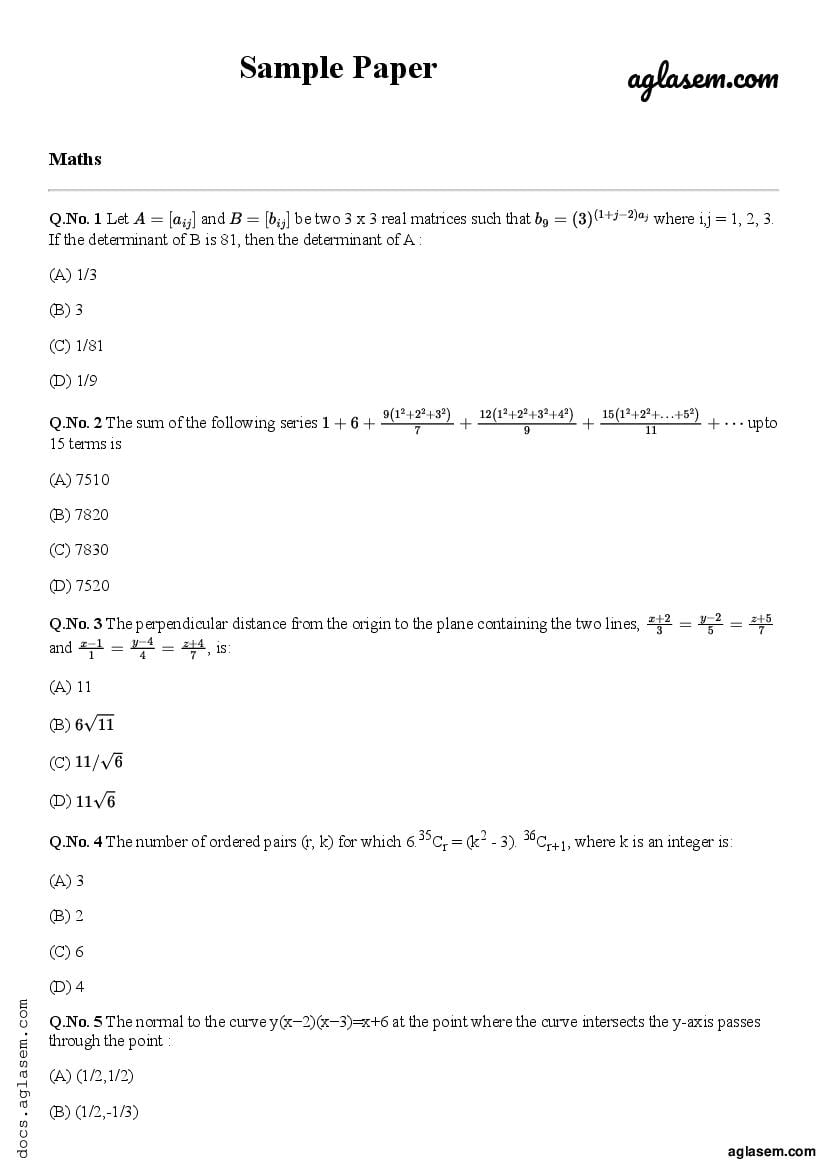
Maths
Q.No. 1 Let A = [a ] and B = [b ] be two 3 x 3 real matrices such that b
ij ij 9
= (3)
(1+j−2)a j
where i,j = 1, 2, 3.
If the determinant of B is 81, then the determinant of A :
(A) 1/3
(B) 3
(C) 1/81
(D) 1/9
2 2 2 2 2 2 2 2 2 2
9(1 +2 +3 ) 12(1 +2 +3 +4 ) 15(1 +2 +…+5 )
Q.No. 2 The sum of the following series 1 + 6 + 7
+
9
+
11
+ ⋯ upto
15 terms is
(A) 7510
(B) 7820
(C) 7830
(D) 7520
Q.No. 3 The perpendicular distance from the origin to the plane containing the two lines, x+2
3
=
y−2
5
=
z+5
7
and x−1
=
1
y−4
=
4
, is:
z+4
7
(A) 11
(B) 6√11
(C) 11/√6
(D) 11√6
Q.No. 4 The number of ordered pairs (r, k) for which 6.35Cr = (k2 - 3). 36Cr+1, where k is an integer is:
(A) 3
(B) 2
(C) 6
(D) 4
Q.No. 5 The normal to the curve y(x−2)(x−3)=x+6 at the point where the curve intersects the y-axis passes
through the point :
(A) (1/2,1/2)
(B) (1/2,-1/3)
Page 2
(D) (-1/2,-1/2)
Q.No. 6 The number of values of k, for which the system of equations (k + 1)x + 8y = 4k kx + (k + 3)y = 3k
− 1 has no solution, is
(A) 1
(B) 2
(C) 3
(D) infinite
Q.No. 7 Let K be the set of all real values of x where the function f (x) = sin |x| − |x| + 2(x − π) cos |x| is
not differentiable. Then the set K is equal to :
(A) {π}
(B) {0, π}
(C) Φ (an empty set)
(D) {0}
Q.No. 8
(A) Φ (an empty set)
(B) {0}
(C) {π}
(D) {0,π}
Q.No. 9 If the fractional part of the number is k/15, then k is equal to :
403
2
15
(A) 6
(B) 8
(C) 14
(D) 4
Q.No. 10 If the point (2, α, β) lies on the plane which passes through the points (3, 4, 2) and (7,0, 6) and is
perpendicular to the plane 2x - 5y=15, then 2α − 3β is equal to :
(A) 7
(B) 12
(C) 17
(D) 5
Page 3
If one of these students is selected at random, then the probability that the student selected has opted neither
for NCC nor for NSS is :
(A) 1
6
(B) 5
6
(C) 1
3
(D) 2
3
Q.No. 12 The sum of all two digit positive numbers which when divided by 7 yield 2 or 5 as remainder is:
(A) 1256
(B) 1365
(C) 1356
(D) 1465
Q.No. 13 For each xeR, let [x] be the greatest integer less than or equal to x. Then lim is
x([x]+|x|) sin[x]
−
x→0
|x|
equal to :
(A) 0
(B) 1
(C) sin 1
(D) -sin 1
Q.No. 14 If the circles x + y − 16x − 20y + 164 = r and (x − 4) + (y − 7)
2 2 2 2 2
= 36 intersect at two
distinct points, then:
(A) 1 < r < 11
(B) r > 11
(C) 0 < r < 1
(D) r=11
Q.No. 15 The area of the region enclosed by the circle x2 + y2 = 2 which is not common to the region
bounded by the parabola y2 = x and the straight line y = x is :
(A) 1
6
(24π − 1)
(B) 1
3
(6π − 1)
(C) 1
(12π − 1)
3
(D) 1
6
(12π − 1)
Q.No. 16 The area (in sq. units) of the region {(x,y) : x≥0, x+y≤3, x²≤4y and y≤1 + √x} is:
(A) 3/2
Page 4
(C) 5/2
(D) 59/12
Q.No. 17 If the system of linear equations 2x + 2ay + az =0 2x + 3by + bz =0 2x + 4cy + cz =0 Where a,b
and c ∈ R are non zero and distinct: has a non zero solution, then :
(A) 1/a, 1/b, 1/c are in A.P.
(B) a,b, and c are in G.P.
(C) a+b+c = 0
(D) a,b and c are in A.P.
Q.No. 18 The product of three consecutive terms of a G.P. is 512. If 4 is added to each of the first and the
second of these terms, the three terms now form an A.P. Then the sum of the original three terms of the given
G.P. is:
(A) 36
(B) 24
(C) 28
(D) 32
Q.No. 19 Let the equations of two sides of a triangle be 3x - 2y+6=0 and 4x +5y-20=0. If the orthocentre of
this triangle is at(1, 1), then the equation of its third side is :
(A) 26x+61y+1675= 0
(B) 122y +26x +1675=0
(C) 26x-122y-1675=0
(D) 122y-26x - 1675=0
Q.No. 20 For (2x) 2y
= 4e
2x−2y
, If x > 1, then (1 + log 2x)
e
2 dy
dx
is equal to:
(A)
x log 2x−log 2
e e
x
(B) log 2xe
(C)
x log 2x+log 2
e e
x
(D) x log 2x e
Q.No. 21 If, for a positive integer n, the quadratic equation, has two consecutive
integral solutions, then n is equal to:
(A) 9
(B) 10
(C) 11
Page 5
Q.No. 22 From 6 different novels and 3 different dictionaries, 4 novels and 1 dictionary are to be selected
and arranged in a row on a shelf so that the dictionary is always in the middle. The number of such
arrangements is :
(A) at least 1000
(B) less than 500
(C) at least 500 but less than 750
(D) at least 750 but less than 1000
Q.No. 23 A box contains 15 green and 10 yellow balls. If 10 balls are randomly drawn, one-by-
one, with replacement, then the variance of the number of green balls drawn is :
(A) 6
(B) 4
(C) 6/25
(D) 12/5
Q.No. 24 If cos −1
(
2
3x
) + cos
−1
(
3
4x
) =
π
2
(x >
3
4
) , then x is equal to:
(A) √ 145
12
(B) √ 145
11
(C) √ 145
10
(D) √ 146
12
Q.No. 25 Let f be a differentiable function such that f(1) = 2 and f'(x) = f(x) for all x ∈ r. If h(x)=f(f(x)), then
h'(1) is equal to:
(A) 2e 2
(B) 4e
(C) 2e
(D) 4e 2
Q.No. 26 If θ1 and θ2 be respectively the smallest and the largest values of θ in (0, 2 π) - {π}) which satisfy
the equation, 2 cot θ − + 4 = 0 then ∫ cos 3θdθ is equal to :
2 5 θ2 2
sin θ 0
(A) π
3
(B) 2π
3
(C) π
3
+⅙
(D) π
9
Page 6
2
(x+2)(x −5x+6)
: 2 = 1}
B = {x ∈ Z : −3 < 2x − 1 < 9} , then the number of subsets of the set A x B, is :
(A) 2 18
(B) 2 12
(C) 2 15
(D) 2 10
Q.No. 28
(A) 2
(B) 4
(C) -1
(D) -2
Q.No. 29 The value of α for which 4a ∫ is :
2 −a|x|
e dx = 5
−1
(A) loge
(B) loge(3/2)
(C) loge√2
(D) loge(4/3)
Q.No. 30 'The value of c in the Lagrange's mean value theorem for the function f(x) = x3 + 8x + 11, when x
∈ [0, 1] is :
(A) 4−√ 5
3
(B) 4−√ 7
3
(C) 2/3
(D) √ 7−2
3
Q.No. 31 Let A, B, C and D be four non-empty sets. The contrapositive statement of " If A ⊆ B and B ⊆ D ,
then A ⊆ C” is
(A) If A ⊄ C, then A ⊆ B and B ⊆ D
(B) If A ⊆ C, then A ⊆ B and B ⊆ D
(C) If A ⊄ C, then A ⊄ B and B ⊆ D
(D) If A ⊄ C, then A ⊄ B and B ⊄ D
Page 7
3 2
and decreasing in [1, 5), then a root of the equation,
f (x)−14
= 0(x ≠ 1) 2
(x−1)
(A) 7
(B) -7
(C) 5
(D) 6
Q.No. 33 Let P be a Plane passing through the points (2,1,0) , (4,1,1) and (5,0,1) and R be any point (2,1,6) .
Then the image of R in the Planet P is :
(A) (6,5,2)
(B) (6,5,-2)
(C) (4,3,2)
(D) (3,4-2)
Q.No. 34 If z is a complex number of unit modulus and argument θ, then arg (1+z)/(1+z)
(A) π/2 - θ
(B) θ
(C) π - θ
(D) - θ
Q.No. 35 Equation of a common tangent to the circle, x² + y² - 6x = 0 and the parabola, y² = 4x, is :
(A) √3y= 3x +1
(B) 2√3y= -x - 12
(C) 2√3y= 12 x + 1
(D) √3y x + 3
2 n
Q.No. 36 Let S n
= 1 + q + q
2
+ … + q
n
and T n
= 1 + (
q+1
2
) + (
q+1
2
) + … + (
q+1
2
) where q is a
real number and q1. If 101
C1 +
101
C2 ⋅ S1 + … +
101
C 101 ⋅ S 100 = αT 100 then α is equal to :
(A) 2⁹⁹
(B) 202
(C) 200
(D) 2¹ºº
Q.No. 37 Let y = y(x) be a function of x satisfying y√1 − x 2
= k − x√ 1 − y
2
where k is a constant and
y(
1
) = −
2
. Then dy/dx at x = 1/2 is equal to:
1
4
(A) − √5
4
Page 8
2
(C) 2
√5
(D) √5
2
Q.No. 38 Let In = ∫ tanⁿ x dx, (n>1). If I₄ + I₆ = a tan⁵ x + bx⁵ + C, where C is a constant of integration, then
the ordered pair (a,b) is equal to:
(A) (1/5,0)
(B) (1/5,-1)
(C) (-1/5,0)
(D) (-1/5,1)
Q.No. 39 The equation of the line passing through (-4, 3, 1), parallel to the plane x+2y-z-5=0 and intersecting
the line =
x+1
−3
= is
y−3
2
z−2
−1
(A) x+4
−1
=
y−3
1
=
z−1
1
(B) x+4
3
=
y−3
−1
=
z−1
1
(C) x−4
3
=
y−3
−1
=
z−1
1
(D) x+4
1
=
y−3
1
=
z−1
3
Q.No. 40 If y = mx +4 is a tangent to both the parabolas, y2 =4x and x2 =2by , then b is equal to :
(A) -32
(B) -64
(C) -128
(D) 128
Answer Sheet
Q.No Answer
Q.No. 1 (D)
Q.No. 2 (B)
Q.No. 3 (C)
Q.No. 4 (D)
Q.No. 5 (A)
Q.No. 6 (C)
Q.No. 7 (C)
Q.No. 8 (A)
Q.No. 9 (B)
Page 9
Q.No. 11 (A)
Q.No. 12 (C)
Q.No. 13 (D)
Q.No. 14 (A)
Q.No. 15 (D)
Q.No. 16 (C)
Q.No. 17 (A)
Q.No. 18 (C)
Q.No. 19 (C)
Q.No. 20 (A)
Q.No. 21 (C)
Q.No. 22 (A)
Q.No. 23 (D)
Q.No. 24 (A)
Q.No. 25 (B)
Q.No. 26 (A)
Q.No. 27 (C)
Q.No. 28 (A)
Q.No. 29 (A)
Q.No. 30 (B)
Q.No. 31 (D)
Q.No. 32 (A)
Q.No. 33 (B)
Q.No. 34 (B)
Q.No. 35 (D)
Q.No. 36 (D)
Q.No. 37 (B)
Q.No. 38 (A)
Q.No. 39 (B)
Q.No. 40 (C)
Document Details
| Board / Org | Assam Exams |
| Exam | Assam Combined Entrance Examination |
| Type | Sample Paper |
| Pages | 9 |
| Updated | 09 Jun 2026 |