Assam CEE 2023 Sample Paper Chemistry
Finished viewing? Save it for later —
Download Assam CEE 2023 Sample Paper Chemistry (PDF · 12 pages)About Assam CEE 2023 Sample Paper Chemistry
Assam CEE 2023 Sample Paper Chemistry is available here for free download. Published by Assam Exams for Assam CEE, this sample paper can be viewed online or downloaded as a PDF (12 pages). Candidates preparing for Assam CEE can use Assam CEE 2023 Sample Paper Chemistry to understand the exam pattern, the type of questions asked, and the overall difficulty level.
Frequently Asked Questions
How can I download Assam CEE 2023 Sample Paper Chemistry?
Open this page and click the Download button to save Assam CEE 2023 Sample Paper Chemistry as a PDF. It is completely free on AglaSem Docs.
Is Assam CEE 2023 Sample Paper Chemistry free to download?
Yes. Assam CEE 2023 Sample Paper Chemistry can be viewed online and downloaded as a PDF free of cost on AglaSem Docs.
How many pages does Assam CEE 2023 Sample Paper Chemistry have?
Assam CEE 2023 Sample Paper Chemistry contains 12 pages, which you can read online or download together as a single PDF.
Where can I find more Assam CEE study material?
You can find more Assam CEE question papers, sample papers, syllabus, and answer keys on AglaSem Docs.
Assam CEE 2023 Sample Paper Chemistry – Text
Read the full text of this sample paper below — useful to quickly search, copy and reference the content online without downloading the PDF.
📄 View text version (12 pages)
Page 1
Chemistry
Q.No. 1 The reaction, MgO(s) +C(s) >Mg(s) +CO(g), for which Δ H = +491.1 kJ mol and
r
∘ −1
r
∘
Δ S = 198.0JK
−1
mol , is not feasible at 298 K. Temperature above which reaction will be feasible is :
−1
(A) 2380.5 K
(B) 2480.3 K
(C) 2040.5 K
(D) 1890.0 K
Q.No. 2 The standard reaction Gibbs energy for a chemical reaction at an absolute temperature T is given by
Δ G = A − BT . Where A and B are non-zero constants. Which of the following is TRUE about this reaction ?
o
r
(A) Endothermic if A<0 and B>O
(B) Exothermic if B<0
(C) Endothermic if A>0
(D) Exothermic if A>O and B<0
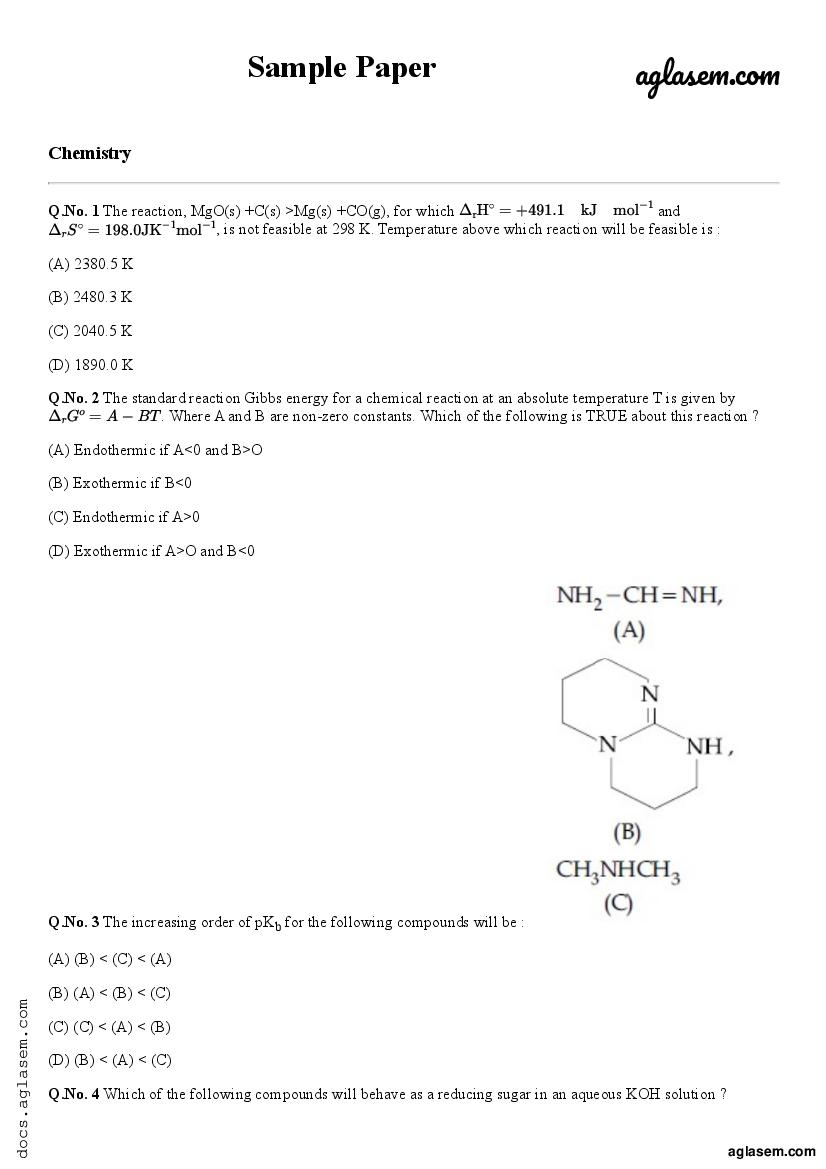
Q.No. 3 The increasing order of pKb for the following compounds will be :
(A) (B) < (C) < (A)
(B) (A) < (B) < (C)
(C) (C) < (A) < (B)
(D) (B) < (A) < (C)
Q.No. 4 Which of the following compounds will behave as a reducing sugar in an aqueous KOH solution ?
Page 2
(B)
(C)
(D)
Q.No. 5 For the reaction, 2A +B → products, when the concentrations of A and B both were doubled, the rate of
the reaction increased from 0.3molL s to 2.4molL s . When the concentration of A alone is doubled, the
−1 −1 −1 −1
rate increased from 0.3 mol L s to 0.6molL s . Which one of the following statements is correct?
−1 −1 −1 −1
(A) Order of the reaction with respect to B is 2
(B) Order of the reaction with respect to B is 1
(C) Order of the reaction with respect to A is 2
(D) Total order of the reaction is 4
Q.No. 6 The two monomers for the synthesis of Nylon 6, 6 are :
HOOC(CH2) COOH
(A) 6
H2N(CH2)6NH2
HOOC(CH2)6COOH
(B)
H2N(CH2) NH2
4
HOOC(CH2)4COOH
(C)
H2N(CH2) NH2
6
HOOC(CH2) COOH
(D) 4
H2N(CH2) NH2
4
Q.No. 7 Total number of lone pair of electrons in I₃⁻ ion is:
(A) 3
(B) 6
(C) 9
(D) 12
Q.No. 8 Consider the reversible isothermal expansion of an ideal gas in a closed system at two different
temperatures T₁ and T₂ (T₁ < T₂). The correct graphical depiction of the dependence of work done (w) on the final
Page 3
(A)
(B)
(C)
(D)
Q.No. 9 The compound that does not produce nitrogen gas by the thermal decomposition is :
(A) Ba(N₃)₂
(B) (NH₄)₂Cr₂O₇
(C) NH₄NO₂
(D) (NH₄)₂SO₄
NEt1
Q.No. 10 The correct structure of product 'p' in the following reaction is : Asn − Ser + (GH CO) O → , P
3 2
(A)
(B)
(C)
Page 4
Q.No. 11 The element that shows greater ability to form pF − pπ multiple bonds, is :
(A) C
(B) Ge
(C) Sn
(D) Si
Q.No. 12 The correct match between Item-I and Item-II is :
(A) A➝Q; B➝P; C➝S; D➝R
(B) A➝R; B➝S; C➝P; D➝Q
(C) A➝R; B➝P; C➝S; D➝Q
(D) A➝Q; B➝S; C➝P; D➝R
Q.No. 13 The relative stability of +1 oxidation state of group 13 elements follows the order :
(A) Tl < In < Ga < Al
(B) Al < Ga < Tl < In
(C) Ga < Al < In < TI
(D) Al < Ga < In < TI
Q.No. 14 An alkali is titrated against an acid with methyl orange as indicator, which of the following is
a correct combination?
(A) Base - Weak Acid - Strong End Point - Colourless to pink
(B) Base - Strong Acid - Strong End Point - Pinkish red to yellow
(C) Base - Weak Acid - Strong End Point - Yellow to pinkish red
(D) Base - Strong Acid - Strong End Point - Pink to colourless
Q.No. 15 The major product of the following reaction is :
Page 5
(B)
(C)
(D)
Q.No. 16
(A) −74.8 kJ mol−1
(B) −144.0 kJ mol−1
(C) 74.8 KJ mol-1
(D) 144.0 KJ mol-1
Q.No. 17 The hardness of a water sample (in terms of equivalents of CaCO3) containing 10⁻³ M CaSO₄ is: (molar
mass of CaSO₄ = 136 g mol⁻¹)
(A) 10 ppm
(B) 100 ppm
(C) 50 ppm
(D) 90 ppm
Q.No. 18 A water sample has ppm level concentration of following anions F- =10 ; SO42- =100 ; NO3- =50 The
anion/anions that make/makes the water sample unsuitable for drinking is/ are :
(A) only F−
Page 6
(C) only NO3-
(D) both SO42− and NO3-
Q.No. 19 Which of the following compounds will form significant amount of meta product during mono-nitration
reaction ?
(A)
(B)
(C)
(D)
Q.No. 20 The main product of the reaction
(A)
(B)
(C)
Page 7
Q.No. 21 The major product of the following reaction is :
(A) CH₃CH=C=CH₂
(B) CH₃CH₂C=CH
(C)
(D) CH₃CH=CHCH₂NH₂
Q.No. 22 3-Methyl-pent-2-ene on reaction with HBr in presence of peroxide forms an addition product. The
number of possible stereoisomers for the product is :
(A) Two
(B) four
(C) six
(D) zero
Q.No. 23 Match the following items in column I with the corresponding items in column II.
(A) (i) → (D); (ii) → (A); (ii) → (B); (iv) → (C)
(B) (i) → (C); (ii) → (B); (ii) → (D); (iv) → (A)
(C) (i) → (C); (ii) → (D); (ii) → (B); (iv) → (A)
(D) (i) → (B); (ii) → (C); (ii) → (A); (iv) → (D)
Q.No. 24 The radius of the largest sphere which fits properly at the centre of the edge of a body centred cubic unit
cell is : (Edge length is represented by 'a')
(A) 0.047 a
(B) 0.134 a
Page 8
(D) 0.067 a
Q.No. 25 The chemical nature of hydrogen peroxide is :
(A) Oxidising and reducing agent in both acidic and basic medium.
(B) Oxidising and reducing agent in acidic medium, but not in basic medium.
(C) Reducing agent in basic medium, but not in acidic medium.
(D) Oxidising agent in acidic medium, but not in basic medium
Q.No. 26 In the following [A] and [B], respectively, are (Hot and Conc )NaOH + Cl2 →[A] + side products (Dry)
Ca(OH) + Cl2 → [B] + side products
(A) NaClO3 and Ca(OCl)2
(B) NaClO3 and Ca(ClO3)2
(C) NaOCl and Ca(OCl)2
(D) NaOCl and CaClO3)2
Q.No. 27 Decomposition of X exhibits a rate constant of 0.05 μg/year. How many years are required for the
decomposition of 5 μg of X into 2.5 μg?
(A) 25
(B) 50
(C) 20
(D) 10
Q.No. 28 A compound with molecular mass 180 is acylated with CH3COCl to get a compound with molecular
mass 390. The number of amino groups present per molecule of the former compound is:
(A) 5
(B) 6
(C) 4
(D) 2
Q.No. 29 Hydrogen peroxide oxidises [Fe(CN)₆]⁴⁻ to [Fe(CN)₆]³⁻ in acidic medium but
reduces [Fe(CN)₆]³⁻ to [Fe(CN)₆]⁴⁻ in alkaline medium. The other products formed are, respectively :
(A) (H₂O+O₂) and H₂O
(B) (H₂O+O₂) and (H₂O+OH⁻)
(C) H₂O and (H₂O+O₂)
(D) H₂O and (H₂O+OH⁻)
Q.No. 30 The isotopes of hydrogen are :
(A) Protium, deuterium and tritium
Page 9
(C) Deuterium and tritium only
(D) Tritium and protium only
Q.No. 31 An aqueous solution contains 0.10 M H₂S and 0.20 M HCl. If the equilibrium constants for the formation
of HS⁻ from H₂S is 1.0 × 10⁻⁷ and that of S²⁻ from HS⁻ ions is 1.2 × 10⁻¹³ then the concentration of S²⁻ ions in
aqueous solution is:
(A) 5×10⁻⁸
(B) 3×10⁻²⁰
(C) 6×10⁻²¹
(D) 5×10⁻¹⁹
Q.No. 32 The de Broglie wavelength (λ) associated with a photoelectron varies with the frequency (v) of the
incident radiation as, [ν₀ is threshold frequency]:
(A) λ ∝ 1
(v−v0)
(B) λ ∝ 1
1
(v−v0) 4
(C) λ ∝ 1
1
(v−v0) 2
(D) λ ∝ 1
3
(v−v0) 2
Q.No. 33 The temporary hardness of water is due to :
(A) Na SO
2 4
(B) CaCl 2
(C) Ca(HCO ) 3 2
(D) Nacl
Q.No. 34 For 1 molal aqueous solution of the following compounds, which one will show the highest freezing
point ?
(A) [Co(H₂O)₆]Cl₃
(B) [Co(H₂O)₅Cl]Cl₂. H₂O
(C) [Co(H₂O)₄Cl₂]Cl . 2H₂O
(D) [Co(H₂O)₃Cl₃]. 3H₂O
Q.No. 35 1 gram of a carbonate (M2CO3) on treatment with excess HCl produces 0.01186 mole of CO2. The molar
mass of M2CO3 in g mol−1 is :
(A) 118.6
(B) 11.86
(C) 1186
(D) 84.3
Page 10
(A)
(B)
(C)
(D)
Q.No. 37 K HgI is 40% ionised in aqueous solution. The value of its van't Hoff factor (i) is :
2 4
(A) 1.8
(B) 2.2
(C) 1.6
(D) 2.0
Q.No. 38 At 100°C, copper (Cu) has FCC unit cell structure with cell edge length of x Å . What is the approximate
density of Cu in g (cm ) at this temperature ? [Atomic Mass of Cu=63.55 u)
−3
(A) 205
x
3
Page 11
x
3
(C) 105
x
3
(D) 422
x
3
Q.No. 39 An unknown alcohol is treated with the “Lucas reagent” to determine whether the alcohol is
primary, secondary or tertiary. Which alcohol reacts fastest and by what mechanism:
(A) tertiary alcohol by SN1
(B) tertiary alcohol by SN2
(C) secondary alcohol by SN2
(D) secondary alcohol by SN1
Q.No. 40 Among the colloids cheese (C), milk (M) and smoke (S), the correct combination of the dispersed phase
and dispersion medium, respectively is:
(A) C: solid in liquid; M: liquid in liquid; S: gas in solid
(B) C : liquid in solid; M : liquid in liquid; S:solid in gas
(C) C: liquid in solid; M: liquid in solid; S:solid in gas
(D) C:solid in liquid; M: solid in liquid; S:solid in gas
Answer Sheet
Q.No Answer
Q.No. 1 (B)
Q.No. 2 (C)
Q.No. 3 (D)
Q.No. 4 (C)
Q.No. 5 (A)
Q.No. 6 (C)
Q.No. 7 (C)
Q.No. 8 (A)
Q.No. 9 (D)
Q.No. 10 (A)
Q.No. 11 (A)
Q.No. 12 (B)
Q.No. 13 (D)
Q.No. 14 (C)
Q.No. 15 (D)
Q.No. 16 (A)
Q.No. 17 (B)
Q.No. 18 (A)
Page 12
Q.No. 20 (B)
Q.No. 21 (B)
Q.No. 22 (B)
Q.No. 23 (C)
Q.No. 24 (D)
Q.No. 25 (D)
Q.No. 26 (A)
Q.No. 27 (B)
Q.No. 28 (A)
Q.No. 29 (C)
Q.No. 30 (A)
Q.No. 31 (B)
Q.No. 32 (C)
Q.No. 33 (C)
Q.No. 34 (D)
Q.No. 35 (D)
Q.No. 36 (A)
Q.No. 37 (A)
Q.No. 38 (D)
Q.No. 39 (A)
Q.No. 40 (B)
Document Details
| Board / Org | Assam Exams |
| Exam | Assam CEE |
| Type | Sample Paper |
| Pages | 12 |
| Updated | 09 Jun 2026 |