Edudel Syllabus Class 9 Social Science
Finished viewing? Save it for later —
Download Edudel Syllabus Class 9 Social Science (PDF · 10 pages)About Edudel Syllabus Class 9 Social Science
Edudel Syllabus Class 9 Social Science is available here for free download. Published by Delhi School Education for Class 9, this syllabus can be viewed online or downloaded as a PDF (10 pages). Candidates preparing for Class 9 can use Edudel Syllabus Class 9 Social Science to understand the exam pattern, the type of questions asked, and the overall difficulty level.
Frequently Asked Questions
How can I download Edudel Syllabus Class 9 Social Science?
Open this page and click the Download button to save Edudel Syllabus Class 9 Social Science as a PDF. It is completely free on AglaSem Docs.
Is Edudel Syllabus Class 9 Social Science free to download?
Yes. Edudel Syllabus Class 9 Social Science can be viewed online and downloaded as a PDF free of cost on AglaSem Docs.
How many pages does Edudel Syllabus Class 9 Social Science have?
Edudel Syllabus Class 9 Social Science contains 10 pages, which you can read online or download together as a single PDF.
Where can I find more Class 9 study material?
You can find more Class 9 question papers, sample papers, syllabus, and answer keys on AglaSem Docs.
Edudel Syllabus Class 9 Social Science – Text
Read the full text of this syllabus below — useful to quickly search, copy and reference the content online without downloading the PDF.
📄 View text version (17 pages)
Page 1
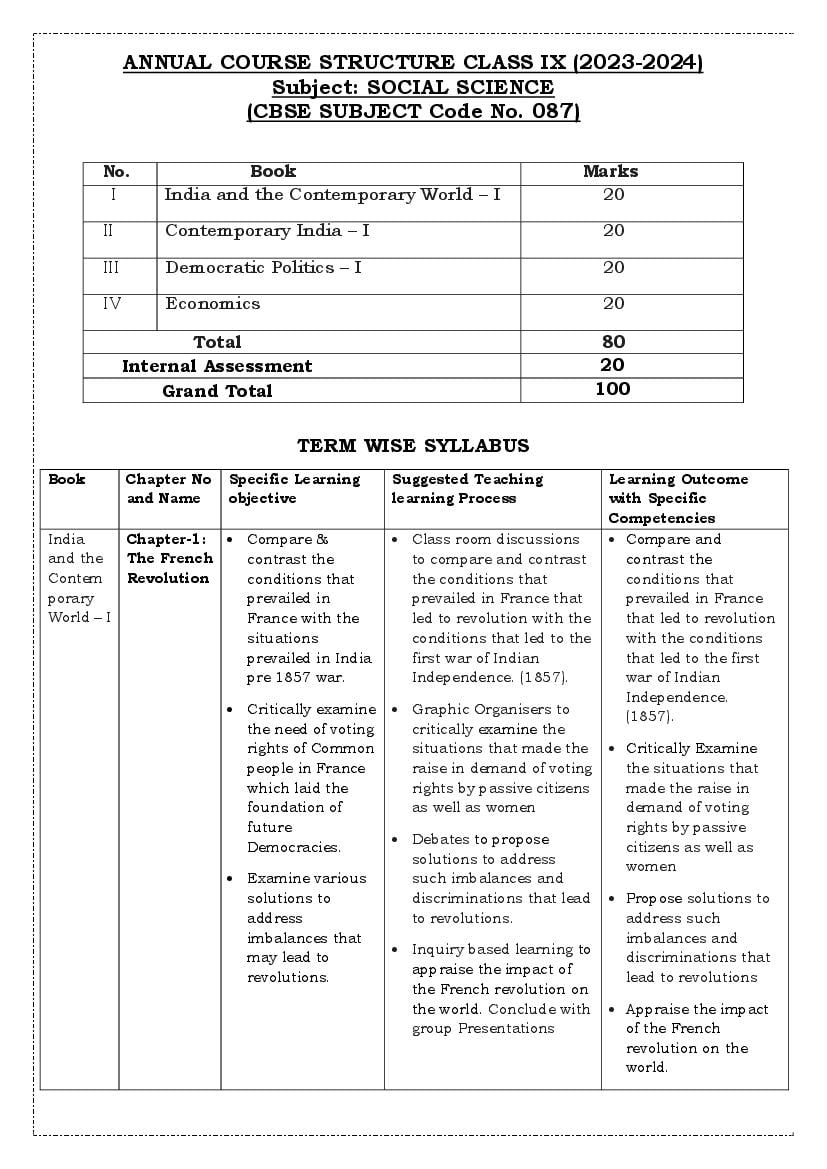
Subject: SOCIAL SCIENCE
(CBSE SUBJECT Code No. 087)
No. Book Marks
I India and the Contemporary World – I 20
II Contemporary India – I 20
III Democratic Politics – I 20
IV Economics 20
Total 80
Internal Assessment 20
Grand Total 100
TERM WISE SYLLABUS
Book Chapter No Specific Learning Suggested Teaching Learning Outcome
and Name objective learning Process with Specific
Competencies
India Chapter-1: Compare & Class room discussions Compare and
and the The French contrast the to compare and contrast contrast the
Contem Revolution conditions that the conditions that conditions that
porary prevailed in prevailed in France that prevailed in France
World – I France with the led to revolution with the that led to revolution
situations conditions that led to the with the conditions
prevailed in India first war of Indian that led to the first
pre 1857 war. Independence. (1857). war of Indian
Independence.
Critically examine Graphic Organisers to
(1857).
the need of voting critically examine the
rights of Common situations that made the Critically Examine
people in France raise in demand of voting the situations that
which laid the rights by passive citizens made the raise in
foundation of as well as women demand of voting
future rights by passive
Debates to propose
Democracies. citizens as well as
solutions to address
women
Examine various such imbalances and
solutions to discriminations that lead Propose solutions to
address to revolutions. address such
imbalances that imbalances and
Inquiry based learning to
may lead to discriminations that
appraise the impact of
revolutions. lead to revolutions
the French revolution on
the world. Conclude with Appraise the impact
group Presentations of the French
revolution on the
world.
Page 2
and the Pastoralist situations that graphic organizers to contrast the lives of
Contem s in the have created compare and contrast Pastoralists pre &
porary Modern Nomadic society. the lives of Pastoralists post colonialism.
World – I world pre & post colonialism.
(To be Draw Analyse the
assessed in comparisons of Art integration to depict situations that have
Periodic African the evolution of nomadic created Nomadic
Assessmen pastoralists and society. society.
t only) Indian
Research based Compare and
Pastoralists
presentations using contrast the lives and
during colonial
resources provided to the reasons for
rule.
compare and contrast poverty of pastoral
Examine the how the lives and the reasons nomads of India with
the colonial laws for poverty of pastoral African Pastoral
impacted nomads of India with Nomadic tribes.
livelihood in African Pastoral Nomadic
Analyse and infer
pastoral tribes.
varying patterns of
communities.
Think- Pair- Share and developments within
Appraise the summarize the reading of pastoral societies in
contribution of resources to analyse and different places in
Pastoralists in the infer varying patterns of India.
modern economy. developments within
Analyse the impact of
pastoral societies in
colonialism on forest
different places in India.
societies leading to
scientific forestry.
Enumerate the
different processes
through which
transformation of
livelihood occur in
the modern world.
Democra Chapter-1: Examine the World café and Café Compare and
tic What is concept conversations strategies Contrast working of
Politics – Democracy /structural for introduction of democracies of India
I ? Why components of concepts of Democracy & and North Korea and
Democracy
Democracy and features of Democracy. infer on their
?
its forms/ differences and
4 corners strategy to
features in significance in each
discuss “What & why of
different country.
democracy?
countries.
Define Democracy
Students create
Examine and and enumerate its
democratic governance
analyse the features.
model in the class.
working structure
Evaluate the
of the Cartoon interpretation to
authenticity of the
governments of summarize the benefits
voting rights of the
India and North of democracy.
Indian population
Korea
versus the
population of Iran.
Page 3
on the different statement
historical processes “Democracy provides
and forces that have a method to deal with
contributed for the differences and
promotion of conflicts” with
democracy. reference to India.
Summarize the
features and benefits
of democracy.
Democra Chapter-2: Comprehend the Group Discussion to Analyse the
tic Constitutio purpose of comprehend the purpose difference between
Politics – nal Design constitution. of constitution. written or unwritten
I constitutions with
Enumerate the Poster making/ wall
reference to India
essential features magazine for Comparing
and USA.
that need to be and contrasting between
kept in mind Preamble of South Describe the
while drafting any African constitutions situation that led to
constitution. with the preamble of creation of Indian
Indian constitution. Constitution.
Examine the
guiding values Role play strategy for Compare and
that created the creation of Indian contrast between
Indian constitution. Preamble of South
constitution. African constitutions
Declamation strategy for
with the preamble of
Comprehend the roles and responsibilities
Indian constitution.
roles and of citizens
responsibilities as Enumerate the roles
citizens of India. and responsibilities
as citizens of India
Contem Chapter-1: Examine how the Use GeoGebra, Google Justify the reasons
porary India - Size location of an earth to represent and for the differences in
India – I and area impacts its justify the reasons for climatic conditions,
Location climate and time the differences in local and standard
with reference to climatic conditions, local time.
longitude and and standard time.
To infer how the
latitude.
Carousel brainstorming conditions and
Explore and strategy for inferring relationships of the
analyze the conditions and people living in states
trading and relationships of the that are sharing
cultural people living in states border with the
relationships of that are sharing border neighbouring
India with its with the neighbouring countries impact
neighbouring countries impact trade trade and culture.
countries. and culture.
Justify the selection
Evaluate the (Link for Carousel Brain of 82.5E* longitude
situation & storming Strategy as Time meridian of
reasons that India (IST).
https://www.youtube.com
made 82.5E*
/watch?v=zZxaS7v1-jo) Critically analyse the
role of opening of
Page 4
meridian of India. improvement of
foreign trade.
Examine how
location of India Propose alternative
enables its solution for the
position as a On map of India problems that arise
strategic partner hypothetically design two due to the size &
in the to four alternate location.
subcontinent. longitudes on either side
of 82.5*E and conclude
on the selection.
Draw out the rationale/
reasons behind fixing
(82.5E) as a time
meridian for India.
PPT presentation to
present alternate
solutions
Contem Chapter-2: Justify why India Use Art integrated Conclude why India
porary Physical is a sub- strategies like gallery is a subcontinent
India – I Features of continent. walk/Model making to based on study of
India demonstrate how different physical
Examine the
physical features make features.
geological process
India a sub-continent.
that played a Analyse the
crucial role in the Role play to depict the conditions and
formation of lives and relationships relationships of the
diverse physical amongst physiographic people living in
features in India. areas. different
physiographic areas.
Analyse the Collaborative
conditions and brainstorming and Enumerate the
relationships of presentation using different
the people living different modes such as environmental issues
in different flipped books, Journals, in India and propose
physiographic Collage and other solutions for these
areas. suitable presentations. issues
Examine various
environmental
issues.
Contem Chapter-3: Justify the Choice Board strategy Enlist the different
porary Drainage statement that where each group to take rivers, the areas they
India – I the rivers are up one river and focus serve and their
lifeline of on the areas they serve impact on the
economy with and the impact on economy of that area.
reference to India. Economy of that area.
Enumerate the
Examine the Students will prepare a different lakes and
information about PPT on lakes. describe their
different lakes contribution to the
Street play strategy/
and infer on their Indian ecology.
poster making/ save
Page 5
Indian ecology. awareness on water solutions to
pollution and suggest overcome the water
Distinguish
solutions. pollution also to
between the
increase the
rivers of north
contribution of water
and south India.
bodies to Indian
Analyse the flow economy.
of different rivers
Identify the river
of India to infer
systems of the
on their impact
country and explain
on livelihood.
the role of rivers in
human society.
Economi Chapter-1: Evaluate the Visit a nearest village, Analyse and infer
cs The Story prevailing farming interview a farmer/ visit how the prevailing
of Village conditions in local markets and farming conditions
Palampur different states interview farmers and impact economic
with reasons. present it in the class. development of
(To be
(Experiential learning different states.
assessed in Examine the
strategy).
Periodic factors of Enlist the
Assessmen production and Poster making/ Concept requirements of
t only) interdependence map and gallery walk to production and
of the enlist the requirements summarize the
requirements. of production and interdependence of
summarize the these requirements.
Examine the
interdependence of these
contribution of Enlist non-farm
requirements.
non-farm activities and depict
activities to the Present a business plan the link with
economic growth for non-farm activities by economic growth.
of the village. using the four factors of
production.
Economi Chapter-2: Examine the Case study on quality of Analyse and infer the
cs People as various factors population. (Class room reasons that
Resource that constitute discussion). contribute to the
the quality of quality of population.
Collect sources from
population.
Newspaper/ Media and Enumerate the
Analyse the role present the findings in different schemes of
of government in the form of a collage or Government in some
improving the an album. states and infer on
quality of the quality of people
Neighbourhood survey
population. there by.
on employment
Examine the /employability in Propose solutions to
factors that neighbourhood, analyse resolve
contribute to the quality of unemployment
unemployment. neighbourhood and problem
present in PPT format.
Note: Above mentioned Syllabus is to be completed by 15th September 2023.
Revision of syllabus for Mid Term Examination.
Mid Term Exam
Page 6
and Name objective learning Process with Specific
Competencies
India Chapter-2: Analyse the Interactive Textual To compare and
and the Socialism situations that interpretations to contrast the
Contem in Europe led to the rise of compare and contrast situations that led to
porary and the Russian and the situations that led to the rise of Russian&
World – I Russian French the rise of Russia & French Revolutions
Revolution revolutions. French Revolutions.
Cite the impact of
Evaluate the Student led seminar to Collaboration and
reasons that led cite the impact of communication
to the rise of Collaboration and rendered by the
Lenin’s communication rendered philosophers and
communism and by the philosophers and leaders in creating
Marxist leaders in creating awareness amongst
Socialism. awareness amongst the the common people.
common people.
Evaluate the
World café’ strategy to situations that
evaluate the situations enabled Lenin’s
that enabled Lenin’s Communism.
Communism.
Interpret the different
Socratic Discussions to ideas of philosophers
Interpret the different and leaders that
ideas of philosophers shaped the
and leaders that shaped revolution.
the revolution
India Chapter-3: Analyse the Watch Video clipping Cite the events that
and the Nazism manipulated from the last days of helped Hitler’s rise to
Contem and the control of Adolf Hitler and discuss power.
porary Rise of situations led by the reasons for rise and
World – I Hitler Evaluate various
an individual. fall of Hitler.
character traits of
Analyse the role Dramatize the Nazi Hitler.
of the “Treaty of Propaganda/ racial
Compare and
Versailles in that discrimination against
contrast the
led to the rise of Jews.
characteristics of
Hitler.
Cartoon interpretation/ Bismarck and Hitler.
Examine the Image interpretation.
Analyse the role of
circumstances
Read passages from “Treaty of Versailles
that led to the
“Dairy of Anne frank in the rise of Nazism
rise and fall of
“and other related and Hitler.
Hitler
literature and discuss
Critique the
Discuss the the impact of Nazism.
genocidal war waged
critical
Jig saw strategy to against Jews by the
significance of
critique the genocidal Nazis.
Nazism in
war waged against Jews
shaping the Discuss the critical
by the Nazis
politics of the significance of
modern world. Nazism in shaping
Page 7
compensation modern world.
compelled on
Germany in the
name of the
“treaty of
Versailles led to
the rise of Hitler.
Compare and
contrast the Nazi
ideology with
fascism of
Mussolini.
India Chapter-4: Inter Refer Annexure II Refer Annexure II
and the Forest Disciplinary
Contem Society Project with
porary and Chapter 5 of
World – I Colonialis Geography
m “Natural
Vegetation and
Wild Life
Democra Chapter-3: Comprehend the Role play/ have school Evaluate the role of
tic Electoral concept and council elections. political parties to
Politics – Politics system of adhere to electoral
I Design and present
elections. promises.
election manifesto.
Evaluate the Create a solution for
Create multiple parties
conditions that eradication of
and create symbols for
make Elections in malpractices in
elections.
India democratic. elections.
Use street play to create
Analyse the Differentiate between
awareness about the
implications of representative
right to vote.
power of vote and democracy and
power of recall. competitive party
politics.
Appraise the role
of election Summarize the
commission for essential features of
the conduct of the Indian Electoral
free and fair system.
elections.
Examine the
rationale for adopting
the present Indian
Electoral System.
Democra Chapter-4: Examine the Watch videos of Analyse and infer
tic Working of roles, Parliament and discuss how the three organs
Politics – Institution responsibilities the importance of are interdependent
I s and question hour. and independent to
interdependency execute their roles.
Present Moot court to
of all the 3 organs
evaluate the rule of Law.
Page 8
Government. case studies to evaluate evaluate the rule of
the rule of law. law in India.
Examine the rule
of law in India Present Mock Parliament Represent the role of
and its relevance. session to convert a bill Parliament and its
into law. procedures.
Understand the
power and Conduct a mock Distinguish between
working of Indian interview with a political and
Judiciary system parliamentarian. permanent executive
and comprehend authorities and
the hierarchy Role play on features of
functions.
system of the the political and
judiciary in India. permanent executive Understand the
parliamentary system
of executive’s
accountability to the
legislature.
Understand the
working of Indian
Judiciary.
Democra Chapter-5: Comprehend Declamation on need to Analyse the need of
tic Democrati what it is to be a have rights and the having rights and
Politics – c Rights responsible importance of performing categorize the rights.
I citizen while duties.
Evaluate the
performing their
Debate the need to have statement
prescribed duties
rights in the light of “Democracy is
versus claiming
study of Saudi Arabia. meaningless without
rights.
rights”.
Case study to analyse
Evaluate the role
the role of citizens when Analyse their role as
of rights in
the rights are exercised responsible citizens.
Democracy.
or otherwise.
Summarize the
6 thinking hats to flipped coexistence of
discuss the current rights versus duties.
issues.
Apply the process
Organize a moot court to available to citizens
discuss the violation of for safeguarding
individual rights. rights
Graphic organizer to
summarize the
coexistence of rights vs
duties.
Contem Chapter-4: Examine and Collect and Read the Infer how the factors
porary Climate analyse the Weather reports and determine the
India – I factors that have a class room climate of India.
determine the discussion to conclude
Analyse and infer the
climate of India. about the factors
effect of monsoon
controlling climate
Discuss the winds on rainfall of
mechanisms of
Page 9
Indian summarize the findings subcontinent.
subcontinent.
Use Mind map/ graphic Analyse the
Analyse and infer organizers to Enumerate temperatures
the reasons and summarize the between plateau
behind the wide reasons for the wide region, Himalayan
difference difference between the region, desert region
between day and day and night and coastal region.
night temperatures at different
Enumerate and
temperatures at geographical locations of
summarize the
different India.
reasons for the wide
geographical
locations of India. Read Newspapers, difference between
prepare and present temperatures at
To interpret how mock drills on protocols different geographical
monsoon acts as as preventive action for locations of India.
a Unifying bond. various disasters.
Propose protocols as
preventive action for
various disasters.
Contem Chapter-5: Inter Refer annexure II Refer annexure II
porary Natural disciplinary
India – I Vegetation project with
and Wild chapter no IV of
life History “Forest,
Society and
(Only Map
Colonialism”
Points)
Contem Chapter-6: Examine the Research based Analyse and infer the
porary Population reasons behind learning/ art integration reasons behind the
India – I the uneven strategy (4 grid analysis) uneven distribution
distribution of to analyse and infer the of population in India
population in reasons behind the with specification to
India with uneven distribution of UP & Rajasthan and
specification to population in India with Mizoram and
UP & Rajasthan specification to UP & Karnataka.
and Mizoram Rajasthan and Mizoram
Enlist the factors
and Karnataka. and Karnataka
that affect the
population density.
Economi Chapter-3: Comprehend that PPT presentation using Analyse and infer the
cs Poverty as poverty is a case study given in reasons of poverty in
a multifaceted NCERT text on the the rural and urban
Challenge concept inherent reasons of rural and areas.
in the rural and urban poverty.
Evaluate the efficacy
urban conditions.
Declamation with data to of government to
Examine the evaluate the efficacy of eradicate poverty.
measures taken government to eradicate
Compare how poverty
by the poverty.
estimates have
government to
Debate whether transformed from
eradicate poverty.
education can remove 1993-94 to 2011-12
poverty Examine the link
Page 10
and poverty.
Economi Chapter-4: Examine the Case study and group Enumerate various
cs Food critical role of discussion to aspects of food
Security in food security for substantiate the link security that will
India its masses. between a well- ensure continuity of
structured food security supply to the
Justify the
system and continuity of masses.
rationale for the
supply to masses.
system of food Examine, analyse
security in India. Invite relevant Govt. and infer various
officials to speak on FSI sources of data that
Appraise the
& PDS. point to the rationale
contributory role
of FSI.
of Public Panel discussion/
Distribution seminar on the impact of Enumerate different
system to address the green revolution and features of PDS that
FSI. PDS. directly address FSI.
Substantiate the Analyse and infer the
role of green impact of Green
revolution in revolution in
strengthening the strengthening the
PDS. PDS.
Note:
Above mentioned Syllabus is to be completed by 31 January 2024.
Revision of Syllabus for Annual Examination.
Whole syllabus will be evaluated in Annual Examination.
Annual Exam 2024
Page 11
SUBJECT – HISTORY (2 Marks)
Chapter-1: The French Revolution
Outline Map of France locate/ label/ identify;
Bordeaux
Nantes
Paris
Marseilles
Chapter-2: Socialism in Europe and the Russian Revolution
Outline Political Map of World locate/ label/ identify;
Major countries of First World War
Central Powers - Germany, Austria-Hungary, Turkey (Ottoman Empire)
Allied Powers - France, England, Russia, and U.S.A.
SUBJECT – GEOGRAPHY (3 Marks)
Chapter -1: India-Size and Location
India-States with Capitals, Tropic of Cancer,
Standard Meridian (Location and Labelling)
Neighbouring Countries
Chapter -2: Physical Features of India
Mountain Ranges: The Karakoram, The Zasker, The Shivalik, The Aravali,
The Vindhya, The Satpura, Western & Eastern Ghats
Mountain Peaks – K2, Kanchan Junga, Anai Mudi
Plateau - Deccan Plateau, Chotta Nagpur Plateau, Malwa Plateau
Coastal Plains - Konkan, Malabar, Coromandal & Northern Circar (Location and
Labelling)
Chapter -3: Drainage
Rivers: (Identification only)
The Himalayan River Systems-The Indus, The Ganges, and The Satluj
The Peninsular rivers-The Narmada, The Tapi, The Kaveri, The Krishna, The Godavari,
The Mahanadi
Lakes: Wular, Pulicat, Sambhar, Chilika
Chapter - 4: Climate
Annual rainfall in India, Monsoon wind directions
Chapter - 6: Population
Population density of all states.
The state having highest and lowest density of population.
Page 12
Weightage to Type of Questions
Sr. Marks
Types of Questions Percentage
No. (80)
1 Mark MCQs (20x1)
1 (Inclusive Of Assertion, Reason, Differentiation 20 25%
&Stem)
2 Marks Narrative Questions (4x2)
2 (Knowledge,Understanding,Application,Analysi 8 10%
s,Evaluation,Synthesis & Create)
3 Marks Narrative Questions (5x3)
3 (Knowledge,Understanding,Application,Analysis, 18.75%
15
Evaluation,Synthesis & Create)
4 MARKS Case Study Questions (3x4)
4 (Knowledge,Understanding,Application,Analysis, 12 15%
Evaluation,Synthesis & Create)
5. Mark Narrative Questions (4x5)
5 (Knowledge,Understanding,Application,Analysis, 20 25%
Evaluation,Synthesis & Create)
6 Map Skills 5 6.25%
Total 80 100
Weightage to Competency Levels
Sr. Competencies Marks Percentage
No. (80)
1 Remembering and Understanding: Exhibiting memory of 24 30%
previously learned material by recalling facts, terms, basic
concepts, and answers; Demonstrating understanding of facts
and ideas by organizing, translating, interpreting, giving
descriptions and stating main ideas.
2 Applying: Solving problems to new situations by applying 11 13.25%
acquiredknowledge, facts, techniques and rules in a different
way.
3 Formulating, Analysing, Evaluating and Creating: 40 50%
Examining and breaking information into parts by identifying
motives or causes; Making inferences and finding evidence to
support generalizations; Presenting and defending opinions by
making judgments about information, validity of ideas, or
quality of work basedon a set of criteria;
Compiling information together in a different way by combining
elements in a new pattern or proposing alternative solutions.
4 Map Skill 5 6.25%
Total 80 100
Page 13
PROJECT WORK CLASS IX (2023-24)
Project Work 10 Periods
Every student has to compulsorily undertake one project on Competencies to develop;
Disaster Management The students need;
Objectives: The main objectives of giving project work on Disaster Collaboration
Management are to: Use analytical skills
Create awareness in them about different disasters, their Evaluate the
consequences and management. situations during
Prepare them in advance to face such situations disasters.
Ensure their participation in disaster mitigation plans. Synthesize the
Enable them to create awareness and preparedness among information
the community. Find creative
The project work should also help in enhancing the Life solutions
Skills of the students. Strategies the order
If possible, various forms of art may be integrated in the of solutions
project work. Use right
communication skills
Guidelines:
In order to realize the expected objectives completely, it would be required of the principals/
teachers to muster support from various local authorities and organizations like the Disaster
Management Authorities, Relief, Rehabilitation and the Disaster Management Departments of
the States, Office of the District Magistrate/ Deputy Commissioners, Fire Service, Police, Civil
Defence etc. in the area where the schools are located.
1) The distribution of marks over different rubrics relating to Project Work is as follows:
S. No. Rubrics Marks
a Content accuracy, originality and 2
Collaborative skills
b Competencies exhibited and 2
Presentation
c Viva Voce 1
2) The project carried out by the students should subsequently be shared among themselves
through interactive sessions such as exhibitions, panel discussions, etc.
3) All documents pertaining to assessment under this activity should be meticulously
maintained by the schools.
4) A Summary Report should be prepared highlighting:
● Objectives realized through individual work and group interactions;
● Calendar of activities;
● Innovative ideas generated in the process; list of questions asked in viva voce.
5) It is to be noted here by all the teachers and students that the projects and models prepared
should be made from eco-friendly products without incurring too much expenditure.
6) The Project Report can be handwritten or digital.
7) The Project Work needs to enhance cognitive, affective and psychomotor skills of the learners.
It will include self-assessment and peer assessment, and progress of the child in project-based
and inquiry-based learning, art integrated activities, experiments, models, quizzes, role plays,
group work, portfolios, etc., along with teacher assessment. (NEP-2020).
8) The Project work can culminate in the form of Power Point Presentation/ Exhibition/ Skit/
albums/ files/ song and dance or culture show/story telling/ debate/ panel discussion/ paper
presentation and whichever is suitable to Visually Impaired Candidates.
9) The record of the project work (internal assessment) should be kept for a period of three
months for verification, if any.
Page 14
Interdisciplinary Project of class IX
10 periods M.M: 05
Subject Name of Specific learning Suggested Learning Time
Name the objectives Teaching Learning outcome with Schedule
and chapter Process specific for
Chapter competencies Completio
No. n
History Forest To categorize Interdisciplinary Compare the The
Chapter- Society different types project forest Schools
4 and of forest during Teachers can situations to do IDP
Coloniali the colonial make use of the prevailed at between
sm regime. pedagogies in pre- colonial, the
To bring out facilitating the colonial and months
the plight of students in post- colonial of April
Forest dwellers completion of era. and
under colonial Inter Analyse and Septemb
rule. Disciplinary evaluate the er at the
To examine the Project growth &role School
reason behind Constructivism. of commercial under
commercial Inquiry based forestry in the
forestry. learning different types guidance
To devise ways Cooperative of Vegetation. of
to protect the learning Critically teacher.
forest Research based analyse the (Carryove
vegetation and learning. reasons for r of
wildlife in Experiential rebellions at project to
India. learning. forest areas of home
To defend the Art integration south East- must be
role of Asia with strictly
Geograp Natural government Multiple specification to avoided)
hy Vegetatio and the local Assessment: JAVA.
Chapter n and communities in Ex. Surveys /
-5 Wildlife protecting the Interviews /
forest cover. Research work/
To discuss the Observation/ Story
social and based
cultural world Presentation/ Art
of forest integration/ Quiz/
communities Debate/ role play/
through the viva, /group
study of discussion, /visual
specific revolts. expression/
To analyse the interactive bulletin
different boards/ gallery
processes walks/ exit cards/
through which concept maps/ peer
agrarian assessment/ art
transformation integration /Self-
may world. assessment/integra
To understand tion of technology
how oral etc.
traditions can
be used to
explore tribal
revolts
Page 15
It involves combining 2 or more disciplines into one activity-more coherent and integrated.
The generally recognized disciplines are economics, History, Geography, Political Science,
A sample plan has been enclosed. Kindly access the link given below
https://docs.google.com/document/d/1668TKkRt80r4-kbjJ_Y7zg4mF3Vq1Y9k/edit
or
Instructions:
Objectives and Outcomes need to be picked from Rationale and Specific Objectives
considering the local context.
Plan of the project:
A suggestive 10 days’ plan given below which you may follow or you can create on your
own, based on the templates provided below
Process:
Initial collaboration among students to arrange their roles, areas of integration, area of
investigation and analysis, roles of students:
Team leader: Main collaborator
Team members:
Note: Teacher to allocate the roles as per the abilities of the students.
Final submission based on course deliverables as given in the template below the 10-day
plan.
Assessment Plan: to be done by the teacher clearly mentioning the Rubrics.
Report, poster and video acknowledgements: reflections & expression of gratitude as given
in the template given below.
Page 16
Day 1-2: "Colonialism and Forest Society"
Discuss the impact of colonialism on forest societies, and explore the concept of forest as a
resource in colonialism.
Group project: Research and present a PPT on the colonial forest policy and its impact on
forest societies.
Day 3-4: "Rebellion in the Forest"
Analyse the causes and effects of forest-based rebellions in history
Watch the following film Group discuss about forest tribes of your state and the exploitations
they face. Refer Annexure VI for Rubrics.
https://www.youtube.com/watch?v=N6SR0REa_YA
Or
Day 5-6: Forest Transformations in Java, Tropical Evergreen Forests
Examine the impact of human activity on forests in Java.
Explore how changes in land use, agriculture, and industry have impacted the forests.
Students can research the history of forest transformations in Java and their impact on the
environment.
Study the transformation of forests in Java, from pre-colonial to post-colonial times
Compare and contrast the conversion of forest into agricultural land and the need.
Through group discussions find solutions. Present an art integrated project.
Discuss the characteristics of tropical evergreen forests, including their climate, soil, and
flora/fauna. Students can research specific examples of tropical evergreen forests and the
challenges they face, such as deforestation and climate change.
Group project: watch the video through the link:
https://www.youtube.com/watch?v=Ml0xvHsBigI
Or
Analyse and present the impact of forest transformations on society, economy and
environment in Java. Compare and contrast it with India.
Present a PPT of your learnings. Refer Annexure VI for rubrics
Day 7-8: Discuss how colonialism has affected the forest's biodiversity and the survival of
indigenous communities living in and around the forest.
Group activity: Divide the group into smaller teams and assign them tasks related to
identifying the impact of colonialism on different types of forests. For example, one team can
research the impact of colonialism on forest fires, while another team can research the impact
of colonialism on the survival of indigenous plants and animals. Make the students use
cartoon strips to present their findings.
Day 9-10: Make the students to compile all the findings of 8 days’ work and present in PPT
and through the template given in Annexure V.
Page 17
Presentation Template by the students - Class IX & X
Name of the Student:
Member of Team:
Class and Section: Date of Submission:
Topics of IDP:
Title of the Project:
Objective:
Multiple Assessment:
Ex. Surveys / Interviews / Research work/ Observation/ Story based Presentation/ Art
integration/ Quiz/ Debate/ role play/ viva,/group discussion,/visual expression/
interactive bulletin boards/ gallery walks/ exit cards/ concept maps/ peer assessment/
Self-assessment/integration of technology etc.
Evidences: Photos, Excerpts from Interviews, observations, Videos, Research References,
etc.
Overall presentation: Link of PPT, shared documents, can be digital/handwritten, as per
the convenience of the school
Acknowledgement:
References (websites, books, newspaper etc):
Reflections:
ANNEXURE VI
Rubrics Marks allocated
Research Work 1
Collaboration & Communication 1
Presentation & Content relevance 1
Competencies- 2
● Creativity
● Analytical skills
● Evaluation
● Synthesizing
Total 5
Note: The Schools may give multiple sub rubrics and may bring it down to 5 marks for
weightage.
Ex: Collaboration: Teamwork/ Language fluency/ Contribution to the team/resilience
etc.
Research Work: Investigation/ reading & comprehending/ compilation etc.
Synthesizing: - Data collection/ Data collation etc.
Document Details
| Board / Org | Delhi Board |
| Exam | Class 9 |
| Type | Syllabus |
| Pages | 10 |
| Updated | 22 Jul 2026 |