SEBA Class 9 Syllabus 2024 Maths
Finished viewing? Save it for later —
Download SEBA Class 9 Syllabus 2024 Maths (PDF · 14 pages)About SEBA Class 9 Syllabus 2024 Maths
SEBA Class 9 Syllabus 2024 Maths is available here for free download. Published by Assam Board for Class 9, this syllabus can be viewed online or downloaded as a PDF (14 pages). Candidates preparing for Class 9 can use SEBA Class 9 Syllabus 2024 Maths to understand the exam pattern, the type of questions asked, and the overall difficulty level.
Frequently Asked Questions
How can I download SEBA Class 9 Syllabus 2024 Maths?
Open this page and click the Download button to save SEBA Class 9 Syllabus 2024 Maths as a PDF. It is completely free on AglaSem Docs.
Is SEBA Class 9 Syllabus 2024 Maths free to download?
Yes. SEBA Class 9 Syllabus 2024 Maths can be viewed online and downloaded as a PDF free of cost on AglaSem Docs.
How many pages does SEBA Class 9 Syllabus 2024 Maths have?
SEBA Class 9 Syllabus 2024 Maths contains 14 pages, which you can read online or download together as a single PDF.
Where can I find more Class 9 study material?
You can find more Class 9 question papers, sample papers, syllabus, and answer keys on AglaSem Docs.
SEBA Class 9 Syllabus 2024 Maths – Text
Read the full text of this syllabus below — useful to quickly search, copy and reference the content online without downloading the PDF.
📄 View text version (14 pages)
Page 1
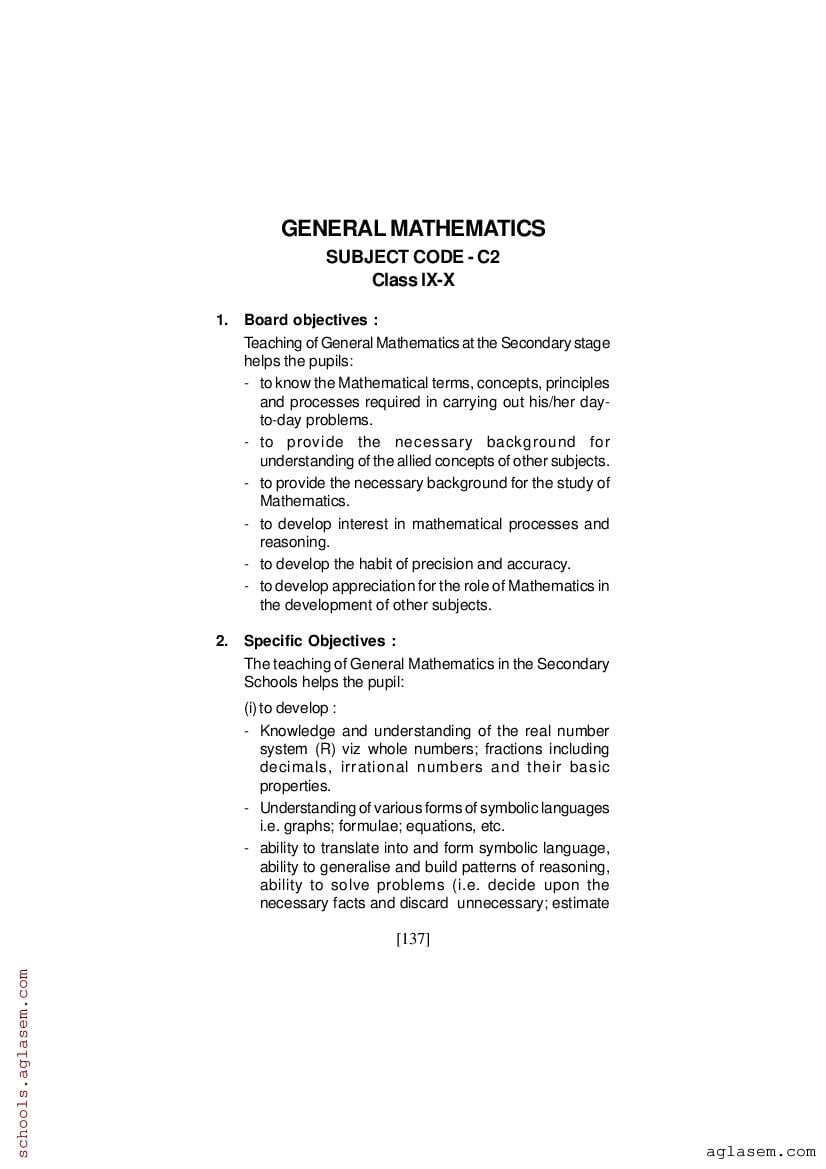
SUBJECT CODE - C2
Class IX-X
1. Board objectives :
Teaching of General Mathematics at the Secondary stage
helps the pupils:
- to know the Mathematical terms, concepts, principles
and processes required in carrying out his/her day-
to-day problems.
- to provide the necessary background for
understanding of the allied concepts of other subjects.
- to provide the necessary background for the study of
Mathematics.
- to develop interest in mathematical processes and
reasoning.
- to develop the habit of precision and accuracy.
- to develop appreciation for the role of Mathematics in
the development of other subjects.
2. Specific Objectives :
The teaching of General Mathematics in the Secondary
Schools helps the pupil:
(i) to develop :
- Knowledge and understanding of the real number
system (R) viz whole numbers; fractions including
decimals, irrational numbers and their basic
properties.
- Understanding of various forms of symbolic languages
i.e. graphs; formulae; equations, etc.
- ability to translate into and form symbolic language,
ability to generalise and build patterns of reasoning,
ability to solve problems (i.e. decide upon the
necessary facts and discard unnecessary; estimate
[137]
Page 2
method and check results).
(ii) To develop the following qualities :
- an attitude of checking computations,
- systematic representation of arguments.
- power of observation and generalisation.
- doing calculations systematically and speedily.
(iii) To develop an appreciation of the contribution of
mathematics to life and to the development of other
subjects.
(iv) To develop the knowledge, understanding and
applications of the acquired knowledge, practical
works to be done.
(v) To develop the interest with the help of activity.
Mathematics laboratory works :
Mathematics laboratory is a room wherein we find
collection of different kinds of materials and teaching/
learning aids, needed for learning and students
understand the concepts through relevent, meaningful
and concrete activities. The year-end assessment of
activities and project work will be done during the
session. The following parameters may be kept in mind
for the same:
a) Internal examination may be organised as per the
convenience of the schools.
b) Every student may be asked to perform two given
activities (which are to be selected from the textbook)
during the allotted time. Special care may be taken
in choosing these two activities to ensure that the
students are not put to any kind of stress due to time
constraint.
C) Appendix
1: Profs in Mathematics.
[138]
Page 3
These two chapters are very important to develop
students’ power of reasoning and understanding of
mathematical logic. These two areas should be included in
practical mathematics. These are to be discussed in the
periods dedicated to practical mathematics, i.e. once in a
week.
General Guidelines : for Class-IX-X
1. All concepts/identities must be illustrated by situational
examples.
2. The language of ‘Word problems’ must be clear, simple,
and unambiguous.
3. All proofs to be produced in a non-didactic manner,
allowing the learner to see flow of reason. Wherever
possible give more than one proof.
4. Motivate most results. Prove explicitly those where a
short and clear argument reingorces mathematical
thanking and reasoning. There must be emphasis on
correct way of expressing their arguments.
5. The reason for doing ruler and compass construction is
to motivate and illustrate logical argument and reasoning.
All constructions must include an analysis of the
construction, and proof for the steps taken to do the
required construction must be given.
marks distribution on practicals/project works
Internal Assessment for Classes IX & X
1) Practicals 7
2) Project 3
Total 10
[139]
Page 4
Units :
I. Number Systems
II. Algebra
III. Coordinate Geometry
IV. Geometry
V. Mensuration
VI. Statistics and Probability
Appendix :
1. Proofs in Mathematics,
2. Introduction to Mathematical Modelling.
Number System
1. Real Numbers : (Periods 20)
Review of representation of natural number, integers,
rational numbers on the number line. Representation of
terminating/non-terminating recurring decimals, on the
number line through successive magnification. Rational
numbers as recurring/terminating decimals.
Examples of non-recurring/non-terminating decimals
such as 2 , 3 , 5 etc. Existence of non-rational
numbers (irrational numbers) such as 2 , 3 and their
representation on the number line. Explaining that every
real number is represented by a unique point on the
number line, and conversely, every point on the number
line represents a unique real number.
Existence of x for a given positive real number x
(visual proof to be emphasized). Definition of nth root of
real number.
Recall of laws of exponents with integral powers.
Rational exponents with positive real bases (to be done
[140]
Page 5
general laws.)
Rationalisation (with precise meaning) of real number
of the type (and their combinations)
1
and x y where x and y are natural
numbers and a, b are integers.
Algebra
2. Polynomials (Periods 25)
Definition of a polynomial in one variable, its coefficients,
with examples and counter examples, its terms, zero
polyonimal. Degree of a polynomial. constant, linear,
quadratic, cubic polynomials; monomials, binomials,
trinomials. Factors and multiples. Zeros/roots of a
polynomial/equation. State and motivate the ‘Remainder
Theorem with examples and 1 analogy to integers.
Statement and proof aof bthex Factor Theorem.
Factorisation of ax 2 bx c, a 0 , where a, b, c are real
numbers, and of cubic polynomials using the Factor
Theorem.
Recall of algebraic expressions and identities.
Further identities of the type:
(x y z)2 x2 y2 z2 2xy2yz2zx,(x y)3 x3 y3 3xy(x y),
x3 y 3 x3 3xyz ( x y z )(x 2 y 2 z 2 xy yz zx)
and their use in factorization of polynomials. Simple
expressions reducible to these polynomials.
3. Co-ordinate Geometry (Periods 9)
The Cartesian plane, coordinates of a point, names and
terms associated with the coordinate plane, notations,
plotting points in the plane, graph of linear equations as
[141]
Page 6
ax by c 0 by writing it as y mx c and linking with
the chapter on linear equations in two variables,
4. Linear Equations in Two Variables (periods 12)
Recall of linear equations in one variable. Introduction to
the equation in two variables. Prove that a linear equation
in two variables has infinitely many solutions, and justify
their being written as ordered pairs of real numbers,
plotting them and showing that they seem to lie on a
line. Examples, problems from real life, including
problems on Ratio and Proportion and with algebraic
and graphical solutions being done simultaneously.
Geometry :
1. Introduction to Euclid’s Geometry [Not from
examination point of view] (Periods 6)
History-Euclid and geometry in India. Euclid’s method
of formalizing observed phenomenon into rigorous
mathematics with definitions, common/obvious notions,
axioms/postulates and theorems. The five postulates
of Euclid. Equivalent versions of the fifth postualate.
Showing the relationship between axiom and theorem.
1. Given two distinct points, there exists one and one
only one line through them.
2. (Prove) Two distinct lines cannot have more than
one point in common.
2. Lines and Angles (Periods 10)
i) (Motivate) If a ray stands on a line, then the sum of the
two adjacent angles so formed is 1800 and the converse.
ii) (Prove) If two lines intersect, the vertically opposite
angles are equal.
iii) (Motivate) Results on corresponding angles, alternate
angles, interior angles when a transversal intersects
two parallel lines.
[142]
Page 7
are parallel.
v) (Prove) The sum of the angles of a triangle is 1800.
vi) (Motivate) If a side of a triangle is produced, the
exterior angle so formed is equal to the sum of the
two remote interior angles.
3. Triangles (Periods 20)
i) (Motivate) Two triangles are congruent if any two
sides and the included angle of one triangle is equal
to any two sides and the included angle of the other
triangle (SAS Congruence).
ii) (Prove) Two triangles are congruent if any two angles
and the included side of one triangle is equal to any
two angles and the included side of the other triangle
(ASA Congruence).
iii) (Motivate) Two triangles are congruent if the three
sides of one triangle are equal to three sides of the
other triangle (SSS Congruence)
iv) (Motivate) Two right triangles are congruent if the
hypotenuse and a side of one triangle are equal
(respectively) to the hypotenuse and a side of the
other triangle.
v) (Prove) The angles opposite to equal sides of a
triangle are equal.
vi) (Motivate) The sides opposite to equal angles of a
triangle are equal.
vii) (Motivate) Triangle inequalities and relation between
‘angle and facing side; inequalities in a triangle.
4. Quadrilaterals : (Periods 10)
i) (Prove) The diagonal divides a parallelogram into two
congruent triangles.
ii) (Motivate) In a parallelogram opposite angles are
equal and conversely.
iii) (Motivate) In a parallelogram opposite sides are equal
[143]
Page 8
iv) (Motivate) A quadrilateral is a parallelogram if a pair
of its oppsite sides is parallel and equal.
v) (Motivate) In a parallelogram, the diagonals bisect
each other and conversely.
vi) (Motivate) In a triangle, the line segment joining the
mid points of any two sides is parallel to the third
side and (motivate) its converse.
5. Area : (Period 4)
Review concept of area, recall area of a rectangle.
i) (Prove) Parallelograms on the same base and
between the same parallels have the same area.
ii) (Motivate) Triangles on the same base and between
the same parallels are equal in area and its converse.
6. Circle : (Period 15)
Through examples, arrive at definitions of circle. related
concepts, radius, circumference, diameter, chord, arc,
subtended angle.
i) (Prove) Equal chords of a circle subtend equal angles
at the centre and (motivate) its converse.
ii) (Motivate) The perpendicular from the centre of a
circle to a chord bisects the chord and conversely,
the line drawn through the centre of a circle to bisect
a chold is perpendicular to the chord.
iii) (Motivate) There is one and only one circle passing
through three given non-collinear points.
iv) (Motivate) Equal chords of a circle (or of congruent
circles) are equidistant from the centre (s) and
conversely.
v) (Prove) The angle subtended by an arc at the centre
is double the angle subtended by it at any point on
the remaining part of the circle.
vi) (Motivate) Angles in the same segment of a circle
[144]
Page 9
vii) (Motivate) If a line segment joining two points
subtends equal angle at two different points lying on
the same side of the line containing the segment,
the four points lie on a circle.
viii) (Motivate) The sum of the either pair of the opposite
angles of a cyclic quadrilateral is 1800 and its converse.
7. Constructions : (Period 10)
i) Construction of bisectors of a line segment and
angle, 600, 900, 450 etc, equilateral triangles.
ii) Construction of a triangle given its base, sum/
difference of the other two sides and one base angle.
iii) Construction of a triangle of given perimeter and
base angles.
Mensuration
8. Areas :
i) Surface Areas and Volumes : (Periods 4)
Area of a triangles using Heron’s formula (without
proof) and its application in finding the area of a
quarilateral.
ii) Surface Areas and Volumes : (Periods 10)
Surface areas and volumes of cubes, cuboids,
spheres (including hemispheres) and right circular
cylinders/cones.
Statistics and Probability
1. Statistics : (Periods 13)
Introduction to Statistics : Collection of data,
Presentation of data-tabular form, ungrouped/
grouped, frequency polygons, qualitative analysis of
data to choose the correct form of presentation for the
correct data. Mean median, mode of ungrouped data.
[145]
Page 10
History, Repeated experiments and observed
frequency approach to probability. Focus is on
empirical probability. (A long period of time to be
devoted to group and to individual activities to
motivate the concept; the experiments to be drawn
from real-life situations, and from examples used in
the chapter on statistics).
Appendix
1. Proof in Mathematics :
What a statement is; when is a statement
mathematically valid. Explanation of axiom/
postulates through familiar examples. Difference
beteen axiom, conjecture and theorem. the concept
and nature of a ‘proof’ (emphasize deductive nature
of the proof, the writing of a proof. Illustrate deductive
proof with complete arguments using simple results
from arithmetic, algebra and geometry (e.g., product
of two odd numbers is odd etc.) Particular stress on
verification not being proof. Illustrate with a few
examples of verifications leading to wrong
conclusions-include statements like “every odd
number greater than 1 is a prime number”.What
does disproving mean, use of counter examples.
2. Introduction to Mathematical modelling :
The concept of mathematical modelling, review of
work done in earlier classes while looking at
situational problems, aims of mathematical
modelling, discussing the broad stages of modelling
in real life situations, setting up of hypothesis,
determining an appropriate model, solving the
mathematical problem equivalent, analyzing the
conclusions and their real-life interpretation,
validating the model. Examples to be drawn from
ratio, proportion, percentages, etc.
[146]
Page 11
FOR CLASS-IX
1. Draw the Square Spiral
2. Locate the following irrational numbers on the Number
line
(ii ) 2 3
(iii ) 3 2 (iv ) 4 3
(v ) 2 3 (vi) 3 2
(vii ) 2 3 (viii) 3 2
3. Represent 7.9 on the Number line.
4. The relation betwen the two scales of temperature in
Fahrenheit and Celsius is given by the following
equation:
9
F C 32, where F represents Fahrenheit and C
5 (i ) 3 2
represents Celsius.
Draw the graph of this equation and answer the
following question with the help of the graph.
(i) If the temperature is 300C, what is the temperature
in Fehrenheit?
(ii) If the temperature is 950F, what is the temperature
in Celsius?
(iii) If the temperature is 00C, what is the temperature
in Fahrenheit and if the temperature is 00F, what is
the temperature in Celsius?
(iv) At what point temperature in Fahrenheit and Celcius
scale are numerically equal?
5. Verify all the properties of parallel lines related to various
types of angles formed by a transversal with the parallel
lines?
[147]
Page 12
7. Verification of angle sum property of quadrilateral.
Verification of the following two theorems.
8. Angles opposite to equal sides of an isoceles triangle
are equal.
9. The sides opposite to equal angles of a triangle are
equal.
10. If two sides of a triangle are unequal, the angle opposite
to the longer side is larger (or greater)
11. In any triangle the side opposite to the larger (greater)
angle is longer.
12. A diagonal of a parallelogram divides it into two
congruent triangles.
13. In a parallelogram opposite sides are equal.
14. In a parallelogram, opposite angles are equal.
15. The diagonals of a parallelogram bisect each other.
16. If the diagonals of a quadrilateral bisect each other, then
it is a parallelogram.
17. If the diagonals of a quadrilateral bisect each other, then
it is a parallelogram.
18. The line segment joining the mid points of two sides of
a triangle is parallel to the third side.
19. Parallelograms on the same base and between the
same parallels have equal area.
20. If the angles subtended by the chords of a circle at the
centre are equal, then the chords are equal in length.
21. The perpendicular from the centre of a circle to a chord,
bisects the chord.
22. The line drawn through the centre of a circle to bisect a
chord is perpendicular to the chord.
23. There is one and only one circle passing through three
given non-collinear points.
24. Equal chords of a circle (or of congruent circles) are
equidistant from the centre (or centres)
[148]
Page 13
in length.
26. The angle subtended by an arc at the centre is double
the angle subtended by it at any point on the remaining
part of the circle.
27. Angles in the same segment of a circle are equal.
28. The sum of either pair of opposite angles of a cyclic
quardriateral is 1800
29. Verification of Heron’s Formula for area of triangle.
30. Construct a cuboid and verify the formula of its surface
area.
31. Construct a cube and verify the formula of its surface
area.
32. Construct a frequency distribution table showing
cummulative frequency of certain data collected by
yourself practically and draw the histogram and
frequency polygon. (This practical should be
compulsory)
33. Find the probability of getting head and tail from the
experiment of tossing a coin practically. (students should
toss the coin at least hundred times)
34. Project : (1) Write a brief history on Euclid’s Geometry.
(2) Write about the discoveries/invensions of 3/4 great
mathematicians.
Important Note :
N.B. - Students should do at least 15 practicals and at
least one project work.
[149]
Page 14
GENERAL MATHEMATICS
Subject Code : C2
Class : IX Time : 3 hours
Full Marks : 100 Pass Marks : 30
Theory : 90
Internal Assessment : 10
Pass marks in written examination : 27
Chapter Units Units Marks
Chapter Name Half Annual
No. Required Omitted
Yearly
Revision Chapter Part I Part II 10 8
1. Number System Whole chapter Nil 10 7
2. Polynomials Whole chapter Nil 15 10
3. Coordinate Geometry Whole chapter Nil 10 5
4. Linear Equations in two Whole chapter Nil 10 5
variables
5.
6.
*Lines and Angles Nil
Whole chapter Nil
Whole chapter ––
10
––
4
7. Triangles Upto unit 7.5 Unit 7.6 12 6
(i.e. Upto onwards
Exercise 7.3)
8. Quadrilaterals Whole chapter Nil 13 6
9. Areas of Parallelograms and Upto unit 9.3 Unit 9.4 –– 6
Triangles (i.e. Upto onwards
Exercise 9.2)
10. Circles Whole chapter Nil –– 8
11. Constructions Whole chapter Nil –– 4
12. Heron’s Formula Whole chapter Nil –– 4
13. Surface Area and Volume Whole chapter Nil –– 8
14. Statistics Upto Unit 14.4 Unit 14.5 –– 6
(Upto Exercise 14.3) onwards
15. Probability Whole chapter Nil –– 3
Theory Total 90
Internal Assessment 10
Grand Total 100
*N.B.: Chapter 5 is excluded from the syllabus.
Textbook : Mathematics (for class IX), published by ASTPPCL
[150]
Document Details
| Board / Org | Assam Board |
| Exam | Class 9 |
| Type | Syllabus |
| Pages | 14 |
| Updated | 22 Jul 2026 |