SEBA Class 9 Syllabus 2024 Science
Finished viewing? Save it for later —
Download SEBA Class 9 Syllabus 2024 Science (PDF · 19 pages)About SEBA Class 9 Syllabus 2024 Science
SEBA Class 9 Syllabus 2024 Science is available here for free download. Published by Assam Board for Class 9, this syllabus can be viewed online or downloaded as a PDF (19 pages). Candidates preparing for Class 9 can use SEBA Class 9 Syllabus 2024 Science to understand the exam pattern, the type of questions asked, and the overall difficulty level.
Frequently Asked Questions
How can I download SEBA Class 9 Syllabus 2024 Science?
Open this page and click the Download button to save SEBA Class 9 Syllabus 2024 Science as a PDF. It is completely free on AglaSem Docs.
Is SEBA Class 9 Syllabus 2024 Science free to download?
Yes. SEBA Class 9 Syllabus 2024 Science can be viewed online and downloaded as a PDF free of cost on AglaSem Docs.
How many pages does SEBA Class 9 Syllabus 2024 Science have?
SEBA Class 9 Syllabus 2024 Science contains 19 pages, which you can read online or download together as a single PDF.
Where can I find more Class 9 study material?
You can find more Class 9 question papers, sample papers, syllabus, and answer keys on AglaSem Docs.
SEBA Class 9 Syllabus 2024 Science – Text
Read the full text of this syllabus below — useful to quickly search, copy and reference the content online without downloading the PDF.
📄 View text version (19 pages)
Page 1
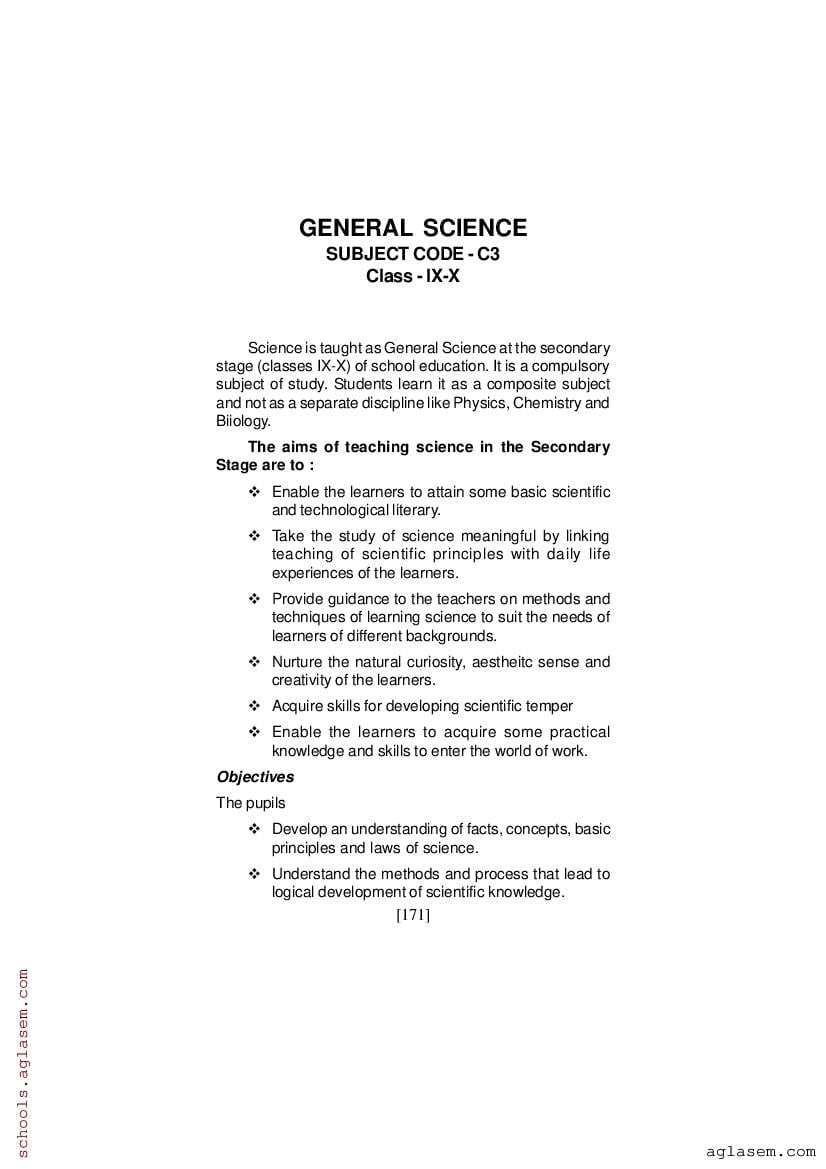
SUBJECT CODE - C3
Class - IX-X
Science is taught as General Science at the secondary
stage (classes IX-X) of school education. It is a compulsory
subject of study. Students learn it as a composite subject
and not as a separate discipline like Physics, Chemistry and
Biiology.
The aims of teaching science in the Secondary
Stage are to :
Enable the learners to attain some basic scientific
and technological literary.
Take the study of science meaningful by linking
teaching of scientific principles with daily life
experiences of the learners.
Provide guidance to the teachers on methods and
techniques of learning science to suit the needs of
learners of different backgrounds.
Nurture the natural curiosity, aestheitc sense and
creativity of the learners.
Acquire skills for developing scientific temper
Enable the learners to acquire some practical
knowledge and skills to enter the world of work.
Objectives
The pupils
Develop an understanding of facts, concepts, basic
principles and laws of science.
Understand the methods and process that lead to
logical development of scientific knowledge.
[171]
Page 2
to solve problems related to daily life.
Learn about the application of technology in daily
life and understand the principles on which they work.
Learn the techniques, skills and methods of exploring
the environment and enrich their experience.
Learn to observe, collect data, take measurements,
formulate hypotheses, perform simple experiments
and comunicate scientifically.
Recongnize the relationship of science, technology
and society.
Recognize the relationship of science, technology
and society.
Develop a scientific attitude and inculcate qualities
like open-mindedness, honesty, integrity, co-
operation, love and concern for life and environment.
Learn to think critically.
Learn to infer and interpret facts, principles and
experiments.
Acquire the skill to solve simple problems based on
scientific relations.
Learn to do experimentation.
Participate in co-curricular activites like doing
projects to solve problems related to agriculture, health,
nutrition, protection and preservation of environment etc.
Cultivate the habit of reading scientific journals,
papers reports.
Develop problem solving and decision making skills.
The Board has adopted the NCERT science syllabi
for Secondary stage w.e.f. the academic session
2013.
[172]
Page 3
2005. In the words of NCERT.
“The exercise of revising the syllabus for science and
technology has been carried out with ‘Learning without
burden’ as a guiding light and the position papers of the
National Focus Groups as points of reference. The aim is to
make the syllabus an enabling document for the creation of
textbooks that are interesting and challenging without being
loaded with factual information.
The themes chosen for class IX-X are : Food; Materials;
The world of the living; How things work; Moving things;
People and ideas; Natural phenomena and Natural
resources. However the theme ‘food has been excluded in
class X.
The syllabus is presented in four columns : Questions,
Key concepts, Resources and Activites/Process.
The questions lead to delve into the themes/subthemes.
In the process the key concepts emerge. The resource and
activity/process column guides the teachers to meaningful
classroom transaction.
Evaluation :
Assessment of learning is to be done by the process of
continuous and comprehensive evaluation and periiodic
evaluation (half yearly and annual examination, preparatory
examination.) Assessment of learning is to be done
continously hand in hand with the process of teaching. This
gives a feedback to the teachers to plan strategies for
meaningful teaching and learning in the classroom. The
areas of evaluation are assessment of knowledge, application
of knowledge, understanding of concepts, skill in solving
simple numerical problems and drawing. Regular remedial
teaching is to be imparted to ensure desirable level of learning
of the students.
[173]
Page 4
Experimentation is an integral part in science education.
The board has made an endeavour to make students learn
science in a joyful manner through simple activites.
Experimentation (Practical) has a weightage of 10%.
The is School based assessment i.e. Internal assessment.
Experimental activites :
There are three categories of experiments/activities.
A. Teacher’s activity : These have to be demostrated
by the teacher in the laboratory.
B. Student’s activity : These include simple
experiments/activites (from which one is allotted to student
in examination on the lottery system). The students shall
perform the experiment and write the procedure and results/
conclusion methodically. The minimum number of
experiments a students will perform is 3 (covering one each
from Phyisics and Chemistry and 1 from Botany or Zoology)
The experiments/activity will cary 6 marks. This 6 marks will
be distributed in the following way :
I. Performance in examination -3 marks :
For this item any experiment either from Physics or
Chemistry or Biology will be selected by the students and
perform.
II. Practical record book - 3 marks :
C. Activities relating to model/project preparation,
specimen collection etc. For this type of activities the
teacher will engage students to develop models of
instruments/ideas to prepare science projects based on
the facts of their own observations/practical experiences/
field experience/ideas, to prepare charts depicting the life
process/ to colect speciments (plants and animals). The
teachers will entrust the students for this kind of activities at
least six months before their final examination. The students
[174]
Page 5
commencement of final examination. This item will carry 4
marks.
Evaluation :
Evaluation will be school based. (Internal Assessment)
1. For experiments under category A, the teacher while
demonstating the experiments will ask studens
relevant questions and will evalute the student out
of a total weightage of 2 in eah demonstration. The
marks for each student will found by calculating the
average mark.
2. (i) For experiments under category B, students will
be evaluated on their performance out of a total
weightage 3.
The 3 marks will be distributed as follows : (i) Theory/
Principle : 1 mark, Experiment and result : 2 marks,
Total : 3 marks.
(ii) The students are required to maintain a neat well
recorded practical book. Marks on the record book
is 3.
3. Students will prepare charts/models. The total marks
is 2.
[175]
Page 6
Class - IX
List of Experiments (Class - IX)
Sl. No. BIOLOGY
1. Demostration of different parts of one Dicot and one
Monocot plant.
2. Identification of plants
3. Morphological study of Honey bee/Ant/Fish/Spider/Mollusca
4. Charts on : (i) Animal Cell
(ii) Plant cell.
(iii) Types of tissues.
(iv) List of three bacterial and two
protozoal diseases with their
symptoms.
PHYSICS :
1. To determine valocity and acceletration of a moving body.
2. To Verify Newton’s Second Law of Motion.
3. To Study variation of Potential Energy with height.
4. To measure temperature of liquid at various state in
Celsius and Fahrenheit scale.
CHEMISTRY :
1. To prepare sulphide from iron filings and sulphur power
and to observe the changes in the properties on the
consituent elements as they combine to form the
compund.
3. To separate the components from mixture of (a) sand
and ammonium chloride (b) Common salt and sand.
4. To Study the extent of cooling caused by evaporation on
(i) Water (ii) Ethanol (alcohol) (iii) Ether.
5. To determine the Boiling point of water.
[176]
Page 7
BIOLOGY :
1. Freshly collected paddy plant with roots, stem and leaves intact.
2. White drawing sheet.
3. Eraser
4. Scale
5. Freshly collected mustard plant with roots, stem and
leaves intact.
6. Specimen of (i) Basket, grass, (ii) Bermuda grass, (iii)
Honey bee (worker) (iv) Termite (worker), (v) Butterfly,
(vi) Fish, (vii) Spider, (viii) Mollusca
PHYSICS :
1. A small rubber or marble
2. Two small wooden blocks or match-boxes
3. A foot scale
4. A small toy car
5. A few long paper strips
6. Paper clips
7. An inclined plane
8. A timer cup
9. Thread
10. Wire
11. Colored solution or ink
12. A few coins
13. A spring balance
14. Flour paste
15. A stone (Small size)
16. Cellotape
17. Scissors
18. A support with a hook and scale
19. A glass breaker
20. Thermometer
[177]
Page 8
22. Tripod stand
23. Water
24. Spirit burner
25. Wire holder
CHEMISTRY :
1. Porcelain basin
2. Tripod stand
3. Iron fillings
4. Sulphur powder
5. Carbon disulphide
6. Bar or horse shoe magnet
7. Test tubes (3 nos)
8. Beakes (3 nos)
9. Funnel
10. Filter paper
11. Bottle of distilled water
12. Lemon, salt/sugar
13. Sand
14. Starch or egg albumin
15. Spirit lamp
16. Wire gauze
17. Stirrer (glass rod)
18. Ammonium Chloride
19. Cotton
20. Water
21. Ethanol or rectified spirit
22. Ether
23. Thermometer
24. Petridish
25. Stopwatch
26. Pipette/syringe
27. Spring balance
[178]
Page 9
Teaching Points and activities
Theme/Sub-theme Questions Key concepts Resources Activities/Processes
1. Food What do we do to get higher yields Plant and animal breeding and Visit to any fish/bee/dairy/ Collection of weeds found in fileds
Higher yields in our farms? selection for quality improvement, pig etc. farms; data showing of different crops; collection of
use of fertilizers, manures; harmful effects of diseased crops; discussion and
protection from pests and insecticides; process for the studying composing/
diseases; organic farming. preparation of compost, vermicomposing.
vermicompost. (periods 8)
[182]
Work done in class-VII;
2. Materials What kinds of clothes help us to Cooling by evaporation. glassware, heat source, Experiments to show cooling by
Material in our keep cool? Absorption of heat. black paper, thermo- meters. evaporation. Experiments to show
clothing Why do wet clothes feel cool? that the white objects get less hot.
(periods 5)
Everyday substances like To feel the texture, observe the
Dfferent kinds of In what way are materials All things occupy space, possess wood, salt, paper, ice, steel, colour and lustre, effect of air, water
materials different from each other? Is there mass. water, etc. and heat, etc. on each of the
some similarity in materials? Definition of matter. materials.
(periods 4)
Page 10
Theme/Sub-theme Questions Key concepts Resources Activities/Processes
In how many ways can you Solid, liquid and gas; Wax, water, ice, oil, suger, Sorting out a medley of materials,
group the different materials you characteristics-shape, volume, camphor/ammonium chloride/ in various ways, Observe shape
see around? How do solids, density, change of state-melting, naphthalene. and physical state of different
liquids and gases differ from each freezing. materials.
other?
Can materials exist in all the three Evaporation, condensation, Observe effect of heat on each
states? sublimation. of the resources. (Teacher to
perform the experiment for
What are things around you made Elements, compounds and Samples of commonly available
camphor, ammonium chloride
of ? mixtures.Heterogeneous and elements, compounds and
and naphthalene.)
What are things made What are the various types of homogeneous mixtures. mixtures. Samples of solution,
[183]
(periods 4)
of ? chemical substances? Colloids and suspensions. suspension and colloid.
Discussion on claims ‘Air is a mixture’
(Mixture of what? How can these
Do substances combine in a Equivalence-that x grams of A is Historical accounts.
be separated?), ‘Water is compound’
difinite manner? chemically not equal to x grams Glassware, chemicals (oxalic acid,
and ‘Oxygen is an element’.
of B. sodium hydroxide, magnesium ribbon.)
Titration using droppers or syringes,
How do things combine with Particle nature, basic units; Kits for making molecular
quantitative experiments
each other? atoms and molecules. models.
Discussion on the fact that elements
Are there any patterns which can Law of constant proportions, Historical account including combine in a fixed proportion.
help us to guess how things will Atomic and molecular masses. experiments of Lavoisier and Through discussion on chemical
combine with each other ? Priestly. formulae of familiar compounds.
Page 11
Theme/Sub-theme Questions Key concepts Resources Activities/Processes
How do chemists weith and Mole concept. Simple numericals to be done
count particles of matter? Relationship of mole to mass of by the students.
the particles and numbers. A game for writing formulae. e.g.
Valency. criss crossing of valencies to be
Chemical formulae of common taught through dividing students
compounds. into pairs. Each student to hold
two playcards: one with the
symbol and the other with the
valency. Keeping symbols in
place, teacher to move only
valencies to form the formula of
[184]
a compound.
What is there inside an Can we see an atom or a Atoms are made up of smaller Charts, films etc. Brief historical account of
atom? molecule under a microscope or particles: electrons, protons, and Rutherford’s experiment.
by some other means? neutrons. (Periods 18)
What is there inside an atom? These smaller particles are
present in all the atoms but their
numbers vary in different atoms.
Isotopes and isobars.
Page 12
Theme/Sub-theme Questions Key concepts Resources Activities/Processes
3. The world of the How do the various plants Diversity of plants and animals- Specimens of some animals, Discussion on Diversity and the
living around us differ from each basic issues in scientific and plants not easily characteristics associated with
Biological Diversity other? How are they similar? naming. Basis of classification, observable around you. any group.
What about animals? How Hierarchy of categories/groups, (Periods 14)
are they similar to and Major groups of plants (salient
features) (Bacteria, Thallophyta,
different from each other?
Bryophyta, Pteridophyta,
Gymnosperms and
Angiosperms.) Major groups
of animals (salient features)
What is the Living being made What are we made up of? (Non-chordates up to phyla and
up of? What are the different parts of
[185]
chordates classes.)
our body? What is the
smallest living unit? Cell as a basic unit of life, Permanent slides, model of Observation of model of human
Prokaryotic and eukaryotic the human body. body to learn about levels of
cells, multicellular organisms; organization-tissue, organ,
cell membrane and cell wall, system, and organism,
cell organelles; chloroplast, observe blood smears (frog and
mitochondria, vacuoles, ER, human), cheek cell, onion peel
Golgi Apparatus; nucleus,
cell, Spirogyra, Hydrila leaves
chromosomes-basic structure,
number. Tissues, organs, organ (cyclosis.)
systems, organism, (Periods 12)
Page 13
Theme/Sub-theme Questions Key concepts Resources Activities/Processes
Structure and functions of animal
and plant tissues (four types in
animals; meristematic and
permanent tissues in plants.)
How do we fall sick? What are the various causes of Health and its failure. Disease Newspaper Surveying neighbourhood to
artricles,
diseases? How can diseases be and its causes, Diseases collect information on disease
information from health centres,
prevented? How can we remain caused by microbes and their occurence pattern. Studying the
photographs of various causal
healthy? prevention-Typhiod, diarrhoea, life cycle of the mosquito and
organisms. Photographs,
malaria, hepatitis, rabies, AIDS, malarial parasite. Discussion on
permanent slides of bacteria.
[186]
TB, polio; pulse polio how malaria is spread, how to
programme. prevent mosquito breeding.
(Periods 10)
How do substance How do food and water move Diffusion/exchange of sub- Egg membrane, Rhoeo Looking at closed and open
move from cell to cell? from cell to cell? How do gases stances between cells and their leaves, sugar, stomata, plasmolysis in Rhoeo
get into the cells? What are the evnironment, and between the microscope, slides. leaf peels.
substance that living organisms cells themselves in the living (Periods 15)
exchange with the external system; role in nutrition, water
world? How do they obtain these and food transport, excretion,
substances? gaseous exchange.
Page 14
Theme/Sub-theme Questions Key concepts Resources Activities/Processes
4. Moving Things, Motion-displacement, velocity; Analysis of motion of different
People and Ideas uniform and non uniform motion common objects. Drawing
Motion How do we describe along a straight line, accelecration, distance time and velocity time
motion? distance-time and velocity-time graphs for uniform motion and
graphs for uniform and uniformly uniformly accelerated motion.
accelerated motion, equation of (Periods 12)
motion by graphical method;
elementary idea of uniform circular
motion.
[187]
Force and Newton’s What makes things change Force and Motion, Newton’s laws Historical accounts; Demonstrating the effect of force
Laws their state of motion ? of motion: Interia of a body, interia Experinences, from daily life; on the state of motion of objects
mass, momentum, force and wooden and glass boards, sand, in a variety of daily-life
acceleration. Elementary idea of balls; wooden support, some situations. Demonstrate the
conservation of momentum, action coins (say of Rs. 2 or Rs. 5) change in direction of motion of
and reaction forces. tumbler; balloons etc. an object by applying force.
(Periods 10)
Gravitation What makes things fall? Gravitation : Universal law of Spring balance Analysis of motion of ball falling
gravition, down.
Page 15
Theme/Sub-theme Questions Key concepts Resources Activities/Processes
Force of gravitation of the earth and of ball thrown up.
(gravity), acceleration due to measuring mass and weight by
Do all things fall in the same gravity; mass and weight;free a spring balance.
way? fall. (Periods 7)
Work energy and How do we measure work Work done by a force, energy Rope(or string), board or plank, Experiments on body rolling
power done in moving anything? How power; kinetic and potential wooden block, ball, arrow, down inclined plane pushing
does falling water make a mill energy;law of conservation of bamboo stick, spring, etc. another body.
[188]
run? energy. Experiments with pendulum.
Experiments with spring.
Discussion.
(Periods 6)
Floating bodies How does a boat float on water? Thrust and pressure. Cycle pump; board pins, bulletin Experiments with floating and
Archimedes’ principle, board, mug, bucket, water etc. sinking objects.
buoyancy, elementary idea at (Periods 4)
relative density.
Page 16
Theme/Sub-theme Questions Key concepts Resources Activities/Processes
How do we hear from a How does sound travel? Nature of sound and its propa- String, ball or stone as bob, water Experiment on reflection of
distance? What kind of sounds can gation in various media, speed tank, stick, slinky, rope, echo sound.
we hear? of sound, range of hearing in tube, rubber pipe etc. (Periods 10)
What is an echo? humans, ultrasound, reflection of
How do we hear? sound, echo and sonar, Structure
of the human ear ( auditory Model or chart showing structure
aspect only) of human ear.
[189]
Page 17
Theme/Sub-theme Questions Key concepts Resources Activities/Processes
5. How things work
6. Natural
Phenomena
7. Natural Resources
Balance in Nature Why do air, water and soil, Physical resources: air, water, Daily newspapers, Case studies of actual situation
seem not to be consumed? soil, air for respiration, for magazines and other reading in India with more generalised
How does the presence of air combustion, for moderarting materials. Weather reports overview of inter relationship
support life on earth? How temperatures, movements of over a few months and air of air, water, soils, forests.
[190]
have human activities created air and role in bringing rains quality reports over the same Debates on these issues
disturbances in the across India. time period. Case study using resources mentioned
atmosphere? Air, water and soil pollution material. alongside, visit to/from an
How does nature work to (brief introduction.) environment NGO;
maintain balance of its Holes in ozone layer and the discusssion.
components? probable damages. Bio-geo (Periods 15)
chemical cycles in nature;
water, oxygen, carbon,
nitrogen.
Page 18
Subject Code : C3
Class : IX Time : 3 hours
Full Marks : 100 Pass Marks : 30
Theory : 90
Internal Assessment : 10
Pass marks in written examination : 27
Marks
Sl. No. Chapters Half
Annual
Yearly
1. Matter in our surroundings 8 5
2. Is matter arround us pure 8 5
3. Atoms and molecules 6
4. Structure of the atom 6
5. The fundamental unit of life 12 5
6. Tissues 12 6
7. Diversity in living organisms 7
8. Motion 12 7
9. Force and Laws of Motion 12 8
10. Gravitation 10 7
11. Work and energy 7
12. Sound 6
13. Why do we fall ill 8 5
14. Natural resources 8 5
15. Improvement in Food resources 5
Total (Theory) 90 90
[191]
Page 19
Marks - 10
Marks
Sl. No. CHAPTERS Half
Annual
Yearly
1. Category A : Teacher’s activity- 2
(Teacher will evaluate the
students as he/she
demonstrates)
2. Category B : Student’s activity-
Activity 3
Practical record book 3
3. Category C : Chart/Model/ 2
Speciment Collection
Total 10 10
Grand Total : 100 100
Textbook : Science (for Class IX), published by The
Assam State Textbook Production and
Publication Corporation Ltd. Guwahati-1
[192]
Document Details
| Board / Org | Assam Board |
| Exam | Class 9 |
| Type | Syllabus |
| Pages | 19 |
| Updated | 22 Jul 2026 |