SEBA Class 9 Syllabus 2024 Social Science
Finished viewing? Save it for later —
Download SEBA Class 9 Syllabus 2024 Social Science (PDF · 27 pages)About SEBA Class 9 Syllabus 2024 Social Science
SEBA Class 9 Syllabus 2024 Social Science is available here for free download. Published by Assam Board for Class 9, this syllabus can be viewed online or downloaded as a PDF (27 pages). Candidates preparing for Class 9 can use SEBA Class 9 Syllabus 2024 Social Science to understand the exam pattern, the type of questions asked, and the overall difficulty level.
Frequently Asked Questions
How can I download SEBA Class 9 Syllabus 2024 Social Science?
Open this page and click the Download button to save SEBA Class 9 Syllabus 2024 Social Science as a PDF. It is completely free on AglaSem Docs.
Is SEBA Class 9 Syllabus 2024 Social Science free to download?
Yes. SEBA Class 9 Syllabus 2024 Social Science can be viewed online and downloaded as a PDF free of cost on AglaSem Docs.
How many pages does SEBA Class 9 Syllabus 2024 Social Science have?
SEBA Class 9 Syllabus 2024 Social Science contains 27 pages, which you can read online or download together as a single PDF.
Where can I find more Class 9 study material?
You can find more Class 9 question papers, sample papers, syllabus, and answer keys on AglaSem Docs.
SEBA Class 9 Syllabus 2024 Social Science – Text
Read the full text of this syllabus below — useful to quickly search, copy and reference the content online without downloading the PDF.
📄 View text version (27 pages)
Page 1
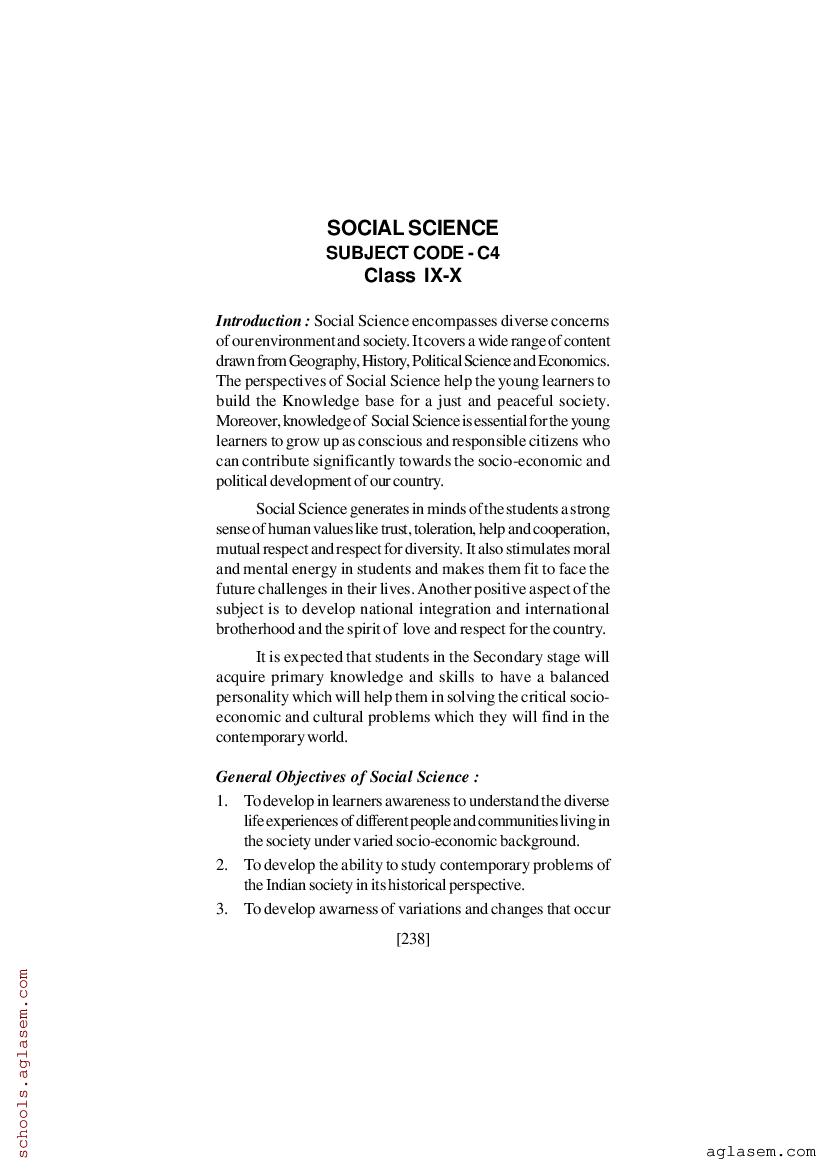
SUBJECT CODE - C4
Class IX-X
Introduction : Social Science encompasses diverse concerns
of our environment and society. It covers a wide range of content
drawn from Geography, History, Political Science and Economics.
The perspectives of Social Science help the young learners to
build the Knowledge base for a just and peaceful society.
Moreover, knowledge of Social Science is essential for the young
learners to grow up as conscious and responsible citizens who
can contribute significantly towards the socio-economic and
political development of our country.
Social Science generates in minds of the students a strong
sense of human values like trust, toleration, help and cooperation,
mutual respect and respect for diversity. It also stimulates moral
and mental energy in students and makes them fit to face the
future challenges in their lives. Another positive aspect of the
subject is to develop national integration and international
brotherhood and the spirit of love and respect for the country.
It is expected that students in the Secondary stage will
acquire primary knowledge and skills to have a balanced
personality which will help them in solving the critical socio-
economic and cultural problems which they will find in the
contemporary world.
General Objectives of Social Science :
1. To develop in learners awareness to understand the diverse
life experiences of different people and communities living in
the society under varied socio-economic background.
2. To develop the ability to study contemporary problems of
the Indian society in its historical perspective.
3. To develop awarness of variations and changes that occur
[238]
Page 2
4. To develop skills and attitude essential for good citizens so
that they can contribute in nation building as well as in social
development.
5. To strengthen national integration in its proper perspective
establishing linkages of regional History and Geography with
national History and Geography.
6. To develop understanding in learners that contribute to build
a society based on values of peace, love, equality and
secularism.
7. To appreciate that dignity of individuals and respect for
Human Rights constitute the basis of a democratic social life
and these are essential for the development of our society
and the nation.
8. To recognize the role of India for promoting peace and
international understanding and to develop the spirit of
international cooperation.
Special Objectives :
History :
1. To promote understanding in leaners about the political,
socio-economic and cultural life of the people of India since
the rule of the Mughals.
2. To develop the ability to study contemporary problems of
the Indian society in its historical perspective.
3. To acquaint the learners with the sources of acquiring
knowledge of History and to create awareness among them
to preserve historical monuments, archaeological sites,
artifacts, literary and oral sources.
4. To know about the political development of Assam, its
relationship with India and her contribution to India’s
Freedom Movement.
5. To develop appreciation on the growth of various
[239]
Page 3
achievements of Indian people in different parts of the
country.
6. To promote understanding about the cultural heritage of India
and the North East.
Geography :
1. To acquaint the learners with diverse natural and social
environment sequentially at local, regional and global levels.
2. To acquaint the learners with the interdependence of various
regions/states in terms of resource, population, transport and
communication etc.
3. To develop in learners the skill of map reading and map
drawing which will encorage them to draw maps, sketches
etc. as per requirement.
4. To help the learners in acquiring understanding about the
existing and emerging development of environment in their
natural and social settings.
5. To inculcate in the minds of the learners a sense of
belongingness to the elements of nature and man-made
environments and their conservation.
Political Science :
1. To foster an urge among learners for effective participation
in community affairs.
2. To acquaint the students with the functioning of various
political institutions at the Centre and the States.
3. To help the pupils in realising the importance of Human Right
and Consumers’ Rights.
4. To help the learners in appreciating the role and contribution
of India and the UNO in promoting world peace.
[240]
Page 4
1. To acquaint the students with those elementary concepts of
Economics which are related to the understanding of the
day-to-day ecnomic activities and current economic
problems.
2. To introduce the students with various economic activities
undertaken by the people in their geographical and social
environment.
3. To acquaint the learners with the preliminary knowledge of
Economic Planning in the context of the national as well as
state economy.
4. To enable the learners to understand the main economic
challenges faced by the people and the country and goverment
endeavours for their solution.
Distributions of marks and periods alloted to each of
the four components of History, Geography Political
Science and Economics :
Components Marks Periods
History 35% 70
Geography 35% 70
Political Science 10% 20
Economics 10% 20
Internal Assessment 10% --
(Environmental Project)
Total marks/periods 100 180
[241]
Page 5
Subject Code – C4, Class IX
CHAPTER / CONTENTS COMPETENCY SUB-COMPETENCY SPECIAL
UNIT INSTRUCTIONS
1 A. Indian History To know the structure of the Government, To understand about the Act of 1858. To start the chapter with
Constitution and Legislative system, local self government key points of
To get acquainted with the structure of
administrative and Indianisation of civil services. discussions and end
governance introduced by the British
Development (1858- with a summary.
government under the Act of 1858.
1905)
(7 marks) To be familiar with the legislative history Sufficient numbers of
of central government. questions to be provided
in the Exercise.
[242]
To get acquainted with the Council Act
of 1861.
To understand about Ripon’s role towards
evolution of local-self government in
India (urban and rural).
To understand about the process of
Indianisation of the Indian civil services.
Page 6
CHAPTER / CONTENTS COMPETENCY SUB-COMPETENCY SPECIAL
UNIT INSTRUCTIONS
2. Growth of Indian To get Familiar with the transport To understand the role of Transport and communication -Do-
Nationalism and and communication, modern system with special emphasis on railways in
its aftermath. education, role of different awkening Nationalism among the Indians.
Associations, vernicular press, To be acquainted with the role and impact of modern
(8 marks) Arms Act, Vernicular press Act, education in the evolution of Nationalism. Mention Exercise will consist
Economic drain, birth of Indian names like. Viveknanda, Raja Rammohan Roy etc. question of Multple-
National Congress and its aims and their contribution in the evolution of nationalism. choice short and long
and objectives. Russo-Japanese Answer types.
war and its impact of Indian. To understand the role of different Association in
[243]
awakening of Nationalism.
To help students to know about the role of vernicular
Press, Arms Act, vernicular Press Act and other
legislation.
To understand Dadabhai Naorajis’ Economic Drain
theory and others in the evolution of Nationalism.
To understand the circumstances leading to the birth of
Indian National Congress (INC).
Page 7
CHAPTER / CONTENTS COMPETENCY SUB-COMPETENCY SPECIAL
UNIT INSTRUCTIONS
3. B. History of Assam To know about the monarchial A brief writing on the sociopolitical background Activities may be suggested
Moamaria uprising oppression, exaction of the during Ahom rulers before the uprising of for project works.
causes, results and Paiks and other causes as Moamoria.
Captain Welsh’s well as results of the To understand the crises arising due to the
expedition to Assam. moamoria uprising with monarchial opperssion, demolition of
special emphasis on the monasteries, exaction of paiks.
(8 marks) expedition of Captain Welsh
To understand other causes of the Moamoria
and his Report on Assam
uprising.
[244]
To understand the effects of the Moamoria
uprising.
To be familiar with the role played by Captain.
Welsh in quelling the moamoria uprising,
challenges of bairagi raja and Krishna
Narayan.
To get acqainted with the Report of captain
welsh on Assam.
Page 8
CHAPTER / CONTENTS COMPETENCY SUB-COMPETENCY SPECIAL
UNIT INSTRUCTIONS
4. Burmese Invesions of To know about the Burmese To understand about the causes and effects of Some Exercises like
Assam (1817 1826) invasions of Assam the Burmese invasions of Assam (1817, 1819 objective, short type, long
and 1821) questions to be added after
(6 marks) each chapter
To understand the Anglo Burmese war and A summery at the end of
the treaty of Yandabo. each chapter.
Maps and picture at
appropriate places.
5. Beginning of To know the beginning of The understand briefly Company’s rule under
company’s rule in East India Company’s rule David scott, Robertson and Jenkins
[245]
Assam (1817-1826) in Assam. To understand the company’s motive of
annexation of various parts of Assam Upper
(6 marks) Assam, Lower Assam, Khasi, Jayantia,
cachar, Naga hills, Garo hills, Luchai hill,
Khamti, Matak and Gova.
To understand the early uprisings against
British by Gomadhar Konwar Dhananjoy
Borgohain, Dhantura Gohain, Gadadhar and
effects.
Page 9
Subject Code – C4, Class IX
CONTENTS SUB CONTENTS COMPETENCY SUB-COMPETENCY
1. Changes of the Exogenic factors of change To know about the different exogenic processes To provide a brief idea of defferent
Earth’s Surface operating on the earth’s surface and to exogenic agents/factors that are
understand their role on landform responsibile for bringing about changes
(7 Marks) on the surface of the earth. The areas of
their operation should be specifically
mentioned.
Works of River To understand the works of river on landform That the running water (river) bring about
development great change in the landform development
[246]
in the tropical and temperate region should
be focused with necessary diagrams.
Works of Wind To understand the works of wind in landform The works of wind and associated
development in the dry areas landform development should be briefly
discussed.
Page 10
CONTENTS SUB CONTENTS COMPETENCY SUB-COMPETENCY
Works of Glacier To understand the landform developed by the To works of glaciers, especially mountain
glaciers glaciers should be briefly discussed with
diagrams.
Works of Sea Waves To understand the works of sea waves in The coastal landform resulting from sea
coastal landform development. wave actions should be briefly discussed.
2. Atmosphere : Meaning of Atmosphere and its To introduce the meaning and composition of The meaning and extent of Atmosphere
Pressure Belts and Layers Atmosphere and its Layers should be clearly defined. The gases that
[247]
Wind system constitute the Atmosphere should be
mentioned and then the layers of the
(8 Marks) Atmosphere (Troposphere, Stratosphere,
Mesosphere and Exosphere) should be
discussed and presented
diagrammatically.
Pressure Belts To introduce the relation between temperature The relation between the distribution of
and pressure and the distribution of pressure temperature and pressure should be
belts defined. The pressure belts should be
shown over a globe.
Page 11
CONTENTS SUB CONTENTS COMPETENCY SUB-COMPETENCY
Wind system To introduce the origin and direction of winds the origin and direction of the permanent
and their relation with pressure distribution. winds should be discussed clearly witrh
The major global wind systems should be diagrams. Brief discussion should be
introduced and discussed. made with regard to particularly trade
wind, westely’s and monsoons.
3. Geography of India Location To show the absolute and relative location To show the latitudinal and longitudinal
extension of India. Laction of the country
(10 Marks) in the context of South Asia should be
[248]
indicated.
Physiography To show the physiography diversity of the To divide India in to major physiographic
country divisions and to show the divisions on a
map. The Major rivers and the mountains
of the country should be incorporated in
the map.
Page 12
CONTENTS SUB CONTENTS COMPETENCY SUB-COMPETENCY
Climate and Natural Vegetation To duscuss different climatic To focus mainly on the climatic seasons and
characteristics with special reference to the distribution pattern of rainfall. The forest
monsoons and the major forest types. types should be shown on a map and richness
in biodiversity should be focussed.
Population Growth and To present the trend of population growth To depict the population growth of the country
Distribution and the distribution with reference to the since 1901. The regional variation in the growth
states should be focused.
To show the distribution of population with the
reference to the physiography divisions and
[249]
the states.
Migration To provide a backgrown of causes and To highlight the problems of over population.
nature of migration of people from
neighboring country to assam.
Population and Sustainable To give the concept of sustainable To focus on the role of the present generation
Development development. how they can preserve the resources and
protect the environment of the earth for the
coming gereration.
Page 13
CONTENTS SUB CONTENTS COMPETENCY SUB-COMPETENCY
Economy To provide brief idea on the economy of To give a generalized picture of the national
the country economy economy. Brief mention should be
made on the agricultural, industry and transport
sector, Maps should be incorporated
wherever feasible.
Political Divisions To show the States and Union terriories To give the picture of the States and Union
and their capitals. Territories with respect to their capitals and
areas and population on a map.
[250]
4. Geography of Assam in the context on Northe To get an understanding of the lication A clear understanding of the location terms of
Assam East India characteristics of Assam in the context of latitude and longitude and relative location in
North East India the context NE India.
(10 Marks)
Physiographic Framework To know relief characteristics of Assam A clear picture of the topography and division
and its relation with climate, soil and the state on the basis of physiography. An
natural vegetation of the state. outline of the physiography. An outline of the
drainage system (major rivers) has to be
included.
Page 14
CONTENTS SUB CONTENTS COMPETENCY SUB-COMPETENCY
Climatic characteristics To understand the climatice characteristics An understanding of the climatic pattern with
and climatic pattern. respect to season and monsoons (South-
west and North-East monsoon). Topographic
influence on climate should be highlighed.
Soils To understand the soil types and their That Assam has diverse foil types, the details
distribution. of soil types and their distribution to be
focused.
[251]
Forests To understand the Forest types and their That Assam has diverse forest types, the
distribution. details of forest types and their distribution to
be focused.
Administrative Divisions. To know the Administrative Divisions of To present a list of Districts and their Head
Assam. quarters along with their areas and population.
Page 15
Subject Code-C4, Class - IX
CHAPTER THEMES SUB THEMES OBJECTIVES MARKS/PERIODS
1. Political Parties in India 13.01: The concept and need of political To provide the understanding of role 5 Marks
parties. of Political parties in Indian in
13.02: Political parties of India formation of government and
13.03: Role of opposition in democracy. establishing democracy in the
country.
13.04: The coalition government-its merits
and demerits.
2. Types of Government 14.01: Classification of Government To be acquainted with the 5 Marks
[252]
14.02: Parlimentry forms of Government- characteristics, merits and demerits
its merits and demerits of various forms of Governments
like parliamentry, presidential,
14.03: Presidential forms of Government-
unitary and federal forms of
its merits and demerits
government.
14.04: Unitary forms of Government-its
merits and demerits
14.05: Federal forms of government-its
merits and demerits
Page 16
Subject Code-C4, Class - IX
CONTENTS SUB CONTENTS COMPETENCY SUB-COMPETENCY
1. Fundamentals of Eco- An introduction to the study of Economics To create Interest of the children In the To explain through appropriate examples how Economics is related to individual
nomics (Marks-5) subject and social life.
To make the children realize the importance of Economics.
(10 periods) Definition of Economics To make the children know what To mention the salient features of the definitions given by Smith, Marshall,
economics is all about Robbins and Samueison-Nordhaus
Scope of Economics To understand the coverage of the contents To explain the concept of main areas of Economics such as consumption,
of Economics production, exchange and distribution, goods, welfare, wants, efficiency etc.
Basic Concepts To understand the problem of poverty and To explain the meaning of utility, Price, wealth, demand, supply, market, national
inequality income, per capita income, capital saving, investment, microeconomics and
macroeconomics.
[253]
2. Major Economic Poverty and inequality To understand the problem of the growth of To know the meaning of poverty line.
Issues (5 Marks) population To have a broad idea about the extent of poverty and inequality in India vis-vis
Assam.
(10 periods) Population growth To understand the problem of To know the population data of India and Assam as given in the Census Report,
unemployment 2011 in respect of the size of population, rate of growth of population, population
density and ex ratio.
Unemployment To understand the importance of To know the meaning of unemployment, organized labour and unorganized
Environmental Economics and tabour and working population.
sustainable development To identify the major causes of unemployment in India and Assam.
Sustainable developments To understand the problem of inflation To know the definition of sustainable development and the meaning of “Green
economy”.
Inflation to know the meaning of inflation, demand puil inflation, cost-push inflation, suppressed inflation;
To Identify the effects of inflation on fixed income groups, savers and exportes;
To know, in general, the anti-inflationary measuresmonetary(bank rate),
fiscal(tax rate) and non-monetary(growth of output) mesures.
Page 17
Subject Code : C4
Class - IX Time : 3 hours
Full Marks : 100 Pass Marks : 30
Internal Assessment : 10
Theory : 90
Internal Assessment : 10
Pass Marks in written examination : 27
Marks
Unit SUB-UNIT/LESSONS Half
Final
Yearly
Section I : History (35)
1. Advent of Europeans into India 13 07
2. Growth of Indian Nationalism 15 08
3. The Moamoriya Rebellion 15 08
4. Burmese Invasions of Assam 06
5. Beginning of British 06
Administration in Assam
Section II : Geography (35)
1. Changes of Earth’s Surface 15 07
2. Atmosphere : Structure,
Pressure Belts and Wind 12 08
System
3. Geography of India 10
4. Geography of Assam 10
Section III : Political Science (10)
and Economics
Part I : Political Science
1. Political Parties In India 10 05
2. Types of Government 05
[265]
Page 18
Unit SUB-UNIT/LESSONS Half
Final
Yearly
Part II : Economics (10)
1. Basic Concepts of Economics 10 05
2. Basic Economic Problems 05
Theory Total 90 90
Internal Assessment 10 10
(Enviornmental Project)
Grand Total 100 100
Textbooks : 1. Social Science Part I-History (ITIHASH) for Class
IX, Publisher-ASTPPC Ltd.
2. Social Science Part II- Geography (BHUGOL) for
Class IX, Publisher- ASTPPC Ltd.
3. Social Science Part III- Political Science and
Economics RAJNEETI and ARTHANEETI BIGYAN)
for Class IX, Publisher- ASTPPC Ltd.
[266]
Page 19
Class - IX
CHAPTER/UNIT CONTENTS COMPETENCY SUB-COMPETENCY
Part I : World To be familiar with the causes, Pupils will know the background
Revolution and courses and results of the of the establishment of the
1. Popular Movement, American war of independence. thirteen European colonies in
American war of North America.
Independence
They will be acquainted with
different phases and courses of
the war including its results.
[306]
2. The French To know the background, Students will be able to understand
Revolution Phases, effects and legacies of the social and economic causes
the French Revolution. of the French Revolution.
They will be familiar with the role
of the French philosophers and
intellectuals in the French
Revolution.
Students will understand the
courses, phases, results and
legacies of the French Revolution.
Page 20
CHAPTER/UNIT CONTENTS COMPETENCY SUB-COMPETENCY
3. Industrial Revolution Pupils will be acquainted with the Students will understand the
concept of Industrial Revolution -- concept of Industrial Revolution
its background, expansion and and its development in Europe.
results. They will understand about
various aspects touched by the
Revolution including its effects.
4. Russian Revolution Students will be able to Pupils will know the social and
understand the background, econimic background of the
phases and effects of the Russian Russian Revolution including its
[307]
Revolution. courses, results and legacies.
They will be able to get an idea
about the Revolution of 1905, the
Menshevik Revolution of 1917
(March) and the Bolshevik
Revolution of 1917 (November)
and the establishment of
communism in Russia.
5. Part II : Pupils will be acquainted with the Students will be acquainted with
The Revolt of 1857 in background, courses and Results the socio-economic and political
India of the Revolt of 1857 in India. causes, religious sentiments,
Page 21
CHAPTER/UNIT CONTENTS COMPETENCY SUB-COMPETENCY
British policy of exploitation and
policy of annexation.
They will be able to know the
courses of the revolt, its
expansion to Assam and the role
of Maniram Dewan and Piyali
Barua.
6 Socio-political Students will be able to know about Pupils will be given an
uprising of the North the Moamariya sect of Assam in introduction of the Moamariya,
[308]
East India. addition to the khasi and Manipuri Khasi and Manipuri sects.
sects of Maghalaya and Manipur.
They will know the religious,
They will know the socio-economic economic and political causes of
and political background of the the uprisings.
uprisings including their nature, They will have an idea about the
courses and results. British occupation of Assam,
Maghalaya and Manipur.
Page 22
Subject Code - 30
Class : IX Time : 3 hours
Full Marks : 100 Pass Marks : 30
Marks
Unit SUB-UNIT/LESSONS Half
Final
Yearly
Part - I,
World Revolution and Popular
Movement.
1. American war of Independance 30 15
2. French Revolution 35 18
3. Industrial Revolution 35 18
4. Russian Revolution 17
Part - II
5. The Revolt of 1857 17
6. Socio-political uprising of the 15
North East India.
Total 100 100
Textbook : Itihash for Class IX Published by the ASTPPC
Ltd. Guwahati-1
[309]
Page 23
Subject Code : 31
Total Marks -100, [Theory = 90, Practical = 10]
UNIT CONTENTS COMPETENCY SUB-COMPETENCY
1. P h y s i c a l 1. Weather and (a) Definition of weather and Climate (a) To define ‘Weather’ and ‘Climate’
Geography Climate and to distinguish between them.
(b) Elements and Factors of Weather
(b) To present a brief discussion
and Climate.
relating to major elements and
factors of weather and climate.
(c) Types of Climate
(c) To introduce briefly the different
[311]
types of climate, their
characteristics and areas of
occurence.
2. H u m a n 1. The People of the (a) Major human races (a) To difine ‘race’ and present a brief
Geography world outine of the origin and spread of
the major races in the world.
(b) Religious composition
(b) To introduce the broad religious
composition of the people of the
world and the distribution of the
major religious groups.
Page 24
UNIT CONTENTS COMPETENCY SUB-COMPETENCY
1. Population Growth (a) World Population Growth (a) To present briefly the trend of
and Distribution population growth in the world and
to understand the situations
leading to high population growth
in cartain periods since the
inception of agriculature.
(b) World distribution of population (b) To introduce the major physical
and human factors influencing
population distribution and to
[312]
present a clear picture of the
present population distribution in
the world with relevent data and
map.
(c) Human migration (c) To introduce the concept of
population migration and the
associated push and pull factors
and to give an outline of the major
international migration with
special reference to India and
Assam.
Page 25
UNIT CONTENTS COMPETENCY SUB-COMPETENCY
3. Human (a) Growth of settlement (a) To discuss the origin and
Settlement development of settlements in
different geographical contexts.
(b) Rural and urban settlements
(b) To understand the growth of rural
and urban settlements, their
characteristics and interrelations
drawing examples from India
and Assam.
[313]
III. Economic 1. Concept and (a) Meaning of resources and its (a) To difine and classify resources
Geography Types of types with examples and to highlight the
Resources fact that the meaning and
functioning of resource is
dynamic.
2. Economic (a) Types of economic activities (a) To classify economic activities
Activities into primary, Secondary, tertiary
and quateranry and to
understand the change of human
occupation from primary to other
sectors incourse of economic
development.
Page 26
UNIT CONTENTS COMPETENCY SUB-COMPETENCY
3. Agriculture (a) Types of agriculture (a) To discuss the major types of
agriculture currently practiced in
the world citing examples.
(b) Major crops (b) To discuss briefly the world
distribution and production of
major crops-Rice, Wheat,
Sugarcane, Cotton and Tea.
4. Industry (a) Types of Industry (a) To classify industries into various
types stating the bases for
[314]
classification.
(b) Industrial location (b) To discuss the general factors of
industrial location with examples.
(c) A few major industries of India (c) To discuss the distribution of iron
and steel and cotton textile
industries in India with reference
to their factors of localization and
production pattern.
Page 27
Subject Code - 31
Class : IX Time : 3 hours
Full Marks : 100 Pass Marks : 30
Theory : 90
Internal Assessment : 10
Pass marks in written examination : 27
Marks
Chapter COURSE CONTENT Half
Final
Yearly
1 Physical Geopraphy :
Weather and climate 20 22
2 Human Geography 20 10
3 Population Growth and 20 12
Distribution
4 Human Settlement 20 12
5 Economic Geography 10 7
6 Economic Activities or 5
occupation
7 Agriculture 12
8 Industry 10
Total 90 90
* Internal Assessment 10 10
Grand Total 100 100
Text Book : Adhunik Bhugul (Class IX), Published by
ASTPPC Ltd.
Activities suggested in the boxes at the end of each
exercise many be treated as Geography practical.
[315]
Document Details
| Board / Org | Assam Board |
| Exam | Class 9 |
| Type | Syllabus |
| Pages | 27 |
| Updated | 22 Jul 2026 |