AP PGCET 2022 Syllabus BFA
Finished viewing? Save it for later —
Download AP PGCET 2022 Syllabus BFA (PDF · 5 pages)About AP PGCET 2022 Syllabus BFA
AP PGCET 2022 Syllabus BFA is available here for free download. Published by APSCHE for Andhra Pradesh Post Graduate Common Entrance Test, this syllabus can be viewed online or downloaded as a PDF (5 pages). Candidates preparing for Andhra Pradesh Post Graduate Common Entrance Test can use AP PGCET 2022 Syllabus BFA to understand the exam pattern, the type of questions asked, and the overall difficulty level.
Frequently Asked Questions
How can I download AP PGCET 2022 Syllabus BFA?
Open this page and click the Download button to save AP PGCET 2022 Syllabus BFA as a PDF. It is completely free on AglaSem Docs.
Is AP PGCET 2022 Syllabus BFA free to download?
Yes. AP PGCET 2022 Syllabus BFA can be viewed online and downloaded as a PDF free of cost on AglaSem Docs.
How many pages does AP PGCET 2022 Syllabus BFA have?
AP PGCET 2022 Syllabus BFA contains 5 pages, which you can read online or download together as a single PDF.
Where can I find more Andhra Pradesh Post Graduate Common Entrance Test study material?
You can find more Andhra Pradesh Post Graduate Common Entrance Test question papers, sample papers, syllabus, and answer keys on AglaSem Docs.
AP PGCET 2022 Syllabus BFA – Text
Read the full text of this syllabus below — useful to quickly search, copy and reference the content online without downloading the PDF.
📄 View text version (5 pages)
Page 1
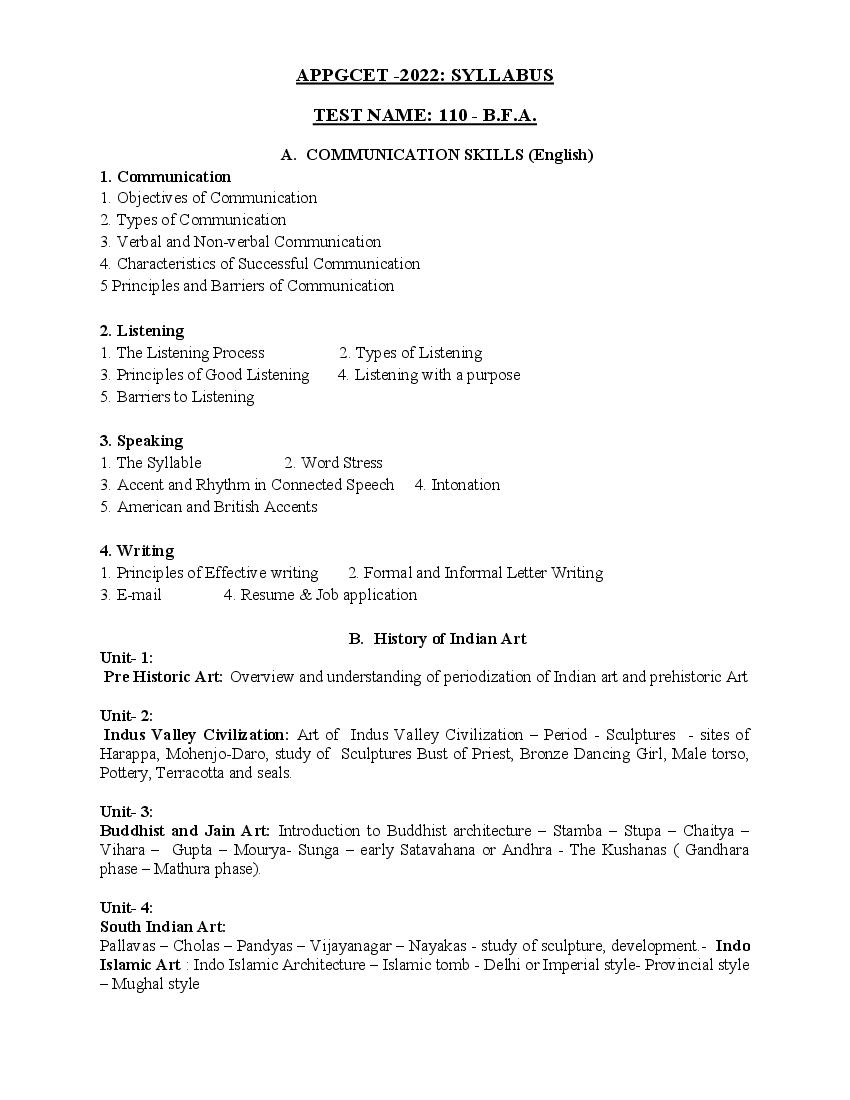
TEST NAME: 110 - B.F.A.
A. COMMUNICATION SKILLS (English)
1. Communication
1. Objectives of Communication
2. Types of Communication
3. Verbal and Non-verbal Communication
4. Characteristics of Successful Communication
5 Principles and Barriers of Communication
2. Listening
1. The Listening Process 2. Types of Listening
3. Principles of Good Listening 4. Listening with a purpose
5. Barriers to Listening
3. Speaking
1. The Syllable 2. Word Stress
3. Accent and Rhythm in Connected Speech 4. Intonation
5. American and British Accents
4. Writing
1. Principles of Effective writing 2. Formal and Informal Letter Writing
3. E-mail 4. Resume & Job application
B. History of Indian Art
Pre Historic Art: Overview and understanding of periodization of Indian art and prehistoric Art
Indus Valley Civilization: Art of Indus Valley Civilization – Period - Sculptures - sites of
Harappa, Mohenjo-Daro, study of Sculptures Bust of Priest, Bronze Dancing Girl, Male torso,
Pottery, Terracotta and seals.
Buddhist and Jain Art: Introduction to Buddhist architecture – Stamba – Stupa – Chaitya –
Vihara – Gupta – Mourya- Sunga – early Satavahana or Andhra - The Kushanas ( Gandhara
phase – Mathura phase).
South Indian Art:
Pallavas – Cholas – Pandyas – Vijayanagar – Nayakas - study of sculpture, development.- Indo
Islamic Art : Indo Islamic Architecture – Islamic tomb - Delhi or Imperial style- Provincial style
– Mughal style
Page 2
Pre Historic Art: Pre Historic and Proto Historic Art – Stone ages – Proto Historic art
Egyptian Art: Introduction to Egyptian Art –Art of Old Kingdom- Middle Kingdom – New
Kingdom-Egyptian pyramids- Evolution of pyramid – paintings, sculptures
Greek Art: Introduction to Greek Art – Archaic Period- Classical Period- Hellenistic Period -
paintings, sculptures
Roman Art: Introduction to Greek Art - paintings, sculptures
Christian Art: Work of art examples
Mosaic works- in the basilicas- study of the visual language - Byzantine paintings - Gothic Art-
paintings, sculptures
Unit- 5:
a) Early Renaissance. Beginning of Renaissance.- Study about Artists Duccio, Giotto,
b) – Mantegna- Masaccio – Uccello – John Van Eyek – Bellni - The golden section – Piero
Della- Pollaivolo brothers – Sandro Botticelli- Sculptor - Donatello
c) High Renaissance. Concepts and ideals of High Renaissance.
d) Leonardo Da Vinci -Michelangelo - Raphael
e) Northern Renaissance – Characteristics and Important Achievement by Contemporary
Painters from the North Include Albert Durer .
Unit- 6:
a) Mannerism.- Artists- Caravaggio – El Greco – Tintoretto
b) Sculptors : Bologna - Cellini
c) Baroque - Caravaggio – Possin – Rembrandt – Vermeer Hals – Ruben –Bernini
Unit- 7:
a) Rococo - Watteau – Boucher – Gain Borough - Reynolds – Hogarth
b) Neo Classism
c) About the movement - Artists David- Ingres – Giorgione – study works
Unit- 8:
a) Romanticism - Concept of Romanticism. Romanticism - Goya and the Spanish
Romanticism. English Artists- Turner, Constable and variant approach of English
Romanticism. Delacroix, Gericault and French Romanticism.
b) Realism. Ideological position of Realism. Study on works of Courbet. Millet, Corot,
Rousseau – Daumier – Rodin
Page 3
Impressionism: Impressionism as the ideological premise. Impressionism and the techniques of
painting. Manet, Monet, Degas, Renoir, Marry Cassatt, Berthe Morisot-Alfred Sisley – Camille
Pissarro.
Post Impressionism: Different approaches of Post Impressionism. Post Impressionism and its
influence on 20th century art. -Van Gogh, Gauguin, Lautrec, Seurat and Cezanne.
Unit- 10:
Expressionism: Characteristics of the movement - Edward Munch – Egon Schiele – Henri
Matisse - Symbolism –Klimt - Henri Rousseau - Munch
Unit- 11:
Cubism: Influence of Post-Impression on Cubism.- Pablo Picasso Blue Period, Red Period -
Analytic cubism and Synthetic Cubism -George Braque, Fernand Leger, Juan Gris and their
works
Unit- 12:
Dadaism & Surrealism
Dadaism
Zurich: Jean Arp and Marcel Janco, Marcel Duchamp, Man Ray, and Francis Picabia ,
Andre Breton.
Surrealism
Manifesto - Psychic automatism - Study on Works of Salvador Dali René Magritte Joan Miró ,
Max Ernst, Man Ray , André Masson, Yves Tanguy ,-Giorgio de Chirico.
D. History of Indian Painting
Indian Mural Painting Tradition: Indian Mural Painting tradition – study of Ajanta- Ellora,
Baugh, Lepakshi
Early Manuscript Illustration Tradition: Eastern Indian Manuscripts (Pala-sena) - Sultanate
School of Painting,
Jain Miniature Painting: Western Indian Miniature Painting Tradition. Jain miniatures-
school, themes, composition.
Mughal Painting: Introduction - Akbar School, Jahangir School - Shahjahan School and his
contribution. Important Manuscripts and Artists and their contributions to the Mughal Painting.
Deccan School of Painting: Bijapur, Golconda, Ahmednagar, Aurangabad.
Rajput Painting: Classification of Rajput schools.
c) Rajasthani Schools and Various schools.- Mewar Udaipur, Deogarh, Nathdwara, Kota,
Bundi, Kishangarh.
d) Pahari School of Painting - Various schools of Pahari painting - Basholi, Guler, Kangra
And Sub-Schools
Page 4
Unit -1:
Company School of Painting: General overview of the political scenario - East India
Company- Bengal 1857 and others; emergence of new centers like Patna, Murshidabad,
Benaras, etc.
Kalighat Paintings.
Unit -2:
The Bengal School of Art: Nationalist sentiments mid-19th century- Abhanindranath Tagore,
Nandalal Bose, Gaganendranath Tagore - Abdur Rehman Chughtai- Rabindranath Tagore.
Ramkinker Vaij-
Unit -3:
Emerging Art of India
Young Turks (1941)The Calcutta Group (1943-53): Prominent artists – Young Turks
Unit -4:
Raja Ravi Varma
Academic realist style (Victorian Salon style) and a new body of Indian imagery. Oleographs
F. Modern Indian Art
Unit -1:
Progressive Artists' Group: Introduction to the post modern Indian art - Reference to other
mediums of expression literature, films, theatre both street and mainstream;
study of the works of the members of the group - F. N. Souza, K. H. Ara, S. H. Raza, M. F.
Husain, S. K. Bakre, H. A. Gade.
Unit - 2:
Post Independence Art Movements: Other Progressive Schools/ Groups: Cholamandal Artists'
Village. Delhi Shilpi Chakra
Unit -3:
Baroda School of Fine Arts, Painters, Printmakers and Sculptors: Years of Inception,
Faculty members- N. S.Bendre, Prodsh Das Gupta, Sankho Chowdhury, K. G. Subramanian,.
Group 1890-ideology.
Unit -4: Modern Indian Sculpture
Study about Indian modern sculptors. –Ramkinker Vaij- Sankho Chowdhury - DP Roy
Chowdhury- Ravinder Reddy- PV Janaki Ram-
Page 5
German Expressionism:Definition and origins of the movement- Die Brücke, (The Bridge)-
Ernst Ludwig Kirchner -Erich Heckel -Emil Nolde.
Abstract Expressionism: Action or Gesture painters Jackson Pollock, William de Kooning,
James Brook, Franz Kline, Krasner, Robert Motherwell, Bardley Walter Tomlin
Colour Field painting, Barnett Newman, Mark Rothko, A.D. Reinhardt - simple, unified blocks
of colour.
Pop Art: About the movement- characteristics of the works - Richard Hamilton – Jasper Johns
– Roy Lichtenstein – Andy Warhol. Op Art - Constructivism & Futurism:About the
movement- characteristics of the works and Artists.
Modern Sculpture: Trends of modern Sculpture, Artist and their Works Henry Moore – David
Smith – Toni Smith – Alexander Calder – Albert Giacometti – Geam Dubuffet – Anish Kapoor .
H. VISUAL FOLK ARTS OF INDIA
1. Introduction to tribal/folk India and geographical distribution.
2. Descriptive accounts of all kinds of Terracotta traditions (Molela, Gujarat, Tamilnadu,
Bengal). Metal casting traditions (Dhokra casting of Bastar).
Puppetry tradition, Types of Puppetry, South Indian Puppetry
Their religious and ritualistic significance.
1. Introduction to prominent tribes, geographical distribution, religious manifestations.
1. Wall painting traditions (Madhuban, Warli, Pitthoro, Gonds), Textile painting traditions
(Mata ni Pachedi, Phads, Puripatas)
I. INDIAN AESTHETICS
Introduction to Indian Aesthetics- and its scope- Brief introduction to basic principles of Indian
philosophy as related to arts.
Evolution of Aesthetic Concepts- Rasa Theory – types of Rasas - their play in the context art-
different opinion on types of Rasa. Theory of Dhvani - Theory of Alankara - Theory of Auchitya.
Interrelationship of Visual Arts and Performing Arts.
Theory of Shadanga.
***************
Document Details
| Board / Org | APSCHE |
| Exam | Andhra Pradesh Post Graduate Common Entrance Test |
| Type | Syllabus |
| Pages | 5 |
| Updated | 22 Jul 2026 |