AP PGCET 2022 Syllabus Botany
Finished viewing? Save it for later —
Download AP PGCET 2022 Syllabus Botany (PDF · 3 pages)About AP PGCET 2022 Syllabus Botany
AP PGCET 2022 Syllabus Botany is available here for free download. Published by APSCHE for Andhra Pradesh Post Graduate Common Entrance Test, this syllabus can be viewed online or downloaded as a PDF (3 pages). Candidates preparing for Andhra Pradesh Post Graduate Common Entrance Test can use AP PGCET 2022 Syllabus Botany to understand the exam pattern, the type of questions asked, and the overall difficulty level.
Frequently Asked Questions
How can I download AP PGCET 2022 Syllabus Botany?
Open this page and click the Download button to save AP PGCET 2022 Syllabus Botany as a PDF. It is completely free on AglaSem Docs.
Is AP PGCET 2022 Syllabus Botany free to download?
Yes. AP PGCET 2022 Syllabus Botany can be viewed online and downloaded as a PDF free of cost on AglaSem Docs.
How many pages does AP PGCET 2022 Syllabus Botany have?
AP PGCET 2022 Syllabus Botany contains 3 pages, which you can read online or download together as a single PDF.
Where can I find more Andhra Pradesh Post Graduate Common Entrance Test study material?
You can find more Andhra Pradesh Post Graduate Common Entrance Test question papers, sample papers, syllabus, and answer keys on AglaSem Docs.
AP PGCET 2022 Syllabus Botany – Text
Read the full text of this syllabus below — useful to quickly search, copy and reference the content online without downloading the PDF.
📄 View text version (3 pages)
Page 1
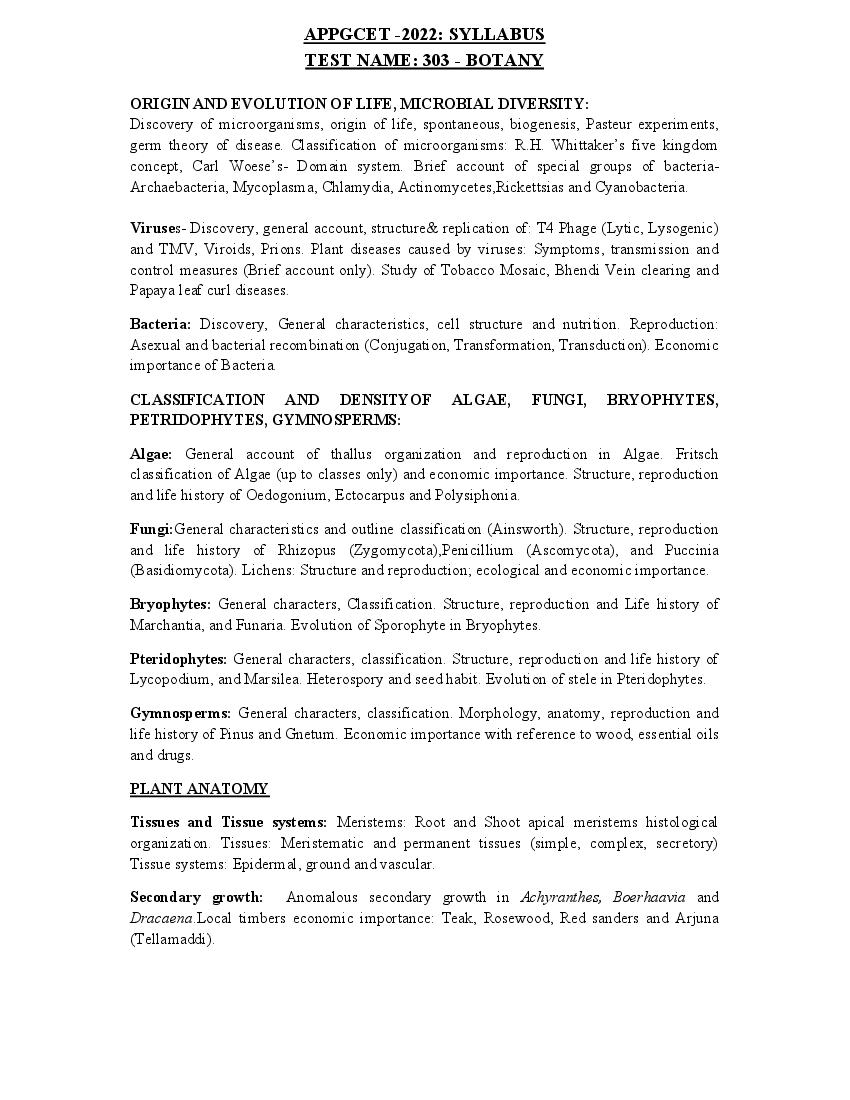
TEST NAME: 303 - BOTANY
ORIGIN AND EVOLUTION OF LIFE, MICROBIAL DIVERSITY:
Discovery of microorganisms, origin of life, spontaneous, biogenesis, Pasteur experiments,
germ theory of disease. Classification of microorganisms: R.H. Whittaker’s five kingdom
concept, Carl Woese’s- Domain system. Brief account of special groups of bacteria-
Archaebacteria, Mycoplasma, Chlamydia, Actinomycetes,Rickettsias and Cyanobacteria.
Viruses- Discovery, general account, structure& replication of: T4 Phage (Lytic, Lysogenic)
and TMV, Viroids, Prions. Plant diseases caused by viruses: Symptoms, transmission and
control measures (Brief account only). Study of Tobacco Mosaic, Bhendi Vein clearing and
Papaya leaf curl diseases.
Bacteria: Discovery, General characteristics, cell structure and nutrition. Reproduction:
Asexual and bacterial recombination (Conjugation, Transformation, Transduction). Economic
importance of Bacteria.
CLASSIFICATION AND DENSITYOF ALGAE, FUNGI, BRYOPHYTES,
PETRIDOPHYTES, GYMNOSPERMS:
Algae: General account of thallus organization and reproduction in Algae. Fritsch
classification of Algae (up to classes only) and economic importance. Structure, reproduction
and life history of Oedogonium, Ectocarpus and Polysiphonia.
Fungi:General characteristics and outline classification (Ainsworth). Structure, reproduction
and life history of Rhizopus (Zygomycota),Penicillium (Ascomycota), and Puccinia
(Basidiomycota). Lichens: Structure and reproduction; ecological and economic importance.
Bryophytes: General characters, Classification. Structure, reproduction and Life history of
Marchantia, and Funaria. Evolution of Sporophyte in Bryophytes.
Pteridophytes: General characters, classification. Structure, reproduction and life history of
Lycopodium, and Marsilea. Heterospory and seed habit. Evolution of stele in Pteridophytes.
Gymnosperms: General characters, classification. Morphology, anatomy, reproduction and
life history of Pinus and Gnetum. Economic importance with reference to wood, essential oils
and drugs.
PLANT ANATOMY
Tissues and Tissue systems: Meristems: Root and Shoot apical meristems histological
organization. Tissues: Meristematic and permanent tissues (simple, complex, secretory)
Tissue systems: Epidermal, ground and vascular.
Secondary growth: Anomalous secondary growth in Achyranthes, Boerhaavia and
Dracaena.Local timbers economic importance: Teak, Rosewood, Red sanders and Arjuna
(Tellamaddi).
Page 2
Introduction to Plant Taxonomy: Fundamental components of taxonomy (identification,
nomenclature, classification), Taxonomic resources: Herbarium: functions and important
herbaria, Botanical gardens, Flora, Keys: single access and multi-access,Botanical
Nomenclature: Principles and rules of ICBN (ranks and names; principle of priority, binomial
system; type method, author citation, valid-publication).
Classification: Types of classifications: Artificial, Natural and Phylogenetic. Bentham &
Hooker’s system andEngler&Prantle’s system of classificationmerits and demerits.
Phylogeny, origin and evolution of Angiosperms.
Systematic Taxonomy: Systematic study and economic importance of: Asteraceae,
Asclepiadaceae, Lamiaceae, Ephorbiaceae,Arecaceae,andPoaceae.
EMBRYOLOGY
Anther structure, microsporogenesis and development of male gametophyte. Ovule structure
and types; Megasporogenesis, development of Monosporic, Bisporic and Tetrasporic
(Peperomia ,Drusa, Adoxa) embryo sacs. Pollination and Fertilization (out lines) Endosperm
development and types. Development of Dicot and Monocot embryos, Polyembryony.
PLANT PHYSIOLOGY AND METABOLISM
Plant Water relations: Physical properties of water, Importance of water to plant life.
Diffusion, imbibition and osmosis; concept & components of Water potential. Absorption
and transport of water and ascent of sap. Transpiration: Definition, types of transpiration,
structure, opening and closing mechanism of stomata.
Mineral nutrition & Enzymes: Mineral Nutrition: Essential elements (macro and
micronutrients) and their role in plant metabolism, deficiency symptoms. Mineral ion uptake
(active and passive transport). Nitrogen metabolism: biological nitrogen fixation in
Rhizobium, outlines of protein synthesis (transcription and translation). Enzymes: General
characteristics, mechanism of enzyme action and factors regulating enzyme action.
Photosynthesis: Photosynthetic pigments, photosynthetic light reactions, photo
phosphorylation, carbon assimilation pathways: C3, C4, and CAM (brief account).
Photorespiration and its significance. Translocation of organic solutes: mechanism of phloem
transport, source-sink relationships.
Plant Metabolism: Respiration: Glycolysis, anaerobic respiration, TCA cycle, electron
transport system. Mechanism of oxidative phosphorylation. Lipid Metabolism: Types of
lipids, Beta-oxidation.
Growth and Development: Growth and development: definition, phases and kinetics of
growth. Physiological effects of phytohormones:Auxins, Gibberellins, Cytokinins, ABA,
Ethylene and Brassinosteroids. Physiology of flowering: photoperiodism, role of
phytochrome in flowering; Vernalization. Physiology of scenescence and Ageing.
Page 3
Cell Biology: Cell, the unit of life; Cell theory, Prokaryotic and eukaryotic cells; Eukaryotic
cell components. Ultra structure and functions of cell wall and cell membranes.
Chromosomes: morphology, organization of DNA in a chromosome (nucleosome model),
Euchromatin and heterochromatin.
GENETICS
Genetic Material: DNA as the genetic material: Griffith’s and Avery’s transformation
experiment, Hershey: Chase bacteriophage experiment. DNA structure (Watson & Crick
model) replication of DNA (semi conservative). Types of RNA (mRNA, tRNA, rRNA), their
structure and function.
Mendelian Inheritance: Mendel’s laws of Inheritance (Monoand Di hybrid crosses);
backcross and test cross. Chromosome theory of Inheritance. Linkage: concept, complete and
incomplete linkage, coupling and repulsion; linkage maps based on two and three factor
crosses. Crossing Over: concept & significance.
PLANT BREEDING
Plant Breeding: Introduction and Objectives of plant breeding. Methods of crop
improvement: Procedure, advantages and limitations of Introduction, Selection, and
Hybridization (outlines only).
Crop Improvement and Biotechnology: Role of mutations in crop improvement. Role of
somaclonal variations in crop improvement. Molecular breeding: use of DNA markers in
plant breeding and crop improvement (RAPD, RFLP).
PLANT ECOLOGY& PHYTOGEOGRAPHY
Elements of Ecology: Ecology: definition, branches and significance of ecology. Climatic
Factors: Light, Temperature, precipitation. Edaphic Factors: Origin, formation, composition
and soil profile. Biotic Factor: Interactions between plants and animals.
Ecosystem Ecology: Ecosystem: Concept and components, energy flow, Food chain, Food
web, Ecological pyramids. Productivity of ecosystem: Primary, Secondary and Net
productivity. Biogeochemical cycles: Carbon, Nitrogen and Phosphorous.
Population &Community Ecology: Population: definition, characteristics and importance,
Ecotypes. Plant communities: characters of a community: Frequency, density, cover, life
forms, competition. Interaction between plants growing in a community.
Phytogeography: Principles of Phytogeography, Distribution (wides, endemic,
discontinuous species) Phytogeographic regions of India. and World. Endemism: types and
causes
Plant Biodiversity and its importance: Definition, levels of biodiversity: genetic, species
and ecosystem. Biodiversity hotspots: Criteria, Biodiversity hotspots of India. Loss of
biodiversity: causes and conservation (In-situ andex-situ methods). Seed banks: conservation
of genetic resources and their importance.
*****************
Document Details
| Board / Org | APSCHE |
| Exam | Andhra Pradesh Post Graduate Common Entrance Test |
| Type | Syllabus |
| Pages | 3 |
| Updated | 22 Jul 2026 |