AP PGCET 2022 Syllabus Chemical Sciences
Finished viewing? Save it for later —
Download AP PGCET 2022 Syllabus Chemical Sciences (PDF · 9 pages)About AP PGCET 2022 Syllabus Chemical Sciences
AP PGCET 2022 Syllabus Chemical Sciences is available here for free download. Published by APSCHE for Andhra Pradesh Post Graduate Common Entrance Test, this syllabus can be viewed online or downloaded as a PDF (9 pages). Candidates preparing for Andhra Pradesh Post Graduate Common Entrance Test can use AP PGCET 2022 Syllabus Chemical Sciences to understand the exam pattern, the type of questions asked, and the overall difficulty level.
Frequently Asked Questions
How can I download AP PGCET 2022 Syllabus Chemical Sciences?
Open this page and click the Download button to save AP PGCET 2022 Syllabus Chemical Sciences as a PDF. It is completely free on AglaSem Docs.
Is AP PGCET 2022 Syllabus Chemical Sciences free to download?
Yes. AP PGCET 2022 Syllabus Chemical Sciences can be viewed online and downloaded as a PDF free of cost on AglaSem Docs.
How many pages does AP PGCET 2022 Syllabus Chemical Sciences have?
AP PGCET 2022 Syllabus Chemical Sciences contains 9 pages, which you can read online or download together as a single PDF.
Where can I find more Andhra Pradesh Post Graduate Common Entrance Test study material?
You can find more Andhra Pradesh Post Graduate Common Entrance Test question papers, sample papers, syllabus, and answer keys on AglaSem Docs.
AP PGCET 2022 Syllabus Chemical Sciences – Text
Read the full text of this syllabus below — useful to quickly search, copy and reference the content online without downloading the PDF.
📄 View text version (9 pages)
Page 1
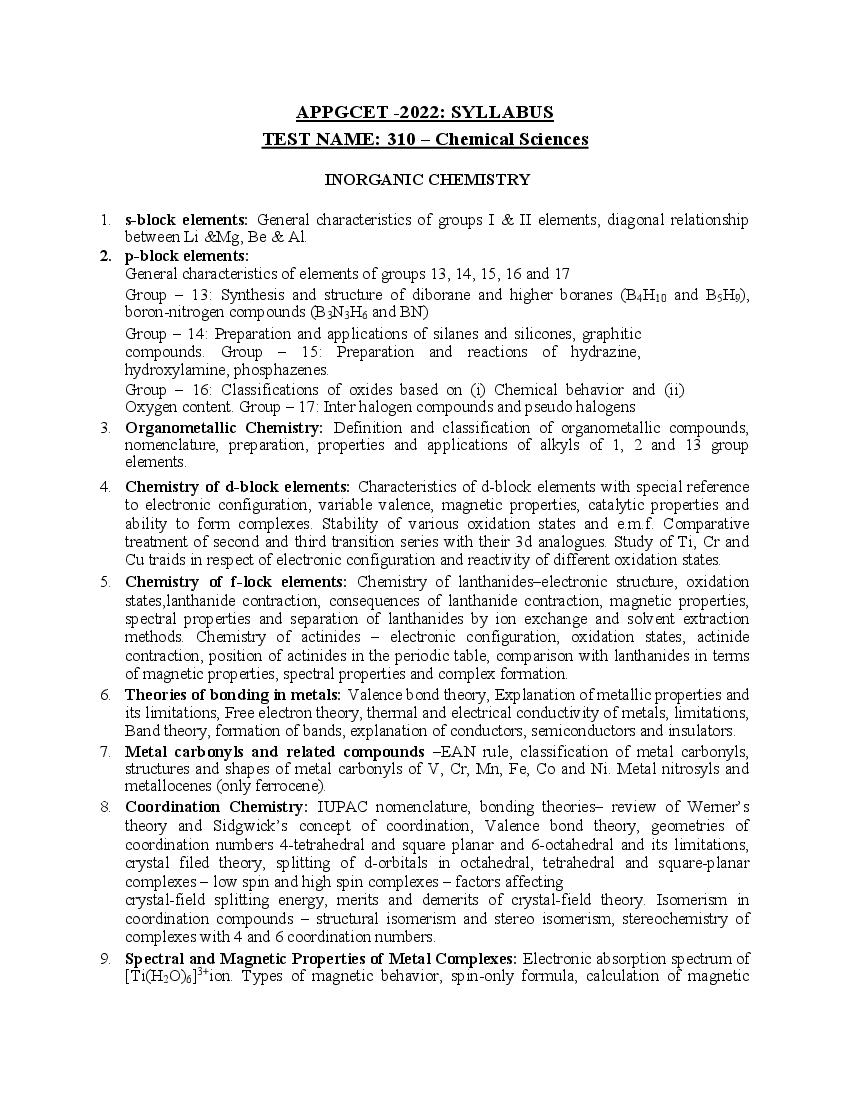
TEST NAME: 310 – Chemical Sciences
INORGANIC CHEMISTRY
1. s-block elements: General characteristics of groups I & II elements, diagonal relationship
between Li &Mg, Be & Al.
2. p-block elements:
General characteristics of elements of groups 13, 14, 15, 16 and 17
Group – 13: Synthesis and structure of diborane and higher boranes (B4H10 and B5H9),
boron-nitrogen compounds (B3N3H6 and BN)
Group – 14: Preparation and applications of silanes and silicones, graphitic
compounds. Group – 15: Preparation and reactions of hydrazine,
hydroxylamine, phosphazenes.
Group – 16: Classifications of oxides based on (i) Chemical behavior and (ii)
Oxygen content. Group – 17: Inter halogen compounds and pseudo halogens
3. Organometallic Chemistry: Definition and classification of organometallic compounds,
nomenclature, preparation, properties and applications of alkyls of 1, 2 and 13 group
elements.
4. Chemistry of d-block elements: Characteristics of d-block elements with special reference
to electronic configuration, variable valence, magnetic properties, catalytic properties and
ability to form complexes. Stability of various oxidation states and e.m.f. Comparative
treatment of second and third transition series with their 3d analogues. Study of Ti, Cr and
Cu traids in respect of electronic configuration and reactivity of different oxidation states.
5. Chemistry of f-lock elements: Chemistry of lanthanides–electronic structure, oxidation
states,lanthanide contraction, consequences of lanthanide contraction, magnetic properties,
spectral properties and separation of lanthanides by ion exchange and solvent extraction
methods. Chemistry of actinides – electronic configuration, oxidation states, actinide
contraction, position of actinides in the periodic table, comparison with lanthanides in terms
of magnetic properties, spectral properties and complex formation.
6. Theories of bonding in metals: Valence bond theory, Explanation of metallic properties and
its limitations, Free electron theory, thermal and electrical conductivity of metals, limitations,
Band theory, formation of bands, explanation of conductors, semiconductors and insulators.
7. Metal carbonyls and related compounds –EAN rule, classification of metal carbonyls,
structures and shapes of metal carbonyls of V, Cr, Mn, Fe, Co and Ni. Metal nitrosyls and
metallocenes (only ferrocene).
8. Coordination Chemistry: IUPAC nomenclature, bonding theories– review of Werner’s
theory and Sidgwick’s concept of coordination, Valence bond theory, geometries of
coordination numbers 4-tetrahedral and square planar and 6-octahedral and its limitations,
crystal filed theory, splitting of d-orbitals in octahedral, tetrahedral and square-planar
complexes – low spin and high spin complexes – factors affecting
crystal-field splitting energy, merits and demerits of crystal-field theory. Isomerism in
coordination compounds – structural isomerism and stereo isomerism, stereochemistry of
complexes with 4 and 6 coordination numbers.
9. Spectral and Magnetic Properties of Metal Complexes: Electronic absorption spectrum of
[Ti(H2O)6]3+ion. Types of magnetic behavior, spin-only formula, calculation of magnetic
Page 2
10. Reactivity of metal complexes: Labile and inert complexes, ligand substitution reactions–
SN1 and SN2, substitution reactions of square planar complexes – Trans effect and
applications of trans effect.
11. Stability of Metal Complexes: Thermodynamic stability and kinetic stability, factors
affecting the stability of metal complexes, chelate effect, determination of composition of
complex by Job’s method and mole ratio method.
12. Hard and soft acids bases (HSAB): Classification, Pearson’s concept ofhardness and
softness, application of HSAB principles – Stability of compounds / complexes, predicting
the feasibility of a reaction.
13. Bioinorganic Chemistry: Essential elements, biological significance of Na, K, Mg, Ca, Fe,
Co, Ni, Cu, Zn and chloride (Cl-). Metalloporphyrins – hemoglobin, structure and function,
Chlorophyll, structure and role in photosynthesis.
ORGANIC CHEMISTRY
1. Structural theory in Organic Chemistry: Types of bond fission and organic reagents
(Electrophilic, Nucleophilic, and free radical reagents including neutral molecules like H2O,
NH3& AlCl3). Bond polarization: Factors influencing the polarization of covalent bonds,
electro negativity – inductive effect. Application of inductive effect (a) Basicity of amines (b)
Acidity of carboxylic acids (c) Stability of carbonium ions. Resonance or Mesomeric effect,
application to (a) acidity of phenol, and (b) acidity of carboxylic acids. Hyper conjugation
and its application to stability of carbonium ions, Free radicals and
alkenes, carbanions, carbones and nitrenes. Types of Organic reactions: Addition –
electrophilic, nucleophilic and free radical. Substitution – electrophilic, nucleophilic and free
radical. Elimination-Examples (mechanism not required).
2. Acyclic Hydrocarbons
Alkanes–IUPAC Nomenclature of Hydrocarbons. Methods of preparation: Hydrogenation of
alkynes andalkenes, Wurtz reaction, Kolbe’s electrolysis, Corey- House reaction. Chemical
reactivity – inert nature, free radical substitution mechanism. Halogenation example-
reactivity, selectivity and orientation.
Alkenes –Preparation of alkenes (a) by dehydration of alcohols (b) by dehydrohalogenation
of alkylhalides (c) by dehalogenation of 1,2 dihalides (briefmechanism), Saytzev’s rule.
Properties: Addition of hydrogen – heat of hydrogenation and stability of alkenes. Addition
of halogen and its mechanism.
Addition of HX, Markonikov’s rule, addition of H2O, HOX, H2SO4 with mechanism and
addition of HBr in the presence of peroxide (anti – Markonikov’s addition). Oxidation –
hydroxylation by KMnO4, OsO4, peracids (via epoxidation) hydroboration, Dienes – Types
of dienes, reactions of conjugated dines – 1,2 and 1,4 addition of HBr to 1,3 – butadiene and
Diel’s – Alder reaction.
Alkynes –Preparation by dehydrohalogenation of dihalides, dehalogenation of tetrahalides,
Properties;Acidity of acetylenic hydrogen (formation of Metal acedtylides). Preperation of
higher acetylenes, Metal ammonia reductions Physical properties. Chemical reactivity –
electrophilic addition of X2, HX, H2O (Tautomerism), Oxidation with KMnO4, OsO4,
reduction and Polymerisation reaction of acetylene.
3. Alicyclic hydrocarbons (Cycloalkanes): Nomenclature, Preparation by Freunds methods,
Page 3
comparing with alkanes, Stability of cycloalkanes – Baeyer’s strain theory, Sachse and Mohr
predictions and Pitzer’s strain theory. Conformational structures of cyclobutane,
cyclopentane, cyclohexane.
4. Benzene and its reactivity: Concept of resonance, resonance energy. Heat of hydrogenation,
heat ofcombustion of Benezene, mention of C-C bond lengths and orbital picture of Benzene.
Concept of aromaticity – aromaticity (definition), Huckel’s rule – application to Benzenoid
(Benzene, Napthalene) and Non – Benzenoid compounds (cyclopropenyl cation,
cyclopentadienyl anion and tropylium cation) Reactions – General mechanism of
electrophilic substitution, mechanism of nitration. Friedel Craft’s alkylation and acylation.
Orientation of aromatic substitution – Definition of ortho, para and meta directing groups.
Ring activating and deactivating groups with examples (Electronic interpretation of various
groups like NO2 and Phenolic). Orientation of (i). Amino, methoxy and methyl groups (ii).
Carboxy, nitro, nitrile, carbonyl and Sulfonic acid groups. (iii). Halogens (Explanation by
taking minimum of one example from each type).
5. Polynuclear Hydrocarbons - Structure of naphthalene and anthracene (Molecular Orbital
diagram andresonance energy) Any two methods of preparation of naphthalene and
reactivity. Reactivity towards electrophilic substitution. Nitration and sulfonation as
examples.
6. Halogen compounds: Nomenclature and classification of alkyl (into primary, secondary,
tertiary), aryl,aralkyl, allyl, vinyl, benzyl halides. Chemical Reactivity, formation of RMgX
Nucleophilic aliphatic substitution reaction- classification into SN1and SN2. Energy profile
diagram of SN1and SN2reactions. Stereochemistry of SN2 (Walden Inversion) SN1
(Racemisation). Explanation of both by taking the example of optically active alkyl halide –
2bromobutane. Ease of hydrolysis – comparison of alkyl, benzyl, alkyl, vinyl and aryl
halides.
7. Hydroxy compounds: Nomenclature and classification of hydroxy compounds. Alcohols:
Preparation with hydroboration reaction, Grignard synthesis of alcohols. Phenols:
Preparation i) from diazonium salt,
ii) from aryl sulphonates, iii) from cumene. Physical properties- Hydrogen bonding
(intermolecular and intramolecular). Effect of hydrogen bonding on boiling point and
solubility in water. Chemical properties:
a) acidic nature of phenols.
b) formation of alkoxides/phenoxides and their reaction with RX.
c) replacement of OH by X using PCl5, PCl3, PBr3, SOCl2 and wit HX/ZnCl2.
d) esterification by acids (mechanism).
e) dehydration of alcohols.
f) oxidation of alcohols by CrO3, KMnO4.
g) special reaction of phenols: Bromination, Kolb-Schmidt reaction, Riemer-Tiemann
reaction, Fries rearrangement, azocoupling. Identification of alcohols by oxidation with
KMnO4, ceric ammonium nitrate, lucas reagent and phenols by reaction with FeCl 3.
Polyhydroxy compounds: Pinacol-Pinacolone rearrangement.
8. Carbonyl compounds: Nomenclature of aliphatic and aromatic carbonyl compounds,
structure of thecarbonyl group. Synthesis of aldehydes from acid chlorides, synthesis of
aldehydes and ketones using 1,3-dithianes, synthesis of ketones from nitriles and from
carboxylic acids. Physical properties: absence of hydrogen bonding, keto-enol tautomerism,
reactivity of carbonyl group in aldehydes and ketones. Nucleophilic addition reaction with a)
Page 4
of hemiacetal and acetal. Halogenation using PCl 5 with mechanism. Base catalysed reactions:
a) Aldol, b) Cannizzaro reaction, c) Perkin reaction, d) Benzoin condensation, e) Haloform
reaction, f) Knoevenagel reaction. Oxidation of aldehydes- Baeyer-Villiger oxidation of
ketones. Reduction: Clemmensen reduction, Wolf-Kishner reduction, MPV reduction,
reduction with LiAlH4 and NaBH4. Analysis of aldehydes and ketones with a) 2,4-DNT test,
b) Tollen’s test, c) Fehling text, d) Schiff test, e) Haloform test (with equation).
9. Carboxylic acids and derivatives: Nomenclature, classification and structure of carboxylic
acids.Methods of preparation by a) hydrolysis of nitriles, amides and esters. b) carbonation of
Grignard reagents. Special methods of preparation of aromatic acids by a) oxidation of side
chain. b) hydrolysis by benzotrichlorides. c) Kolbe reaction. Physical properties: Hydrogen
bonding, dimeric association, acidity-strength of acids with examples of trimethyl acetic acid
and trichloroacetic acid. Relative differences in the acidities of aromatic and aliphatic acids.
Chemical properties: Reactions involving H, OH and COOH groups- salt formation,
anhydride formation, acid chloride formation, amide formation and esterification
(mechanism). Degradation of carboxylic acids byHuns-Diecker reaction, decarboxylation by
Schimdt reaction, Arndt-Eistert synthesis, halogenation by Hell-Volhard- Zelinsky reaction.
Derivatives of carboxylic acids: Reaction of acid chlorides, acid anhydrides, acid amides,
esters (mechanism of the hydrolysis of esters by acids and bases).
10. Active methylene compounds: Acetoacetic esters: preparation by Claisen condensation,
keto-enoltautomerism. Acid hydrolysis and ketonic hydrolysis. Preparation of a)
monocarboxylic acids. b) dicarboxylic acids. Reaction with urea Malonic ester: preparation
from acetic acid. Synthetic applications: Preparation of
i. monocarboxylic acids (propionic acid and n-butyric acid).
ii. dicarboxylic acids (succinic acid and adipic acid).
iii. ,ß-unsaturated carboxylic acids (crotonoic acid), Reaction with urea.
11. Nitrogen compounds
Nitro hydrocarbons: Nomenclature and classification – nitro hydrocarbons – structure.
Tautomerism of nitroalkanes leading to aci and keto form. Preparation of Nitroalkanes.
Reactivity – halogenation, reaction with HONO (Nitrous acid), Nef reaction and Mannich
reaction leading to Michael addition and reduction. Amines (Aliphatic and Aromatic):
Nomenclature, Classification into 1°, 2°, 3° Amines and Quarternary ammonium compounds.
Preparative methods -1. Ammonolysis of alkyl halides 2. Gabriel synthesis 3. Hoffman’s
bromamide reaction (mechanism). 4. Reduction of Amides and Schmidt reaction. Physical
properties and basic character – Comparative basic strength of Ammonia, methyl amine,
dimethyl amine, trimethyl amine and aniline – comparative basic strength of aniline,
Nmethylaniline and N,N-dimethyl aniline (in aqueous and non-aqueous medium), steric
effects and substituent effects. Use of amine salts as phase transfer catalysts. Chemical
properties: a) Alkylation b) Acylation c) Carbylamine reaction
d) Hinsberg separation e) Reaction with Nitrous acid of 1°, 2°, 3° (Aliphatic and aromatic
amines). Electrophilic substitutions of Aromatic amines – Bromination and Nitration.
oxidation of aryl and 3° Amines. Diazotization Cyanides and isocyanides: Nomenclature
(aliphatic and aromatic) structure. Preparation of cyanides from a) Alkyl halides b) from
amides c) from aldoximes. Preparation of isocyanides from Alkyl halides and Amines.
Properties of cyanides and isocyanides, a) hydrolysis b) addition of Grignard reagent iii)
reduction iv) oxidation.
Page 5
Introduction and definition: Simple 5 membered ring compounds with one hetero atom Ex.
Furan. Thiophene and pyrrole. Importance of ring system – presence in important natural
products like hemoglobin and chlorophyll. Numbering the ring systems as per Greek letter
and Numbers. Aromatic character – 6- electron system (four-electrons from two double
bonds and a pair of non-bonded electrons from the hetero atom). Tendency to undergo
substitution reactions. Resonance structures: Indicating electron surplus carbons and electron
deficient hetero atom. Explanation of feebly acidic character of pyrrole, electrophillic
substitution at 2 or 5 position, Halogenation, Nitration and Sulphonation under mild
conditions. Reactivity of furan as 1,3-diene, Diels Alder reactions (one example).
Sulphonation of thiophene purification of Benzene obtained from coal tar). Preparation of
furan, Pyrrole and thiophene from 1,4,- dicarbonyl compounds only, Paul-Knorr
synthesis, structure of pyridine, Basicity –Aromaticity- Comparison with pyrrole – one
method of preparation and properties – Reactivity towards Nucleophilic substitution reaction
– chichibabin reaction.
14. Carbohydrates: Monosaccharides: All discussion to be confined to (+) glucose as an
example of aldohexoses and (-) fructose as example of ketohexoses. Chemical properties and
structureal elucidation: Evidences for straight chain pentahydroxy aldehyde structure
(Acetylation, reduction to n-hexane, cyanohydrin formation, reduction of Tollen’s and
Fehling’s reagents and oxidation to gluconic and saccharic acid). Number of optically active
isomers possible for the structure, configuration of glucose based on D-glyceraldehyde as
primary standard (no proof for configuration is required). Evidence for cyclic structure of
glucose (some negative aldehydes tests and mutarotation). Cyclic structure of glucose.
Decomposition of cyclic structure (Pyranose structure, anomeric Carbon and anomers). Proof
for the ring size (methylation, hydrolysis and oxidation reactions). Different ways of writing
pyranose structure (Haworth formula and chair conformationa formula). Structure of
fructose: Evidence of 2 – ketohexose structure (formation of penta acetate, formation of
cyanohydrin its hydrolysis and reduction by HI to give 2-Carboxy-n-hexane). Same osazone
formation from glucose and fructose, Hydrogen bonding in osazones, cyclic structure for
fructose (Furanose structure and Haworth formula). Interconversion of Monosaccharides:
Aldopentose to aldo hexose – eg: Arabinose to D-Glucose, DMannose (Kiliani - Fischer
method). Epimers, Epimerisation – Lobry de bruyn van Ekenstein rearrangement.
Aldohexose to Aldopentose eg: D-glucose to D-arabinose by Ruff’f degradation. Aldohexose
(+) (glucose) to ketohexose (-) (Fructose) and Ketohexose (fructose) to aldohexose (Glucose)
15. Amino acids and proteins: Introduction: Definition of Amino acids, classification of Amino
acids into alpha, beta, and gama amino acids. Natural and essential amino acids – definition
and examples, classification of alpha amino acids into acidic, basic and neutral amino acids
with examples. Methods of synthesis: General methods of synthesis of alpha amino acids
(specific examples – Glycine, Alanine, valine and leucene) by following methods: a) from
halogenated carboxylic acid b) Malonic ester synthesis
c) Strecker’s synthesis. Physical properties: Optical activity of naturally occurring amino
acids: L-configuration, irrespective of sign rotation, Zwitterion structure – salt like character
- solubility, melting points, amphoteric character , definition of isoelectric point. Chemical
properties: General reactions due to amino and carboxyl groups – lactams from gamma and
delta amino acids by heating peptide bond (amide linkage). Structure and nomenclature of
peptides and proteins.
16. Mass Spectrometry: Basic principles–Molecular ion / parent ion, fragment ions / daughter
Page 6
– formation of parent ions. Representation of mass spectrum. Identification of parent ion,
(M+1), (M+2), base peaks (relative abundance 100%) Determination of molecular formula –
Mass spectra of ethylbenzene, acetophenone, n-butyl amine and 1- proponal.
PHYSICAL CHEMISTRY
1. Gaseous state: Compression factors, deviation of real gases from ideal behavior. Van der
Waal’sequation of state. P-V Isotherms of real gases, Andrew’s isotherms of carbon dioxide,
continuity of state. Critical phenomena. The van der Waal’s equation and the critical state.
Relationship between critical constants and van der Waal’s constants. The law of
corresponding states and reduced equation of states. Joule Thomson effect. Liquefaction of
gases: i) Linde’s method and ii) Claude’s method.
2. Liquid state: Intermolecular forces, structure of liquids (qualitative description). Structural
differencesbetween solids, liquids and gases. Liquid crystals, the mesomorphic state.
Classification of liquid crystals into Smectic and Nematic. Differences between liquid crystal
and solid/liquid. Application of liquid crystals as LCD devices.
3. Solid state: Symmetry in crystals. Law of constancy of interfacial angles. The law of
rationality ofindices. The law of symmetry. Definition of lattice point, space lattice, unit cell.
Bravis lattices and crystal systems.
X-ray diffraction and crystal structure. Bragg’s law. Determination of crystal structure by
Bragg’s method and the powder method. Indexing of planes and structure of NaCl and KCl
crystals. Defects in crystals. Stoichiometric and non-stoichiometric defects. Band theory of
semoconductors. Extrinsic and intrinsic semiconductors, n- and p-type semiconductors and
their applications in photo electrochemical cells.
4. Solutions: Liquid-liquid -ideal solutions, Raoult’s law. Ideally dilute solutions, Henry’s law.
Non-idealsolutions. Vapour pressure – composition and vapour pressure-temperature curves.
Azeotropes-HCl- H2O, ethanol-water systems and fractional distillation. Partially miscible
liquids-phenol-water, trimethylamine-water, nicotine-water systems. Effect of impurity on
consulate temperature. Immiscible liquids and steam distillation. Nernst distribution law.
Calculation of the partition coefficient. Applications of distribution law.
5. Colloids and surface chemistry: Definition of colloids. Solids in liquids(sols),
preparation,purification,properties -kinetic,optical,electrical. Stability of colloids, Hardy-
Schulze law, protective colloid. Liquids in liquids (emulsions) preparation, properties, uses.
Liquids in solids (gels) preparation, uses. Adsorption: Physical adsorption, chemisorption.
Freundlich, Langmuir adsorption isotherms. Applications of adsorption
6. Phase rule: Concept of phase, components, degree of freedom. Derivation of Gibbs phase
rule. Phaseequilibrium of one component – water system. Phase equilibrium of two-
component system, solidliquid equilibrium. Simple eutectic diagram of Pb-Ag system,
desilverisation of lead. Solid solutionscompound with congruent melting point- (Mg-Zn)
system, compound with incongruent melting point – NaCl- watersystem. Freezing mixtures.
7. Dilute solutions: Colligative properties. Raoult’s law, relative lowering of vapour pressure,
its relation to molecular weight of non-volatile solute. Elevation of boiling point and
depression of freezing point. Derivation of relation between molecular weight and elevation
in boiling point and depression in freezing point. Experimental methods of determination.
Osmosis, osmotic pressure, experimental determination. Theory of dilute solutions.
Determination of molecular weight of non-volatile solute from osmotic pressure. Abnormal
Page 7
8. Electrochemistry: Specific conductance, equivalent conductance, measurement of
equivalentconductance. Variation of equivalent conductance with dilution. Migration of ions,
Kohlrausch’s law. Arrhenius theory of electrolyte dissociation and its limitations. Ostwald’s
dilution law. Debye-Huckel-Onsagar’s equation for strong electrolytes (elementary treatment
only). Definition of transport number, determination by Hittorf’s method. Application of
conductivity measurements-determination of dissociation constant (Ka) of an acid,
determination of solubility product of sparingly soluble salt, conductometric titrations. Types
of reversible electrodes- the gas electrode, metal-metal ion, metalinsoluble salt and redox
electrodes. Electrode reactions, Nernst equation, single electrode potential, standard
Hydrogen electrode, reference electrodes, standard electrode potential, sign convention,
electrochemical series and its significance. Reversible and irreversible cells, conventional
representation of electrochemical cells. EMF of a cell and its measurements. Computation of
cell EMF. Applications of EMF measurements, Calculation of thermodynamic quantities of
cell reactions (DG, DH and K). Determination of pH using quinhydrone electrode, Solubility
product of AgCl. Potentiometric titrations.
9. Chemical kinetics: Rate of reaction, factors influencing the rate of a reaction-concentration,
temperature,pressure, solvent, light, catalyst. Experimental methods to determine the rate of
reaction. Definition of order and molecularity. Derivation of rate constants for first, second,
third and zero order reactions and examples. Derivation for time half change. Methods to
determine the order of reactions. Kinetics of complex reactions (first order only): opposing
reactions, parallel reactions, consecutive reactions and chain reactions. Effect of temperature
on rate of reaction, Arrheniusequation, concept of activation energy. Theories of reaction
rates- collision theory-derivation of rate constant for bimolecular reaction. The transition
state theory (elementary treatment).
10. Photochemistry: Difference between thermal and photochemical processes. Laws of
photochemistry-Grothus-Draper’s law and Stark-Einstein’s law of photochemical
equivalence. Quantum yield. Ferrioxalate actinometry. Photochemical hydrogen- chlorine,
hydrogen-bromine reaction. Jablonski diagram depicting various processes occurring in the
excited state, qualitative description of fluorescence, phosphorescence, non-radiative
processes (internal conversion, intersystem crossing). Photosensitized reactions- energy
transfer processes (simple example)
11. Thermodynamics: The first law of thermodynamics-statement, definition of internal energy
and enthalpy. Heat capacities and their relationship. Joule’s law-Joule-Thomson coefficient.
Calculation of w, q, dU and dH for the expansion of perfect gas under isothermal and
adiabatic conditions for reversible processes. State function. Temperature dependence of
enthalpy of formation-Kirchoff’s equation. Second law of thermodynamics. Different
Statements of the law. Carnot cycle and its efficiency. Carnot theorem. Thermodynamic scale
of temperature. Concept of entropy, entropy as a state function, entropy changes in cyclic,
reversible, and irreversible processes and reversible phase change. Calculation of entropy
changes with changes in V & T and P&T. Entropy of mixing inert perfect gases. Entropy
changes in spontaneous and equilibrium processes. The Gibbs (G) and Helmholtz (A)
energies. A & G as criteria for thermodynamic
equilibrium and spontaneity-advantage over entropy change. Gibbs equations and the
Maxwell relations. Variation of G with P, V and T.
Page 8
1. Atomic Structure and elementary quantum mechanics: Blackbody radiation, Planck’s
radiation law, photoelectric effect, Compton effect, de Broglie’s hypothesis, Heisenberg’s
uncertainty principle. Postulates of quantum mechanics. Schrodinger wave equation and a
particle in a box, energy levels, wave functions and probability densities. Schrodinger wave
equation for H-atom. Separation of variables, Radial and angular functions, hydrogen like
wave functions, quantum numbers and their importance.
2. Chemical Bonding: Valence bond theory, hybridization, VB theory as applied to ClF3,
BrF5, Ni(CO)4,XeF2. Dipole moment – orientation of dipoles in an electric field, dipole
moment, induced dipole moment, dipole moment and structure of molecules. Molecular
orbital theory – LCAO method, construction of M.O. diagrams for homo-nuclear and hetero-
nuclear diatomic molecules (N2, O2, HCl, CO and NO). Comparision of VB and MO
theories.
3. Stereochemistry of carbon compounds: Molecular representations- Wedge, Fischer,
Newman and Saw-Horse formulae. Stereoisomerism, Stereoisomers: enantiomers,
diastereomers- definition and examples. Conformational and configurational isomerism-
definition. Conformational isomerism of ethane and n-butane. Enantiomers: Optical activity-
wave nature of light, plane polarised light, interaction with molecules, optical rotation and
specific rotation. Chiral molecules- definition and criteria- absence of plane, center, and Sn
axis of symmetry- asymmetric and disymmetric molecules. Examples of asymmetric
molecules (Glyceraldehyde, Lactic acid, Alanine) and disymmetric molecules (trans -1,2-
dichloro cyclopropane). Chiral centers: definition- molecules with similar chiral carbon
(Tartaric acid), definition of mesomers- molecules with dissimilar chiral carbons (2,3-
dibromopentane). Number of enantiomers and mesomers- calculation. D,L and R,S
configuration for asymmetric and disymmetric molecules. Cahn-Ingold-
Prelog rules. Racemic mixture- racemisation and resolution techniques. Diastereomers:
definition-
geometrical isomerism with reference to alkenes- cis, trans and E,Z- configuration.
4. General Principles of Inorganic qualitative analysis: Solubility product, common ion
effect,characteristic reactions of anions, elimination of interfering anions, separation of
cations into groups, group reagents, testing of cations.
5. Molecular symmetry: Concept of symmetry in chemistry-symmetry operations, symmetry
elements.Rotational axis of symmetry and types of rotational axes. Planes of symmetry and
types of planes. Improper rotational axis of symmetry. Inversion centre. Identity element.
The symmetry operations of a molecule form a group. Flow chart for the identification of
molecular point group.
6. Theory of quantitative analysis
a) Principles of volumetric analysis. Theories of acid-base, redox, complexometric,
iodometric and precipitation titrations, choice of indicators for these titrations.
b) Principles of gravimetric analysis: precipitation, coagulation, peptization, coprecipitation,
post precipitation, digestion, filtration and washing of precipitate, drying and ignition,
precipitation from homogenous solutions, requirements of gravimetric analysis.
7. Evaluation of analytical data. : Theory of errors, idea of significant figures and its
importance, accuracy – methods of expressing accuracy, error analysis and minimization of
errors, precision – methods of expressing precision, standard deviation and confidence limit.
8. Introductory treatment to:
a) Pericyclic Reactions Concerted reactions, Molecular orbitals, Symmetry properties
HOMO, LUMO, Thermal and photochemical pericyclic reactions. Types of pericyclic
Page 9
b) Synthetic strategies Terminology – Disconnection, synthons, synthetic equivalent,
Functional group interconversion, Linear, Convergent and Combinatorial syntheses,
Target molecule. Retrosynthesis of the following molecules; 1) acetophenone, 2)
cyclohexene, 3) phenylethylbromide.
c) Asymmetric (Chiral) synthesis Definitions-Asymmetric synthesis, enantiomeric excess,
diastereomeric excess. stereospecific reaction, definition, example, dehalogenation of
1,2-dibromides. stereoselective reaction, definition, example, acid catalysed dehydration
of 1-phenylproponol.
************
Document Details
| Board / Org | APSCHE |
| Exam | Andhra Pradesh Post Graduate Common Entrance Test |
| Type | Syllabus |
| Pages | 9 |
| Updated | 22 Jul 2026 |