CBSE Class 9 Computer Applications Syllabus 2020-21
Finished viewing? Save it for later —
Download CBSE Class 9 Computer Applications Syllabus 2020-21 (PDF · 4 pages)About CBSE Class 9 Computer Applications Syllabus 2020-21
CBSE Class 9 Computer Applications Syllabus 2020-21 is available here for free download. Published by CBSE for Class 9, this syllabus can be viewed online or downloaded as a PDF (4 pages). Candidates preparing for Class 9 can use CBSE Class 9 Computer Applications Syllabus 2020-21 to understand the exam pattern, the type of questions asked, and the overall difficulty level.
Frequently Asked Questions
How can I download CBSE Class 9 Computer Applications Syllabus 2020-21?
Open this page and click the Download button to save CBSE Class 9 Computer Applications Syllabus 2020-21 as a PDF. It is completely free on AglaSem Docs.
Is CBSE Class 9 Computer Applications Syllabus 2020-21 free to download?
Yes. CBSE Class 9 Computer Applications Syllabus 2020-21 can be viewed online and downloaded as a PDF free of cost on AglaSem Docs.
How many pages does CBSE Class 9 Computer Applications Syllabus 2020-21 have?
CBSE Class 9 Computer Applications Syllabus 2020-21 contains 4 pages, which you can read online or download together as a single PDF.
Where can I find more Class 9 study material?
You can find more Class 9 question papers, sample papers, syllabus, and answer keys on AglaSem Docs.
CBSE Class 9 Computer Applications Syllabus 2020-21 – Text
Read the full text of this syllabus below — useful to quickly search, copy and reference the content online without downloading the PDF.
📄 View text version (4 pages)
Page 1
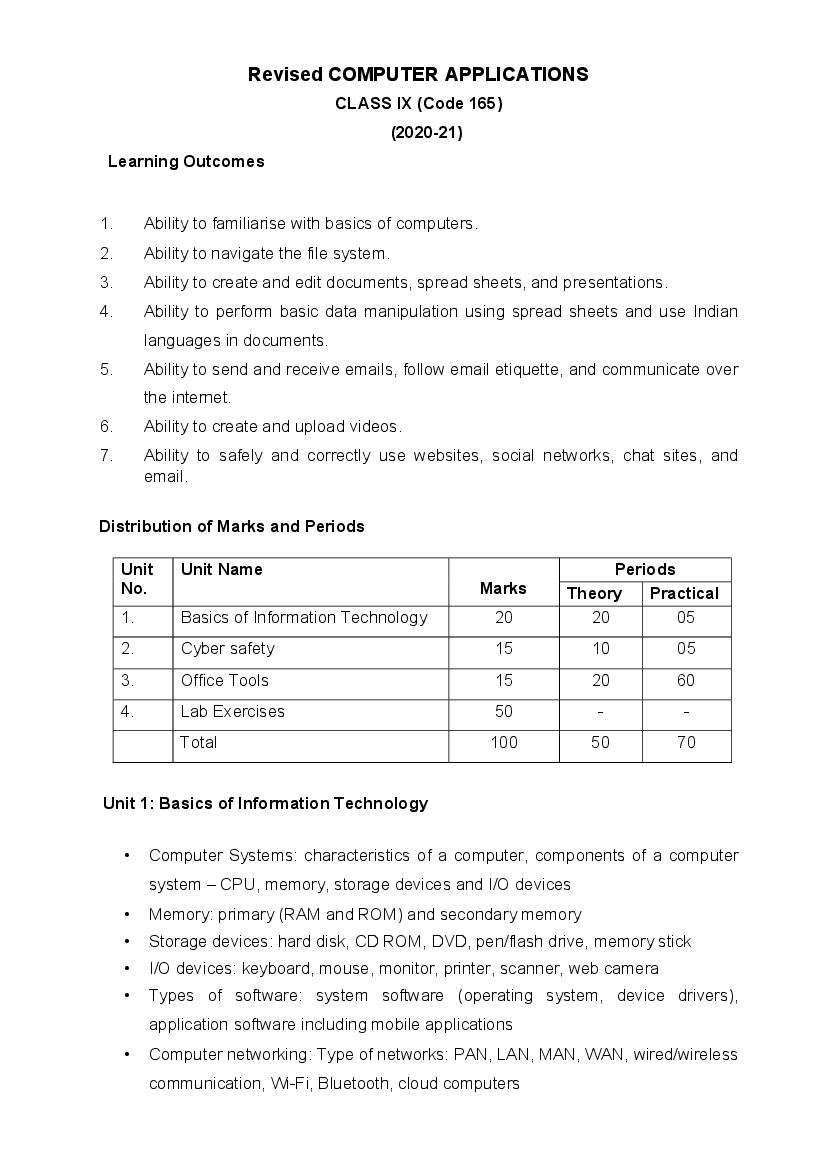
CLASS IX (Code 165)
(2020-21)
Learning Outcomes
1. Ability to familiarise with basics of computers.
2. Ability to navigate the file system.
3. Ability to create and edit documents, spread sheets, and presentations.
4. Ability to perform basic data manipulation using spread sheets and use Indian
languages in documents.
5. Ability to send and receive emails, follow email etiquette, and communicate over
the internet.
6. Ability to create and upload videos.
7. Ability to safely and correctly use websites, social networks, chat sites, and
email.
Distribution of Marks and Periods
Unit Unit Name Periods
No. Marks Theory Practical
1. Basics of Information Technology 20 20 05
2. Cyber safety 15 10 05
3. Office Tools 15 20 60
4. Lab Exercises 50 - -
Total 100 50 70
Unit 1: Basics of Information Technology
• Computer Systems: characteristics of a computer, components of a computer
system – CPU, memory, storage devices and I/O devices
• Memory: primary (RAM and ROM) and secondary memory
• Storage devices: hard disk, CD ROM, DVD, pen/flash drive, memory stick
• I/O devices: keyboard, mouse, monitor, printer, scanner, web camera
• Types of software: system software (operating system, device drivers),
application software including mobile applications
• Computer networking: Type of networks: PAN, LAN, MAN, WAN, wired/wireless
communication, Wi-Fi, Bluetooth, cloud computers
Page 2
• Multimedia: images, audio, video, animation
Unit 2: Cyber-safety
• Safely browsing the web and using social networks: identity protection, proper
usage of passwords, privacy, confidentiality of information, cyber stalking,
reporting cybercrimes
• Safely accessing websites: viruses and malware , adware
Unit 3: Office tools
• Introduction to a word processor: create and save a document.
• Edit and format text: text style (B, I, U), font type, font size, text colour,
alignment of text. Format paragraphs with line and/or paragraph spacing. Add
headers and footers, numbering pages, grammar and spell check utilities,
subscript and superscript, insert symbols, use print preview, and print a
document.
• Insert pictures, change the page setting, add bullets and numbering, borders
and shading, and insert tables – insert/delete rows and columns, merge and
split cells.
• Use auto-format, track changes, review comments, use of drawing tools,
shapes and mathematical symbols.
• Presentation tool: understand the concept of slide shows, basic elements of a
slide, different types of slide layouts, create and save a presentation, and learn
about the different views of a slide set – normal view, slide sorter view and
hand-outs.
• Edit and format a slide: add titles, subtitles, text, background, and watermark,
headers and footers, and slide numbers.
• Insert pictures from files, create animations, add sound effects, and rehearse
timings.
• Spreadsheets: concept of a worksheet and a workbook, create and save a
worksheet.
• Working with a spreadsheet: enter numbers, text, date/time, series using auto
fill; edit and format a worksheet including changing the colour, size, font,
alignment of text; insert and delete cells, rows and columns. Enter a formula
using the operators (+,-,*, /), refer to cells, and print a worksheet.
Page 3
(without compound statements); embed charts of various types: line, pie,
scatter, bar and area in a worksheet.
4. Lab Exercises
• Browser settings for a secure connection
• Working with the operating system: Navigation of the file system using a mouse
and keyboard.
• Word processing: create a text document; create a letter, report, and greeting
card.
• Create a text document with figures in it. It should describe a concept taught in
another course.
• Discuss the following in a text document about the basic organisation of a
computer: CPU, memory, input/output devices, hard disk.
• Create a text document in an Indian language other than English.
• Create a presentation.
• Create a presentation with animation.
• Include existing images/ pictures in a presentation.
• Animate pictures and text with sound effects in a presentation
• Create a simple spreadsheet and perform the following operations: min, max,
sum, and average.
• Create different types of charts using a spreadsheet: line, bar, area and pie.
Breakup of marks for the Practicals:
S.No. Unit Name Marks
1. Lab Test
(30 marks)
Word processing 10
Handling spreadsheets 10
Creating presentations 10
2. Report File + viva
Page 4
• 4 documents each with a word processor,
spreadsheet, and presentation tool
Viva voce (based on the report file) 4
3. Project (that uses most of the concepts that have been learnt)
Total Marks 50
Document Details
| Board / Org | CBSE |
| Exam | Class 9 |
| Type | Syllabus |
| Pages | 4 |
| Updated | 22 Jul 2026 |