AP PGCET 2022 Syllabus Education
Finished viewing? Save it for later —
Download AP PGCET 2022 Syllabus Education (PDF · 13 pages)About AP PGCET 2022 Syllabus Education
AP PGCET 2022 Syllabus Education is available here for free download. Published by APSCHE for Andhra Pradesh Post Graduate Common Entrance Test, this syllabus can be viewed online or downloaded as a PDF (13 pages). Candidates preparing for Andhra Pradesh Post Graduate Common Entrance Test can use AP PGCET 2022 Syllabus Education to understand the exam pattern, the type of questions asked, and the overall difficulty level.
Frequently Asked Questions
How can I download AP PGCET 2022 Syllabus Education?
Open this page and click the Download button to save AP PGCET 2022 Syllabus Education as a PDF. It is completely free on AglaSem Docs.
Is AP PGCET 2022 Syllabus Education free to download?
Yes. AP PGCET 2022 Syllabus Education can be viewed online and downloaded as a PDF free of cost on AglaSem Docs.
How many pages does AP PGCET 2022 Syllabus Education have?
AP PGCET 2022 Syllabus Education contains 13 pages, which you can read online or download together as a single PDF.
Where can I find more Andhra Pradesh Post Graduate Common Entrance Test study material?
You can find more Andhra Pradesh Post Graduate Common Entrance Test question papers, sample papers, syllabus, and answer keys on AglaSem Docs.
AP PGCET 2022 Syllabus Education – Text
Read the full text of this syllabus below — useful to quickly search, copy and reference the content online without downloading the PDF.
📄 View text version (13 pages)
Page 1
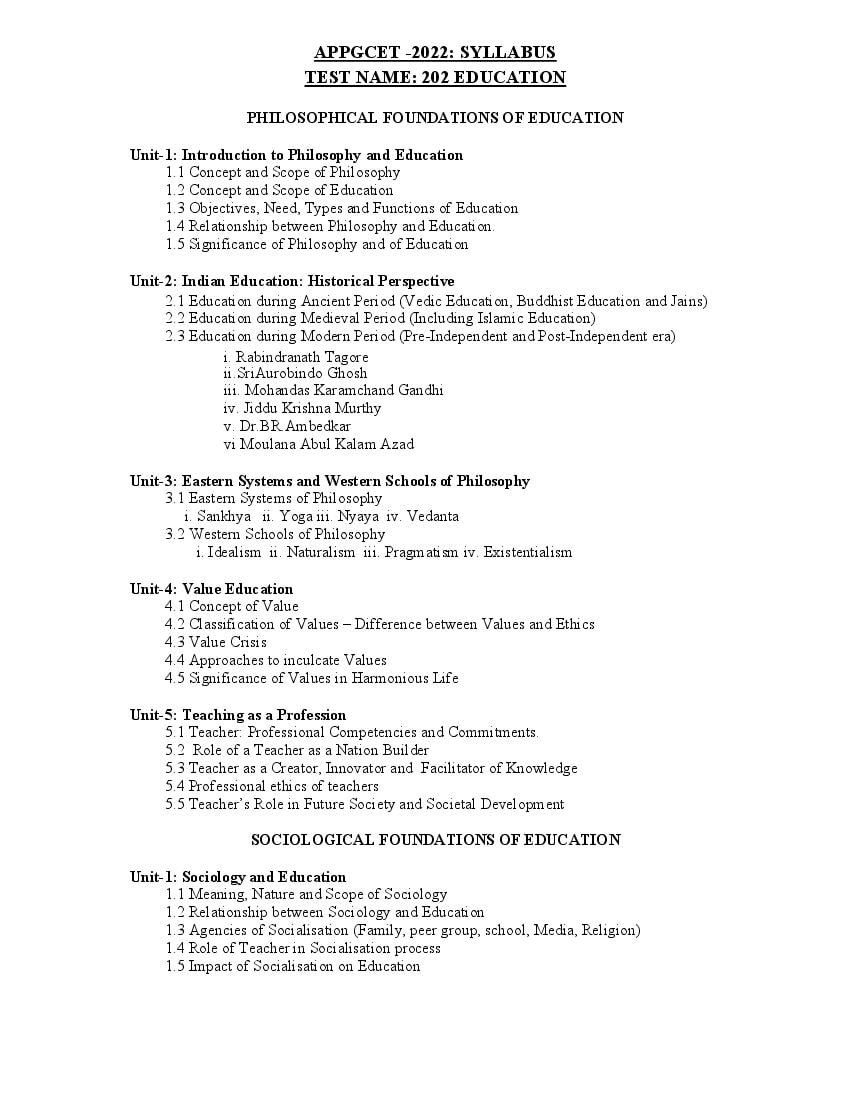
TEST NAME: 202 EDUCATION
PHILOSOPHICAL FOUNDATIONS OF EDUCATION
Unit-1: Introduction to Philosophy and Education
1.1 Concept and Scope of Philosophy
1.2 Concept and Scope of Education
1.3 Objectives, Need, Types and Functions of Education
1.4 Relationship between Philosophy and Education.
1.5 Significance of Philosophy and of Education
Unit-2: Indian Education: Historical Perspective
2.1 Education during Ancient Period (Vedic Education, Buddhist Education and Jains)
2.2 Education during Medieval Period (Including Islamic Education)
2.3 Education during Modern Period (Pre-Independent and Post-Independent era)
i. Rabindranath Tagore
ii.SriAurobindo Ghosh
iii. Mohandas Karamchand Gandhi
iv. Jiddu Krishna Murthy
v. Dr.BR.Ambedkar
vi Moulana Abul Kalam Azad
Unit-3: Eastern Systems and Western Schools of Philosophy
3.1 Eastern Systems of Philosophy
i. Sankhya ii. Yoga iii. Nyaya iv. Vedanta
3.2 Western Schools of Philosophy
i. Idealism ii. Naturalism iii. Pragmatism iv. Existentialism
Unit-4: Value Education
4.1 Concept of Value
4.2 Classification of Values – Difference between Values and Ethics
4.3 Value Crisis
4.4 Approaches to inculcate Values
4.5 Significance of Values in Harmonious Life
Unit-5: Teaching as a Profession
5.1 Teacher: Professional Competencies and Commitments.
5.2 Role of a Teacher as a Nation Builder
5.3 Teacher as a Creator, Innovator and Facilitator of Knowledge
5.4 Professional ethics of teachers
5.5 Teacher’s Role in Future Society and Societal Development
SOCIOLOGICAL FOUNDATIONS OF EDUCATION
Unit-1: Sociology and Education
1.1 Meaning, Nature and Scope of Sociology
1.2 Relationship between Sociology and Education
1.3 Agencies of Socialisation (Family, peer group, school, Media, Religion)
1.4 Role of Teacher in Socialisation process
1.5 Impact of Socialisation on Education
Page 2
2.1 Meaning and definitions of culture
2.2 Characteristics of culture
2.3 Dimensions of culture, cultural lag, cultural pluralism
2.4 Impact of culture on Education
2.5 Role of Education in preservation, transmission and promotion of culture
Unit-III: Social Change and Education
3.1 Meaning and factors responsible for Social change
3.2 Concept and attributes of Modernization
3.3 Social stratification, Social Mobility and Education
3.4 Education as a facilitator for social change
3.5 Social Networking and its implications on social cohesion and education
Unit-IV: Democracy and Education
4.1 Concept and Principles of Democracy
4.2 Equality and equity in Education
4.3 Preamble of the Constitution in relation to Education
4.4 Role of Education in strengthening democracy and democratic citizenship : Teacher as
a democrat
Unit-V: Education and National Integration
5.1 Concept, Need for National Integration
5.2 Education as an instrument for national integration
5.3 Programmes to promote National Integration and International understanding,
5.4 Peace education in schools
5.5 Social Crisis and its Management
CONTEMPORARY INDIA AND EDUCATION
Unit-1 Normative Vision of Indian Education: Indian Constitution
1.1 Constitution of India : Basic Features
i. Fundamental Rights
ii. Directive principles of State policy
iii. Federal Structure
iv. Features and Structure of Indian Education
1.2 Preamble of the Constitution : The Ideals
i. Sovereign Nation
ii. Democratic and Secular polity
iii. Liberty equality and fraternity
iv.Justice : Social, Economic and Political
Unit- 2 Education as Fundamental Right
2.1 Human Rights : Meaning Nature and Classification;
2.2 Right of Children: International Convention and Indian Constitution; Education as
Fundamental Right of Children-2009
2.3 Issues in Implementing RTE-2009: A Critical understanding
i. Issues that affect and negate the children’s right to education (Child Labor:
Street Children, Abandoned and Orphans)
ii. Differently-abled children: Attitude towards the girl child and her participation in
Page 3
Unit-3 Contemporary Indian Schooling: Concerns and Issues
3.1 Equality of Educational Opportunity: Meaning and Nature: Forms of inequality:
Religion, Regional, Caste, Gender and other marginalized groups.
3.2 Inequality in Schooling: Public – Private schools, Rural – urban schools, Mass-elite
schools, single teacher schools and many other forms of in-equal school systems.
Critical understanding of Paradox of Equal opportunity and in-equal schooling: positive
discrimination; concept and issues and policy interventions.
3.3 Schooling: Quality concerns and issues
i. Universal access
ii. Universal Enrollment
iii. Universal retention
iv. Universal success
Unit-4 Understanding Exclusion in schooling
4.1 Exclusion: Meaning and Nature
4.2 Forms of Exclusion: a) physical / Psychological Exclusion
4.3 Different types of differently abled children: Nature of problems and their impact on
learning
4.4 Measure to address the issue of learning of differently abled children and professional
preparedness of Institutions;
4.5 Socio-cultural and economic exclusion: Understanding different forms of socio-culture
and economic exclusion in schooling – Caste, Class, Gender, Minority, and other
Marginalized sections of the society.
Unit- 5 Secondary Education: Concerns and Issues
5.1 Secondary School stage: its linkages with primary and higher secondary stages of
education;
5.2 Aims of Secondary School Stages of Education
5.3 Universalisation of Secondary School stages of Education: Its Status
i. Quantitative expansion , Qualitative consolidation and Equity perspective – A
sociological understanding;
ii. Issues in Secondary school stages of Education :Privatization, Vocationalization
iii. Reforms in Secondary School Stages Education: Curricular , Pedagogical and
Examinations;
5.4 Rashtriya Madhyamika ShikshaAbhiyan (RMSA): Goals and policy intervention for
Quality Secondary School Stages of Education
GENDER, SCHOOL AND SOCIETY
Unit-1: Basics of Gender
1.1 Concept, Meaning, Scope of Gender,
1.2 The difference between Sex and Gender - Gender Discrimination
1.3 The characteristics of patriarchal system and its impact on Wome’s status
1.4 The need and importance of Women’s Education – Benefits
Unit-2: Factors affecting gender Discrimination
2.1 Factors influencing gender differences and practices- inequality in ratio, female
infanticide, feticide, crime, violence.
2.2 Religious, Physical, Sociological, Economic, Political, Legal, employment,
Page 4
2.3 Sociolisation process and its impact on decision making Women / Girls Education
2.4 Rural / Urban /Tribal Societies in relation to girls Education
2.5 Women and Girls status at present in our Society
Unit-3: Historical Perspectives and changing status of Women
3.1 Epic . Vedic age – Kaikeyi, Sathyabhama, Gargi, Maitreyi, Lopamudra etc.
3.2 Medieval age – Rami Lakshmi Bai, Chennamma, Rudramadevi.
3.3 British Age – Victoria, Elizebeth, Noorjahan
3.4 Present Age – Indira Gandhi, SushmaSwaraj, Bandaranayake, Kiranbedi,
KalpanaChawala, Prathibapatil, Meerakumar.
Unit-4: Legal issues of Gender
4.1 Women‟s Rights
4.2 Legal Provisions
4.3 Equality of Sexes
4.4 Education and division of Labour – Home, School, Society, work place
Unit-5: Gender and Education
5.1 Educational provisions specially meant for girls’ Education
5.2 Emerging trends in the field of girls’ Education – Reservations
5.3 Gender as an influencing factor in course choices
5.4 Women empowerment through girls’ education – Need – National Development
PERSPECTIVES IN CHILD DEVELOPMENT
Unit-1: Approaches of Human Development
1.1 Concept of Growth, Development and Maturation
1.2 Principles of Development
1.3 Stages of Growth and Development (Infancy Childhood, Adolescence)
1.4 Dimensions of Growth and Development (Physical, Cognitive, Emotional, Social, Moral,
language)
1.5 Longitudinal and cross sectional approaches of understanding development
Unit-2: Theories of Development
2.1 Cognitive Theory of Development (Piaget)
2.2 Psycho-Socialtheory of development (Erikson).
2. 3 Theory of Moral Development (Kohlberg).
2.4 Theory of Psycho- Sexual Development (Freud).
2.5 Theory of Emotional Development (Goleman).
Unit-3: Childhood as a period of Socialization
3.1 Characteristics of Childhood – developmental tasks.
3.2 Child development – Physical, cognitive, social, emotional, moral and language
development during childhood.
3.3 Child in different socio-cultural contexts.
3.4 Process of socialization – conflicts resolution and social development.
3.5 Stages of Social development – Isolated play, parallel play and social play.
Characteristics of socially matured person.
Unit-4: Adolescence as a period of transition
4.1 Characteristics and Functions in Adolescence
4.2 Genesis of problems during adolescence-Physical, cognitive, emotional, social, moral
and language development.
4.3 Adolescent Groups – Gangs
Page 5
development
4.5 Leadership:Meaning - Types of Leadership, Development of Leadership qualities in
adolescents and its educational implications.
Unit-5: Individual Differences
1.1 Dimensions of Individual differences-cognitive abilities, interests, aptitude, creativity,
personality and values
1.2 Theory of multiple intelligence ( Gardner) – Implications for understanding differences
in children
1.3 Difference in children based on learning styles and socio cultural context (home language
and Instructional language)
1.4 Individual differences based on cognitive abilities – learning difficulties, slow learners
and intellectually challenged, intellectual giftedness - implications for catering to
individual variations in view of “differences” rather than “deficits” perspective.
1.5 Fostering creativity among children.
LEARNING AND TEACHING
Unit-1: Process of Learning
1.1 Concept of learning, types of learning and factors influencing learning
1.2 Learning process: Attention, sensation, perception, and concept formation
1.3 Memory &forgetting: concept, types of memory, applicability to learning and strategies
for better management of memory.
1.4 Transfer of learning: concept, theories and types( Horizontal and Vertical)
1.5 Role of motivation in learning; methods of improving motivation
Unit-2: Behaviourist Perspectives of Learning
2.1 Trial and error - Thorndike, Laws of learning, concept and principles and classroom
implications
2.2 Classical Conditioning - Pavlov, concept and principles and classroom
implications
2.3 Operant Conditioning – Skinner, concept and principles and classroom
implications
2.4 Compare these perspectives in terms of their merits and applicability to classroom
learning
Unit-3: Cognitive and Humanist Perspectives of Learning
3.1 Cognitive perspectives of learning (insight learning – Kohler, Discovery learning -
Bruner, Developmental theory of learning - Piaget, Social Learning - Bandura, Social
constructivism – Vygotsky)
3.2 Humanist perspectives of learning (Learner centered approach – Rogers)
Unit-4: Teaching Process
4.1 Concept of teaching, teaching as a profession and teacher as a professional, teaching as
an art and science
4.2 Distinction between Instruction, training and teaching
4.3 Phases of teaching: planning, execution and reflection
4.4 Role of teacher in teaching learning process: teacher as a model, facilitator, negotiator,
co-learner, reflective practitioner and classroom researcher
4.5 Functions of a teacher in classroom, school and community
Unit-5: Learning Environment and Learning Engagement
5.1 Meaning of learning environment and learning engagement
5.2 Creating positive and productive environment for learning - creation of emotionally
safe learning environment to increase learning
Page 6
5.4 Role of culture in the educative process, creating culturally responsive learning
environment, create cultural congruity between home and school
5.5 Assisted performance, supervised discussion and reciprocal teaching as strategies to
enhance motivation and learning
LEARNING ASSESSMENT
Unit-1: Perspectives on Assessment and Evaluation
1.1 Meaning of Assessment, Measurement, Tests, Examination, Appraisal, and Evaluation
and their interrelationships
1.2 Purpose(s) and principles of Assessment, characteristics of quality assessment
1.3 Current thinking about learning based on Behaviorist, Cognitivist and Constructivist
learning theories and their implications for classroom assessment-changing the culture
of classroom assessment
1.4 Classification of assessment: based on purpose (prognostic, formative, diagnostic and
summative), scope (teacher made, standardized), attribute measured (achievement,
aptitude, attitude, etc.), nature of information gathered (qualitative, quantitative), mode
of response (oral and written; selection and supply), nature of interpretation (self-
referenced, norm-referenced, criterion-referenced) and context (internal, external)
1.5 Policy perspectives on examinations and evaluation: Recommendations in National
Policies of Education and curriculum frameworks- continuous and comprehensive
assessment
Unit-2: Formative and Summative Assessment
2.1 Formative Assessment (FA) meaning, purpose, essential elements (formative
assessment in practice), major barriers to wider use of FA, role of students and teachers
in formative assessments,
2.2 Observation, questioning, reflection on learning as strategies for using assessment in
the process of learning;
2.3 Use of Projects, Assignments, Work sheets, Practical work, Performance-based
activities and Reports as assessment devices; Self, Peer and Teacher assessments- use
of rubrics,
2.4 Summative assessment: meaning, purpose, summative assessment in practice, use of
teacher-made and standardized test
2.5 Aligning formative and summative assessments
Unit-3: Tools of Assessment
3.1 Assessment of cognitive learning: understanding and application; thinking skills
–convergent, divergent, critical, problem solving, and decision making;
3.2 Selected-Response Assessment: Multiple Choice, Binary Choice, and Matching and
Constructed Response Assessment: Completion, Short-Answer, and essay Items as
tools-nature, advantages and limitations, guidelines for their construction and scoring
3.3 Assessment of affective learning: attitude and values, interest, self-concept;
tools and procedures for their assessment; observation, interview, rating scales, check-
lists, inventories as tools/techniques, their uses and preparation
3.4 Assessment of Performance/ project-based assessment- meaning, characteristics, scope;
using rubrics to grade a performance-based assessment
3.5 Portfolios: meaning, types, purposes, guidelines for portfolio entries and assessing
portfolios
Page 7
4.1 Planning: Deciding on what, why and how to assess- difference between instructional,
learning and assessment objectives, stating of assessment objectives , deciding on the
nature and form of assessment - oral tests and written tests; open book examination;
weightage to content, objectives, allocation of time; Preparation of a blue print
4.2 Construction/selection of items: writing test items/questions, reviewing and refining the
items, assembling the test items; writing test directions and guidelines for
administration (if any), Scoring procedure – manual and electronic; Development of
Rubrics
4.3 Administration, item analysis and determining item and test characteristics; Item
response analysis, ascertaining student needs, identifying student interests and feeding
forward for improving learning
4.4 Analysis and Interpretation of Students‟ Performance
Processing test data: graphical representations; calculation of measures of central
tendency and variability, and derived scores- percentiles, percentile rank, percentage
score, grade point averages, z-scores; and Frame of reference for interpretation of
assessment data: norm-referenced, criterion-referenced and self-referenced ie., relative
and absolute interpretation;
4.6 Reporting Student Performance – content and formats; Progress reports, Cumulative
records, Profiles, and Open house; Using feedback for reporting to different
stakeholders – students, parents, and administrators
4.7 Use of Feedback for teachers‟ self-improvement and curriculum revision
Unit-5: Issues, Concerns and Trends in Assessment and Evaluation
5.1 Existing Practices: Class/Unit tests, half- yearly and annual examinations, Board
examinations and Entrance tests, State and National achievement surveys; Management
of assessment and examinations; Use of question bank
5.2 Issues and Problems: Marking Vs Grading, Non-detention policy, Objectivity Vs
Subjectivity; Impact of entrance test and public examination on teaching and learning –
the menace of coaching.
5.3 Trends in assessment and evaluation: Online examination, Computer-based examination
and other technology based examinations
Standards- based assessment – international practices
UNDERSTANDING THE SELF
Unit-1: Self as a human resource:
1.1 Cognitive resources of the self: Self-critical awareness about ones abilities and
opportunities to develop independent thinking-critical thinking and creative thinking,
decision making and problem solving and develop them as skills.
1.2 Affective resources: Feelings of love, joy, appreciation; emotions like fear, anger,
jealousy, affection, happiness to be understood both as assets and threats or limiting
factors.
1.3 Sensitize the ability to identify the structural and functional commonality of the human
body except the organs of reproduction and allied features of the human kind.
1.4 Empathic understanding of geographical, climatic and genetic conditions causing
physical differences.
Page 8
2.1 Self-critical awareness of the causes for one’s positive and negative relations with the
people based on caste, class, language, religion, nation, region etc.,
2.2 Self-critical understanding of the basic realities of the man- made divisions over the
time-scale.
2.3 Critical understanding of the Natures necessity of gender difference for the onset and
continuity of human race.
2.4 Critical understanding of the basic realities of cultural differences across the time-scale
and across the globe.
Unit-3: Self (person) as a part of the Nature:
3.1 Nature, harmony in existence and co-existence
3.2 Dependence of Self on the Nature for the very life; dependence of self on other selves
for comfortable living.
3.3 Responsibility of self towards conservation, protection and enrichment of plant and
animal life.
3.4 Responsibility of self towards other human beings in the family, society, and people
across the globe.
Unit-4: Self in relation to profession:
4.1 Self-critical awareness of teaching competency: adequacy of subject matter knowledge,
professional skills, and effective communication to the students.
4.2 Self-critical awareness of ones attitudes towards students, teaching, teaching material ,
interest in students and subject and ones aptitude in the inculcation of interest in
students and in tapping their abilities to realize the values identified in the lesson.
4.3 Self-critical awareness of suitability of ones role being performed contextually to enrich
learners capabilities and guiding them for self-actualization while interacting.
4.4 Self-critical awareness of involvement in team work with colleagues, head of the
institution parents of learners and management for the development of the learners.
Unit-5: Self- development through self-learning (Self-knowledge):
5.1 Development of self and social identities in the learners to enrich human resources and
self-esteem; Realistic understanding of any self as depending on the source of the
whole existence for spiritual awakening free of any religious identity.
5.2 Objective view of beliefs, prejudices and stereotypes to liberate from irrational
tendencies.
5.3 Understanding human roots in animal and possibility of heights in the divinity through
the philosophers like Swamy Vivekananda, Sri Aurobindo and J. Krishnamurti to
awaken oneself to Truth, beauty and goodness both inside and outside.
5.4 Yogic practices for physical, mental and spiritual health and to lay the seeds or
foundations for Self-realization.
INCLUSIVE EDUCATION
Unit-1: Concept of Inclusive Education
1.1 Inclusive Education – concept, meaning, definition and importance.
1.2 Concept of Impairment, Disability and Handicap
1.3 Concept of Special Education, Integrated Education, Mainstreaming and Inclusive
Education
1.4 Need for Inclusive Education in India for children with special needs.
Page 9
2.1 Concept, types and characteristics of different types of children with special learning
needs:
2.2 Children with Physical challenges– Visual, Hearing, Loco-motor and Neurological.
2.3 Children with Intellectual challenges – Gifted, Mentally Challenged, Autism (ASD)
and Learning Difficulties (LD).
2.4 Children with Emotional and Behavioral deviations with special reference to ADHD
and Juvenile Delinquency.
2.5 Children with Socio- cultural deviations (SC, ST, Minorities) and Linguistic
Minorities.
Unit-3: Identification, Assessment and Educational Provisions
3.1 Identification, assessment and education of Children with physical challenges – Visual,
Hearing, Loco-motor and Neurological.
3.2 Identification, assessment and education of Children with Intellectual challenges
– Gifted, Mentally Challenged, Autism, Learning Difficulties (LD).
3.3 Identification, assessment and education of Children with Emotional and Behavioral
deviations with special reference to ADHD and Juvenile Delinquency.
3.4 Identification, assessment and education of Children with Socio- cultural deviations and
Linguistic minorities.
3.5 Challenges and prospects in Identification and assessment of children in inclusive
education.
Unit-4: Policy Perspectives for Children with Special Needs
4.1 International Legislations –Salmanca Declaration, UNESCAP, UNCRPD
4.2 National Legislations – NPE-1986, PoA-1992, RCI Act-1992, PWD Act-1995 with
latest amendments , National Trust Act-1999, RTE Act-2009
4.3 Government schemes and provisions – SSA, RMSA with special reference to the
provisions and activities aimed at meeting the needs of children with special learning
needs.
Unit-5: Educating Children in Inclusive Classrooms
5.1 Need for creation of physical, psychological, sociological barriers free environment
within and outside the classroom
5.2 Assistive devices and technologies required for education of children with special
needs in inclusive classroom
5.3 Need for parent and community involvement to promote positive behaviours and social
competence in children with special learning needs
5.4 Need for multi-disciplinary approach to address the educational needs of children with
special learning needs
5.5 Challenges and prospects in providing education in inclusive classrooms.
SECTION -C
INFORMATION AND COMMUNICATION TECHNOLOGY (ICT) FOR
ENRICHING TEACHING AND LEARNING
Unit-1: Information and Communication Technology (ICT)
1.1 Educational Technology – Concept, Growth, Objectives, Characteristics, Advantages,
Page 10
1.2 Information Technology - Knowledge Explosion, Preservation and Retrieval
1.3 Communication – Concept, Elements, Process, Barriers & Types – Teaching as
Communication - Communication Technology – Its application in Education
1.4 Instructional Media and Aids – Aural, Print, Visual and multimedia
1.5 Concept, Importance, Characteristics and Scope of Information and Communication
Technology (ICT)
Unit-2: ICT in Education
2.1 Knowledge Acquisition and Multi-sensory approach
2.2 Classroom Communication and Communicative Skills for Teachers and Students –
Flander’s Interaction Analysis Category System
2.3 Individualised Instruction – Concept, Need, Principles and Techniques
2.4 Programmed Learning - Principles, Types, modes of presentation, development,
application and role of teacher
2.5 Changing roles of the learner and the teacher in ICT-Integration and Challenges
Unit-3: Computer Fundamentals and Applications
3.1 Types, Characteristics and features of Computers
3.2 Components of Computers – Hardware, Software, Memory and Maintenance of
computers
3.3 Operating Systems - DOS, Windows and Macintosh and Mobile Apps for Teaching
3.4 Software for Word Processing, Presentation, Statistical & Graphical, Page Layout,
multimedia and webpage creator
3.5 Concept, Applications and Challenges of Computer networks, Internet, E-mail and
Digital Space
Unit-4: ICT Enriched Learning Experiences
4.1 Application of ICT for Enriching Classroom Experiences
4.2 Application and use of Multimedia Educational Software for classroom situations
4.3 Use of Internet based media for teaching and learning enrichment - Acknowledgement
4.4 Project based learning using computers, Internet and Activities
4.5 Collaborative learning using group discussion, projects, field visits, blogs, etc.
Unit-5: Application of Computers in Education
5.1 Computer as a learning tool – Concept of E-learning
5.2 Web 2.0 Technologies-characteristics, types and examples
5.3 Virtual Classroom, Smart Boards, Tools and Opportunities
5.4 Open Educational Resources – Concept and Significance
5.5 Critical issues in Internet usage – Authenticity, Addiction, Plagiarism, Ethical and
Legal Standards
CLASSROOM MANAGEMENT LEADERSHIP AND ACTION RESEARCH
Unit-1: Classroom Organization
1.1 Classroom organization – Meaning and purpose
1.2 Classroom Seating Arrangement for different purposes
1.3 Technology integration – OHP/ LCD, Smart board, Chalk board, White board, Display
boards, multimedia, E-Classroom.
1.4 Characteristics of Classroom Environment - Learner friendly and inclusive
1.5 Management and maintenance of physical and material resources to optimize access to
learning; Sharing of resources – School Complex
Page 11
2.1 Classroom management – concept, need and approaches .
2.2 Managing with different types of students – Leader, Follower, passive
2.3 Classroom behavior management – problems, mistakes, disciplinary practices, corporal
punishments, classroom rules, routines and regulations.
2.4 Violation of rights of children – legal consequences.
2.5 Strategies to manage behavior problems- preventive, supportive and corrective.
2.6 Time management in a classroom – Allocated time, instructional time, engaged time
and Academic learning time.
Unit-3: Role of Teacher in School Functions
3.1 Teacher as a facilitator of learning
3.2 Perspective planning and coordination with authorities for support.
3.3 Accountability and self assessment of teachers and feedback mechanisms.
3.4 Conducive school environment – teamwork, transparency, self-esteem among head
teacher, teachers, students.
Unit-4: Teacher as a Leader
4.1 Concept, Nature and Characteristics of a Leader
4.2 Types of Leadership
4.3 Strategies to develop leadership qualities
4.4 Role of a teacher as a leader in managing classroom dynamics
Unit-5: Action Research in Education
5.1 Action Research – Meaning, Need and Scope
5.2 Steps in Action Research
5.3 Action Research Cycle
5.4 Action Research Problem Areas – Student, Classroom, School, Teacher,
Administration, etc.
ART EDUCATION
. Unit-1: Art and Aesthetics
1.1 Aesthetics – as a branch of Philosophy.
1.2 Aesthetics – its meaning, dimensions and constituents.
1.3 Art as a form of Aesthetics.
1.4 Indian Art and Rasa principle.
1.5 Importance of Arts in Education
Unit-2: Art and Education
2.1 Art as a medium of education.
2.2 Art as a unifying principle in education.
2.3 Art and Society.
2.4 Art and Human development.
2.5 Art for self- expression, keen observation, and sense of appreciation.
Unit-3: Place of Visual Art and Performing Arts in Teaching
3.1 Different forms of visual and performing Arts.
3.2 Teaching as an Art.
3.3 Drama as a form of Teaching.
3.4 Identification of local Art forms and their integration to teaching – learning.
3.5 Evaluation strategies; assessing the different forms of Art.
Page 12
4.1 Rabindranath Tagore
4.2 A.K. Coomara Swamy
4.3 Herbert Read
4.4 Elliot Eisener
Unit-5: Art and Craft in Education
5.1 Art in Craft
5.2 Craft in Art
5.3 Traditional Craft and their relevance to Education
5.4 Local Craft and their place in SUPW
5.5 Indian Festivals and its Artistic significance
ENVIRONMENTAL EDUCATION
Unit-1: Swatch Bharath- an Environmental Awakening
1.1 Meaning, concept, definition of Swatch Bharath
1.2 Evolution of the concept of Swatch Bharath, objectives, its campaign and execution.
1.3 Integration of Swatch Bharath campaign with educational institutions
1.4 Strategies to implement the Swatch Bharath campaign in schools and other educational
institutions.
Unit-2: Objectives, Scope and Nature of Environmental Education
2.1 Meaning, importance, definition, characteristics and objectives of environmental
education
2.2 Importance, objectives, scope and guiding principles of environmental education.
2.3 Factors of degradation of environment – adverse socio –economic impacts of degradation
of environment.
2.4 Types of pollution: Land, Air, Water, Noise, and Radiation
2.5 Green house effect - Ozone layer depletion.
2.6 Importance of need and scope of environmental conservation and regeneration.
2.7 Impact of industry/mining/transport on environment
Unit-3: Environmental Management and Protection
3.1 Need for environmental management – functions and characteristics of
environmental management
3.2 Dimensions of environmental management. Factors responsible for flora and fauna
extinction
3.3 Measures to conserve flora and fauna.- causes for forest fire- measures of prevention
3.4 Major environmental problems in India – Environmental protection and polices in
India.
3.5 Need and objectives of conservation – Environmental conservation measures taken in
India, waste management, alternative sources of energy, organic farming, rain water
harvesting, community participation in nature resource management, water and forests.
3.6 Constitutional amendments made and Environmental laws,
Unit-4: Environmental Movements and Developments
4.1 Environmental movements in India: Silent Valley movement, Chipko movement,
Narmada Bachao, Andolan, National Test Range at Balipal, Orissa.
4.2 Conditions for achieving the goals of sustainable development
4.3 Strategies for sustainable development in India.
Page 13
1982 – The Rio Summit 1992
4.5 The Rio Declaration at the earth charter – Major achievements of the Rio Summit –
Main features of the Rio Declaration
4.6 Kyoto conference and part on Global Warming 1997.
Unit-5: Environmental Education in the School Curriculum and Means to Sensitize the
Students
5.1 Environmental education at Primary, Secondary and Higher Education level
5.2 Major constraints for its implementation at these levels.
5.3 Teacher’s role – National Resource centre for Environmental Education.
5.4 Characteristics of good teaching method.
5.5 Seminar, Workshop, Problem–Solving, Field Trips and Surveys, Projects, Exhibition
and other methods.
5.6 Relative efficiency of Teaching Methods, Role of IT and Media in environment and
human health.
**************
Document Details
| Board / Org | APSCHE |
| Exam | Andhra Pradesh Post Graduate Common Entrance Test |
| Type | Syllabus |
| Pages | 13 |
| Updated | 22 Jul 2026 |