WBJEE 2026 Syllabus
Finished viewing? Save it for later —
Download WBJEE 2026 Syllabus (PDF · 16 pages)About WBJEE 2026 Syllabus
WBJEE 2026 Syllabus is available here for free download. Published by WBJEEB for West Bengal Joint Entrance Examination, this syllabus can be viewed online or downloaded as a PDF (16 pages). Candidates preparing for West Bengal Joint Entrance Examination can use WBJEE 2026 Syllabus to understand the exam pattern, the type of questions asked, and the overall difficulty level.
Frequently Asked Questions
How can I download WBJEE 2026 Syllabus?
Open this page and click the Download button to save WBJEE 2026 Syllabus as a PDF. It is completely free on AglaSem Docs.
Is WBJEE 2026 Syllabus free to download?
Yes. WBJEE 2026 Syllabus can be viewed online and downloaded as a PDF free of cost on AglaSem Docs.
How many pages does WBJEE 2026 Syllabus have?
WBJEE 2026 Syllabus contains 16 pages, which you can read online or download together as a single PDF.
Where can I find more West Bengal Joint Entrance Examination study material?
You can find more West Bengal Joint Entrance Examination question papers, sample papers, syllabus, and answer keys on AglaSem Docs.
WBJEE 2026 Syllabus – Text
Read the full text of this syllabus below — useful to quickly search, copy and reference the content online without downloading the PDF.
📄 View text version (16 pages)
Page 1
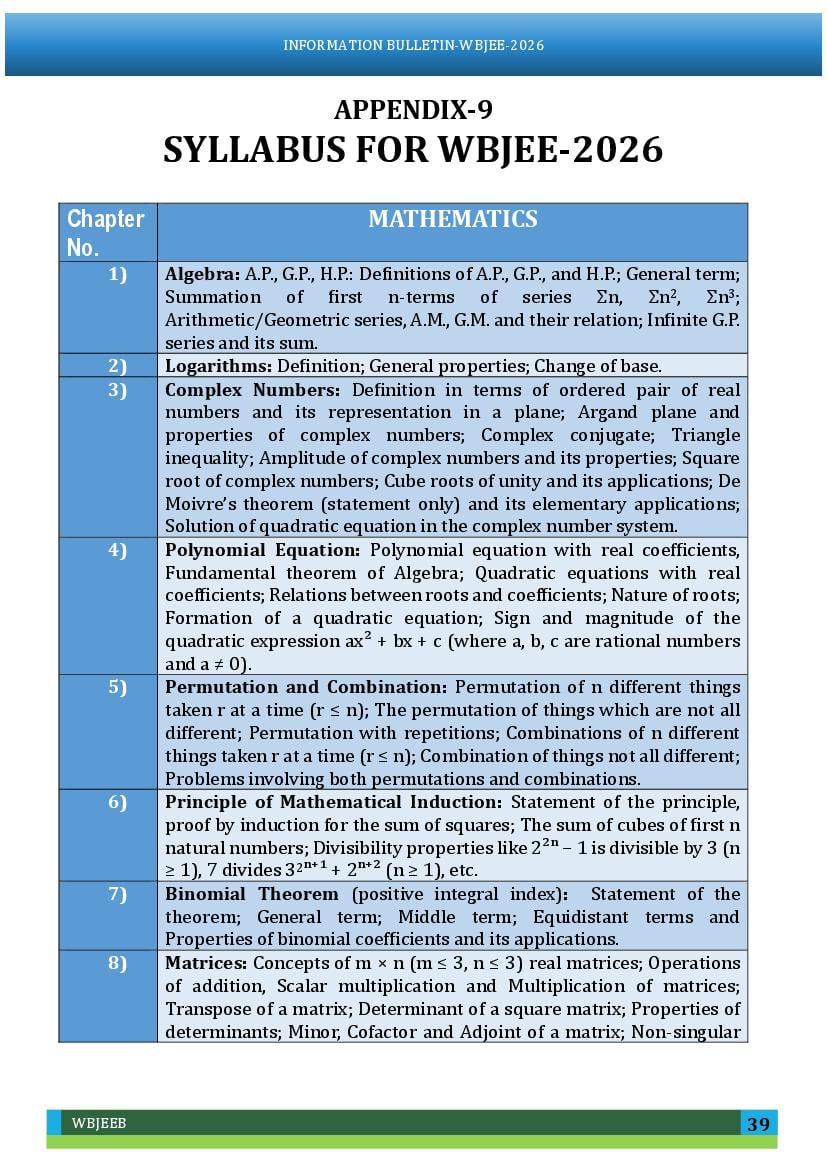
SYLLABUS FOR WBJEE-2026
Chapter MATHEMATICS
No.
1) Algebra: A.P., G.P., H.P.: Definitions of A.P., G.P., and H.P.; General term;
Summation of first n-terms of series Σn, Σn2, Σn3;
Arithmetic/Geometric series, A.M., G.M. and their relation; Infinite G.P.
series and its sum.
2) Logarithms: Definition; General properties; Change of base.
3) Complex Numbers: Definition in terms of ordered pair of real
numbers and its representation in a plane; Argand plane and
properties of complex numbers; Complex conjugate; Triangle
inequality; Amplitude of complex numbers and its properties; Square
root of complex numbers; Cube roots of unity and its applications; De
Moivre’s theorem (statement only) and its elementary applications;
Solution of quadratic equation in the complex number system.
4) Polynomial Equation: Polynomial equation with real coefficients,
Fundamental theorem of Algebra; Quadratic equations with real
coefficients; Relations between roots and coefficients; Nature of roots;
Formation of a quadratic equation; Sign and magnitude of the
quadratic expression ax² + bx + c (where a, b, c are rational numbers
and a ≠ 0).
5) Permutation and Combination: Permutation of n different things
taken r at a time (r ≤ n); The permutation of things which are not all
different; Permutation with repetitions; Combinations of n different
things taken r at a time (r ≤ n); Combination of things not all different;
Problems involving both permutations and combinations.
6) Principle of Mathematical Induction: Statement of the principle,
proof by induction for the sum of squares; The sum of cubes of first n
natural numbers; Divisibility properties like 2²ⁿ − 1 is divisible by 3 (n
≥ 1), 7 divides 32ⁿ⁺¹ + 2ⁿ⁺² (n ≥ 1), etc.
7) Binomial Theorem (positive integral index): Statement of the
theorem; General term; Middle term; Equidistant terms and
Properties of binomial coefficients and its applications.
8) Matrices: Concepts of m × n (m ≤ 3, n ≤ 3) real matrices; Operations
of addition, Scalar multiplication and Multiplication of matrices;
Transpose of a matrix; Determinant of a square matrix; Properties of
determinants; Minor, Cofactor and Adjoint of a matrix; Non-singular
WBJEEB 39
Page 2
(Not more than 3 variables); Application of Determinants in finding
the area of triangle.
9) Sets, Relations and Mappings: Concept of sets; Subsets, Power set,
Complement, Union, Intersection, Difference and Symmetric
difference of sets; Venn diagram; De Morgan’s Laws; Inclusion /
Exclusion formula for at most three sets; Cartesian product of sets.
10) Relation and its Properties: Equivalence relation — definition and
elementary examples; Mapping; Range and Domain; Injective,
Surjective, and Bijective mappings; Composition of mappings; Inverse
of a mapping.
11) Statistics and Probability: Measure of dispersion; Mean; Variance
and Standard deviation; Frequency distribution; Notion of
probability; Addition and Multiplication rules of probability;
Conditional probability and Bayes’ Theorem; Independence of events;
Repeated independent trials and Binomial distribution.
12) Trigonometry: Trigonometric functions; Compound angles; Addition
and Subtraction formulae; Formulae involving Multiple and
Submultiple angles; General solution of trigonometric equations;
Inverse trigonometric functions and their properties.
13) Coordinate Geometry of Two Dimensions:
Coordinates: Distance formula; Section formula; Area of a triangle;
Condition of collinearity of three points in a plane; Polar coordinates;
Transformation from Cartesian to polar coordinates and vice versa;
Parallel transformation of axes; Concept of locus; Problems on Locus
involving familiar geometrical configurations.
14) Straight Lines: The slope of a straight line; Equation of straight lines
in different forms; The angle between two straight lines; Condition of
perpendicularity and parallelism of two straight lines; Distance of a
point from a straight line; Distance between two parallel straight lines;
Straight lines through the point of intersection of two straight lines;
Equations of bisectors of angles between two straight lines.
15) Circle & Conic Sections: Equation of a circle with a given centre and
radius; Condition that a general equation of second degree in x, y may
represent a circle; Equation of a circle in terms of endpoints of a
diameter; Parametric equation of a circle; Equation of tangent, normal
and chord of a Circle; The intersection of a straight line with a circle;
Equation of common chord and common tangent of two intersecting
circles; Definition of conic section; Directrix; Focus and Eccentricity;
Classification based on eccentricity; Equation of Parabola, Ellipse and
WBJEEB 40
Page 3
parametric equations.
16) Co-ordinate Geometry of Three Dimensions: Direction cosines and
Direction ratios; Distance between two points and Section formula;
Equation of a straight line; Equation of a plane and Distance of a point
from a plane and straight lines; Angle between two straight lines;
Shortest distance between two skew lines.
17) Calculus:
Differential Calculus: Functions; Domain and Range of functions;
Composition of two functions and Inverse of a function; Basic
properties of functions; Limit; Continuity; Differentiability;
Derivative; Chain rule and Derivative of functions in various forms;
Concept of differential and its applications; Second order derivative.
18) Rolle's Theorem and Lagrange's Mean Value Theorem (statement
only). Their geometric interpretation and Elementary application;
L'Hospital's rule (statement only) and applications.
19) Integral Calculus: Integration as a reverse process of differentiation;
Indefinite integral of standard functions; Integration by parts;
Integration by substitution and Partial fraction; Definite integral as a
limit of a sum with equal subdivisions; Fundamental theorem of
integral calculus and its applications; Properties of definite integrals.
20) Differential Equations: Formation of ordinary differential equations;
Order and Degree of differential equations; Solution of homogeneous
differential equations; Separation of variables method; Linear first
order differential equations.
21) Application of Calculus: Differential coefficient as a measure of rate;
Determination of monotonicity of functions; Maxima and Minima of
functions; Tangent and Normal; Conditions of tangency; Motion in a
straight line with constant acceleration; Calculation of area bounded
by elementary curves and Straight lines; The area of the region
included between two elementary curves.
22) Vectors: Addition of vectors; Scalar multiplication; Dot and Cross
products; Scalar triple product; Geometrical interpretation of these
products and their applications.
WBJEEB 41
Page 4
No.
1) Physical World, Measurements, Units & dimensions: Physical
World, fundamental and derived units.
Units & Dimensions of physical quantities, dimensional analysis & its
applications.
Need for measurement, units of measurement, accuracy and precision
of measurements, error in measurement, rounding off and order of
magnitude, significant figures and their application.
2) Motion in one dimension and two dimensions: Inertial frame and
non-inertial frame of reference, motion in a straight line, elementary
differential and integral calculus for describing motion, position- time,
velocity- time and relevant graphs. Uniformly accelerated motion and
its associated graphical representations. Instantaneous velocity and
relation for uniformly accelerated motion (graphical and calculus
treatment).
3) Motion in a Plane
Scalars and vectors, representation of vectors in 3D, dot and cross
product and their application, resolution of vectors, rectangular and
non-rectangular.
Relative velocity, Motion in a plane, cases of uniform velocity and
uniform acceleration, uniformly accelerated motion (using graphical
and calculus methods), projectile motion and inclined plane.
4) Laws of Motion
Force and inertia, Newton’s laws of motion, impulse and impulsive
force, Conservation of linear momentum with applications, Concept of
free body diagram and its application, Equilibrium of concurrent force,
Static and Kinetic friction, laws of friction, ideas of coefficient of
friction, rolling friction.
Dynamics of uniform circular motion, centripetal and centrifugal
forces and their applications, banking of roads,
5) Work, power, energy: Work, power, energy, work-energy theorem
with constant and variable forces, work done by constant & variable
forces, potential energy (PE) & kinetic energy (KE), conservation of
mechanical energy, conservative and nonconservative forces, PE of a
spring, motion in a vertical circle, elastic and inelastic collisions in one
and two dimensions.
6) Motion of system of particles and rigid body: Centre of mass of the
two- particle system, motion of the connected system, torque, angular
momentum, law of conservation of angular momentum and its
WBJEEB 42
Page 5
with idea of radius of gyration, moments of inertia of simple geometric
bodies [without derivation], parallel and perpendicular axis theorem
and their applications.
7) Gravitation: Universal law of gravitation, acceleration due to gravity
(g), variation of g, Kepler’s laws and applications, gravitational
potential & PE, escape velocity, orbital velocity of satellites, time period
of satellites, geostationary satellites.
8) Bulk properties of matter: Elasticity, Hooke’s law, Young’s modulus,
bulk modulus, idea of compressibility, shearing modulus, Poisson’s
ratio, elastic potential energy of stretched string and extended spring,
Fluid pressure: Pressure due to a fluid column, buoyancy, Pascal’s law,
effect of gravity on fluid pressure.
Surface tension: Surface energy, phenomena involving surface tension,
excess pressure, application of surface tension for drops and bubbles,
angle of contact, and capillary rise.
9) Viscosity: Coefficient of viscosity, streamline & turbulent motion,
Reynolds’ number, Stokes’ law, terminal velocity, Bernoulli’s theorem
and its applications.
10) Heat & Thermal Physics: Heat & temperature, thermal expansion of
solids. Liquids & gases, ideal gas laws, isothermal & adiabatic
processes; anomalous expansion of water & its effects, sp. heat
capacity,
Calorimetry: change of state, specific latent heat capacity. Heat
transfer: conduction, convection and radiation, conduction of heat
through slabs in series and parallel combination and the idea of
equivalent thermal conductance.
Black body radiation, Kirchhoff’s law, thermal conductivity, Newton’s
law of cooling, Wien’s displacement law, Stefan’s law and Boltzmann’s
correction.
11) Thermodynamics: Thermal equilibrium (Zeroth law of
thermodynamics), concept of heat, external work and internal energy.
1st law of thermodynamics, CP and CV determination and relation
between them, isothermal & adiabatic processes and relation
equations, P-V diagrams, calculation of external works.
2nd law of thermodynamics, reversible & irreversible processes, Carnot
engine and its efficiency, efficiency of refrigerator (only qualitative
idea).
12) Kinetic theory of gases: Equation of state of a perfect gas, kinetic
theory of gases, assumptions in Kinetic theory of gases, concept of
WBJEEB 43
Page 6
freedom, law of equipartition of energy (introductory ideas) &
application to specific heats of gases; mean free path, Avogadro’s
number.
13) Oscillations & Waves: Periodic motion – time period, frequency, time-
displacement equation, Simple harmonic motion (S.H.M) & its
equation; phase; SHM in different systems, restoring force & force
constant, energy in S.H.M.-KE & PE, determination of time period of
simple pendulum, loaded spring, liquid-filled U-tubes, floating body in
liquid, vertical SHM.
Free, forced & damped oscillations (introductory ideas), resonance
wave motion, equation for progressive wave, longitudinal & transverse
waves, sound waves.
Newton’s formula & Laplace’s correction, factors affecting the velocity
of sound in air, principles of superposition of waves, reflection of
waves, standing waves in strings & organ pipes, fundamental mode,
harmonics &overtones, beats, Doppler effect of sound.
14) Electrostatics: Conservation of electric charges, Coulomb's law force
between two-point charges, forces between multiple charges;
superposition principle & continuous charge distribution.
Electric field: electric field due to a point charge, electric field lines.
Electric dipole, electric field due to a dipole (at a point on its axis, at a
point on its perpendicular bisector, at any point), and torque on a
dipole in a uniform electric field.
Electric flux, statement of Gauss's theorem and its application to find
the field due to an infinitely long straight wire, a uniformly charged
infinite plane sheet, and a uniformly charged thin spherical shell (field
inside and outside).
Electric potential, potential difference, relation between electric field
intensity and potential, electric potential: due to a point charge, a
dipole and a system of point charges, equipotential surface and its
properties, electrical potential - energy of a system of two-point
charges and of an electric dipole in an electrostatic field.
Conductors and insulators, free charges and bound charges inside a
conductor. Dielectrics and electric polarization.
Capacitors and capacitance are a combination of capacitors in series
and in parallel. Capacitance of parallel plate capacitors with or without
a dielectric medium between the plates. Capacitances of solid and
hollow spherical capacitors. Energy is stored in a capacitor. Examples
of capacitors in our daily life (only qualitative ideas).
WBJEEB 44
Page 7
metallic conductor. Drift velocity, mobility and their relation with
electric current. Ohm's law, electrical resistance, resistivity and
conductivity. V-I characteristics for ohmic resistance, temperature
dependence of resistance.
Series, parallel and mixed grouping of resistances. Internal resistance
of a cell, potential difference and emf of a cell, combination of cells in
series and in parallel and in mixed grouping.
Parallel combination of two cells of unequal emfs, series combination
of n cells of unequal emfs.
Kirchhoff's law and simple applications.
Wheatstone bridge principle, Meter Bridge principle (end error
correction not required). Potentiometer: principle and its applications
to measure the potential difference and for comparing emfs of two
cells, and measurement of the internal resistance of a cell.
16) Magnetic effect of current and Magnetism: Concept of magnetic
field, Oersted's experiment, Biot - Savart law & its application to
current carrying circular loop; Ampere's law & its applications to
infinitely long straight wire, straight and toroidal solenoids; force on a
moving charge in uniform magnetic & electric fields, cyclotron
frequency; force on a current-carrying conductor in a uniform
magnetic field, force between two parallel current-carrying
conductors-- definition of ampere. Torque experienced by a current
loop in a uniform magnetic field; moving coil galvanometer current
sensitivity & conversion to ammeter & voltmeter, Inter-conversion of
voltmeter & ammeter & change of their ranges.
Current loop as a magnetic dipole & its magnetic dipole moment,
magnetic dipole moment of a revolving electron, magnetic field
intensity due to a magnetic dipole bar magnet along its axis &
perpendicular to its axis, torque on a magnetic dipole (bar magnet) in
a uniform magnetic field; magnet as an equivalent solenoid, magnetic
field lines; Earth's magnetic field & its magnetic elements.
Magnetic properties of a material: magnetic permeability, magnetic
susceptibility, intensity of magnetisation, magnetic retentivity and
coercivity. Hysteresis: B – H loop and its significance (only qualitative
idea).
Para-, dia- & ferromagnetic substances, with examples.
Electromagnets & the factors affecting their strengths, permanent
magnets.
17) Electromagnetic induction & alternating current: Electromagnetic
induction, concept of magnetic flux.
WBJEEB 45
Page 8
Concept of self and mutual inductance, self-inductance of a solenoid
and mutual inductance of two coaxial solenoids (qualitative ideas).
Alternating current, peak and RMS values of alternating
current/voltage, reactance and impedance.
Concept of phasor diagram: only resistive circuit, only inductive circuit,
only capacitive circuit.
LR circuit, CR circuit, and LCR series circuit, resonance
LC oscillator (qualitative idea only).
Power in an AC circuit, power factor in an AC circuit, wattless current.
AC generator and transformer.
18) Electromagnetic waves: Basic idea of displacement current.
Electromagnetic waves and their characteristics (qualitative ideas
only).
Transverse nature of electromagnetic waves, electromagnetic
spectrum, applications of the waves from the different parts of the
spectrum, Basic idea of displacement current.
19) Optics I (Ray optics): Reflection of light, spherical mirrors, mirror
formula. Refraction of light, total internal reflection & its applications,
optical fibres, refraction at spherical surfaces, lenses, thin lens formula,
lens maker’s formula. Newton's relation: Displacement method to find
the position of images (conjugate points), Magnification, power of a
lens,
A combination of thin lenses in contact, a combination of a lens & a
mirror.
Refraction and dispersion of light through a prism; optical
instruments, image formation & accommodation, correction of eye
defects (myopia, hypermetropia) using lenses, microscopes &
astronomical telescopes (reflecting & refracting) & their magnifying
powers.
20) Optics II (Wave Optics): Wave front and Huygens' principle, reflection
and refraction of a plane wave at a plane surface using Huygens'
principle.
Interference: interference of monochromatic light by double slits –
Young’s experiment, conditions for sustained interference of light –
coherent sources, conditions of maxima and minima in terms of path
difference and phase difference, expression for the fringe width.
Diffraction: Fraunhoffer's diffraction due to a single slit, width of the
central maximum.
WBJEEB 46
Page 9
Polarisation, plane polarised light. Brewster's law uses plane-polarised
light and a polaroid.
The scattering of the light-blue colour of the sky is an elementary
example of the Raman effect.
Particle nature of light & wave-particle dualism: Particle nature of light,
Photoelectric effect, Hertz and Lenard’s observations; Einstein’s
photoelectric equation
Matter waves; wave nature of particles, De Broglie relation and its
simple applications.
21) Atomic Physics: Alpha-particle scattering experiment, Rutherford's
nuclear atom model of atom; Bohr model of hydrogen atom, energy
levels in a hydrogen atom, hydrogen spectrum, continuous &
characteristic X-rays, Moseley’s law.
22) Nuclear Physics: Composition & size of nucleus, atomic masses,
isotopes, isobars; isotones, radioactivity - alpha, beta & gamma
particles/ rays & their properties; radioactive decay law; mass-energy
relation, mass defect; binding energy per nucleon & its variation with
mass number; chain reaction, nuclear fission & fusion.
23) Solid state Electronics: Band theory of solids (qualitative ideas only),
classification of conductors, insulators & semiconductors in terms of
band theory; Intrinsic and extrinsic semiconductors, Band Diagram.
24) Semiconductor diode: P-N junction diode, I-V characteristics in
forward & reverse bias, diode as a rectifier; basic construction and I-V
characteristics of LED, photodiode, solar cell.
Zener diode: I-V characteristics, Zener diode as a voltage regulator.
Bipolar junction transistor (BJT), transistor action, characteristics of a
BJT, BJT as an amplifier (CE configuration) & oscillator.
Logic gates (OR, AND, NOT, NAND & NOR) and their simple
combinations.
WBJEEB 47
Page 10
No.
1) Some Basic Concepts of Chemistry
Laws of chemical combination. Concept of elements, atoms and
molecules. Atomic and molecular masses. Mole concept and molar
mass, percentage composition, empirical and molecular formula,
chemical reactions, stoichiometry and calculations based on
stoichiometry. Different concentration terms of solutions and related
calculations.
2) Structure of an Atom
Bohr’s model and its limitations, concept of shell and sub-shells, dual
nature of matter and light, de Broglie’s relationship, Heisenberg
uncertainty principle, Schrodinger wave equation (elementary idea
only). Concept of orbitals, quantum numbers, shapes of s, p and d
orbitals, rules for filling electrons in orbitals: Aufbau principle, Pauli’s
exclusion principle and Hund’s rule, exchange energy, electronic
configuration of an atom, stability of half-filled, completely filled
orbitals.
3) Classification of Elements and Periodicity in Properties
Modern periodic law and the present form of the periodic table;
periodic trends in the properties of elements – atomic radii, ionic radii,
van der Waals’ radii, ionization enthalpy, electron gain enthalpy,
electronegativity, valency. Nomenclature of elements with atomic
number greater than 100.
4) Chemical Bonding and Molecular Structure
Valence electrons, ionic bond, bond parameters, covalent bond, Lewis
structure, formal charge, polar character of covalent bond, covalent
character of ionic bond, valence bond theory, resonance, geometry of
covalent molecules, VSEPR theory, concept of hybridization involving s,
p and d orbitals and shapes of some simple molecules, intermolecular
interactions (dipolar interactions, London dispersion forces, van der
Waals’ interactions), intra- and intermolecular hydrogen bonding,
Molecular orbital theory of homonuclear diatomic molecules (H2, He2,
O2, N2, F2 – qualitative idea only)
5) States of Matter - Solids and Gases
Classification of solids (elementary idea): molecular, ionic, covalent and
metallic solids, amorphous and crystalline solids (elementary idea),
unit cell in two-dimensional and three-dimensional lattices, packing
efficiency, calculation of density of unit cell, packing in solids, voids,
number of atoms per unit cell in a cubic unit cell, point defects.
WBJEEB 48
Page 11
Graham’s law, deviation from ideal behaviour and van der Waals’
equation of state, Liquefaction of gases, critical parameters.
6) Chemical Thermodynamics
Concepts of system (including types of system), surroundings. Work,
heat, energy, extensive and intensive properties, state function, Zeroth
law of thermodynamics and definition of temperature. The first law of
thermodynamics – internal energy change (∆U) and enthalpy change
(∆H), Enthalpy of bond dissociation, combustion, formation,
atomization, ionization, solution and sublimation. Transformation of
state. Hess’s law of constant heat summation, Born Haber Cycle and its
application. 2nd law of thermodynamics, the introduction of entropy as
a state function, Gibbs free energy change for spontaneous and non-
spontaneous processes, criteria for equilibrium.
7) Equilibrium
Equilibrium in physical and chemical processes, dynamic nature of
equilibrium, law of mass action, equilibrium constant, factors affecting
equilibrium – Le Chatelier’s principle; ionic equilibrium, ionisation of
acids and bases, strong and weak electrolytes, degree of ionisation of
polybasic acids, acid strength, concept of pH, Henderson Equation.
Hydrolysis of salts (elementary idea). Buffer solutions, buffer action,
solubility product, common ion effect (with illustrative examples).
8) Solutions
Introduction, solubility of gases in liquids, solid solutions, vapour
pressure and Raoult’s law. Colligative properties: relative lowering of
vapour pressure, elevation of boiling point, depression of freezing point,
and osmotic pressure. Determination of molecular mass using
colligative properties. Abnormal molecular mass, van’t Hoff factor and
calculations involving it. Colloidal solution, true solutions, colloids and
suspensions.
9) Chemical Kinetics
Rate of a reaction (average and instantaneous), factors affecting the rate
of reaction: concentration, temperature and catalyst. Order and
molecularity of a reaction. rate law and specific rate constant,
integrated rate equations and half-life (only for zero and first order
reactions), Arrhenius equation, activation energy, the concept of
collision theory (elementary idea, no mathematical treatment).
Catalysis, homogeneous and heterogeneous catalysis, enzyme catalysis.
10) Redox Reactions
WBJEEB 49
Page 12
balancing redox reactions in terms of loss and gain of electrons and
change in oxidation number, applications of redox reactions in
permanganometry and dichromatometry.
11) Electrochemistry
Conductance in electrolytic solutions, specific and molar conductivity,
variation of conductivity with concentration, Kohlrausch’s law,
electrolysis and laws of electrolysis (elementary idea), dry cell –
electrolytic cells and Galvanic cells, emf of a cell, standard electrode
potential, Nernst equation and its application to chemical cells, relation
between Gibbs free energy change and emf of a cell, fuel cells, Li-ion
battery.
12) Organic Chemistry: Some Basic Principles
General introduction, classification and IUPAC nomenclature of organic
compounds.
Electronic displacements in a covalent bond: inductive effect, resonance
and hyperconjugation. Homolytic and heterolytic fission of covalent
bonds: free radicals, carbocations and carbanions, electrophiles and
nucleophiles.
Types of organic reactions: elementary idea of addition, elimination and
substitution reactions.
13) Hydrocarbons: Classification of Hydrocarbons
Alkanes –Nomenclature, isomerism, conformations (ethane only),
physical properties (up to 6 carbons) and chemical reactions including
halogenations, free radical mechanism, combustion and pyrolysis.
Alkenes – Nomenclature, structure of double bond (ethene),
geometrical isomerism, physical properties (up to 3 carbons) and
methods of preparation. Chemical reactions: addition of hydrogen,
halogen, water, hydrogen halides (Markovnikov’s addition and peroxide
effect), ozonolysis and oxidation. Mechanism of electrophilic addition.
Alkynes – Nomenclature, structure of triple bond (ethyne), physical and
chemical properties (up to 3 carbons) and preparation, Chemical
reactions; addition of hydrogen, halogens, hydrogen halides and water.
Aromatic hydrocarbons – Introduction, IUPAC nomenclature.
Benzene; resonance, Huckel’s rule and aromaticity, chemical properties,
mechanism of electrophilic substitution – nitration, sulphonation,
halogenations, Friedel-Crafts alkylation and acylation.
WBJEEB 50
Page 13
Haloalkanes:
Nomenclature, nature of C-X bond, physical and chemical properties,
and mechanism of substitution reactions. Stability of carbocations. R/S
and D/L configurations. Uses and environmental effects of
dichloromethane, trichloromethane, tetrachloromethane, iodoform,
and freons.
15) Haloarenes:
Nature of C-X bond, substitution reaction (directive influence of halogen
for monosubstituted compounds only), stability of carbocations. Uses
and environmental effects of DDT.
16) Alcohols, Phenols and Ethers
Alcohols:
Nomenclature, methods of preparation, physical and chemical
properties (primary alcohols only), identification of primary, secondary
and tertiary alcohols, mechanism of dehydration, uses of methanol and
ethanol.
17) Phenols:
Nomenclature, methods of preparation, physical and chemical
properties, acidic nature of phenols, electrophilic substitution reaction,
and uses of phenolic compounds.
18) Ethers:
Nomenclature, methods of preparation, physical and chemical
properties, and uses.
19) Aldehydes, Ketones and Carboxylic Acids
Aldehydes and Ketones:
Nomenclature, nature of carbonyl group, methods of preparation,
physical and chemical properties, mechanism of nucleophilic addition,
reactivity of alpha hydrogen in aldehydes, and uses.
20) Carboxylic Acids:
Nomenclature, acidic nature, methods of preparation, physical and
chemical properties, and uses.
21) Organic compounds containing Nitrogen
22) Nitro compounds:
General methods of preparation and reduction reactions.
Amines:
WBJEEB 51
Page 14
physical and chemical properties, uses, identification of primary,
secondary and tertiary amines.
23) Cyanides and Isocyanides:
Nomenclature, structure, methods of preparation, and chemical
reactions (hydrolysis and reduction reactions only).
24) Diazonium salts:
Preparations, chemical reactions and importance in synthetic organic
chemistry.
Biomolecules
25) Carbohydrates:
Classification (aldoses and ketoses), monosaccharides (glucose and
fructose), D/L configuration, oligosaccharides (sucrose),
polysaccharides (starch, cellulose)
26) Proteins:
Elementary idea of α-amino acids, zwitterionic structures of amino
acids, peptide bonds, polypeptides, structure of proteins (primary
structure only), denaturation of proteins, and enzymes.
27) Nucleic Acids:
DNA & RNA (introduction and basic concept)
28) Polymers
Classification (natural and synthetic), methods of polymerisation
(addition and condensation), and copolymerization. Some important
polymers like polythene, nylon, polyesters, Bakelite, and rubber.
Biodegradable and non- biodegradable polymers.
29) s-Block Elements (Group 1 and Group 2 elements)
Electronic configuration, occurrence, trends in the variation of
properties (such as ionization enthalpy, atomic and ionic radii), trends
in chemical reactivity with oxygen, water, hydrogen and halogens,
hydrides (ionic, covalent and interstitial), hydrogen peroxide
(preparation, properties, structure & use), hydrogen as a fuel. Biological
importance of Na, K, Mg, and Ca.
30) p-Block Elements
WBJEEB 52
Page 15
occurrence, variation in properties, oxidation states, and trends in
chemical reactivity.
31) Group 13: Boron-physical and chemical properties of compounds of
Boron, boron oxides, boric acid, borates, B2H6 and inorganic graphite.
Aluminum: Reactions of Al with acid and alkali, uses of Al, preparation
and uses of LiAlH4 and Al2O3.
Group 14: Carbon: Catenation, allotropic forms, nano carbon,
graphene, physical and chemical properties of two oxides of carbon- CO
and CO2,
Silicon: Some compounds of silicon and their important uses –silicon
tetrachloride (structure, preparation, hydrolysis and reduction reaction
only), silicates [structure of open chain silicates constructing of
(SiO3)𝑛2𝑛− ions], use of zeolites.
Group 15 : General introduction, electronic configuration,
occurrence, oxidation states. Structure and reaction of NH3, HNO3, NCl3,
oxides of nitrogen (structures only). Phosphorus – allotropic forms
(white and red), preparation and properties of phosphine, phosphorus
halides (PCl3 and PCl5) and oxoacids (elementary idea only).
Group 16: General introduction, electronic configuration,
occurrence, oxidation states.
Oxygen-classification of oxides. Preparation and properties of ozone.
Sulphur-allotropic forms (rhombic and monoclinic). Properties and
uses of oxides, oxoacids and peracids of Sulphur.
Group 17: General introduction, electronic configuration, oxidation
states, occurrence, trends in physical and chemical properties.
Compounds of halogen- preparation, structure and uses of oxides,
oxoacids of halogens, interhalogen compounds. Elementary idea of
pseudohalogens and polyhalides.
Group 18:
General introduction, electronic configuration, occurrence, and uses of
noble gases. Preparation, structure and chemical reactions of XeO2,
XeO3, XeF2, XeF4, XeF6, XeOF2.
32) d and f Block Elements
General introduction, electronic configuration, occurrence and
characteristics of transition metals, general trends in properties of the
first-row transition metals – ionic radii, ionisation enthalpy, oxidation
states, colour, catalytic and magnetic properties. Preparation and
properties of K2Cr2O7 and KMnO4.
WBJEEB 53
Page 16
reactivity, lanthanoid contraction and its consequences, uses.
34) Actinoids: Electronic configuration, oxidation states, comparison with
lanthanoids, uses.
35) Coordination Compounds
Introduction, ligands, classification of ligands based on denticity and
field strength, coordination number, colour, and magnetic properties.
IUPAC nomenclature of mononuclear coordination compounds, EAN
rule, Bonding (Werner’s theory, VBT and CFT), CFSE, structural-
isomerism and stereo- isomerism, importance of coordination
compounds (in qualitative analysis, extraction of metals and biological
systems)
36) Environmental Chemistry
Environmental pollution – air, water and soil pollution (cause and
effects), primary and secondary pollutants (solid and liquid), chemical
reactions in the atmosphere, smog, pollution due to industrial wastes,
solid waste management (elementary idea only), SPM, RSPM, green
chemistry as an alternative tool for reducing pollution. Water
preservation and protection. Strategy for control of environmental
pollution.
37) Qualitative and Quantitative Analysis
Detection of special elements (N, S, halogens) in organic compounds by
the Lassaigne test. Identification of the following functional groups
present in organic compounds: primary aromatic amine, aldehyde,
ketone, carboxylic acid and unsaturation.
Calculations based on acid-based and redox titration
(dichromatometry and pernanganometry). Detection of water-soluble
non-interfering acid and basic radicals by dry and wet tests among the
following:
Acid radicals: Cl-, S2-, SO42-, NO2-, NO3-, CO32-
Basic radicals: Cu2+, Al3+, Fe2+, Fe3+, Zn2+, Ca2+, Mg2+, Na+, NH4+
WBJEEB 54
Document Details
| Board / Org | WBJEEB |
| Exam | West Bengal Joint Entrance Examination |
| Type | Syllabus |
| Pages | 16 |
| Language | english |
| Updated | 22 Jul 2026 |