AP PGCET 2022 Syllabus Polymer Science
Finished viewing? Save it for later —
Download AP PGCET 2022 Syllabus Polymer Science (PDF · 13 pages)About AP PGCET 2022 Syllabus Polymer Science
AP PGCET 2022 Syllabus Polymer Science is available here for free download. Published by APSCHE for Andhra Pradesh Post Graduate Common Entrance Test, this syllabus can be viewed online or downloaded as a PDF (13 pages). Candidates preparing for Andhra Pradesh Post Graduate Common Entrance Test can use AP PGCET 2022 Syllabus Polymer Science to understand the exam pattern, the type of questions asked, and the overall difficulty level.
Frequently Asked Questions
How can I download AP PGCET 2022 Syllabus Polymer Science?
Open this page and click the Download button to save AP PGCET 2022 Syllabus Polymer Science as a PDF. It is completely free on AglaSem Docs.
Is AP PGCET 2022 Syllabus Polymer Science free to download?
Yes. AP PGCET 2022 Syllabus Polymer Science can be viewed online and downloaded as a PDF free of cost on AglaSem Docs.
How many pages does AP PGCET 2022 Syllabus Polymer Science have?
AP PGCET 2022 Syllabus Polymer Science contains 13 pages, which you can read online or download together as a single PDF.
Where can I find more Andhra Pradesh Post Graduate Common Entrance Test study material?
You can find more Andhra Pradesh Post Graduate Common Entrance Test question papers, sample papers, syllabus, and answer keys on AglaSem Docs.
AP PGCET 2022 Syllabus Polymer Science – Text
Read the full text of this syllabus below — useful to quickly search, copy and reference the content online without downloading the PDF.
📄 View text version (13 pages)
Page 1
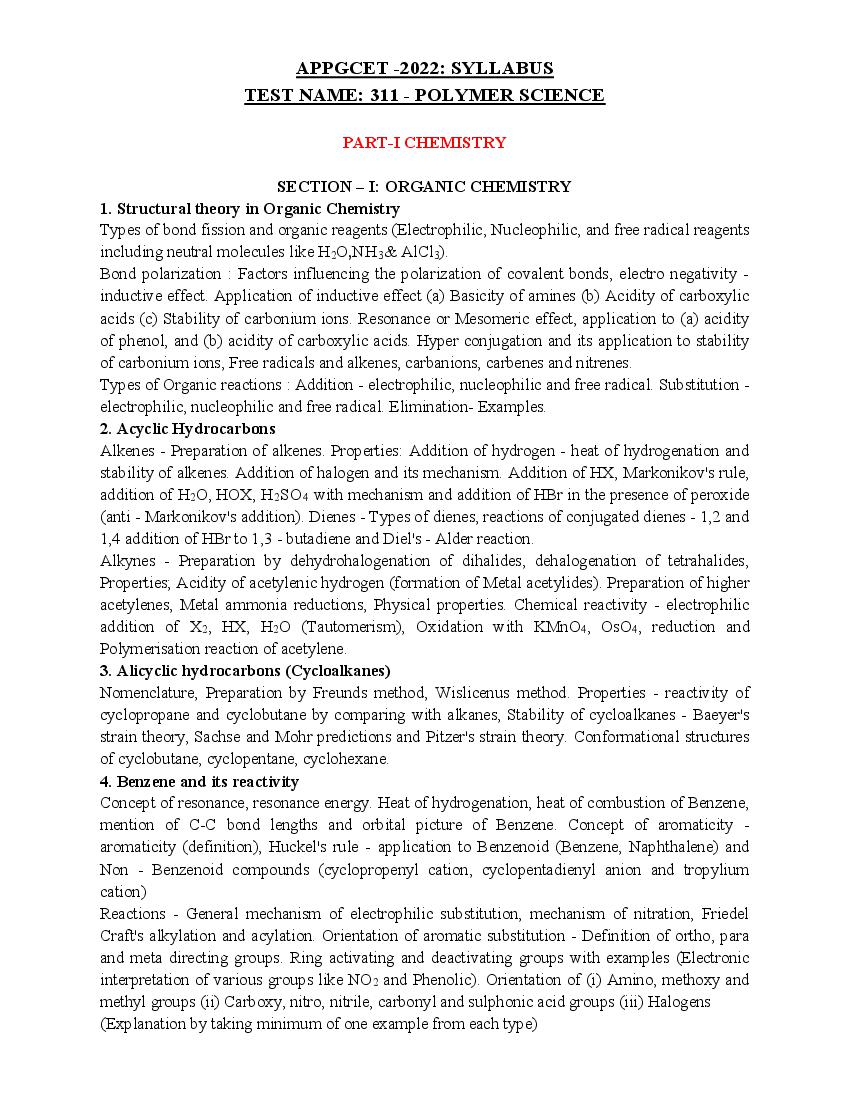
TEST NAME: 311 - POLYMER SCIENCE
PART-I CHEMISTRY
SECTION – I: ORGANIC CHEMISTRY
1. Structural theory in Organic Chemistry
Types of bond fission and organic reagents (Electrophilic, Nucleophilic, and free radical reagents
including neutral molecules like H2O,NH 3 & AlCl3).
Bond polarization : Factors influencing the polarization of covalent bonds, electro negativity -
inductive effect. Application of inductive effect (a) Basicity of amines (b) Acidity of carboxylic
acids (c) Stability of carbonium ions. Resonance or Mesomeric effect, application to (a) acidity
of phenol, and (b) acidity of carboxylic acids. Hyper conjugation and its application to stability
of carbonium ions, Free radicals and alkenes, carbanions, carbenes and nitrenes.
Types of Organic reactions : Addition - electrophilic, nucleophilic and free radical. Substitution -
electrophilic, nucleophilic and free radical. Elimination- Examples.
2. Acyclic Hydrocarbons
Alkenes - Preparation of alkenes. Properties: Addition of hydrogen - heat of hydrogenation and
stability of alkenes. Addition of halogen and its mechanism. Addition of HX, Markonikov's rule,
addition of H2O, HOX, H 2 SO 4 with mechanism and addition of HBr in the presence of peroxide
(anti - Markonikov's addition). Dienes - Types of dienes, reactions of conjugated dienes - 1,2 and
1,4 addition of HBr to 1,3 - butadiene and Diel's - Alder reaction.
Alkynes - Preparation by dehydrohalogenation of dihalides, dehalogenation of tetrahalides,
Properties; Acidity of acetylenic hydrogen (formation of Metal acetylides). Preparation of higher
acetylenes, Metal ammonia reductions, Physical properties. Chemical reactivity - electrophilic
addition of X2, HX, H2O (Tautomerism), Oxidation with KMnO4, OsO4, reduction and
Polymerisation reaction of acetylene.
3. Alicyclic hydrocarbons (Cycloalkanes)
Nomenclature, Preparation by Freunds method, Wislicenus method. Properties - reactivity of
cyclopropane and cyclobutane by comparing with alkanes, Stability of cycloalkanes - Baeyer's
strain theory, Sachse and Mohr predictions and Pitzer's strain theory. Conformational structures
of cyclobutane, cyclopentane, cyclohexane.
4. Benzene and its reactivity
Concept of resonance, resonance energy. Heat of hydrogenation, heat of combustion of Benzene,
mention of C-C bond lengths and orbital picture of Benzene. Concept of aromaticity -
aromaticity (definition), Huckel's rule - application to Benzenoid (Benzene, Naphthalene) and
Non - Benzenoid compounds (cyclopropenyl cation, cyclopentadienyl anion and tropylium
cation)
Reactions - General mechanism of electrophilic substitution, mechanism of nitration, Friedel
Craft's alkylation and acylation. Orientation of aromatic substitution - Definition of ortho, para
and meta directing groups. Ring activating and deactivating groups with examples (Electronic
interpretation of various groups like NO2 and Phenolic). Orientation of (i) Amino, methoxy and
methyl groups (ii) Carboxy, nitro, nitrile, carbonyl and sulphonic acid groups (iii) Halogens
(Explanation by taking minimum of one example from each type)
Page 2
Nomenclature and classification of alkyl (into primary, secondary, tertiary), aryl, aryl alkyl, allyl,
vinyl, benzyl halides.
Nucleophilic aliphatic substitution reaction- classification intoSN 1 andSN 2 – reaction
mechanism with examples – Ethyl chloride, t-butyl chloride and optically active alkyl halide 2-
bromobutane.
6. Hydroxy compounds
Nomenclature and classification of hydroxy compounds.
Alcohols: Preparation with hydroboration reaction, Grignard synthesis of alcohols. Phenols:
Preparation i) from diazonium salt, ii) from aryl sulphonates, iii) from cumene. Physical
properties- Hydrogen bonding (intermolecular and intramolecular). Effect of hydrogen bonding
on boiling point and solubility in water.
Identification of alcohols by oxidation with KMnO4, Ceric ammonium nitrate, Luca’s reagent
and phenols by reaction with FeCl3.
Chemical properties:
a) Dehydration of alcohols.
b) Oxidation of alcohols by CrO3, KMnO4.
c) Special reaction of phenols: Bromination, Kolbe-Schmidt reaction, Riemer-Tiemann
reaction, Fries rearrangement, azocoupling, Pinacol-Pinacolone rearrangement.
7. Carbonyl compounds
Nomenclature of aliphatic and aromatic carbonyl compounds, structure of the carbonyl group.
Synthesis of aldehydes from acid chlorides, synthesis of aldehydes and ketones using 1,3-
dithianes, synthesis of ketones from nitriles and from carboxylic acids. Physical properties:
Reactivity of carbonyl group in aldehydes and ketones.
Nucleophilic addition reaction with a) NaHSO3, b) HCN, c) RMgX, d) NH2OH, e)PhNHNH2, f)
2,4 DNPH, g) Alcohols-formation of hemiacetal and acetal. Base catalysed reactions: a) Aldol,
b) Cannizzaro’s reaction, c) Perkin reaction, d) Benzoin condensation, e) Haloform reaction, f)
Knoevenagel reaction. Oxidation of aldehydes- Baeyer-Villiger oxidation of ketones.Reduction:
Clemmensen reduction, Wolf-Kishner reduction, MPV reduction, reduction with LiAlH 4 and
NaBH4. Analysis of aldehydes and ketones with a) 2,4-DNPH test, b) Tollen's test, c) Fehling
test, d) Schiff’s test e) Haloform test (with equation)
8. Carboxylic acids and derivatives
Nomenclature, classification and structure of carboxylic acids. Methods of preparation by a)
Hydrolysis of nitriles, amides b) Hydrolysis of esters by acids and bases with mechanism c)
Carbonation of Grignard reagents. Special methods of preparation of aromatic acids by a)
Oxidation of side chain. b) Hydrolysis by benzotrichlorides. c) Kolbe reaction. Physical
properties: Hydrogen bonding, dimeric association, acidity- strength of acids with examples of
trimethyl acetic acid and trichloroacetic acid. Relative differences in the acidities of aromatic and
aliphatic acids. Chemical properties: Reactions involving H, OH and COOH groups- salt
formation, anhydride formation, acid chloride formation, amide formation and esterification
Page 3
Schimdt reaction, Arndt-Eistert synthesis, halogenation by Hell- Volhard- Zelinsky reaction.
9. Active methylene compounds
(i) Acetoacetic ester: keto-enol tautomerism, preparation by Claisen condensation, Acid
hydrolysis and ketonic hydrolysis. Preparation of a) monocarboxylic acids. b) Dicarboxylic
acids. c) Reaction with urea
(ii) Malonic ester: preparation from acetic acid. Synthetic applications: Preparation of a)
monocarboxylic acids (propionic acid and n-butyric acid). b) Dicarboxylic acids (succinic acid
and adipic acid) c) α,β-unsaturated carboxylic acids (crotonic acid).
d) Reaction with urea.
10. Nitro hydrocarbons:
Nomenclature and classification-nitro hydrocarbons, structure -Tautomerism of nitroalkanes
leading to aci and keto form, Preparation of Nitroalkanes, reactivity -halogenation, reaction with
HONO (Nitrous acid),Nef reaction and Mannich reaction leading to Micheal addition and
reduction.
11. Nitrogen compounds :
Amines (Aliphatic and Aromatic): Nomenclature, Classification into 1°, 2°, 3° Amines and
Quarternary ammonium compounds. Preparative methods –
1. Ammonolysis of alkyl halides 2. Gabriel synthesis 3. Hoffman's bromamide reaction
(mechanism).
Reduction of Amides and Schmidt reaction. Physical properties and basic character -
Comparative basic strength of Ammonia, methyl amine, dimethyl amine, trimethyl amine and
aniline - comparative basic strength of aniline, N-methylaniline and N,N-dimethyl aniline (in
aqueous and non-aqueous medium), steric effects and substituent effects. Chemical properties: a)
Alkylation b) Acylation c) Carbylamine reaction d) Hinsberg separation e) Reaction with Nitrous
acid of 1°, 2°, 3° (Aliphatic and aromatic amines). Electrophillic substitution of Aromatic amines
– Bromination and Nitration. Oxidation of aryl and Tertiary amines, Diazotization.
12. Heterocyclic Compounds
Introduction and definition: Simple five membered ring compounds with one hetero atom Ex.
Furan. Thiophene and pyrrole - Aromatic character – Preparation from 1,4,- dicarbonyl
compounds, Paul-Knorr synthesis.
Properties : Acidic character of pyrrole - electrophillic substitution at 2 or 5 position,
Halogenation, Nitration and Sulphonation under mild conditions - Diels Alder reaction in furan.
Pyridine – Structure - Basicity - Aromaticity - Comparison with pyrrole - one method of
preparation and properties - Reactivity towards Nucleophilic substitution reaction.
13. Carbohydrates
Monosaccharides: (+) Glucose (aldo hexose) - Evidence for cyclic structure of glucose (some
negative aldehydes tests and mutarotation) - Proof for the ring size (methylation, hydrolysis and
oxidation reactions) - Pyranose structure (Haworth formula and chair conformational formula).
(-) Fructose (ketohexose) - Evidence of 2 - ketohexose structure (formation of pentaacetate,
formation of cyanohydrin its hydrolysis and reduction by HI). Cyclic structure for fructose
Page 4
Definition of anomers with examples.
Interconversion of Monosaccharides: Aldopentose to Aldohexose (Arabinose to
D- Glucose, D-Mannose) (Kiliani - Fischer method). Epimers, Epimerisation - Lobry de bruyn
van Ekenstein rearrangement. Aldohexose to Aldopentose (D-Glucose to
D- Arabinose) by Ruff degradation. Aldohexose to Ketohexose
[(+) Glucose to (-) Fructose] and Ketohexose to Aldohexose (Fructose to Glucose)
14. Amino acids and proteins
Introduction: Definition of Amino acids, classification of Amino acids into alpha, beta, and
amma amino acids. Natural and essential amino acids - definition and examples, classification of
alpha amino acids into acidic, basic and neutral amino acids with examples. Methods of
synthesis: General methods of synthesis of alpha amino acids (specific examples - Glycine,
Alanine, valine and leucine) by following methods: a) from halogenated carboxylic acid b)
Malonic ester synthesis c) strecker's synthesis.
Physical properties: Zwitter ion structure - salt like character - solubility, melting points,
amphoteric character, definition of isoelectric point.
Chemical properties: General reactions due to amino and carboxyl groups - lactams from gamma
and delta amino acids by heating peptide bond (amide linkage). Structure and nomenclature of
peptides and proteins.
SECTION - II: INORGANIC CHEMISTRY
1. p-block elements –I & II
Group-13: Synthesis and structure of diborane and higher boranes (B 4H10 and B 5 H 9 ), boron-
nitrogen compounds (B3N3H6 and BN).
Group - 14: Preparation and applications of silanes and silicones.
Group - 15: Preparation and reactions of hydrazine, hydroxylamine.
Group - 16: Classifications of oxides based on (i) Chemical behaviour and (ii) Oxygen content.
Group-17: Inter halogen compounds and pseudo halogens.
2. Organometallic Chemistry
Definition - classification of Organometallic compounds - nomenclature, preparation, properties
and applications of alkyls of Li and Mg.
3. Chemistry of d-block elements:
Characteristics of d-block elements with special reference to electronic configuration, variable
valence, magnetic properties, catalytic properties and ability to form complexes. Stability of
various oxidation states
4. Theories of bonding in metals:
Metallic properties and its limitations, Valence bond theory, Free electron theory, Explanation of
thermal and electrical conductivity of metals, limitations, Band theory, formation of bands,
explanation of conductors, semiconductors and insulators.
5. Metal carbonyls :
EAN rule, classification of metal carbonyls, structures and shapes of metal carbonyls of V, Cr,
Mn, Fe, Co and Ni.
6. Chemistry of f-block elements:
Chemistry of lanthanides - electronic structure, oxidation states, lanthanide contraction,
consequences of lanthanide contraction, magnetic properties. Chemistry of actinides - electronic
configuration, oxidation states, actinide contraction, comparison of lanthanides and actinides.
Page 5
IUPAC nomenclature - bonding theories - Review of Werner's theory and Sidgwick's concept of
coordination - Valence bond theory - geometries of coordination numbers 4-tetrahedral and
square planar and 6-octahedral and its limitations, crystal filed theory - splitting of d-orbitals in
octahedral, tetrahedral and square-planar complexes - low spin and high spin complexes - factors
affecting crystal-field splitting energy, merits and demerits of crystal-field theory. Isomerism in
coordination compounds - structural isomerism and stereo isomerism, stereochemistry of
complexes with 4 and 6 coordination numbers.
8. Spectral and magnetic properties of metal complexes:
Types of magnetic behavior, spin-only formula, calculation of magnetic moments, experimental
determination of magnetic susceptibility-Gouymethod.
9. Stability of metal complexes:
Thermodynamic stability and kinetic stability, factors affecting the stability of metal complexes,
chelate effect, determination of composition of complex by Job's method and mole ratio method.
10. Reactivity of metal complexes:
Labile and inert complexes, ligand substitution reactions - SN 1 and SN 2,substitution reactions of
square planar complexes - Trans effect and applications of trans effect.
11. Bioinorganic chemistry:
Essential elements, biological significance of Na, K, Mg, Ca, Fe, Co, Ni, Cu, Zn and Cl -.
Metalloporphyrins – Structure and functions of hemoglobin, Myoglobin and Chlorophyll.
SECTION – III: PHYSICAL CHEMISTRY
1. Solidstate
Symmetry in crystals. Law of constancy of interfacial angles. The law of rationality of indices.
The law of symmetry. Definition of lattice point, space lattice, unit cell. Bravis lattices and
crystal systems. X-ray diffraction and crystal structure. Bragg's law. Defects in crystals.
Stoichiometric and non-stoichiometric defects.
2. Gaseous state
Compression factors, deviation of real gases from ideal behavior. Vander Waal's equation of
state. P-V Isotherms of real gases, Andrew's isotherms of carbon dioxide, continuity of state.
Critical phenomena. The vander Waal's equation and the critical state. Law of corresponding
states.Relationship between critical constants and vander Waal's constants. Joule Thomson
effect.
3. Liquid state
Structural differences between solids, liquids and gases. Liquid crystals, the mesomorphic state.
Classification of liquid crystals into Smectic and Nematic. Differences between liquid crystal
and solid/liquid. Application of liquid crystals as LCD devices.
4. Solutions
Liquid-liquid - ideal solutions, Raoult's law. Ideally dilute solutions, Henry's law. Non-ideal
solutions. Vapour pressure - composition and vapour pressure- temperature curves. Azeotropes-
HCl-H2O, ethanol-water systems and fractional distillation. Partially miscible liquids-phenol-
water, trimethylamine-water, nicotine-water systems. Effect of impurity on consulate
temperature. Immiscible liquids and steam distillation.
Page 6
5. Dilute solutions
Colligative properties. Raoult's law, relative lowering of vapour pressure, its relation to
molecular weight of non-volatile solute. Elevation of boiling point and depression of freezing
point. Derivation of relation between molecular weight and elevation in boiling point and
depression in freezing point. Experimental methods of determination. Osmosis, osmotic pressure,
experimental determination. Theory of dilute solutions. Determination of molecular weight of
non-volatile solute from osmotic pressure. Abnormal Colligative properties- Van’t Hoff factor.
6. Electrochemistry-I & II
Specific conductance, equivalent conductance. Variation of equivalent conductance with
dilution. Migration of ions, Kohlrausch's law. Arrhenius theory of electrolyte dissociation and its
limitations. Ostwald's dilution law. Debye-Huckel-Onsagar's equation for strong electrolytes
(elementary treatment only). Definition of transport number, determination by Hittorfs method.
Application of conductivity measurements- conductometric titrations.
Single electrode potential, sign convention, Reversible and irreversible cells Nernst Equation-
Reference electrode, Standard Hydrogen electrode, calomel electrode, Indicator electrode, metal
– metal ion electrode, Inert electrode, Determination of EMF of cell, Applications of EMF
measurements - Potentiometric titrations.
7. Phase rule
Concept of phase, components, degrees of freedom. Thermodynamic Derivation of Gibbs phase
rule. Phase equilibrium of one component system - water system. Phase equilibrium of two-
component system, solid-liquid equilibrium. Simple eutectic diagram of Pb-Ag system, simple
eutectic diagram, desilverisation of lead., NaCl-Water system, Freezing mixtures.
8. Thermodynamics
The first law of thermodynamics-statement, definition of internal energy and enthalpy. Heat
capacities and their relationship. Joule-Thomson effect- coefficient. Calculation of w, for the
expansion of perfect gas under isothermal and adiabatic conditions for reversible processes. State
function. Temperature dependence of enthalpy of formation-Kirchoff s equation. Second law of
thermodynamics. Different Statements of the law. Carnot cycle and its efficiency. Carnot
theorem. Concept of entropy, entropy as a state function, entropy changes in reversible and
irreversible processes. Entropy changes in spontaneous and equilibrium processes.
9. Chemical kinetics
Rate of reaction - Definition of order and molecularity. Derivation of rate constants for first,
second, third and zero order reactions and examples. Derivation for time half change. Methods to
determine the order of reactions. Effect of temperature on rate of reaction, Arrhenius equation,
concept of activation energy.
10. Photochemistry
Difference between thermal and photochemical processes. Laws of photochemistry- Grothus-
Draper's law and Stark-Einstein's law of photochemical equivalence. Quantum yield-
Photochemical reaction mechanism- hydrogen- chlorine, hydrogen- bromine reaction. Qualitative
description of fluorescence, phosphorescence, Photosensitized reactions- energy transfer
processes (simple example)
Page 7
1. Electronic spectroscopy:
Interaction of electromagnetic radiation with molecules and types of molecular spectra. Energy
levels of molecular orbitals (σ, π, n). Selection rules for electronic spectra. Types of electronic
transitions in molecules effect of conjugation. Concept of chromophore and auxochrome.
2. Infra red spectroscopy
Different Regions in Infrared radiations. Modes of vibrations in diatomic and polyatomic
molecules. Characteristic absorption bands of various functional groups. Interpretation of
spectra-Alkanes, Aromatic, Alcohols carbonyls, and amines with one example to each.
3. Proton magnetic resonance spectroscopy (1H-NMR)
Principles of nuclear magnetic resonance, equivalent and non-equivalent protons, position of
signals. Chemical shift, NMR splitting of signals - spin-spin coupling, coupling constants.
Applications of NMR with suitable examples - ethyl bromide, ethanol, acetaldehyde, 1,1,2-
tribromo ethane, ethyl acetate, toluene and acetophenone.
PART-II: PHYSICS
Section I: Mechanics & Properties of Matter
1. Vector Analysis
Scalar and vector fields, gradient of a scalar field and its physical significance. Divergence
and curl of a vector field with derivations and physical interpretation. Vector integration
(line, surface and volume), Statement and proof of Gauss and Stokes theorems.
2. Mechanics of particles
Laws of motion, motion of variable mass system, Equation of motion of a rocket.
Conservation of energy and momentum, Collisions in two and three dimensions, Concept of
impact parameter, scattering cross-section, Rutherford scattering-derivation.
3. Mechanics of Rigid bodies
Definition of rigid body, rotational kinematic relations, equation of motion for a rotating
body, angular momentum, Euler equations and its applications, precession of a top,
Gyroscope, precession of the equinoxes.
4. Mechanics of continuous media
Elastic constants of isotropic solids and their relations, Poisson's ratio and expression for
Poisson's ratio in terms of y, n, k. Classification of beams, types of bending, point load,
distributed load, shearing force and bending moment, sign conventions.
5. Central forces
Central forces, definition and examples, characteristics of central forces, conservative nature
of central forces, conservative force as a negative gradient of potential energy, equatglobal
ion of motion under a central force. Derivation of Kepler’s laws.Motion of satellites, idea of
Global Positioning System (GPS).
6. Special theory of relativity
Galilean relativity, absolute frames.Michelson-Morley experiment, negative result.Postulates of
special theory of relativity.Lorentz transformation, time dilation, length contraction, addition of
velocities, mass-energy relation.Concept of four-vector formalism.
Page 8
1. Simple Harmonic oscillations
Simple harmonic oscillator and solution of the differential equation-Physical characteristics
of SHM, torsion pendulum-measurements of rigidity modulus, compound pendulum-
measurement of ‘g’, Principle of superposition,beats, combination of two mutually
perpendicular simple harmonic vibrations of same frequency and different frequencies.
Lissajous figures.
2. Damped and forced oscillations
Damped harmonic oscillator, solution of the differential equation of damped oscillator.
Energy considerations, comparison with un-damped harmonic oscillator, logarithmic
decrement, relaxation time, quality factor, differential equation of forced oscillator and its
solution, amplitude resonance and velocity resonance.
3. Complex vibrations
Fourier theorem and evaluation of the Fourier coefficients, analysis of periodic wave
functions-square wave, triangular wave, saw tooth wave, simple problems on evolution of
Fourier coefficients.
4. Vibrating strings:
Transverse wave propagation along a stretched string, general solution of wave equation and
its significance, modes of vibration of stretched string clamped at ends, overtones and
harmonics. Energy transport and transverse impedance.
5. Vibrations of bars:
Longitudinal vibrations in bars-wave equation and its general solution. Special cases (i) bar
fixed at both ends (ii) bar fixed at the midpoint (iii) bar fixed at one end. Tuning fork.
6. Ultrasonics:
Ultrasonics, properties of ultrasonic waves, production of ultrasonics by piezoelectric and
magnetostriction methods, detection of ultrasonics, determination of wavelength of
ultrasonic waves.Applications of ultrasonic waves.
Section III: Wave Optics
1. Aberrations:
Introduction – monochromatic aberrations, spherical aberration, methods of minimizing
spherical aberration, coma, astigmatism and curvature of field, distortion. Chromatic
aberration-the achromatic doublet.Achromatism for two lenses ( i )in contact and (ii)
separated by a distance.
2. Interference
Principle of superposition – coherence-temporal coherence and spatial coherence-conditions
for interference of light.Fresnel’s biprism-determination of wavelength of light –change of
phase on reflection.Oblique incidence of a plane wave on a thin film due to reflected and
transmitted light (cosine law) –colors of thin films-
Interference by a film with two non-parallel reflecting surfaces (Wedge shaped film).
Determination of diameter of wire, Newton’s rings in reflected light. Michelson
interferometer, Determination of wavelength of monochromatic light using Newton’s rings
and Michelson Interferometer.
3.Diffraction
Introduction,distinction between Fresnel and Fraunhoffer diffraction, Fraunhoffer diffraction
–Diffraction due to single slit-Fraunhoffer diffraction due to double slit-Fraunhoffer
diffraction pattern with N slits (diffraction grating).Resolving power of grating,
Page 9
using diffraction grating,
Fresnel’s half period zones-area of the half period zones-zone plate-comparison of zone
plate with convex lens-difference between interference and diffraction.
4.Polarisation:
Polarized light: methods of polarization polarization by reflection, refraction, double
refraction, scattering of light-Brewster’s law-Mauls law-Nicol prism polarizer and analyzer-
Quarter wave plate, Half wave plate-optical activity, determination of specific rotation by
Laurent’s half shade polarimeter-Babinet’s compensator - idea of elliptical and circular
polarization
5. Lasers and Holography
Lasers: introduction,spontaneous emission, stimulated emission. Population Inversion, Laser
principle-Einstein coefficients-Types of lasers-He-Ne laser, Ruby laser- Applications of
lasers.Holography: Basic principle of holography-Gabor hologram and its limitations,
Applications of holography.
6. Fiber Optics
Introduction- different types of fibers, rays and modes in an optical fiber, fiber
material,principles of fiber communication (qualitative treatment only), advantages of fiber
optic communication.
Section IV: Thermodynamics &Radiation Physics
1.Kinetic theory of gases
Introduction –Deduction of Maxwell’s law of distribution of molecular speeds, experimental
verification. Transport phenomena – Mean free path - Viscosity of gases-thermal
conductivity-diffusion of gases.
2. Thermodynamics
Introduction- Isothermal and adiabatic process- Reversible and irreversible processes-
Carnnot’s engine and its efficiency-Carnot’s theorem-Second law of thermodynamics.
Kelvin’s and Claussius statements-Entropy, physical significance –Change in entropy in
reversible and irreversible processes-Entropy and disorder-Entropy of Universe–
Temperature-Entropy (T-S) diagram and its uses - Change of entropy of a perfect gas-
change of entropy when ice changes into steam.
3. Thermodynamic potentials and Maxwell’s equations
Thermodynamic potentials-Derivation of Maxwell’s thermodynamic relations-Clausius-
Clayperon’s equation-Derivation for ratio of specific heats-Derivation for difference of two
specific heats for perfect gas.Joule Kelvin effect-expression for Joule Kelvin coefficient for
perfect and vander Waal’s gas.
4. Low temperature Physics
Introduction-Joule Kelvin effect-Porous plug experiment - Joule expansion-Distinction
between adiabatic and Joule Thomson expansion-Expression for Joule Thomson cooling-
Liquefaction of helium, Kapitza’s method-Adiabatic demagnetization, Production of low
temperatures -applications of substances at lowtemperature-effects of chloro and fluoro
carbons on ozone layer.
5. Quantum theory of radiation
Blackbody-Ferry’s black body-distribution of energy in the spectrum of black body-Wein’s
displacement law,Wein’s law, Rayleigh-Jean’s law-Quantum theory of radiation-Planck’s
law-Measurement of radiation-Types of pyrometers-Disappearing filament optical
Page 10
constant, Temperature of Sun.
Section V: Electricity, Magnetism& Electronics
1. Electric field intensity and potential:
Gauss’s law statement and its proof- Electric field intensity due to (1) Uniformly charged
sphere and (2) an infinite conducting sheet of charge. Electrical potential – equipotential
surfaces- potential due to i) a point charge, ii) charged spherical shell and uniformly charged
sphere.
2. Dielectrics:
Electric dipole moment and molecular polarizability- Electric displacement D, electric
polarization P – relation between D, E and P- Dielectric constant and susceptibility.
Boundary conditions at the dielectric surface.
3. Electric and magnetic fields
Biot-Savart’s law, explanation and calculation of B due to long straight wire, a circular
current loop and solenoid – Lorentz force – Hall effect – determination of Hall coefficient
and applications.
4. Electromagnetic induction
Faraday’s law-Lenz’s law- Self and mutual inductance, coefficient of coupling, calculation
of self inductance of a long solenoid, energy stored in magnetic field.Transformer - energy
losses - efficiency.
5. Alternating currents and electromagnetic waves
Alternating current - Relation between current and voltage in LR and CR circuits,vector
diagrams, LCR series and parallel resonant circuit, Q –factor, power in ac circuits.
6. Maxwell’s equations
Idea of displacement current - Maxwell’s equations (integral and differential forms) (no
derivation), Maxwell’s wave equation (with derivation), Transverse nature of
electromagnetic waves.Poynting theorem (statement and proof), production of
electromagnetic waves (Hertz experiment).
7. Basic electronics:
PN juction diode, Zener diode, Tunnel diode, I-V characteristics, PNP and NPN transistors,
CB, CE and CC configurations – Relation between, and - transistor (CE) characteristics
-Determination of hybrid parameters, Transistor as an amplifier.
8. Digital electronics
Number systems - Conversion of binary to decimal system and vice versa.Binary addition
and subtraction (1’s and 2’s complement methods).Laws of Boolean algebra - De Morgan’s
laws-statement and proof, Basic logic gates, NAND and NOR as universal gates, exclusive-
OR gate, Half adder and Full adder, Parallel adder circuits.
Section VI: Modern Physics
1. Atomic and molecular physics
Introduction –Drawbacks of Bohr’s atomic model- Sommerfeld’s elliptical orbits-relativistic
correction (no derivation).Vector atom model and Stern-Gerlach experiment - quantum
numbers associated with it. L-S and j- j coupling schemes.Zeeman effect and its
experimental arrangement.
Raman effect, hypothesis, Stokes and Anti Stokes lines. Quantum theory of Raman effect.
Experimental arrangement – Applications of Raman effect.
2. Matter waves & Uncertainty Principle
Page 11
waves - Davisson and Germer experiment – Phase and group velocities.
Heisenberg’s uncertainty principle for position and momentum (x and p), & energy and time
(E and t). Experimental verification - Complementarity principle of Bohr.
3. Quantum (wave) mechanics
Basic postulates of quantum mechanics-Schrodinger time independent and time dependent
wave equations-derivations. Physical interpretation of wave function. Eigen functions, Eigen
values. Application of Schrodinger wave equation to particle in one dimensional infinite box.
4. General Properties of Nuclei
Basic ideas of nucleus -size, mass, charge density (matter energy), binding energy, angular
momentum, parity, magnetic moment, electric moments. Liquid drop model and Shell model
(qualitative aspects only) - Magic numbers.
5. Radioactivity decay:
Alpha decay: basics of α-decay processes. Theory of α-decay, Gamow’s theory, Geiger
Nuttal law.β-decay, Energy kinematics for β-decay, positron emission, electron capture,
neutrino hypothesis.
6. Crystal Structure
Amorphous and crystalline materials, unit cell, Miller indices, reciprocal lattice, types of
lattices, diffraction of X-rays by crystals, Bragg’s law, experimental techniques, Laue’s
method and powder diffraction method.
7. Superconductivity:
Introduction - experimental facts, critical temperature - critical field - Meissner effect –
Isotope effect - Type I and type II superconductors - BCS theory (elementary ideas only) -
applications of superconductors.
PART III: POLYMER SCIECE
SECTION-I : FUDAMENTALS OF POLYMERS
1. WORLD POLYMERS:
Itroduction – brief history of development of polymerization – cocept of macromolecule
– what are polymers – polymers in day today world – importace of polymers ad scope of
polymer science – examples of various polymers produced India.
Introduction to Polymerization – Introduction – Repeat unit – Nomeclature –
Functionality of polymers – Degree of Polymerizatio – Classification of polymers –
defiitations – various terms used in polymers – Thermoplastics – Thermosets –
Elastomers, Fibers – Adjesives – Definition ad examples under each category.
2. CHEMICAL AD GEOMETRICAL STRUCTURES OF POLYMERS:
Introduction – Micro structure – Organic Polymers – Inorganic Polymers – home
polymers and copolymers – Stereo regular polymers – Examples – Difference – inter
molecular Forces - Texture and polymer structure.
3. TYPES OF POLYMERIZATION:
Definition of step growth and chain growth polymerization –differences – homogeneous
polymerization – heterogeneous polymerization – bulk polymerization – Solution
polymerization – suspension polymerization – Emulsion polymerization – Melt
polycondensation – Comparision of different techniques.
Page 12
Free radical – Cationic – Anionic and co – ordination polymerization – Zeigler – Natta
Catalysis – Ring opening polymerization – Differenced and examples under each
category – Elementary Treatment of the above mechanisms.
5. MOLECULAR WEIGHT OF POLYMERS:
Introduction – Importance of molecular weight – conceptual differences between Micro
and Macromolecules – Weight average molecular weight – Number average molecular
weight – Viscosity average molecular weight – poly dispersity - Role of molecular
weight in applicatios- Elementary treatment – Determination of molecular weight –
Osmometry – End group analysis – Light scattring measurements – Mark – Houwink
equation –ubbelhold viscometer etc.,
Section II: PROPERTIES OF POLYMERS
1. TYPES OF POLYMERIZATION
(a) Step Polymerisation – difference between step polymerisation and chain
polymerization –synthesis of polyesters –polyaminers and poly urethanes – Kinetics
of step polymerization – Urea, Phenol formaldehyde resins.
(b) Chain polymerisation –introduction –Kinetics and mechanism of free radical addition
polymerisation-Kinetic chain length – factors affecting chain polymerization.
2. PHYSICAL PROPERTIES OF POLYMERS
Introduction –Molecular weight and mechanical properties secondary valency forces.
Nature of chain packing-chain flexibility.
3. TRANSITION IN POLYMERS
Glass transition temperature – Factors affecting glass transition temparature – Effect of
crosslinking and crystalinity on glass transition temperature.
4. FlOW PROPERTIES OF POLYMERS
Viscoelasticity – Spring model, Newton model, Maxwell model – Deformation of
Polymeric material –Rubber elasticity.
5. NATURALLY OCCUPATION POLYMERS
Poly saccharides – Cellulose and starch – proteins – primary, secondary and tertiary
structures with examples – Nucleic acids –Nucleosides and nucleotides olementary
tretment.
6. POLYMER DEGRADATION
Introduction – Thermal degradation –Photo degradation –Exidative degradation –
stablizers-Antioxidants.
Section III: PLASTICS, RUBBERS AND ACRYLICS
1. Preparation, properties and uses of (i) Polyethylene, Polypropylene, Polystyrene, PVC
(ii) Polyesters, Polyamides (Nylon-6 & Nylon-6,6) (iii). Polyurethanes
Page 13
uses and Manufacture.
3. Resins-Phenol formaldehyde, urea formaldehyde and melamine – formaldehydehyde and
epoxy –resins.
4. Acrylic polymers: Preparation properties and uses Poly(ethyl acrylate), Poly (Butyl
acrylate), Poly (methyl methacrylate)
5. Cellulose and its derivatives.
SECTION IV
POLYMER PROCESSING
1. ELASTOMERIC FIBRE FORMING AND PLASTIC MATERIALS
a. Introduction
b. Elastomeric Materials
c. Fibre forming materials
d. Plastic materials
2. POLYMER PROCESSING
Plastics, Fibre and elastomers – Compounding – Processing techniques – Calendering
– die casting – rotational casting.
3. INJECTION MOULDING – BLOW MOULDING – EXTRUSION
Moulding – Elementary Treatment - Thermofoming and framing.
4. REINFORCEMENT
Fibre reinforcement – Hand –lay-up technique – filament winding technique.
5. FIBRE SPINNING
Dry Spinning – Wet Spinning.
Document Details
| Board / Org | APSCHE |
| Exam | Andhra Pradesh Post Graduate Common Entrance Test |
| Type | Syllabus |
| Pages | 13 |
| Updated | 22 Jul 2026 |