NCERT Class 11 Syllabus for Physics
Finished viewing? Save it for later —
Download NCERT Class 11 Syllabus for Physics (PDF · 4 pages)About NCERT Class 11 Syllabus for Physics
NCERT Class 11 Syllabus for Physics is available here for free download. Published by NCERT for Class 11, this syllabus can be viewed online or downloaded as a PDF (4 pages). Candidates preparing for Class 11 can use NCERT Class 11 Syllabus for Physics to understand the exam pattern, the type of questions asked, and the overall difficulty level.
Frequently Asked Questions
How can I download NCERT Class 11 Syllabus for Physics?
Open this page and click the Download button to save NCERT Class 11 Syllabus for Physics as a PDF. It is completely free on AglaSem Docs.
Is NCERT Class 11 Syllabus for Physics free to download?
Yes. NCERT Class 11 Syllabus for Physics can be viewed online and downloaded as a PDF free of cost on AglaSem Docs.
How many pages does NCERT Class 11 Syllabus for Physics have?
NCERT Class 11 Syllabus for Physics contains 4 pages, which you can read online or download together as a single PDF.
Where can I find more Class 11 study material?
You can find more Class 11 question papers, sample papers, syllabus, and answer keys on AglaSem Docs.
NCERT Class 11 Syllabus for Physics – Text
Read the full text of this syllabus below — useful to quickly search, copy and reference the content online without downloading the PDF.
📄 View text version (1 page)
Page 1
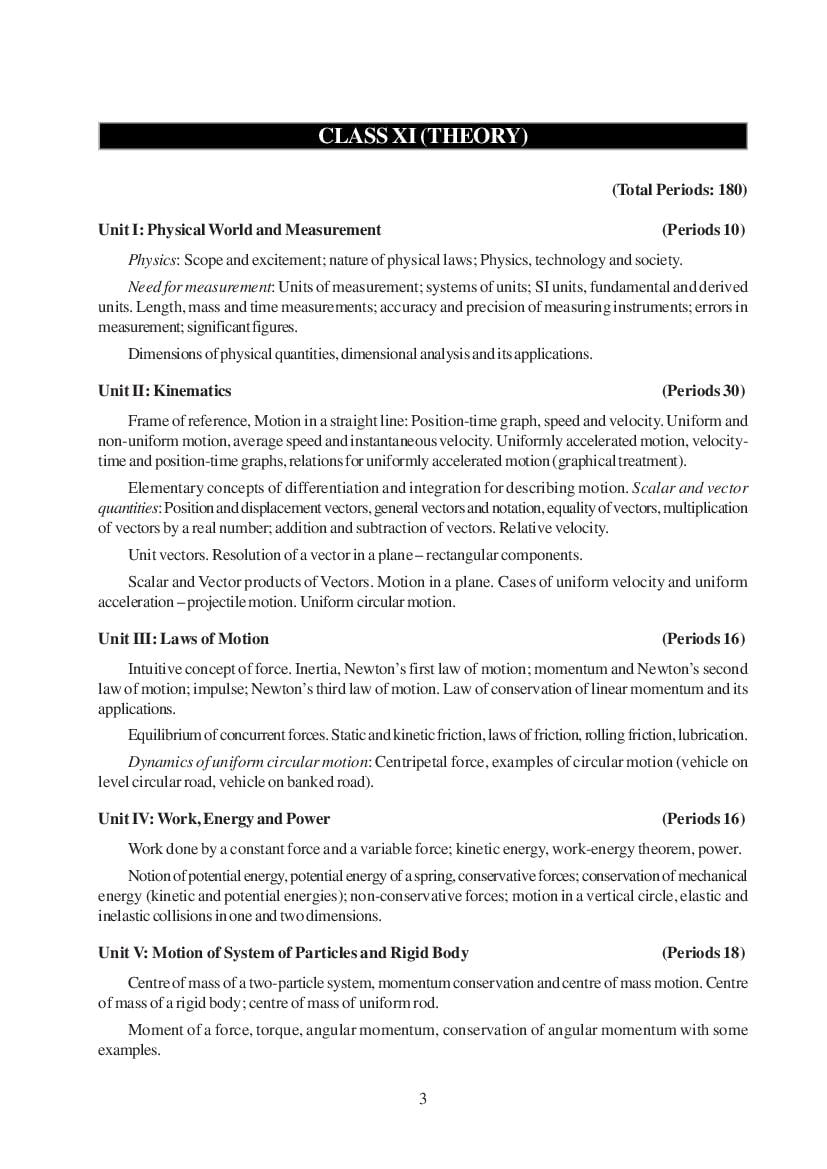
Unit I: Physical World and Measurement (Periods 10)
Physics: Scope and excitement; nature of physical laws; Physics, technology and society.
Need for measurement: Units of measurement; systems of units; SI units, fundamental and derived
units. Length, mass and time measurements; accuracy and precision of measuring instruments; errors in
measurement; significant figures.
Dimensions of physical quantities, dimensional analysis and its applications.
Unit II: Kinematics (Periods 30)
Frame of reference, Motion in a straight line: Position-time graph, speed and velocity. Uniform and
non-uniform motion, average speed and instantaneous velocity. Uniformly accelerated motion, velocity-
time and position-time graphs, relations for uniformly accelerated motion (graphical treatment).
Elementary concepts of differentiation and integration for describing motion. Scalar and vector
quantities: Position and displacement vectors, general vectors and notation, equality of vectors, multiplication
of vectors by a real number; addition and subtraction of vectors. Relative velocity.
Unit vectors. Resolution of a vector in a plane – rectangular components.
Scalar and Vector products of Vectors. Motion in a plane. Cases of uniform velocity and uniform
acceleration – projectile motion. Uniform circular motion.
Unit III: Laws of Motion (Periods 16)
Intuitive concept of force. Inertia, Newton’s first law of motion; momentum and Newton’s second
law of motion; impulse; Newton’s third law of motion. Law of conservation of linear momentum and its
applications.
Equilibrium of concurrent forces. Static and kinetic friction, laws of friction, rolling friction, lubrication.
Dynamics of uniform circular motion: Centripetal force, examples of circular motion (vehicle on
level circular road, vehicle on banked road).
Unit IV: Work, Energy and Power (Periods 16)
Work done by a constant force and a variable force; kinetic energy, work-energy theorem, power.
Notion of potential energy, potential energy of a spring, conservative forces; conservation of mechanical
energy (kinetic and potential energies); non-conservative forces; motion in a vertical circle, elastic and
inelastic collisions in one and two dimensions.
Unit V: Motion of System of Particles and Rigid Body (Periods 18)
Centre of mass of a two-particle system, momentum conservation and centre of mass motion. Centre
of mass of a rigid body; centre of mass of uniform rod.
Moment of a force, torque, angular momentum, conservation of angular momentum with some
examples.
3
Showing the first page only. Download the PDF above for the complete document.
Document Details
| Board / Org | NCERT |
| Exam | Class 11 |
| Type | Syllabus |
| Pages | 4 |
| Updated | 24 Sep 2026 |