NIOS Class 10 Question Paper 2022 (Apr) Economics
Finished viewing? Save it for later —
Download NIOS Class 10 Question Paper 2022 (Apr) Economics (PDF · 24 pages)About NIOS Class 10 Question Paper 2022 (Apr) Economics
NIOS Class 10 Question Paper 2022 (Apr) Economics is available here for free download. Published by NIOS for National Institute of Open Schooling Class 10, this question paper can be viewed online or downloaded as a PDF (24 pages). Candidates preparing for National Institute of Open Schooling Class 10 can use NIOS Class 10 Question Paper 2022 (Apr) Economics to understand the exam pattern, the type of questions asked, and the overall difficulty level.
Frequently Asked Questions
How can I download NIOS Class 10 Question Paper 2022 (Apr) Economics?
Open this page and click the Download button to save NIOS Class 10 Question Paper 2022 (Apr) Economics as a PDF. It is completely free on AglaSem Docs.
Is NIOS Class 10 Question Paper 2022 (Apr) Economics free to download?
Yes. NIOS Class 10 Question Paper 2022 (Apr) Economics can be viewed online and downloaded as a PDF free of cost on AglaSem Docs.
How many pages does NIOS Class 10 Question Paper 2022 (Apr) Economics have?
NIOS Class 10 Question Paper 2022 (Apr) Economics contains 24 pages, which you can read online or download together as a single PDF.
Where can I find more National Institute of Open Schooling Class 10 study material?
You can find more National Institute of Open Schooling Class 10 question papers, sample papers, syllabus, and answer keys on AglaSem Docs.
NIOS Class 10 Question Paper 2022 (Apr) Economics – Text
Read the full text of this question paper below — useful to quickly search, copy and reference the content online without downloading the PDF.
📄 View text version (24 pages)
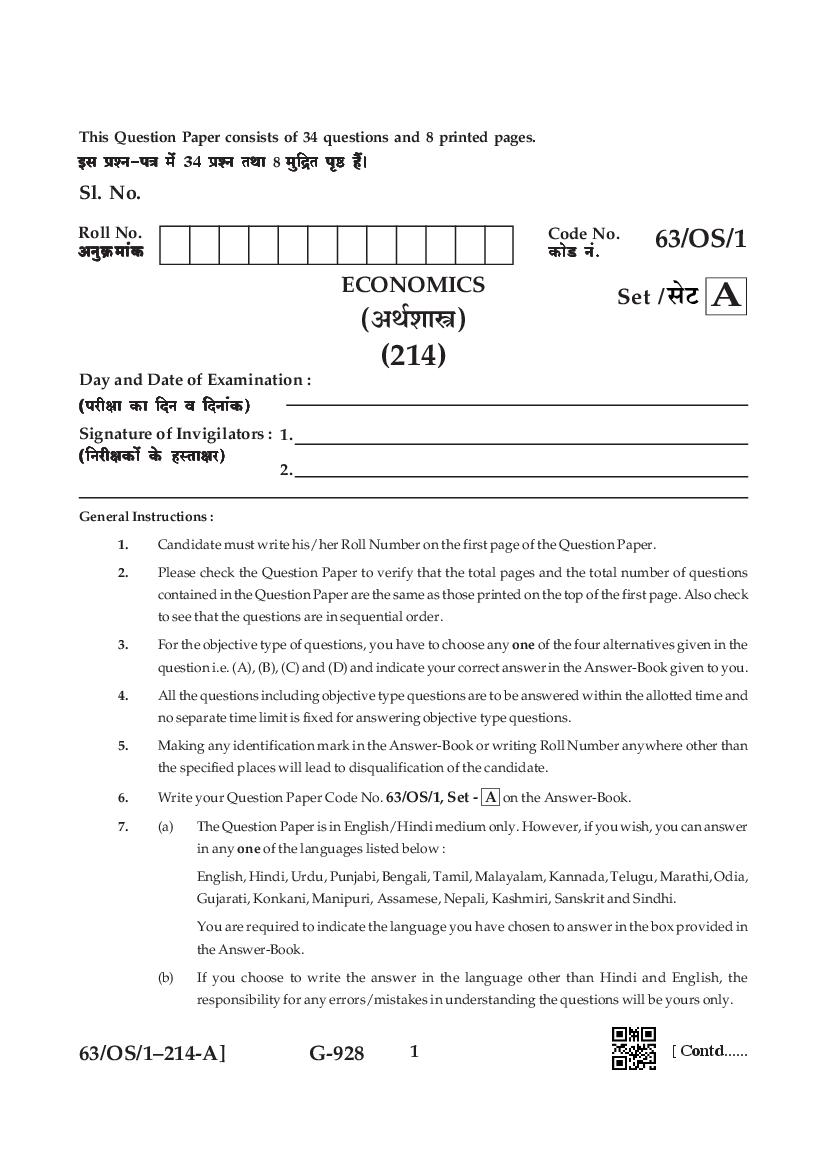
Page 1
Bg àíZ-nÌ _| 34 àíZ VWm 8 ‘w{ÐV n¥ ð > h¢ &
Sl. No.
Roll No. Code No.
AZw H « $ _m§ H $ H$mo S > Z§ .
63/OS/1
ECONOMICS
Set / go Q > A
(AW©emó)
(214)
Day and Date of Examination :
(narjm H$m {XZ d {XZm§ H $)
Signature of Invigilators : 1.
({ZarjH$m| Ho $ hñVmja)
2.
General Instructions :
1. Candidate must write his/her Roll Number on the first page of the Question Paper.
2. Please check the Question Paper to verify that the total pages and the total number of questions
contained in the Question Paper are the same as those printed on the top of the first page. Also check
to see that the questions are in sequential order.
3. For the objective type of questions, you have to choose any one of the four alternatives given in the
question i.e. (A), (B), (C) and (D) and indicate your correct answer in the Answer-Book given to you.
4. All the questions including objective type questions are to be answered within the allotted time and
no separate time limit is fixed for answering objective type questions.
5. Making any identification mark in the Answer-Book or writing Roll Number anywhere other than
the specified places will lead to disqualification of the candidate.
6. Write your Question Paper Code No. 63/OS/1, Set - A on the Answer-Book.
7. (a) The Question Paper is in English/Hindi medium only. However, if you wish, you can answer
in any one of the languages listed below :
English, Hindi, Urdu, Punjabi, Bengali, Tamil, Malayalam, Kannada, Telugu, Marathi, Odia,
Gujarati, Konkani, Manipuri, Assamese, Nepali, Kashmiri, Sanskrit and Sindhi.
You are required to indicate the language you have chosen to answer in the box provided in
the Answer-Book.
(b) If you choose to write the answer in the language other than Hindi and English, the
responsibility for any errors/mistakes in understanding the questions will be yours only.
63/OS/1–214-A] G-928 1 [ Contd......
Page 2
1. narjmWu àíZ-nÌ Ho$ nhbo n¥ð> na AnZm AZwH«$‘m§H$ Adí¶ {bI|&
2. H¥$n¶m àíZ-nÌ H$mo Om±M b| {H$ àíZ-nÌ Ho$ Hw$b n¥ð>m| VWm àíZm| H$s CVZr hr g§»¶m h¡ {OVZr àW‘ n¥ð> Ho$ g~go D$na N>nr h¡& Bg
~mV H$s Om±M ^r H$a b| {H$ àíZ H«${‘H$ ê$n ‘| h¢&
3. dñVw{Zð> àíZm| _| AmnH$mo Mma {dH$ënm| (A), (B), (C) VWm (D) _| go H$moB© EH$ CÎma MwZZm h¡ VWm Xr JB© CÎma-nwpñVH$m _| Amn ghr
CÎma {b{IE&
4. dñVw{Zð> àíZm| Ho$ gmW-gmW g^r àíZm| Ho$ CÎma {ZYm©[aV Ad{Y Ho$ ^rVa hr XoZo h¢& dñVw{Zð> àíZm| Ho$ {bE AbJ go g_` Zht {X`m
OmEJm&
5. CÎma-nwpñVH$m ‘| nhMmZ-{M• ~ZmZo AWdm {Z{X©ï> ñWmZm| Ho$ A{V[aº$ H$ht ^r AZwH«$‘m§H$ {bIZo na narjmWu H$mo A¶mo½¶ R>ham¶m
Om¶oJm&
6. AnZr CÎma-nwpñVH$m na àíZ-nÌ H$r H$moS> g§»¶m 63/OS/1, goQ> - A {bI|&
7. (H$) àíZ-nÌ Ho$db A§Jo«Or/qhXr ‘mܶ‘ ‘| h¡& {’$a ^r, ¶{X Amn Mmh| Vmo ZrMo Xr JB© {H$gr EH$ ^mfm ‘| CÎma Xo gH$Vo h¢ :
A§J«oOr, qhXr, CXÿ©, n§Om~r, ~±Jbm, V{‘b, ‘b¶mb‘, H$ÝZ‹S>, VobwJy, ‘amR>r, C{‹S>¶m, JwOamVr, H$m|H$Ur, ‘{Unwar, Ag{‘¶m,
Zonmbr, H$í‘rar, g§ñH¥$V Am¡a qgYr&
H¥$n¶m CÎma-nwpñVH$m ‘| {XE JE ~m°³g ‘| {bI| {H$ Amn {H$g ^mfm ‘| CÎma {bI aho h¢&
(I) ¶{X Amn qhXr Ed§ A§J«oOr Ho$ A{V[a³V {H$gr Aݶ ^mfm ‘| CÎma {bIVo h¢, Vmo àíZm| H$mo g‘PZo ‘| hmoZo dmbr Ìw{Q>¶m|/Jb{V¶m|
H$s {Oå‘oXmar Ho$db AmnH$s hmoJr&
63/OS/1–214-A] G-928 2 [ Contd......
Page 3
(AW©emó)
(214)
Time : 3 Hours] [Maximum Marks : 100
g_` : 3 KÊQ>]o [nyUmªH$ : 100
Note : (i) All questions are compulsory.
(ii) Marks allotted to each question are indicated against it.
(iii) Each question from Question Nos. 1 to 8 has four alternatives (A), (B), (C) and (D) and out of which
one is the most appropriate. Select the correct answer and write it in your answer-book against the
number of question.
{ZX} e : (i) g^r àíZ A{Zdm`© h¢&
(ii) àË`oH$ àíZ Ho$ A§H$ CgHo$ gm_Zo Xem©E JE h¢&
(iii) dñVw{Zð> àíZ H«$_m§H$ 1 go 8 VH$, àË`oH$ àíZ _| Mma d¡H$pënH$ CÎma (A), (B), (C) Am¡a (D) {XE JE h¢, {OZ_| go EH$ ghr `m
gdm©{YH$ C{MV h¡& ghr CÎma Mw{Z`o VWm AnZr CÎma-nwpñVH$m _| Cgo àíZ H«$_m§H$ Ho$ gm_Zo {b{IE&
1. Classical thinkers believed that Economics is : [1]
(A) the science of wealth (B) the science of development
(C) the science of consumption (D) the science of competition
Šbm{gH$b {dMmaH$m| H$m _V Wm {H$ AW©emó `h h¡ …
(A) YZ H$m {dkmZ (B) {dH$mg H$m {dkmZ
(C) Cn^moJ H$m {dkmZ (D) à{V`mo{JVm H$m {dkmZ
2. Production activities require : [1]
(A) Skilled labour (B) Unskilled labour
(C) (A) and (B) Both (D) None of these
CËnmXZ J{V{d{Y`m| Ho$ {bE BZH$s Amdí`H$Vm hmoVr h¡ …
(A) Hw$eb l_ (B) AHw$eb l_
(C) (A) VWm (B) XmoZm| (D) BZ_| H$moB© Zht
63/OS/1–214-A] G-928 3 [ Contd......
Page 4
(A) the socialist economy
(B) the capitalist economy
(C) the mixed economy
(D) the centrally planned economy
AW©ì`dñWm H$m àmMrZV_ ñdê$n `h h¡ …
(A) g_mOdmXr AW©ì`dñWm (B) ny±OrdmXr AW©ì`dñWm
(C) {_{lV AW©ì`dñWm (D) Ho$ÝÐ {Z`§{ÌV AW©ì`dñWm
4. The price at which quantity demanded of a commodity is equal to its quantity
supplied is called : [1]
(A) the equilibrium price (B) the supply price
(C) the demand price (D) the fixed price
{Og H$s_V na {H$gr dñVw H$s _m±Jr JB© _mÌm CgH$s Amny{V© _mÌm Ho$ ~am~a hmo Cgo H$hVo h¢ …
(A) g§VwbZ H$s_V (B) Amny{V© H$s_V
(C) _m±J H$s_V (D) pñWa H$s_V
5. In the study of economics mostly these informations are used for analysis : [1]
(A) qualitative (B) quantitative
(C) qualitative and quantitative both (D) imaginary
AW©emó Ho$ AÜ``Z _| {díbofU Ho$ {bE _w»` ê$n go `o gyMZmE§ à`moJ H$s OmVr h¢ …
(A) JwUmË_H$ (B) g§»`mË_H$
(C) JwUmË_H$ Am¡a g§»`mË_H$ XmoZm| (D) H$mën{ZH$
6. For production of goods and services these resources are required : [1]
(A) man-made (B) natural
(C) man-made and natural both (D) imported
dñVwAm| Am¡a godmAm| Ho$ CËnmXZ Ho$ {bE BZ g§gmYZm| H$s Amdí`H$Vm hmoVr h¡ …
(A) _mZd-{Z{_©V (B) àmH¥${VH$
(C) _mZd {Z{_©V Am¡a àmH¥${VH$ XmoZm| (D) Am`m{VV
63/OS/1–214-A] G-928 4 [ Contd......
Page 5
(A) biotic factors (B) abiotic factors
(C) biotic and abiotic factors both (D) none of these
n`m©daU _| {ZåZ{b{IV H$maH$ gpå_{bV h¢ …
(A) O¡d H$maH$ (B) AO¡d H$maH$
(C) O¡d H$maH$ VWm AO¡d H$maH$ XmoZm| (D) BZ_| H$moB© Zht
8. The institute that conducts the quality testing of many consumer goods is : [1]
(A) Indian Statistical Institute (B) Industrial Training Institute
(C) Indian Institute of Technology (D) Indian Standard Institute
H$B© Cn^moº$m dñVwAm| H$s JwUdÎmm H$s Om±M `h g§ñWmZ H$aVm h¡ …
(A) ^maVr` g§p»`H$s` g§ñWmZ (B) Am¡Úmo{JH$ à{ejU g§ñWmZ
(C) ^maVr` àm¡Úmo{JH$ g§ñWmZ (D) ^maVr` _mZH$ g§ñWmZ
9. What is meant by an economy? [2]
AW©ì`dñWm {H$go H$hVo h¢?
10. What is the relationship between price of a commodity and its demand? [2]
dñVw H$s H$s_V Am¡a CgH$s _m±J _| Š`m gå~ÝY h¡?
11. Explain barter system with an example. [2]
dñVw {d{Z_` àUmbr H$mo CXmhaU XoH$a g_PmBE&
12. Define supply. State the law of supply. [2]
Amny{V© H$s n[a^mfm Xr{OE& Amny{V© H$m {Z`_ ~VmBE&
13. Fair price shops are for help to poor people. Explain. [2]
C{MV Xa XþH$mZ| Jar~ bmoJm| H$s ghm`Vm Ho$ {bE h¢& g_PmBE&
14. Explain qualitative information and quantitative information with example. [2]
JwUmË_H$ gyMZm Am¡a g§»`mË_H$ gyMZm H$mo CXmhaU XoH$a g_PmBE&
63/OS/1–214-A] G-928 5 [ Contd......
Page 6
example from your daily life. [2]
AnZo X¡{ZH$ OrdZ go CXmhaU XoH$a g_PmBE {H$ dñVwE± Am¡a godmE± XmoZm| _mZd Amdí`H$VmAm| H$s Vw{ï> Ho$ {bE
_hËdnyU© h¢&
16. Calculate total revenue of a shopkeeper Sanjay on the basis of following
transactions : [2]
- He sold 80 kg wheat at the rate of Rs. 30.00 per kg.
- He sold 50 kg rice at the rate of Rs. 60.00 per kg.
- He sold 50 litre oil at the rate of Rs. 110.00 per litre.
{ZåZ{b{IV boZ XoZm| Ho$ AmYma na EH$ XþH$mZXma g§O` Ho$ Hw$b AmJ_ H$s JUZm H$s{OE …
- CgZo ê$. 30.00 à{V {H$bmo. H$s Xa go 80 {H$bmo. Johÿ± ~oMm
- CgZo ê$. 60.00 à{V {H$bmo. H$s Xa go 50 {H$bmo. Mmdb ~oMm
- CgZo ê$. 110.00 à{V brQ>a H$s Xa go 50 brQ>a Vob ~oMm
17. Suppose you have opened a Savings Bank Account in your name in a post
office. Explain the process you have undergone for opening the Savings Bank
Account. [2]
_mZ br{OE AmnZo nmoñQ> Am° {\$g _| AnZo Zm_ H$m EH$ ~MV ~¢H$ ImVm Imobm h¡& ~MV ~¢H$ ImVm ImobZo _|
AmnHo$ Ûmam AnZmB© JB© à{H«$`m H$mo g_PmBE&
18. Suppose there is inflation on account of some specific food items your family
consumes. What one possible step will you take without reducing the total quantity
of food consumed to fight the inflation? [2]
_mZ br{OE AmnHo$ n[adma Ûmam Cn^moJ H$s OmZo dmbr Hw$N> {d{eð> ^moOZ _Xm| Ho$ H$maU _wÐmñ\$s{V hmoVr h¡&
_wÐmñ\$s{V go {ZnQ>Zo Ho$ {bE, {~Zm Hw$b ^moOZ H$s _mÌm H$_ {H$E, Amn H$m¡Z gm EH$ VarH$m AnZmE±J|?
19. Explain the importance of data in Economic planning. [4]
Am{W©H$ {Z`moOZ _| Am±H$‹S>m| H$m _hËd g_PmBE&
20. How does the Government play major role in controlling prices. [4]
gaH$ma H$s_V {Z`ÝÌU _| à_wI ^y{_H$m {H$g àH$ma AXm H$aVr h¡?
21. With the advance of human civilisation a lot of environmental problems have
cropped up. Explain. [4]
_mZd gä`Vm H$s CÞ{V Ho$ gmW n`m©daU gå~ÝYr AZoH$ g_ñ`mE§ CËnÞ hmo JB© h¢& g_PmBE&
63/OS/1–214-A] G-928 6 [ Contd......
Page 7
(A) Present wants are more important than future wants.
(B) Wants change and expand with development.
Amdí`H$VmAm| H$s {ZåZ{b{IV {deofVmAm| H$mo g_PmBE&
(A) dV©_mZ Amdí`H$VmE§ ^mdr Amdí`H$VmAm| go A{YH$ _hËdnyU© hmoVr h¢&
(B) Amdí`H$VmAm| _| {dH$mg Ho$ gmW n[adV©Z Am¡a {dñVma hmoVm h¡&
23. Describe following characteristics of a capitalist economy. [4]
(A) Private property
(B) Freedom of enterprise
ny±OrdmXr AW©ì`dñWm H$s {ZåZ{b{IV {deofVmAm| H$s ì`m»`m H$s{OE&
(A) {ZOr g§n{Îm
(B) CÚ_ H$s ñdVÝÌVm
24. Now-a-days online shopping has become popular with the growth of technology.
Explain. [4]
àm¡Úmo{JH$s Ho$ {dH$mg Ho$ gmW AmOH$b Am°ZbmBZ IarXmar bmoH${à` hmo JB© h¡& g_PmBE&
25. Differentiate between diagrammatic and graphic presentation of data in Economics.
[4]
AW©emó _| Am±H$‹S>m| H$mo {MÌm| Ûmam VWm aoIm{MÌm| Ûmam àñVwV H$aZo _| Š`m AÝVa h¡?
26. Describe the production activities included in secondary sector of our economy.
[4]
h_mar AW©ì`dñWm Ho$ {ÛVr`H$ joÌH$ _| gpå_{bV CËnmXZ J{V{d{Y`m| H$m dU©Z H$s{OE&
27. What are the sources of air pollution? [4]
dm`w àXÿfU {H$Z lmoVm| go hmoVm h¡?
28. Explain the following rights of consumers. [4]
(A) Right to safety
(B) Right to be heard
Cn^moº$mAm| Ho$ {ZåZ{b{IV A{YH$mam| H$mo g_PmBE&
(A) gwajm H$m A{YH$ma
(B) gwZo OmZo H$m A{YH$ma
63/OS/1–214-A] G-928 7 [ Contd......
Page 8
Calculate arithmetic mean by using short-cut method. [4]
Marks 0-20 20-40 40-60 60-80 80-100
No. of students 4 6 15 20 15
60 N>mÌm| Ho$ EH$ g_yh Zo AW©emó _| {ZåZ A§H$ àmá {H$E& bKw {d{Y Ûmam g_mÝVa _mÜ` H$s JUZm H$s{OE&
A§H$ 0-20 20-40 40-60 60-80 80-100
N>mÌm| H$s g§»`m 4 6 15 20 15
30. What were the reasons for occurrence of famines in India during British rule? [4]
A§J«oOr emgZ _| ^maV _| AH$mb n‹S>Zo Ho$ Š`m H$maU Wo?
31. Explain the importance of firms and industries. [6]
\$_m] Am¡a CÚmoJm| Ho$ _hËd H$mo g_PmBE&
32. What factors influence the seller in fixing the price of a commodity? [6]
dñVw H$s H$s_V H$mo {ZpíMV H$aZo _| {dH«o$Vm {H$Z VÏ`m| go à^m{dV hmoVm h¡?
33. Describe primary functions of a Bank. [6]
~¢H$ Ho$ àmW{_H$ H$m`m] H$s ì`m»`m H$s{OE&
34. Explain the reasons for poverty. [6]
Jar~r Ho$ H$maU g_PmBE&
63/OS/1–214-A] G-928 8
Page 9
Bg àíZ-nÌ _| 34 àíZ VWm 8 ‘w{ÐV n¥ ð > h¢ &
Sl. No.
Roll No. Code No.
AZw H « $ _m§ H $ H$mo S > Z§ .
63/OS/1
ECONOMICS
Set / go Q > B
(AW©emó)
(214)
Day and Date of Examination :
(narjm H$m {XZ d {XZm§ H $)
Signature of Invigilators : 1.
({ZarjH$m| Ho $ hñVmja)
2.
General Instructions :
1. Candidate must write his/her Roll Number on the first page of the Question Paper.
2. Please check the Question Paper to verify that the total pages and the total number of questions
contained in the Question Paper are the same as those printed on the top of the first page. Also check
to see that the questions are in sequential order.
3. For the objective type of questions, you have to choose any one of the four alternatives given in the
question i.e. (A), (B), (C) and (D) and indicate your correct answer in the Answer-Book given to you.
4. All the questions including objective type questions are to be answered within the allotted time and
no separate time limit is fixed for answering objective type questions.
5. Making any identification mark in the Answer-Book or writing Roll Number anywhere other than
the specified places will lead to disqualification of the candidate.
6. Write your Question Paper Code No. 63/OS/1, Set - B on the Answer-Book.
7. (a) The Question Paper is in English/Hindi medium only. However, if you wish, you can answer
in any one of the languages listed below :
English, Hindi, Urdu, Punjabi, Bengali, Tamil, Malayalam, Kannada, Telugu, Marathi, Odia,
Gujarati, Konkani, Manipuri, Assamese, Nepali, Kashmiri, Sanskrit and Sindhi.
You are required to indicate the language you have chosen to answer in the box provided in
the Answer-Book.
(b) If you choose to write the answer in the language other than Hindi and English, the
responsibility for any errors/mistakes in understanding the questions will be yours only.
63/OS/1–214-B] G-928 1 [ Contd......
Page 10
1. narjmWu àíZ-nÌ Ho$ nhbo n¥ð> na AnZm AZwH«$‘m§H$ Adí¶ {bI|&
2. H¥$n¶m àíZ-nÌ H$mo Om±M b| {H$ àíZ-nÌ Ho$ Hw$b n¥ð>m| VWm àíZm| H$s CVZr hr g§»¶m h¡ {OVZr àW‘ n¥ð> Ho$ g~go D$na N>nr h¡& Bg
~mV H$s Om±M ^r H$a b| {H$ àíZ H«${‘H$ ê$n ‘| h¢&
3. dñVw{Zð> àíZm| _| AmnH$mo Mma {dH$ënm| (A), (B), (C) VWm (D) _| go H$moB© EH$ CÎma MwZZm h¡ VWm Xr JB© CÎma-nwpñVH$m _| Amn ghr
CÎma {b{IE&
4. dñVw{Zð> àíZm| Ho$ gmW-gmW g^r àíZm| Ho$ CÎma {ZYm©[aV Ad{Y Ho$ ^rVa hr XoZo h¢& dñVw{Zð> àíZm| Ho$ {bE AbJ go g_` Zht {X`m
OmEJm&
5. CÎma-nwpñVH$m ‘| nhMmZ-{M• ~ZmZo AWdm {Z{X©ï> ñWmZm| Ho$ A{V[aº$ H$ht ^r AZwH«$‘m§H$ {bIZo na narjmWu H$mo A¶mo½¶ R>ham¶m
Om¶oJm&
6. AnZr CÎma-nwpñVH$m na àíZ-nÌ H$r H$moS> g§»¶m 63/OS/1, goQ> - B {bI|&
7. (H$) àíZ-nÌ Ho$db A§Jo«Or/qhXr ‘mܶ‘ ‘| h¡& {’$a ^r, ¶{X Amn Mmh| Vmo ZrMo Xr JB© {H$gr EH$ ^mfm ‘| CÎma Xo gH$Vo h¢ :
A§J«oOr, qhXr, CXÿ©, n§Om~r, ~±Jbm, V{‘b, ‘b¶mb‘, H$ÝZ‹S>, VobwJy, ‘amR>r, C{‹S>¶m, JwOamVr, H$m|H$Ur, ‘{Unwar, Ag{‘¶m,
Zonmbr, H$í‘rar, g§ñH¥$V Am¡a qgYr&
H¥$n¶m CÎma-nwpñVH$m ‘| {XE JE ~m°³g ‘| {bI| {H$ Amn {H$g ^mfm ‘| CÎma {bI aho h¢&
(I) ¶{X Amn qhXr Ed§ A§J«oOr Ho$ A{V[a³V {H$gr Aݶ ^mfm ‘| CÎma {bIVo h¢, Vmo àíZm| H$mo g‘PZo ‘| hmoZo dmbr Ìw{Q>¶m|/Jb{V¶m|
H$s {Oå‘oXmar Ho$db AmnH$s hmoJr&
63/OS/1–214-B] G-928 2 [ Contd......
Page 11
(AW©emó)
(214)
Time : 3 Hours] [Maximum Marks : 100
g_` : 3 KÊQ>]o [nyUmªH$ : 100
Note : (i) All questions are compulsory.
(ii) Marks allotted to each question are indicated against it.
(iii) Each question from Question Nos. 1 to 8 has four alternatives (A), (B), (C) and (D) and out of which
one is the most appropriate. Select the correct answer and write it in your answer-book against the
number of question.
{ZX} e : (i) g^r àíZ A{Zdm`© h¢&
(ii) àË`oH$ àíZ Ho$ A§H$ CgHo$ gm_Zo Xem©E JE h¢&
(iii) dñVw{Zð> àíZ H«$_m§H$ 1 go 8 VH$, àË`oH$ àíZ _| Mma d¡H$pënH$ CÎma (A), (B), (C) Am¡a (D) {XE JE h¢, {OZ_| go EH$ ghr `m
gdm©{YH$ C{MV h¡& ghr CÎma Mw{Z`o VWm AnZr CÎma-nwpñVH$m _| Cgo àíZ H«$_m§H$ Ho$ gm_Zo {b{IE&
1. In the study of economics mostly these informations are used for analysis : [1]
(A) qualitative (B) quantitative
(C) qualitative and quantitative both (D) imaginary
AW©emó Ho$ AÜ``Z _| {díbofU Ho$ {bE _w»` ê$n go `o gyMZmE§ à`moJ H$s OmVr h¢ …
(A) JwUmË_H$ (B) g§»`mË_H$
(C) JwUmË_H$ Am¡a g§»`mË_H$ XmoZm| (D) H$mën{ZH$
2. For production of goods and services these resources are required : [1]
(A) man-made (B) natural
(C) man-made and natural both (D) imported
dñVwAm| Am¡a godmAm| Ho$ CËnmXZ Ho$ {bE BZ g§gmYZm| H$s Amdí`H$Vm hmoVr h¡ …
(A) _mZd-{Z{_©V (B) àmH¥${VH$
(C) _mZd {Z{_©V Am¡a àmH¥${VH$ XmoZm| (D) Am`m{VV
63/OS/1–214-B] G-928 3 [ Contd......
Page 12
(A) biotic factors (B) abiotic factors
(C) biotic and abiotic factors both (D) none of these
n`m©daU _| {ZåZ{b{IV H$maH$ gpå_{bV h¢ …
(A) O¡d H$maH$ (B) AO¡d H$maH$
(C) O¡d H$maH$ VWm AO¡d H$maH$ XmoZm| (D) BZ_| H$moB© Zht
4. The institute that conducts the quality testing of many consumer goods is : [1]
(A) Indian Statistical Institute (B) Industrial Training Institute
(C) Indian Institute of Technology (D) Indian Standard Institute
H$B© Cn^moº$m dñVwAm| H$s JwUdÎmm H$s Om±M `h g§ñWmZ H$aVm h¡ …
(A) ^maVr` g§p»`H$s` g§ñWmZ (B) Am¡Úmo{JH$ à{ejU g§ñWmZ
(C) ^maVr` àm¡Úmo{JH$ g§ñWmZ (D) ^maVr` _mZH$ g§ñWmZ
5. Economics as a subject has assumed great importance in the field of [1]
(A) Political Science (B) Social Science
(C) Physical Science (D) Life Science
AW©emó H$mo EH$ {df` Ho$ ê$n _| Bg joÌ _| ~hþV _hËd àmá hþAm h¡&
(A) amOZr{V {dkmZ (B) gm_m{OH$ {dkmZ
(C) ^m¡{VH$ {dkmZ (D) OrdZ {dkmZ
6. Production activities require : [1]
(A) Skilled labour (B) Unskilled labour
(C) (A) and (B) Both (D) None of these
CËnmXZ J{V{d{Y`m| Ho$ {bE BZH$s Amdí`H$Vm hmoVr h¡ …
(A) Hw$eb l_ (B) AHw$eb l_
(C) (A) VWm (B) XmoZm| (D) BZ_| H$moB© Zht
63/OS/1–214-B] G-928 4 [ Contd......
Page 13
(A) the socialist economy
(B) the capitalist economy
(C) the mixed economy
(D) the centrally planned economy
AW©ì`dñWm H$m àmMrZV_ ñdê$n `h h¡ …
(A) g_mOdmXr AW©ì`dñWm (B) ny±OrdmXr AW©ì`dñWm
(C) {_{lV AW©ì`dñWm (D) Ho$ÝÐ {Z`§{ÌV AW©ì`dñWm
8. The price at which quantity demanded of a commodity is equal to its quantity
supplied is called : [1]
(A) the equilibrium price (B) the supply price
(C) the demand price (D) the fixed price
{Og H$s_V na {H$gr dñVw H$s _m±Jr JB© _mÌm CgH$s Amny{V© _mÌm Ho$ ~am~a hmo Cgo H$hVo h¢ …
(A) g§VwbZ H$s_V (B) Amny{V© H$s_V
(C) _m±J H$s_V (D) pñWa H$s_V
9. Explain qualitative information and quantitative information with example. [2]
JwUmË_H$ gyMZm Am¡a g§»`mË_H$ gyMZm H$mo CXmhaU XoH$a g_PmBE&
10. What does the study of Economics tell us? [2]
AW©emó H$m AÜ``Z h_| Š`m ~VmVm h¡?
11. Calculate total revenue of a shopkeeper Sanjay on the basis of following
transactions : [2]
- He sold 80 kg wheat at the rate of Rs. 30.00 per kg.
- He sold 50 kg rice at the rate of Rs. 60.00 per kg.
- He sold 50 litre oil at the rate of Rs. 110.00 per litre.
{ZåZ{b{IV boZ XoZm| Ho$ AmYma na EH$ XþH$mZXma g§O` Ho$ Hw$b AmJ_ H$s JUZm H$s{OE …
- CgZo ê$. 30.00 à{V {H$bmo. H$s Xa go 80 {H$bmo. Johÿ± ~oMm
- CgZo ê$. 60.00 à{V {H$bmo. H$s Xa go 50 {H$bmo. Mmdb ~oMm
- CgZo ê$. 110.00 à{V brQ>a H$s Xa go 50 brQ>a Vob ~oMm
63/OS/1–214-B] G-928 5 [ Contd......
Page 14
office. Explain the process you have undergone for opening the Savings Bank
Account. [2]
_mZ br{OE AmnZo nmoñQ> Am° {\$g _| AnZo Zm_ H$m EH$ ~MV ~¢H$ ImVm Imobm h¡& ~MV ~¢H$ ImVm ImobZo _|
AmnHo$ Ûmam AnZmB© JB© à{H«$`m H$mo g_PmBE&
13. Suppose there is inflation on account of some specific food items your family
consumes. What one possible step will you take without reducing the total quantity
of food consumed to fight the inflation? [2]
_mZ br{OE AmnHo$ n[adma Ûmam Cn^moJ H$s OmZo dmbr Hw$N> {d{eð> ^moOZ _Xm| Ho$ H$maU _wÐmñ\$s{V hmoVr h¡&
_wÐmñ\$s{V go {ZnQ>Zo Ho$ {bE, {~Zm Hw$b ^moOZ H$s _mÌm H$_ {H$E, Amn H$m¡Z gm EH$ VarH$m AnZmE±J|?
14. What is meant by an economy? [2]
AW©ì`dñWm {H$go H$hVo h¢?
15. What is the relationship between price of a commodity and its demand? [2]
dñVw H$s H$s_V Am¡a CgH$s _m±J _| Š`m gå~ÝY h¡?
16. Explain barter system with an example. [2]
dñVw {d{Z_` àUmbr H$mo CXmhaU XoH$a g_PmBE&
17. Explain the importance of division of labour in production activity. [2]
CËnmXZ à{H«$`m _| l_ {d^mOZ H$m _hËd g_PmBE&
18. How does the technology of production influence the supply of a commodity?
[2]
CËnmXZ H$s VH$ZrH$ {H$gr dñVw H$s Amny{V© H$mo H¡$go à^m{dV H$aVr h¡?
63/OS/1–214-B] G-928 6 [ Contd......
Page 15
Calculate arithmetic mean by using short-cut method. [4]
Marks 0-20 20-40 40-60 60-80 80-100
No. of students 4 6 15 20 15
60 N>mÌm| Ho$ EH$ g_yh Zo AW©emó _| {ZåZ A§H$ àmá {H$E& bKw {d{Y Ûmam g_mÝVa _mÜ` H$s JUZm H$s{OE&
A§H$ 0-20 20-40 40-60 60-80 80-100
N>mÌm| H$s g§»`m 4 6 15 20 15
20. What were the reasons for occurrence of famines in India during British rule? [4]
A§J«oOr emgZ _| ^maV _| AH$mb n‹S>Zo Ho$ Š`m H$maU Wo?
21. Explain the importance of data in Economic planning. [4]
Am{W©H$ {Z`moOZ _| Am±H$‹S>m| H$m _hËd g_PmBE&
22. How does the Government play major role in controlling prices. [4]
gaH$ma H$s_V {Z`ÝÌU _| à_wI ^y{_H$m {H$g àH$ma AXm H$aVr h¡?
23. With the advance of human civilisation a lot of environmental problems have
cropped up. Explain. [4]
_mZd gä`Vm H$s CÞ{V Ho$ gmW n`m©daU gå~ÝYr AZoH$ g_ñ`mE§ CËnÞ hmo JB© h¢& g_PmBE&
24. Explain the subject matter of micro Economics. Give any one example. [4]
ì`{ï> AW©emó H$s {df` gm_J«r H$mo g_PmBE& H$moB© EH$ CXmhaU Xr{OE&
25. Describe following characteristics of a capitalist economy. [4]
(A) Private property
(B) Freedom of enterprise
ny±OrdmXr AW©ì`dñWm H$s {ZåZ{b{IV {deofVmAm| H$s ì`m»`m H$s{OE&
(A) {ZOr g§n{Îm
(B) CÚ_ H$s ñdVÝÌVm
63/OS/1–214-B] G-928 7 [ Contd......
Page 16
Explain. [4]
àm¡Úmo{JH$s Ho$ {dH$mg Ho$ gmW AmOH$b Am°ZbmBZ IarXmar bmoH${à` hmo JB© h¡& g_PmBE&
27. Differentiate between diagrammatic and graphic presentation of data in Economics.
[4]
AW©emó _| Am±H$‹S>m| H$mo {MÌm| Ûmam VWm aoIm{MÌm| Ûmam àñVwV H$aZo _| Š`m AÝVa h¡?
28. What are main features of National Rural Health Mission? [4]
amï´>r` J«m_rU ñdmñÏ` {_eZ H$s _w»` {deofVmE± Š`m h¡?
29. Explain the concern for consumer awareness in rural India. [4]
J«m_rU ^maV _| Cn^moº$m OmJê$H$Vm H$s Amdí`H$Vm H$mo g_PmBE&
30. Explain the following rights of consumers. [4]
(A) Right to safety
(B) Right to be heard
Cn^moº$mAm| Ho$ {ZåZ{b{IV A{YH$mam| H$mo g_PmBE&
(A) gwajm H$m A{YH$ma
(B) gwZo OmZo H$m A{YH$ma
31. Explain online market and its features. [6]
Am°ZbmBZ ~mOma Am¡a BgH$s {deofVmE± g_PmBE&
32. Describe primary functions of a Bank. [6]
~¢H$ Ho$ àmW{_H$ H$m`m] H$s ì`m»`m H$s{OE&
33. Explain the reasons for poverty. [6]
Jar~r Ho$ H$maU g_PmBE&
34. What factors influence the seller in fixing the price of a commodity? [6]
dñVw H$s H$s_V H$mo {ZpíMV H$aZo _| {dH«o$Vm {H$Z VÏ`m| go à^m{dV hmoVm h¡?
63/OS/1–214-B] G-928 8
Page 17
Bg àíZ-nÌ _| 34 àíZ VWm 8 ‘w{ÐV n¥ ð > h¢ &
Sl. No.
Roll No. Code No.
AZw H « $ _m§ H $ H$mo S > Z§ .
63/OS/1
ECONOMICS
Set / go Q > C
(AW©emó)
(214)
Day and Date of Examination :
(narjm H$m {XZ d {XZm§ H $)
Signature of Invigilators : 1.
({ZarjH$m| Ho $ hñVmja)
2.
General Instructions :
1. Candidate must write his/her Roll Number on the first page of the Question Paper.
2. Please check the Question Paper to verify that the total pages and the total number of questions
contained in the Question Paper are the same as those printed on the top of the first page. Also check
to see that the questions are in sequential order.
3. For the objective type of questions, you have to choose any one of the four alternatives given in the
question i.e. (A), (B), (C) and (D) and indicate your correct answer in the Answer-Book given to you.
4. All the questions including objective type questions are to be answered within the allotted time and
no separate time limit is fixed for answering objective type questions.
5. Making any identification mark in the Answer-Book or writing Roll Number anywhere other than
the specified places will lead to disqualification of the candidate.
6. Write your Question Paper Code No. 63/OS/1, Set - C on the Answer-Book.
7. (a) The Question Paper is in English/Hindi medium only. However, if you wish, you can answer
in any one of the languages listed below :
English, Hindi, Urdu, Punjabi, Bengali, Tamil, Malayalam, Kannada, Telugu, Marathi, Odia,
Gujarati, Konkani, Manipuri, Assamese, Nepali, Kashmiri, Sanskrit and Sindhi.
You are required to indicate the language you have chosen to answer in the box provided in
the Answer-Book.
(b) If you choose to write the answer in the language other than Hindi and English, the
responsibility for any errors/mistakes in understanding the questions will be yours only.
63/OS/1–214-C] G-928 1 [ Contd......
Page 18
1. narjmWu àíZ-nÌ Ho$ nhbo n¥ð> na AnZm AZwH«$‘m§H$ Adí¶ {bI|&
2. H¥$n¶m àíZ-nÌ H$mo Om±M b| {H$ àíZ-nÌ Ho$ Hw$b n¥ð>m| VWm àíZm| H$s CVZr hr g§»¶m h¡ {OVZr àW‘ n¥ð> Ho$ g~go D$na N>nr h¡& Bg
~mV H$s Om±M ^r H$a b| {H$ àíZ H«${‘H$ ê$n ‘| h¢&
3. dñVw{Zð> àíZm| _| AmnH$mo Mma {dH$ënm| (A), (B), (C) VWm (D) _| go H$moB© EH$ CÎma MwZZm h¡ VWm Xr JB© CÎma-nwpñVH$m _| Amn ghr
CÎma {b{IE&
4. dñVw{Zð> àíZm| Ho$ gmW-gmW g^r àíZm| Ho$ CÎma {ZYm©[aV Ad{Y Ho$ ^rVa hr XoZo h¢& dñVw{Zð> àíZm| Ho$ {bE AbJ go g_` Zht {X`m
OmEJm&
5. CÎma-nwpñVH$m ‘| nhMmZ-{M• ~ZmZo AWdm {Z{X©ï> ñWmZm| Ho$ A{V[aº$ H$ht ^r AZwH«$‘m§H$ {bIZo na narjmWu H$mo A¶mo½¶ R>ham¶m
Om¶oJm&
6. AnZr CÎma-nwpñVH$m na àíZ-nÌ H$r H$moS> g§»¶m 63/OS/1, goQ> - C {bI|&
7. (H$) àíZ-nÌ Ho$db A§Jo«Or/qhXr ‘mܶ‘ ‘| h¡& {’$a ^r, ¶{X Amn Mmh| Vmo ZrMo Xr JB© {H$gr EH$ ^mfm ‘| CÎma Xo gH$Vo h¢ :
A§J«oOr, qhXr, CXÿ©, n§Om~r, ~±Jbm, V{‘b, ‘b¶mb‘, H$ÝZ‹S>, VobwJy, ‘amR>r, C{‹S>¶m, JwOamVr, H$m|H$Ur, ‘{Unwar, Ag{‘¶m,
Zonmbr, H$í‘rar, g§ñH¥$V Am¡a qgYr&
H¥$n¶m CÎma-nwpñVH$m ‘| {XE JE ~m°³g ‘| {bI| {H$ Amn {H$g ^mfm ‘| CÎma {bI aho h¢&
(I) ¶{X Amn qhXr Ed§ A§J«oOr Ho$ A{V[a³V {H$gr Aݶ ^mfm ‘| CÎma {bIVo h¢, Vmo àíZm| H$mo g‘PZo ‘| hmoZo dmbr Ìw{Q>¶m|/Jb{V¶m|
H$s {Oå‘oXmar Ho$db AmnH$s hmoJr&
63/OS/1–214-C] G-928 2 [ Contd......
Page 19
(AW©emó)
(214)
Time : 3 Hours] [Maximum Marks : 100
g_` : 3 KÊQ>]o [nyUmªH$ : 100
Note : (i) All questions are compulsory.
(ii) Marks allotted to each question are indicated against it.
(iii) Each question from Question Nos. 1 to 8 has four alternatives (A), (B), (C) and (D) and out of which
one is the most appropriate. Select the correct answer and write it in your answer-book against the
number of question.
{ZX} e : (i) g^r àíZ A{Zdm`© h¢&
(ii) àË`oH$ àíZ Ho$ A§H$ CgHo$ gm_Zo Xem©E JE h¢&
(iii) dñVw{Zð> àíZ H«$_m§H$ 1 go 8 VH$, àË`oH$ àíZ _| Mma d¡H$pënH$ CÎma (A), (B), (C) Am¡a (D) {XE JE h¢, {OZ_| go EH$ ghr `m
gdm©{YH$ C{MV h¡& ghr CÎma Mw{Z`o VWm AnZr CÎma-nwpñVH$m _| Cgo àíZ H«$_m§H$ Ho$ gm_Zo {b{IE&
1. Production activities require : [1]
(A) Skilled labour (B) Unskilled labour
(C) (A) and (B) Both (D) None of these
CËnmXZ J{V{d{Y`m| Ho$ {bE BZH$s Amdí`H$Vm hmoVr h¡ …
(A) Hw$eb l_ (B) AHw$eb l_
(C) (A) VWm (B) XmoZm| (D) BZ_| H$moB© Zht
2. The oldest form of economy is : [1]
(A) the socialist economy
(B) the capitalist economy
(C) the mixed economy
(D) the centrally planned economy
AW©ì`dñWm H$m àmMrZV_ ñdê$n `h h¡ …
(A) g_mOdmXr AW©ì`dñWm (B) ny±OrdmXr AW©ì`dñWm
(C) {_{lV AW©ì`dñWm (D) Ho$ÝÐ {Z`§{ÌV AW©ì`dñWm
63/OS/1–214-C] G-928 3 [ Contd......
Page 20
(A) Price (B) Profit
(C) Tax (D) None of the above
Hw$b AmJ_ Am¡a Hw$b IM© H$m AÝVa `h hmoVm h¡&
(A) H$s_V (B) bm^
(C) H$a (D) Cnamoº$ _| go H$moB© Zht
4. In the study of economics mostly these informations are used for analysis : [1]
(A) qualitative (B) quantitative
(C) qualitative and quantitative both (D) imaginary
AW©emó Ho$ AÜ``Z _| {díbofU Ho$ {bE _w»` ê$n go `o gyMZmE§ à`moJ H$s OmVr h¢ …
(A) JwUmË_H$ (B) g§»`mË_H$
(C) JwUmË_H$ Am¡a g§»`mË_H$ XmoZm| (D) H$mën{ZH$
5. For production of goods and services these resources are required : [1]
(A) man-made (B) natural
(C) man-made and natural both (D) imported
dñVwAm| Am¡a godmAm| Ho$ CËnmXZ Ho$ {bE BZ g§gmYZm| H$s Amdí`H$Vm hmoVr h¡ …
(A) _mZd-{Z{_©V (B) àmH¥${VH$
(C) _mZd {Z{_©V Am¡a àmH¥${VH$ XmoZm| (D) Am`m{VV
6. The environment includes these factors : [1]
(A) biotic factors (B) abiotic factors
(C) biotic and abiotic factors both (D) none of these
n`m©daU _| {ZåZ{b{IV H$maH$ gpå_{bV h¢ …
(A) O¡d H$maH$ (B) AO¡d H$maH$
(C) O¡d H$maH$ VWm AO¡d H$maH$ XmoZm| (D) BZ_| H$moB© Zht
63/OS/1–214-C] G-928 4 [ Contd......
Page 21
(A) Indian Statistical Institute (B) Industrial Training Institute
(C) Indian Institute of Technology (D) Indian Standard Institute
H$B© Cn^moº$m dñVwAm| H$s JwUdÎmm H$s Om±M `h g§ñWmZ H$aVm h¡ …
(A) ^maVr` g§p»`H$s` g§ñWmZ (B) Am¡Úmo{JH$ à{ejU g§ñWmZ
(C) ^maVr` àm¡Úmo{JH$ g§ñWmZ (D) ^maVr` _mZH$ g§ñWmZ
8. Classical thinkers believed that Economics is : [1]
(A) the science of wealth (B) the science of development
(C) the science of consumption (D) the science of competition
Šbm{gH$b {dMmaH$m| H$m _V Wm {H$ AW©emó `h h¡ …
(A) YZ H$m {dkmZ (B) {dH$mg H$m {dkmZ
(C) Cn^moJ H$m {dkmZ (D) à{V`mo{JVm H$m {dkmZ
9. What is the relationship between price of a commodity and its demand? [2]
dñVw H$s H$s_V Am¡a CgH$s _m±J _| Š`m gå~ÝY h¡?
10. Explain barter system with an example. [2]
dñVw {d{Z_` àUmbr H$mo CXmhaU XoH$a g_PmBE&
11. Define supply. State the law of supply. [2]
Amny{V© H$s n[a^mfm Xr{OE& Amny{V© H$m {Z`_ ~VmBE&
12. What is meant by individual demand curve? [2]
ì`{º$JV _m±J dH«$ go Š`m Ame` h¡?
13. Explain qualitative information and quantitative information with example. [2]
JwUmË_H$ gyMZm Am¡a g§»`mË_H$ gyMZm H$mo CXmhaU XoH$a g_PmBE&
63/OS/1–214-C] G-928 5 [ Contd......
Page 22
example from your daily life. [2]
AnZo X¡{ZH$ OrdZ go CXmhaU XoH$a g_PmBE {H$ dñVwE± Am¡a godmE± XmoZm| _mZd Amdí`H$VmAm| H$s Vw{ï> Ho$ {bE
_hËdnyU© h¢&
15. Calculate total revenue of a shopkeeper Sanjay on the basis of following
transactions : [2]
- He sold 80 kg wheat at the rate of Rs. 30.00 per kg.
- He sold 50 kg rice at the rate of Rs. 60.00 per kg.
- He sold 50 litre oil at the rate of Rs. 110.00 per litre.
{ZåZ{b{IV boZ XoZm| Ho$ AmYma na EH$ XþH$mZXma g§O` Ho$ Hw$b AmJ_ H$s JUZm H$s{OE …
- CgZo ê$. 30.00 à{V {H$bmo. H$s Xa go 80 {H$bmo. Johÿ± ~oMm
- CgZo ê$. 60.00 à{V {H$bmo. H$s Xa go 50 {H$bmo. Mmdb ~oMm
- CgZo ê$. 110.00 à{V brQ>a H$s Xa go 50 brQ>a Vob ~oMm
16. Differentiate between Bank and Banking. [2]
~¢H$ VWm ~¢qH$J _| ^oX H$s{OE&
17. Suppose there is inflation on account of some specific food items your family
consumes. What one possible step will you take without reducing the total quantity
of food consumed to fight the inflation? [2]
_mZ br{OE AmnHo$ n[adma Ûmam Cn^moJ H$s OmZo dmbr Hw$N> {d{eð> ^moOZ _Xm| Ho$ H$maU _wÐmñ\$s{V hmoVr h¡&
_wÐmñ\$s{V go {ZnQ>Zo Ho$ {bE, {~Zm Hw$b ^moOZ H$s _mÌm H$_ {H$E, Amn H$m¡Z gm EH$ VarH$m AnZmE±J|?
18. In capitalism there is 'consumer's sovereignty'? Explain. [2]
ny±OrdmX _| Cn^moº$m H$m à^wËd h¡& g_PmBE&
19. Explain the following characteristics of wants. [4]
(A) Some wants arise again and again.
(B) Varying nature of wants.
Amdí`H$VmAm| H$s {ZåZ{b{IV {deofVmAm| H$mo g_PmBE&
(A) Hw$N> Amdí`H$VmE§ ~ma-~ma AZw^d hmoVr h¢&
(B) Amdí`H$VmAm| H$s {d{dYVmnyU© àH¥${V&
63/OS/1–214-C] G-928 6 [ Contd......
Page 23
(A) Private property
(B) Freedom of enterprise
ny±OrdmXr AW©ì`dñWm H$s {ZåZ{b{IV {deofVmAm| H$s ì`m»`m H$s{OE&
(A) {ZOr g§n{Îm
(B) CÚ_ H$s ñdVÝÌVm
21. Now-a-days online shopping has become popular with the growth of technology.
Explain. [4]
àm¡Úmo{JH$s Ho$ {dH$mg Ho$ gmW AmOH$b Am°ZbmBZ IarXmar bmoH${à` hmo JB© h¡& g_PmBE&
22. Explain 'reasonable standard of accuracy' feature of data. [4]
Am±H$‹S>m| H$s EH$ {deofVm "n[aewÕVm H$m EH$ C{MV ñVa' g_PmBE&
23. Describe the production activities included in secondary sector of our economy.
[4]
h_mar AW©ì`dñWm Ho$ {ÛVr`H$ joÌH$ _| gpå_{bV CËnmXZ J{V{d{Y`m| H$m dU©Z H$s{OE&
24. What are the sources of air pollution? [4]
dm`w àXÿfU {H$Z lmoVm| go hmoVm h¡?
25. Explain the following rights of consumers. [4]
(A) Right to safety
(B) Right to be heard
Cn^moº$mAm| Ho$ {ZåZ{b{IV A{YH$mam| H$mo g_PmBE&
(A) gwajm H$m A{YH$ma
(B) gwZo OmZo H$m A{YH$ma
26. Following are the marks obtained by a group of 60 students in Economics.
Calculate arithmetic mean by using short-cut method. [4]
Marks 0-20 20-40 40-60 60-80 80-100
No. of students 4 6 15 20 15
60 N>mÌm| Ho$ EH$ g_yh Zo AW©emó _| {ZåZ A§H$ àmá {H$E& bKw {d{Y Ûmam g_mÝVa _mÜ` H$s JUZm H$s{OE&
A§H$ 0-20 20-40 40-60 60-80 80-100
N>mÌm| H$s g§»`m 4 6 15 20 15
63/OS/1–214-C] G-928 7 [ Contd......
Page 24
A§J«oOr emgZ _| ^maV _| AH$mb n‹S>Zo Ho$ Š`m H$maU Wo?
28. Explain the importance of data in Economic planning. [4]
Am{W©H$ {Z`moOZ _| Am±H$‹S>m| H$m _hËd g_PmBE&
29. Explain main features of 'Right of Children to free and compulsory education
Act 2009'. [4]
"~ƒm| H$mo {Z…ewëH$ Am¡a A{Zdm`© {ejm H$m A{YH$ma A{Y{Z`_ 2009' H$s _w»` ~mV| g_PmBE&
30. With the advance of human civilisation a lot of environmental problems have
cropped up. Explain. [4]
_mZd gä`Vm H$s CÞ{V Ho$ gmW n`m©daU gå~ÝYr AZoH$ g_ñ`mE§ CËnÞ hmo JB© h¢& g_PmBE&
31. Explain the activities included in the primary sector of our economy. [6]
h_mar AW©ì`dñWm Ho$ àmW{_H$ joÌH$ _| gpå_{bV H$m`m] H$mo g_PmBE&
32. Explain the importance of firms and industries. [6]
\$_m] Am¡a CÚmoJm| Ho$ _hËd H$mo g_PmBE&
33. What factors influence the seller in fixing the price of a commodity? [6]
dñVw H$s H$s_V H$mo {ZpíMV H$aZo _| {dH«o$Vm {H$Z VÏ`m| go à^m{dV hmoVm h¡?
34. Describe primary functions of a Bank. [6]
~¢H$ Ho$ àmW{_H$ H$m`m] H$s ì`m»`m H$s{OE&
63/OS/1–214-C] G-928 8
Document Details
| Board / Org | NIOS |
| Exam | National Institute of Open Schooling Class 10 |
| Type | Question Paper |
| Pages | 24 |
| Updated | 22 Jul 2026 |