NIOS Class 10 April 2024 Question Paper Folk Art
Finished viewing? Save it for later —
Download NIOS Class 10 April 2024 Question Paper Folk Art (PDF · 8 pages)About NIOS Class 10 April 2024 Question Paper Folk Art
NIOS Class 10 April 2024 Question Paper Folk Art is available here for free download. Published by NIOS for National Institute of Open Schooling Class 10, this question paper can be viewed online or downloaded as a PDF (8 pages). Candidates preparing for National Institute of Open Schooling Class 10 can use NIOS Class 10 April 2024 Question Paper Folk Art to understand the exam pattern, the type of questions asked, and the overall difficulty level.
Frequently Asked Questions
How can I download NIOS Class 10 April 2024 Question Paper Folk Art?
Open this page and click the Download button to save NIOS Class 10 April 2024 Question Paper Folk Art as a PDF. It is completely free on AglaSem Docs.
Is NIOS Class 10 April 2024 Question Paper Folk Art free to download?
Yes. NIOS Class 10 April 2024 Question Paper Folk Art can be viewed online and downloaded as a PDF free of cost on AglaSem Docs.
How many pages does NIOS Class 10 April 2024 Question Paper Folk Art have?
NIOS Class 10 April 2024 Question Paper Folk Art contains 8 pages, which you can read online or download together as a single PDF.
Where can I find more National Institute of Open Schooling Class 10 study material?
You can find more National Institute of Open Schooling Class 10 question papers, sample papers, syllabus, and answer keys on AglaSem Docs.
NIOS Class 10 April 2024 Question Paper Folk Art – Text
Read the full text of this question paper below — useful to quickly search, copy and reference the content online without downloading the PDF.
📄 View text version (8 pages)
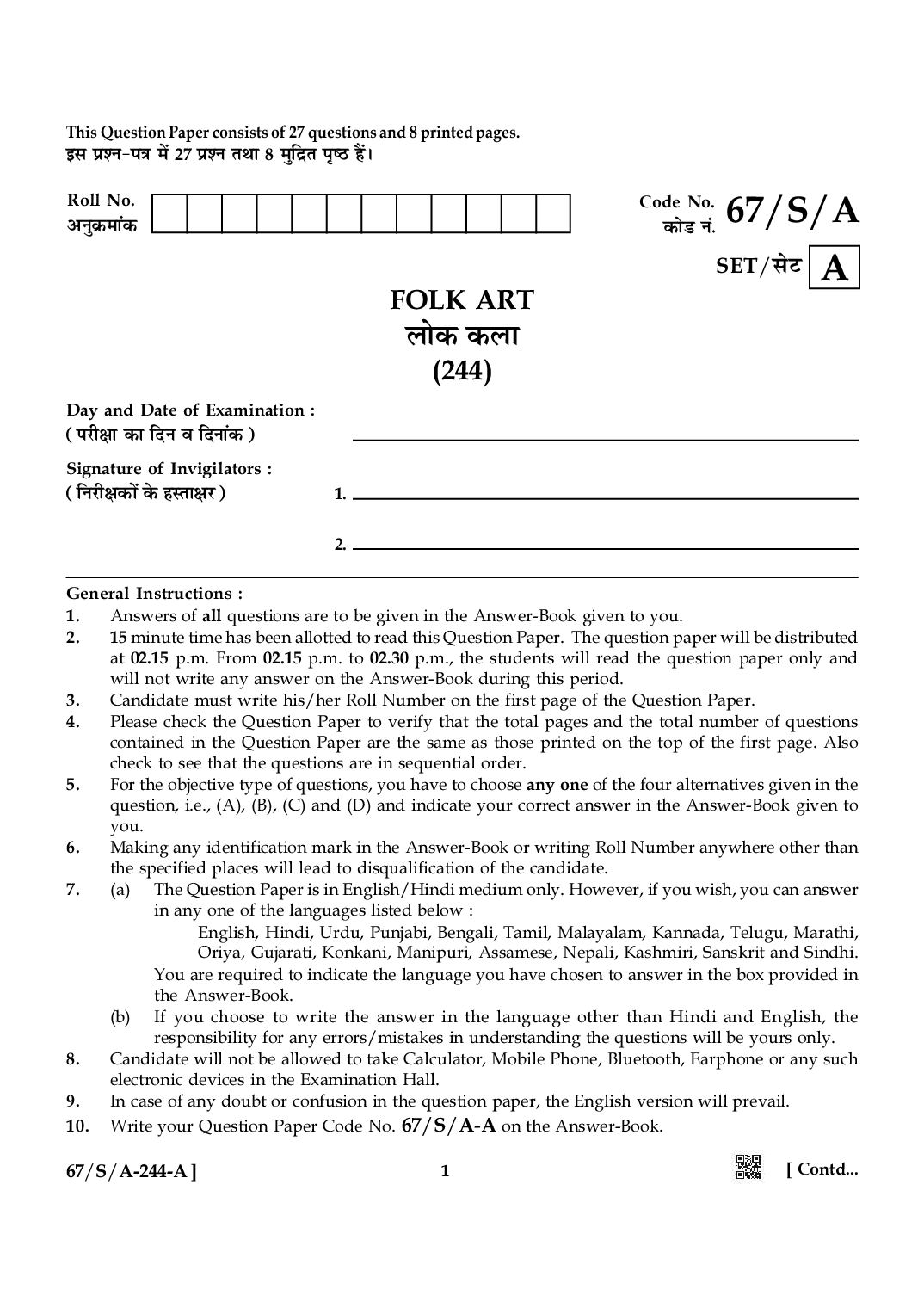
Page 1
ß‚ ¬˝‡Ÿ-¬òÊ ◊¥ 27 ¬˝‡Ÿ ÃÕÊ 8 ◊ÈÁŒ˝Ã ¬Îc∆U „Ò¥–
Roll No. Code No.
•ŸÈ∑˝§◊Ê¥∑§ ∑§Ê«U Ÿ¥.
67/S/A
SET/‚ ≈ A
FOLK ART
‹Ê∑§ ∑§‹Ê
(244)
Day and Date of Examination :
(¬⁄UˡÊÊ ∑§Ê ÁŒŸ fl ÁŒŸÊ¥∑§)
Signature of Invigilators :
(ÁŸ⁄UˡÊ∑§Ê¥ ∑§ „SÃÊˇÊ⁄U) 1.
2.
General Instructions :
1. Answers of all questions are to be given in the Answer-Book given to you.
2. 15 minute time has been allotted to read this Question Paper. The question paper will be distributed
at 02.15 p.m. From 02.15 p.m. to 02.30 p.m., the students will read the question paper only and
will not write any answer on the Answer-Book during this period.
3. Candidate must write his/her Roll Number on the first page of the Question Paper.
4. Please check the Question Paper to verify that the total pages and the total number of questions
contained in the Question Paper are the same as those printed on the top of the first page. Also
check to see that the questions are in sequential order.
5. For the objective type of questions, you have to choose any one of the four alternatives given in the
question, i.e., (A), (B), (C) and (D) and indicate your correct answer in the Answer-Book given to
you.
6. Making any identification mark in the Answer-Book or writing Roll Number anywhere other than
the specified places will lead to disqualification of the candidate.
7. (a) The Question Paper is in English/Hindi medium only. However, if you wish, you can answer
in any one of the languages listed below :
English, Hindi, Urdu, Punjabi, Bengali, Tamil, Malayalam, Kannada, Telugu, Marathi,
Oriya, Gujarati, Konkani, Manipuri, Assamese, Nepali, Kashmiri, Sanskrit and Sindhi.
You are required to indicate the language you have chosen to answer in the box provided in
the Answer-Book.
(b) If you choose to write the answer in the language other than Hindi and English, the
responsibility for any errors/mistakes in understanding the questions will be yours only.
8. Candidate will not be allowed to take Calculator, Mobile Phone, Bluetooth, Earphone or any such
electronic devices in the Examination Hall.
9. In case of any doubt or confusion in the question paper, the English version will prevail.
10. Write your Question Paper Code No. 67/S/A-A on the Answer-Book.
67/S/A-244-A ] 1 [ Contd...
Page 2
1. ‚÷Ë ¬˝‡ŸÊ¥ ∑§ ©ûÊ⁄U •Ê¬∑§Ê ŒË ªÿË ©ûÊ⁄U-¬ÈÁSÃ∑§Ê ◊¥ „Ë Á‹π¥–
2. ß‚ ¬˝‡Ÿ-¬òÊ ∑§Ê ¬…∏Ÿ ∑§ Á‹∞ 15 Á◊Ÿ≈U ∑§Ê ‚◊ÿ ÁŒÿÊ ªÿÊ „Ò– ¬˝‡Ÿ-¬òÊ ∑§Ê ÁflÃ⁄UáÊ ŒÊ¬„⁄U ◊¥ 02.15 ’¡ Á∑§ÿÊ ¡Ê∞ªÊ–
02.15 ’¡ ‚ 02.30 ’¡ Ã∑§ ¿UÊòÊ ∑§fl‹ ¬˝‡Ÿ-¬òÊ ∑§Ê ¬…∏¥ª •ÊÒ⁄U ß‚ •flÁœ ∑§ ŒÊÒ⁄UÊŸ fl ©ûÊ⁄U-¬ÈÁSÃ∑§Ê ¬⁄U ∑§Ê߸ ©ûÊ⁄U Ÿ„Ë¥
Á‹π¥ª–
3. ¬⁄UˡÊÊÕ˸ ¬˝‡Ÿ-¬òÊ ∑§ ¬„‹ ¬Îc∆U ¬⁄U •¬ŸÊ •ŸÈ∑˝§◊Ê¥∑§ •fl‡ÿU Á‹π¥–
4. ∑Χ¬ÿÊ ¬˝‡Ÿ-¬òÊ ∑§Ê ¡ÊÚ°ø ‹¥ Á∑§ ¬˝‡Ÿ-¬òÊ ∑§ ∑ȧ‹ ¬Îc∆UÊ¥ ÃÕÊ ¬˝‡ŸÊ¥ ∑§Ë ©ÃŸË „Ë ‚¥ÅUÿÊ „Ò Á¡ÃŸË ¬˝Õ◊ ¬Îc∆ ∑ §‚’‚ ™§¬⁄U
¿U¬Ë „Ò– ß‚ ’Êà ∑§Ë ¡ÊÚ°ø ÷Ë ∑§⁄U ‹¥ Á∑§ ¬˝‡Ÿ ∑˝ Á◊∑§ UM§¬ ◊¥ „Ò¥–
5. flSÃÈÁŸc∆U ¬˝‡ŸÊ¥ ◊¥ •Ê¬∑§Ê øÊ⁄U Áfl∑§À¬Ê¥ (A), (B), (C) ÃÕÊ (D) ◊¥ ‚ ∑§Ê߸ ∞∑§ ©ûÊ⁄U øÈŸŸÊ „Ò ÃÕÊ ŒË ªß¸ ©ûÊ⁄U-¬ÈÁSÃ∑§Ê ◊¥
‚„Ë ©ûÊ⁄U Á‹πŸÊ „Ò–
6. § ©ûÊ⁄U-¬ÈÁSUÃ∑§Ê ◊¥ ¬„øÊŸ-Áøq ’ŸÊŸ •ÕflÊ ÁŸÁŒ¸c≈U SÕÊŸÊ¥ ∑§§•ÁÃÁ⁄UÄà ∑§„Ë¥ ÷Ë •ŸÈ∑˝§◊Ê¥∑§ Á‹πŸ ¬⁄U ¬⁄UˡÊÊÕ˸ ∑§Ê •ÿÊÇÿ
∆U„⁄UÊÿÊ ¡ÊÿªÊ–
7. (∑§) ¬˝‡Ÿ-¬òÊ ∑§fl‹ •¥ª˝¡Ë/Á„¥ŒË ◊¥ „Ò– Á»§⁄U ÷Ë, ÿÁŒ •Ê¬ øÊ„¥ ÃÊ ŸËø ŒË ªß¸ Á∑§‚Ë ∞∑§ ÷Ê·Ê ◊¥ ©ûÊ⁄ Œ ‚∑§Ã „Ò¥ —
•¥ª˝¡Ë, Á„¥ŒË, ©ŒÍ¸, ¬¥¡Ê’Ë, ’°ª‹Ê, ÃÁ◊‹, ◊‹ÿÊ‹◊, ∑§ãŸ«∏, ËȪÍ, ◊⁄UÊ∆UË, ©Á«∏ÿÊ, ªÈ¡⁄UÊÃË, ∑§Ê¥∑§áÊË,
◊ÁáʬÈ⁄UË, •‚Á◊ÿÊ, Ÿ¬Ê‹Ë, ∑§‡◊Ë⁄UË, ‚¥S∑Χç•ÊÒ⁄U Á‚¥œË–
∑Χ¬ÿÊ ©ûÊ⁄U-¬ÈÁSÃ∑§Ê ◊¥ ÁŒ∞ ª∞ ’ÊÚÄ‚ ◊¥ Á‹π¥ Á∑§ •Ê¬ Á∑§‚ ÷Ê·Ê ◊¥ ©ûÊ⁄U Á‹π ⁄U„ „Ò¥–
(π) ÿÁŒ •Ê¬ Á„¥ŒË ∞fl¥ •¥ª˝¡Ë ∑§ •ÁÃÁ⁄UÄà Á∑§‚Ë •ãÿ ÷Ê·Ê ◊¥ ©ûÊ⁄U Á‹πà „Ò¥, ÃÊ ¬˝‡ŸÊ¥ ∑§Ê ‚◊¤ÊŸ ◊¥ „ÊŸ flÊ‹Ë
òÊÈÁ≈UÿÊ¥/ª‹ÁÃÿÊ¥ ∑§Ë Á¡ê◊UŒÊ⁄Ë ∑ fl‹ •Ê¬∑§Ë „ʪ˖
8. ¬⁄UˡÊÊÕ˸ ∑§Ê ¬⁄UˡÊÊ „ÊÚ‹ ◊¥ ∑Ò§À∑ȧ‹≈U⁄U, ◊Ê’Êß‹ »§ÊŸ, é‹Í≈ÍUÕ, ßÿ⁄U»§ÊŸ, ¡Ò‚ Á∑§‚Ë ÷Ë ß‹Ä≈˛UÊÚÁŸ∑§ ©¬∑§⁄UáÊ ∑§Ê ‹ ¡ÊŸ ∑§Ë
•ŸÈ◊Áà Ÿ„Ë¥ „Ò–
9. ¬˝‡Ÿ-¬òÊ ◊¥ Á∑§‚Ë ÷Ë ¬˝∑§Ê⁄U ∑§ ‚¥Œ„ •ÕflÊ ŒÈÁflœÊ ∑§Ë ÁSÕÁà ◊¥ •¥ª˝¡Ë •ŸÈflÊŒ „Ë ◊Êãÿ „ʪʖ
10. •¬ŸË ©ûÊ⁄U-¬ÈÁSUÃ∑§Ê ¬⁄U ¬˝‡Ÿ-¬òÊ ∑§Ê ∑§Ê«U Ÿ¥. 67/S/A-A Á‹π¥–
67/S/A-244-A ] 2 [ Contd...
Page 3
‹Ê∑§ ∑§‹Ê
(244)
Time : 1½ Hours ] [ Maximum Marks : 40
‚◊ÿ — 1½ ÉÊá≈U ] [ ¬ÍáÊÊZ∑§ — 40
Note :
(i) This question paper consists of 27 questions in all.
(ii) All questions are compulsory.
(iii) Marks are given against each question.
(iv) Section - A consists of
Q.No. 1 to 8 - Multiple Choice type questions (MCQs) carrying 1 mark each. Select and write the
most appropriate option out of the four options given in each of these questions. An internal
choice has been provided in some of these questions. You have to attempt only one of the given
choices in such questions.
(v) Section - B consists of Objective type questions
(a) Q.No. 9 to 12 - Read the passage carefully then fill in the blanks carrying 1 mark each. An
internal choice has been provided in some of these questions.
(b) Q.No. 13 to 16 - Read the passage carefully then match the questions carrying 1 mark each.
An internal choice has been provided in some of these questions.
(c) Q.No. 17 to 20 - Answer the following questions carrying 1 mark each to be answered in the
range of 15 to 25 words. An internal choice has been provided in some of these questions.
(vi) Section - C consists of Subjective type questions
(a) Q.No. 21 to 25 - Short Answer type questions carrying 2 marks each to be answered in the
range of 30 to 40 words.
(b) Q.No. 26 and 27 - Long Answer type questions carrying 5 marks each to be answered in the
range of 100 to 120 words.
ÁŸŒ¸‡Ê —
(i) ß‚ ¬˝‡Ÿ-¬òÊ ◊¥ ∑ȧ‹ 27 ¬˝‡Ÿ „Ò¥–
(ii) ‚÷Ë ¬˝‡Ÿ •ÁŸflÊÿ¸ „Ò¥–
(iii) ¬˝àÿ∑§ ¬˝‡Ÿ ∑§ ‚Ê◊Ÿ ©‚∑§ •¥∑§ ÁŒ∞ ª∞ „Ò¥–
(iv) πá«U - ∑§ ◊¥ ‡ÊÊÁ◊‹ „Ò¥ —
¬˝‡Ÿ ‚¥ÅÿÊ 1 ‚ 8 Ã∑§ ’„ÈÁfl∑§À¬Ëÿ ¬˝∑§Ê⁄U ∑§ ¬˝‡Ÿ „Ò¥ •ÊÒ⁄U ¬˝àÿ∑§ 1 •¥∑§ ∑§Ê „Ò– ߟ◊¥ ‚ ¬˝àÿ∑§ ¬˝‡Ÿ ◊¥ ÁŒ∞ ª∞ øÊ⁄U
Áfl∑§À¬Ê¥ ◊¥ ‚ ‚’‚ ©¬ÿÈÄà Áfl∑§À¬ ∑§Ê øÿŸ ∑§⁄U Á‹πŸÊ „Ò– ߟ◊¥ ‚ ∑ȧ¿U ¬˝‡ŸÊ¥ ◊¥ •Ê¥ÃÁ⁄U∑§ Áfl∑§À¬ ÁŒ∞ ª∞ „Ò¥– •Ê¬∑§Ê
∞‚ ¬˝‡ŸÊ¥ ◊¥ ÁŒ∞ ª∞ Áfl∑§À¬Ê¥ ◊¥ ‚ ∑§fl‹ ∞∑§ Áfl∑§À¬ ∑§Ê „Ë ©ûÊ⁄U Á‹πŸÊ „ʪʖ
67/S/A-244-A ] 3 [ Contd...
Page 4
(a) ¬˝‡Ÿ ‚¥ÅÿÊ 9 ‚ 12 - ÁŒ∞ ª∞ •ŸÈë¿UŒ ∑§Ê äÿÊŸ¬Ífl¸∑§ ¬…∏∑§⁄U Á⁄UÄà SÕÊŸ ∑§Ê ÷Á⁄U∞– ¬˝àÿ∑§ 1 •¥∑§ ∑§Ê „Ò– ߟ◊¥
‚ ∑ȧ¿U ¬˝‡ŸÊ¥ ◊¥ •Ê¥ÃÁ⁄U∑§ Áfl∑§À¬ ÁŒ∞ ª∞ „Ò¥–
(b) ¬˝‡Ÿ ‚¥ÅÿÊ 13 ‚ 16 - ÁŒ∞ ª∞ •ŸÈë¿UŒ ∑§Ê äÿÊŸ¬Ífl¸∑§ ¬…∏∑§⁄U ¬˝‡ŸÊ¥ ∑§Ê ‚È◊Á‹Ã ∑§ËÁ¡∞– ¬˝àÿ∑§ 1 •¥∑§ ∑§Ê „Ò–
ߟ◊¥ ‚ ∑ȧ¿U ¬˝‡ŸÊ¥ ◊¥ •Ê¥ÃÁ⁄U∑§ Áfl∑§À¬ ÁŒ∞ ª∞ „Ò¥–
(c) ¬˝‡Ÿ ‚¥ÅÿÊ 17 ‚ 20 - ÁŒ∞ ª∞ ¬˝‡ŸÊ¥ ∑§ ©ûÊ⁄U ŒËÁ¡∞– ¬˝àÿ∑§ 1 •¥∑§ ∑§Ê „Ò– ߟ ¬˝‡ŸÊ¥ ∑§ ©ûÊ⁄U 15 ‚ 25 ‡ÊéŒÊ¥
◊¥ ÁŒ∞ ¡ÊŸ øÊÁ„∞– ߟ◊¥ ‚ ∑ȧ¿U ¬˝‡ŸÊ¥ ◊¥ •Ê¥ÃÁ⁄U∑§ Áfl∑§À¬ ÁŒ∞ ª∞ „Ò¥–
(vi) πá«U - ª§ ◊¥ Áfl·ÁÿÁŸc∆U ¬˝‡Ÿ ‡ÊÊÁ◊‹ „Ò¥ —
(a) ¬˝‡Ÿ ‚¥ÅÿÊ 21 ‚ 25 - ‹ÉÊÈ-©ûÊ⁄UËÿ ¬˝∑§Ê⁄U ∑§ ŒÊ-ŒÊ •¥∑§Ê¥ ∑§ ¬˝‡Ÿ „Ò¥– ߟ ¬˝‡ŸÊ¥ ∑§ ©ûÊ⁄U 30 ‚ 40 ‡ÊéŒÊ¥ ◊¥ ÁŒ∞
¡ÊŸ øÊÁ„∞–
(b) ¬˝‡Ÿ ‚¥ÅÿÊ 26 •ÊÒ⁄U 27 - ŒËÉʸ ©ûÊ⁄UËÿ ¬˝∑§Ê⁄U ∑§ ¬Ê°ø-¬Ê°ø •¥∑§Ê¥ ∑§ ¬˝‡Ÿ „Ò¥– ߟ ¬˝‡ŸÊ¥ ∑§ ©ûÊ⁄U 100 ‚ 120 ‡ÊéŒÊ¥
◊¥ ÁŒ∞ ¡ÊŸ øÊÁ„∞–
SECTION - A / πá«U - ∑§
Multiple Choice Questions (MCQ). 8x1=8
’„ÈÁfl∑§ÁÀ¬∑§ ¬˝‡Ÿ —
1. What is the age of Jogimara Fresco ? 1
(A) 500 BCE (B) 300 BCE
(C) 1st C.BCE (D) 400 BCE
¡ÊªË◊Ê⁄UÊ »˝§S∑§Ê ∑§Ê ‚◊ÿ ∑§Ê‹ ÄÿÊ „Ò?
(A) ¬Ê°ø ‚ÊÒ ß¸‚Ê ¬Ífl¸ (B) ÃËŸ ‚ÊÒ ß¸‚Ê ¬Ífl¸
(C) ¬„‹Ë ‡ÊÃÊéŒË ߸.¬Í. (D) øÊ⁄ U‚ÊÒ ß¸‚Ê ¬Ífl¸
2. Identify the tribe famous for Jadupat Art. 1
(A) Khasi (B) Warli
(C) Santhal (D) Gond
¡ÊŒÈ¬≈U ∑§Ë ¡Ÿ¡ÊÁà ∑§‹Ê∑§Ê⁄UÊ¥ ∑§Ê ¬„øÊÁŸ∞ —
(A) πÊ‚Ë (B) flU‹Ë¸
(C) ‚¥ÃÊ‹ (D) ªÊ¥«U
3. What is Fresco Painting ? 1
(A) Painting on Paper (B) Painting on Canvas
(C) Painting on Wall (D) Painting on Floor
»˝§S∑§Ê ÁøòÊ ÄÿÊ „Ò?
(A) ∑§Êª$¡ ¬⁄U ÁøòÊ (B) ∑Ò§ŸflÊ‚ ¬⁄U ÁøòÊ
(C) ŒËflÊ⁄U ¬⁄U ÁøòÊ (D) »§‡Ê¸ ¬⁄U ÁøòÊ
67/S/A-244-A ] 4 [ Contd...
Page 5
(A) Guruppa Chetty (B) Seeta Devi
(C) Soma Masse (D) Jangorh Shyam
ÁŸêŸÁ‹Áπà ŸÊ◊Ê¥ ◊¥ ◊œÈflŸË ∑§‹Ê∑§Ê⁄U ∑§Ê ŸÊ◊ ¬„øÊÁŸ∞ —
(A) ªÈM§å¬Ê ø^Ë (B) ‚ËÃÊ ŒflË
(C) ‚Ê◊Ê ◊Ê‚ (D) ¡¥ªÊ:„ ‡ÿÊ◊
5. Who had arranged the exhibition “Unknown India” in 1978 in America ? 1
(A) Pupul Jayakar (B) Dr. V. Elwin
(C) Kamala Devi Chattopadhyay (D) Stella Kramariesh
1978 ◊¥ •◊Á⁄U∑§Ê ◊¥ “Unknown India” ¬˝Œ‡Ê¸ŸË Á∑§‚Ÿ •ÊÿÊ¡Ÿ Á∑§∞ Õ?
(A) ¬È¬È‹ ¡ÿÊ∑§Ê⁄U (B) Dr. V. ∞‹ÁflŸ
(C) ∑§◊‹Ê ŒflË ø^ʬÊäÿÊÿ (D) S≈U‹Ê ∑˝§Ê◊Á⁄U‡Ê
6. Name the author of ‘The Agaria’ : 1
(A) Rabindranath Tagore (B) Pupul Jayakar
(C) Kamala Devi Chattopadhyay (D) Dr. Verrier Elwin
‘The Agaria’ ¬ÈSÃ∑§ ∑§Ê ‹π∑§ ∑§Ê ŸÊ◊ ’ÃÊ∞° —
(A) ⁄UflËãŒ˝ŸÊÕ ∆UUÊ∑ȧ⁄U (B) ¬È¬È‹ ¡ÿÊ∑§Ê⁄U
(C) ∑§◊‹Ê ŒflË ø^ʬÊäÿÊÿ (D) Dr. V. ∞‹ÁflŸ
, Find the Padma Vibhushan among these authors.
(A) Kamala Devi Chattopadhyay (B) Dr. Verrier Elwin
(C) Guruppa Chetty (D) Stella Kramariesh
ÁŸêŸ ‹π∑§Ê¥ ◊¥ ¬k Áfl÷Í·áÊ ¬˝ÊåÃ∑§Ãʸ ∑§Ê ¬„øÊÁŸ∞–
(A) ∑§◊‹Ê ŒflË ø^ʬÊäÿÊÿ (B) «UÊ. flÁ⁄Uÿ⁄U ∞ÀflËŸ
(C) ªÈM§å¬Ê ø^Ë (D) S≈U‹Ê ∑˝§Ê◊Á⁄U‡Ê
7. Tradition paintings are done in : 1
(A) Acrylic Colour (B) Oil Colour
(C) Vegetable and Natural Colour (D) Water Colour
¬⁄¥U¬⁄UÊ ÁøòÊ∑§‹Ê ÁŸêŸÁ‹Áπà ⁄¥Uª ‚ Á∑§ÿÊ ¡ÊÃÊ „Ò —
(A) ∞∑˝§Á‹∑§ ⁄¥Uª (B) Ë ⁄¥Uª
(C) flŸS¬Áà •ÊÒ⁄U ¬˝Ê∑ΧÁÃ∑§ ⁄¥Uª (D) ¡‹ ⁄¥Uª
8. Acrylic is related to : 1
(A) Sculpture (B) Print making
(C) Painting (D) Pottery
∞Á∑˝§Á‹∑§ ‚¥’¥ÁœÃ „Ò —
(A) ◊ÍÁø∑§‹Ê (B) ◊ÈŒ˝áÊ
(C) ÁøòÊáÊ (D) Á◊^Ë ∑§Ê ’øŸ
67/S/A-244-A ] 5 [ Contd...
Page 6
Read the passage carefully and fill in the blanks given below.
ÁŸêŸÁ‹Áπà ªlÊ¥‡Ê ∑§Ê äÿÊŸ¬Ífl¸∑§ ¬…∏¥ •ÊÒ⁄U Á⁄UÄà SÕÊŸ ÷⁄U¥–
Pre-historic hunters and food gatherers gradually introduced agriculture and farming
into their lifestyle. Safety and security became important to them. Cave dwellers started to
live in a group in colony like a settlement for security. Day by day the sphere was on expansion
and the people exchanged their thoughts and ideas among other neighbouring groups.
¬˝ÊªÒÁÄÊÁ‚∑§ Á‡Ê∑§Ê⁄UË •ÊÒ⁄U ÷Ê¡Ÿ ß∑§_Ê ∑§⁄UŸ flÊ‹Ê¥ Ÿ œË⁄U-œË⁄U πÃË •ÊÒ⁄U Á∑§‚ÊŸË ∑§Ê •¬ŸË ¡ËflŸ ‡ÊÒ‹Ë ◊¥
‡ÊÊÁ◊‹ Á∑§ÿÊ– ‚È⁄UˇÊÊ •ÊÒ⁄U ‚¥⁄UˇÊÊ ©Ÿ∑§ Á‹∞ ◊„àfl¬Íáʸ „Ê ªß¸– ªÈ»§ÊflÊ‚Ë ‚È⁄UˇÊÊ ∑§Ë ŒÎÁc≈U ‚ ∞∑§ ’SÃË ∑§Ë Ã⁄U„ ∞∑§
‚◊Í„ ◊¥ ⁄U„Ÿ ‹ª– ÁŒŸ-’-ÁŒŸ, ˇÊòÊ ∑§Ê ÁflSÃÊ⁄U „Ê ⁄U„Ê ÕÊ •ÊÒ⁄U ‹ÊªÊ¥ Ÿ •ãÿ ¬«∏Ê‚Ë ‚◊Í„Ê¥ ∑§ ’Ëø •¬Ÿ ÁfløÊ⁄UÊ¥ •ÊÒ⁄U
÷ÊflŸÊ•Ê¥ ∑§Ê •ÊŒÊŸ-¬˝ŒÊŸ Á∑§ÿÊ–
9. Pre-historic hunters and __________ gradually introduced _____, _____. 1
¬˝ÊªÒÁÄÊÁ‚∑§ Á‡Ê∑§Ê⁄UË ÃÕÊ __________œË⁄U-œË⁄U _____, _____ ¡ËflŸ ‡ÊÒ‹Ë ◊¥ ‡ÊÊÁ◊‹ Á∑§ÿÊ–
10. _____, _____ became important to them. 1
_____, _____ ©Ÿ∑§ Á‹∞ ◊„àfl¬Íáʸ „Ê ªß¸–
11. __________ dwellers started to live in a __________. 1
__________ ‚È⁄UˇÊÊ ∑§ Á‹∞ __________ ◊¥ ⁄U„Ÿ ‹ª–
12. Day by Day, the __________ was on __________. 1
ÁŒŸ-’-ÁŒŸ __________ ÁflSÃÊ⁄U „Ê __________.
The people __________ their _____, _____ among other neighbouring groups.
‹ÊªÊ¥ Ÿ •ãÿ __________ ∑§ ‚ÊÕ •¬ŸËU _____, _____ ∑§Ê •ÊŒÊŸ-¬˝ŒÊŸ Á∑§ÿÊ–U
Read the passage carefully and match the following questions :
ªlÊ¥‡Ê ∑§Ê äÿÊŸ¬Ífl¸∑§ ¬…∏¥ •ÊÒ⁄U ÁŸêŸÁ‹Áπà ∑§Ê Á◊‹Ê∞°–
, Material like chalk, geru, rice powder etc. for different colours like red, black, yellow
and white can be used directly to paint walls, floors, utensils, etc. by the common village
folks. These colours can be used both dry and wet. The young women of some rural areas
use dry rice powder to paint Alpana, Rangoli, Aripan, Chowk etc., while Warli Paintings
are done with wet rice powder. Other kinds of colours are prepared and used by professional
painters. These are colour pigments are made by mixing binders like gum from mango,
neem, babul leaves etc. The leaf of Bel fruit or apple is also used to make a binder.
‹Ê‹, ∑§Ê‹Ê, ¬Ë‹Ê •ÊÒ⁄U ‚»§Œ ¡Ò‚ ÁflÁ÷㟠⁄¥UªÊ¥ ∑§ Á‹∞ øÊ∑§, ªL§, øÊfl‹ ¬Ê©«U⁄U •ÊÁŒ ¡Ò‚Ë ‚Ê◊Áª˝ÿÊ¥ ∑§Ê
©¬ÿʪ •Ê◊ ª˝Ê◊ËáÊ ‹ÊªÊ¥ mÊ⁄UÊ ‚Ëœ ŒËflÊ⁄UÊ¥, »§‡Ê¸, ’øŸÊ¥ •ÊÁŒ ∑§Ê ⁄¥UªŸ ∑§ Á‹∞ Á∑§ÿÊ ¡Ê ‚∑§ÃÊ „Ò– ߟ ⁄¥UªÊ¥ ∑§Ê ‚ÍπÊ
•ÊÒ⁄U ªË‹Ê ŒÊŸÊ¥ Ã⁄U„ ‚ ßSÃ◊Ê‹ Á∑§ÿÊ ¡Ê ‚∑§ÃÊ „Ò– ∑ȧ¿U ª˝Ê◊ËáÊ ˇÊòÊÊ¥ ∑§Ë ÿÈflÊ ◊Á„‹Ê∞° •À¬ŸÊ, ⁄¥UªÊ‹Ë, •Á⁄U¬Ÿ,
øÊÒ∑§ •ÊÁŒ ∑§Ê ÁøÁòÊà ∑§⁄UŸ ∑§ Á‹∞ ‚Íπ øÊfl‹ ∑§ ¬Ê©«U⁄U ∑§Ê ©¬ÿʪ ∑§⁄UÃË „¥Ò, ¡’Á∑§ fl‹Ë¸ ÁøòÊ ªË‹ øÊfl‹ ∑§
¬Ê©«U⁄U ‚ ∑§Ë ¡ÊÃË „Ò– •ãÿ ¬˝∑§Ê⁄U ∑§ ⁄¥Uª ¬‡Êfl⁄U ÁøòÊ∑§Ê⁄UÊ¥ mÊ⁄UÊ ÃÒÿÊ⁄U •ÊÒ⁄U ©¬ÿʪ Á∑§∞ ¡Êà „Ò¥– ÿ ⁄¥UªËŸ ⁄¥UªŒ˝√ÿ „Ò
¡Ê ’ÊßZ«U ⁄U ∑§Ê Á◊‹Ê∑§⁄U ’ŸÊ∞° ¡Êà „Ò¥– ¡Ò‚ Á∑§ •Ê◊, ŸË◊, ’’Í‹ ∑§ ¬ûÊ •ÊÁŒ ‚ ªÊ¥Œ Á◊‹ÃÊ „Ò– ’‹ »§‹ ÿÊ ‚’
Á∑§ ¬ûÊ ∑§Ê ©¬ÿʪ ’ÊßZ«U⁄U ’ŸÊŸ ∑§ Á‹∞ ÷Ë Á∑§ÿÊ ¡ÊÃÊ „Ò–
67/S/A-244-A ] 6 [ Contd...
Page 7
Á◊‹ÊŸ ∑§ËÁ¡∞ —
13. (i) Materials like (a) with wet rice powder 1
‚Ê◊Áª˝ÿÊ° ¡Ò‚Ë ªË‹Ê øÊfl‹ ¬Ê©«U⁄U ‚ ÁøÁòÊà „ÊÃÊ
14. (ii) The colours can be used (b) both dry and wet 1
ß‚ ⁄¥UªÊ¥ ∑§ ‚ÍπÊ •ÊÒ⁄U ªË‹Ê ßSÃ◊Ê‹ „ÊÃÊ
15. (iii) Use dry rice powder (c) chalk, geru, rice powder etc. 1
‚Íπ øÊfl‹ ∑§ ¬Ê©«U⁄U øÊ∑§, ªL§, øÊfl‹ ¬Ê©«U⁄U •ÊÁŒ–
16. (iv) Warli painting is done (d) to paint Alpana, Rangoli, Aripan 1
fl‹Ë¸ ÁøòÊ •À¬ŸÊ, ⁄¥UªÊ‹Ë, •Á⁄U¬Ÿ ∑§ Á‹∞ ©¬ÿʪ „ÊÃÊ
OR/•ÕflÊ OR/•ÕflÊ
The leaf of Bel fruit is also used to make a binder
’‹ »§‹ Á∑§ ¬ûÊ ’ÊßZ«U⁄U ’ŸÊŸ ◊¥ ©¬ÿʪ „ÊÃÊ
Answer the following questions :
ÁŸêŸÁ‹Áπà ¬˝‡ŸÊ¥ ∑§Ê ©ûÊ⁄U Œ¥–
17. Specify one typical character of Folk Art. 1
‹Ê∑§ ∑§‹Ê ∑§Ë ∞∑§ Áfl‡Ê·ÃÊ ’ÃÊ∞°–
18. Write few words on Warli painting. 1
∑ȧ¿U ‡ÊéŒÊ¥ ◊¥ fl‹Ë¸ ÁøòÊ∑§‹Ê ¬⁄U Á‹π¥–
19. What do you know about Dr. V. Elwin ? 1
Dr. V. ∞‹ÁflŸ ∑§ ’Ê⁄U ◊¥ •Ê¬ ÄÿÊ ¡ÊŸÃ „Ê?
20. (a) Write the names of two tribal painters. 1
ŒÊ ¡Ÿ¡ÊÃË ÁøòÊ∑§Ê⁄U ∑§Ê ŸÊ◊ ’ÃÊ∞°–
(b) What is Gelatin ?
Á¡‹Á≈UŸ ÄÿÊ „Ò?
SECTION - C / πá«U - ª
Answer the Short Answer Questions.
ÁŸêŸÁ‹Áπà ‹ÉÊÈ ©ûÊ⁄UËÿ ¬˝‡ŸÊ¥ ∑§Ê ©ûÊ⁄U Á‹π¥–
21. What are the divisions of Cave Art ? 2
ªÈ»§Ê ∑§‹Ê ∑§Ë Áfl÷ʪ ÄÿÊ „Ò¥?
22. Write a short note on Soura tribes. 2
‚ÊÒ⁄UÊ •ÊÁŒflÊ‚Ë ¬⁄U ∞∑§ Á≈Uå¬áÊË Á‹π¥–
23. What are the themes of Bhimbhetka Painting ? Mention its favourite theme. 2
÷Ë◊÷≈U∑§Ê ÁøòÊ ∑§Ê Áfl·ÿflSÃÈ ÄÿÊ „Ò? ß‚ ÁøòÊ ∑§Ê ¬‚¥ŒËŒÊ Áfl·ÿflSÃÈ ’ÃÊ∞°–
67/S/A-244-A ] 7 [ Contd...
Page 8
ÁøòÊ ’ŸÊŸ ∑§Ê ÁflÁœ •ÊÒ⁄U ‚Ê◊ª˝Ë •ÊÁŒ◊ÊŸfl Ÿ ∑Ò§‚ •Êª ’…∏ÊÿÊ?
25. Describe the source of colours in Folk art. 2
‹Ê∑§ ∑§‹Ê ∑§Ê ⁄¥UªÊ¥ ∑§Ê ‚˝Êà ÄÿÊ „Ò?
What are the sources of designs and motifs of Kantha ?
∑§Ê¥ÕÊ ∑§Ê Á«U$¡Êߟ ÃÕÊ ◊ÊÁ≈U»§ ∑§ ‚˝Êà ÄÿÊ „Ò¥?
Answer the long Answer questions :
ÁŸêŸÁ‹Áπà ŒËÉʸ ©ûÊ⁄UËÿ ¬˝‡ŸÊ¥ ∑§Ê ©ûÊ⁄U Á‹π¥–
26. (a) What is lekhna ? Write the technique used for writers on Palm Leaf. 5
‹πŸÊ ÄÿÊ „Ò? ÃÊ⁄U¬òÊ ¬⁄U Á‹πŸ ∑§ Á‹∞ ∑Ò§‚ Ã∑§ŸË∑§ ∑§Ê ©¬ÿʪ „È•Ê?
(b) Phad paintings belong to which part of India ? What are its main features ?
»§«∏ ÁøòÊ∑§Ê⁄UË ÷Ê⁄Uà ∑§ Á∑§‚ ¬˝Êãà ◊¥ ¬˝Êåà „ÊÃË „Ò? ß‚∑§Ë ◊ÈÅÿ Áfl‡Ê·ÃÊ•Ê¥ ¬⁄U Á‹π¥–
27. (a) Explain the influence of Guruppa Chetty of folk art form of Kalamkari. 5
∑§‹◊∑§Ê⁄UË ‹Ê∑§ ∑§‹Ê ¬⁄U ªÈM§å¬Ê ø^Ë ∑§Ê ¬˝÷Êfl ∑§Ë √ÿÊÅÿÊ ∑§⁄¥U–
(b) Explain the pre-historic Rock painting with example.
¬˝ÊªÒÁÄÊÁ‚∑§ ‡ÊÒ‹ ÁøòÊ∑§‹Ê ∑§Ë ©ŒÊ„⁄UáÊ ∑§ ‚ÊÕ √ÿÊÅÿÊ ∑§⁄U¥–
-oOo-
67/S/A-244-A ] 8 [ Contd...
Document Details
| Board / Org | NIOS |
| Exam | National Institute of Open Schooling Class 10 |
| Type | Question Paper |
| Pages | 8 |
| Language | english |
| Updated | 24 Sep 2026 |