AP PGCET 2022 Syllabus Statistics
Finished viewing? Save it for later —
Download AP PGCET 2022 Syllabus Statistics (PDF · 3 pages)About AP PGCET 2022 Syllabus Statistics
AP PGCET 2022 Syllabus Statistics is available here for free download. Published by APSCHE for Andhra Pradesh Post Graduate Common Entrance Test, this syllabus can be viewed online or downloaded as a PDF (3 pages). Candidates preparing for Andhra Pradesh Post Graduate Common Entrance Test can use AP PGCET 2022 Syllabus Statistics to understand the exam pattern, the type of questions asked, and the overall difficulty level.
Frequently Asked Questions
How can I download AP PGCET 2022 Syllabus Statistics?
Open this page and click the Download button to save AP PGCET 2022 Syllabus Statistics as a PDF. It is completely free on AglaSem Docs.
Is AP PGCET 2022 Syllabus Statistics free to download?
Yes. AP PGCET 2022 Syllabus Statistics can be viewed online and downloaded as a PDF free of cost on AglaSem Docs.
How many pages does AP PGCET 2022 Syllabus Statistics have?
AP PGCET 2022 Syllabus Statistics contains 3 pages, which you can read online or download together as a single PDF.
Where can I find more Andhra Pradesh Post Graduate Common Entrance Test study material?
You can find more Andhra Pradesh Post Graduate Common Entrance Test question papers, sample papers, syllabus, and answer keys on AglaSem Docs.
AP PGCET 2022 Syllabus Statistics – Text
Read the full text of this syllabus below — useful to quickly search, copy and reference the content online without downloading the PDF.
📄 View text version (3 pages)
Page 1
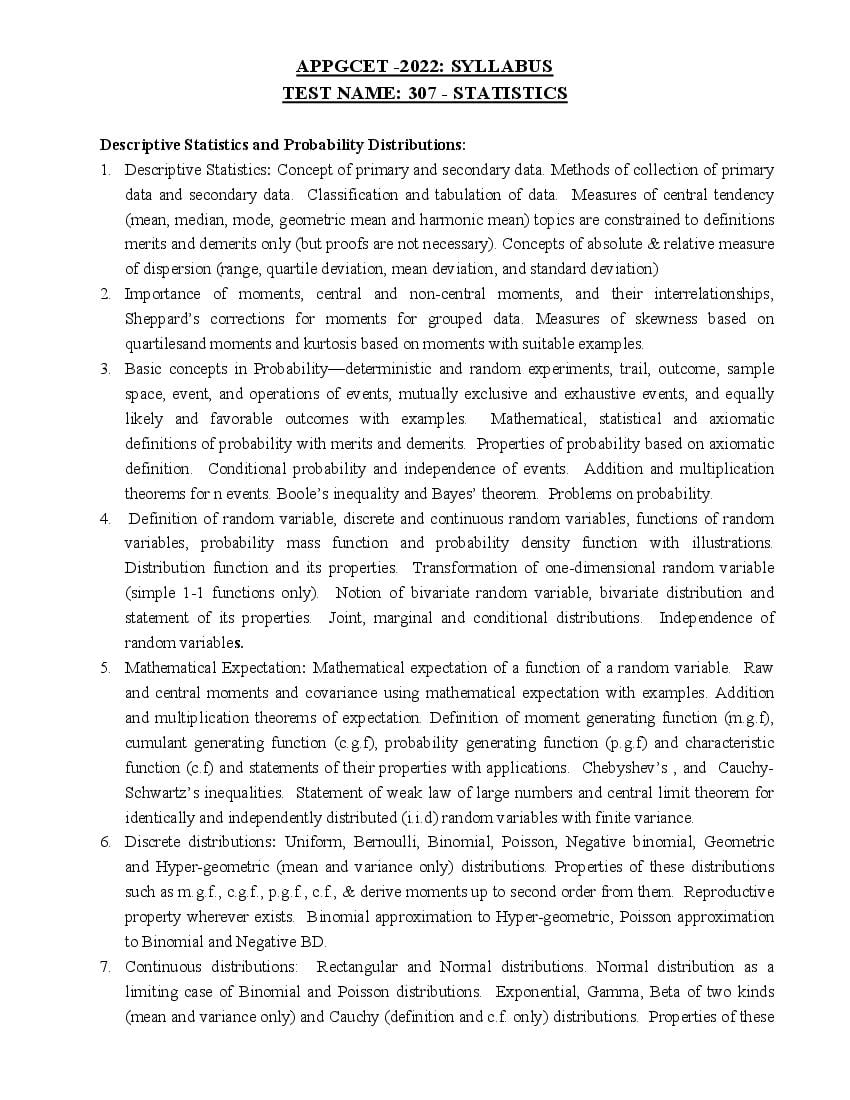
TEST NAME: 307 - STATISTICS
Descriptive Statistics and Probability Distributions:
1. Descriptive Statistics: Concept of primary and secondary data. Methods of collection of primary
data and secondary data. Classification and tabulation of data. Measures of central tendency
(mean, median, mode, geometric mean and harmonic mean) topics are constrained to definitions
merits and demerits only (but proofs are not necessary). Concepts of absolute & relative measure
of dispersion (range, quartile deviation, mean deviation, and standard deviation)
2. Importance of moments, central and non-central moments, and their interrelationships,
Sheppard’s corrections for moments for grouped data. Measures of skewness based on
quartilesand moments and kurtosis based on moments with suitable examples.
3. Basic concepts in Probability—deterministic and random experiments, trail, outcome, sample
space, event, and operations of events, mutually exclusive and exhaustive events, and equally
likely and favorable outcomes with examples. Mathematical, statistical and axiomatic
definitions of probability with merits and demerits. Properties of probability based on axiomatic
definition. Conditional probability and independence of events. Addition and multiplication
theorems for n events. Boole’s inequality and Bayes’ theorem. Problems on probability.
4. Definition of random variable, discrete and continuous random variables, functions of random
variables, probability mass function and probability density function with illustrations.
Distribution function and its properties. Transformation of one-dimensional random variable
(simple 1-1 functions only). Notion of bivariate random variable, bivariate distribution and
statement of its properties. Joint, marginal and conditional distributions. Independence of
random variables.
5. Mathematical Expectation: Mathematical expectation of a function of a random variable. Raw
and central moments and covariance using mathematical expectation with examples. Addition
and multiplication theorems of expectation. Definition of moment generating function (m.g.f),
cumulant generating function (c.g.f), probability generating function (p.g.f) and characteristic
function (c.f) and statements of their properties with applications. Chebyshev’s , and Cauchy-
Schwartz’s inequalities. Statement of weak law of large numbers and central limit theorem for
identically and independently distributed (i.i.d) random variables with finite variance.
6. Discrete distributions: Uniform, Bernoulli, Binomial, Poisson, Negative binomial, Geometric
and Hyper-geometric (mean and variance only) distributions. Properties of these distributions
such as m.g.f., c.g.f., p.g.f., c.f., & derive moments up to second order from them. Reproductive
property wherever exists. Binomial approximation to Hyper-geometric, Poisson approximation
to Binomial and Negative BD.
7. Continuous distributions: Rectangular and Normal distributions. Normal distribution as a
limiting case of Binomial and Poisson distributions. Exponential, Gamma, Beta of two kinds
(mean and variance only) and Cauchy (definition and c.f. only) distributions. Properties of these
Page 2
applications and reproductive productive property wherever exists.
Statistical Methods and Inference:
1. Bivariate data, scattered diagram Correlation coefficient and it’s properties. Computation of
correlation coefficient for grouped data. Correlation ratio, Spearman’s rank correlation
coefficient and it’s properties. Simple linear regression properties of regression coefficients,
correlation verses regression. Principles of least squares, fitting of quadratic and power curves.
Concepts of partial and multiple correlation coefficients (only for three variables).
2. Analysis of categorical data, independence and association and partial association of
attributes, various measures of association (Yule’s)& coefficient of colligation for two way
data and coefficient of contingency (Pearsonss’s &Tcheprow’s)
3. Concept of population, parameter, random sample, statistic, sampling distribution and
standard error. Standard error of sample mean (s) and sample proportions (s). Exact sampling
distributions:-Statements and properties of X^2,t, &F distributions and their inter
relationships.
4. Point estimation of a parameter. Concept of bias and mean square error of an estimate.
Criteria of good estimator-consistency, unbiasedness, efficiency and sufficiency with
examples. Statement of Neyman’s Factorization theorem, derivations of sufficient statistics
in case of Binomial, Poisson, Normal and Exponential (one parameter only) distributions.
Estimation by the method of moments, Maximum likelihood (ML), statements of asymptotic
properties of MLE. Concept of interval estimation. Confidence Intervals of parameters of
normal population.
5. Concepts of statistical hypothesis, null and alternative, hypothesis, critical region, two Types
of errors, level of significance and power of a test. One and two tailed tests, Neyman
Pearson’s fundamental lemma for Randomised tests. Examples in case of Binomial, poisson,
Exponential and Normal distributions and their powers. Use of central limit theorem in
testing large sample tests and confidence intervals for mean(s), proportion(s), standard
deviation(s) and correlation coefficient(s).
6. Test of significance based on x2, t, F, x2-test for goodness of fit and test for independence of
attributes. Definition of order statistics.
7. Non-Parametric tests their advantages and disadvantages, comparison with parametric tests.
Measurement scale: nominal, ordinal, interval and ratio. One sample runs test, sign test and
Wilcoxon-signed rank tests (single and paired samples). Two independent sample tests:
Median test, Wilcoxon –Mann-Whitney U test, Wald Wolfowitz’s runs test.
APPLIED STATISTICS:
Design of Sample Surveys: Concept of population, sample, sampling unit, parameter, statistic,
sampling errors, sampling distribution, sample frame and standard error.
Principle steps in sampling surveys-need for sampling, census verses samples surveys
Sampling and non-sampling errors, sources and treatment of non-sampling errors, advantages
and limitations of sampling. Types of sampling: subjective, probability and mixed sampling
methods. Methods of drawing random samples with and without replacement. Estimates of
Page 3
methods
i) SRSWR and SRSWOR
ii) Stratified random sampling with proportional and Neyman allocation.
Comparison of relative efficiencies.
Concept of Systematic sampling N=nk
Analysis of Variance and Design of Experiments: ANOVA-one-way, two way classifications
with one observation per cell-concept of Gauss - Markoff linear model, Statement of Cochran’s
theorem, Mathematical Analysis, importance and applications of design of experiments.
Principles of Experimentation, Analysis of Completely randomized Design (CRD), Randomized
Block Design (RBD) and Latin Square Design (LSD)
Time Series: Time series and it’s components with illustrations, additive, multiplicative and
mixed models, Determination of trend by least squares, moving average methods Determination
of Seasonal indices by Ratio to moving average, Ratio to trend and link relative methods.
Index Numbers: Concept, Construction, uses and limitations of simple and weighted index
numbers, lasperyer’s, Paasche’s and Fisher’s Index numbers. Fisher’s index as ideal index
number. Fixed and chain base index numbers. Cost of living index numbers and wholesale price
index numbers. Base shifting, Splicing and deflation of index numbers.
Official Statistics: Functions and organization of CSO and NSSO. Agricultural Statistics, area
and yield statistics. National Income and it’s computation, utility and difficulties in estimation of
National income.
Vital Statistics: Introduction, definition and uses of vital statistics. Sources of vital statistics,
registration method and census method. Rates and ratios, Crude Death rate, age specific death
rate, standardized death rates, crude birth rate, age specific fertility rate, general fertility rate,
total fertility rate. Measurement of population Growth, crude rate in natural increase – Pearl’s
vital index. Gross reproductive rate and net reproductive rate, Life tables, construction and uses
of life tables and abridged life tables.
Demand Analysis: Introduction, Demand and supply, price elastics of supply and demand.
Methods of determining demand and supply curves, Leontief’s, Pigous’s methods of determining
demand curve from time series data, limitations of these methods.
***************
Document Details
| Board / Org | APSCHE |
| Exam | Andhra Pradesh Post Graduate Common Entrance Test |
| Type | Syllabus |
| Pages | 3 |
| Updated | 22 Jul 2026 |