Competency Based Questions Class 6 Science
Finished viewing? Save it for later —
Download Competency Based Questions Class 6 Science (PDF · 90 pages)About Competency Based Questions Class 6 Science
Competency Based Questions Class 6 Science is available here for free download. Published by AglaSem for Class 6, this question bank can be viewed online or downloaded as a PDF (90 pages). Candidates preparing for Class 6 can use Competency Based Questions Class 6 Science to understand the exam pattern, the type of questions asked, and the overall difficulty level.
Frequently Asked Questions
How can I download Competency Based Questions Class 6 Science?
Open this page and click the Download button to save Competency Based Questions Class 6 Science as a PDF. It is completely free on AglaSem Docs.
Is Competency Based Questions Class 6 Science free to download?
Yes. Competency Based Questions Class 6 Science can be viewed online and downloaded as a PDF free of cost on AglaSem Docs.
How many pages does Competency Based Questions Class 6 Science have?
Competency Based Questions Class 6 Science contains 90 pages, which you can read online or download together as a single PDF.
Where can I find more Class 6 study material?
You can find more Class 6 question papers, sample papers, syllabus, and answer keys on AglaSem Docs.
Competency Based Questions Class 6 Science – Text
Read the full text of this question bank below — useful to quickly search, copy and reference the content online without downloading the PDF.
📄 View text version (60 pages)
Page 1
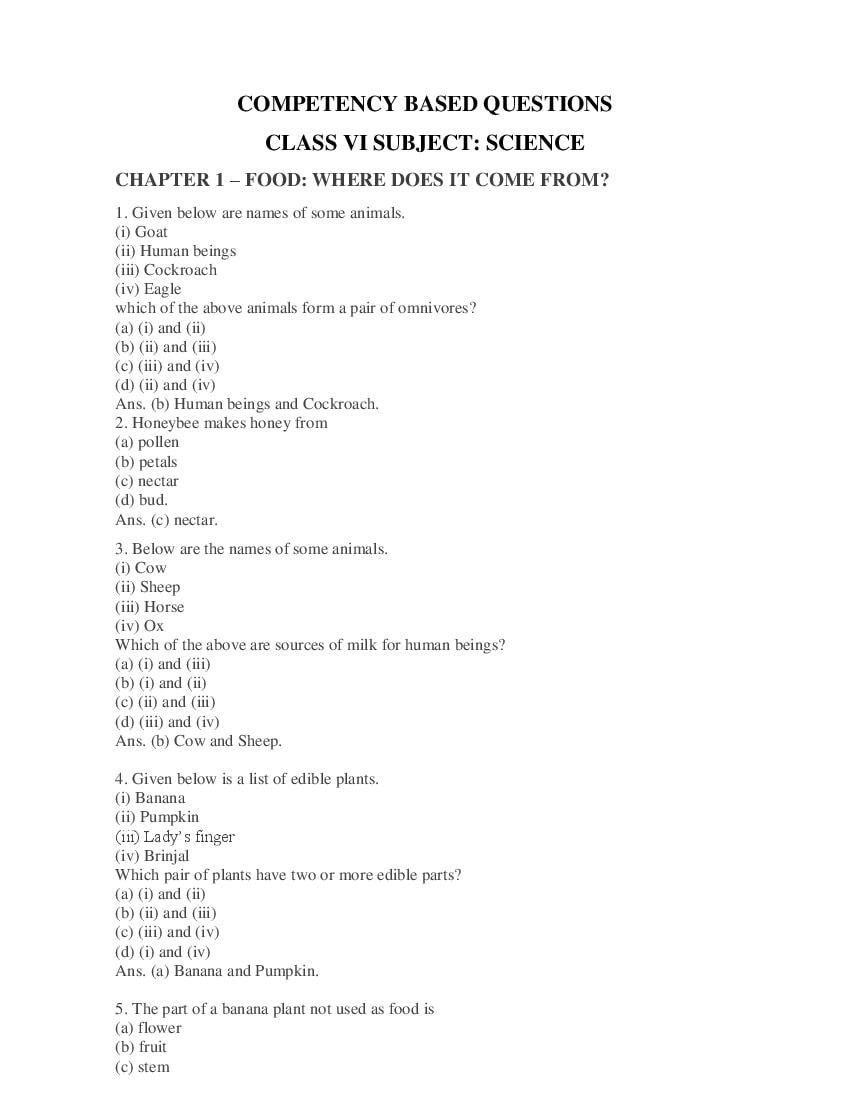
CLASS VI SUBJECT: SCIENCE
CHAPTER 1 – FOOD: WHERE DOES IT COME FROM?
1. Given below are names of some animals.
(i) Goat
(ii) Human beings
(iii) Cockroach
(iv) Eagle
which of the above animals form a pair of omnivores?
(a) (i) and (ii)
(b) (ii) and (iii)
(c) (iii) and (iv)
(d) (ii) and (iv)
Ans. (b) Human beings and Cockroach.
2. Honeybee makes honey from
(a) pollen
(b) petals
(c) nectar
(d) bud.
Ans. (c) nectar.
3. Below are the names of some animals.
(i) Cow
(ii) Sheep
(iii) Horse
(iv) Ox
Which of the above are sources of milk for human beings?
(a) (i) and (iii)
(b) (i) and (ii)
(c) (ii) and (iii)
(d) (iii) and (iv)
Ans. (b) Cow and Sheep.
4. Given below is a list of edible plants.
(i) Banana
(ii) Pumpkin
(iii) Lady’s finger
(iv) Brinjal
Which pair of plants have two or more edible parts?
(a) (i) and (ii)
(b) (ii) and (iii)
(c) (iii) and (iv)
(d) (i) and (iv)
Ans. (a) Banana and Pumpkin.
5. The part of a banana plant not used as food is
(a) flower
(b) fruit
(c) stem
Page 2
Ans. (d) root.
6. Read each set of terms and identify the odd set.
(a) Cow, milk, butter
(b) Hen, meat, egg
(c) Goat, milk, meat
(d) Plant, vegetable, buttermilk
Ans. (d) Plant, vegetable, buttermilk
7. Read the clues and fill up the blanks given below each of them.
(a) Honeybees suck from flower.
N_ _T_R
Ans. (a) NECTAR
(b) Animals which eat other animals.
_A _N_V_R_S
Ans. (b) CARNIVORES
(c) Animals which eat only plants and plant products.
HE_B_ _ _ _ E_
Ans. (c) HERBIVORES
(d) Animals which eat both plants and animals.
_MN I_O_ _ _
Ans. (d) OMNIVORES
8. Given below are jumbled words which are names of parts of a plant. Rearrange them to
get the correct words.
(a) LILCHI
(b) ITRUF
(c) SEANBOYA
(d) GURSA
(e) ROUNDGUNT
Ans. The rearranged words are:
(a) CHILLI
(b) FRUIT
(c) SOYABEAN
(d) SUGAR
(e) GROUNDNUT
9. Identify the animals in the grid given below as figure and categorize them into herbivore,
carnivore and omnivore.
T A C O W O L F
T A R W X G O R
N N O L I O N O
E T W Q L A N G
H U M A N T W O
Page 3
Herbivore – Cow, Goat, Hen
Carnivore – Wolf, Lion, Frog
Omnivore – Cat, Rat, Crow, Human, Ant, Owl
10. Label the different parts of the plant in the figure given below.
Ans.
(a) Flower
(b) Floral bud
(c) Leaf
(d) Stem
11. Read the names of animals written in the inner ring of the given figure. Within the
second ring write the types of food they eat and the category to which they belong (based on
the eating habit) in the outermost ring.
Page 4
12. Connect the animal with the food it eats by an arrow using different colours in the given
figure.
Ans.
Page 5
Lion – Goat
Lizard – Insects, Spider
Rat – Grain
Insect – Grain, Grass
Spider – Insects
Snake – Rat, Lizard, Goat
Goat – Grass, Grain
Page 6
1. Which one of the following food items does not provide dietary fibre?
(a) Whole grains
(b) Whole pulses
(c) Fruits and vegetables
(d) Milk
Ans. (d) Milk
2. Which of the following sources of protein is different from others?
(a) Peas
(b) Gram
(c) Soyabeans
(d) Cottage cheese (paneer)
Ans. (d) Cottage cheese (paneer)
3. Which of the following nutrients is not present in milk?
(a) Protein
(b) Vitamin C
(c) Calcium
(d) Vitamin D
Ans. (b) Vitamin C
4. Read the food items given below:
(i) Wheat
(ii) Ghee
(iii) Iodised salt
(iv) Spinach (palak)
Which of the above food items are “energy giving foods”?
(a) (i) and (iv)
(b) (ii) and (iv)
(c) (i) and (ii)
(d) (iii) and (iv)
Ans. (c) (i) and (ii)
5. Read the following statements about diseases.
(i) They are caused by germs.
(ii) They are caused due to lack of nutrients in our diet.
(iii) They can be passed on to another person through contact.
(iv) They can be prevented by taking a balanced diet.
Which pair of statements best describe a deficiency disease?
(a) (i) and (ii)
(b) (ii) and (iii)
(c) (ii) and (iv)
Page 7
Ans. (c) (ii) and (iv)
6. Given below are the steps to test the presence of proteins in a food item:
(i) Take a small quantity of the food item in a test tube, add 10 drops of water to it
and shake it.
(ii) Make a paste or powder of food to be tested.
(iii) Add 10 drops of caustic soda solution to the test tube and shake well.
(iv) Add 2 drops of copper sulphate solution to it.
Which of the following is the correct sequence of the steps?
(a) i, ii, iv, iii
(b) ii, i, iv, iii
(c) ii, i, iii, iv
(d) iv, ii, i, iii
Ans. (b) ii, i, iv, iii
7. Unscramble the following words related to components of food and write them in the
space provided.
Ans. (a) Protein (b) Minerals (c) Vitamin (d) Carbohydrates (e) Nutrients (f) Fat
8. Fill in the blanks given below:
(a) Egg yolk is rich in ____________ and egg albumin is rich in __________.
(b) Deficiency diseases can be prevented by taking a ___________.
(c) Eating too much of fat rich foods may lead to a condition called ____________.
(d) The component of food that does not provide any nutrient to our body and yet is
essential in our food is ___________.
(e) The vitamin that gets easily destroyed by heating during cooking is __________.
Ans. (a) fat, protein (b) balanced diet (c) obesity (d) roughage (e) Vitamin C
9. Read the items of food listed below. Classify them into carbohydrate rich, protein
rich and fat rich foods and fill them in the given table.
Moong dal, fish, mustard oil, sweet potato, milk, rice, egg, beans, butter, butter milk
(chhachh), cottage cheese (paneer), peas, maize, white bread.
Ans.
Carbohydrates Rich Protein Rich Food Item Fat Rich Food Item (C)
Food Item (A) (B)
Page 8
white bread egg, beans, butter milk egg, butter
(chhachh), cottage cheese
(paneer), peas
10. Rohan was having difficulty in seeing things in dim light. The doctor tested his
eyesight and prescribed a particular vitamin supplement. He also advised him to
include a few food items in his diet.
(a) Which deficiency disease is he suffering from?
(b) Which food component may be lacking in his diet?
(c) Suggest some food items that he should include in his diet.
Ans. (a) Rohan is suffering from night blindness which results in difficulty of seeing
things in dim light.
(b) Deficiency of vitamin A causes night blindness. Hence vitamin A might be
lacking in his diet.
(c) In his diet, Rohan can include food items such as carrot, spinach, papaya, milk,
green leafy, vegetables, fish oil, etc. which are rich in vitamin A.
11. Solve the cross-word puzzle given as Figure from the clues given below.
Across
1. Lack of nutrients in our diet over a long period causes these diseases (10)
2. Rice and potato are rich in this type of carbohydrate (6)
3. Deficiency disease in bones making it become soft and bent (7)
4. The diet that provides all the nutrients that our body needs, in right quantities,
along with adequate amount of roughage and water (8, 4)
5. Deficiency disease with bleeding gums (6)
6. Disease caused due to deficiency of iodine (6)
Ans. 1. DEFICIENCY 2. STARCH 3. RICKETS 4. BALANCED DIET 5.
SCURVY 6. GOITRE
Down
7. Starch and sugar in our food are rich in this type of energy giving nutrient (13)
8. The term given to the useful components of food (9)
Page 9
10. Green leafy vegetables, liver and apples are rich in this mineral (4)
11. Deficiency disease caused due to lack of Vitamin B 1 in the diet (8)
Ans. 7. CARBOHYDRATES 8. NUTRIENTS 9. ANAEMIA 10. IRON 11.
BERIBERI
12. Observe the items given in figure given below carefully and answer the questions
that follow.
Ans. (i) Chapati (ii) phosphorus (iii) D (iv) Butter (v) protein (vi) calcium (vii)
papaya (viii) iron (ix) peas (x) proteins
13.
Page 10
(a) The food items shown are mainly rich in ‘X’, a nutrient component of food. What is ‘X’?
Ans. (a) X is Protein
(b) Name the disease caused by deficiency of component ‘X’.
Ans. (b) Kwashiorkor
(c) What is the main function of this food component?
Ans. Proteins are required for growth and repairing of tissues in our body. They help in
building new tissues.
(d) What are the chemicals used to test the presence of the ‘X’ in the food items?
Ans. (d) Copper sulphate, Caustic Soda and Biuret Reagent
14. Reena performed the following test on the given food sample
Water soluble food sample + iodine solution observed blue black colour.
Which component of food is present in it?
A. Proteins
B. Vitamins
C. Starch
D. Fat
Ans. C. Starch
15. From given help box find out the correct vitamin or mineral and write it at the centre
of the given images A and B.
Vitamin D Vitamin C Iron Proteins Iodine
Page 11
In image B Iron
16. Case Study Question
We know that each dish is usually made up of one or more ingredients, which we get
from plants or animals. These ingredients contain some components that are needed
by our body. These components are called nutrients. The major nutrients in our food
are named carbohydrates, proteins, fats, vitamins and minerals. In addition, food
contains dietary fibres and water which are also needed by our body. With some
simple methods we can test whether cooked food or a raw ingredient contains one or
more of these nutrients. For carrying out these tests, you will need solutions of
iodine, copper Sulphate and caustic soda. You will also need a few test tubes and a
dropper. Try these tests on cooked food items as well as raw materials. If the
required solutions are not available in readymade form, you can prepare them as
given in the Table. There are many types of carbohydrates. The main carbohydrates
found in our food are in the form of starch and sugars.
Table:
A dilute solution of iodine can be prepared by adding a few drops of tincture
iodine to a test tube half filled with water.
Copper sulphate solution can be prepared by dissolving 2 g of copper sulphate
in 100 ml of water.
10 g of Caustic soda dissolved in100 ml of water makes the required solution of
Caustic soda.
Q1. Starch and sugar are the forms of carbohydrates mainly present in our food?
(a) True
(b) False
Ans. (a)True
Q2. To make the solution of caustic soda, we need to dissolve …………………in 100 ml
of ……………?
(a) Iodine and water
(b) Salt and water
(c) Caustic soda and salt
(d) Caustic soda and water
Ans. (d) Caustic soda and water
Q3. Which of the following is NOT required to test the presence of nutrients in food?
Page 12
(b) Iodine solution
(c) Copper Sulphate
(d) Caustic soda solution
Ans. (a) Vinegar solution
Q4. What are nutrients? Give one example?
Ans. Our food is made up of one or more ingredients. These ingredients contain components
that are needed by our body. These components are called Nutrients. For example- Proteins
Q5. Name all the components present in our food?
Ans. The major nutrients in our food are carbohydrates, proteins, fats, vitamins and
minerals. Apart from nutrients, food also contains dietary fibres and water.
Page 13
1. Sunidhi wants to present her friend a gift made of plant fibre. Which out of the following
will she select?
(a) Jute bag
(b) Woollen shawl
(c) Silk saree
(d) Nylon scarf
Ans. (a) Jute Bag
2. Which statement out of the following is incorrect?
(a) Use of charkha was popularized by Mahatma Gandhi as a part of the Independence
Movement.
(b) In India, jute is mainly grown in Kerala and Punjab.
(c) To make fabric, the fibres are first converted into yarns.
(d) Sufi saint Kabir was a weaver.
Ans. (b) In India, jute is mainly grown in Bihar, West Bengal, Assam and Andhra Pradesh.
3. Which of the following materials did people use in ancient times for making clothes?
(i) Leaves of trees
(ii) Newspaper
(iii) Metal foils
(iv) Animal skins and furs
(a) (i) and (ii)
(b) (i) and (iii)
(c) (ii) and (iii)
(d) (i) and (iv)
Ans. (d): Leaves of trees and Animal skins and furs.
4. Which of the following is not a natural fibre?
(a) Cotton
(b) Jute
(c) Nylon
(d) Flax
Ans. (c) Nylon, it is a synthetic fibre manufactured using chemicals at factories.
5. Which set of substances is not used for making fibres?
(a) Silk, chemicals
(b) Yak hair, camel hair
(c) Husk, bones
(d) Flax, wool
Ans. (c) Husk, bones
6. Ajay went to a cloth shop. There he found a fabric which was smooth to touch, and had
vibrant colour and shine. The fabric could be
(a) cotton
(b) wool
(c) silk
(d) jute.
Ans. (c) Silk, it is obtained from the cocoon of the silkworm.
7. Which part of the jute plant is used for getting jute fibre?
(a) Flower
(b) Stem
Page 14
(d) Leaf
Ans. (b) Stem
8. Yarn is woven to get fabric using
(a) charkha
(b) spinning machines
(c) looms
(d) knitting needles.
Ans. (c) looms
9. Beera is a farmer. His field has black soil, and the climate is warm. Which fibre-yielding
plant should he grow in his field?
(a) Jute
(b) Cotton
(c) Coconut
(d) Wool
Ans. (b) Cotton, Places having black soil and warm climatic condition is good for yielding
cotton plants.
10. The correct sequence to get cloth is
(a) fibre → fabric → yarn
(b) fibre → yarn → fabric
(c) fabric → yarn → fibre
(d) yarn → fibre → fabric.
Solution:
(b): fibre → yarn → fabric
11. Binny wants to make yarn from the fibre at home. Which of the following will he use to
carry out the task?
(a) Power loom
(b) Handloom
(c) Charkha
(d) Knitting needles
Ans. (c) Charkha, Spinning is the method of making yarn from fibres. Charkha is a simple
hand-operated device used for spinning.
12. Yarn, fabric and fibres are related to each other. Show the relationship by filling the
blanks in the following sentence.
The fabric of a cotton saree is made by weaving cotton_______ which in turn is made by
spinning thin cotton_____.
Ans. yarn, fibres
13. Some terms related to fabrics are jumbled up and given below. Write them in their
correct form.
(a) onttoc
(b) sinnping
(c) vingwea
(d) bisref
Ans. (a) Cotton
(b) Spinning
(c) Weaving
Page 15
14. State whether the following statements are true or false. If false, correct them.
(a) Silk is a plant fibre.
(b) Jute is obtained from the leaves of a plant.
(c) Weaving is a process of arranging two sets of yarn together.
(d) Cotton yarn on burning gives an odour similar to that of a burning paper.
Ans. (a) False. Since silk is an animal fibre obtained from silkworms.
(b) False. Since jute is obtained from the stem of a plant.
(c) True
(d) True
15. Match the articles given in column I with the articles in column II.
Column I Column II
(a) Sweater (i) Cotton
(b) Cotton bolls (ii) Wool
(c) Dhoti (iii) Ginning
(d) Gunny bags (iv) Jute
Ans. (a) – (ii), (b) – (iii), (c) – (i), (d) – (iv)
16. Fill in the blanks to complete the life story of cotton fibre.
My parents, cotton plants were grown in_______ soil and ______climate. The plants bore
fruits called______. I, the cotton fibre, was separated from seeds in the cotton bolls by the
process of _______. Other cotton fibres and myself were made into yarn by the process of
_____. The yarn was ______to give beautiful colours and then to get cotton fabric.
Ans. (i) black (ii) warm (iii) cotton bolls (iv) ginning (v) spinning (vi) dyed
17. Match the terms given in column I with the statements given in column II.
Column I Column II
(a) Weaving (i) A single yarn used to make a fabric
(b) Knitting (ii) Combing of cotton fibres to remove seeds
(c) Spinning (iii) Yarns are made from these thin strands
(d) Ginning (iv) These are spun from fibres and then used to
make fabrics
(e) Fibre (v) Process of arranging two sets of yarns
together to make a fabric
(f) Yarn (vi) Process of making yarn from fibres
Ans. (a) – (v), (b) – (i), (c) – (vi), (d) – (ii), (e) – (iii), (f) – (iv)
Page 16
Ans.
Page 17
1. An iron nail is kept in each of the following liquids. In which case would it lose its
shine and appear dull?
(a) Mustard oil
(b) Soft drink
(c) Coconut oil
(d) Kerosene
Ans. (b) Soft drink
2. Pick one material from the following which is completely soluble in water.
(a) Chalk powder
(b) Tea leaves
(c) Glucose
(d) Saw dust
Ans. (c) Glucose
3. You are provided with the following materials
(i) Magnifying glass
(ii) Mirror
(iii) Stainless steel plate
(iv) Glass tumbler
Which of the above materials will you identify as transparent?
(a) (i) and (ii)
(b) (i) and (iii)
(c) (i) and (iv)
(d) (iii) and (iv)
Ans. (c) (i) and (iv)
4. Rehana found a bag containing the following materials
(i) Mirror
(ii) Paper stained with oil
(iii) Magnet
(iv) Glass spectacles
Help Rehana in finding out the material(s) which is/are opaque.
(a) (i) only
(b) (iv) only
(c) (i) and (iii)
(d) (ii) and (iv)
Ans. (c) (i) and (iii)
5. While doing an activity in class, the teacher asked Harshita to handover a
transluscent material. Which among the following materials will Harshita pick and
give her teacher?
Page 18
(b) Mirror
(c) Muslin cloth
(d) Aluminium foil
Ans. (c) Muslin cloth
6. Which pair of substances among the following would float in a tumbler half filled
with water?
(a) Cotton thread, thermocol
(b) Feather, plastic ball
(c) Pin, oil drops
(d) Rubber band, coin
Ans. (b) Feather, plastic ball
7. Which among the following are commonly used for making a safety pin?
(a) Wood and glass
(b) Plastic and glass
(c) Leather and plastic
(d) Steel and plastic
Ans. (d) Steel and plastic
8. Which of the following materials is not lustrous?
(a) Gold
(b) Silver
(c) Wood
(d) Diamond
Ans. (c) Wood
9. Find the odd one out from the following
(a) Tawa
(b) Spade
(c) Pressure cooker
(d) Eraser
Ans. (d) Eraser
10. Which type of the following materials is used for making the front glass (wind
screen) of a car?
(a) Transparent
(b) Translucent
(c) Opaque
(d) All the above
Page 19
11. During summer holidays, a group of children collected a lump of salt, green grass,
broken glass piece, a small thermocol box, pen, iron nail, glass marbles, hair,
naphthalene ball, a piece of sugar candy (mishri) and tried to group them on the basis
of properties given in table below. Help them in filling the Table.
Name of the Appearance Transparency Floats/ Soluble/
material (Hard/Soft) (Transparent/Translucent Sink in Insoluble
/Opaque) water in water
Lump of salt Hard Opaque Sink Soluble
Green grass Soft Opaque Floats Insoluble
Broken glass Hard Transparent Sink Insoluble
piece
Thermocol box Soft Opaque Floats Insoluble
Pen Hard Opaque Floats Insoluble
Iron nail Hard Opaque Sink Insoluble
Glass marbles Hard Transparent Sink Insoluble
Hair Hard Opaque Floats Insoluble
Naphthalene Hard Opaque Floats Insoluble
ball
A piece of sugar Hard Opaque Sink Soluble
candy (mishri)
12. Arrange the jumbled words to arrive at the appropriate names of materials and also
write two uses of each.
(a) milaunuim
(b) tcaslpi
(c) soekrnee
(d) gavnier
Ans. (a) Aluminium (b) Plastic (c) Kerosene (d) Vinegar
13. Match the objects given in Column I with the materials given in Column II.
Column I Column II
(a) Surgical Instruments (i) Plastic
(b) Newspaper (ii) Animal product
(c) Electrical Switches (iii) Steel
(d) Wool (iv) Plant product
Ans. (a) – (iii) (b) – (iv) (c) – (i) (d) – (ii)
Page 20
sink in water.
Ans. (i) Coin (ii) Stone (iii) Key (iv) Pencil (v) Eraser
15.
(a) Why is Sachin not able to see through the wall?
A. The wall is transparent.
B. The wall is translucent.
C. The wall is opaque.
D. The wall is reflective
Ans. C. Wall is opaque
(b) Name the device Sachin is using to see the tree on the other side of the wall.
A. Microscope
B. Periscope
C. Telescope
D. Electroscope
Ans. B. Periscope
Page 21
Ans. Any two from:
Reflection of light from object/tree
At right angles, from two plane mirrors, which are in parallel to each other
(d) Periscopes are often used by in national defence. Describe two possible uses of this
device by the military.
Ans. 1. Use in submarine
2. Used by soldiers in trenches to see enemies.
Page 22
1. Harshita bought some vegetables such as French beans, lady’s finger, green chillies,
brinjals and potatoes all mixed in a bag. Which of the following methods of
separation would be most appropriate for her to separate them?
(a) Winnowing
(b) Sieving
(c) Threshing
(d) Hand picking
Ans. (d) Hand picking
2. Komal’s grandmother is suffering from diabetes. Her doctor advised her to take
‘Lassi’ with less fat content. Which of the following methods would be most
appropriate for Komal’s grandmother to prepare it?
(a) Filtration
(b) Decantation
(c) Churning
(d) Winnowing
Ans. (b) Decantation
3. Which of the following mixtures would you be able to separate using the method of
filtration?
(a) Oil in water
(b) Cornflakes in milk
(c) Salt in water
(d) Sugar in milk
Ans. (b) Cornflakes in milk
4. Which amongst the following methods would be most appropriate to separate grains
from bundles of stalks?
(a) Hand picking
(b) Winnowing
(c) Sieving
(d) Threshing
Ans. (d) Threshing
5. Four mixtures are given below
(i) Kidney beans and chick peas
(ii) Pulses and rice
(iii) Rice flakes and corn
(iv) Potato wafers and biscuits
Which of these can be separated by the method of winnowing?
(a) (i) and (ii)
(b) (ii) and (iii)
Page 23
(d) (iii) and (iv)
Ans. (d) (iii) and (iv)
6. While preparing chapatis, Vandana found that the flour to be used was mixed with
wheat grains. Which out of the following is the most suitable method to separate the
grains from the flour?
(a) Threshing
(b) Sieving
(c) Winnowing
(d) Filtration
Ans. (b) Sieving
7. You might have observed the preparation of ghee from butter and cream at home.
Which method(s) can be used to separate ghee from the residue?
(i) Evaporation
(ii) Decantation
(iii) Filtration
(iv) Churning
Which of the following combination is the correct answer?
(a) (i) and (ii)
(b) (ii) and (iii)
(c) (ii) and (iv)
(d) (iv) only
Ans. (b) (ii) and (iii)
8. In an activity, a teacher dissolved a small amount of solid copper sulphate in a
tumbler half filled with water. Which method would you use to get back solid copper
sulphate from the solution?
(a) Decantation
(b) Evaporation
(c) Sedimentation
(d) Condensation
Ans. (b) Evaporation
9. During summer, Binni John carries water in a transparent plastic bottle to his school.
One day he left his bottle in the school. The bottle still had some water left in it. The
following day, he observed some water droplets on the inner surface of the empty
portion of the bottle. These droplets of water were formed due to
(a) boiling and condensation.
(b) evaporation and saturation.
(c) evaporation and condensation.
(d) condensation and saturation.
Ans. (c) evaporation and condensation.
Page 24
water. Mohini observed some water droplets on the outer surface of the glass and
asked Mohan how these droplets of water were formed? Which of the following
should be Mohan’s answer?
(a) Evaporation of water from the glass.
(b) Water that seeped out from the glass.
(c) Evaporation of atmospheric water vapour.
(d) Condensation of atmospheric water vapour.
Ans. (d) Condensation of atmospheric water vapour.
11. The process of condensation is the reverse of
(a) Evaporation
(b) Condensation
(c) Transpiration
(d) Elimination
Ans. (a) Condensation is the reverse of evaporation.
12. A mixture of pebbles and stones from sand can be separated using
(a) Decantation
(b) Filtration
(c) Sieving
(d) Hand picking
Ans. (c) Sieving allows the fine sand particles to pass through the holes of the sieve
while the bigger stones and pebbles remain on the sieve.
13. Name the method used for separating heavier and lighter components by blowing air.
(a) Sieving
(b) Threshing
(c) Winnowing
(d) Sedimentation
Answer (c) Winnowing
14. Sheela, Saima and Ravi have to dissolve maximum amount of sugar in the same
amount of milk so as to win in a game. Ravi took hot boiling milk while Saima took
ice cold milk. Sheela managed to get milk at room temperature. Whom do you
think would win the game and why?
Ans. The solubility of solids in liquids increases with temperature.
Ravi would win the game because he will be able to dissolve the maximum amount
of sugar in hot boiling milk.
Saima will be able to dissolve the minimum amount of sugar in ice-cold milk.
Sheela will be able to dissolve more sugar than Saima since the milk is at room
temperature.
Page 25
(i) Small pieces of stone can be removed from rice by __________.
(ii) ___________ are obtained from stalks by threshing.
(iii)Husk from wheat flour is generally removed by __________.
(iv) The process of settling of heavier particles is called __________.
(v) Filtration is helpful in separating an insoluble __________ from a __________.
Ans. (i) handpicking
(ii) grains
(iii) sieving
(iv) sedimentation
(v) solid, liquid
16. State whether the following statements are true or false.
(a) A mixture of oil and water can be separated by filtration.
(b) Water can be separated from salt by evaporation.
(c) A mixture of wheat grains and wheat flour can be separated by sieving.
(d) A mixture of iron filings and rice flour can be separated by magnet.
(e) A mixture of wheat grains and rice flakes can be separated by winnowing.
(f) A mixture of tea leaves and milk can be separated by decantation.
Ans. (a) False – A mixture of oil and water can be separated by separating funnel.
(b) True
(c) True
(d) True
(e) True
(f) True
17. Match the mixtures in Column I with their method of separation in Column II.
Column I Column II
(a) Oil mixed in water (i) Sieving
(b) Iron powder mixed with four (ii) Hand-picking
(c) Salt mixed with water (iii) Decantation
(d) Lady’s figure mixed with French (iv) Magnet
beans
(e) Rice flour mixed with kidney beans (v) Evaporation
Ans. (a) - (iii) Decantation
(b) - (iv) Magnet
(c) - (v) Evaporation
(d) - (ii) Hand-picking
(e) - (i) Sieving
Page 26
teaspoonful of salt and half a glass of water, whereas Mohan was given twenty
teaspoons full of salt and half a glass of water.
(a) How would they make salt solutions?
(b) Who would be able to prepare saturated solution?
Ans. (a) To make a salt solution, mix the salt in water and by continuous stirring
results in a salt solution.
(b) Mohan will be able to prepare a saturated solution when some salt will be left
undissolved even after mixing the maximum salt in water.
Page 27
1. Pick the change that can be reversed from the following.
(a) Cutting of trees
(b) Melting of ghee
(c) Burning of candle
(d) Blooming of flower
Ans. (b) Melting of ghee
2. Which of the following change cannot be reversed?
(a) Hardening of cement
(b) Freezing of ice cream
(c) Opening a door
(d) Melting of chocolate
Ans. (a) Hardening of cement
3. An iron ring is heated. Which of the following statement about it is incorrect?
(a) The ring expands.
(b) The ring almost comes to the same size on cooling.
(c) The change, in this case, is reversed.
(d) The ring changes its shape and the change cannot be reversed.
Ans. (d) The ring changes its shape and the change cannot be reversed.
The change is reversible, the ring expands on heating and comes back to its original size on
cooling.
4. While lighting a candle, Kushal observed the following changes.
(i) Wax was melting
(ii) Candle was burning
(iii) Size of the candle was reducing
(iv) Melted wax was getting solidified
Of the above, the changes that can be reversed are
(a) (i) and (ii)
(b) (ii) and (iii)
(c) (iii) and (iv)
(d) (i) and (iv)
Ans. (d) Wax was melting; Melted wax was getting solidified
5. Salt can be separated from its solution (salt dissolved in water), because
(a) mixing of salt in water is a change that can be reversed by heating and melting of salt
(b) mixing of salt in water is a change that cannot be reversed
(c) mixing of salt in water is a permanent change
(d) mixing of salt in water is a change that can be reversed by evaporation
Ans. (d) mixing of salt in water is a change that can be reversed by evaporation.
6. Rolling of chapati and baking of chapati are the changes that
(a) can be reversed
(b) cannot be reversed
(c) can be reversed and cannot be reversed, respectively
(d) cannot be reversed and can be reversed, respectively
Ans. (c) can be reversed and cannot be reversed, respectively.
7. The iron rim is made slightly smaller than the wooden wheel. The rim is usually heated
before fixing into the wooden wheel because on heating the iron rim
Page 28
(b) contracts and fits onto the wooden wheel
(c) no change in the size takes place
(d) expands first, then on cooling contracts and fits onto the wooden wheel.
Ans. (d) expands first, then on cooling contracts and fits onto the wooden wheel.
8. Look at the given figure, which shows three situations
(a) a burning candle
(b) an extinguished candle
(c) melting wax.
Which of these shows a reversible change and why?
Ans. Melting of wax in figure (c) is a reversible change because the melted wax can be
solidified again.
9. Can we reverse the following changes? If yes, suggest the name of the method.
(a) Water into water vapour
(b) Water vapour into water
(c) Ice into water
(d) Curd into milk.
Ans. (a) Water into water vapour – Yes, by using the method of condensation, water vapour
can be converted to water.
(b) Water vapour into the water – Yes, by using the evaporation method, water can be
converted to water vapour.
(c) Ice into the water – Yes, by freezing method, water can be converted to ice.
(d) Curd into milk – No, it is an irreversible process.
10. Which of the following changes cannot be reversed?
(a) Blowing of a balloon
(b) Folding a paper to make a toy aeroplane
(c) Rolling a ball of dough to make roti
(d) Baking cake in an oven
(e) Drying a wet cloth
(f) Making biogas from cow dung
(g) Burning of a candle
Ans. The following changes cannot be reversed: (d), (f), (g)
11. Give one example in each case:
(a) Change which occurs on heating but can be reversed.
Page 29
(b) Change which occurs on heating but cannot be reversed.
Ans. Baking of chapati
(c) Change which occurs on cooling but can be reversed.
Ans. Formation of ice from water
(d) Change which occurs on mixing two substances, but can be reversed.
Ans. Formation of salt solution
(e) Change which occurs on mixing two substances, but cannot be reversed.
Ans. Mixing of cement with water
12. Mohan mixed flour and water and
(i) made dough,
(ii) rolled the dough to make chapati,
(iii) baked the chapati on a pan,
(iv) dried the chapati and ground it in a grinder to make powder.
Identify the changes (i) to (iv) as the changes that can be reversed or that cannot be reversed.
Solution:
(i) An irreversible change.
(ii) A reversible change.
(iii) An irreversible change.
(iv) An irreversible change.
13. On Seema’s birthday, her brother Simba was helping her to decorate the house for the
birthday party and their parents were also busy making other arrangements. Following were
the activities going on at Seema’s home:
(i) Simba blew balloons and put them on the wall.
(ii) Some of the balloons got burst.
(iii) Seema cut colourful strips of paper and put them on the wall with the help of tape.
(iv) She also made some flowers by origami (paper folding) to decorate the house.
(v) Her father made dough balls.
(vi) Mother rolled the dough balls to make puris.
(vii) Mother heated oil in a pan.
(viii) Father fried the puris in hot oil.
Identify the activities at Seema’s home as those that can be reversed and those which cannot
be reversed.
Solution:
Activities which are reversible:
(i) Simba blew balloons and puts them on the wall.
(iv) She also made some flowers by origami (paper folding) to decorate the house.
(v) Her father made dough balls.
(vi) Mother rolled the dough balls to make puris.
Page 30
Activities which are irreversible:
(ii) Some of the balloons got burst.
(iii) Seema cut colourful strips of paper and put them on the wall with the help of tape.
(viii) Father fried the puris in hot oil.
Page 31
1. Which one of the following best describes characteristics of a tree?
A. Weak stem which cannot stand upright.
B. Thick, woody stem with branches high on the plant.
C. Green, tender stem.
D. Thick, woody stem with branching near the base.
Ans. B. Thick, woody stem with branches high on the plant.
2.
The picture shows a pumpkin. The spreading stems shown indicate that a pumpkin should
be classified as a:
A. Herb
B. Shrub
C. Creeper
D. Tree
Ans. C. Creeper
3. Which of the following combination of features would you observe in grass?
(a) Parallel venation and fibrous root
(b) Parallel venation and tap root
(c) Reticulate venation and fibrous root
(d) Reticulate venation and tap root
Ans. (a) Parallel venation and fibrous root
4. Which of the following is the correct match between the characteristics of stem and
the category of plant?
(a) weak stem which cannot stand upright: Creeper
(b) green tender stem: Shrub
(c) thick, hard stem with branching near the base: Tree
(d) thick, hard stem with branches high on the plant: Herb
Ans. (a) weak stem which cannot stand upright: Creeper
5. Which of the following is not the primary function of stem?
Page 32
(b) Photosynthesis
(c) Formation of branches
(d) Bears flowers and fruits
Ans. (b) Photosynthesis
6. Which of the following is not a correct match?
(a) Petiole: attaches leaf to stem
(b) Lamina: green flat part of leaf
(c) Margin: gives shape to the leaf
(d) Veins: transpiration
Ans. (d) Veins: transpiration
7. Read the following sentences about photosynthesis:
(i) Sunlight, carbon dioxide, chlorophyll and water are necessary.
(ii) Oxygen is absorbed.
(iii) Leaves carry out photosynthesis.
(iv) Proteins are made during photosynthesis.
Choose the correct pair of sentences that are true to photosynthesis
(a) (iii) and (iv)
(b) (i) and (iii)
(c) (ii) and (iv)
(d) (i) and (iv)
Ans. (b) (i) and (iii)
8. Which of the following terms constitute the female part of the flower.
(a) sepals, petal and stamen
(b) stigma, style and ovary
(c) ovary, stamen and stigma
(d) ovary, style and stamen
Ans. (b) stigma, style and ovary
9. Fill in the blanks:
a. (a) The small green leaves at the base of flowers are known as ————.
b. (b) The swollen basal part of the pistil is the ———which bears the ———-.
c. (c) Stamen has two parts called ————- and ————.
d. (d) The young unopened flower is termed as ————-.
Ans. (a) sepals (b) ovary, ovules (c) filament, anther (d) bud.
10. Solve the riddles given below:
Page 33
(b) I come out first from the seed when it is soaked in water. I provide anchorage
to plants. Who am I? Write another function that I perform.
Ans. (a) I am a ‘Herb’. Herbs are the small plants with a green and tender stem.
(b) I am ‘Root’. Root comes out first from the seed when it is soaked in water. Another
function of the root is to absorb water and mineral from the soil.
11. Match the parts of plant given in Column I with their function in Column II
Column I Column II
(a) Flower (i) Excretion
(b) Leaf (ii) Photosynthesis
(c) Stem (iii) Reproduction
(d) Root (iv) Bears branches
(v) Anchorage
Ans. (a) - (iii) (b) - (ii) (c) - (iv) (d) - (v)
12. Sohan wanted to test the presence of starch in leaves. He performed the following
steps.
a. (1) He took a leaf and boiled it in water,
b. (2) He placed the leaf in a petri dish and poured some iodine over it.
He did not get the expected result. Which step did he miss? Explain.
Ans. To remove the green colour of the leaf, firstly the leaf has to be boiled in
the water next it has to be boiled in alcohol so that chlorophyll comes out.
Sohan missed the step of not boiling the leaf in the alcohol which removes the
chlorophyll and therefore, he did not get the expected result (i.e., change in
colour of the leaf).
13. Read the function of parts of a plant given below:
(a) fixes plant to the soil
(b) prepares starch
(c) takes part in reproduction
(d) supports branches and bears flowers
In the given diagram, write the names of the parts whose functions at the
appropriate space.
Page 34
(b) Prepares starch – Leaf
(c) Takes part in reproduction – Flower
(d) Supports branches and bears flowers – Stem
14. Draw the veins of leaves in the given figure below and write the type of venation.
Solution:
Page 35
(a) Label the parts 1, 2, 3 and 4 in the diagram.
(b) What type of venation does the leaf have?
(c) What type of venation is seen in grass leaves?
Ans.
(a) Part 1 – Petiole
Part 2 – Midrib
Part 3 – Lamina
Part 4 – Veins
(b) The leaf has reticulated venation. In reticulate venation, veins form a network like an
appearance.
(c) In grass leaves, parallel venation is seen.
16. Identify the wrong statements and correct them.
(a) The anther is a part of the pistil.
(b) The visible parts of a bud are the petals.
Page 36
(d) Leaves perform the function of transpiration only.
Ans. (a) The statement is wrong – Anther is a part of the stamen.
(b) The statement is wrong – The visible parts of a bud are the sepals.
(c) The statement is correct.
(d) The statement is wrong – Leaves perform various functions other than transpiration,
such as gaseous exchange through tiny pores called stomata, photosynthesis etc.
17. Solve the crossword given in the figure as per the clues given below it.
Across
1. The term that describes the upward movement of water in a stem.
3. The part of the leaf which is attached to the stem.
5. This part is attached to the tip of the filament.
Down
1. Plants that are weak and spread on the ground.
2. Ovules are present in this part of the flower.
4. Is the broad part of a leaf?
Ans.
Page 37
Anther, male, ovary, ovule, petals, pistil, stamen, filament.
Sepals, (a) ____, stamens and (b) ____ are the parts of a flower. Stamen is made up of (c)
____ and (d) ____ and it represents the (e) ____part of the flower. The female part of the
flower is called the (f) _____. The basal, swollen part of the pistil is called the (g) ____
which contains the (h) _____.
Ans.
(a) petals
(b) pistil
(c) anther
(d) filament
(e) male
(f) pistil
(g) ovary
(h) ovules
19. Case Based Question
Plants can be classified into three categories: herbs, shrubs and trees. Plants with green and
tender stems are called herbs. They are usually short and may not have many branches. For
example- Tomato. Some plants develop branches near the base of stem. The stem is hard but
not very thick. Such plants are called shrubs. For example- lemon. Some plants are very tall
and have hard and thick stem. The stems have branches in the upper part, much above the
ground. Such plants are called trees. For example- mango.
Plants with weak stems that cannot stand upright but spread on the ground are called
creeper, while those that take support and climb up are called Climber. These are different
from the herbs, shrubs and trees.
Q (1) …………………… is an example of herb?
(a) Mango
(b) Tomato
(c) Pumpkin
(d) Lemon
Ans. (b)Tomato
Q (2) Plants that spread on the ground are called Climbers?
(a) True
(b) False
Ans. (b) False
Q (3) Name the plant type, in which the stems have branches in the upper part, much above
the ground.
Page 38
(b) Climbers
(c) Trees
(d) Creepers
Ans. (c) Trees
Q (4) What kind of plants are called Creepers?
Ans. Plants with weak stems that cannot stand upright but spread on the ground are called
creeper.
Q (5) Briefly explain with an example, what do you mean by “shrubs?”
Ans. Some plants develop branches near the base of stem. The stem is hard but not very
thick. Such plants are called shrubs. For example- lemon.
Page 39
1. Which of the following parts of our body help us in movement?
(i) Bones
(ii) Skin
(iii) Muscles
(iv) Organs
Choose the correct answer from the option below.
(a) (i) and (iii)
(b) (ii) and (iv)
(c) (i) and (iv)
(d) (iii) and (ii)
Ans. (a) (i) and (iii)
2. Which of the following joints is immovable?
(a) Shoulder and arm
(b) Knee and joint
(c) Upper jaw and skull
(d) Lower jaw and upper jaw
Ans. (c) Upper jaw and skull
3. Which of the following organisms does not have both muscles and skeleton for
movement?
(a) dog
(b) snail
(c) earthworm
(d) human being
Ans. (c) earthworm
4. Underwater divers wear fin-like flippers on their feet to
(a) swim easily in water.
(b) look like a fish.
(c) walk on water surface.
(d) walk over the bottom of the sea (sea bed).
Ans. (a) swim easily in water.
5. Snail moves with the help of its
(a) shell
(b) bone
(c) muscular foot
(d) whole body
Ans. (c) muscular foot
Page 40
(a) One
(b) Two
(c) Three
(d) Four
Ans. (b) Two
7. Name the type of joint of your hand which help you to grasp a badminton racquet.
Ans. Hinge joints
8. Provide one-word answers to the statements given below.
(i) Joint which allows movement in all directions.
Ans. Ball and socket joint
(ii) Hard structure that forms the skeleton.
Ans. Bone
(iii) Part of the body with a fixed joint.
Ans. Upper jaw with the skull
(iv) Help in the movement of body by contraction and relaxation.
Ans. Muscles
(v) Bones that join with chest bone at one end and to the backbone at
the other end.
Ans. Ribs
(vi) Framework of bones which gives shape to our body.
Ans. Skeleton
(vii) Bones which enclose the organs of our body that lie below the
abdomen.
Ans. Pelvic bones
(viii) Joint where our neck joins the head.
Ans. Pivotal joint
(ix) Part of the skeleton that forms the earlobe.
Ans. Cartilage
9. Write the type of joint which is used for each of the following movements:
(a) A cricket bowler bowls the ball.
(b) A girl moves her head in right and left direction.
(c) A person lifts weights to build up his biceps.
Ans. (a) Hinge joint and ball and socket joint
(b) Pivotal joint
(c) Hinge joint
Page 41
movement given in Column II.
Column I Column II
(a) Human being (i)Fins
(b) Cow (ii)Wings
(c) Snake (iii)Legs
(d) Eagle (iv)Whole body
(e) Fish (v)Limbs
Ans. (a) – (iii) (b) – (v) (c) – (iv) (d) – (ii) (e) – (i)
11. Given below is a list of different types of movements in animals.
Running, Jumping, Walking, Slithering, Crawling, Flying, Swimming, Creeping
Write the types of movements seen in each animal.
Ans. (a) Duck – Walking, Flying, Swimming
(b) Horse – Running, Walking
(c) Kangaroo – Jumping
(d) Snail – Creeping, Crawling
(e) Snake – Slithering
(f) Fish – Swimming
(g) Human beings – Walking, Running, Jumping, Swimming, Crawling
(h) Cockroach – Walking, Flying, Running
12. (a) Unscramble the jumbled words and write them in the blank spaces provided.
Page 42
unscrambled.
Ans. (a) (i) Bones (ii) movement (iii) Contraction (iv) Muscles (v) Cartilage (vi) Shape
(vii) Internal organs (viii) Relaxation
(b) (a) Bones (b) Cartilage (c) shape (d) movement (e) Internal organs (f) Contraction
(g) Relaxation (h) Muscles
13. In the given figure, there are two snakes of the same size slithering on sand. Can you
identify which of them would move faster and why?
Ans. Snake “A” will move faster than snake “B”. Since a snake form loops in its body
while slithering. Each loop of the snake gives it a forward push by pressing against the
ground. Hence, the snake with a larger number of loops moves much faster than the
snake with a lesser number of loops.
14. Case Study Question
We are able to bend or rotate our body in places where two parts of our body seem to be
joined together — like elbow, shoulder or neck. These places are called joints. Bones are
joined together at these joints. Bones cannot be bent. So, it is not one long Bone from the
upper arm to our wrist. It is different bones joined together at the Elbow. Similarly, there are
many bones present in each part of the body. We can bend or move our body only at those
points where bones meet. There are different types of joints in our body to help us carry out
different movements and activities.
We will learn about ball and socket movement with the help of an activity. Roll a strip of
paper into a cylinder. Make a small hole in an old rubber or plastic ball and stick the
cylinder on the ball. Put the ball in a small bowl. Now, imagine that the paper cylinder is
your arm and the ball is its end. The Bowl is like the part of the shoulder to which your arm
is joined. The rounded End of one bone fits into the cavity (hollow space) of the other bone.
Such a joint allows movements in all directions.
The joint where our neck joins the head is a pivotal joint. It allows us to bend our head
forward and backward and turn the head to our right or left.
Page 43
back-and-forth Movement.
Q1. Which joint allows movements in all directions?
(a) Ball and socket
(b) Pivotal joint
(c) Hinge Joint
(d) Both (a) and (c)
Ans. (a) Ball and socket joint
Q2. The Elbow has a...……………… that allows only back and forth Movement.
(a) Pivotal joint
(b) Hinge Joint
(c) Ball and socket
(d) None of the above
Ans. (b) Hinge Joint
Q3. The places where bones are joined together are called joints?
(a) True
(b) False
Ans. (a) True
Q4. Explain how are we able to bend our Elbow?
Ans. As we know that bones cannot be bend but Elbow is not one long Bone from the upper
arm to our wrist. It is different bones joined together at the Elbow. We can bend or move our
body only at those points where bones meet.
Q5. What is the function of the Pivotal joint?
Ans. The joint where our neck joins the head is a pivotal joint. It allows us to bend our head
forward and backward and turn the head to our right or left.
Page 44
HABITATS
1. Which of the following cannot be called a habitat?
(a) A desert with camels.
(b) A pond with fishes.
(c) A jungle with wild animals.
(d) Cultivated land with grazing cattle.
Ans. (d) Cultivated land with grazing cattle.
2. Following are some features of plants
(i) They lose a lot of water through transpiration.
(ii) Their leaves are always broad and flat.
(iii) They lose very little water through transpiration.
(iv) Their roots grow very deep into the soil.
Which of the combination of above features are typical of desert plants?
(a) (i) and (ii)
(b) (ii) and (iv)
(c) (ii) and (iii)
(d) (iii) and (iv)
Ans. (d) (iii) and (iv)
3. Ritika comes across an animal having a stream-lined and slippery body. What is the
habitat of the animal?
(a) Water
(b) Desert
(c) Grassland
(d) Mountain
Ans. (a) Water
4. Which of the following are characteristics of living beings?
(i) Respiration
(ii) Reproduction
(iii) Adaptation
(iv) Excretion
Choose the correct answer from the options below:
(a) (i), (ii) and (iv) only
(b) (i) and (ii) only
(c) (ii) and (iv) only
(d) (i), (ii), (iii) and (iv)
Ans. (d) (i), (ii), (iii) and (iv)
5. Earthworms breathe through them
(a) skin
Page 45
(c) lungs
(d) stomata
Ans. (a) skin
6. Which of the following is not an example of response to stimulus?
(a) Watering in mouth when we see delicious food items.
(b) Closing of leaves of mimosa plant when touched.
(c) Shutting our eyes when an object is suddenly thrown in our direction.
(d) A chick hatching out of an egg.
Ans. (d) A chick hatching out of an egg.
7. Which of the following is correct for respiration in plants?
(a) Respiration takes place only during day time.
(b) Respiration takes place only during night.
(c) Respiration takes place both during day and night.
(d) Respiration takes place only when plants are not making food.
Ans. (c) Respiration takes place both during day and night.
8. Which of the following is an incorrect statement about excretion?
(a) Excretion takes place in plants.
(b) Excretion takes place both in plants and animals.
(c) Excretion is the process of getting rid of excess water only.
(d) Secretion is one method of excretion.
Ans. (c) Excretion is the process of getting rid of excess water only.
9. Choose the set that represents only the biotic components of a habitat.
(a) Tiger, Deer, Grass, Soil
(b) Rocks, Soil, Plants, Air
(c) Sand, Turtle, Crab, Rocks
(d) Aquatic plant, Fish, Frog, Insect
Ans. (d) Aquatic plant, Fish, Frog, Insect
10. Which one of the following is not associated with reproduction?
(a) A new leaf coming out of a tree branch.
(b) A dog giving birth to puppy.
(c) A seed growing into a plant.
(d) Chick hatching from an egg.
Ans. (a) A new leaf coming out of a tree branch.
11. Choose the odd one out from below with respect to reproduction.
(a) Eggs of hen
Page 46
(c) Buds of potato
(d) Roots of mango tree
Ans. (d) Roots of mango tree
12. Although organisms die, their kind continue to live on earth. Which characteristic of
living organisms makes this possible?
(a) Respiration.
(b) Reproduction.
(c) Excretion.
(d) Movement.
Ans. (b) Reproduction.
13. If you happen to go to a desert, what changes do you expect to observe in the urine
you excrete? You would
(i) excrete small amount of urine.
(ii) excrete large amount of urine.
(iii) excrete concentrated urine.
(iv) excrete very dilute urine.
Which of the above would hold true?
(a) (i) and (iii)
(b) (ii) and (iv)
(c) (i) and (iv)
(d) (i) and (ii)
Ans. (a) (i) and (iii)
14. Unscramble the given words below to get the correct word using the clues given
against them.
Ans. (a) ADAPTATIONS
(b) EXCRETION
(c) STIMULI
(d) REPRODUCTION
Page 47
Grassland, Mountain, Desert, Pond, River
Ans. (a) Deer – Grassland
(b) Frog – It is red-eyed tree frog that lives in a tropical rain forest (not in a pond).
(c) Yak – Mountain
(d) Camel – Desert
16. Classify the following habitats into terrestrial and aquatic types.
Grassland, Pond, Ocean, Rice Field
Ans. Terrestrial habitats – Grassland, Rice field
Aquatic habitats – Pond, Ocean
17. Fill in the blanks:
(a) Saline water, hot air and sand are ……………. components of a habitat.
(b) The habitat of plants and animals that live in ……………. is called the aquatic
habitat.
(c) ……………. enable a plant or an animal to live in its surroundings.
(d) Plants and animals that live on land are said to live in ……………. habitats.
Ans. (a) Abiotic (non-living)
(b) Water
(c) Adaptations
(d) Terrestrial
18. Read the features of plants given below:
(a) Thick waxy stem
(b) Short roots
(c) Cone shaped plants
(d) Sloping branches
(e) Small or spine-like leaves
Page 48
Choose the type of plant for every feature given in a, b, c, d, e and f from the list
given below:
Aquatic plant, Desert plant, Mountainous plant
Ans. (a) Thick waxy stem – Desert plant
(b) Short roots – Aquatic plant
(c) Cone-shaped plants – Mountainous plant
(d) Sloping branches – Mountainous plant
(e) Small or spine-like leaves – Desert plant
(f) Hollow stem – Aquatic plant
19. Case Based Question
The place where organisms live is called habitat. Habitat means a dwelling place (a home).
The habitat provides food, water, air, shelter and other needs to organisms. Several kinds of
plants and animals live in the same habitat. The plants and animals that live on land are said
to live in terrestrial habitats. Some examples of terrestrial habitats are forests, grasslands,
deserts, coastal and mountain regions. On the other hand, the habitats of plants and animals
that live in water are called aquatic habitats. Lakes, rivers and oceans are some examples of
aquatic habitats. There are large variations among terrestrial habitats like forests, grasslands,
deserts, coastal and mountain regions located in different parts of the world.
The organisms, both plants and animals, living in a habitat are its biotic components. The
non-living things such as rocks, soil, air and water in the habitat constitute its abiotic
components.
Que.1) Habitat means …….……………
a) Grassland
b) Dwelling place
c) Terrestrial habitat
d) All of the above
Ans. b) Dwelling place
Que. 2) Which of the following is an aquatic habitat?
a) Lakes
b) Forest
c) Oceans
d) Both (a) and (c)
Ans. d) Both (a) and (c)
Que.3) Non-living things are the biotic components of a habitat.
a) True
b) False
Ans. b) False
Page 49
Ans. The organisms, both plants and animals, living in a habitat are its biotic components.
The non-living things such as rocks, soil, air and water in the habitat constitute its abiotic
components.
Que.5) How terrestrial habitats are different from aquatic habitats?
Ans. The plants and animals that live on land are said to live in terrestrial habitats. Some
examples of terrestrial habitats are forests, grasslands, deserts, coastal and mountain regions.
On the other hand, the habitats of plants and animals that live in water are called aquatic
habitats. Lakes, rivers and oceans are some examples of aquatic habitats.
Page 50
1. The distance between Chandigarh and Delhi is usually expressed in units of
(a) decametre
(b) metre
(c) centimetre
(d) kilometre
Ans. (d) kilometre
2. Which of the following does not express a time interval?
(a) A day
(b) A second
(c) A school periods
(d) Time of the first bell in the school
Ans. (d) Time of the first bell in the school
3. Figure shows a measuring scale which is usually supplied with a geometry box.
Which of the following distance cannot be measured with this scale by using it only
once?
(a) 0.1 m
(b) 0.15 m
(c) 0.2 m
(d) 0.05 m
Ans. (c) 0.2 m
4. A piece of ribbon folded five times is placed along a 30 cm long measuring scale as
shown in the given figure.
The length of the ribbon is between
(a) 1.15 m – 1.25 m
(b) 1.25 m – 1.35 m
(c) 1.50 m – 1.60 m
(d) 1.60 m – 1.70 m
Ans. (b) 1.25 m – 1.35 m
According to the above figure, the five times folded ribbon piece is (27.5 – 2) cm × 5
= 1.275 m long approximately.
Page 51
cover a certain distance AB and 30 minutes to cover the rest of distance BC. She
then turns back and takes 30 minutes to cover the distance CB and 20 minutes to
cover the rest of the distance to her starting point. She makes 5 rounds on the road
the same way. Kritika concludes that her motion is
(a) only rectilinear motion.
(b) only periodic motion.
(c) rectilinear and periodic both.
(d) neither rectilinear nor periodic.
Ans. (c) rectilinear and periodic both.
6. Bholu and Golu are playing in a ground. They start running from the same point A in
the ground and reach point B at the same time by following the paths marked 1 and 2
respectively as shown in the given figure. Which of the following is/are true for the
given situation.
As compared to Golu, Bholu covers a
(a) longer distance but with a lower speed.
(b) longer distance with a higher speed.
(c) shorter distance with a lower speed.
(d) shorter distance with a higher speed.
Ans. (b) longer distance with a higher speed.
7. Four pieces of wooden sticks A, B, C and D are placed along the length of 30 cm
long scale as shown in the given figure. Which one of them is 3.4 cm in length?
Page 52
(b) B
(c) C
(d) D
Ans. (c) C, We can observe from the given figure, that stick C lies between 10.4 cm
and 7 cm. So, its length is (10.4 – 7) cm = 3.4 cm.
8. Which of the following figure shows the correct placement of a block along a scale
for measuring its length?
Ans. (b)
9. You are provided three scales A, B and C as shown in the given figure to measure a
length of 10 cm.
Page 53
(a) A only
(b) B only.
(c) C only.
(d) Any of the three scales.
Ans. d) Any of the three scales.
10. The second hand of a clock moves _______ than the hour hand.
(a) Faster
(b) Slower
(c) With the same speed
(d) Faster only at some intervals
Ans. (a) The second hand of a clock moves faster than the hour hand. The second
hand completes one round in 60 seconds, whereas the hour hand completes one
round in 12 hours.
11. Correct the following.
(i) The motion of a swing is an example of rectilinear motion.
(ii) 1m = 1000 cm
Ans. (i) The motion of a swing is an example of periodic motion as it repeats its
motion after a fixed interval of time.
(ii) 1m = 100 cm.
12. Fill in the blanks
(i) Motion of an object or a part of it around a fixed point is known as …………….
motion.
(ii) A body repeating its motion after certain interval of time is in ………. motion.
(iii) In rectilinear motion, object moves………. a ………… line.
(iv) SI unit of length is …………
Ans. (i) Circular
Page 54
(iii) along; straight
(iv) metre
13. Write one example for each of the following type of motion.
(i) Rectilinear
(ii) Circular
(iii) Periodic
(iv) Circular and periodic
Ans. (i) Rectilinear – An apple falling vertically downwards.
(ii) Circular – The motion of a point marked on the hands of a clock.
(iii) Periodic – Motion of a child on a swing.
(iv) Circular and periodic – Blades of a rotating fan.
14. The photograph given as above figure shows a section of a grille made up of straight
and curved iron bars. How would you measure the length of the bars of this section,
so that the payment could be made to the contractor?
Ans. As the grille is made up of straight and curved iron bars, so the length of the
curved bars can be measured with the help of thread first and then can be further
measured using a scale. The straight bars can be measured with measuring tape.
15. Identify the different types of motion in the following word diagram given as figure.
Ans.
Page 55
different ways to measure it.
(i) Sam measured it with a half metre long thread.
(ii) Gurmeet measured it with a 15 cm scale from her geometry box.
(iii) Reena measured it using her hand span.
(iv) Salim measured it using a 5 m long measuring tape.
Which one of them would get the most accurate length? Give reason for your
answer.
Ans. (iv) Salim measured it using a 5 m long measuring tape. By using a 5 m long
measuring tape which is longer than the table, Salim would get the most accurate
length. So, he can measure the length of the table in one go accurately.
17. Match the events related to motion in Column I with the types of motions given in
Column II.
Column I Column II
(a) A moving of a sewing machine (i)Circular motion
(b) Movement of tip of the minute (ii)Rotational motion
hand of a clock in one hour
(c) A moving swing (iii)Periodic motion
Ans. (a) – (ii), (b) – (i), (c) – (iii)
18. Sohan was riding in his bicycle along a straight road. He classified the motion of
various parts of the bicycle as (i) rectilinear motion, (ii) circular motion and (iii) both
rectilinear as well as circular motion. Can you list one part of the bicycle for each
type of motion? Support your answer with reason.
Ans. (i) Rectilinear motion: Handle of the bicycle has rectilinear motion. It moves in
a straight line as the wheels of bicycle move forward.
(ii) Circular motion: Pedal of the bicycle is having circular motion it rotates with its
shaft but does not move from its place.
(iii) Rectilinear and circular motion: Wheel of the moving bicycle is having both
circular and rectilinear motion. Wheels rotate on their shafts as well as move forward
on the ground.
Page 56
1. Observe the picture in the given figure carefully.
A patch of light is obtained at B, when the torch is lighted as shown. Which of the
following is kept at position A to get this patch of light?
(a) A wooden board
(b) A glass sheets
(c) A mirror
(d) A sheet of white paper
Ans. (c) A mirror
2. A student observes a tree in the given figure through a pin hole camera. Which of the
diagrams given in the figure (a) to (d), depicts the image seen by her correctly?
Ans. (b)
3. Four students A, B, C and D looked through pipes of different shapes to see a candle
flame as shown in the given figure.
Page 57
Who will be able to see the candle flame clearly?
(a) A
(b) B
(c) C
(d) D
Ans. (D)
4. Which of the following is/are not always necessary to observe a shadow?
(a) Sun
(b) Screen
(c) Source of light
(d) Opaque object
Ans. (a) Sun
5. Rachna observed the shadow of a tree at 8:00 a.m., 12:00 noon and 3:00 p.m. Which
of the following statements is closest to her observation about the shape and size of
the shadow?
(a) The shape of the shadow of the tree changes but the size remains the same.
(b) The size of the shadow of the tree changes but the shape remains the same.
(c) Both the size and shape of the shadow of the tree change.
(d) Neither the shape nor the size of the shadow changes.
Ans. (c) Both the size and shape of the shadow of the tree change.
6. Which of the following can never form a circular shadow?
(a) A ball
(b) A flat disc
(c) A shoe box
(d) An ice cream cone
Ans. (c) A shoe box
Page 58
noticed that they could see their own and each other’s image. The table top is likely
to be made of:
(a) unpolished wood
(b) red stone
(c) glass sheet
(d) wood top covered with cloth
Ans. (c) glass sheet
8. You have 3 opaque strips with very small holes of different shapes as shown in the
given figure. If you obtain an image of the sun on a wall through these holes, will the
image formed by these holes be the same or different?
Ans. All these three objects form the same images. These opaque strips will act as
pinholes and image of the sun will be obtained on the wall.
9. Observe the picture given in the figure. A sheet of some material is placed at position
‘P’, still the patch of light is obtained on the screen. What is the type of material of
this sheet?
Ans. Light passes through only transparent material hence, sheet P must be of
transparent material as it allows light to pass through it.
10. Three torches A, B and C shown in the figure are switched on one by one. The light
from which of the torches will not form a shadow of the ball on the screen.
Page 59
form a shadow of the ball on the screen. Since torch C is placed parallel to the screen
light cannot pass through the screen.
11. Look at the figure given in the figure.
Will there be any difference in the shadow formed on the screen in A and B.
Ans. No, shadows formed on the screens A and B will be the same.
12. Correct the following statements.
(i) The colour of the shadow of an object depends on its colour of the object.
(ii) Transparent objects allow light to pass through them partially.
Ans. (i) No, the colour of the object does not depend on the colour of the shadow
since the shadow is usually dark in colour.
(ii) Transparent objects allow most of the light to pass through them. Translucent
objects allow light to pass through them partially.
13. A torch is placed at two different positions A and B, one by one, as shown in the
given figure.
Page 60
Match the position of the torch and shape of the shadow of the ball.
Ans. A → a;
Position A will form the shadow ‘a’.
B→b
Position B will form the shadow ‘b’.
As the position of torch changes, we can observe the change in the shape of the
shadow.
14. In the given figure, a flower made of thick coloured paper has been pasted on the
transparent glass sheet. What will be the shape and colour of shadow seen on the
screen?
Ans. The shadow formed will be of the shape of a flower along with the stalk and the
shadow will be dark in colour.
15. A sheet of plywood, a piece of muslin cloth and that of a transparent glass, all of the
same size and shape were placed at A one by one in the arrangement shown in the
figure. Will the shadow be formed in each case. If yes, how will the shadow on the
screen be different in each case? Give reasons for your answer.