NIOS Class 10 Question Paper 2022 (Apr) Indian Culture and Heritage
Finished viewing? Save it for later —
Download NIOS Class 10 Question Paper 2022 (Apr) Indian Culture and Heritage (PDF · 24 pages)About NIOS Class 10 Question Paper 2022 (Apr) Indian Culture and Heritage
NIOS Class 10 Question Paper 2022 (Apr) Indian Culture and Heritage is available here for free download. Published by NIOS for National Institute of Open Schooling Class 10, this question paper can be viewed online or downloaded as a PDF (24 pages). Candidates preparing for National Institute of Open Schooling Class 10 can use NIOS Class 10 Question Paper 2022 (Apr) Indian Culture and Heritage to understand the exam pattern, the type of questions asked, and the overall difficulty level.
Frequently Asked Questions
How can I download NIOS Class 10 Question Paper 2022 (Apr) Indian Culture and Heritage?
Open this page and click the Download button to save NIOS Class 10 Question Paper 2022 (Apr) Indian Culture and Heritage as a PDF. It is completely free on AglaSem Docs.
Is NIOS Class 10 Question Paper 2022 (Apr) Indian Culture and Heritage free to download?
Yes. NIOS Class 10 Question Paper 2022 (Apr) Indian Culture and Heritage can be viewed online and downloaded as a PDF free of cost on AglaSem Docs.
How many pages does NIOS Class 10 Question Paper 2022 (Apr) Indian Culture and Heritage have?
NIOS Class 10 Question Paper 2022 (Apr) Indian Culture and Heritage contains 24 pages, which you can read online or download together as a single PDF.
Where can I find more National Institute of Open Schooling Class 10 study material?
You can find more National Institute of Open Schooling Class 10 question papers, sample papers, syllabus, and answer keys on AglaSem Docs.
NIOS Class 10 Question Paper 2022 (Apr) Indian Culture and Heritage – Text
Read the full text of this question paper below — useful to quickly search, copy and reference the content online without downloading the PDF.
📄 View text version (24 pages)
Page 1
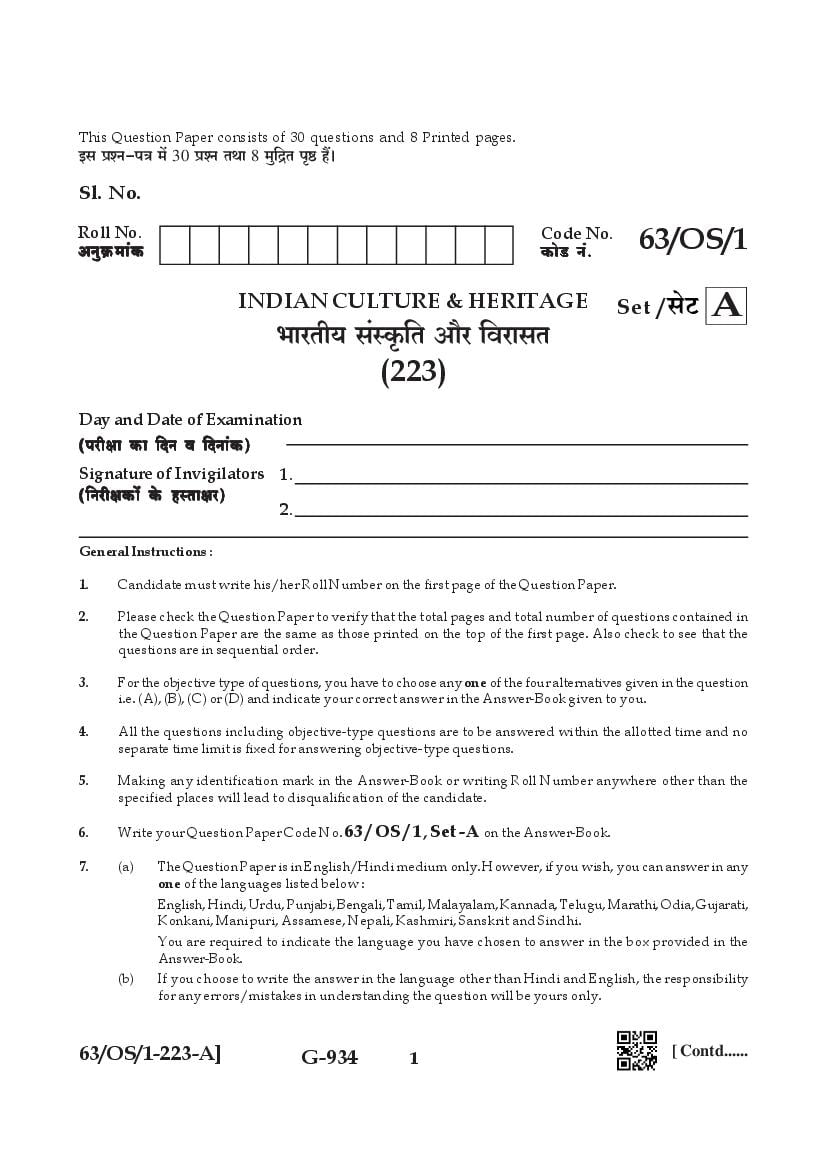
Bg àíZ-nÌ _| 30 àíZ VWm 8 ‘w{ÐV n¥ð> h¢&
Sl. No.
Roll No.
AZw H « $ _m§ H $
Code No.
H$mo S > Z§ . 63/OS/1
INDIAN CULTURE & HERITAGE Set / go Q > A
^maVr` g§ñH¥${V Am¡a {damgV
(223)
Day and Date of Examination
(narjm H$m {XZ d {XZm§ H $)
Signature of Invigilators 1.
({ZarjH$m| Ho $ hñVmja)
2.
General Instructions :
1. Candidate must write his/her Roll Number on the first page of the Question Paper.
2. Please check the Question Paper to verify that the total pages and total number of questions contained in
the Question Paper are the same as those printed on the top of the first page. Also check to see that the
questions are in sequential order.
3. For the objective type of questions, you have to choose any one of the four alternatives given in the question
i.e. (A), (B), (C) or (D) and indicate your correct answer in the Answer-Book given to you.
4. All the questions including objective-type questions are to be answered within the allotted time and no
separate time limit is fixed for answering objective-type questions.
5. Making any identification mark in the Answer-Book or writing Roll Number anywhere other than the
specified places will lead to disqualification of the candidate.
6. Write your Question Paper Code No. 63 / OS / 1, Set -A on the Answer-Book.
7. (a) The Question Paper is in English/Hindi medium only. However, if you wish, you can answer in any
one of the languages listed below :
English, Hindi, Urdu, Punjabi, Bengali, Tamil, Malayalam, Kannada, Telugu, Marathi, Odia, Gujarati,
Konkani, Manipuri, Assamese, Nepali, Kashmiri, Sanskrit and Sindhi.
You are required to indicate the language you have chosen to answer in the box provided in the
Answer-Book.
(b) If you choose to write the answer in the language other than Hindi and English, the responsibility
for any errors/mistakes in understanding the question will be yours only.
63/OS/1-223-A] G-934 1 [ Contd......
Page 2
1. narjmWu àíZ-nÌ Ho$ nhbo n¥ð> na AnZm AZwH«$‘m§H$ Adí¶ {bI|&
2. H¥$n¶m àíZ-nÌ H$mo Om±M b| {H$ àíZ-nÌ Ho$ Hw$b n¥ð>m| VWm àíZm| H$s CVZr hr g§»¶m h¡ {OVZr àW‘ n¥ð> Ho$ g~go D$na N>nr h¡& Bg ~mV
H$s Om±M ^r H$a b| {H$ àíZ H«${‘H$ ê$n ‘| h¢&
3. dñVw{Zð> àíZm| _| AmnH$mo Mma {dH$ënm| (A), (B), (C) VWm (D) _| go H$moB© EH$ CÎma MwZZm h¡ VWm Xr JB© CÎma-nwpñVH$m _| Amn ghr
CÎma {b{IE &
4. dñVw{Zð> àíZm| Ho$ gmW-gmW g^r àíZm| Ho$ CÎma {ZYm©[aV Ad{Y Ho$ ^rVa hr XoZo h¢ & dñVw{Zð> àíZm| Ho$ {bE AbJ go g_` Zht {X`m
OmEJm &
5. CÎma-nwpñVH$m ‘| nhMmZ-{M• ~ZmZo AWdm {Z{X©ï> ñWmZm| Ho$ A{V[aº$ H$ht ^r AZwH«$‘m§H$ {bIZo na narjmWu H$mo A¶mo½¶ R>ham¶m
Om¶oJm&
6. AnZr CÎma-nwpñVH$m na àíZ-nÌ H$s H$moS> g§»¶m 63 / OS / 1, Set - A {bI|&
7. (H$) àíZ-nÌ Ho$db A§JO o« r/qhXr ‘| h¡& {’$a ^r, ¶{X Amn Mmh| Vmo ZrMo Xr JB© {H$gr EH$ ^mfm ‘| CÎma Xo gH$Vo h¢ :
A§J«oOr, qhXr, CXÿ©, n§Om~r, ~§Jbm, V{‘b, ‘b¶mb‘, H$ÝZ‹S>, VobwJy, ‘amR>r, C{‹S>¶m, JwOamVr, H$m|H$Ur, ‘{Unwar, Ag{‘¶m, Zonmbr,
H$í‘rar, g§ñH¥$V Am¡a qgYr&
H¥$n¶m CÎma-nwpñVH$m ‘| {XE JE ~m°³g ‘| {bI| {H$ Amn {H$g ^mfm ‘| CÎma {bI aho h¢&
(I) ¶{X Amn qhXr Ed§ A§J«oOr Ho$ A{V[a³V {H$gr Aݶ ^mfm ‘| CÎma {bIVo h¢ Vmo àíZ H$mo g‘PZo ‘| hmoZo dmbr Ìw{Q>¶m|/Jb{V¶m| H$s
{Oå‘oXmar Ho$db AmnH$s hmoJr&
63/OS/1-223-A] G-934 2 [ Contd......
Page 3
^maVr` g§ñH¥${V Am¡a {damgV
(223)
Time : 3 Hours] [Maximum Marks : 100
g_` : 3 KÊQ>o] [nyUmªH$ : 100
Instructions :
(i) Attempt all the questions.
(ii) Marks allotted to each question are indicated against it.
(iii) Question Nos. 1 to 8 are multiple choice questions. Answer to these questions are
to be given in Answer-Book provided to you. No separate time is allotted for
attempting these questions.
(iv) Question Nos. 9 to 16 are to be answered in about 25 words.
(v) Question Nos. 17 to 25 are to be answered in about 40-50 words.
(vi) Question Nos. 26 to 30 are to be answered in about 150-200 words.
{ZX}e :
(i) g^r àíZm| Ho$ CÎma Xr{O`o &
(ii) à˶oH$ àíZ Ho$ A§H$ CgHo$ gm_Zo Xem©`o J`o h¢ &
(iii) àíZ g§»`m 1 go 8 VH$ dñVw{Zð> àíZ {XE J`o h¢ & BZHo$ CÎma Xr JB© CÎma-nwpñVH$m _| {b{IE & dñVw{Zð> àíZm| Ho$ {bE AbJ
go g_` Zht {X`m J`m h¡ &
(iv) àíZ g§»`m 9 go 16 VH$ Ho$ àíZm| Ho$ CÎma bJ^J 25 eãXm| _| {b{IE &
(v) àíZ g§»`m 17 go 25 VH$ Ho$ àíZm| Ho$ CÎma bJ^J 40-50 eãXm| _| {b{IE &
(vi) àíZ g§»`m 26 go 30 VH$ Ho$ àíZm| Ho$ CÎma bJ^J 150-200 eãXm| _| {b{IE &
1. At which of the following place is the Dashavatara temple situated? [1]
(A) Devgarh (B) Shivgarh
(C) Ramgarh (D) Raigarh
XemdVma _pÝXa {ZåZ _| go {H$g ñWmZ na pñWV h¡?
(A) XodJ‹T> (B) {edJ‹T>
(C) am_J‹T> (D) am`J‹T>
63/OS/1-223-A] G-934 3 [ Contd......
Page 4
(A) Standing near (B) To listen
(C) Sitting down near (D) To understand
Cn{ZfX H$m Š`m AW© h¡?
(A) {ZH$Q> I‹S>o ahZm (B) gwZZm
(C) {ZH$Q> ~¡R>Zm (D) g_PZm
3. Which of the following is the correct reason for the spread of European languages
in India? [1]
(A) Contribution of the Christian missionaries
(B) Role of schools and colleges
(C) Role of the printing press
(D) All of them
{ZåZ _| go H$m¡Z ^maV _| `yamonr` ^mfmAm| Ho$ àgma H$m ghr H$maU h¡?
(A) BgmB© Y_©àMmaH$m| H$m `moJXmZ (B) {dX²`mb`m| VWm _hm{dX²`mb`m| H$s ^y{_H$m
(C) N>mnmImZo H$s ^y{_H$m (D) `o g^r
4. In medieval India what were the Parameshvara and Mahabhaskariya families
famous for? [1]
(A) For their contribution in the field of medicine
(B) For their contribution in the field of astronomy
(C) For their contribution in the field of agriculture
(D) For their contribution in the field of chemistry
_Ü``wJrZ ^maV _| na_oída VWm _hm^mñH$ar` n[adma {H$g Ho$ {bE à{gÕ Wo?
(A) Am¡f{Y`m| Ho$ joÌ _| `moJXmZ Ho$ H$maU (B) IJmob{dkmZ Ho$ joÌ _| `moJXmZ Ho$ H$maU
(C) H¥${f Ho$ joÌ _| `moJXmZ Ho$ H$maU (D) agm`Z {dkmZ Ho$ joÌ _| `moJXmZ Ho$ H$maU
5. Which of the following was the author of Siddanta Shiromani? [1]
(A) Mahaviracharya (B) Brahmagupta
(C) Bhaskaracharya (D) Baudhayan
{ZåZ _| go {gÕmÝV {eamo_{U H$m boIH$ H$m¡Z Wm?
(A) _hmdramMm`© (B) ~«÷Jwá
(C) ^mñH$amMm`© (D) ~m¡Ym`Z
63/OS/1-223-A] G-934 4 [ Contd......
Page 5
[1]
(A) Process of learning
(B) Process of business
(C) Process of making a house
(D) Process of tilling the land
{ZåZ _| go {H$g à{H«$`m H$m àmaå^ Ym{_©H$ AZwð>mZ "CnZ`Z' X²dmam {H$`m OmVm Wm?
(A) {ejm àm{á H$s à{H«$`m
(B) ì`mnma H$s à{H«$`m
(C) Ka ~ZmZo H$s à{H«$`m
(D) ^y{_ OmoVZo H$s à{H«$`m
7. Who were the 'Kaivartas' in ancient India? [1]
(A) Clerks (B) Writers
(C) Merchants (D) Fishermen
àmMrZ ^maV _| "H¡$dV©' H$m¡Z Wo?
(A) {b{nH$ (B) boIH$
(C) ì`mnmar (D) _Nw>Amao
8. Who among the following is called the father of Indian Nuclear Science? [1]
(A) A.P.J. Abdul Kalam (B) C.V. Raman
(C) Homi J. Bhabha (D) V. A. Sarabhai
{ZåZ _| go {H$g H$mo ^maVr` Zm{^H$s` {dkmZ H$m OZH$ OmVm h¡?
(A) E.nr.Oo. AãXþb H$bm_ (B) gr.dr. a_Z
(C) hmo_r Oo. ^m^m (D) dr.E. gmam^mB©
63/OS/1-223-A] G-934 5 [ Contd......
Page 6
gm§ñH¥${VH$ {damgV H$mo n[a^m{fV H$s{O`o &
10. Give two reasons why Aurangzeb stopped patronizing music and painting? [2]
Am¡a§JµOo~ Zo g§JrV VWm {MÌH$bm H$mo g§ajU XoZm Š`m| ~§X H$a {X`m Wm, Xmo H$maU ~VmB`o &
11. Mention two materials used for making Mithila paintings. [2]
{_{Wbm H$bmH¥${V`m| H$mo ~ZmZo _| à`wŠV hmoZo dmbr Xmo gm_{J«`m| H$m CëboI H$s{O`o &
12. What are two similar features of Hindusthani and Carnatic music? [2]
{hÝXþñVmZr g§JrV VWm H$Zm©Q>H$ g§JrV XmoZm| _| g_mZ Xmo bjU H$m¡Z go h¢?
13. Give any two reasons why Karkhanas were so important in medieval India. [2]
_Ü`H$mbrZ ^maV _| H$maImZo BVZo _hËdnyU© Š`m| Wo, H$moB© Xmo H$maU ~VmB`o &
14. Explain any two achievements of Srinivas Ramanujan. [2]
lr{Zdmg am_mZwOZ H$s Xmo CnbpãY`m| H$mo g_PmB`o &
15. Describe any two features of education imported in the Vedic period. [2]
d¡{XH$ `wJ _| Omo {ejm àXmZ H$s OmVr Wr CgHo$ {H$Ýht Xmo bjUm| H$m dU©Z H$s{OE &
16. Mention the role of libraries located in Buddhist monasteries during the Gupta
period. [2]
JwáH$mb _| ~m¡Õ {dhmam| _| pñWV nwñVH$mb`m| H$s ^y{_H$m H$m CëboI H$s{O`o &
63/OS/1-223-A] G-934 6 [ Contd......
Page 7
^maV H$s {d{^ÝZVm H$m à{V{Z{YËd H$aZo dmbo {H$Ýht Mma KQ>H$m| H$m dU©Z H$s{OE &
18. Explain with two examples why man has made amazing progress in various
spheres of life? [4]
_mZd Zo OrdZ Ho$ {d{^ÝZ joÌm| _| h¡amZ H$a XoZo dmbr Omo àJ{V H$s CgH$mo Xmo CXmhaUm| g{hV ñnï> H$s{OE?
19. Examine the role of Raja Ram Mohan Roy in reforming Hindu society during
the nineteenths century. [4]
CÝZrgdt eVmãXr _| {hÝXÿ g_mO H$mo gwYmaZo _| amOm am_ _mohZ am` H$s ^y{_H$m H$m narjU H$s{O`o &
20. Give an account of the Shaiva movement in South India. [4]
X{jU ^maV _| hþ`o e¡d Am±XmobZ H$m dU©Z H$s{O`o &
21. Describe the contribution of Aryabhatta in the field of astronomy. [4]
IJmob {dkmZ Ho$ joÌ _| Am`©^Å> Ho$ `moJXmZ H$m dU©Z H$s{O`o &
22. Explain the state of education during the Mauryan period. [4]
_m¡`© H$mb _| {ejm ì`dñWm H$s pñW{V H$s ì`m»`m H$s{O`o &
23. Describe the characteristic features of Indian families. [4]
^maVr` n[admam| H$s Xmo bmj{UH$ {d{eï>VmAm| H$m dU©Z H$s{O`o &
24. Explain the demerits of caste system in India. [4]
^maV _| Om{V àWm H$s Xmo Ìw{Q>`m| H$s ì`m»`m H$s{OE &
63/OS/1-223-A] G-934 7 [ Contd......
Page 8
"Ü`mZ `moJ' Ho$ H$mo[a`m g_mO na Š`m à^md n‹S>o Wo? ñnï> H$s{OE &
26. Explain the changes that took place in Europe at the beginning of the modern
period which changed the destiny of Europe. [8]
AmYw{ZH$ H$mb Ho$ àmaå^ _| hþ`o `yamon Ho$ ^m½` H$mo ~Xb XoZo dmbo n[adV©Zm| H$s ì`m»`m H$s{O`o &
27. Examine the development of Northern Indian languages and scripts during the
medieval period. [8]
_Ü`H$mb _| CÎma ^maVr` ^mfmAm| Am¡a {b{n`m| Ho$ {dH$mg H$m narjU H$s{O`o &
28. Explain the development of the Bhakti movement. [8]
^{ŠV Am±XmobZ Ho$ {dH$mg H$s ì`m»`m H$s{O`o &
29. Analyse the significance of the art of painting as a part of culture. [8]
g§ñH¥${V Ho$ EH$ ^mJ Ho$ ê$n _| {MÌH$bm Ho$ _hËd H$m {díbofU H$s{OE &
30. Explain the origin and culture of the Roma or the Gypsy people of Europe. [8]
`yamon Ho$ amo_m AWdm {Oßgr bmoJm| H$s CËn{ËV VWm g§ñH¥${V H$s ì`m»`m H$s{O`o &
63/OS/1-223-A] G-934 8
Page 9
Bg àíZ-nÌ _| 30 àíZ VWm 8 ‘w{ÐV n¥ð> h¢&
Sl. No.
Roll No.
AZw H « $ _m§ H $
Code No.
H$mo S > Z§ . 63/OS/1
INDIAN CULTURE & HERITAGE Set / go Q > B
^maVr` g§ñH¥${V Am¡a {damgV
(223)
Day and Date of Examination
(narjm H$m {XZ d {XZm§ H $)
Signature of Invigilators 1.
({ZarjH$m| Ho $ hñVmja)
2.
General Instructions :
1. Candidate must write his/her Roll Number on the first page of the Question Paper.
2. Please check the Question Paper to verify that the total pages and total number of questions contained in
the Question Paper are the same as those printed on the top of the first page. Also check to see that the
questions are in sequential order.
3. For the objective type of questions, you have to choose any one of the four alternatives given in the question
i.e. (A), (B), (C) or (D) and indicate your correct answer in the Answer-Book given to you.
4. All the questions including objective-type questions are to be answered within the allotted time and no
separate time limit is fixed for answering objective-type questions.
5. Making any identification mark in the Answer-Book or writing Roll Number anywhere other than the
specified places will lead to disqualification of the candidate.
6. Write your Question Paper Code No. 63 / OS / 1, Set -B on the Answer-Book.
7. (a) The Question Paper is in English/Hindi medium only. However, if you wish, you can answer in any
one of the languages listed below :
English, Hindi, Urdu, Punjabi, Bengali, Tamil, Malayalam, Kannada, Telugu, Marathi, Odia, Gujarati,
Konkani, Manipuri, Assamese, Nepali, Kashmiri, Sanskrit and Sindhi.
You are required to indicate the language you have chosen to answer in the box provided in the
Answer-Book.
(b) If you choose to write the answer in the language other than Hindi and English, the responsibility
for any errors/mistakes in understanding the question will be yours only.
63/OS/1-223-B] G-934 1 [ Contd......
Page 10
1. narjmWu àíZ-nÌ Ho$ nhbo n¥ð> na AnZm AZwH«$‘m§H$ Adí¶ {bI|&
2. H¥$n¶m àíZ-nÌ H$mo Om±M b| {H$ àíZ-nÌ Ho$ Hw$b n¥ð>m| VWm àíZm| H$s CVZr hr g§»¶m h¡ {OVZr àW‘ n¥ð> Ho$ g~go D$na N>nr h¡& Bg ~mV
H$s Om±M ^r H$a b| {H$ àíZ H«${‘H$ ê$n ‘| h¢&
3. dñVw{Zð> àíZm| _| AmnH$mo Mma {dH$ënm| (A), (B), (C) VWm (D) _| go H$moB© EH$ CÎma MwZZm h¡ VWm Xr JB© CÎma-nwpñVH$m _| Amn ghr
CÎma {b{IE &
4. dñVw{Zð> àíZm| Ho$ gmW-gmW g^r àíZm| Ho$ CÎma {ZYm©[aV Ad{Y Ho$ ^rVa hr XoZo h¢ & dñVw{Zð> àíZm| Ho$ {bE AbJ go g_` Zht {X`m
OmEJm &
5. CÎma-nwpñVH$m ‘| nhMmZ-{M• ~ZmZo AWdm {Z{X©ï> ñWmZm| Ho$ A{V[aº$ H$ht ^r AZwH«$‘m§H$ {bIZo na narjmWu H$mo A¶mo½¶ R>ham¶m
Om¶oJm&
6. AnZr CÎma-nwpñVH$m na àíZ-nÌ H$s H$moS> g§»¶m 63 / OS / 1, Set - B {bI|&
7. (H$) àíZ-nÌ Ho$db A§JO o« r/qhXr ‘| h¡& {’$a ^r, ¶{X Amn Mmh| Vmo ZrMo Xr JB© {H$gr EH$ ^mfm ‘| CÎma Xo gH$Vo h¢ :
A§J«oOr, qhXr, CXÿ©, n§Om~r, ~§Jbm, V{‘b, ‘b¶mb‘, H$ÝZ‹S>, VobwJy, ‘amR>r, C{‹S>¶m, JwOamVr, H$m|H$Ur, ‘{Unwar, Ag{‘¶m, Zonmbr,
H$í‘rar, g§ñH¥$V Am¡a qgYr&
H¥$n¶m CÎma-nwpñVH$m ‘| {XE JE ~m°³g ‘| {bI| {H$ Amn {H$g ^mfm ‘| CÎma {bI aho h¢&
(I) ¶{X Amn qhXr Ed§ A§J«oOr Ho$ A{V[a³V {H$gr Aݶ ^mfm ‘| CÎma {bIVo h¢ Vmo àíZ H$mo g‘PZo ‘| hmoZo dmbr Ìw{Q>¶m|/Jb{V¶m| H$s
{Oå‘oXmar Ho$db AmnH$s hmoJr&
63/OS/1-223-B] G-934 2 [ Contd......
Page 11
^maVr` g§ñH¥${V Am¡a {damgV
(223)
Time : 3 Hours] [Maximum Marks : 100
g_` : 3 KÊQ>o] [nyUmªH$ : 100
Instructions :
(i) Attempt all the questions.
(ii) Marks allotted to each question are indicated against it.
(iii) Question Nos. 1 to 8 are multiple choice questions. Answer to these questions are
to be given in Answer-Book provided to you. No separate time is allotted for
attempting these questions.
(iv) Question Nos. 9 to 16 are to be answered in about 25 words.
(v) Question Nos. 17 to 25 are to be answered in about 40-50 words.
(vi) Question Nos. 26 to 30 are to be answered in about 150-200 words.
{ZX}e :
(i) g^r àíZm| Ho$ CÎma Xr{O`o &
(ii) à˶oH$ àíZ Ho$ A§H$ CgHo$ gm_Zo Xem©`o J`o h¢ &
(iii) àíZ g§»`m 1 go 8 VH$ dñVw{Zð> àíZ {XE J`o h¢ & BZHo$ CÎma Xr JB© CÎma-nwpñVH$m _| {b{IE & dñVw{Zð> àíZm| Ho$ {bE AbJ
go g_` Zht {X`m J`m h¡ &
(iv) àíZ g§»`m 9 go 16 VH$ Ho$ àíZm| Ho$ CÎma bJ^J 25 eãXm| _| {b{IE &
(v) àíZ g§»`m 17 go 25 VH$ Ho$ àíZm| Ho$ CÎma bJ^J 40-50 eãXm| _| {b{IE &
(vi) àíZ g§»`m 26 go 30 VH$ Ho$ àíZm| Ho$ CÎma bJ^J 150-200 eãXm| _| {b{IE &
1. Ajanta caves are situated near which of the following cities? [1]
(A) Moradabad (B) Ghaziabad
(C) Aurangabad (D) Hyderabad
AO§Vm H$s Jw\$m`| {ZåZ _| go {H$g ZJa Ho$ nmg pñWV h¡?
(A) _wamXm~mX (B) Jm{O`m~mX
(C) Am¡a§Jm~mX (D) h¡Xam~mX
63/OS/1-223-B] G-934 3 [ Contd......
Page 12
in India? [1]
(A) Contribution of the Christian missionaries
(B) Role of schools and colleges
(C) Role of the printing press
(D) All of them
{ZåZ _| go H$m¡Z ^maV _| `yamonr` ^mfmAm| Ho$ àgma H$m ghr H$maU h¡?
(A) BgmB© Y_©àMmaH$m| H$m `moJXmZ (B) {dX²`mb`m| VWm _hm{dX²`mb`m| H$s ^y{_H$m
(C) N>mnmImZo H$s ^y{_H$m (D) `o g^r
3. In medieval India what were the Parameshvara and Mahabhaskariya families
famous for? [1]
(A) For their contribution in the field of medicine
(B) For their contribution in the field of astronomy
(C) For their contribution in the field of agriculture
(D) For their contribution in the field of chemistry
_Ü``wJrZ ^maV _| na_oída VWm _hm^mñH$ar` n[adma {H$g Ho$ {bE à{gÕ Wo?
(A) Am¡f{Y`m| Ho$ joÌ _| `moJXmZ Ho$ H$maU (B) IJmob{dkmZ Ho$ joÌ _| `moJXmZ Ho$ H$maU
(C) H¥${f Ho$ joÌ _| `moJXmZ Ho$ H$maU (D) agm`Z {dkmZ Ho$ joÌ _| `moJXmZ Ho$ H$maU
4. Which of the following was the author of Siddanta Shiromani? [1]
(A) Mahaviracharya (B) Brahmagupta
(C) Bhaskaracharya (D) Baudhayan
{ZåZ _| go {gÕmÝV {eamo_{U H$m boIH$ H$m¡Z Wm?
(A) _hmdramMm`© (B) ~«÷Jwá
(C) ^mñH$amMm`© (D) ~m¡Ym`Z
5. Which of the following process began with the religious ceremony 'Upanayana'?
[1]
(A) Process of learning (B) Process of business
(C) Process of making a house (D) Process of tilling the land
{ZåZ _| go {H$g à{H«$`m H$m àmaå^ Ym{_©H$ AZwð>mZ "CnZ`Z' X²dmam {H$`m OmVm Wm?
(A) {ejm àm{á H$s à{H«$`m (B) ì`mnma H$s à{H«$`m
(C) Ka ~ZmZo H$s à{H«$`m (D) ^y{_ OmoVZo H$s à{H«$`m
63/OS/1-223-B] G-934 4 [ Contd......
Page 13
(A) Clerks (B) Writers
(C) Merchants (D) Fishermen
àmMrZ ^maV _| "H¡$dV©' H$m¡Z Wo?
(A) {b{nH$ (B) boIH$
(C) ì`mnmar (D) _Nw>Amao
7. Who among the following is called the father of Indian Nuclear Science? [1]
(A) A.P.J. Abdul Kalam (B) C.V. Raman
(C) Homi J. Bhabha (D) V. A. Sarabhai
{ZåZ _| go {H$g H$mo ^maVr` Zm{^H$s` {dkmZ H$m OZH$ OmVm h¡?
(A) E.nr.Oo. AãXþb H$bm_ (B) gr.dr. a_Z
(C) hmo_r Oo. ^m^m (D) dr.E. gmam^mB©
8. What is the meaning of upanishad? [1]
(A) Standing near (B) To listen
(C) Sitting down near (D) To understand
Cn{ZfX H$m Š`m AW© h¡?
(A) {ZH$Q> I‹S>o ahZm (B) gwZZm
(C) {ZH$Q> ~¡R>Zm (D) g_PZm
63/OS/1-223-B] G-934 5 [ Contd......
Page 14
Am¡a§JµOo~ Zo g§JrV VWm {MÌH$bm H$mo g§ajU XoZm Š`m| ~§X H$a {X`m Wm, Xmo H$maU ~VmB`o &
10. Mention two materials used for making Mithila paintings. [2]
{_{Wbm H$bmH¥${V`m| H$mo ~ZmZo _| à`wŠV hmoZo dmbr Xmo gm_{J«`m| H$m CëboI H$s{O`o &
11. What are two similar features of Hindusthani and Carnatic music? [2]
{hÝXþñVmZr g§JrV VWm H$Zm©Q>H$ g§JrV XmoZm| _| g_mZ Xmo bjU H$m¡Z go h¢?
12. Give any two reasons why Karkhanas were so important in medieval India. [2]
_Ü`H$mbrZ ^maV _| H$maImZo BVZo _hËdnyU© Š`m| Wo, H$moB© Xmo H$maU ~VmB`o &
13. Explain any two achievements of Srinivas Ramanujan. [2]
lr{Zdmg am_mZwOZ H$s Xmo CnbpãY`m| H$mo g_PmB`o &
14. Describe any two features of education imported in the Vedic period. [2]
d¡{XH$ `wJ _| Omo {ejm àXmZ H$s OmVr Wr CgHo$ {H$Ýht Xmo bjUm| H$m dU©Z H$s{OE &
15. Mention the role of libraries located in Buddhist monasteries during the Gupta
period. [2]
JwáH$mb _| ~m¡Õ {dhmam| _| pñWV nwñVH$mb`m| H$s ^y{_H$m H$m CëboI H$s{O`o &
16. Define Cultural Heritage. [2]
gm§ñH¥${VH$ {damgV H$mo n[a^m{fV H$s{O`o &
63/OS/1-223-B] G-934 6 [ Contd......
Page 15
^maVr` g§ñH¥${V H$s Mma à_wI {deofVmAm| H$m dU©Z H$s{O`o &
18. Explain with two examples why man has made amazing progress in various
spheres of life? [4]
_mZd Zo OrdZ Ho$ {d{^ÝZ joÌm| _| h¡amZ H$a XoZo dmbr Omo àJ{V H$s CgH$mo Xmo CXmhaUm| g{hV ñnï> H$s{OE?
19. Examine the work of the 'Prarthana Samaj' in Maharashtra. [4]
_hmamï´> _| "àmW©Zm g_mO' Ho$ H$m`© H$m narjU H$s{O`o &
20. Describe the contribution of Aryabhatta in the field of astronomy. [4]
IJmob {dkmZ Ho$ joÌ _| Am`©^Å> Ho$ `moJXmZ H$m dU©Z H$s{O`o &
21. Explain the state of education during the Mauryan period. [4]
_m¡`© H$mb _| {ejm ì`dñWm H$s pñW{V H$s ì`m»`m H$s{O`o &
22. Describe the characteristic features of Indian families. [4]
^maVr` n[admam| H$s Xmo bmj{UH$ {d{eï>VmAm| H$m dU©Z H$s{O`o &
23. Explain the demerits of caste system in India. [4]
^maV _| Om{V àWm H$s Xmo Ìw{Q>`m| H$s ì`m»`m H$s{OE &
24. What were the effects of 'dhyana yoga' on the Korean society? Explain. [4]
"Ü`mZ `moJ' Ho$ H$mo[a`m g_mO na Š`m à^md n‹S>o Wo? ñnï> H$s{OE &
63/OS/1-223-B] G-934 7 [ Contd......
Page 16
X{jU ^maV _| hþ`o e¡d Am±XmobZ H$m dU©Z H$s{O`o &
26. Explain the process by which India was subjugated by the British. [8]
A§J«oOm| X²dmam ^maV na A{YH$ma H$aZo H$s à{H«$`m H$s ì`m»`m H$s{O`o &
27. Examine the development of Northern Indian languages and scripts during the
medieval period. [8]
_Ü`H$mb _| CÎma ^maVr` ^mfmAm| Am¡a {b{n`m| Ho$ {dH$mg H$m narjU H$s{O`o &
28. Explain the beliefs of the Bhakti saints. [8]
^{ŠV g§Vm| Ho$ {dídmgm| H$s ì`m»`m H$s{O`o?
29. Explain the origin and culture of the Roma or the Gypsy people of Europe. [8]
`yamon Ho$ amo_m AWdm {Oßgr bmoJm| H$s CËn{ËV VWm g§ñH¥${V H$s ì`m»`m H$s{O`o &
30. Analyse the significance of the art of painting as a part of culture. [8]
g§ñH¥${V Ho$ EH$ ^mJ Ho$ ê$n _| {MÌH$bm Ho$ _hËd H$m {díbofU H$s{OE &
63/OS/1-223-B] G-934 8
Page 17
Bg àíZ-nÌ _| 30 àíZ VWm 8 ‘w{ÐV n¥ð> h¢&
Sl. No.
Roll No.
AZw H « $ _m§ H $
Code No.
H$mo S > Z§ . 63/OS/1
INDIAN CULTURE & HERITAGE Set / go Q > C
^maVr` g§ñH¥${V Am¡a {damgV
(223)
Day and Date of Examination
(narjm H$m {XZ d {XZm§ H $)
Signature of Invigilators 1.
({ZarjH$m| Ho $ hñVmja)
2.
General Instructions :
1. Candidate must write his/her Roll Number on the first page of the Question Paper.
2. Please check the Question Paper to verify that the total pages and total number of questions contained in
the Question Paper are the same as those printed on the top of the first page. Also check to see that the
questions are in sequential order.
3. For the objective type of questions, you have to choose any one of the four alternatives given in the question
i.e. (A), (B), (C) or (D) and indicate your correct answer in the Answer-Book given to you.
4. All the questions including objective-type questions are to be answered within the allotted time and no
separate time limit is fixed for answering objective-type questions.
5. Making any identification mark in the Answer-Book or writing Roll Number anywhere other than the
specified places will lead to disqualification of the candidate.
6. Write your Question Paper Code No. 63 / OS / 1, Set -C on the Answer-Book.
7. (a) The Question Paper is in English/Hindi medium only. However, if you wish, you can answer in any
one of the languages listed below :
English, Hindi, Urdu, Punjabi, Bengali, Tamil, Malayalam, Kannada, Telugu, Marathi, Odia, Gujarati,
Konkani, Manipuri, Assamese, Nepali, Kashmiri, Sanskrit and Sindhi.
You are required to indicate the language you have chosen to answer in the box provided in the
Answer-Book.
(b) If you choose to write the answer in the language other than Hindi and English, the responsibility
for any errors/mistakes in understanding the question will be yours only.
63/OS/1-223-C] G-934 1 [ Contd......
Page 18
1. narjmWu àíZ-nÌ Ho$ nhbo n¥ð> na AnZm AZwH«$‘m§H$ Adí¶ {bI|&
2. H¥$n¶m àíZ-nÌ H$mo Om±M b| {H$ àíZ-nÌ Ho$ Hw$b n¥ð>m| VWm àíZm| H$s CVZr hr g§»¶m h¡ {OVZr àW‘ n¥ð> Ho$ g~go D$na N>nr h¡& Bg ~mV
H$s Om±M ^r H$a b| {H$ àíZ H«${‘H$ ê$n ‘| h¢&
3. dñVw{Zð> àíZm| _| AmnH$mo Mma {dH$ënm| (A), (B), (C) VWm (D) _| go H$moB© EH$ CÎma MwZZm h¡ VWm Xr JB© CÎma-nwpñVH$m _| Amn ghr
CÎma {b{IE &
4. dñVw{Zð> àíZm| Ho$ gmW-gmW g^r àíZm| Ho$ CÎma {ZYm©[aV Ad{Y Ho$ ^rVa hr XoZo h¢ & dñVw{Zð> àíZm| Ho$ {bE AbJ go g_` Zht {X`m
OmEJm &
5. CÎma-nwpñVH$m ‘| nhMmZ-{M• ~ZmZo AWdm {Z{X©ï> ñWmZm| Ho$ A{V[aº$ H$ht ^r AZwH«$‘m§H$ {bIZo na narjmWu H$mo A¶mo½¶ R>ham¶m
Om¶oJm&
6. AnZr CÎma-nwpñVH$m na àíZ-nÌ H$s H$moS> g§»¶m 63 / OS / 1, Set - C {bI|&
7. (H$) àíZ-nÌ Ho$db A§JO o« r/qhXr ‘| h¡& {’$a ^r, ¶{X Amn Mmh| Vmo ZrMo Xr JB© {H$gr EH$ ^mfm ‘| CÎma Xo gH$Vo h¢ :
A§J«oOr, qhXr, CXÿ©, n§Om~r, ~§Jbm, V{‘b, ‘b¶mb‘, H$ÝZ‹S>, VobwJy, ‘amR>r, C{‹S>¶m, JwOamVr, H$m|H$Ur, ‘{Unwar, Ag{‘¶m, Zonmbr,
H$í‘rar, g§ñH¥$V Am¡a qgYr&
H¥$n¶m CÎma-nwpñVH$m ‘| {XE JE ~m°³g ‘| {bI| {H$ Amn {H$g ^mfm ‘| CÎma {bI aho h¢&
(I) ¶{X Amn qhXr Ed§ A§J«oOr Ho$ A{V[a³V {H$gr Aݶ ^mfm ‘| CÎma {bIVo h¢ Vmo àíZ H$mo g‘PZo ‘| hmoZo dmbr Ìw{Q>¶m|/Jb{V¶m| H$s
{Oå‘oXmar Ho$db AmnH$s hmoJr&
63/OS/1-223-C] G-934 2 [ Contd......
Page 19
^maVr` g§ñH¥${V Am¡a {damgV
(223)
Time : 3 Hours] [Maximum Marks : 100
g_` : 3 KÊQ>o] [nyUmªH$ : 100
Instructions :
(i) Attempt all the questions.
(ii) Marks allotted to each question are indicated against it.
(iii) Question Nos. 1 to 8 are multiple choice questions. Answer to these questions are
to be given in Answer-Book provided to you. No separate time is allotted for
attempting these questions.
(iv) Question Nos. 9 to 16 are to be answered in about 25 words.
(v) Question Nos. 17 to 25 are to be answered in about 40-50 words.
(vi) Question Nos. 26 to 30 are to be answered in about 150-200 words.
{ZX}e :
(i) g^r àíZm| Ho$ CÎma Xr{O`o &
(ii) à˶oH$ àíZ Ho$ A§H$ CgHo$ gm_Zo Xem©`o J`o h¢ &
(iii) àíZ g§»`m 1 go 8 VH$ dñVw{Zð> àíZ {XE J`o h¢ & BZHo$ CÎma Xr JB© CÎma-nwpñVH$m _| {b{IE & dñVw{Zð> àíZm| Ho$ {bE AbJ
go g_` Zht {X`m J`m h¡ &
(iv) àíZ g§»`m 9 go 16 VH$ Ho$ àíZm| Ho$ CÎma bJ^J 25 eãXm| _| {b{IE &
(v) àíZ g§»`m 17 go 25 VH$ Ho$ àíZm| Ho$ CÎma bJ^J 40-50 eãXm| _| {b{IE &
(vi) àíZ g§»`m 26 go 30 VH$ Ho$ àíZm| Ho$ CÎma bJ^J 150-200 eãXm| _| {b{IE &
1. Bagh caves are situated near which of the following cities? [1]
(A) Lucknow (B) Gwalior
(C) Chandigarh (D) Ujjain
~mK Jw\$m`| {ZåZ _| go {H$g ZJa Ho$ g_rn pñWV h¢?
(A) bIZD$ (B) ½dm{b`a
(C) MÝS>rJ‹T> (D) CÁO¡Z
63/OS/1-223-C] G-934 3 [ Contd......
Page 20
famous for? [1]
(A) For their contribution in the field of medicine
(B) For their contribution in the field of astronomy
(C) For their contribution in the field of agriculture
(D) For their contribution in the field of chemistry
_Ü``wJrZ ^maV _| na_oída VWm _hm^mñH$ar` n[adma {H$g Ho$ {bE à{gÕ Wo?
(A) Am¡f{Y`m| Ho$ joÌ _| `moJXmZ Ho$ H$maU (B) IJmob{dkmZ Ho$ joÌ _| `moJXmZ Ho$ H$maU
(C) H¥${f Ho$ joÌ _| `moJXmZ Ho$ H$maU (D) agm`Z {dkmZ Ho$ joÌ _| `moJXmZ Ho$ H$maU
3. Which of the following was the author of Siddanta Shiromani? [1]
(A) Mahaviracharya (B) Brahmagupta
(C) Bhaskaracharya (D) Baudhayan
{ZåZ _| go {gÕmÝV {eamo_{U H$m boIH$ H$m¡Z Wm?
(A) _hmdramMm`© (B) ~«÷Jwá
(C) ^mñH$amMm`© (D) ~m¡Ym`Z
4. Which of the following process began with the religious ceremony 'Upanayana'?
[1]
(A) Process of learning (B) Process of business
(C) Process of making a house (D) Process of tilling the land
{ZåZ _| go {H$g à{H«$`m H$m àmaå^ Ym{_©H$ AZwð>mZ "CnZ`Z' X²dmam {H$`m OmVm Wm?
(A) {ejm àm{á H$s à{H«$`m (B) ì`mnma H$s à{H«$`m
(C) Ka ~ZmZo H$s à{H«$`m (D) ^y{_ OmoVZo H$s à{H«$`m
5. Who were the 'Kaivartas' in ancient India? [1]
(A) Clerks (B) Writers
(C) Merchants (D) Fishermen
àmMrZ ^maV _| "H¡$dV©' H$m¡Z Wo?
(A) {b{nH$ (B) boIH$
(C) ì`mnmar (D) _Nw>Amao
63/OS/1-223-C] G-934 4 [ Contd......
Page 21
(A) A.P.J. Abdul Kalam (B) C.V. Raman
(C) Homi J. Bhabha (D) V. A. Sarabhai
{ZåZ _| go {H$g H$mo ^maVr` Zm{^H$s` {dkmZ H$m OZH$ OmVm h¡?
(A) E.nr.Oo. AãXþb H$bm_ (B) gr.dr. a_Z
(C) hmo_r Oo. ^m^m (D) dr.E. gmam^mB©
7. What is the meaning of upanishad? [1]
(A) Standing near (B) To listen
(C) Sitting down near (D) To understand
Cn{ZfX H$m Š`m AW© h¡?
(A) {ZH$Q> I‹S>o ahZm (B) gwZZm
(C) {ZH$Q> ~¡R>Zm (D) g_PZm
8. Which of the following is the correct reason for the spread of European languages
in India? [1]
(A) Contribution of the Christian missionaries
(B) Role of schools and colleges
(C) Role of the printing press
(D) All of them
{ZåZ _| go H$m¡Z ^maV _| `yamonr` ^mfmAm| Ho$ àgma H$m ghr H$maU h¡?
(A) BgmB© Y_©àMmaH$m| H$m `moJXmZ
(B) {dX²`mb`m| VWm _hm{dX²`mb`m| H$s ^y{_H$m
(C) N>mnmImZo H$s ^y{_H$m
(D) `o g^r
63/OS/1-223-C] G-934 5 [ Contd......
Page 22
{_{Wbm H$bmH¥${V`m| H$mo ~ZmZo _| à`wŠV hmoZo dmbr Xmo gm_{J«`m| H$m CëboI H$s{O`o &
10. What are two similar features of Hindusthani and Carnatic music? [2]
{hÝXþñVmZr g§JrV VWm H$Zm©Q>H$ g§JrV XmoZm| _| g_mZ Xmo bjU H$m¡Z go h¢?
11. Give any two reasons why Karkhanas were so important in medieval India. [2]
_Ü`H$mbrZ ^maV _| H$maImZo BVZo _hËdnyU© Š`m| Wo, H$moB© Xmo H$maU ~VmB`o &
12. Explain any two achievements of Srinivas Ramanujan. [2]
lr{Zdmg am_mZwOZ H$s Xmo CnbpãY`m| H$mo g_PmB`o &
13. Describe any two features of education imported in the Vedic period. [2]
d¡{XH$ `wJ _| Omo {ejm àXmZ H$s OmVr Wr CgHo$ {H$Ýht Xmo bjUm| H$m dU©Z H$s{OE &
14. Mention the role of libraries located in Buddhist monasteries during the Gupta
period. [2]
JwáH$mb _| ~m¡Õ {dhmam| _| pñWV nwñVH$mb`m| H$s ^y{_H$m H$m CëboI H$s{O`o &
15. Define Cultural Heritage. [2]
gm§ñH¥${VH$ {damgV H$mo n[a^m{fV H$s{O`o &
16. Give two reasons why Aurangzeb stopped patronizing music and painting? [2]
Am¡a§JµOo~ Zo g§JrV VWm {MÌH$bm H$mo g§ajU XoZm Š`m| ~§X H$a {X`m Wm, Xmo H$maU ~VmB`o &
63/OS/1-223-C] G-934 6 [ Contd......
Page 23
^maVr` g§ñH¥${V Ho$ Mma bjUm| H$m dU©Z H$s{O`o &
18. Explain with two examples why man has made amazing progress in various
spheres of life? [4]
_mZd Zo OrdZ Ho$ {d{^ÝZ joÌm| _| h¡amZ H$a XoZo dmbr Omo àJ{V H$s CgH$mo Xmo CXmhaUm| g{hV ñnï> H$s{OE?
19. Examine the work of Swami Vivekananda. [4]
ñdm_r {ddoH$mZÝX Ho$ H$m`© H$m narjU H$s{O`o &
20. Explain the state of education during the Mauryan period. [4]
_m¡`© H$mb _| {ejm ì`dñWm H$s pñW{V H$s ì`m»`m H$s{O`o &
21. Describe the characteristic features of Indian families. [4]
^maVr` n[admam| H$s Xmo bmj{UH$ {d{eï>VmAm| H$m dU©Z H$s{O`o &
22. Explain the demerits of caste system in India. [4]
^maV _| Om{V àWm H$s Xmo Ìw{Q>`m| H$s ì`m»`m H$s{OE &
23. What were the effects of 'dhyana yoga' on the Korean society? Explain. [4]
"Ü`mZ `moJ' Ho$ H$mo[a`m g_mO na Š`m à^md n‹S>o Wo? ñnï> H$s{OE &
24. Give an account of the Shaiva movement in South India. [4]
X{jU ^maV _| hþ`o e¡d Am±XmobZ H$m dU©Z H$s{O`o &
63/OS/1-223-C] G-934 7 [ Contd......
Page 24
IJmob {dkmZ Ho$ joÌ _| Am`©^Å> Ho$ `moJXmZ H$m dU©Z H$s{O`o &
26. Explain how the British gradually made Indian economy subordinate to British
economy. [8]
A§J«oOm| Zo {H$g àH$ma Yrao Yrao ^maVr` AW©ì`dñWm H$mo {~«{Q>e AW©ì`dñWm Ho$ AYrZ ~Zm {X`m, ì`m»`m
H$s{OE &
27. Examine the development of Northern Indian languages and scripts during the
medieval period. [8]
_Ü`H$mb _| CÎma ^maVr` ^mfmAm| Am¡a {b{n`m| Ho$ {dH$mg H$m narjU H$s{O`o &
28. Explain the methods used by Bhakti saints to spread their message. [8]
CZ {d{Y`m| H$s ì`m»`m H$s{O`o {OZH$m à`moJ ^{ŠV H$mb Ho$ g§Vm| Zo AnZo g§Xoe H$mo àgm[aV H$aZo Ho$ {b`o
{H$`m &
29. Analyse the significance of the art of painting as a part of culture. [8]
g§ñH¥${V Ho$ EH$ ^mJ Ho$ ê$n _| {MÌH$bm Ho$ _hËd H$m {díbofU H$s{OE &
30. Explain the origin and culture of the Roma or the Gypsy people of Europe. [8]
`yamon Ho$ amo_m AWdm {Oßgr bmoJm| H$s CËn{ËV VWm g§ñH¥${V H$s ì`m»`m H$s{O`o &
63/OS/1-223-C] G-934 8
Document Details
| Board / Org | NIOS |
| Exam | National Institute of Open Schooling Class 10 |
| Type | Question Paper |
| Pages | 24 |
| Updated | 30 Apr 2026 |