AHSEC 1st Year Syllabus 2024-25 Education
Finished viewing? Save it for later —
Download AHSEC 1st Year Syllabus 2024-25 Education (PDF · 3 pages)About AHSEC 1st Year Syllabus 2024-25 Education
AHSEC 1st Year Syllabus 2024-25 Education is available here for free download. Published by Assam Board for Class 11, this syllabus can be viewed online or downloaded as a PDF (3 pages). Candidates preparing for Class 11 can use AHSEC 1st Year Syllabus 2024-25 Education to understand the exam pattern, the type of questions asked, and the overall difficulty level.
Frequently Asked Questions
How can I download AHSEC 1st Year Syllabus 2024-25 Education?
Open this page and click the Download button to save AHSEC 1st Year Syllabus 2024-25 Education as a PDF. It is completely free on AglaSem Docs.
Is AHSEC 1st Year Syllabus 2024-25 Education free to download?
Yes. AHSEC 1st Year Syllabus 2024-25 Education can be viewed online and downloaded as a PDF free of cost on AglaSem Docs.
How many pages does AHSEC 1st Year Syllabus 2024-25 Education have?
AHSEC 1st Year Syllabus 2024-25 Education contains 3 pages, which you can read online or download together as a single PDF.
Where can I find more Class 11 study material?
You can find more Class 11 question papers, sample papers, syllabus, and answer keys on AglaSem Docs.
AHSEC 1st Year Syllabus 2024-25 Education – Text
Read the full text of this syllabus below — useful to quickly search, copy and reference the content online without downloading the PDF.
📄 View text version (3 pages)
Page 1
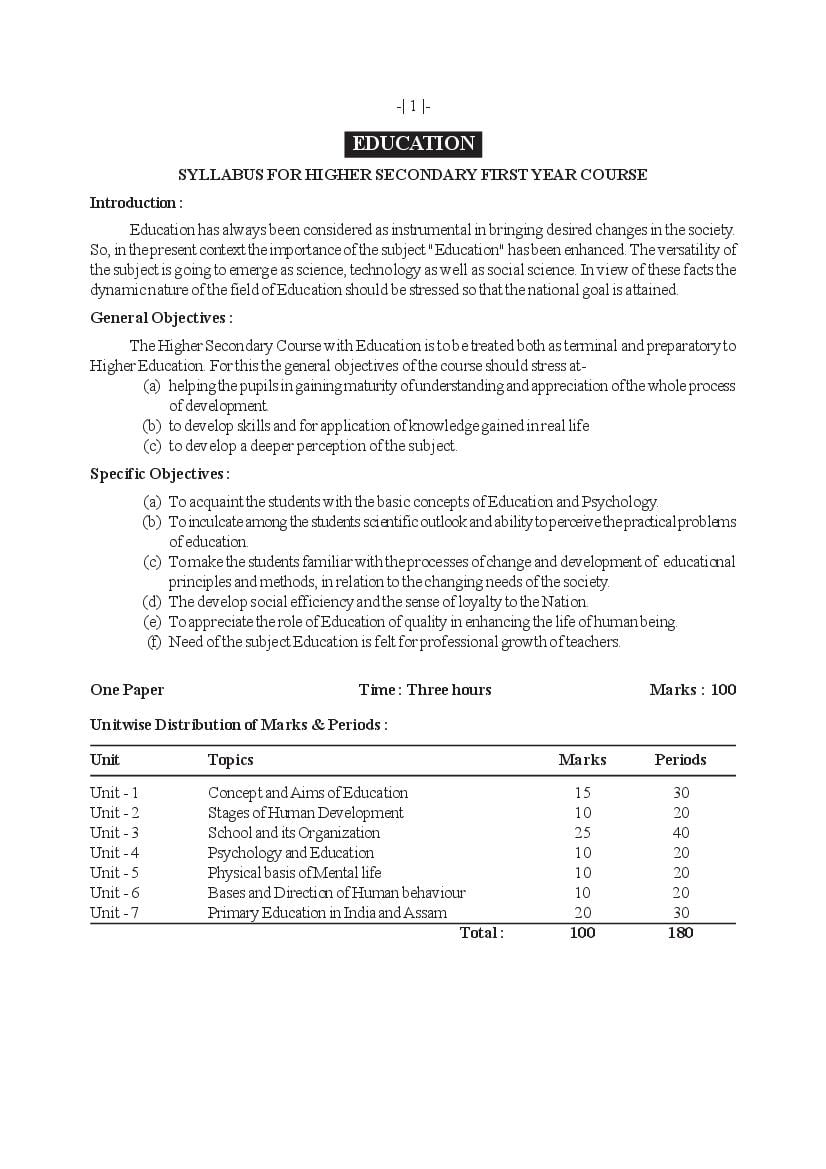
EDUCATION
SYLLABUS FOR HIGHER SECONDARY FIRST YEAR COURSE
Introduction :
Education has always been considered as instrumental in bringing desired changes in the society.
So, in the present context the importance of the subject "Education" has been enhanced. The versatility of
the subject is going to emerge as science, technology as well as social science. In view of these facts the
dynamic nature of the field of Education should be stressed so that the national goal is attained.
General Objectives :
The Higher Secondary Course with Education is to be treated both as terminal and preparatory to
Higher Education. For this the general objectives of the course should stress at-
(a) helping the pupils in gaining maturity of understanding and appreciation of the whole process
of development.
(b) to develop skills and for application of knowledge gained in real life
(c) to develop a deeper perception of the subject.
Specific Objectives :
(a) To acquaint the students with the basic concepts of Education and Psychology.
(b) To inculcate among the students scientific outlook and ability to perceive the practical problems
of education.
(c) To make the students familiar with the processes of change and development of educational
principles and methods, in relation to the changing needs of the society.
(d) The develop social efficiency and the sense of loyalty to the Nation.
(e) To appreciate the role of Education of quality in enhancing the life of human being.
(f) Need of the subject Education is felt for professional growth of teachers.
One Paper Time : Three hours Marks : 100
Unitwise Distribution of Marks & Periods :
Unit Topics Marks Periods
Unit - 1 Concept and Aims of Education 15 30
Unit - 2 Stages of Human Development 10 20
Unit - 3 School and its Organization 25 40
Unit - 4 Psychology and Education 10 20
Unit - 5 Physical basis of Mental life 10 20
Unit - 6 Bases and Direction of Human behaviour 10 20
Unit - 7 Primary Education in India and Assam 20 30
Total : 100 180
Page 2
Unitwise Distribution of Course Contents :
Unit-1 : Concept and Aims of Education : (Marks 15)
(a) Meaning, definition, scope and types of education. 05
(b) Aims of education - Individual, Social,
Vocational and Democratic aim. 05
(c) Relation with Biology, Sociology, Philosophy,
Economics and Statistics. 05
Unit-2 : Stages of Human Development : (Marks 10)
(a) Infancy 03
(b) Childhood 03
(c) Adolescence 04
Unit-3 : School and its Organization : (Marks 25)
(a) Physical resources - School building and equipments,
library, role of technology in education (computer, internet,
E-mail, teleconferencing, website) 05
(b) Human Resources: Teacher - Multiple role of teacher as
motivator, Facilitator, Counselor, Innovator, their role in
the school and society.
Students- Their role in the -school and society. 10
(c) Guiding agencies- NCERT, UGC, SCERT, DIET. 05
(d) Curriculum- Concept and need, principles of curriculum 05
construction, co-curricular activities.
Unit-4 : Psychology and Education : (Marks 10)
(a) Concept, scope and relation between Education and
Psychology 05
(b) Educational Psychology and its significance. 05
Unit-5 : Physical basis of Mental life : (Marks 10)
(a) Central Nervous system 04
(b) Receptors and effectors 02
(c) Knowing process - concept of sensation, perception and
conception. 04
Unit-6 : Bases adn Direction of Human Behaviour : (Marks 10)
(a) Concept of Needs, Drives, Instinct and Emotion. 05
(b) Habit - Its importance, Formation and dissolution of
bad habits. 05
Unit-7 : Primary Education in India and Assam : (Marks 20)
(a) Indigenous systems of education (Gurukula, Pathsala, Tol,
Page 3
Satra, Maktab & Madrassa, Monitorial system). 05
(b) Missionary contribution towards education in Assam. 05
(c) Charter Act of 1813, Woods Dispatch of 1854, Hunter
Commission of 1882, Lord Curzon’s Policy of 1901,
Gokhale’s contribution to primary education, Wardha
Scheme of 1935, Primary Education Act in Assam 1926. 05
(d) Universalisation of Primary education since Independence. 05
Prescribed Textbook : Education (in English), Published by AHSEC.
ø˙鬱 (in Assamese), Published by AHSEC.
Document Details
| Board / Org | Assam Board |
| Exam | Class 11 |
| Type | Syllabus |
| Pages | 3 |
| Updated | 22 Jul 2026 |