AHSEC 1st Year Syllabus 2024-25 English Core
Finished viewing? Save it for later —
Download AHSEC 1st Year Syllabus 2024-25 English Core (PDF · 9 pages)About AHSEC 1st Year Syllabus 2024-25 English Core
AHSEC 1st Year Syllabus 2024-25 English Core is available here for free download. Published by Assam Board for Class 11, this syllabus can be viewed online or downloaded as a PDF (9 pages). Candidates preparing for Class 11 can use AHSEC 1st Year Syllabus 2024-25 English Core to understand the exam pattern, the type of questions asked, and the overall difficulty level.
Frequently Asked Questions
How can I download AHSEC 1st Year Syllabus 2024-25 English Core?
Open this page and click the Download button to save AHSEC 1st Year Syllabus 2024-25 English Core as a PDF. It is completely free on AglaSem Docs.
Is AHSEC 1st Year Syllabus 2024-25 English Core free to download?
Yes. AHSEC 1st Year Syllabus 2024-25 English Core can be viewed online and downloaded as a PDF free of cost on AglaSem Docs.
How many pages does AHSEC 1st Year Syllabus 2024-25 English Core have?
AHSEC 1st Year Syllabus 2024-25 English Core contains 9 pages, which you can read online or download together as a single PDF.
Where can I find more Class 11 study material?
You can find more Class 11 question papers, sample papers, syllabus, and answer keys on AglaSem Docs.
AHSEC 1st Year Syllabus 2024-25 English Core – Text
Read the full text of this syllabus below — useful to quickly search, copy and reference the content online without downloading the PDF.
📄 View text version (9 pages)
Page 1
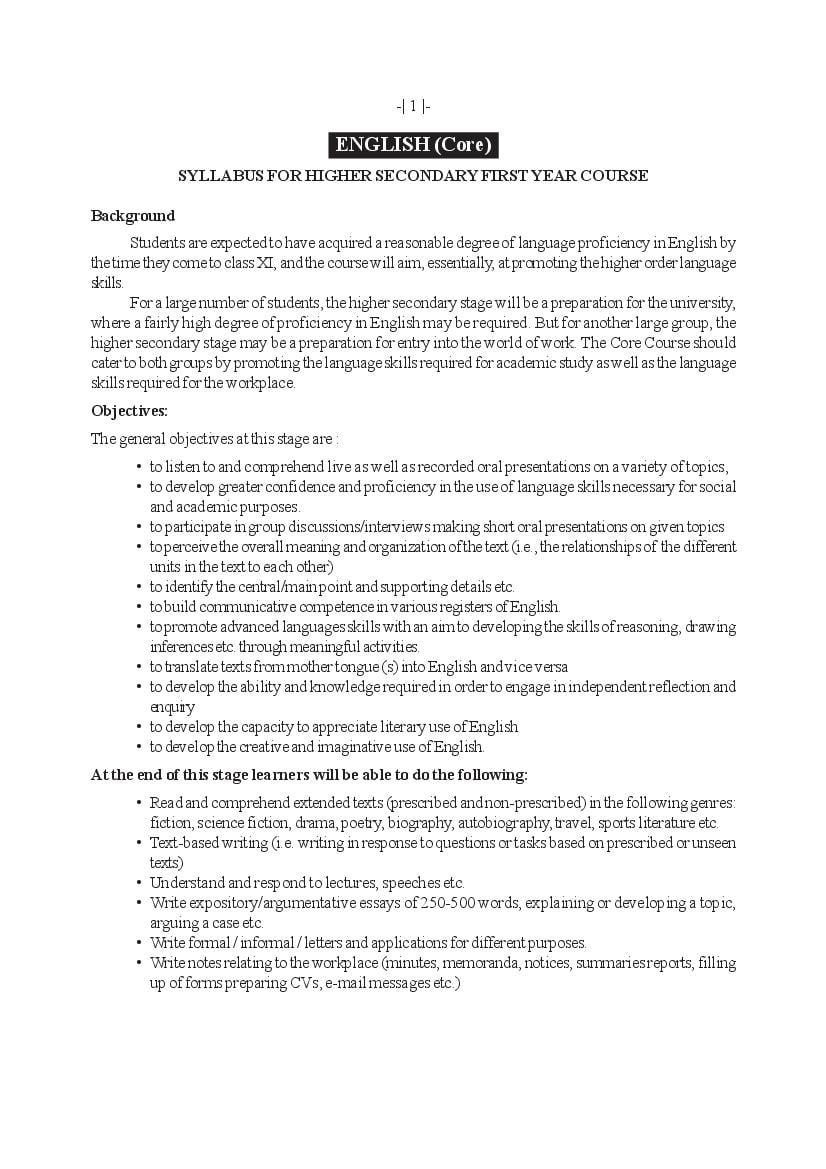
ENGLISH (Core)
SYLLABUS FOR HIGHER SECONDARY FIRST YEAR COURSE
Background
Students are expected to have acquired a reasonable degree of language proficiency in English by
the time they come to class XI, and the course will aim, essentially, at promoting the higher order language
skills.
For a large number of students, the higher secondary stage will be a preparation for the university,
where a fairly high degree of proficiency in English may be required. But for another large group, the
higher secondary stage may be a preparation for entry into the world of work. The Core Course should
cater to both groups by promoting the language skills required for academic study as well as the language
skills required for the workplace.
Objectives:
The general objectives at this stage are :
• to listen to and comprehend live as well as recorded oral presentations on a variety of topics,
• to develop greater confidence and proficiency in the use of language skills necessary for social
and academic purposes.
• to participate in group discussions/interviews making short oral presentations on given topics
• to perceive the overall meaning and organization of the text (i.e., the relationships of the different
units in the text to each other)
• to identify the central/main point and supporting details etc.
• to build communicative competence in various registers of English.
• to promote advanced languages skills with an aim to developing the skills of reasoning, drawing
inferences etc. through meaningful activities.
• to translate texts from mother tongue (s) into English and vice versa
• to develop the ability and knowledge required in order to engage in independent reflection and
enquiry
• to develop the capacity to appreciate literary use of English
• to develop the creative and imaginative use of English.
At the end of this stage learners will be able to do the following:
• Read and comprehend extended texts (prescribed and non-prescribed) in the following genres:
fiction, science fiction, drama, poetry, biography, autobiography, travel, sports literature etc.
• Text-based writing (i.e. writing in response to questions or tasks based on prescribed or unseen
texts)
• Understand and respond to lectures, speeches etc.
• Write expository/argumentative essays of 250-500 words, explaining or developing a topic,
arguing a case etc.
• Write formal / informal / letters and applications for different purposes.
• Write notes relating to the workplace (minutes, memoranda, notices, summaries reports, filling
up of forms preparing CVs, e-mail messages etc.)
Page 2
• Taking/making notes from reference materials, recorded talks etc.
Language Items:
The Core Course should draw upon the language items suggested for classes IX-X and delve
deeper into their usage and functions. Particular attention may, however, be given to the following areas of
grammar;
• The uses of different tense forms for different kinds of narration (e.g. media commentaries,
reports, programmes etc.)
• The use of passive forms in scientific and innovative writings
• Converting one kind of sentence/clause into a different kind of structure as well as other items to
exemplify stylistic variations in different discourses
• Modal auxiliaries - uses based on semantic considerations.
The study of formal (descriptive) grammar, at a very elementary level, will be introduced in Class
XI. A conscious knowledge of some grammatical rules and sound patterns may be useful and interesting
at this stage.
Methods and Techniques:
The techniques used for teaching should promote habits of self-learning and reduce dependence on
the teacher. In general, a multi-skilled, learner-centered, activity based approach, of which there can be
many variations, is recommended. The core classroom activity is likely to be that of silent reading of
prescribed/selected texts for comprehension, which can lead to other forms of language learning activities
such as role play, dramatization group discussion writing etc. although many such activities could be
carried out without the preliminary use of textual material. It is important that students be trained to read
independently and intelligently, interacting actively with texts, with the use of reference materials (dictio-
naries, thesauruses etc.) where necessary. Some pre-reading activity will generally be required and the
course books should suggest suitable activities leaving teachers free to devise other activities when de-
sired. So also the reading of texts should be followed by post reading activities. It is important to remem-
ber that every text can generate different readings. Students should be encouraged to interpret texts in
different ways.
Group and pair activities can be resorted to when desired, but many useful language activities can
be carried out individually.
In general, teachers should encourage students to interact actively with texts and with each other.
Oral activity (group discussion etc.) should be encouraged.
Page 3
Syllabus Class XI
One Paper Three Hours Marks: 100
Unit wise Distribution of Marks and Periods:
Unit Areas of Learning Marks Periods
A Reading Unseen Passages (two) 20 30
B Writing 20 30
C Grammar 10 20
D Textual Questions 40 80
(i) Textbook 30
(ii) Supplementary Reader 10
E Conversation Skills 20
(i) Listening 05
(ii) Speaking 05
Total 100 180
Section -A
Reading unseen Passages for comprehension and note making
Two unseen passages with variety of questions including 5 marks exclusively for vocabulary such as
• Word formation
• Inferring meaning
The total length of both the passages together should be around 1100 words.
Types of the passages: 1. factual passages e.g. instructions, descriptions, reports
2. Discursive passages involving opinion
e.g. argumentative, persuasive
Section Wise - [Summary]
Unit Unseen No. of Testing areas Marks Total
No passage Words Marks
01 01 600 SA type Questions to test 10 marks 12
Local, Global and • Local Comprehension
Inferential test --- 4 Questions of
Comprehension 1 mark each(lx4=4)
• Global and inferential
comprehension test
3 questions of 2
marks each (3x2 =6)
Vocabulary 02 marks
• 2 questions of 1 mark
each (on inferring
meaning)
02 500 Note making in 05 marks 08
Page 4
appropriate format
Vocabulary 03 marks
• 3 questions of 1 mark
each (Word formation)
Total marks 20
Section - B Writing
No No. of questions Types Marks Word limit
03 One out of two (a) A Factual description of any 06 80-100 Words
event or incident,
Or/
(b) A report based on the verbal
input provided
04 One out of two Compositions based on a visual 06 100-150 words
and / or verbal output
[The output may be descriptive or
argumentative in nature - such as
an article for publication in a
newspaper or a school magazine
or a speech]
05 One out of two Writing a letter based on the 08
given input. Letter types
include
a) business or official letter for
making enquires registering
complaints asking for and giving
information, placing orders and
sending replies.
b) letters to editors (giving
suggestions, opinions on an
issue of public interest.)
c) Application for a job
Total Marks 20
Section - C
Grammar
Different grammatical structures in meaningful contexts will be tested. Item types will include:
a) Gap filling
b) Sentence re-ordering
c) Dialogue completion
d) Sentence transformation
Page 5
The grammar syllabus include
Q. No. Language Item Mark Marking Scheme
Q. No.6 i. Determiners 1 mark ½ mark × 2 questions
ii. Tense 1 mark ½ mark × 2 questions
iii. Modal Auxiliary 1 mark ½ mark × 2 questions
iv. Error Correction 1 mark ½ mark × 2 questions
Q. No.7 i. Dialogue completion 2 marks l mark × 2 questions
ii. Sentence transformation 2 marks 1mark × 2 questions
Q. No.8 i. Reordering of sentence 2 marks l mark × 2 questions
Total 10 marks
Section - D (Textual Questions)
Prescribed Books : Hornbill - Textbook published by AHSEC, Guwahati
Selected pieces
Name of the topic Writer
Prose 1. The Portrait of a lady Khushwant Sillgh
2. Landscape of the Soul Nathalie Trouveroy
3. The Ailing Planet: the Green Nani Palkhivala
Movements Role
4. My Impressions of Assam Verrier Elwin
Poetry 1. A photograph Shirley Toulson
2. The Voice of the Rain Walt Whitman
3. Childhood Markus Natten
4. Father to Son Elizabeth Jennings
Q.no 9. 08 marks
One out of two extracts based on poetry from the text for comprehension and appreciation.
• Comprehension Question SA type 4 questions of 1 mark each.
• Appreciation SA type 1 question of 4 marks
Q no 10. Two out of three Short answer type questions from the poetry section to test local and global
comprehension of the text.(up to 30 words) 06 marks
• SA Type question 2 questions of 3 marks each
Q no 11. Five out of six short answer type questions on the lessons from the prescribed text.(Up to 30
words) 10 marks
• SA Type Question 5 questions of 2marks each
Q no. 12. One out of two long answer type questions based on the text to test global comprehension
and extrapolation beyond the set text. (Expected word limit would be about 100-125 words
each) 06 marks
• LA Type Question 1 question of 6 marks
Page 6
Supplementary Reader Total mark 10
Prescribed Textbook - Snapshots, Published by AHSEC
Selected pieces:
1. Ranga's Marriage - Masti Venkatesha Iyengar
2. Albert Einstein at School - Patrick Pringle
Q No 13. One out of two long answer type questions based on the Supplementary Reader to test
comprehension of theme character and incidents. (Up to 100 words)
LA Type Question 1 question of 6 marks 06 marks
Q No 14. Two of three short answer type questions from the Supplementary Reader. (Upto 30 words)
SA Type Question 2 questions 2 marks each 04 marks
Page 7
ASSESSMENT OF LISTENING & SPEAKING SKILL
ALLOTTED MARKS = 10 MARKS
Speaking and Listening
Speaking needs a very strong emphasis and is an important objective leading to professional com-
petence. Hence testing of oral skills must be made an important component of the overall testing pattern.
To this end, speaking and listening skills are overtly built into the material to guide the teachers in the
actualization of the skills.
Assessment of Speaking and Listening Skills (ASL)
The Assam Higher Secondary Education Council had introduced the formal assessment of speak-
ing and listening skills in class XI with effect from the session 2012-13. As a part of the CCE, it is believed
that assessment should be used to control and regulate the quality and also to maintain the desired stan-
dards of performance in specific areas of learning. As good communication skills raise the self esteem and
give a student the confidence to face the challenges of life, it is desired that the student acquires proficiency
in this by the time he or she completes the secondary level education. Speaking and listening being consid-
ered to be the essential skills of learning a language a formal assessment of speaking and listening skills has
been included in the overall assessment scheme with a view to bringing in a 'washback' effect in the
teaching process.
Speaking Assessment
The assessment of speaking skill is based on four aspects of a language which include language
functions, grammar, lexis or range of vocabulary and phonology. Students will be assessed on a scale of
5-1 where 1 is the lowest point and 5 is the highest. If a student performs reasonably well but doesn't fall
in the highest category he or she can be marked in between 3 and 5.
Specific Objectives of Listening & Speaking:
Students are expected to develop the ability:
1. to listen to lectures and talks and to be able to extract relevant and useful information for a specific
purpose.
2. to listen to news bulletins and to develop the ability to discuss informally on a wide ranging issues
like current national and international affairs, sports, business, etc.
3. to respond in interviews and to participate in formal group discussions.
4. to make enquiries meaningfully and adequately and to respond to enquiries for the purpose of within
the country and abroad.
5. to listen to business news and to be able to extract relevant important information.
6. to develop the art of formal public speaking.
Page 8
CONVERSATION SKILLS ASSESSMENT SCALE
GIDDELINE FOR ASSESSMENT OF LISTENING
The teacher will read aloud a passage based on a relevant theme or a short story. The passage may
be factual or discursive. The length of the passage should be around 350 words. The examinees are
expected to complete the listening comprehension tasks given in a separate sheet while listening to the
teacher. The tasks set may be gap-filling, multiple choice, true or false or short answer questions. There
may be 10 different questions for half mark each.
ASSESSMENT SCALE
LISTENING
The learner
1. has the ability to understand words and phrases in a familiar context but cannot follow connected
speech.
2. has ability to follow short connected utterances in a familiar context.
3. has ability to understand explicitly stated information in both familiar and unfamiliar contexts.
4. understands a range of longer spoken texts with reasonable accuracy and is able to draw
inferences.
5. shows ability to interpret complex discourse in terms of points of view; adapts listening strategies
to suit purposes.
MARKING SCHEME FOR LISTENING
Allotted Marks – 05 Allotted Time 10 minutes
Sl No. Listening Skill Total Mark Marks obtained
(a) Comprehends a word uttered at an average speech rate (½ × 4) = 2
(b) Evaluate whether a statement in a given context is true (½ × 2)= 1
or false .
(c) Grasps the meaning of words in context (½ × 4) = 2
GUIDELINES FOR ASSESSMENT OF SPEAKING
Narration based on a sequence of pictures. In this section the candidate will be required to use
narrative language.
Description of a picture (Can be pictures of people or places)
Speaking on a given topic.
ASSESSMENT SCALE
SPEAKING
The learner
1. shows ability to use only isolated words and phrases but cannot operate on connected speech
level.
2. in familiar situations, uses only short connected utterances with limited accuracy.
Page 9
3. shows ability to use more complex utterances with some fluency in longer discourse; still makes
some errors which impede communication.
4. organizes and presents thoughts in a reasonably logical and fluent manner in unfamiliar situations;
makes errors which do not interfere with communication.
5. can spontaneously adapt style appropriate to purpose and audience; makes only negligible
errors.
MARKING SCHEME FOR SPEAKING
Allotted Marks – 05
Sl No. Speaking Skill Total Marks Marks obtained
(a) Speaks loud and clear with acceptable pronunciation (½ × 4) = 2
(minimum 4 sentences)
(b) Presents the idea in a logical sequence with minimal 1
hesitation
(c) Speaks using appropriate sentence structures (minimum ½ ×4) = 2
4 sentences)
NOTE : 1. At the start of the examination the examiner will give the candidate some time to
prepare. In case of narration the present tense should be used.
2. Topics chosen should be within the personal experience of the examinee such as:
relating a funny anecdote, retelling the theme of a book read or a movie seen recently.
3. Once the candidate has started to speak, the examiner should intervene as little as
possible.
Note to the Teacher:
The teacher may assess the students on the basis of the given guidelines at his her convenience
during the session. The marks allotted should then be recorded for submission at the time of declaration
of the result of H.S. 1st year annual examination.
Document Details
| Board / Org | Assam Board |
| Exam | Class 11 |
| Type | Syllabus |
| Pages | 9 |
| Updated | 22 Jul 2026 |