JNVST 2023 Syllabus
Finished viewing? Save it for later —
Download JNVST 2023 Syllabus (PDF · 11 pages)About JNVST 2023 Syllabus
JNVST 2023 Syllabus is available here for free download. Published by Navodaya Vidyalaya Samiti for JNVST, this syllabus can be viewed online or downloaded as a PDF (11 pages). Candidates preparing for JNVST can use JNVST 2023 Syllabus to understand the exam pattern, the type of questions asked, and the overall difficulty level.
Frequently Asked Questions
How can I download JNVST 2023 Syllabus?
Open this page and click the Download button to save JNVST 2023 Syllabus as a PDF. It is completely free on AglaSem Docs.
Is JNVST 2023 Syllabus free to download?
Yes. JNVST 2023 Syllabus can be viewed online and downloaded as a PDF free of cost on AglaSem Docs.
How many pages does JNVST 2023 Syllabus have?
JNVST 2023 Syllabus contains 11 pages, which you can read online or download together as a single PDF.
Where can I find more JNVST study material?
You can find more JNVST question papers, sample papers, syllabus, and answer keys on AglaSem Docs.
JNVST 2023 Syllabus – Text
Read the full text of this syllabus below — useful to quickly search, copy and reference the content online without downloading the PDF.
📄 View text version (11 pages)
Page 1
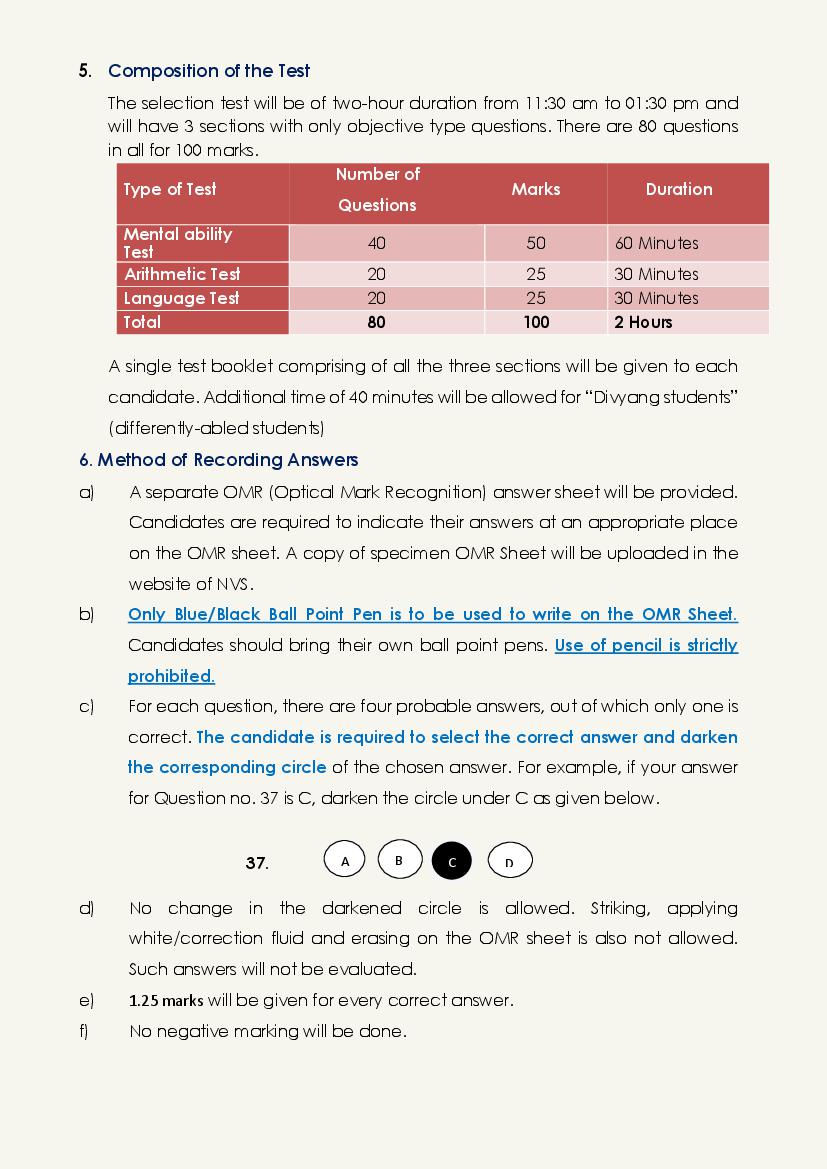
The selection test will be of two-hour duration from 11:30 am to 01:30 pm and
will have 3 sections with only objective type questions. There are 80 questions
in all for 100 marks.
Number of
Type of Test Marks Duration
Questions
Mental ability
40 50 60 Minutes
Test
Arithmetic Test 20 25 30 Minutes
Language Test 20 25 30 Minutes
Total 80 100 2 Hours
A single test booklet comprising of all the three sections will be given to each
candidate. Additional time of 40 minutes will be allowed for “Divyang students”
(differently-abled students)
6. Method of Recording Answers
a) A separate OMR (Optical Mark Recognition) answer sheet will be provided.
Candidates are required to indicate their answers at an appropriate place
on the OMR sheet. A copy of specimen OMR Sheet will be uploaded in the
website of NVS.
b) Only Blue/Black Ball Point Pen is to be used to write on the OMR Sheet.
Candidates should bring their own ball point pens. Use of pencil is strictly
prohibited.
c) For each question, there are four probable answers, out of which only one is
correct. The candidate is required to select the correct answer and darken
the corresponding circle of the chosen answer. For example, if your answer
for Question no. 37 is C, darken the circle under C as given below.
37. A B C D
d) No change in the darkened circle is allowed. Striking, applying
white/correction fluid and erasing on the OMR sheet is also not allowed.
Such answers will not be evaluated.
e) 1.25 marks will be given for every correct answer.
f) No negative marking will be done.
Page 2
various sections/ categories is uploaded in the NVS website www.navodaya.gov.in
under the section “Admission”.
7. Instructions and Examples
A. The candidate must carefully read the instructions given on the cover page
of the test booklet as well as those for each section before attempting the
questions. Candidates are advised to confirm that the test booklet received
by them is of the language opted for the test. In case test booklet of correct
language opted for is not provided, the candidate should get it changed
before the start of the examination. It is the responsibility of the candidate to
obtain the test booklet of his choice as opted in the application form. No
representation in this regard will be entertained after the examination is over.
B. The total time would be two hours without any break. Additional time of 40
minutes will be allowed for “Divyang students” (differently-abled students).
C. Securing qualifying marks in each of the three sections is essential.
Candidates are advised not to spend more time on each section of test than
suggested, although they are free to adjust the total time, as they like.
D. There will be a bell after every 30 minutes.
i. No candidate will be allowed to appear in the selection test without
proper Admit Card.
ii. Candidates have to be seated in the allotted rooms latest by 11:00
a.m. late comers will not be permitted to appear for the test.
iii. No candidate will be permitted to leave the examination hall/room till
the completion of full allotted time.
Page 3
Jawahar Navodaya Vidyalaya Selection Test is conducted in various
languages state wise as given below:
Name of the State/UT Languages
ANDAMAN & NICOBAR ISLANDS Hindi, English, Tamil, Urdu, Bengali
Hindi, English, Telugu, Marathi, Urdu, Oriya,
ANDHRA PRADESH
Kannada
ARUNACHAL PRADESH English, Hindi
English, Hindi, Assamese, Bodo, Garo, Bengali,
ASSAM
Manipuri (Bangla Script), Manipuri (Meitei Mayek)
BIHAR English, Hindi, Urdu
CHANDIGARH English, Hindi, Punjabi
CHHATTISGARH English, Hindi
DELHI English, Hindi
GOA English, Hindi, Marathi, Kannada
GUJARAT English, Hindi, Gujrati, Marathi
HARYANA English, Hindi
HIMACHAL PRADESH English, Hindi
JAMMU AND KASHMIR English, Hindi, Urdu
JHARKHAND English, Hindi, Urdu, Oriya
Hindi, English, Kannada, Telugu, Marathi, Urdu,
KARNATAKA
Malayalam, Tamil
KERALA Hindi, English, Malayalam, Tamil, Kannada
LAKSHADWEEP Hindi, English, Malayalam
MADHYA PRADESH English, Hindi, Urdu, Marathi, Gujarati
English, Hindi, Kannada, Marathi, Urdu, Telugu,
MAHARASHTRA
Gujrati, Bengali
MANIPUR English, Hindi, Manipuri (Meitei Mayek)
MEGHALAYA English, Hindi, Khasi, Garo, Bengali, Assamese
MIZORAM English, Hindi, Mizo
NAGALAND English, Hindi
ODISHA English, Hindi, Telugu, Oriya, Urdu
PUDUCHERRY English, Tamil, Telugu, Malyalam, Hindi
PUNJAB English, Hindi, Punjabi
RAJASTHAN English, Hindi
SIKKIM English, Hindi, Nepali
TELANGANA Hindi, English, Telugu, Kannada, Marati, Urdu
TRIPURA English, Hindi, Bengali
UT Ladakh English, Hindi, Urdu
UT OF DADAR & NAGAR HAVELI
English, Hindi, Gujrati, Marathi
and Daman and Diu
UTTAR PRADESH English, Hindi, Urdu
UTTARAKHAND English, Hindi, Urdu
WEST BENGAL English, Hindi, Bengali, Nepali, Urdu
NOTE: - A CANDIDATE WILL BE GIVEN A TEST BOOKLET IN THE LANGUAGE WHICH
HE/SHE HAS MENTIONED IN THE APPLICATION FORM.
Page 4
Section-1Mental Ability Test (MAT)
This is a non – verbal test. Questions are based on figures and diagrams only.
Questions are meant to assess general mental functioning of the
candidates. The section is divided into ten parts having 4 questions each.
Given below are some examples:
PART-I (ODD-MAN OUT)
Directions: In questions 1 to 4, four figures A,B,C and D have been given in
each question. Of these four figures, three figures are similar in some way
and one figure is different. Select the figure which is different.
Correct answer is (A)
PART- II (FIGURE MATCHING)
Directions:
In questions 5 to 8, a problem figure is given on the left side and four answer
figures marked A, B, C and D are given on the right side. Select the answer
figure which is exactly the same as the problem figure.
Correct answer is (C)
Page 5
Part- III (PATTERN COMPLETION
Directions:
In questions 9 to 12 there is a problem figure on the left-hand side, a part of
which is missing. Observe the answer figures A, B, C and D on the right-hand
side and find out the answer figure which without changing the direction, fits
in the missing part of the problem figure in order to complete the pattern in
the problem figure.
Correct answer is (A)
PART- IV (FIGURE SERIES COMPLETION)
Directions:
In questions 13 to 16, there are three problem figures on the left-hand side
and the space for the fourth figure is left blank. The problem figures are in a
series. Find out one figure among the answer figures given on the right-hand
side, which occupies the blank space for the fourth figure on the left-hand
side and completes the series.
Correct answer is (C)
Page 6
Directions:
In questions 17 to 20, there are two sets of two problem figures each. The
second set has a mark of interrogation (?). There exists a relationship
between the first two problem figures. Similar relationship should exist
between the third and fourth problem figure. Select one of the answer
figures which replaces the mark of interrogation.
Correct answer is (A)
PART - VI [Geometrical Figure Completion (Triangle, Square, Circle)]
Directions:
In questions 21 to 24 one part of a geometrical figure is on the left-hand side
as question figure and the other one is among the four answer figures A, B,
C and D given on the right-hand side. Find out the figure that completes the
geometrical figure.
(A) (B) (C) (D)
Correct answer is (A)
Page 7
Directions:
In questions 25 to 28 there is a problem figure on the left side and four answer
figures marked A, B, C and D are given on the right side. Select the answer
figure which is exactly the mirror image of the problem figure when the mirror
is held at X Y.
Correct answer is (D)
PART - VIII (PUNCHED HOLD PATTERN - Folding/Unfolding)
Directions:
In question 29 to 32 a piece of paper is folded and punched as shown in
problem figures on the left side and four answer figures marked A, B, C and
D are given on right side. Select the answer figure which indicates how the
paper will appear when opened (unfolded).
Correct answer is (A)
Page 8
Directions:
In questions 33 to 36 a problem figure is given on the left side and four answer
figures, marked A, B, C and D are given on the right side. Select the answer
figure which can be formed from the cut-off pieces given in the problem
figure.
(A) (B) (C) (D)
Correct answer is (D)
PART –X (EMBEDDED FIGURE)
Directions:
In questions 37 to 40 a problem figure is given on the left side and four answer
figures, marked A, B, C and D are given on the right side. Select the answer
figure in which the problem figure is hidden/ embedded.
Correct answer is (B)
Page 9
The main purpose of this test is to measure candidate's basic competencies in
Arithmetic. All the Twenty questions of this test will be based on the following 15 topics
1. Number and numeric system.
2. Four fundamental operations on whole number.
3. Fractional number and four fundamental operations on them.
4. Factors and multiples including their properties.
5. LCM and HCF of numbers.
6. Decimals and fundamental operations on them.
7. Conversion of fractions to decimals and vice-versa.
8. Measurement of length, mass, capacity, time, money etc.
9. Distance, time and speed.
10. Approximation of expressions.
11. Simplification of Numerical Expressions,
12. Percentage and its applications.
13. Profit and loss.
14. Simple interest.
15. Perimeter, area and volume.
Note:- Emphasis will be more on testing of understanding and application of the
concepts and skills involved. In order to provide some guidance to the
candidates on the types of questions that are expected in Arithmetic Test, a few
examples are given below-
Example - 1 (Test of Understanding):
What is the prime factorization of 1000?
A. 10x10x10 C. 2 x 2 x 2 x5 x 5
B. 2x5x5x10 D. 2 x 2x 2 x 5 x5 x 5
A factorization of a number is said to be a prime factorization if (i) the product of the
factors (taking a factor as many times as it occurs) is equal to the given number, and
(ii) each factor is a prime number. Here only option D satisfies both the requirements.
As such, option D is the correct answer.
Example 2 (Test of Understanding):
Page 10
A. 5 B. 4 C. 5 D. 16
The first four odd numbers are 1, 3, 5 and 7. Their average is (l+3+5+7)/4. As such, option
B is the correct answer.
Example 3 (Test of Application):
A 1 km. long goods train is running at speed of 1 km per 3 minutes. The time taken by this
train to pass through 2 km. long tunnel is:
A. 1 minute C. 6 minutes
B. 3 minutes D. 9 minutes
The tunnel is 2 km. long and the train is 1 km. in length. The train will have to cover a total
distance of 3 km. in order to pass through the tunnel running at a speed of 1 km per 3
minutes, the train will take 9 minutes to pass through the tunnel and that is the correct
answer. As such, option D is the correct answer.
Section 3: Language Test.
The main purpose of this test is to assess reading comprehension of the candidates. The
test consists of four passages. Each passage is followed by 5 questions. Candidates shall
read each passage carefully and answer the questions that follow.
Given below is a specimen passage and the questions follow the passage.
PASSAGE
Forests are useful to us in many ways. They provide us with timber to build houses and
make furniture. Forests also provide us with wood for fuel and making paper. They provide
shelter for birds, wild animals and insects. Forests bring rainfall. Existence of forests is very
important for the preservation of the ecosystem. The fact that we have to care for an
ecosystem is indisputably established. Wise use of the environment and its resources are
essential for man's continued survival.
1. To preserve the ecosystem, existence of...............is essential.
A. forests C. animals
Page 11
Correct answer is A
2. Opposite of preservation' is...............
A. conservation B. Shelter
C. construction D.destruction
Correct answer is D
3. Which one of the following is not a synonym of 'wise'?
A. Sensible D. Judicious
B. Intelligent
C. Humorous
Correct answer is C
4. Carpenters depend on forests because they provide...............
A. wood for fuel C. timber to make furniture
B. wood for making paper D. houses for animals
Correct answer is C
5. Wild animals will become homeless if...............
A. paper mills are destroyed C. forests are destroyed
B. houses are built D. ecosystem is taken
Correct answer is C
Document Details
| Board / Org | Navodaya Vidyalaya Samiti |
| Exam | JNVST |
| Type | Syllabus |
| Pages | 11 |
| Updated | 24 Sep 2026 |