JNV Class 11th Lateral Entry Admission 2026 Syllabus
Finished viewing? Save it for later —
Download JNV Class 11th Lateral Entry Admission 2026 Syllabus (PDF · 8 pages)About JNV Class 11th Lateral Entry Admission 2026 Syllabus
JNV Class 11th Lateral Entry Admission 2026 Syllabus is available here for free download. Published by Navodaya Vidyalaya Samiti for JNVST, this syllabus can be viewed online or downloaded as a PDF (8 pages). Candidates preparing for JNVST can use JNV Class 11th Lateral Entry Admission 2026 Syllabus to understand the exam pattern, the type of questions asked, and the overall difficulty level.
Frequently Asked Questions
How can I download JNV Class 11th Lateral Entry Admission 2026 Syllabus?
Open this page and click the Download button to save JNV Class 11th Lateral Entry Admission 2026 Syllabus as a PDF. It is completely free on AglaSem Docs.
Is JNV Class 11th Lateral Entry Admission 2026 Syllabus free to download?
Yes. JNV Class 11th Lateral Entry Admission 2026 Syllabus can be viewed online and downloaded as a PDF free of cost on AglaSem Docs.
How many pages does JNV Class 11th Lateral Entry Admission 2026 Syllabus have?
JNV Class 11th Lateral Entry Admission 2026 Syllabus contains 8 pages, which you can read online or download together as a single PDF.
Where can I find more JNVST study material?
You can find more JNVST question papers, sample papers, syllabus, and answer keys on AglaSem Docs.
JNV Class 11th Lateral Entry Admission 2026 Syllabus – Text
Read the full text of this syllabus below — useful to quickly search, copy and reference the content online without downloading the PDF.
📄 View text version (8 pages)
Page 1
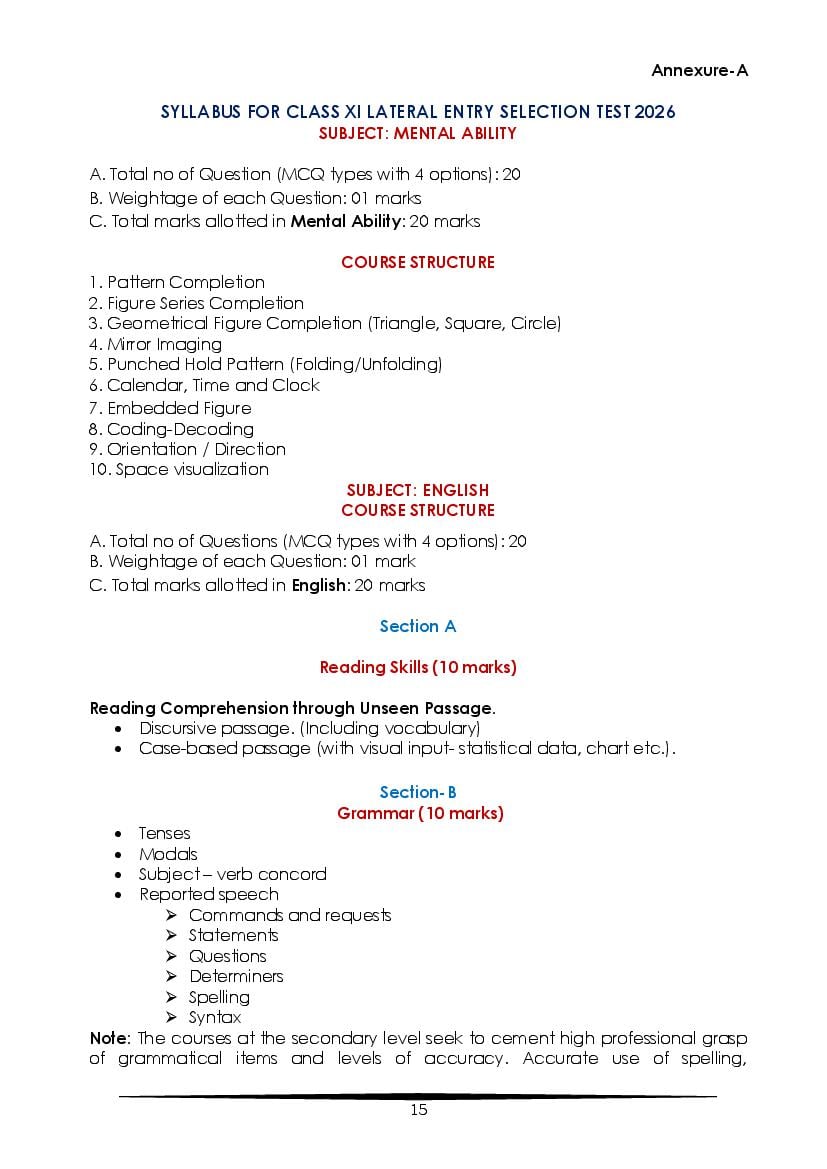
SYLLABUS FOR CLASS XI LATERAL ENTRY SELECTION TEST 2026
SUBJECT: MENTAL ABILITY
A. Total no of Question (MCQ types with 4 options): 20
B. Weightage of each Question: 01 marks
C. Total marks allotted in Mental Ability: 20 marks
1. Pattern Completion
2. Figure Series Completion
3. Geometrical Figure Completion (Triangle, Square, Circle)
4. Mirror Imaging
5. Punched Hold Pattern (Folding/Unfolding)
6. Calendar, Time and Clock
7. Embedded Figure
8. Coding-Decoding
9. Orientation / Direction
10. Space visualization
SUBJECT: ENGLISH
A. Total no of Questions (MCQ types with 4 options): 20
C. Total marks allotted in English: 20 marks
Section A
Reading Skills (10 marks)
Reading Comprehension through Unseen Passage.
Discursive passage. (Including vocabulary)
Case-based passage (with visual input- statistical data, chart etc.).
Section-B
Grammar (10 marks)
Tenses
Modals
Subject – verb concord
Reported speech
Commands and requests
Statements
Questions
Determiners
Spelling
Syntax
Note: The courses at the secondary level seek to cement high professional grasp
of grammatical items and levels of accuracy. Accurate use of spelling,
15
Page 2
SUBJECT : MATHEMATICS
A. Total no of Questions (MCQ types with 4 options): 20
C. Total marks allotted in Mathematics: 20 marks
UNIT I: NUMBER SYSTEMS
1. REAL NUMBER: Fundamental Theorem of Arithmetic - statements after reviewing
work done earlier and after illustrating and motivating through examples, Proofs of
irrationality of √2, √3, √5
UNIT II: ALGEBRA
1. POLYNOMIALS Zeros of a polynomial. Relationship between zeros and
coefficients of quadratic polynomials.
2. PAIR OF LINEAR EQUATIONS IN TWO VARIABLES: Pair of linear equations in two
variables and graphical method of their solution, consistency / inconsistency.
Algebraic conditions for number of solutions. Solution of a pair of linear equations
in two variables algebraically – by substitution, by elimination. Simple situational
problems.
3. QUADRATIC EQUATIONS: Standard form of a quadratic equation ax2 + bx + c =
0, (a ≠ 0). Solutions of quadratic equations (only real roots) by factorization and
by using quadratic formula. Relationship between 16 discriminant and nature of
roots. Situational problems based on quadratic equations related to day-today
activities to be incorporated.
4. ARITHMETIC PROGRESSIONS: Motivation for studying Arithmetic Progression
Derivation of the nth term and sum of the first n terms of A.P. and their application
in solving daily life problems.
UNIT III: COORDINATE GEOMETRY
Coordinate Geometry: Review: Concepts of coordinate geometry, graphs of
linear equations. Distance formula. Section formula (internal division).
UNIT IV: GEOMETRY
1. TRIANGLES: Definitions, examples, counter examples of similar triangles.
• (Prove) If a line is drawn parallel to one side of a triangle to intersect the other
two sides in distinct points, the other two sides are divided in the same ratio.
• (Motivate) If a line divides two sides of a triangle in the same ratio, the line is
parallel to the third side.
• (Motivate) If in two triangles, the corresponding angles are equal, their
corresponding sides are proportional and the triangles are similar.
• (Motivate) If the corresponding sides of two triangles are proportional, their
corresponding angles are equal and the two triangles are similar.
16
Page 3
the sides including these angles are proportional, the two triangles are similar.
2. CIRCLES: (Prove) Tangent to a circle at, point of contact. (Prove) The tangent at
any point of a circle is perpendicular to the radius through the point of contact.
The lengths of tangents drawn from an external point to a circle are equal.
UNIT V: TRIGONOMETRY
1. INTRODUCTION TO TRIGONOMETRY: Trigonometric ratios of an acute angle of a
right-angled triangle. Proof of their existence (well defined); 17 motivate the ratios
whichever are defined at 0o and 90o. Values of the trigonometric ratios of 30 0, 450
and 600. Relationships between the ratios.
2. TRIGONOMETRIC IDENTITIES: Proof and applications of the identity Sin 2A + Cos2A
= 1. (Only simple identities to be given).
3. HEIGHTS AND DISTANCES: Angle of elevation, Angle of Depression. : Simple problems on
heights and distances. Problems should not involve more than two right triangles. Angles
of elevation / depression should be only 30°, 45°, and 60°.
UNIT VI: MENSURATION
1. AREAS RELATED TO CIRCLES: Area of sectors and segments of a circle. Problems
based on areas and perimeter / circumference of the above said plane figures.
(In calculating area of segment of a circle, problems should be restricted to central
angle of 60°, 90° and 120° only).
2. SURFACE AREAS AND VOLUMES: Surface areas and volumes of combinations of
any two of the following: cubes, cuboids, spheres, hemispheres and right circular
cylinders/cones.
UNIT VII: STATISTICS AND PROBABILITY
1. STATISTICS: Mean, Median and Mode of grouped data (bimodal situation to be
avoided).
2. PROBABILITY: Classical definition of probability. Simple problems on finding the
probability of an event.
SUBJECT: SCIENCE
A. Total no of Questions (MCQ types with 4 options): 20
C. Total marks allotted in Science: 20 marks
17
Page 4
Unit I: Chemical Substances - Nature and Behaviour
Chemical reactions: Chemical equation, Balanced Chemical Equation,
implications of a balanced chemical equation, types of chemical reactions:
combination, decomposition, displacement, double displacement, precipitation,
endothermic exothermic reactions, oxidation and reduction.
Acids, bases and salts: Their definitions in terms of furnishing of H+ and OH– ions.
General properties, examples and uses, neutralization, concept of pH scale
(Definition relating to logarithm not required), importance of pH in everyday life;
preparation and uses of Sodium Hydroxide, Bleaching powder, Baking soda,
Washing soda and Plaster of Paris.
Metals and Non-metals: Properties of metals and non-metals; Reactivity series;
Formation and properties of ionic compounds; Basic metallurgical processes;
Corrosion and its prevention.
Carbon compounds: Covalent bonding in carbon compounds. Versatile nature of
carbon. Homologous series. Nomenclature of carbon compounds containing
functional groups (halogens, alcohol, ketones, aldehydes, alkanes and alkynes),
difference between saturated hydro carbons and unsaturated hydrocarbons.
Chemical properties of carbon compounds (combustion, oxidation, addition and
substitution reaction). Ethanol and Ethanoic acid (only properties and uses), soaps
and detergents.
Theme: The World of the Living
Unit II: The World of Living
Life processes: ‘Living Being’. Basic concept of nutrition, respiration, transport
and excretion in plants and animals.
Control and co-ordination in animals and plants: Tropic movements in plants;
Introduction of plant hormones; Control and co-ordination in animals: Nervous
system; Voluntary, involuntary and reflex action; Chemical co-ordination: animal
hormones.
Reproduction: Reproduction in animals and plants (asexual and sexual)
reproductive health – need and methods of family planning. Safe sex V HIV/AIDS.
Child bearing and women’s health.
Heredity and Evolution: Heredity; Mendel’s contribution- Laws for inheritance of
traits: Sex determination: brief introduction: (topics excluded - evolution; evolution
and classification and evolution should not be equated with progress).
Theme: Natural Phenomena
Unit III: Natural Phenomena
Light: Reflection of light by curved surfaces; Images formed by spherical mirrors,
centre of curvature, principal axis, principal focus, focal length, mirror formula
(Derivation not required), magnification. Refraction; Laws of refraction, refractive
index. Refraction of light by spherical lens; Image formed by spherical lenses; Lens
formula (Derivation not required); Magnification. Power of a lens. Functioning of a
lens in human eye, defects of vision and their corrections, applications of spherical
mirrors and lenses. Refraction of light through a prism, dispersion of light, scattering
18
Page 5
Theme : How Things Work
Unit IV: Effects of Current
Electric current, potential difference and electric current. Ohm’s law; Resistance,
Resistivity, Factors on which the resistance of a conductor depends. Series
combination of resistors, parallel combination of resistors and its applications in
daily life. Heating effect of electric current and its applications in daily life. Electric
power, Interrelation between P, V, I and R.
Magnetic effects of current: Magnetic field, field lines, field due to a current
carrying conductor, field due to current carrying coil or solenoid; Force on current
carrying conductor, Fleming’s Left Hand Rule, Direct current. Alternating current:
frequency of AC. Advantage of AC over DC. Domestic electric circuits.
Theme : Natural Resources
Unit V: Natural Resources
Our Environment: Eco-system, Environmental problems, Ozone depletion, waste
production and their solutions. Biodegradable and non-biodegradable
substances.
SUBJECT: SOCIAL SCIENCE
A. Total no of questions (MCQ types with 4 options): 20
C. Total marks allotted in Social Science: 20 marks
Unit 1: India and the Contemporary World – II
Section 1: Events and Processes:
1. The Rise of Nationalism in Europe:
The French Revolution and the Idea of the Nation
The Making of Nationalism in Europe
The Age of Revolutions: 1830-1848
The Making of Germany and Italy
Visualizing the Nation
Nationalism and Imperialism
2. Nationalism in India:
The First World War, Khilafat and Non -Cooperation
Differing Strands within the Movement
Towards Civil Disobedience
The Sense of Collective Belonging
Section 2: Livelihoods, Economies and Societies:
3. The Making of a Global World:
The Pre-modern world
The Nineteenth Century (1815-1914)
The Inter war Economy
Rebuilding a World Economy: The Post-War era
19
Page 6
Before the Industrial Revolution
Hand Labour and Steam Power
Industrialization in the Colonies
Factories Come Up
The Peculiarities of Industrial Growth
Market for Goods
Section 3: Everyday Life, Culture and Politics:
5. Print Culture and the Modern World:
The First Printed Books
Print Comes to Europe
The Print Revolution and its Impact
The Reading Mania
The Nineteenth Century
India and the World of Print
Religious Reform and Public Debates
New Forms of Publication
Print and Censorship
Unit 2: Contemporary India – II
1. Resources and Development:
Concept
Development of Resources
Resource Planning - Resource Planning in India, Conservation of Resources
Land Resources
Land Utilization
Land Use Pattern in India
Land Degradation and Conservation Measures
Soil as a Resource - Classification of Soils, Soil Erosion and Soil Conservation
(excluding Box Information on State of India’s Environment)
2. Forest and Wildlife
Conservation of forest and wildlife in India
Types and distribution of forests and wildlife resources
Community and Conservation
3. Water Resources:
Water Scarcity and The Need for Water Conservation and Management
Multi-Purpose River Projects and Integrated Water Resources Management
Rainwater Harvesting
4. Agriculture:
Types of Farming – Primitive Subsistence, Intensive
Subsistence, Commercial
Cropping Pattern – Major Crops, Food Crops other than Grains, Non-Food
Crops, Technological and Institutional Reforms
Food Security (excluding impact of globalization on agriculture)
2. Minerals and Energy Resources
What is a mineral?
Mode of occurrence of Minerals – Where are these minerals found? Ferrous
20
Page 7
Conservation of Minerals
Energy Resources - Conventional Sources of Energy, Non-Conventional
Sources of Energy
Conservation of Energy Resources
3. Manufacturing Industries:
Importance of Manufacturing – Industrial Location (excluding Industry
Market Linkage), Agro based Industry (excluding Cotton Textiles, Jute
Textiles, Sugar Industry), Mineral based Industries(excluding Iron Steel
Industry,
Cement Industry), Industrial Pollution and Environmental Degradation,
Control of Environmental Degradation
4. Life Lines of National Economy:
Roadways
Railways
Pipelines
Waterways
Major Seaports
Airways
Communication
International Trade
Tourism as a Trade
Unit 3: Democratic Politics – II
1. Power Sharing:
Belgium and Sri Lanka
Majoritarianism in Sri Lanka
Accommodation in Belgium
Why power sharing is desirable?
Forms of Power Sharing
2. Federalism:
What is Federalism?
What make India a Federal Country?
How is Federalism practiced?
Decentralization in India
3. Gender, Religion and Caste:
Gender and Politics - Public/Private division, Women’s political
representation
Religion, Communalism and Politics – Communalism, Secular State
(excluding image on page 46, 48, 49 of NCERT Textbook – Democratic
Politics –II - reprinted edition 2021)
Caste and Politics - Caste inequalities, Caste in politics, Politics in caste
4. Political Parties:
Why do we need Political Parties? – Meaning, Functions, Necessity
How many parties should we have?
National Parties
State Parties
Challenges to Political Parties
How can Parties be reformed?
21
Page 8
How do we assess democracy’s outcomes?
Accountable, responsive and legitimate government
Economic growth and development
Reduction of inequality and poverty
Accommodation of social diversity
Dignity and freedom of the citizens
Unit 4: Understanding Economic Development
1. Development:
What Development Promises - Different People, Different Goals
Income and Other Goals
National Development
How to compare different countries or States?
Income and other criteria
Public Facilities
Sustainability of Development
2. Sectors of the Indian Economy:
Sectors of Economic Activities
Comparing the three sectors
Primary, Secondary and Tertiary Sectors in India
Division of sectors as organized and un-organized
Sectors in terms of ownership: Public and Private Sectors
3. Money and Credit:
Money as a medium of exchange
Modern forms of Money
Loan activities of Banks
Two different Credit situations
Terms of Credit
Formal Sector Credit in India
Self Help Groups for the Poor
4. Globalization and the Indian Economy:
Production across countries
Interlinking production across countries
Foreign Trade and integration of markets
What is Globalization?
Factors that have enabled Globalization
World Trade Organization
Impact of Globalization in India
The Struggle for a fair Globalization
********
22
Document Details
| Board / Org | Navodaya Vidyalaya Samiti |
| Exam | JNVST |
| Type | Syllabus |
| Pages | 8 |
| Language | english |
| Updated | 22 Jul 2026 |