AHSEC 1st Year Syllabus 2024-25 Fine Arts
Finished viewing? Save it for later —
Download AHSEC 1st Year Syllabus 2024-25 Fine Arts (PDF · 9 pages)About AHSEC 1st Year Syllabus 2024-25 Fine Arts
AHSEC 1st Year Syllabus 2024-25 Fine Arts is available here for free download. Published by Assam Board for Class 11, this syllabus can be viewed online or downloaded as a PDF (9 pages). Candidates preparing for Class 11 can use AHSEC 1st Year Syllabus 2024-25 Fine Arts to understand the exam pattern, the type of questions asked, and the overall difficulty level.
Frequently Asked Questions
How can I download AHSEC 1st Year Syllabus 2024-25 Fine Arts?
Open this page and click the Download button to save AHSEC 1st Year Syllabus 2024-25 Fine Arts as a PDF. It is completely free on AglaSem Docs.
Is AHSEC 1st Year Syllabus 2024-25 Fine Arts free to download?
Yes. AHSEC 1st Year Syllabus 2024-25 Fine Arts can be viewed online and downloaded as a PDF free of cost on AglaSem Docs.
How many pages does AHSEC 1st Year Syllabus 2024-25 Fine Arts have?
AHSEC 1st Year Syllabus 2024-25 Fine Arts contains 9 pages, which you can read online or download together as a single PDF.
Where can I find more Class 11 study material?
You can find more Class 11 question papers, sample papers, syllabus, and answer keys on AglaSem Docs.
AHSEC 1st Year Syllabus 2024-25 Fine Arts – Text
Read the full text of this syllabus below — useful to quickly search, copy and reference the content online without downloading the PDF.
📄 View text version (9 pages)
Page 1
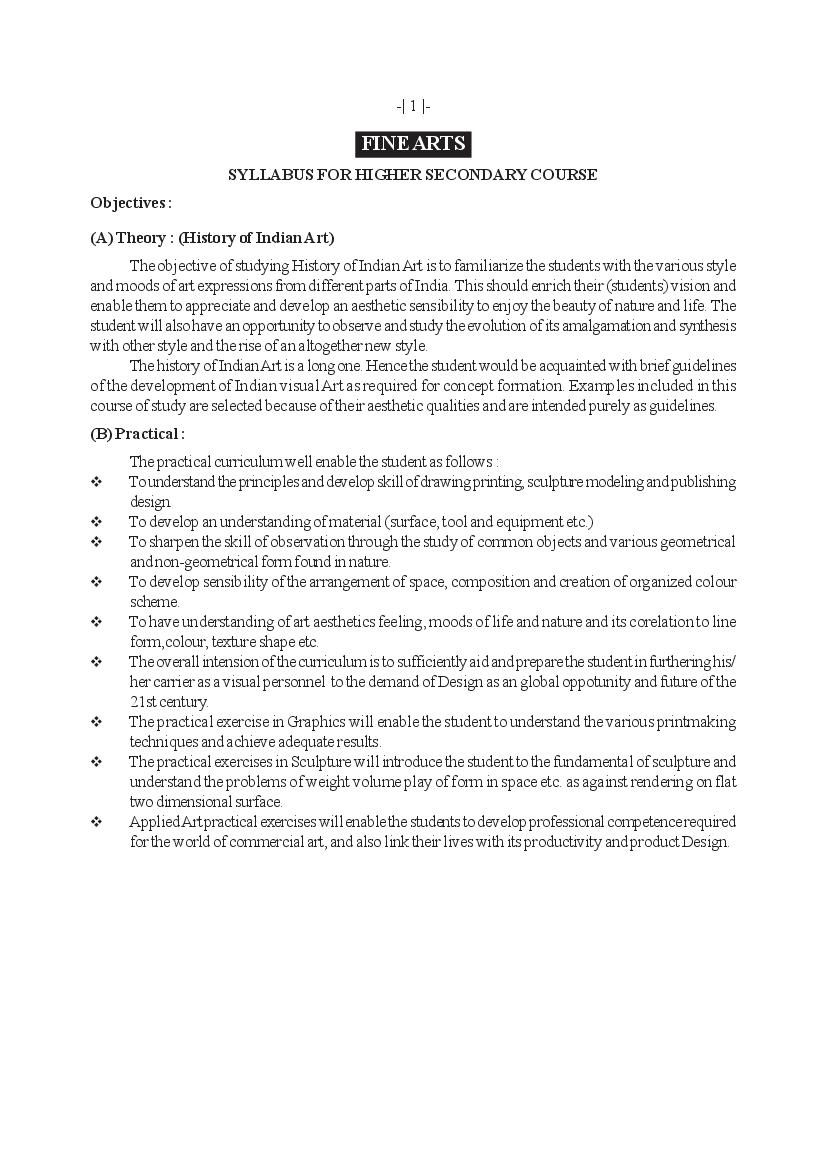
FINE ARTS
SYLLABUS FOR HIGHER SECONDARY COURSE
Objectives :
(A) Theory : (History of Indian Art)
The objective of studying History of Indian Art is to familiarize the students with the various style
and moods of art expressions from different parts of India. This should enrich their (students) vision and
enable them to appreciate and develop an aesthetic sensibility to enjoy the beauty of nature and life. The
student will also have an opportunity to observe and study the evolution of its amalgamation and synthesis
with other style and the rise of an altogether new style.
The history of Indian Art is a long one. Hence the student would be acquainted with brief guidelines
of the development of Indian visual Art as required for concept formation. Examples included in this
course of study are selected because of their aesthetic qualities and are intended purely as guidelines.
(B) Practical :
The practical curriculum well enable the student as follows :
To understand the principles and develop skill of drawing printing, sculpture modeling and publishing
design.
To develop an understanding of material (surface, tool and equipment etc.)
To sharpen the skill of observation through the study of common objects and various geometrical
and non-geometrical form found in nature.
To develop sensibility of the arrangement of space, composition and creation of organized colour
scheme.
To have understanding of art aesthetics feeling, moods of life and nature and its corelation to line
form,colour, texture shape etc.
The overall intension of the curriculum is to sufficiently aid and prepare the student in furthering his/
her carrier as a visual personnel to the demand of Design as an global oppotunity and future of the
21st century.
The practical exercise in Graphics will enable the student to understand the various printmaking
techniques and achieve adequate results.
The practical exercises in Sculpture will introduce the student to the fundamental of sculpture and
understand the problems of weight volume play of form in space etc. as against rendering on flat
two dimensional surface.
Applied Art practical exercises will enable the students to develop professional competence required
for the world of commercial art, and also link their lives with its productivity and product Design.
Page 2
FINE ARTS
SYLLABUS FOR HIGHER SECONDARY FIRST YEAR COURSE
A student may offer anyone of the following Courses :
(a) Painting
(b) Graphics
(c) Sculpture
(d) Applied Art
The following art terminologies for all the four subjects are prescribed only for reference and gen-
eral enrichment :
1. Elements of Composition : Paint, Line, Form, Colour, Tone, Texture and Space
2. Principles of Composition : Units, Harmony, Balance, Rhythm, Emphasis and Proportion
(abstraction and stylization)- subjective to individual candidate.
3. Drawing and Painting : Terminologies, Foreshortening, Perspective, Eve level, Fixed paint
of View, Vanishing point, Ratio proportion, Sketching, Drawing,
Light and Shade, Painting Still life, Landscape, Anatomy (Vertical
& Horizontal format), two and three dimensional (transparent and
opaque) technique.
(A) Material : Paper, Pencil, Water, Acrylic Colours, Tempera Colours, Poster
Colours,Water proof ink, Canvas, Hardboard.
4. Media of Composition : Pencil drawing, Collage, Painting, Paper mural.
5. Sculpture : Relief and round sculpture, Modeling with clay, Terracotta, Mould
making, mask making and casting in plaster of Paris.
6. Graphics : Linocut, Relief prinign, silkscreen printing.
7. Applied Art : Book cover design and illustration, Cartooning, Poster,
Advertisement for newspaper and Magazines etc Photograph,
Computer, graphic.
One Paper Time : Two Hours Marks : 30
Unit Topics Marks Periods
Unit-1 : Art of Indus Valley 05 20
Unit-2 : Buddhist, Jain and Hindu Art 10 20
Unit-3 : Temple sculpture, Bronzes and Artistic 15 30
aspects of Indian Architecture 15
Total : 30 70
Page 3
Unit-1 : Art of Indus Valley
(Harappan and Mahenjo-daro) (2500 B.C. to 1500 B.C.)
1. Introduction :
(i) Period and Location
(ii) Possible reasons of extinction.
2. Study of the following Sculpture and terracotta’s :
(i) Dancing girl (Mahenjo-daro)
Bronje, 10.5 × 5 × 2.5
Circa 2500 B.C. (collection National Museum, New Delhi)
(ii) Male Torso (Harappa)
Stone, 9.2 × 5.8 × 3 cm
Circa 2500 B.C. (collection National Museum, New Delhi)
3. Study of following :
Seal :
(i) Bull (Mohenjo-daro)
Stone, 2.5 × 2.5 × 1.4 cm
Circa 2500 B.C. (collection National Museum, New Delhi)
Unit-2 : Buddhist, Jain and Hindu Art
(3rd Century B.C. to 8th Century A.D.)
(a) General Introduction to Art during Mauryan, Sunga, Kushana and Gupta period.
(b) Study of the following Sculpture :
(i) Lion Capital from Sarnath (Mauryan period)
Polished sand Stone
Circa 3rd Century B.C.
(Collection : Sarnath Museum V.P.)
(ii) Gateway and Railings of Stupa from Bharat
(Shunga Period) Early 1st Century B.C.
(Collection Indian Museum Kolkata)
(iii) Yakshi from Bharut.
Pillar Relief in Red. Sandstone.
(Sunga Period) Early 1st Century B.C.
(Collection Indian Museum, Kolkata)
(iv) Yakshi from Bhutesar, Mathura Railing Pillar in Red Stone,
(Kushan Period) 2nd Century A.D.
(Collection Indian Museum, Kolkata)
(v) Seated Buddha from Sarnath.
(Gupta Period, Chunar Sandstone)
5th Century A.D.
(Collection Museum of Archeology, Sarnath)
Page 4
4. Introduction of Ajanta :
Location, Period, No. of Caves, Chaitya and Yihara, Painting and Sculpture, Subject matters and
Techniques etc.
5. Study of the following :
Painting and Sculpture :
(i) Padmapani and Boddhisattra (Ajanta Cave No.-1)
Mural Painting
(Circa 5th Century A.D.)
(ii) Dying Princess (Ajanta Cave No.)
Sculpture in Stone
Circa 5th Century A.D.
Format of the question :
Unit-1 : Nature/Object study :
Draw and paints the still life or the group of object arrange before you from a fixed point of view on
the drawing paper (½ imperial size/full imperial size) in pencil. The drawing should be proportionate to
paper size. The objects should be painted in realistic manner with proper light shade and prospective.
Note : The groups of object are to be decided by the external and internal examiner jointly and the
arrangements for nature study/object study are to be arranged before the candidates. The selection of
objects should be in such a way that the natural and geometrical forms may be covered by the groups of
objects. Any objects relating to nature and in accordance to availability of Season and location may be
include. Two draperies in different colours, one in light shade and the other in dark shade is to be included
in the background keeping in view the colours and tones of objects chosen for study.
Unit-2 : Painting and Composition :
Make of painting composition on anyone of the following five subjects on either medium, such as
watercolor or collage in the paper size provided (½ imperial size/full imperial size). The composition
should be original and effective. Weightage should be given to a well-compolled drawing and effective use
of the medium.
Note : Any five subjects for painting will be decided by the Paper Setter. The question should be
according to the standard of class XI & natural environment of Assam.
General Instruction to Examiners :
The candidates must be given one-hour break after first three hours.
The work of candidate is to be evaluated jointly by external & internal examiners and duly signed by
both.
Unit-3 : Temple Sculpture, Bronzes and Indian Architecture Artistic aspects of Indian Temples
(6th Century A.D. to 13th Century A.D.)
1. Introduction to Temples Sculpture with emphasis on Early Mediaeval Temple architecture in
Assam(from this Barman’s to the Paalas of Assam in 5th Century to 13th Century A.D. Art
activity(sculpture) in context and Comparison to the Gupta art style.)
Page 5
2. Study of the following Temples Sculptures :
(i) Descent of Ganga (Pallava Dynasty, Mahabalipuram, Tamil Nadu)
(Stone Circa 7th Century A.D.)
(ii) Ravana shaking Mount Kailash (Rasatrakuta Ellora, Maharastra).
(Stone Circa 8th Century A.D.)
(iii) Trimurti (Eleohanta, Maharastra) Stone.
(Stone Circa 9th Century A.D.)
(iv) Lakshmi Narayana (Kandariya Mahadev Temple)
(Chandela, Khajuraho, M.P.)
(Stone Circa 10th Century A.D.)
(v) Cymbal Player Sun Temple (Ganga Dynesty, Konark, Orissa) Stone.
(Circa 13th Century A.D.)
(vi) The Relief sculptures of Kamakshya.
(vii) The Da-Parvatiya Temple, Tezpur
(Stone Door Frame)
(viii) The ruins of Madan Kamdev Temple
3. Bronzes :
(i) Introduction to Indian Bronzes
4. Study of following Indian Bronzes :
(i) Nataraj (Thanjavuh Dist, Tamilnadu)
Cnola Period (12th Century A.D.)
(Collection, National Museum, New Delhi)
(ii) “Indra”–11th Century A.D. (Paala Dynasty, Assam)
Recovered from Kahilipara, Guwahati
(Collection, Assam State Museum, Guwahati)
5. Study of the following Architectures :
(i) Qutab Minar, Delhi
(ii) Taj Mahal, Agra
(iii) Talatal Ghar, Sivasagar, Assam
Page 6
SYLLABUS FOR FINE ARTS PRACTICAL
PAINTING
Time : Six hours Full Marks : 70 Pass Marks : 28
Unit Topics Marks
Unit-1 Nature/Object study 15
Unit-2 Painting and composition 30
Unit-3 Sessional work 25
Total : 70
Unit-1 : Nature Study and Painting :
(i) Study of flowers and fo.liages, and plants. vegetable etc. Natural forms like plants, vegetables,
fruits and flowers etc. are to be used
(ii) Still life study of natural objects in pencil and pen and ink;
Unit-2: Painting and Composition :
(i) Study of geometric forms/basic forms (like sphere, cone, cubes. cylinder) in pencil. and
executed with ·light and shade from a fixed view point.
(ii) Sketches from life and simple composition done with mediums like- pencil, oil pastel and
water colour:
Unit-3 : Sessional Works :
(i) Five selected nature and objects of study exercised in drawing and in any medium done
during the session and including 2 (two) still life exercise.
(ii) Two selected works of painting done during the year.
These paintings and selected works are to be certified by the school authorities that it has
been executed by the student and is to be placed before the external examiners for assessment.
Note :The time table is to be framed in such a way so as to allow the student to work continuously for a
maximum of two periods at a stretch.
GRAPHICS
Introduction : The course in graphics at senior secondary stage is aimed to develop the aesthetic
sense of students through the understanding of various important print making medias and possible practical
exercises of graphic prints for developing students mental faculties of observation, imagination. creation
and physical and technical skill. The introduction of practical exercises in graphics will help the students to
make composition in monochrome and black and white and colours through various print making technique,
using method and materials specifically prescribed for best result. The students should be given a brief
history about print making and the exercises are to be given in such a way to learn, articulate the tools and
apparatus used, as well as the maintenance and handling of prints.
Page 7
Time : Six hours Full Marks : 70 Pass Marks : 28
Unit Topics Marks
Unit-1 Simple compositions and study in monochrome-linocut, colograph 50
Unit-2 Sessional works 20
Total : 70
Unit-1 : Simple compositions and study in monochrome-linocut, colograph :
1. To make simples compositions in paper with medium like black & white or monochrome colour.
Exercises to be given on 1/4 imperial size paper on any subject as studied by the student. The
composition may be based on regular sketching as exercises by students.
2. Syllabus for relief printing (Linocut and Colograp or Paper cardboard print) .
Introduction of the history of printmaking
Printing methods and materials .
Characteristic of printing ink- solvent and dyes .
Registration method
Colour printing in bicolour .
Editions specification, mounting and finishing etc.
Unit-2 : Sessional works :
The selected prints either of linocut or paper cardboard print prepared during the year is to be
evaluated by the class teacher and the external examiner.
SCULPTURE
The Course in Sculpture at Senior Secondary stage as an elective subject is aimed at developing
aesthetic sense of the students through the understanding of various important, well known aspects and
mode of Visual Art expression in India's rich cultural heritage from the period of Indus Valley to the
present time. It also aims at developing the students understanding of form and shape in the three dimensional
and relating formal modulation through ths sensibility of touch, man's primary sense and develop creativity
in the dimensional aptitude.
It encompasses a wider range of practical exercises in making of various sculptures for developing
their mental faculties of observation, imagination and creation and the physical & technical skills.
The aim is to introduce the student to the fundamentals of making sculptures. All assigments should
be designed to understand problems of volume, weight, play of from in space etc. as against rendering on
flat two dimensional. Adequate, technical skills may be provided depending on the facilities available.
Page 8
Time : Six hours Full Marks : 70 Pass Marks : 28
Unit Topics Marks
Unit-1 Modelling in Relief 25
Unit-2 Modelling in Round 25
Unit-3 Sessional works 20
Total : 70
Unit-1 : Modelling in Relief on given subjects from life and nature.
Unit-2 : Modelling in Round on given subjects from life and nature
Handling of clay and its, techniques through pinching, coiling. rolling etc.
Unit-3 : Session Work
Four selected pieces of works prepared during the course by the candidate and certified by
the school authorities as works executed in the school are to be placed before the examiners
for assessment.
Note : The time table to be so framed as to allow the students to; work continuously for minimum of
two periods at a stretch.
All assignment should be designed to understand the problems of volume, weight, play of
form is space etc. as against rendering on flat two-Dimensional and also on the round.
APPLIED ART
Introduction :
The Course in Applied Art. (Commercial Art) at Senior Secondary stage as an elective subject
is aimed to develop aesthetic sense of the students through the understanding of various important, well
known aspects and modes of Visual Art expressions. The student will prepare himself herself for
combating the variety of commercial options opportunities available in the world of Commercial Art
and the applied disciplines qf Design. The practical exercises specified for Commercial Art will develop
their mental faculties of observation, imagination, creation and physical & technical skills in necessary
for the purpose.
The purpose of introducing practical exercises in Applied Art (Commercial) is to help and enable
the students to develop professional competence in making Model Drawing Lettering layout Preparation
and poster so that they can professionally assist the world of commercial Design.
Page 9
Time : Six hours Full Marks : 70 Pass Marks : 28
Unit Topics Marks
Unit-1 Drawing 25
Unit-2 Lettering and layout 25
Unit-3 Sessional works 20
Total : 70
Unit-I : Drawing:
Drawing from Still-Life and Nature, pencil monochrome/ colour.
Unit-II : Lettering and layout :
(a) Lettering
(i) Study of lettering of Roman and Devanagri Scripts
(ii) Identification of some Type-faces and their sizes
(b) Layout
Marking :it simple layout with lettering as the main component.
Unit-III : Sessional works :
Submission of portfolio consisting of :
(a) Five selected drawings in any media done during the year including minimum of three lives.
(b) Two selected works in chosen subject done during the year.
Note: The time table to be so framed as to allow the students to work continuously for minimum of
two periods at a stretch.
Document Details
| Board / Org | Assam Board |
| Exam | Class 11 |
| Type | Syllabus |
| Pages | 9 |
| Updated | 22 Jul 2026 |