AHSEC 1st Year Syllabus 2024-25 Geography
Finished viewing? Save it for later —
Download AHSEC 1st Year Syllabus 2024-25 Geography (PDF · 4 pages)About AHSEC 1st Year Syllabus 2024-25 Geography
AHSEC 1st Year Syllabus 2024-25 Geography is available here for free download. Published by Assam Board for Class 11, this syllabus can be viewed online or downloaded as a PDF (4 pages). Candidates preparing for Class 11 can use AHSEC 1st Year Syllabus 2024-25 Geography to understand the exam pattern, the type of questions asked, and the overall difficulty level.
Frequently Asked Questions
How can I download AHSEC 1st Year Syllabus 2024-25 Geography?
Open this page and click the Download button to save AHSEC 1st Year Syllabus 2024-25 Geography as a PDF. It is completely free on AglaSem Docs.
Is AHSEC 1st Year Syllabus 2024-25 Geography free to download?
Yes. AHSEC 1st Year Syllabus 2024-25 Geography can be viewed online and downloaded as a PDF free of cost on AglaSem Docs.
How many pages does AHSEC 1st Year Syllabus 2024-25 Geography have?
AHSEC 1st Year Syllabus 2024-25 Geography contains 4 pages, which you can read online or download together as a single PDF.
Where can I find more Class 11 study material?
You can find more Class 11 question papers, sample papers, syllabus, and answer keys on AglaSem Docs.
AHSEC 1st Year Syllabus 2024-25 Geography – Text
Read the full text of this syllabus below — useful to quickly search, copy and reference the content online without downloading the PDF.
📄 View text version (4 pages)
Page 1
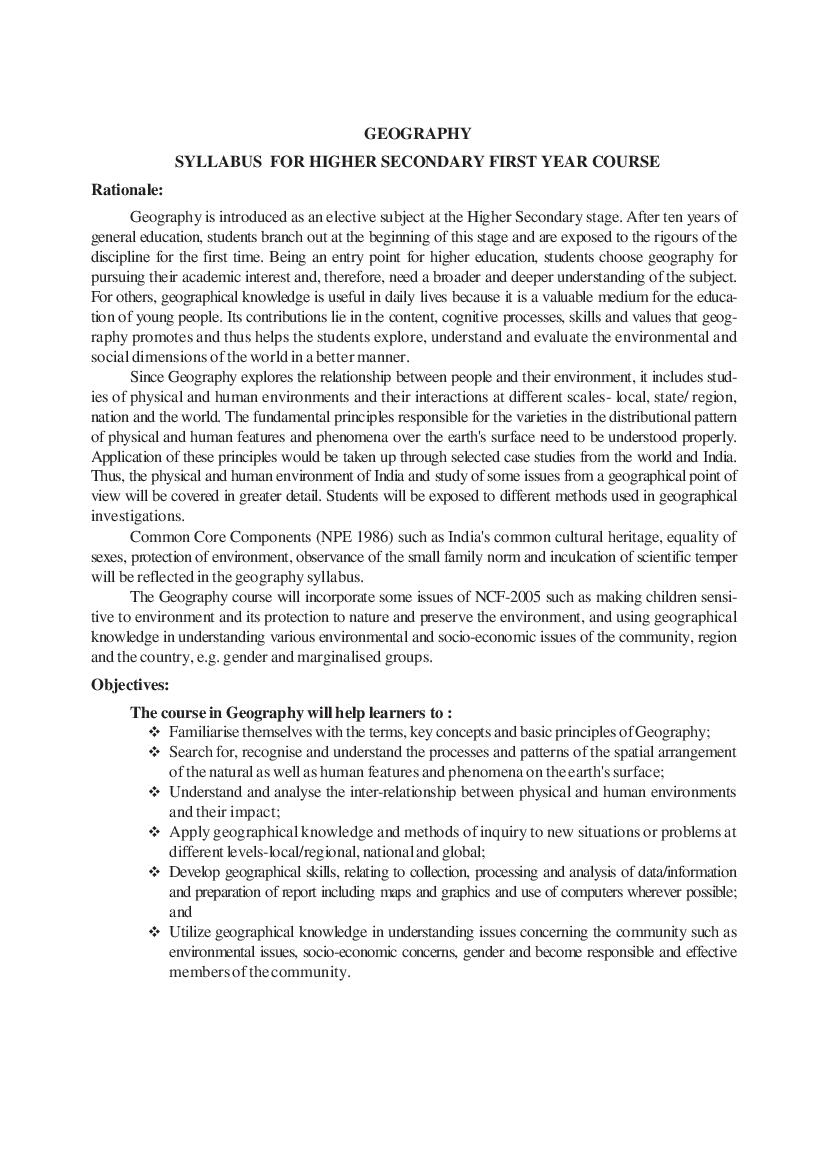
Geography is introduced as an elective subject at the Higher Secondary stage. After ten years of
general education, students branch out at the beginning of this stage and are exposed to the rigours of the
discipline for the first time. Being an entry point for higher education, students choose geography for
pursuing their academic interest and, therefore, need a broader and deeper understanding of the subject.
For others, geographical knowledge is useful in daily lives because it is a valuable medium for the educa-
tion of young people. Its contributions lie in the content, cognitive processes, skills and values that geog-
raphy promotes and thus helps the students explore, understand and evaluate the environmental and
social dimensions of the world in a better manner.
Since Geography explores the relationship between people and their environment, it includes stud-
ies of physical and human environments and their interactions at different scales- local, state/ region,
nation and the world. The fundamental principles responsible for the varieties in the distributional pattern
of physical and human features and phenomena over the earth's surface need to be understood properly.
Application of these principles would be taken up through selected case studies from the world and India.
Thus, the physical and human environment of India and study of some issues from a geographical point of
view will be covered in greater detail. Students will be exposed to different methods used in geographical
investigations.
Common Core Components (NPE 1986) such as India's common cultural heritage, equality of
sexes, protection of environment, observance of the small family norm and inculcation of scientific temper
will be reflected in the geography syllabus.
The Geography course will incorporate some issues of NCF-2005 such as making children sensi-
tive to environment and its protection to nature and preserve the environment, and using geographical
knowledge in understanding various environmental and socio-economic issues of the community, region
and the country, e.g. gender and marginalised groups.
Objectives:
The course in Geography will help learners to :
Familiarise themselves with the terms, key concepts and basic principles of Geography;
Search for, recognise and understand the processes and patterns of the spatial arrangement
of the natural as well as human features and phenomena on the earth's surface;
Understand and analyse the inter-relationship between physical and human environments
and their impact;
Apply geographical knowledge and methods of inquiry to new situations or problems at
different levels-local/regional, national and global;
Develop geographical skills, relating to collection, processing and analysis of data/information
and preparation of report including maps and graphics and use of computers wherever possible;
and
Utilize geographical knowledge in understanding issues concerning the community such as
environmental issues, socio-economic concerns, gender and become responsible and effective
members of the community.
Page 2
One Paper Time : Three Hours Marks : 70
Unitwise Distribution of Marks & Periods :
Unit Topics Marks Periods
A. FUNDAMENTALS OF PHYSICAL GEOGRAPHY (Total Marks 35)
Unit-I Geography as a Discipline 03 06
Unit-II The Earth 05 11
Unit-III Landforms 08 23
Unit-IV Climate 07 30
Unit-V Water (Ocean) 04 10
Unit-VI Life on the Earth 03 07
Unit-VII Map and Diagram 05 05
B. INDIA– PHYSICAL ENVIRONMENT (Total Marks 35)
Unit-I Introduction 03 04
Unit-II Physiography 08 28
Unit-III Climate and Natural Vegetation 10 28
Unit-IV Natural Hazards and Disasters 09 14
Unit-V Map and Diagram 05 04
Total : 70 170
Evaluation :
C. PRACTICAL WORK IN GEOGRAPHY PART-I MARKS 30 PERIODS 50
Unit-I Fundamentals of Maps 15 25
Unit-II Topographic Maps 10 25
Practical Record Book and Viva 05 ---
30 50
Unitwise Distribution of Course Contents:
A. FUNDAMENTALS OF PHYSICAL GEOGRAPHY
Unit-I : Geography as a Discipline MARKS 03 Periods 06
Geography as an integrating discipline.
Branches of geography; Physical Geography, Human Geography and Biogeography
Unit II : The Earth MARKS 05 Periods 11
Origin and Evolution of the earth;
Interior of the earth: Earthquakes and volcanoes; Causes, types and effects
Distribution of oceans and continents: Wegener’s continental drift theory and plate tectonics.
Unit III : Landforms MARKS 08 Periods 23
Geomorphic processes: Weathering; mass wasting; erosion and deposition; soil formation
Landforms and their evolution-Brief erosional and depositional features
Page 3
Unit -IV: Climate MARKS 07 Periods 30
Atmosphere- composition and structure; elements of weather and climate;
Solar Radiation- Insolation- heat budget of the earth heating and cooling of atmosphere
(terrestrial radiation) temperature- factors controlling temperature; distribution of temperature-
horizontal and vertical; inversion of temperature
Atmospheric circulation and weather systems pressure belts; winds- planetary, seasonal and
local; air masses and fronts; tropical and extra tropical cyclones
Water in the atmosphere- Precipitation-evaporation; condensation- dew, frost, fog, mist
and cloud; rainfall- types and world distribution
World climate- and climate change
Unit V : Water (Oceans) MARKS 04 Periods 10
Basics of Oceanography
Oceans- distribution of temperature and salinity;
Movements of ocean water- waves, tides and currents; submarine reliefs
Unit VI : Life on the Earth MARKS 03 Periods 07
Biodiversity and conservation;
Map work on identification of features based on 1 to 6 units on the outline physical/political
map of the world MARKS 05 Periods 05
B. INDIA- PHYSICAL ENVIRONMENT MARKS 35 Periods 78
Unit VII : Introduction
India : Location- space relations and India's MARKS 03 Periods 04
place in the world.
Unit VIII : Physiography MARKS 08 Periods 28
Structure and; Physiography
Drainage systems : concept of river basins, the Himalayan and Peninsular; rivers
Unit IX : Climate and Vegetation MARKS 10 Periods 28
Weather and climate- Indian monsoon;
Natural vegetation- forest types and distribution; wild life; conservation; biosphere reserves;
Unit X : Hazards and Disasters : Causes, MARKS 09 Periods 14
Consequences and Management
Floods
Droughts-Types and impact
Earthquakes and Tsunami, Cyclones-Features and impact
Landslides
Map work of features based on above units for locating and labeling on the outline
political/Physical map of India MARKS 05 Periods 04
Page 4
C. PRACTICAL WORK IN GEOGRAPHY Part-I MARKS-30 PERIODS-50
Unit I: Fundamentals of Maps
Geo spatial data, concept of Geographical data matrix; Point, line, area data
Maps-types; scales-types; construction of simple linear scale, measuring distance; finding
direction and use of symbols
Map Projection latitude, Longitude and time, types, construction and properties of projection;
conical projection with one standard parallel and Mercator’s projection (only two Projections)
Unit II: Topographic Maps MARKS-10 PERIODS-25
Study of topographic maps (1: 50,000 or 1: 25,000 survey of India maps); contour cross
section and identification of landforms-slopes, hills, valleys, waterfall, cliffs, distribution
of settlements
Satellite imaginaries, stages in remote sensing data-acquisition, platform and sensors and
data products, (Photographic and digital)
Practical Record Book and Viva Voce MARKS-05
Viva to be based on Practical unit I- and II only
-------x-------
Document Details
| Board / Org | Assam Board |
| Exam | Class 11 |
| Type | Syllabus |
| Pages | 4 |
| Updated | 22 Jul 2026 |