Page 1
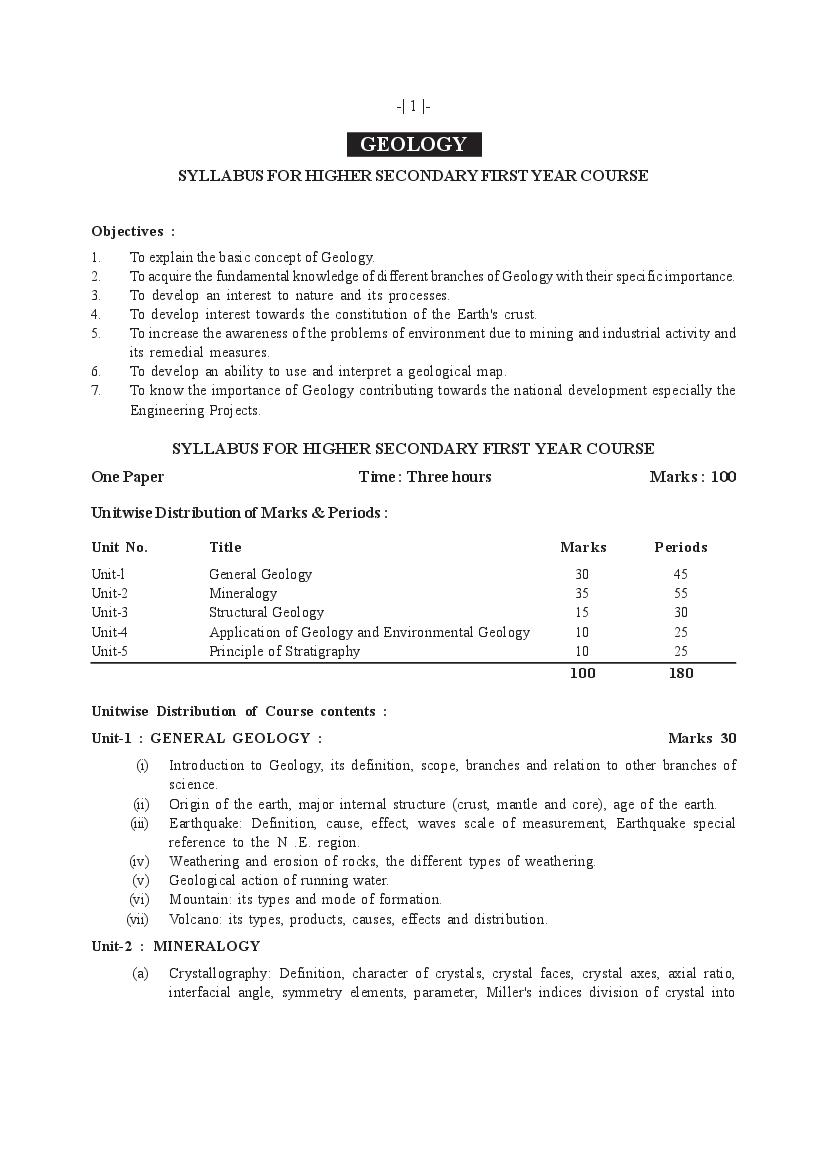
-| 1 |- GEOLOGY SYLLABUS FOR HIGHER SECONDARY FIRST YEAR COURSE Objectives : 1. To explain the basic concept of Geology. 2. To acquire the fundamental knowledge of different branches of Geology with their specific importance. 3. To develop an interest to nature and its processes. 4. To develop interest towards the constitution of the Earth's crust. 5. To increase the awareness of the problems of environment due to mining and industrial activity and its remedial measures. 6. To develop an ability to use and interpret a geological map. 7. To know the importance of Geology contributing towards the national development especially the Engineering Projects. SYLLABUS FOR HIGHER SECONDARY FIRST YEAR COURSE One Paper Time : Three hours Marks : 100 Unitwise Distribution of Marks & Periods : Unit No. Title Marks Periods Unit-l General Geology 30 45 Unit-2 Mineralogy 35 55 Unit-3 Structural Geology 15 30 Unit-4 Application of Geology and Environmental Geology 10 25 Unit-5 Principle of Stratigraphy 10 25 100 180 Unitwise Distribution of Course contents : Unit-1 : GENERAL GEOLOGY : Marks 30 (i) Introduction to Geology, its definition, scope, branches and relation to other branches of science. (ii) Origin of the earth, major internal structure (crust, mantle and core), age of the earth. (iii) Earthquake: Definition, cause, effect, waves scale of measurement, Earthquake special reference to the N .E. region. (iv) Weathering and erosion of rocks, the different types of weathering. (v) Geological action of running water. (vi) Mountain: its types and mode of formation. (vii) Volcano: its types, products, causes, effects and distribution. Unit-2 : MINERALOGY (a) Crystallography: Definition, character of crystals, crystal faces, crystal axes, axial ratio, interfacial angle, symmetry elements, parameter, Miller's indices division of crystal into
Page 2
-| 2 |- crystal systems. Study of the normal class of the isometric, tetragonal and hexagonal system. Marks 15 (b) Physical Mineralogy: Definition of a mineral, its physical properties, Description of the following minerals with respect to their physical properties, Chemical composition and common use: Quartz, Potash feldspar, Plagioclase Feldspar, horibleude, biotite, Muscovite, Kyanite, Silliminite. Tourmaline, Calcite, Garnet, Talc, Gypsum, Fluorite, Augite pyrite, Hematite, Magnetite. Marks 20 Unit-3 : STRUCTURAL GEOLOGY : Marks 15 Bedding, dip, strike, fold, elements of fold, types of fold (anticline, syncline, symmetrical, asymmetrical, recumbent isoclinal), Fault, elements of fault, types of faults (normal, reverse, horst, graben, thrust), unconformities definition and types (angular U.C. disconformity and non conformity). Unit-4 : APPLICATION OF GEOLOGY AND ENVIRONMENTAL GEOLOGY : Marks 10 Soil, its formation, erusion and its prevention, Landslides-its causes and preventive measures, a preliminary idea of environmental pollution related to mining, drilling, flaring of natural gas, water logging. Study of rocks as building material, its durability, strength and color. Unit-5 : PRINCIPLE OF STRATIGRAPHY : Marks 10 Definition, scope, code of stratigraphy nomenclature-Rock unit or lithographic unit, Time unit or chronological unit, Time stratigraphic or chronostratigraphic unit. Biostratigraphic unit. Methods of correlation, geological time scale.