AHSEC 1st Year Syllabus 2024-25 History
Finished viewing? Save it for later —
Download AHSEC 1st Year Syllabus 2024-25 History (PDF · 3 pages)About AHSEC 1st Year Syllabus 2024-25 History
AHSEC 1st Year Syllabus 2024-25 History is available here for free download. Published by Assam Board for Class 11, this syllabus can be viewed online or downloaded as a PDF (3 pages). Candidates preparing for Class 11 can use AHSEC 1st Year Syllabus 2024-25 History to understand the exam pattern, the type of questions asked, and the overall difficulty level.
Frequently Asked Questions
How can I download AHSEC 1st Year Syllabus 2024-25 History?
Open this page and click the Download button to save AHSEC 1st Year Syllabus 2024-25 History as a PDF. It is completely free on AglaSem Docs.
Is AHSEC 1st Year Syllabus 2024-25 History free to download?
Yes. AHSEC 1st Year Syllabus 2024-25 History can be viewed online and downloaded as a PDF free of cost on AglaSem Docs.
How many pages does AHSEC 1st Year Syllabus 2024-25 History have?
AHSEC 1st Year Syllabus 2024-25 History contains 3 pages, which you can read online or download together as a single PDF.
Where can I find more Class 11 study material?
You can find more Class 11 question papers, sample papers, syllabus, and answer keys on AglaSem Docs.
AHSEC 1st Year Syllabus 2024-25 History – Text
Read the full text of this syllabus below — useful to quickly search, copy and reference the content online without downloading the PDF.
📄 View text version (3 pages)
Page 1
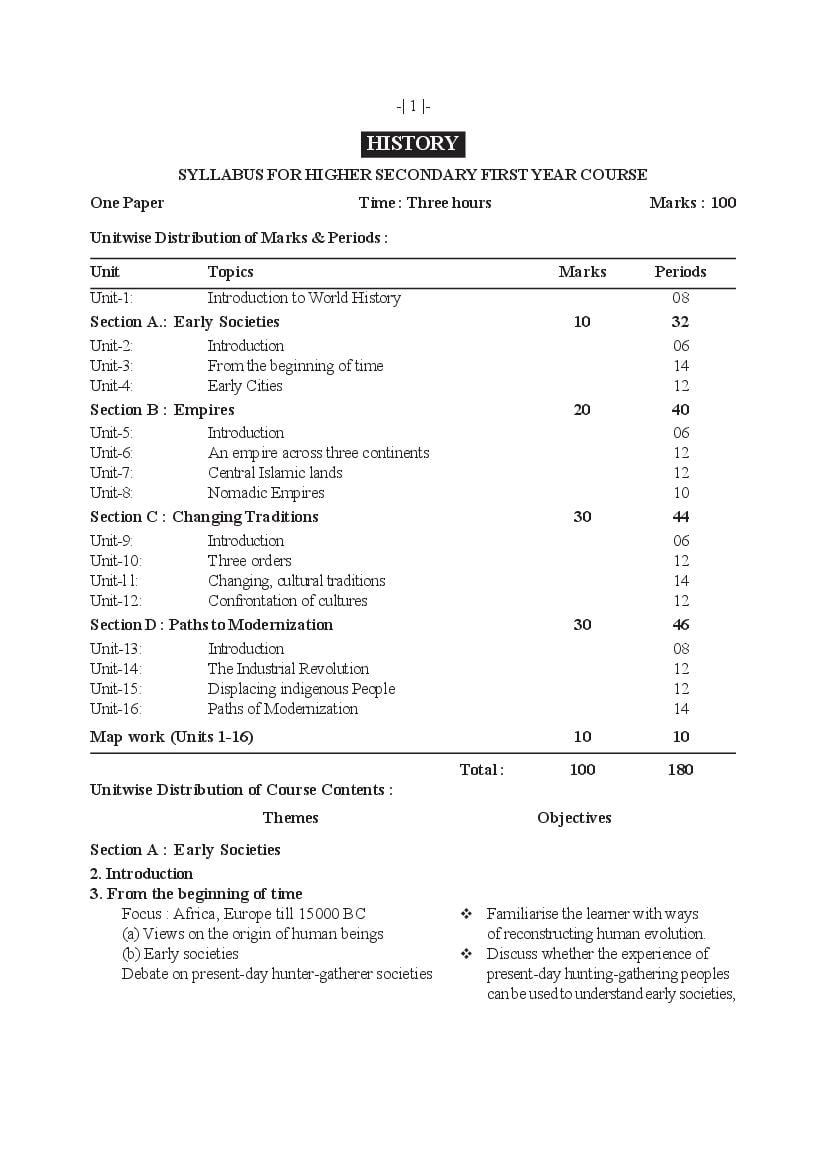
HISTORY
SYLLABUS FOR HIGHER SECONDARY FIRST YEAR COURSE
One Paper Time : Three hours Marks : 100
Unitwise Distribution of Marks & Periods :
Unit Topics Marks Periods
Unit-1: Introduction to World History 08
Section A.: Early Societies 10 32
Unit-2: Introduction 06
Unit-3: From the beginning of time 14
Unit-4: Early Cities 12
Section B : Empires 20 40
Unit-5: Introduction 06
Unit-6: An empire across three continents 12
Unit-7: Central Islamic lands 12
Unit-8: Nomadic Empires 10
Section C : Changing Traditions 30 44
Unit-9: Introduction 06
Unit-10: Three orders 12
Unit-l l: Changing, cultural traditions 14
Unit-12: Confrontation of cultures 12
Section D : Paths to Modernization 30 46
Unit-13: Introduction 08
Unit-14: The Industrial Revolution 12
Unit-15: Displacing indigenous People 12
Unit-16: Paths of Modernization 14
Map work (Units 1-16) 10 10
Total : 100 180
Unitwise Distribution of Course Contents :
Themes Objectives
Section A : Early Societies
2. Introduction
3. From the beginning of time
Focus : Africa, Europe till 15000 BC Familiarise the learner with ways
(a) Views on the origin of human beings of reconstructing human evolution.
(b) Early societies Discuss whether the experience of
Debate on present-day hunter-gatherer societies present-day hunting-gathering peoples
can be used to understand early societies,
Page 2
4. Early Cities
Focus: Iraq, 3rd millennium BC Familiarise the learner with the
(a) Growth of towns nature of early urban centres.
(b) Nature of early urban societies. Discuss whether writing is signifi
Debate on uses of writing cant as a marker of civilization
Section B :Empires
5. Introduction
6. An Empire across Three Continents
Focus: Roman Empire. 27 BC, to . AD 600 Familiarise the learner with the history
(a) Political evolution of a major world empire.
(b) Economic expansion Discuss whether slavery was a signifi
(c) Religion cant element in the economy.
(d) Late Antiquity
Debate on the institution of slavery.
7. Central Islamic Lands
Focus: 7th to 12th centuries. Familiarise the learner with the rise
(a) Polity of Islamic empires in the Afro-Asian
(b) Economy territories and its implications for
(c) Culture economy and society.
Debate on the nature of the crusades. Understand what the crusades meant
in these regions and how they were
experienced
8. Nomadic Empires
Focus: the Mongol, 13th to 14th century. Familiarise the learner with the varieties
(a) The nature of nomadism of nomadic society and their
(b) Formation of empires institutions.
(c) Conquests and relations with other states Discuss whether state formation is
Debate on nomadic societies and state possible in nomadic societies.
formation.
Section C : Changing Traditions
9. Introduction
10. Three orders
Focus: Western Europe, 9th-16th century Familiarise the learner with the nature
(a) Feudal society and economy. of the economy and society of this
(b) Formation of states. period and the changes within them.
(c) Church and society. Show how the debate on the decline
Debate on decline of feudalism processes of of feudalism help in understanding
transition.
11. Changing Cultural Traditions
Focus: on Europe, 14th to 17th century Explore the intellectual trends in the
(a) New ideas and new trends in literature period.
and arts. Familiarize students with the paintings
Page 3
(b) Relationship with earlier ideas and buildings of the period.
(c) The contribution of West Asia. Introduces the debate around the idea
Debate: Is the nation 'European Renaissance valid? of ‘Renaissance’.
12. Confrontation of Cultures
Focus: on the Americas, 15th to 18th century Discuss changes in European' economy
(a) European voyages of exploration. that led to the voyages.
(b) Search for gold; enslavement, raids, Discuss the implications of the conqu-
extermination ests for the indigenous people.
(c) Indigenous peoples and cultures- the Explore the debate on the nature of
Arawaks, the Aztecs, the Incas. the slave trade and see what this deba-
(d) The history of displacements. te tells us about the meaning of these
Debate on the slave trade. ‘discoveries’.
Section D : Paths to Modernisation
13. Introduction
14. The Industrial Revolution
Focus on England, 18th and 19th century Understand the nature of growth in
(a) Innovations and technologcal change. the period and its limits.
(b) Pattern of growth. Initiate student to the debate on the
(c) Emergence of a working class. idea of industrial revolution.
Debate: Was there an Industrial Revolution?
15. Displacing Indigenous People
Focus on North America and Australia, Sensitise students to the processes of
18th-20th century displacement that accompanied the
(a) European colonists in North America development of America and Australia
and Australia.
(b) Formation of white settler societies. Understand the implications of such
(c) Displacement and repression of local processes for the displaced
people. populations.
Debate on the impact of European
settlement on indigenous populations.
16. Paths to Modernisation,
Focus on East Asia. Late 19th and 20th Make students aware that transformation
century. in the modern world takes many different
(a) Militarization and economic growth in forms.
Japan.
(b) China and the Communist alternative. Show how notions like 'modernisation'
Debate on the meaning of Modernisation. need to be critically assessed.
17. Map Work on Unit 1-16.
Prescribed Textbook : Themes in World History, Published by NCERT.
ø¬ıù´ ˝◊øÓ¬˝√√±¸1 ø¬ı¯∏˚˛¬ıd¸˜”˝√, Published by AHSEC.
[Note : The textbooks are available in Bengali Medium also]
Document Details
| Board / Org | Assam Board |
| Exam | Class 11 |
| Type | Syllabus |
| Pages | 3 |
| Updated | 22 Jul 2026 |