ICSE Class 10 Specimen Paper 2022 Chemistry Semester 1
Finished viewing? Save it for later —
Download ICSE Class 10 Specimen Paper 2022 Chemistry Semester 1 (PDF · 9 pages)About ICSE Class 10 Specimen Paper 2022 Chemistry Semester 1
ICSE Class 10 Specimen Paper 2022 Chemistry Semester 1 is available here for free download. Published by CISCE for Class 10, this sample paper can be viewed online or downloaded as a PDF (9 pages). Candidates preparing for Class 10 can use ICSE Class 10 Specimen Paper 2022 Chemistry Semester 1 to understand the exam pattern, the type of questions asked, and the overall difficulty level.
Frequently Asked Questions
How can I download ICSE Class 10 Specimen Paper 2022 Chemistry Semester 1?
Open this page and click the Download button to save ICSE Class 10 Specimen Paper 2022 Chemistry Semester 1 as a PDF. It is completely free on AglaSem Docs.
Is ICSE Class 10 Specimen Paper 2022 Chemistry Semester 1 free to download?
Yes. ICSE Class 10 Specimen Paper 2022 Chemistry Semester 1 can be viewed online and downloaded as a PDF free of cost on AglaSem Docs.
How many pages does ICSE Class 10 Specimen Paper 2022 Chemistry Semester 1 have?
ICSE Class 10 Specimen Paper 2022 Chemistry Semester 1 contains 9 pages, which you can read online or download together as a single PDF.
Where can I find more Class 10 study material?
You can find more Class 10 question papers, sample papers, syllabus, and answer keys on AglaSem Docs.
ICSE Class 10 Specimen Paper 2022 Chemistry Semester 1 – Text
Read the full text of this sample paper below — useful to quickly search, copy and reference the content online without downloading the PDF.
📄 View text version (9 pages)
Page 1
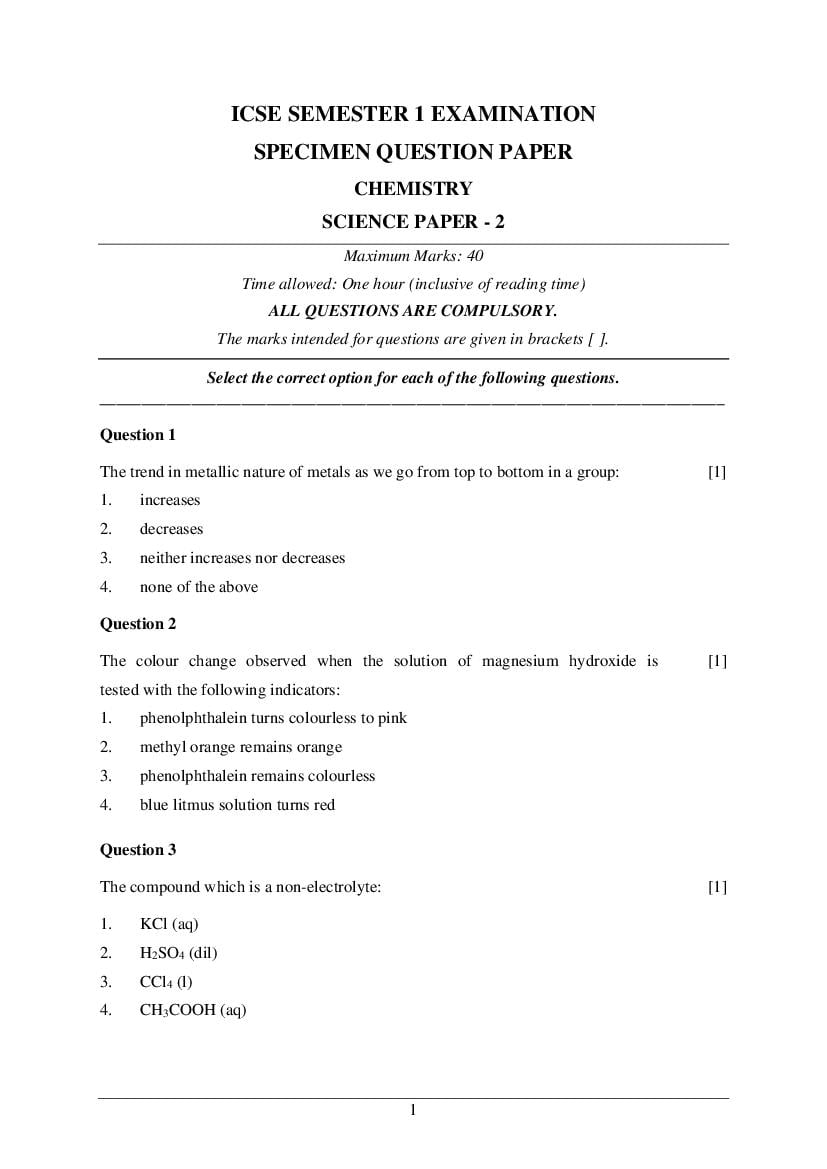
SPECIMEN QUESTION PAPER
CHEMISTRY
SCIENCE PAPER - 2
Maximum Marks: 40
Time allowed: One hour (inclusive of reading time)
ALL QUESTIONS ARE COMPULSORY.
The marks intended for questions are given in brackets [ ].
Select the correct option for each of the following questions.
___________________________________________________________________________
Question 1
The trend in metallic nature of metals as we go from top to bottom in a group: [1]
1. increases
2. decreases
3. neither increases nor decreases
4. none of the above
Question 2
The colour change observed when the solution of magnesium hydroxide is [1]
tested with the following indicators:
1. phenolphthalein turns colourless to pink
2. methyl orange remains orange
3. phenolphthalein remains colourless
4. blue litmus solution turns red
Question 3
The compound which is a non-electrolyte: [1]
1. KCl (aq)
2. H2SO4 (dil)
3. CCl4 (l)
4. CH3COOH (aq)
1
Page 2
Twice the vapour density gives: [1]
1. Actual vapour density
2. Relative vapour density
3. Molecular mass
4. Molar volume
Question 5
The number of lone pair of electrons in the nitrogen atom in ammonia molecule: [1]
1. One
2. Two
3. Three
4. Four
Question 6
Elements with similar valence shell configuration in a Periodic Table are placed in: [1]
1. different groups
2. same period
3. different period
4. same group
Question 7
The gas liberated when sodium sulphite reacts with dilute sulphuric acid: [1]
1. Carbon dioxide
2. Hydrogen
3. Hydrogen sulphide
4. Sulphur dioxide
Question 8
Thickness of metal coating during electroplating depends on: [1]
1. Duration of current passage
2. A low current
3. Nature of cathode
4. Purity of anode
2
Page 3
Ionic bonding is seen in: [1]
1. Methane
2. Hydrogen
3. Ammonia
4. Sodium oxide
Question 10
The molecular formula of an organic compound is C6H12O6 and the empirical [1]
formula is CH2O, the value of n is:
1. 2
2. 6
3. 1
4. 12
Question 11
When an electron is added in the valence shell: [1]
1. energy is released
2. energy is absorbed
3. energy remains same
4. none of the above
Question 12
The most electronegative element is: [1]
1. Sodium
2. Aluminium
3. Bromine
4. Fluorine
Question 13
The bond in Carbon Tetrachloride is: [1]
1. Single Covalent Bond
2. Double Covalent Bond
3. Ionic bond
4. Triple Covalent Bond
3
Page 4
The type of bonding present in the nitrogen molecule: [1]
1. Single Covalent Bond
2. Double Covalent Bond
3. Polar Covalent bond
4. Triple Covalent Bond
Question 15
A compound with Empirical formula XY2, has the vapour density equal to its [1]
Empirical formula weight, its molecular formula is
1. X2Y4
2. X2Y2
3. XY
4. X4Y2
Question 16
Identify one statement that does not hold true for electrorefining of copper: [1]
1. Electrolyte is acidified CuSO4 solution
2. Cathode is a thin strip of impure copper
3. Anode dissolves in the electrolyte
4. Anode gets thicker.
Question 17
The observation when ammonium chloride reacts with potassium hydroxide: [1]
1. A reddish brown gas
2. A colourless gas which turns moist red litmus blue.
3. A green coloured gas which turns moist blue litmus paper red.
4. A colourless gas which turns lime water milky.
Question 18
The colour of the precipitate formed when ferrous ions react with ammonium [1]
hydroxide solution:
1. Blue
2. Reddish brown
3. Dirty green
4. white
4
Page 5
During ionisation, metals lose electrons this change can be called: [1]
1. Oxidation
2. Reduction
3. Redox
4. Displacement
Question 20
The oxide of a metal that reacts both with acid and alkali to form salt and water: [1]
1. Sodium oxide
2. Magnesium oxide
3. Aluminium oxide
4. Ferrous oxide
Question 21
The property which decreases from left to right across the periodic table: [1]
1. Electron affinity
2. Electro negativity
3. Ionisation energy
4. Metallic character
Question 22
On the basis of electronic configuration the period and group of 𝐵59 is: [1]
1. 2 and IIIA
2. 3 and IIA
3. 4 and VIA
4. 5 and VIIA
Question 23
Select the ion that would get selectively discharged from the aqueous mixture of [1]
the ions listed below:
1. SO4-2
2. NO3-1
3. OH-1
4. Cl-1
5
Page 6
Hydronium ion is formed when a molecule of water combines with: [1]
1. Hydrogen atom
2. Proton
3. Hydrogen molecule
4. Oxygen atom
Question 25
The condition that is most appropriate for electroplating with nickel: [1]
1. Electrolyte is molten copper sulphate
2. Anode should be made of impure nickel plate
3. Alternating current is used
4. Periodic replacement of cathode is needed.
Question 26
The hydroxide which is soluble in excess ammonium hydroxide: [1]
1. Lead hydroxide
2. Ferrous hydroxide
3. Zinc hydroxide
4. Ferric hydroxide
Question 27
Which statement is not true for electrolysis? [1]
1. Cations migrate towards cathode
2. Anions discharge at anode
3. Anions get reduced during electrolysis
4. Cations get reduced during electrolysis
Question 28
H2Y is the formula of a compound. What is the valency exhibited by Y? [1]
1. 1
2. 2
3. 3
4. none of the above
6
Page 7
The particles which attract one another to form electrovalent compounds are: [1]
1. Electrons
2. Protons
3. Ions
4. Molecules
Question 30
Which one of the following statements is NOT correct? [1]
1. Pure water does not allow a current to flow through it.
2. The electrolyte only conducts when in the molten state.
3. Electrodes that react with the electrolytes are said to be “active”.
4. Ions must be present in the electrolyte in order that it conducts electricity.
Question 31
The salt formed by partial replacement of hydrogen ion of an acid by a basic [1]
radical.
1. Sodium sulphite
2. Magnesium hydroxide
3. Potassium sulphate
4. Zinc hydrogen sulphite
Question 32
Alkali which dissociates only partially in aqueous solution: [1]
1. Lithium hydroxide
2. Calcium hydroxide
3. Potassium hydroxide
4. Sodium hydroxide
Question 33
The property that matches with elements of the halogen family are: [1]
1. They are chemically highly reactive
2. They are metallic in nature.
3. They are monoatomic in their molecular form.
4. They have one electron in the valence shell.
7
Page 8
Cathode is a reducing electrode because: [1]
1. It has less number of electrons.
2. It has deficiency of electrons
3. Cations gain electrons from cathode
4. Anions lose electrons to cathode
Question 35
The simplest ratio of the atoms of carbon and hydrogen is 1:1. Identify the possible [1]
molecular formula.
1. C6H6
2. C2H4
3. C6H2
4. C3H4
Question 36
The empirical formula of the compound is CH2O, the possible molecular formula [1]
can be:
1. C3H6O3
2. C2H4O
3. C4H3O2
4. C4H6O2
8
Page 9
Observe the Periodic Table to answer the questions: [4]
In the above table some elements are mentioned with their own symbol and
position of the Periodic Table while others are shown with a letter. Answer the
following questions pertaining to the same.
(a) Identify the most electronegative element.
1. Li.
2. Ne
3. Z
4. J
(b) How many Valence electrons are present in Q?
1. 3
2. 5
3. 15
4. 4
(c) The formula of the compound formed between E and O is
1. EO
2. E3O2
3. E2O3
4. EO3
(d) The type of bond formed between A and X:
1. Ionic bond
2. Metallic bond
3. Covalent bond
4. Coordinate bond
9
Document Details
| Board / Org | CISCE |
| Exam | Class 10 |
| Type | Sample Paper |
| Pages | 9 |
| Language | english |
| Updated | 22 Jul 2026 |