Goa Board Class 10 Sample Paper 2026 Astronomy
Finished viewing? Save it for later —
Download Goa Board Class 10 Sample Paper 2026 Astronomy (PDF · 3 pages)About Goa Board Class 10 Sample Paper 2026 Astronomy
Goa Board Class 10 Sample Paper 2026 Astronomy is available here for free download. Published by Goa Board for Class 10, this sample paper can be viewed online or downloaded as a PDF (3 pages). Candidates preparing for Class 10 can use Goa Board Class 10 Sample Paper 2026 Astronomy to understand the exam pattern, the type of questions asked, and the overall difficulty level.
Frequently Asked Questions
How can I download Goa Board Class 10 Sample Paper 2026 Astronomy?
Open this page and click the Download button to save Goa Board Class 10 Sample Paper 2026 Astronomy as a PDF. It is completely free on AglaSem Docs.
Is Goa Board Class 10 Sample Paper 2026 Astronomy free to download?
Yes. Goa Board Class 10 Sample Paper 2026 Astronomy can be viewed online and downloaded as a PDF free of cost on AglaSem Docs.
How many pages does Goa Board Class 10 Sample Paper 2026 Astronomy have?
Goa Board Class 10 Sample Paper 2026 Astronomy contains 3 pages, which you can read online or download together as a single PDF.
Where can I find more Class 10 study material?
You can find more Class 10 question papers, sample papers, syllabus, and answer keys on AglaSem Docs.
Goa Board Class 10 Sample Paper 2026 Astronomy – Text
Read the full text of this sample paper below — useful to quickly search, copy and reference the content online without downloading the PDF.
📄 View text version (3 pages)
Page 1
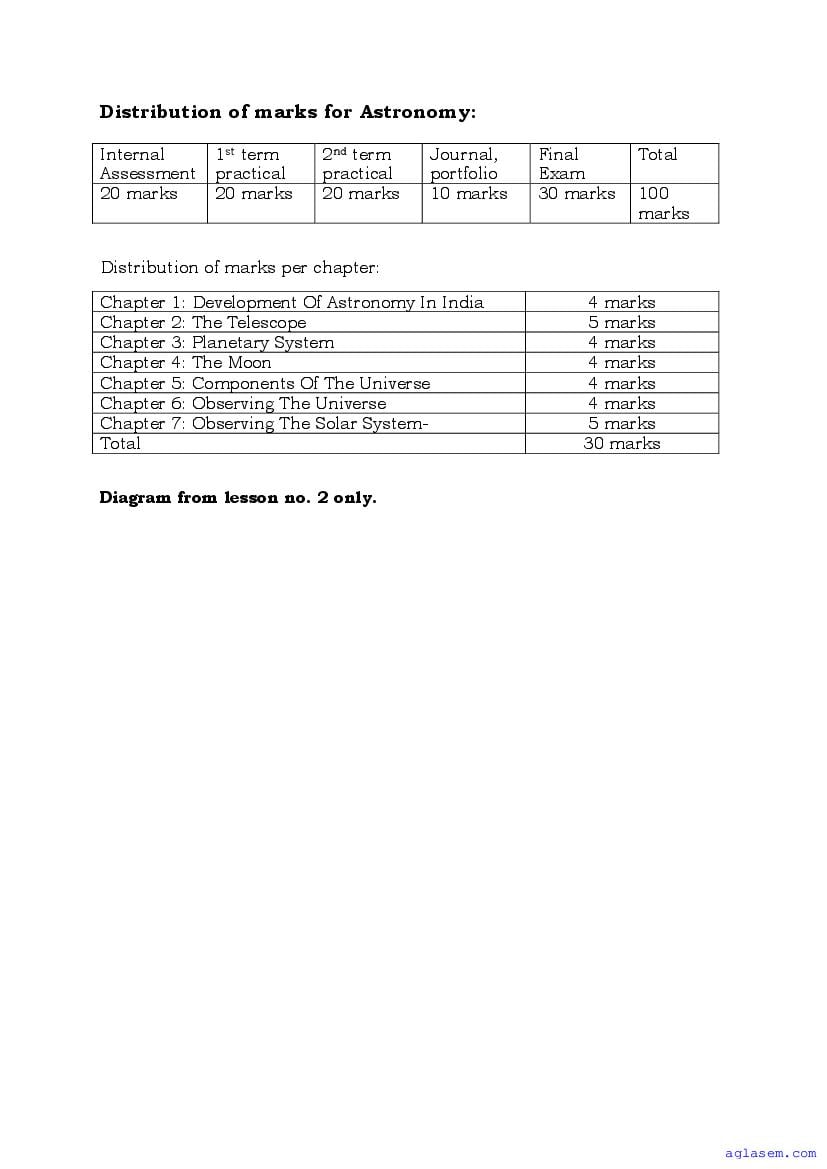
Internal 1st term 2nd term Journal, Final Total
Assessment practical practical portfolio Exam
20 marks 20 marks 20 marks 10 marks 30 marks 100
marks
Distribution of marks per chapter:
Chapter 1: Development Of Astronomy In India 4 marks
Chapter 2: The Telescope 5 marks
Chapter 3: Planetary System 4 marks
Chapter 4: The Moon 4 marks
Chapter 5: Components Of The Universe 4 marks
Chapter 6: Observing The Universe 4 marks
Chapter 7: Observing The Solar System- 5 marks
Total 30 marks
Diagram from lesson no. 2 only.
Page 2
Total No. of questions: 25 Time: 1 ½ hours
Select and write the most correct alternative from those (3)
provided in the bracket.
(1) The Indian astronomer recognised for law of gravitation
is_____.
(A) Aryabhatta
(B) Bhaskara
(C) Varahamihira
(D) Brahmagupta
(2) The only planet that doesn’t experience seasons that other
planets do is _________.
(A) Venus
(B) Mercury
(C) Mars
(D) Saturn
(3) The light used during sky observation is ________
(A) Red
(B) White
(C) Blue
(D) Yellow
Name the following (2)
(4) The first celestial object studied by Galileo through his
telescope.
(5) Russian exploration which returned the first photos of the
lunar far side.
Give Astronomical term for the following. (2)
(6) Cooler areas on the sun which appear as black spots.
(7) A group of stars that creates an imaginary shape in the
night sky.
Answer the following in one-two words. (2)
(8) What is the term used to describe the brightness of an
object as it appears to an observer on earth.
(9) What term is used to refer to a giant cloud of dust and gas
in space.
Answer the following in one or two sentences each. (4)
(10) Which theory explain the tilt of the earth?
(11) Why do stars twinkle more near the horizon.
(12) What are Rahu and Ketu?
(13) Which devices can be used to observe the Sun?
Give reasons for the following. (4)
(14) Hans Lippershey become a crestfallen man.
(15) Jupiter is called a failed star.
(16) A star is a self-luminous body.
(17) Only one side of the moon is visible to us.
Page 3
A B
(18) Heliocentric model Jai Singh II
(19) Jantar Mantar Aryabhatta
Brahmagupta
Bhaskara II
Corelation (2)
(20) Red colour star: least temperature::______: Highest
temperature
(21) Partially cover: Partial Solar eclipse: _________: Total Solar
Eclipse
(22) Draw a neat labelled diagram of Simplified Refracting (3)
telescope and mark the following:
a) objective lens
b) eye piece
c) focus
d) eye
Answer the following in 2-3 sentences. (6)
(23) Describe the Big-bang theory.
or
(23) Describe the Milky Way Galaxy.
(24) Differentiate between terrestrial planets and gas giant
planets.
Or
(24) Write a note on TNOs.
(25) Explain the origin of the moon.
Or
(25) Mention any two main objectives accomplished by Apollo
mission.
Document Details
| Board / Org | Goa Board |
| Exam | Class 10 |
| Type | Sample Paper |
| Pages | 3 |
| Updated | 24 Sep 2026 |