AHSEC 1st Year Syllabus 2024-25 Music
Finished viewing? Save it for later —
Download AHSEC 1st Year Syllabus 2024-25 Music (PDF · 23 pages)About AHSEC 1st Year Syllabus 2024-25 Music
AHSEC 1st Year Syllabus 2024-25 Music is available here for free download. Published by Assam Board for Class 11, this syllabus can be viewed online or downloaded as a PDF (23 pages). Candidates preparing for Class 11 can use AHSEC 1st Year Syllabus 2024-25 Music to understand the exam pattern, the type of questions asked, and the overall difficulty level.
Frequently Asked Questions
How can I download AHSEC 1st Year Syllabus 2024-25 Music?
Open this page and click the Download button to save AHSEC 1st Year Syllabus 2024-25 Music as a PDF. It is completely free on AglaSem Docs.
Is AHSEC 1st Year Syllabus 2024-25 Music free to download?
Yes. AHSEC 1st Year Syllabus 2024-25 Music can be viewed online and downloaded as a PDF free of cost on AglaSem Docs.
How many pages does AHSEC 1st Year Syllabus 2024-25 Music have?
AHSEC 1st Year Syllabus 2024-25 Music contains 23 pages, which you can read online or download together as a single PDF.
Where can I find more Class 11 study material?
You can find more Class 11 question papers, sample papers, syllabus, and answer keys on AglaSem Docs.
AHSEC 1st Year Syllabus 2024-25 Music – Text
Read the full text of this syllabus below — useful to quickly search, copy and reference the content online without downloading the PDF.
📄 View text version (23 pages)
Page 1
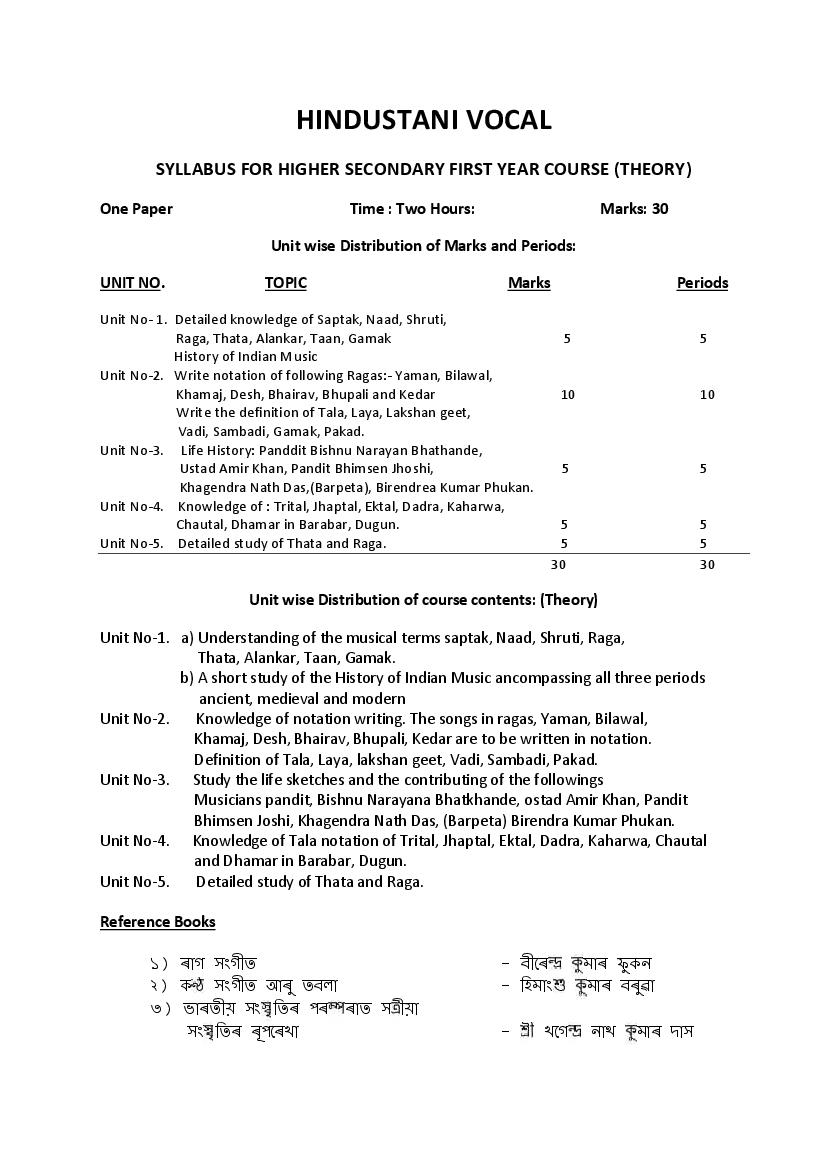
SYLLABUS FOR HIGHER SECONDARY FIRST YEAR COURSE (THEORY)
One Paper Time : Two Hours: Marks: 30
Unit wise Distribution of Marks and Periods:
UNIT NO. TOPIC Marks Periods
Unit No- 1. Detailed knowledge of Saptak, Naad, Shruti,
Raga, Thata, Alankar, Taan, Gamak 5 5
History of Indian Music
Unit No-2. Write notation of following Ragas:- Yaman, Bilawal,
Khamaj, Desh, Bhairav, Bhupali and Kedar 10 10
Write the definition of Tala, Laya, Lakshan geet,
Vadi, Sambadi, Gamak, Pakad.
Unit No-3. Life History: Panddit Bishnu Narayan Bhathande,
Ustad Amir Khan, Pandit Bhimsen Jhoshi, 5 5
Khagendra Nath Das,(Barpeta), Birendrea Kumar Phukan.
Unit No-4. Knowledge of : Trital, Jhaptal, Ektal, Dadra, Kaharwa,
Chautal, Dhamar in Barabar, Dugun. 5 5
Unit No-5. Detailed study of Thata and Raga. 5 5
30 30
Unit wise Distribution of course contents: (Theory)
Unit No-1. a) Understanding of the musical terms saptak, Naad, Shruti, Raga,
Thata, Alankar, Taan, Gamak.
b) A short study of the History of Indian Music ancompassing all three periods
ancient, medieval and modern
Unit No-2. Knowledge of notation writing. The songs in ragas, Yaman, Bilawal,
Khamaj, Desh, Bhairav, Bhupali, Kedar are to be written in notation.
Definition of Tala, Laya, lakshan geet, Vadi, Sambadi, Pakad.
Unit No-3. Study the life sketches and the contributing of the followings
Musicians pandit, Bishnu Narayana Bhatkhande, ostad Amir Khan, Pandit
Bhimsen Joshi, Khagendra Nath Das, (Barpeta) Birendra Kumar Phukan.
Unit No-4. Knowledge of Tala notation of Trital, Jhaptal, Ektal, Dadra, Kaharwa, Chautal
and Dhamar in Barabar, Dugun.
Unit No-5. Detailed study of Thata and Raga.
Reference Books
১) ৰাগ সংগীত - বীেৰ মাৰ ফু কন
২) ক সংগীত আৰু তবলা - িহমাং মাৰ বৰুৱা
৩) ভাৰতীয় সং ৃ িতৰ পৰ ৰাত স ীয়া
সং ৃ িতৰ ৰূপেৰখা - খেগ নাথ মাৰ দাস
Page 2
SYLLABUS FOR HIGHER SECONDARY FIRST YEAR COURSE (PRACTICAL)
One Paper Time : Two Hours : Marks: 70
Unit wise Distribution of Marks and Periods :
UNIT NO TOPIC Marks Periods
Unit No-1. Knowledge of various alankar 5 5
Unit No-2. Lakshan Geet in each Raga 5 5
Unit No-3 Bilambit Khyal in with-Alap, Tana in any two
Ragas of the following Bhairav, Yaman, 40 40
Unit No-4. Swarmalika with drut Khyal of following Raga:
Yaman, Bilawal, Khamaj, Desh, Bhairav, Bhupali
and Kedar. 5 5
Unit No-5. Tal notation of Trital, Jhaptal, Ektal Dadra,
Kaharwa, Chautal, Tilowara with barabar dugun 15 15
70 70
Unit wise Distribution of course contents : (Practical)
Unit No 1: The student is to learn and practice various alankars:
Unit No 2: One Lakshan Geet in each of the Ragas
Unit No 3: One Bilambit Kheyal with Alap and Tana in any two of the Following:
Ragas : Yaman, Bhairav and Kedar.
Unit No 4. Swarmalika and Drut Kheyal in Yaman, Bilwal, Khamaj, Desh, Bhairav,
Bhupali and Kedar.
Unit No 5. Oral rendering of Pataksharas or Thekas in Trital, Kaharwa,
Jhaptal, Dadra, Ektal, Tilowara, Chautal in Dugun.
Page 3
SYLLABUS FOR HIGHER SECONDARY COURSE
Introduction:
Education in performing arts is a key part of many primary and secondary education
curricula and is also available as a specialization at the tertiary level. The performing arts, broadly
dance, music and theatre are key elements of culture giving engage in participants at a number of
levels. This engagement through participation and formal and informal education is often lifelong.
The end point for education in performing arts varies from people to people. For some
people, it is part of their engagement on their own. In other it is part of their traditions cultures,
such as that of indigenous people and folklore. For others it leads to professional careers up to an
elite level.
For this latter group, depending on the discipline, the physical demands are such that
early entry into training can be essential. This is seen particularly with classical ballet and circus
arts.
Performing arts are often a core curriculum area in education and seeks to expose
students to ways to ‘’express ideas and emotions that they cannot express in language alone’’.
The curriculum needs to be sequential, from preschool to high school, to develop ‘’students’’
skills and understanding of creating, performing, and responding’’, to “promote knowledge and
understanding of the historical and cultural contexts of the arts’’ and provide opportunities for
students to make connections among the arts, with other disciplines within the core curriculum,
and with arts resources available in the community.
Objective of the Course:
The objective, of including both theory and practical as well as providing a glimpse of how
these have been described in the scriptures, is to familiarize the students with the various
interpretations of music as a performing art and as a theoretical subject.
(A) Objective of teaching the Theory part:
It is thus important for the student to be introduced to music in its historical perspective. This
would enable him/her to briefly see how music has evolved over the centuries up to its present
form. Discussions should be encouraged on how music has developed from simple to complex,
providing scope for comparative analysis, linking music with other areas of study. This will enable
him/her to develop a sense of appreciation and aesthetic sensibility to enjoy the beauty of music.
Experimentation in classical, popular and devotional music as well as the increasing attraction
toward electronic music is something that has left very few people untouched.
Indian music has an ancient history. Brief glimpses of the scriptures, oral texts and written
material on performances of different genres of music would be key in acquainting the student
with music in its historical perspective. This would provide an opportunity for him/her to be
introduced to a detailed study of different musical instruments.
Page 4
Music is a performance-oriented subject. However, its theory is as relevant as its
performance. Hence, these become complementary to each other and therefore need to be
studied together. While the student is being introduced to the theory of different musical forms
and genres, it is imperative that the student understands and learns these practically so that
he/she is enabled to perform these him/herself.
Therefore the purpose of introducing the student to the practical side of music is:
To develop an understanding of the theory and practice of the Raga system and
demonstrating effectively what has been taught in theory.
To increase listening capacity, improve upon performance skills through analyzing
musical phrases as well as studying different traditional and modern musical
compositions.
To develop an ability to create, improvise and analyze musical phrases as a part of
performance.
To express the different emotions and moods through musical improvisation.
To develop performance skill in rendering Raga
Course Design:
The subject combination will be as follows:
1. English-----Core 1
2. MIL--- Core 2
3. Two subjects from arts stream as elective subject from the AHSEC Course curricula.
4. Two other subjects from the Music syllabus (Group A, Group B & Group C)
There will be Practical papers for music syllabus.
Subject Specifications
The music syllabus consists of 3[three] group--- Group A, Group B & Group C
1. Student can opt only 1[one] subject from each group.
2. Student can opt maximum any 2[two]subjects selecting from the three group.
Group A[Hindustani] Group B[Sattriya] Group C
1. Hindustani Vocal 1. Borgeet (Vocal) 1. Assamese Folk Music and Dance
2. Kathak 2. Sattriya Dance Practical (Any One)
3. Tabla 3. Khol a. Assamese Folk Music
4. Violin b. Assamese Folk Dance
5. Sitar
Page 5
SYLLABUS FOR HIGHER SECONDARY FIRST YEAR COURSE
(THEORY)
Time : Two Hours: Marks: 30
Unit wise Distribution of Marks and Periods:
Unit No Topic Marks Periods
Unit No-1. Brief knowledge of Kathak Dance 5 4
Unit No-2. Knowledge of the following Indin Classical Dance 5 4
a) Bharat Nattyam, b) Sattriya, c) Oddisi
Unit No-3. Knowledge of the following terms-
a) Som b) Tali c) Khali d) Matra e) Bibhag
f) Avartan g) Theka h) Laya i) Tihai 5 5
Knowledge of single hand gestures according to
Abhinaya Darpan
Unit No-4. Introduction of the following Tala: 4 5
a) Trital b) Jhaptal c) Dhamar
Unit No-5. Life sketch and contribution of the following gurus:
a) Lacchu Maharaj b) Pandit Durga Lal 5 5
b) Surendra Saikia
Unit No-6. Ability to write notation of the bols in
Bhatkhandey notation system 6 7
30 30
Unit wise Distribution of course contents: First year (Theory)
Unit No-1 Name of the place where the Dance form originated, costumes and Musical instruments.
Name of the Gurus and sequence of the dance form.
Unit No-2 Name of the province, costume and accompaniment instrument, sequence of the Dance
form.
Unit No-3 A) Definition with proper example is essential
B) Single hand gestures to be studied from Abhinaya Darpan.
Unit No-4 Competency in Bhatkhandey-System of writings of the given Taals.
Unit No-5 Prime importance should be on the life sketch of the Gurus and their contribution in the
field of Kathak.
Unit No-6 Proper notation in Bhatkhandey system.
Reference Books:
১) নতন কলা ম ৰু ী-১ম খ , ২য় খ চাৰু বৰদৈল
২) নৃত কলা দপন- ৰামকৃ তালুকদাৰ
Page 6
SYLLABUS FOR HIGHER SECONDARY FIRST YEAR COURSE
(PRACTICAL)
Time: Two Hours: Marks: 70
Unit wise Distribution of Marks and Periods:
Unit No. Topic Marks Periods
Unit No-1 Demonstration of Tatkar in Barabar, Dugun,
Chougun and Aathgun laya with Tihai in Trital 10 10
Unit No-2 Knowledge of basic Hand, Eye and Neck movements
Used in Kathak Dance, practice of following bols by
Foot. 20 10
a) Takita-Dhigita b) Taka-Taka c) Kran-Dha
c) Dhit-Dhit e) Traka-Dhit f) Dhina
Unit No-3 Trital
A) i) One Thaat ii) One slow and Fast Amad
iii) One Rangmanch Ke Tukda (Pranami or Salami)
B) One simple and chakradhar Tukda, one Paran,
Two Tihai
C) One Palta Based on Tatkar bols 20 30
D) One simple and one Basuri ke Gat Nikas
Unit No-4 Jhaptal
A) Barabar, Dugun and Chougun Laya with Tihai 10 5
B) One Chakradhar Tukda and one Chakradhar Paran
C) One Ginti ke Tihai (counting with numbers)
Unit No-5 Padhant of learned bols 10 5
70 60
Unit wise Distribution of course contents: First year (Practical)
Unit No-1. Proper Tatkar of Ta thai thai Tat I Aa thai thai tat in mentioned Laya
Unit No-2. a) To be practive urdha (upper) Madhya (Middle) and Tolo (Lower) hand
Movements.
b) Given bols should be produce with proper weight.
c) Sundari and Paribartita greeba in neck movements.
d) Sama, Sachi and Anubrita Dristi in eye movements.
Unit No-3. Mentioned items to be studied with proper body-language.
Unit No-4. To be studied the Taala with proper Division.
Unit No-5. Speaking the bols with proper Tali, Khali, Matra and Som, showing by both hands.
Page 7
SYLLABUS FOR HIGHER SECONDARY FIRST YEAR COURSE
(THEORY)
Time : Two Hours Marks: 30
Unit No Topic Marks Periods
Unit No-1 Notation of prescribed Ragas:-
Bhupali, Bilawal, Bhairav, Kaphi and Desh, 10 10
Description of prescribed Ragas.
Unit No-2 i. History of Indian classical music.
ii. Introduction and History of Sitar in details 5 3
Unit No-3 Notation of following Talas:- 6 9
Trital, Ektal, Jhaptal, Rupak
Unit No-4 Life sketch of Sundar Bordoloi, Satish Rajkhowa
Baba Alauddin Khan 5 3
Unit No-5 Definition:- Mizrab, Name of seven strings,
Meend, Gamak, Khatka, Jamjama, Ghaseat,
Pukar Toda, Jhala, Gat (Rajakhani,Masitkhani) 4 6
30 30
Unit wise Distribution of Course Contents:
SITAR : THEORY : 1st YEAR :
Unit-1: Ability to write the Ragas with Notation and Description of the Ragas. The nature of
the Ragas, the performing time of the Ragas.
Unit-2: History of the Indian classical music. A detail study of the Sitar and its History and
Development.
Unit-3: Ability to write the Talas with showing the Bibhag,Tali,Khali, and Matra.
Unit-4: Life History of the famous Sitar players of Assam and India.
Unit-5: Definition about the parts of the Sitar and about the producing terms of the Sitar.
Reference Book:
১) চতাৰ িব ান - নীিলমা বৰঠা ৰ
২) ঝংকাৰ - ই কাঁৱৰ
Page 8
SYLLABUS FOR HIGHER SECONDARY FIRST YEAR COURSE
(PRACTICAL)
Time : Two Hours Marks: 70
Unit wise Distribution of Marks and Periods: Marks Periods
Unit No-1. At least 10 paltas of both hand in various
Chanda. At least 3 paltas with Meend. 5 5
Unit No-2 One Rajakhani Gat in each Raga with Toda.
a) Raga-Yaman, Bhupali, Brindabani Sarang.
b) Maseetkhani Gat in Raga Yaman. 40 40
Unit No-3 Knowledge of prescribed Talas, Trital,
Ektal, Jhaptal, Rupak with Barbara 15 15
Dugun and Chaugun laya
Unit-4 Knowledge of playing Dhun 5 5
Unit-5 Knowledge of Tuning of the instrument,
Exercise/Practice of holding of
Sitar and Meezrab. 5 5
70 70
Unit wise Distribution of Course Contents
SITAR: PRACTICAL : 1st YEAR
Unit: 1 : Ability to play the paltas with both in different chandas with some of them with
Meend.
Unit: 2 : Ability to play the Rajakhani Gat and Maseetkhani Gat in prescribe Talas.
Knowledge To perform the Rajakhani Gat with Toda.
Unit: 3 : Ability to perform the prescribe Talas with Hath Tali and Khali.
Unit: 4 : Knowledge of playing light Dhun.
Unit: 5 : Ability to Tune the instrument, practice of holding of Sitar and Meezrab.
Page 9
SYLLABUS FOR HIGHER SECONDARY FIRST YEAR COURSE
(THEORY)
One Paper Time : Two Hours : Marks: 30
Unit wise Distribution of Marks and Periods:
UNIT NO TOPIC Marks Periods
Unit No-1. Knowledge of the fingers
Or 3 2
Knowledge of the classification of musical
Instruments
Unit No-2. Knowledge of different parts of Tabla with
Diagram
Or 7 7
A general Knowledge of the origin of Tabla
Unit No-3. Technique of producing syllable(varna)
Individually and jointly
Or
Writing in notation of the Tals in Borabor, 5 7
Dugun-Trital, Jhaptal, Rupak, Ektal,
Adachoutal,Kaharwa and Dadra.
Unit No-4. Knowledge of paribhashik word-Sangeet,
Tat Vadya, Avanadha Vadya, Ghana Vadya,
Nad(ahat and anahat), Tal, Som, Bhari (Tali,
Khali, Matra, Laya(Vilambit, Madhya and
Druta)Vibhag, Abartan, Theka, Borabor, Dugun,
Chougun
Or
Description of the following-Quida, Rela, Mukhda, 5 7
Tehai, Chakradar, Paran, Palta(Vistar), Tukda.
Unit No-5. Life HHistory and contribution of Ustad Ahmedjan
Thirkwa, Pt Samta Prasad, Khagen Das, Promod
Chandra Chakravorty. 10 5
30 28
Reference Books
১) ভাৰতীয় সংগীত সাধক - ড০ িদলীপ ৰ ন বৰঠা ৰ
২) তবলা িব ান - ড০ িদলীপ ৰ ন বৰঠা ৰ
৩) তাল মিণ ট - পৱন বৰদৈল
৪) ক সংগীত আৰু তবলা - িহমাং মাৰ বৰুৱা
Page 10
SYLLABUS FOR HIGHER SECONDARY FIRST YEAR COURSE
(PRACTICAL)
One Paper Time : Two Hours : Marks: 70
Unit wise Distribution of Marks and Periods:
UNIT NO TOPIC Marks Periods
Unit No-1. Knowledge of producing single and 10 15
Combine Syllabus
Unit No-2. a) Hat tali of prescribed tals in barabar
Dugun & chougun 15 20
b) Pradhant of all the composition played.
Unit No-3. Two different simple quidas in Trital,
Ektal, and Jhaptal with six vistars in barabar, 15 30
Dugun and tehai.
Unit No-4. Two mukhda, two tukdas, two gats, two
Chakradars and two tehais in Trital and 15 25
Jhaptal.
Unit No-5. Simple tehais in all prescribed tals 15 15
Total 70 105
+28
Total days 133
Page 11
SYLLABUS FOR HIGHER SECONDARY FIRST YEAR COURSE
(THEORY)
One Paper Time: Two Hours: Marks:30
Unit wise Distribution of Marks and Periods: Marks Periods
Unit No-1. i. History of Indian classical Music
ii. Introduction and History of Violin in details 5 3
Unit No-2. Life sketch, Pt. Vishnu Gobinda Jog. Pt Vishnu
Narayan Bhatkande, Pt. Gangadhar Dev Mishra 5 3
Unit No-3. Notations of prescribed Ragas, Bhupali, Bilawal
Bhairav, Kaphi, and Desh. 10 9
Description of prescribed Ragas
Unit No-4. Study of the following technical terminology, Nad,
Sangit, Shruti, Soptak, Swara, Shuddha-Vikrita Swar, 4 6
Achal Swara, Vadi, Somvadi, Anuvadi, Barjit, Vivadi
Vakra swara, Thata and Raga
Unit No-5. Study of following Talas, Trital, Ektal, Jhaptal,
Rupak, Dadra, Kaharwa 6 9
30 30
Unit wise Distribution of Course Contents: VIOLIN: Theory:
1st YEAR:
Unit: 1: History of Indian classical Music, A detail study of the Violin and its History and
Development.
Unit: 2: Life History of famous Violin players of Assam and India.
Unit: 3: Ability to write the prescribed Ragas with Notation and knowledge to describe
about the prescribe Ragas.
Unit: 4: Knowledge to Define about the Nad, Sangeet, Shruti, Saptak Swara, Suddha-Vikrit
Swara, Achal Swara, Vadi, Samvadi, Anuvadi, Vivadi etc.
Unit: 5: Knowledge to write the prescribe Talas with notation.
Reference Books:
১. ৰাগ সংগীত - বীেৰ মাৰ ফু কন
Page 12
SYLLABUS FOR HIGHER SECONDARY FIRST YEAR COURSE
(PRACTICAL)
Time: Two Hours: Marks:70
Unit wise Distribution of Marks and Periods: Marks Periods
Unit No-1. Tuning of instrument, 5 2
Exercise/Practice of holding of Violin and bowing
Unit No-2. Prescribed Ragas. (Students must to learn/play
Vilambit and Drut got with-Alap-Tan, Jhala of 40 35
One/more Ragas for 15 minutes with Tabla
Accompaniment) Bhupali, Bilawa, Bhairav,
Kafi, and Desh.
Unit No-3. How to produce the swaras-Shuddha, Tivra,
Komalin Mandra-Madhya-Tar Saptak Practice 5 6
with various Aalankar
Unit No-4. Introduction of Violin in detail 5 2
(Name of Parts of Violin)
Unit No-5. Prescribed Talas (student must to learn/play and
Hat-tali and Tala parhant with Ekgun and Dugun)
Trital, Ektal, Jhaptal, Rupak, Dadra, Kararwa.
Practice of Song: a one Jyoti Sangit,
b. National Anthem, c. Jatiya Sangeet d.
one Bihu geet. 15 15
70 60
Unit wise Distribution to Course Contents:
VIOLIN : PRACTICAL : 1st YEAR
Unit: 1: Knowledge oftuning the Instrument. Knowledge of Holding the Violin and its
Bowing
Unit: 2: Ability to perform the one or more Raga from prescribed Ragas in Vilambit and
Drutgat withAlap, Tan, Jhala for atleast 15 minutes with Tabla Accompaiment.
Unit: 3: Ability to produce the Suddha, Tivra, Komal swara in every Saptak. Practice of
various Alankars.
Unit: 4: Knowledge about the instrument (Violin) in detail with its different parts
Unit: 5: a) Ability to perform with Hath Tali and Khali of prescribe Talas in Ekgun and
Dugun.
b) Ability to play prescribe song in Violin.
Page 13
SYLLABUS FOR HIGHER SECONDARY FIRST YEAR COURSE
(THEORY)
Time: Two Hours: Marks: 30
Unit wise Distribution of Marks and Periods:
Unit No. Topics. Marks. Periods
Unit No.-1 Knowledge of the main bols on khol
Method of producing bols on khol, by right hand 4 4
Left hand both hands.
Unit No.-2 Brief introduction to the following terms:
Sattra, Kirtanghar, Banti, Gacha, Laikhuta,
Chandratap, Guruasana, Karapat, Sarai, Hati. 4 3
Unit No.-3 Knowledge of Khol Description with diagram
Of the different parts of the Khol 6 5
Unit No.-4 Knowledge on the following Sattriya instrument:
Khol, Bhortal, Bahi, Behela, Tanpura, Khutital,Setar 5 4
Unit No.-5 Life History of Sankardeva, Maniram Dutta Bayan
Muktiyar, Bapuram Bayan Atai. 6 4
Unit No.-6 Knowledge on the following Talas :
- Ektal,
- Parital,
- Rupak, 5 5
- Dharamjati,
- Potparital.
30 25
Page 14
SYLLABUS FOR HIGHER SECONDARY FIRST YEAR COURSE
(PRACTICAL)
Time : Two Hours Marks : 70 marks
Unit wise Distribution of Marks and Periods :
Unit No. Topic Marks Periods
Unit No.-1 Ability of playing the main bols on Khol by
left hand, right hand and both hands. 10 10
Unit No.-2 Playing bols on Khol showing Taal, Maan
Lay, Hali etc. 15 5
Unit No.-3 Taala.
- Ektal
- Parital
- Rupak 35 15
- Dharamjati
- Potparital
Unit No.-4 Knowledge on the different parts of the Khol 10 3
70 33
Reference Books:
1. Khol Badya Anga : Mahananda Das Bayan
2. Sattriya Khol Pradip : Gobinda Saikia
3. Tal Pradip : Keshab Changkakati
4. Khol Vigyan : Dr. Dilip Ranjan Borthakur
5. Badya Abhigyan : Dr Debajit Saikia
Page 15
SYLLABUS FOR HIGHER SECONDARY COURSE
Objectives:
To acquire knowledge of cultural heritage of Assam with special reference to Sattriya
Dance-a major component of Assamese culture.
To take interest and develop proper attitude towards study of Sattriya Dance which,
Inter-alia, would provide Job opportunity to the learner practitioner.
To provide facility for those students who might not opt for other general or
vocational subjects.
To acquire proficiency in this lesser known art form of Assam with a view to providing
facility for broader exposure of Sattriya Dance.
To attract the younger generation to keep themselves engaged in the pursuit of finer
art forms like Dance and music so as to avert their attention from being a strayed in
the social set up.
To introduce as one of the subjects to serve the purpose of extracurricular activities.
One Paper Time : Three Hours Total Marks : 100
Unitwise Distribution of Marks and Periods : (Theory)
Unit No. Title Marks Periods
Unit-1 Tradition of dances in Assam
Origin and development of Sattriya Dance 6 3
Unit-2 Life and contribution of Sankardeva and
Madhavdeva to the Society and Culture of Assam. 5 3
Unit-3 Cncept of Nritta, Nritya, Natya, Anga, Pratyanga,
Upanga, Hasta, Taal, Laya, Gaaman, Ghat,
Bhangima, Chok and Matiakhara. 10 9
Unit-4 Introduction to the following: Natya-Sastra,
Abhinaya-darpana, Sangit ratnakara and
Hastamuktawali. 4 6
Unit-5 Bhatkhande notation syatem for writing of
the following taals.
Thukoni-taal, Suta-taal, Ek-taal, Dharamjauti-taal 5 9
and Chutkala taal.
Total 30 30
Page 16
Unit-1: Dance tradition of Assam will mean different forms of Dances like:
Oja-pali Devadasi or Nati. Putala nac and some major folk dances of Assam. These are
to be studied from the historical point of view only. The origin at Sattriya Dance will
include the knowledge of its originator i.e. Mahapursa Sankardeva, his first show
“Chihna-yatra” and his other dramatic works as a seed-bed of Sattriya Dance.
In the part of the development of Sattriya Dance, following topics are to be studied:
(a) Dances of Angkiya-bhaona.
(b) Independent dance number introduced by Madhavadeva and other Gurus, number
of different dance forms under different independent Sattriya Dances introduced
by Sri Madhabdeva and subsequent Gurus.
(c) Contribution of Satras towards its efflorescence of Fine Arts.
(d) Justification of the name “Sattriya Dance”
(e) Introduction of new repertoire is to be given.
Unit-2: Prime importance should be on the life sketch of Sankardeva as fountain head of
Sattriya Dance, his Dramatic writings, his compositions including Borgeets and plays,
his other activities for Socio-Cultural upliftment in the context of forming greater
Assamese society.
Madhavadeva as a chief apostle of Sankardeva play wright, poet, composter, lyricist
and initiator of independent dance number.
Unit-3: Definition with proper example is essential.
Unit-4: Name of author, period of composition and major topics dealt in these works.
Unit-5: Competency in Bhatkhande system of writings of the given taals.
SYLLABUS FOR SATTRIYA DANCE PRACTICAL
Total Marks : 70
Unitwise Distribution of Marks and Periods :
Unit No. Title Marks
Periods
Unit-1: Mati-akhara 15 15
Unit-2: Dance 40 35
Unit-3: Hasta-karana 5 2
Unit-4: Pada-karana 5 3
Unit-5: Taal 5 5
Total 70 60
Page 17
Marks Periods
Unit No. Mati-akhara : 15 15
Kacha-bandha কাছ-বা
Kacha-bandh-di-khacaka কাছ-বা -িদ-খছকা
Ora (purus-ora and prakriti-ora) ওৰা (পুৰুষ-ওৰা আৰু কৃ িত-ওৰা)
Har-bhanga হাড়-ভ া
Pacala-tola পছলা- তালা
Pani-hicha পানী-িসঁচা
Hat-salowa হাত-সেলাৱা
Hat-pakowa হাত-পেকাৱা
Pada-calana পদ-চালনা
Citika িছ কা
Chata (ora-baha-,kati-, utha-samukhalai) ছটা (ওৰা-বহা,
কা , উঠা, স ুখৈল)Jalak জলক
Muruka (Thiya, baha) মুৰুকা (িথয়, বহা)
Pak (purus, prakriti, sari, akal, tukura, pithi) পাক
(পুৰুষ, কৃ িত, শাৰী, আকল, টু ৰা, িপ )
Bagh-jap বাঘ-জাপ
Gerowa-chowa গৰুৱা- চাৱা
Athuwa আঁঠুৱা
Chatrawali চ াৱলী
Sinha-jalak িসংহ-জলক
Hat-bhari-calana হাত-ভিৰ-চালনা
Lan (athu-thiya, kati, udha) ল (আঁঠু, িথয় কা , উধা)
Buku-chowa বু -চু ৱা
Unit-2: Dance: 40 35
Krishna-nac(Lawanucuri) কৃ নাচ (লৱনুচুৰী)
Gosai-nac গাসাঁই নাচ
Gopi-nac গাপী নাচ
Jhumura-nac (Ram-dani and gitar nac) ঝু মুৰা নাচ
(ৰাম-দানী আৰু গীতৰ নাচ)
Nadu-bhangi (Ram-dani) নাদু-ভ ী (ৰাম-দানী)
Unit-3 Hasta-karana: 5 2
Avestita Udvestita, Vyavartita and Parivartita
Unit-4 Pada-karana : পদকৰণ 5 3
Page 18
সম, অি তা, কৃ ি তা, অ তল-স াৰ, উতঘ তা
Unit-5: Tall:
Thukani, Cuta, Ek, Dharamjyoti
ঠু কিন, চু , এক, ধৰমযিত
REFERENCE BOOK
1. Tradition and Style, Maheswar Neog
2. Sattriya Nritya Aru Sattriya Nrityar Taal: Maheswar Neog and Keshab
Changkakati
3. Guru –carit-katha (Adi-bhag) : Keshavananda Deva Goswami.
4. Sattriya Nrityar-Abhas : Ghanakanta Borah
5. Sattriya Nrityar Katha : Dr. Jagannath Mahanta.
Edited by Pradip Jyoti Mahanta.
6. Sattriya Nrityar Prarambhik Gyan : Jatin Goswami.
7. Satriya Nrityar Rup Darsan : Karuna Bora
8. Sattriya Nrityar Hasta : Dr. Jagannath Mahanta.
9. Khol Bigyan : Dilip Ranjan Borthakur
Page 19
SYLLABUS FOR HIGHER SECONDARY FIRST YEAR COURSE
Higher Secondary 1st year course
Total marks 30
Theory Paper
Unit wise Distribution of Marks and Periods:
Unit No. Title Marks Periods
Unit-1 Elementary knowledge of the following:- 5 8
Shruti, Swara vadi, Samvadi, Pakad, Saptak,
Naad, Meed, Matra, Laya, Gamak
Unit-2 Elementary knowledge of notation of the
following Taalas:-
Pari Taal, Pat Pari Taal, Rupak Taal, Kharmaan Taal 5 10
Unit-3 Knowledge about Ankiya Bhaona 5 6
Unit-4 Knowledge about Sattra 5 6
Unit-5 Short notes on
Namghosha, Borgeet, Kirton Ghosha,
Kotha Guru Charit, Totoya, Bhatima, 5 8
Leshari, Dulori
Unit-6 Life history & contribution 5 8
1. Mahapurush Sankardeva
2. Mahapurush Madhavdeva
3. Dayal Chandra Sutradhar
4. Kamal Chandra Bargayan
30 46
Page 20
SYLLABUS FOR HIGHER SECONDARY FIRST YEAR COURSE
Practical Paper
Total Marks-70
Unit wise Distribution of marks and Periods:
Unit No. Title Marks Periods
Unit-1 Exxercise of palta & Alankar 10 25
Unit-2 Elementary Knowledge of Swara, 10 15
Scale, Taal
Unit-3 Borgeet & Ankiyageet from the following 30 44
Raag-Belowar, Ashowari, Kalyan, Dhanashree,
Bhatiwali
Unit-4 Study of the following Taal:-
Rupak Taal, Kharman Taal, Pari Taal, 20 16
Patpari Taal
70 100
Recommended books for Higher Secondary level Music course:-
Sattriya Vocal Music
১. শংকৰী সংগীতৰ সুৰ ম ৰী - মহান দাস বায়ন
২. বৰগীত ৰসামৃত - ভূ েপ নাথ ওজা
৩. শা ীয় শংকৰী ক সংগীত - িডে ৰ ভূ ঞা
৪. ভাৰতীয় সং ৃ িতৰ পৰ ৰাত
স ীয়া সং ৃ িতৰ ৰূপেৰখা - খেগ নাথ দাস
৫. ৰাগ-সংগীত - বীেৰ মাৰ ফু কন
৬. বৰগীত - মহাপুৰুষ ম
শংকৰেদৱ, মাধৱেদৱ িবৰিচত
Page 21
Higher Secondary 1st year Course
Theory Paper Marks: 30
Common for (A) Folk Music
(B) Folk Dance
Unit Wise Distribution of Marks & Periods
Unit No. Title Marks Periods
Unit-1 History of Folk Music of Assam 7 15
History of Folk Dance of Assam
Unit-2 Short notes on Bihu Dance, Bodo Dance 5 8
Rabha Dance Tiwa Dance, Kushaan Dance,
Deuri Dance, Hajong Dance, Jhumur Dance.
Short notes on Bihunam, Aainam, Dehbichar Geet,
Tokari Geet, Biya nam, Nishukoni Geet, Ban Geet.
Unit-3 Various instruments used in Folk Music of Assam 8 14
Various instruments used in Folk Dance of Assam
Unit-4 Knowledge about Bihu Dance & its chapar 5 4
Unit-5 Life History of
1. Jogesh Chandra Bharali 5 6
2. Pratima Barua Pande
3. Lahit Chandra Nath
30 47
Note: This Theory Paper is common for both the group in
(a) Folk Music
(b) Folk Dance.
Page 22
Higher Secondary 1st year Course
Practical Paper
(A) Folk Music
Total Marks 70 Marks
Unit wise Distribution of Marks and Periods:
Unit No. Title Marks Periods
Assessment of singing performance of
Unit-1 Kamrupee Lokageet 15 15
Unit-2 Goalpariya Lokageet 15 15
Unit-3 Tiwa/Bodo songeet 5 15
Unit-4 Bihu naam/Aaai nam 5 10
Unit-5 Tokari geet 10 10
Unit-6 Bishnu Rabha Sangeet & Jyoti Sangeet 15 15
Unit-7 Parbati Prasad Baruah Baruah’s Sangeet 5 10
(Bangeet)
70 90
Page 23
Higher Secondary 1st year course
Practical Paper
(B) Folk Dance
Total Marks 70 marks
Unit wise Distribution of marks & Periods
Unit No. Title Marks Periods
Assessment of dancing performance of
Unit-1 Bihu Dance with the rhythm of Bihu Dhol 20 25
Unit-2 Jeng Bihu 10 20
Unit-3 Bodo Dance 10 20
Unit-4 Kushaan Dance 10 10
Unit-5 Jhumoor Dance 10 15
Unit-6 Rabha Dance 10 15
70 105
Recommended books for Higher Secondary level Music course:-
Assamese Folk Music & Dance
১. স াংগিগিকী - বীৰেন্দ্ৰ কুম ে ফুকন
২. উত্তেঃ পূব ঞ্চলে
ব পগেৰবশ্য কল - ড০ নবীন চন্দ্ৰ শ্ম ব
৩. সাংস্কৃগি ম গলক - আনন্দ মম হন ভ িৱিী
৪. প্ৰ চীন ক মৰূপীয় সাংিীি - কীগিবন থ বেদলল
৫. িীি-ম লগি বন্দন - শ্ৰী নৰেশ্বে শ্ম ব বৰুৱ
৬. অসমীয় সাংিীিে ঐগিহয - ড০ বীৰেন্দ্ৰ ন থ দত্ত
৭. Brief History of Modern Assamese Music - Nilutpal Deka
৮. অসমে মদৱদ সী নৃিয কল - ড০ পৱন বেদলল
৯. অসমীয় মল কিীি সমীক্ষ - ড০ বসন্ত কুম ে ভট্ট চ ৰ্যযব
১০. অসমীয় মল ক স গহিযে ৰূপৰেখ - ড০ লীল িলি
১১. অসমে ওজ প গল - ড০ নবীন চন্দ্ৰ শ্ম ব
১২. Folk Culture of Assam(Assamese) - Birinchi Kumar Baruah
Document Details
| Board / Org | Assam Board |
| Exam | Class 11 |
| Type | Syllabus |
| Pages | 23 |
| Updated | 22 Jul 2026 |