Goa Board Class 12 Question Paper June 2018 Cost Accounting and Taxation
Finished viewing? Save it for later —
Download Goa Board Class 12 Question Paper June 2018 Cost Accounting and Taxation (PDF · 3 pages)About Goa Board Class 12 Question Paper June 2018 Cost Accounting and Taxation
Goa Board Class 12 Question Paper June 2018 Cost Accounting and Taxation is available here for free download. Published by Goa Board for Class 12, this question paper can be viewed online or downloaded as a PDF (3 pages). Candidates preparing for Class 12 can use Goa Board Class 12 Question Paper June 2018 Cost Accounting and Taxation to understand the exam pattern, the type of questions asked, and the overall difficulty level.
Frequently Asked Questions
How can I download Goa Board Class 12 Question Paper June 2018 Cost Accounting and Taxation?
Open this page and click the Download button to save Goa Board Class 12 Question Paper June 2018 Cost Accounting and Taxation as a PDF. It is completely free on AglaSem Docs.
Is Goa Board Class 12 Question Paper June 2018 Cost Accounting and Taxation free to download?
Yes. Goa Board Class 12 Question Paper June 2018 Cost Accounting and Taxation can be viewed online and downloaded as a PDF free of cost on AglaSem Docs.
How many pages does Goa Board Class 12 Question Paper June 2018 Cost Accounting and Taxation have?
Goa Board Class 12 Question Paper June 2018 Cost Accounting and Taxation contains 3 pages, which you can read online or download together as a single PDF.
Where can I find more Class 12 study material?
You can find more Class 12 question papers, sample papers, syllabus, and answer keys on AglaSem Docs.
Goa Board Class 12 Question Paper June 2018 Cost Accounting and Taxation – Text
Read the full text of this question paper below — useful to quickly search, copy and reference the content online without downloading the PDF.
📄 View text version (3 pages)
Page 1
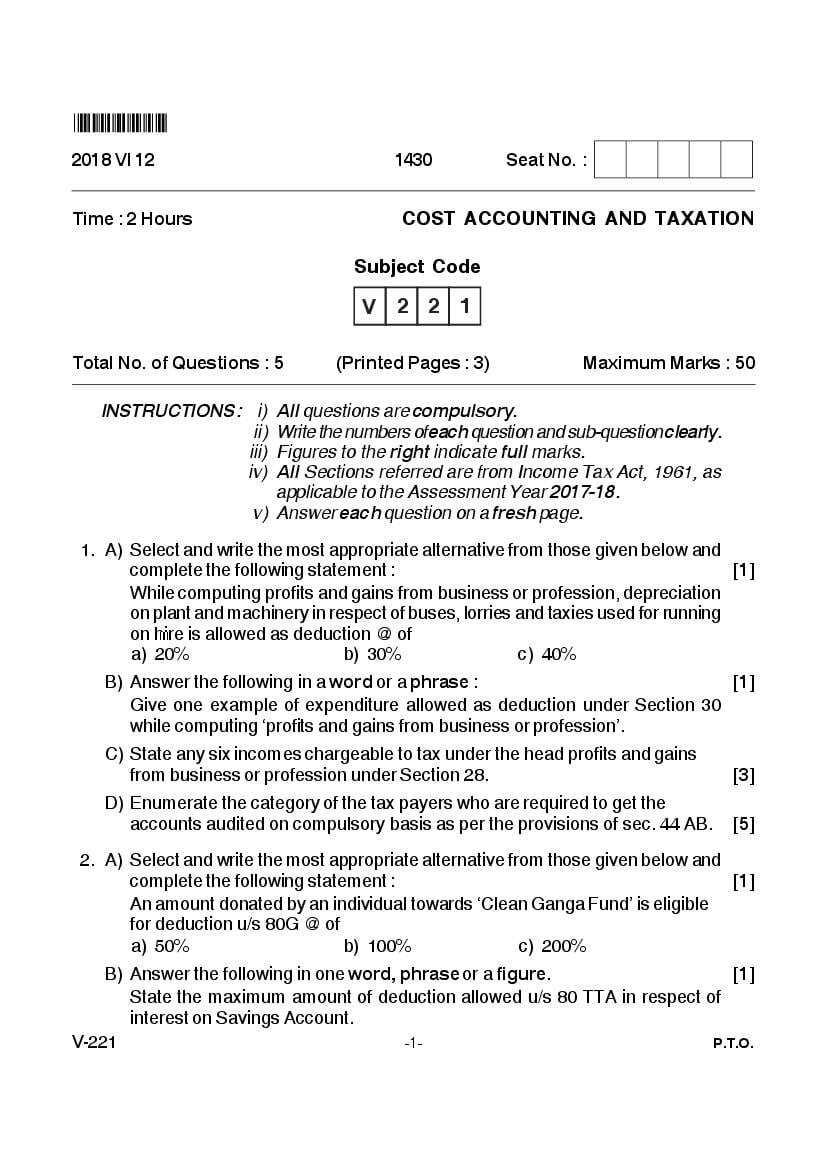
Time : 2 Hours COST ACCOUNTING AND TAXATION
Subject Code
V 2 2 1
Total No. of Questions : 5 (Printed Pages : 3) Maximum Marks : 50
INSTRUCTIONS : i) All questions are compulsory.
ii) Write the numbers of each question and sub-question clearly.
iii) Figures to the right indicate full marks.
iv) All Sections referred are from Income Tax Act, 1961, as
applicable to the Assessment Year 2017-18.
v) Answer each question on a fresh page.
1. A) Select and write the most appropriate alternative from those given below and
complete the following statement : [1]
While computing profits and gains from business or profession, depreciation
on plant and machinery in respect of buses, lorries and taxies used for running
on hire is allowed as deduction @ of
a) 20% b) 30% c) 40%
B) Answer the following in a word or a phrase : [1]
Give one example of expenditure allowed as deduction under Section 30
while computing ‘profits and gains from business or profession’.
C) State any six incomes chargeable to tax under the head profits and gains
from business or profession under Section 28. [3]
D) Enumerate the category of the tax payers who are required to get the
accounts audited on compulsory basis as per the provisions of sec. 44 AB. [5]
2. A) Select and write the most appropriate alternative from those given below and
An amount donated by an individual towards ‘Clean Ganga Fund’ is eligible
for deduction u/s 80G @ of
a) 50% b) 100% c) 200%
B) Answer the following in one word, phrase or a figure. [1]
State the maximum amount of deduction allowed u/s 80 TTA in respect of
interest on Savings Account.
V-221 -1- P.T.O.
Page 2
the following : [3]
i) Life Insurance Premiums paid Rs. 20,000 per annum.
ii) Contribution towards General Provident Fund Rs. 36,000 p.a.
iii) Purchase of National Savings Certificates Rs. 30,000 during the year.
iv) Donation given to National Defense Fund Rs. 10,000.
v) Interest paid on loan taken for higher education Rs. 50,000.
vi) Insurance premia paid on ‘Mediclaim’ Rs. 25,000.
vii) Contribution towards Public Provident Fund Rs. 25,000 during the year.
viii) Tuition fees for full time higher education (2 children) Rs. 15,000.
D) Explain any five provisions of Section 80 D, a deduction in respect of
medical insurance premium.
OR
Explain any five provisions of Sec. 80E, a deduction in respect of interest on
loan taken for higher education. [5]
3. A) Select and write the most appropriate alternative from those given below and
The maximum amount of deduction allowed under Section 80 DDB, in respect
of medical treatment of specified diseases of super senior citizen is Rs.
a) Rs. 80,000
b) Rs. 60,000
c) Rs. 40,000
B) Answer the following in a word or a phrase or a figure. [1]
State the rate of Income tax applicable to a resident individual who has attained
the age of 81 years and whose total income exceeding Rs. 5,00,000 but not
exceeding Rs. 10,00,000.
C) What are the provisions of Sec. 87A in respect of rebate on tax ? [3]
D) Explain FIFO method of pricing the material issues (any five points).
OR
Explain the following :
i) Maximum stock level
ii) Reorder level. [5]
V-221 -2-
Page 3
What is selling cost ? [1]
B) Explain ‘Unit Costing’ method of ascertainment of cost. [2]
C) Explain ‘Batch Costing’ method of ascertainment of cost. [2]
D) Explain ‘Marginal Costing’, technique of ascertainment of cost. [2]
E) Explain the classification of cost according to the behaviour. [3]
5. A) Answer the following in one word or phrase :
It is the study of the movement of an employee in doing an operation for the
purpose of eliminating unnecessary and inefficient movements. [1]
B) What are the functions of pay roll department (any four). [2]
C) Write a note on casual workers. [2]
D) State the basis of apportionment for the following items of overhead (expenses). [2]
i) Rent of building
ii) Electric power
iii) Canteen expenses
iv) Depreciation on plant and machinery.
E) Explain the following principles of apportionment of overheads.
i) Ability to pay method
ii) Survey method. [3]
__________
V-221 -3-
Document Details
| Board / Org | Goa Board |
| Exam | Class 12 |
| Type | Question Paper |
| Pages | 3 |
| Updated | 30 Apr 2026 |