Goa Board Class 12 Question Paper June 2018 Psychology _Old Pattern_
Finished viewing? Save it for later —
Download Goa Board Class 12 Question Paper June 2018 Psychology _Old Pattern_ (PDF · 4 pages)About Goa Board Class 12 Question Paper June 2018 Psychology _Old Pattern_
Goa Board Class 12 Question Paper June 2018 Psychology _Old Pattern_ is available here for free download. Published by Goa Board for Class 12, this question paper can be viewed online or downloaded as a PDF (4 pages). Candidates preparing for Class 12 can use Goa Board Class 12 Question Paper June 2018 Psychology _Old Pattern_ to understand the exam pattern, the type of questions asked, and the overall difficulty level.
Frequently Asked Questions
How can I download Goa Board Class 12 Question Paper June 2018 Psychology _Old Pattern_?
Open this page and click the Download button to save Goa Board Class 12 Question Paper June 2018 Psychology _Old Pattern_ as a PDF. It is completely free on AglaSem Docs.
Is Goa Board Class 12 Question Paper June 2018 Psychology _Old Pattern_ free to download?
Yes. Goa Board Class 12 Question Paper June 2018 Psychology _Old Pattern_ can be viewed online and downloaded as a PDF free of cost on AglaSem Docs.
How many pages does Goa Board Class 12 Question Paper June 2018 Psychology _Old Pattern_ have?
Goa Board Class 12 Question Paper June 2018 Psychology _Old Pattern_ contains 4 pages, which you can read online or download together as a single PDF.
Where can I find more Class 12 study material?
You can find more Class 12 question papers, sample papers, syllabus, and answer keys on AglaSem Docs.
Goa Board Class 12 Question Paper June 2018 Psychology _Old Pattern_ – Text
Read the full text of this question paper below — useful to quickly search, copy and reference the content online without downloading the PDF.
📄 View text version (4 pages)
Page 1
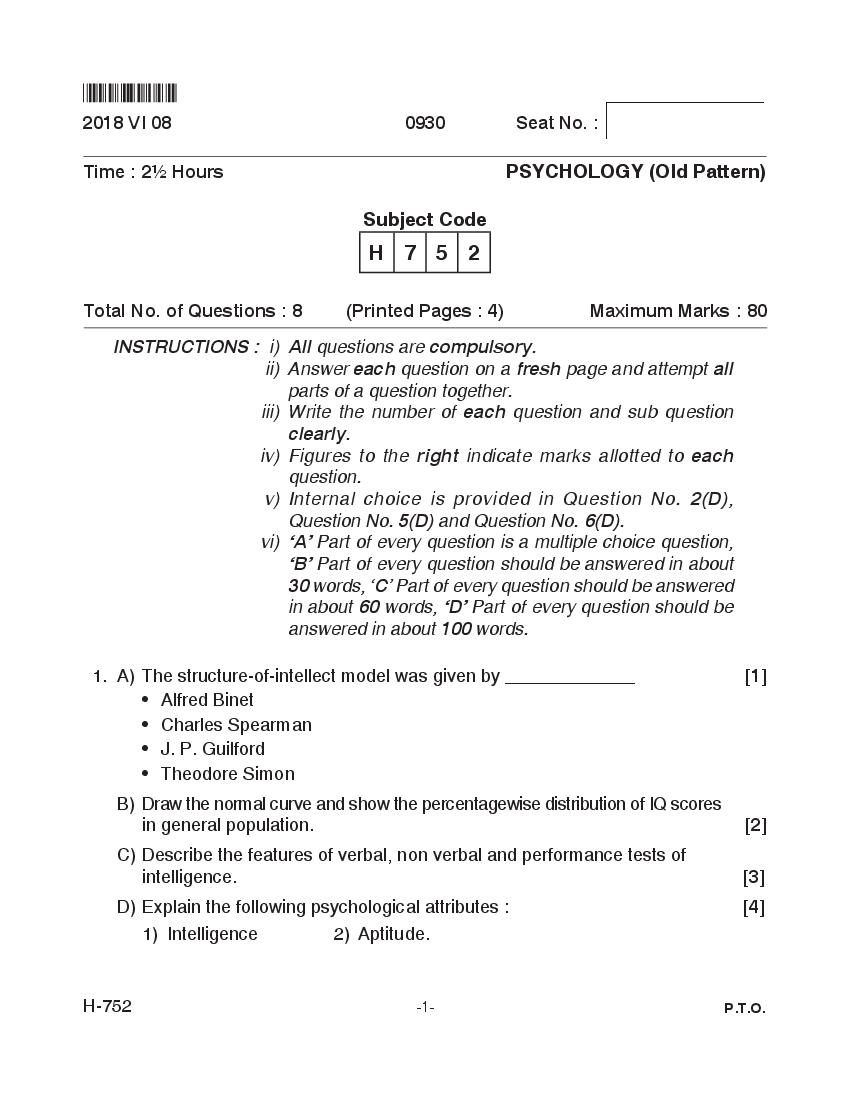
Time : 2½ Hours Psychology (Old Pattern)
Subject Code
H 7 5 2
Total No. of Questions : 8 (Printed Pages : 4) Maximum Marks : 80
Instructions : i) All questions are compulsory.
ii) Answer each question on a fresh page and attempt all
parts of a question together.
iii) Write the number of each question and sub question
clearly.
iv) Figures to the right indicate marks allotted to each
question.
v) Internal choice is provided in Question No. 2(D),
Question No. 5(D) and Question No. 6(D).
vi) ‘A’ part of every question is a multiple choice question,
‘B’ part of every question should be answered in about
30 words, ‘C’ Part of every question should be answered
in about 60 words, ‘D’ Part of every question should be
answered in about 100 words.
1. A) The structure-of-intellect model was given by _____________ [1]
• Alfred Binet
• Charles Spearman
• J. P. Guilford
• Theodore Simon
B) Draw the normal curve and show the percentagewise distribution of IQ scores
in general population. [2]
C) Describe the features of verbal, non verbal and performance tests of
intelligence. [3]
D) Explain the following psychological attributes : [4]
1) Intelligence 2) Aptitude.
H-752 -1- P.T.O.
Page 2
and attributes is called ___________ [1]
• Self-efficacy
• Self-esteem
• Self-concept
• Self-regulation
B) Explain the characteristics of introverts and extraverts as proposed by Jung. [2]
C) Describe the three levels of consciousness according to Freud. [3]
D) Analyse the Thematic Apperception Test. [4]
OR
Analyse nomination and situational tests as methods of personality assessment.
3. A) The strategy which involves denying or minimising the seriousness of the situation
while coping with stress is called _________ [1]
• Task-oriented strategy
• Emotion-oriented strategy
• Avoidance-oriented strategy
• Assertiveness
B) Explain how life events can generate stress. [2]
C) Describe the three types of social support which are related to psychological
well-being. [3]
D) Analyse the role of the following techniques to manage stress : [4]
1) Creative visualization 2) Exercise
4. A) When the person has to use more and more of a substance to get the same
effect, is called _________ [1]
• Substance dependence
• Substance abuse
• Tolerance
• Withdrawal
B) State the symptoms of Hypochondriasis and Conversion disorder. [2]
C) Explain the factors which predispose an individual to depression. [3]
D) Discuss the four types of Delusions. [4]
H-752 -2-
Page 3
techniques is ____________ [1]
• Biomedical therapy
• Gestalt therapy
• Client-centred therapy
• Cognitive behaviour therapy
B) Explain how intrapersonal communication different from interpersonal
communication. [2]
C) Explain any three elements which are common to all major theoretical
approaches to counselling. [3]
D) Discuss the four characteristics of all psychotherapeutic approaches. [4]
OR
Discuss ‘transference’ as a means of treatment in psychoanalytic approach.
6. A) The cognitive component of attitudes which form the ground on which they
stand is _______________ [1]
• Values
• Beliefs
• Prejudice
• Stereotype
B) Discuss how attitudes are learnt through exposure to information. [2]
C) Explain the influence of primacy, recency and halo effects on impression
formation. [3]
D) Analyse the role of the following factors in determining pro-social
behaviour : [4]
1) Cultural factors
2) Diffusion of responsibility.
OR
Analyse the importance of the following in social facilitation :
1) Evaluation Apprehension
2) Nature of the task
H-752 -3- P.T.O.
Page 4
• Roles
• Norms
• Status
• Cohesiveness
B) Explain how common motives and goals facilitate group formation. [2]
C) Discuss how cooperative goals differ from competitive goals. [3]
D) Analyse the following conflict resolution strategies : [4]
1) Increasing intergroup contacts
2) Negotiations.
8. A) The act of aggression which is meant to obtain a certain goal or object is ________
[1]
• Violence
• Hostile aggression
• Instrumental aggression
• Frustration
B) Explain the role of poverty and deprivation on motivation of the poor. [2]
C) Describe the three approaches of Human Environment Relationship. [3]
D) Analyse the impact of television on behaviour. [4]
___________________
H-752 -4-
Document Details
| Board / Org | Goa Board |
| Exam | Class 12 |
| Type | Question Paper |
| Pages | 4 |
| Updated | 30 Apr 2026 |