Goa Board Class 12 Question Paper June 2018 Psychology _New Pattern_
Finished viewing? Save it for later —
Download Goa Board Class 12 Question Paper June 2018 Psychology _New Pattern_ (PDF · 4 pages)About Goa Board Class 12 Question Paper June 2018 Psychology _New Pattern_
Goa Board Class 12 Question Paper June 2018 Psychology _New Pattern_ is available here for free download. Published by Goa Board for Class 12, this question paper can be viewed online or downloaded as a PDF (4 pages). Candidates preparing for Class 12 can use Goa Board Class 12 Question Paper June 2018 Psychology _New Pattern_ to understand the exam pattern, the type of questions asked, and the overall difficulty level.
Frequently Asked Questions
How can I download Goa Board Class 12 Question Paper June 2018 Psychology _New Pattern_?
Open this page and click the Download button to save Goa Board Class 12 Question Paper June 2018 Psychology _New Pattern_ as a PDF. It is completely free on AglaSem Docs.
Is Goa Board Class 12 Question Paper June 2018 Psychology _New Pattern_ free to download?
Yes. Goa Board Class 12 Question Paper June 2018 Psychology _New Pattern_ can be viewed online and downloaded as a PDF free of cost on AglaSem Docs.
How many pages does Goa Board Class 12 Question Paper June 2018 Psychology _New Pattern_ have?
Goa Board Class 12 Question Paper June 2018 Psychology _New Pattern_ contains 4 pages, which you can read online or download together as a single PDF.
Where can I find more Class 12 study material?
You can find more Class 12 question papers, sample papers, syllabus, and answer keys on AglaSem Docs.
Goa Board Class 12 Question Paper June 2018 Psychology _New Pattern_ – Text
Read the full text of this question paper below — useful to quickly search, copy and reference the content online without downloading the PDF.
📄 View text version (4 pages)
Page 1
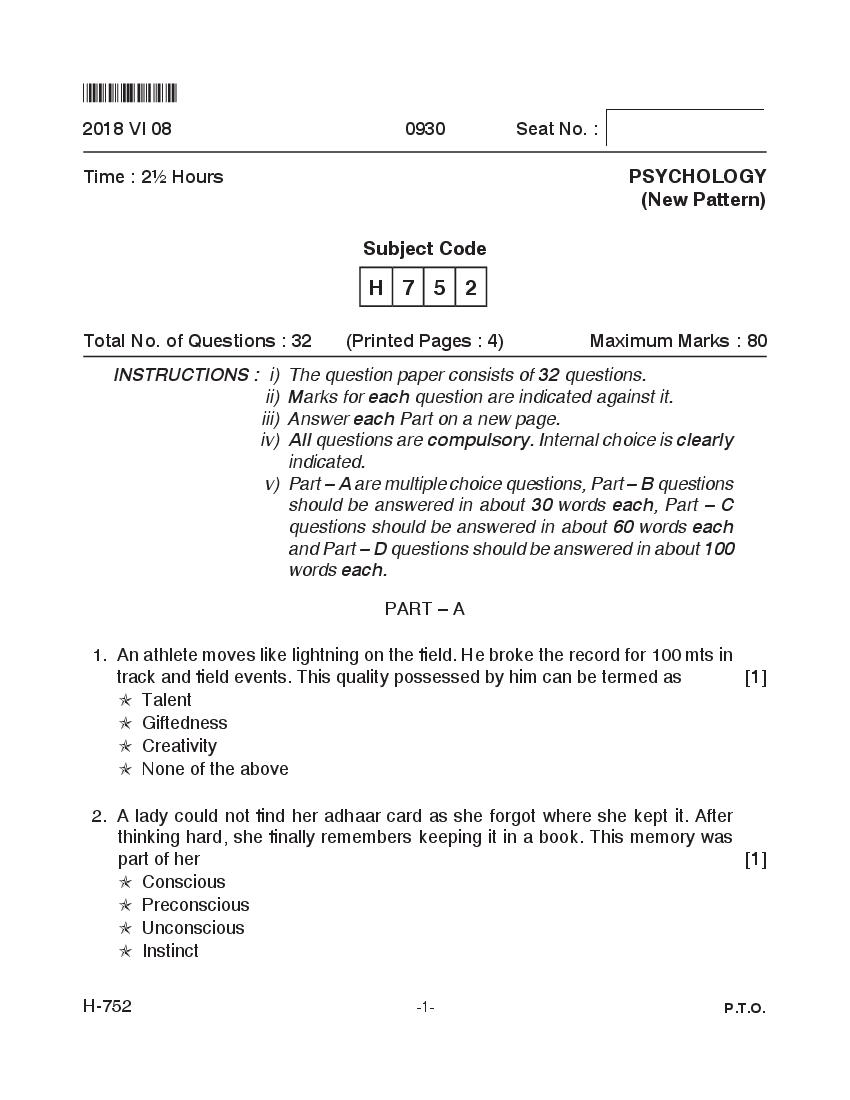
Time : 2½ Hours PSYCHOLOGY
(New Pattern)
Subject Code
H 7 5 2
Total No. of Questions : 32 (Printed Pages : 4) Maximum Marks : 80
Instructions : i) The question paper consists of 32 questions.
ii) Marks for each question are indicated against it.
iii) Answer each Part on a new page.
iv) All questions are compulsory. Internal choice is clearly
indicated.
v) Part – A are multiple choice questions, Part – B questions
should be answered in about 30 words each, Part – C
questions should be answered in about 60 words each
and Part – D questions should be answered in about 100
words each.
PART – A
1. An athlete moves like lightning on the field. He broke the record for 100 mts in
track and field events. This quality possessed by him can be termed as [1]
Talent
Giftedness
Creativity
2. A lady could not find her adhaar card as she forgot where she kept it. After
thinking hard, she finally remembers keeping it in a book. This memory was
part of her [1]
Conscious
Preconscious
Unconscious
Instinct
H-752 -1- P.T.O.
Page 2
suffered physical injuries and a family member died. Since then he suffers from
poor concentration and reduced short term memory. This can be identified as a [1]
Emotional effect
Physiological effect
Cognitive effect
Behavioural effect
4. A woman says that God appears to her is the day and every night and speaks
to her. The psychological disorder she is suffering from is [1]
Somatoform Disorder
Dissociative Disorder
Mood Disorder
Schizophrenic Disorder
5. Smitha is moved to tears as her classmate had to drop out of high school and
start working due to financial difficulties. She is displaying [1]
Unconditional Positive Regard
Empathy
Intellectual understanding
Confrontation
6. When Mumbai was flooded, the community stepped forward to help the effected
people with food , water and shelter. This is an instance of [1]
Pro-Social Behaviour
Diffusion of Responsibility
Social Facilitation
Social Cognition
7. When a group project was given to the class, each individual in the group worked
less hard as compared to an individual project. This phenomenon is referred
to as [1]
Social Facilitation
Group Polarisation
Bandwagon Effect
Social Loafing
H-752 -2-
Page 3
communities for the rich. This approach of the human environment relationship
is called [1]
Minimalist Perspective
Instrumental Perspective
Spiritual Perspective
PART – B
9. Explain social competence and emotional competence as facets of intelligence
in the Indian tradition. [2]
10. Explain Jung’s typology. [2]
11. Describe physical and environmental stress. [2]
12. Explain obsessive-compulsive disorder. [2]
13. Draw a neat labelled diagram of the communication process. [2]
14. Nature of the Task effects performance in the presence of others. Explain. [2]
15. Differentiate between primary groups and secondary groups. (2 pts.) [2]
16. How is crowding related to density ? [2]
PART – C
17. Elaborate the three basic features of intellectual disability. [3]
18. Explain 16 PF as a self report measure. [3]
19. Elaborate three characteristics of the personality trait of Hardiness. [3]
20. Explain the three dissociative disorders. [3]
21. Explain the three levels of Human Communication. [3]
22. Describe the media related influences on attitude formation. [3]
23. Describe three salient characteristics of groups. [3]
24. Explain the psychological features of Environmental Design. [3]
H-752 -3- P.T.O.
Page 4
25. Analyse the influence of heredity on intelligence. [4]
OR
Analyse Psychological test and case study as assessment methods.
26. Explain the Thematic Apperception Test. [4]
27. Analyse Cognitive Behavioural Techniques as a stress management technique. [4]
28. Analyse the biological factors underlying abnormal behaviour. [4]
OR
Analyse Alcohol Abuse and Dependence.
29. Analyse Aversive Conditioning and Positive Reinforcement as behavioural
Techniques. [4]
OR
Analyse the process of transference as a modality of treatment.
30. Explain Scapegoating and self-fulfilling prophecy as sources of prejudice. [4]
31. Analyse increasing inter group contacts and structural solutions as conflict
resolution strategies. [4]
32. Explain personality factors and cultural factors as situational factors leading to
aggression. [4]
––––––––––––––––
H-752 -4-
Document Details
| Board / Org | Goa Board |
| Exam | Class 12 |
| Type | Question Paper |
| Pages | 4 |
| Updated | 30 Apr 2026 |