UGC NET Syllabus for Defence and Strategic Studies 2020
Finished viewing? Save it for later —
Download UGC NET Syllabus for Defence and Strategic Studies 2020 (PDF · 13 pages)About UGC NET Syllabus for Defence and Strategic Studies 2020
UGC NET Syllabus for Defence and Strategic Studies 2020 is available here for free download. Published by NTA for UGC NET, this syllabus can be viewed online or downloaded as a PDF (13 pages). Candidates preparing for UGC NET can use UGC NET Syllabus for Defence and Strategic Studies 2020 to understand the exam pattern, the type of questions asked, and the overall difficulty level.
Frequently Asked Questions
How can I download UGC NET Syllabus for Defence and Strategic Studies 2020?
Open this page and click the Download button to save UGC NET Syllabus for Defence and Strategic Studies 2020 as a PDF. It is completely free on AglaSem Docs.
Is UGC NET Syllabus for Defence and Strategic Studies 2020 free to download?
Yes. UGC NET Syllabus for Defence and Strategic Studies 2020 can be viewed online and downloaded as a PDF free of cost on AglaSem Docs.
How many pages does UGC NET Syllabus for Defence and Strategic Studies 2020 have?
UGC NET Syllabus for Defence and Strategic Studies 2020 contains 13 pages, which you can read online or download together as a single PDF.
Where can I find more UGC NET study material?
You can find more UGC NET question papers, sample papers, syllabus, and answer keys on AglaSem Docs.
UGC NET Syllabus for Defence and Strategic Studies 2020 – Text
Read the full text of this syllabus below — useful to quickly search, copy and reference the content online without downloading the PDF.
📄 View text version (13 pages)
Page 1
UGC NET
Syllabus · Defence
Strategic Studies
EXAM YEAR TYPE SUBJECT
UGC NET — Syllabus Defence Strategic Studies
Notes · Sample Papers · Previous Year Papers · Mock Tests
Page 2
m .co
c. o
e m
em l a s
s a g
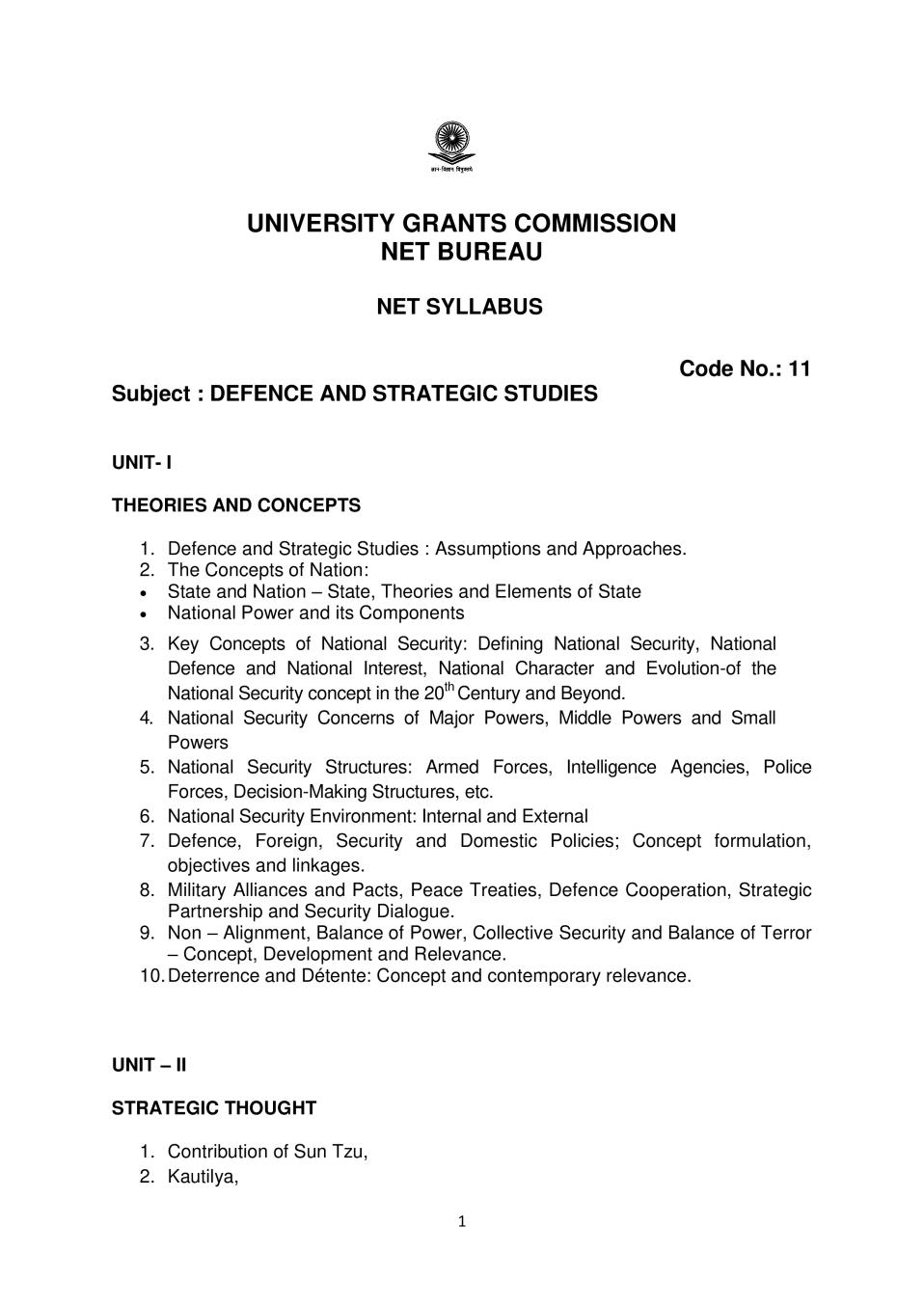
UNIVERSITY GRANTS COMMISSION
NET BUREAU
m
m c. o
co
NET SYLLABUS
. e m
m la s
se
Subject l:aDEFENCE a
Code No.: 11
g
ag
AND STRATEGIC STUDIES
UNIT- I
THEORIES AND CONCEPTS
1. Defence and Strategic Studies : Assumptions and Approaches.
2. The Concepts of Nation:
m
c. o
State and Nation – State, Theories and Elements of State
National Power and its Components
3. Key Concepts of National Security:mDefining National Security, National
Defence and National Interest,as
e
l
ag 20 Century and Beyond.
National Character and Evolution-of the
th
National Security concept in the
4. National Security Concerns of Major Powers, Middle Powers and Small
Powers
5. National Security Structures: Armed Forces, Intelligence Agencies, Police
Forces, Decision-Making Structures, etc.
6. National Security Environment: Internal and External
7. Defence, Foreign, Security and Domestic Policies; Concept formulation,
m
co
objectives and linkages.
m .
c. o
8. Military Alliances and Pacts, Peace Treaties, Defence Cooperation, Strategic
m
se
Partnership and Security Dialogue.
em la
9. Non – Alignment, Balance of Power, Collective Security and Balance of Terror
las – Concept, Development and Relevance.
a g
g
10. Deterrence and Détente: Concept and contemporary relevance.
a
UNIT – II
STRATEGIC THOUGHT
1. Contribution of Sun Tzu,
m .
co m
2. Kautilya,
m . s e
se l a
1
l a a g
ag For more Question Papers, Sample Papers, Notes & Syllabus visit Page 1 of 12
Page 3
4. Jomini,
5. Carl von Clausewitz,
6. General Giulio Douhet
7. W.Mitchell,
8. J.F.C.Fuller,
9. Capt.B.H.Liddell Hart,
10. Marx, Lenin, Mao Zedong and Che Guevara.
11. Nuclear Deterrence: Andre Beaufre, Henry Kissinger and K. Subrahmanyam.
12. Thoughts of Gandhi and Nehru on Peace, Security and Development.
UNIT – III
WAR AS AN INSTRUMENT IN INTERNATIONAL RELATIONS
1. Theories and causes of War.
2. Principles of War.
3. Contemporary Warfare : Conventional Warfare in Nuclear age, Limited War,
Revolutionary Warfare, Low Intensity Operations, Guerilla Warfare,
Insurgency and Counter – Insurgency.
4. Armaments : Arms Race, Arms Aid, Arms Trade, Arms Proliferation,
Proliferation of Small Arms
5. Military Alliances and Pacts, Peace Treaties, Defence Cooperation, Strategic
Partnership and Security Dialogue.
6. Terrorism : Concept and kinds (National, International and Cross border).
7. Conflicting Ideologies : Militarism, Nationalism, Fundamentalism, Separatism,
Irredentism.
8. Concept and Elements of Deterrence: Nuclear & Conventional.
9. Evolution of Global Nuclear Doctrines
10. Democratic Peace Theory
UNIT – IV
WMD, NUCLEAR PROLIFERATION AND NATIONAL SECURITY
1. Basic Concepts and Theory
(i) Concepts of Disarmament & Arms Control
(ii) Objectives and Conditions of Disarmament
(iii) Elements of Arms Control Mechanisms: Agreements, verification,
inspection, control.
(iv) Approaches to Disarmament & Arms Control
2. Historical Survey of Disarmament Efforts:
2
For more Question Papers, Sample Papers, Notes & Syllabus visit Page 2 of 12
Page 4
m .co
c. o
e m
em l a s
s a g
(i) Under the League of Nations
(ii) Under the United Nations
(iii) Unilateral, Bilateral and Multilateral approaches
(iv) Role of Non-aligned Nations in Disarmament Negotiations
3. Weapons of Mass Destruction: Nuclear, Chemical & Biological Weapons.
4. Nuclear Arms Limitation Nuclear Arms Control Treaties.
m
c. o
5. Chemical weapons Convention and Biological Weapons Convention
m
6. Concept of Non-proliferation, NPT, CTBT, PTBT MTCR FMCT, & other
.co e m
treaties
7.
em
Nuclear Export Control Regimes
la s
a s g
8. New Challenges and Responses - Missile Defense, Cooperative Threat
l a
ag
Reduction and G-7 Global Partnership
9. Disarmament & Arms Control and Economic Development
10. Terrorism and Nuclear Proliferation.
11. Concept of Star Wars and NMD
UNIT – V
GLOBAL SECURITY CONCERNS
m
. co
em
1. End of cold war and emergence of new world order.
a s
2. Proliferation of Military, Nuclear and missile capabilities
g l
3. Environmental Issues : climate change and Global Warming, Desertification,
a
Acid Rains, Industrial Pollution, Deforestation
4. Organized Crimes : Money Laundering, Narco – trafficking , Human
Trafficking and small arms proliferation.
5. Migrants and Refugees: (a) Causes (b) Illegal migration and border
management (c) Problem in South Asia (d) Role of International
Committee of Red Cross and UN High Commission for Refugees.
6. Global Security Concerns: Palestinian-Israeli conflict & Arab Spring,
Developments in Central Asian Republics (CARs), Rise of Fundamentalism,
m
Challenges in Korean Peninsula, Taiwan and Power Rivalry in South China
m .co
Sea.
c. o m
7. Problem of System of Governance and Human Rights
em se
8. Food Security, Energy Security and Water Security problems in modern era.
s g la
9. Millennium Development Goals.
gla a
a UNIT – VI
INDIA’S SECURITY CONCERNS & POLICIES IN CONTEMPORARY
INTERNATIONAL SCENARIO
1. Genesis of Sino-Indian Relations
2. The Boundary Dispute, Sino- Pakistan Nexus, OBOR and CPEC, China and
India- Military Balance, Chinese Policy towards South Asia
m .
.co s e m
e m l a
s
3
l a a g
ag For more Question Papers, Sample Papers, Notes & Syllabus visit Page 3 of 12
Page 5
Indian Ocean and South China Sea
4. Strategic Dimension of India- Pakistan Relations: Genesis of India-Pakistan
Conflict, Indo-Pak Military balance, The Kashmir Question, Pakistan
Sponsored Terrorism, Pakistan's Nuclear Strategy, The Powers Structure of
Pakistan, Contentious. Issues: Siachin, Sir Creek, River Waters, etc.
5. India and South Asia: Issues and Challenges for Regional Cooperation.
6. Making of India’s Defence Policy since Independence: (a) Threat perception,
assessment and preparedness (b) Political and military lessons of 1948,
1962, 1965, 1971, 1999 wars (c) Future trends
7. India’s Look East and Act East Policies, Indo- Pacific Cooperation, Strategic
Partnerships.
8. India’s maritime security and strategy in 21st century: (a) Indian Ocean (b)
Asia-Pacific region(c) Security of Sea Lanes, India’s Maritime Strategy for the
21st Century.
9. India’s Defence Doctrines and Strategies including Nuclear Doctrine
10. Higher Defence Organization of India.
UNIT – VII
ISSUES IN CONFLICT RESOLUTION
1. Origin, Type and Structure of Conflict.
2. Ideologies and International conflicts.
3. Role of United Nations in Conflict Management and Re – Structuring of UNO
4. Techniques of Conflict Prevention
5. Conflict Management : Pacific Solutions of International Disputes, Coercive
methods.
6. International Humanitarian Laws and Laws of Armed Conflicts.
7. Confidence Building Measures : Concept, kinds and utility.
8. IGOs & NGOs in Conflict Resolution: Peace Making, Peace Keeping and
Peace Building.
9. Gandhian Philosophy on Peace and Non-violence
10. Nehruvian approach to National Security and Cooperation
UNIT – VIII
DISASTER MANAGEMENT AND NATIONAL SECURITY
1. Basic Concept & meaning of Disaster, Introduction to terminologies
associated with Disaster and National Security: Natural and Manmade,
Vulnerability, Risk etc., Identifying various types of Disasters.
2. Natural Disaster and Human Induced Disaster: Floods, Cyclone, Earthquake,
Tsunami - WMD Disaster - Disaster associated with various industries
4
For more Question Papers, Sample Papers, Notes & Syllabus visit Page 4 of 12
Page 6
m .co
c. o
e m
em l a s
s a g
3. Study of Disaster in India / Around the World: Case Studies: Tsunami 2004,
Bhopal Gas Tragedy, Chernobyl, Fukushima, Uttarakhand etc.
4. Disaster Management : Meaning, Association and Distinction with related
concepts like Disaster Mitigation, Response, and Recovery, Relief, and
Reconstruction
5. Institutional Mechanism for Disaster Management in India: Role of Armed
m
Forces, Central and State Governments, NGO, National Disaster
m c. o
Management Authority, Indian National Centre for Ocean Information
.co e m
Services.
em la s
l
UNIT – IX
a s a g
ag
DEFENCE ECONOMICS
1. Economic Theories of Defence.
2. Sustainable Development: Challenges & Responses.
3. Basics of Defence Planning, Determinants of Defence Expenditure.
4. Defence Budgeting.
5. Economic Causes of War.
m
6. Economic Warfare in modem times.
. co
7. Economic Problems of Post War reconstruction.
em
8. National Security and International Trade regimes (WTO, TRIPS, TRIMS,
s
FTA’s NAFTA, SAPTA, & NSG).
l a
9. India’s role in Regional and Global Economic Forums and Organizations.
g
a
10. Geo-economics and its Implications for global/regional economic stability
UNIT –X
SCIENCE & TECHNOLOGY AND NATIONAL SECURITY
m
co
1. Broad Survey of Technological Changes from Industrial Revolution to
m .
c. o m
Information Revolution.
se
2. India’s Civil Nuclear and Space Programs, India’s Energy Scenario.
s em la
3. Research and Development :
la
Relevance of Science and Technology in National Security.
a g
ag
Impact of Information Technology; Revolution in Military Affairs (RMA).
Choice of Weapon Systems.
4. Impact of Economic Liberalization and Globalization :
Defence Production in India ( Role of DPSU’s and Ordnance factories
).
Defence and Development and Peace & Development Dichotomies.
5. Issues of Mobilization of Resources during War and Peace.
6. Military Industrial Complexes.
7. Transfer of Technology : Dual use and critical technologies and their impact
m .
co
on national security.
. e m
e m l as
s
5
l a a g
ag For more Question Papers, Sample Papers, Notes & Syllabus visit Page 5 of 12
Page 7
9. Cyber Security : Vulnerabilities of Information technology and internet, Need
and importance of cyber security, Different kinds of cyber security
vulnerabilities, Cyber wars including propaganda, measures for cyber
security- Technology, laws and regulations, global issues in cyber security.
10. Social Media and its Impact on National Security- Global reach with rapid
speed for propaganda and indoctrinate misinformation and rumour mongering
cadre recruitment and use of social networking sites for mobilizing public
opinion.
6
For more Question Papers, Sample Papers, Notes & Syllabus visit Page 6 of 12
Page 8
. s e
em l a
as a g
m
om . co
.c e m
e m l a s
l a s a g
ag
m
. co
s em
g l a
a
m
m c. o
c. o s e m
s em la
gla ag
a
m . c
c. o s e m
m a
se
For more Question Papers, Sample Papers, Notes & Syllabus visit
g lPage 7 of 12
Page 9
Page 10
. s e
em l a
as a g
m
om . co
.c e m
e m l a s
l a s a g
ag
m
. co
s em
g l a
a
m
m c. o
c. o s e m
s em la
gla ag
a
m . c
c. o s e m
m a
se
For more Question Papers, Sample Papers, Notes & Syllabus visit
g lPage 9 of 12
Page 11
Page 12
. s e
em l a
as a g
m
om . co
.c e m
e m l a s
l a s a g
ag
m
. co
s em
g l a
a
m
m c. o
c. o s e m
s em la
gla ag
a
m . c
c. o s e m
m a
se
For more Question Papers, Sample Papers, Notes & Syllabus visit
g l
Page 11 of 12
Page 13
Document Details
| Board / Org | NTA |
| Exam | UGC NET |
| Type | Syllabus |
| Pages | 13 |
| Updated | 15 Jul 2026 |