ICSE Class 10 Specimen Paper 2022 Environmental Science Semester 1
Finished viewing? Save it for later —
Download ICSE Class 10 Specimen Paper 2022 Environmental Science Semester 1 (PDF · 9 pages)About ICSE Class 10 Specimen Paper 2022 Environmental Science Semester 1
ICSE Class 10 Specimen Paper 2022 Environmental Science Semester 1 is available here for free download. Published by CISCE for Class 10, this sample paper can be viewed online or downloaded as a PDF (9 pages). Candidates preparing for Class 10 can use ICSE Class 10 Specimen Paper 2022 Environmental Science Semester 1 to understand the exam pattern, the type of questions asked, and the overall difficulty level.
Frequently Asked Questions
How can I download ICSE Class 10 Specimen Paper 2022 Environmental Science Semester 1?
Open this page and click the Download button to save ICSE Class 10 Specimen Paper 2022 Environmental Science Semester 1 as a PDF. It is completely free on AglaSem Docs.
Is ICSE Class 10 Specimen Paper 2022 Environmental Science Semester 1 free to download?
Yes. ICSE Class 10 Specimen Paper 2022 Environmental Science Semester 1 can be viewed online and downloaded as a PDF free of cost on AglaSem Docs.
How many pages does ICSE Class 10 Specimen Paper 2022 Environmental Science Semester 1 have?
ICSE Class 10 Specimen Paper 2022 Environmental Science Semester 1 contains 9 pages, which you can read online or download together as a single PDF.
Where can I find more Class 10 study material?
You can find more Class 10 question papers, sample papers, syllabus, and answer keys on AglaSem Docs.
ICSE Class 10 Specimen Paper 2022 Environmental Science Semester 1 – Text
Read the full text of this sample paper below — useful to quickly search, copy and reference the content online without downloading the PDF.
📄 View text version (9 pages)
Page 1
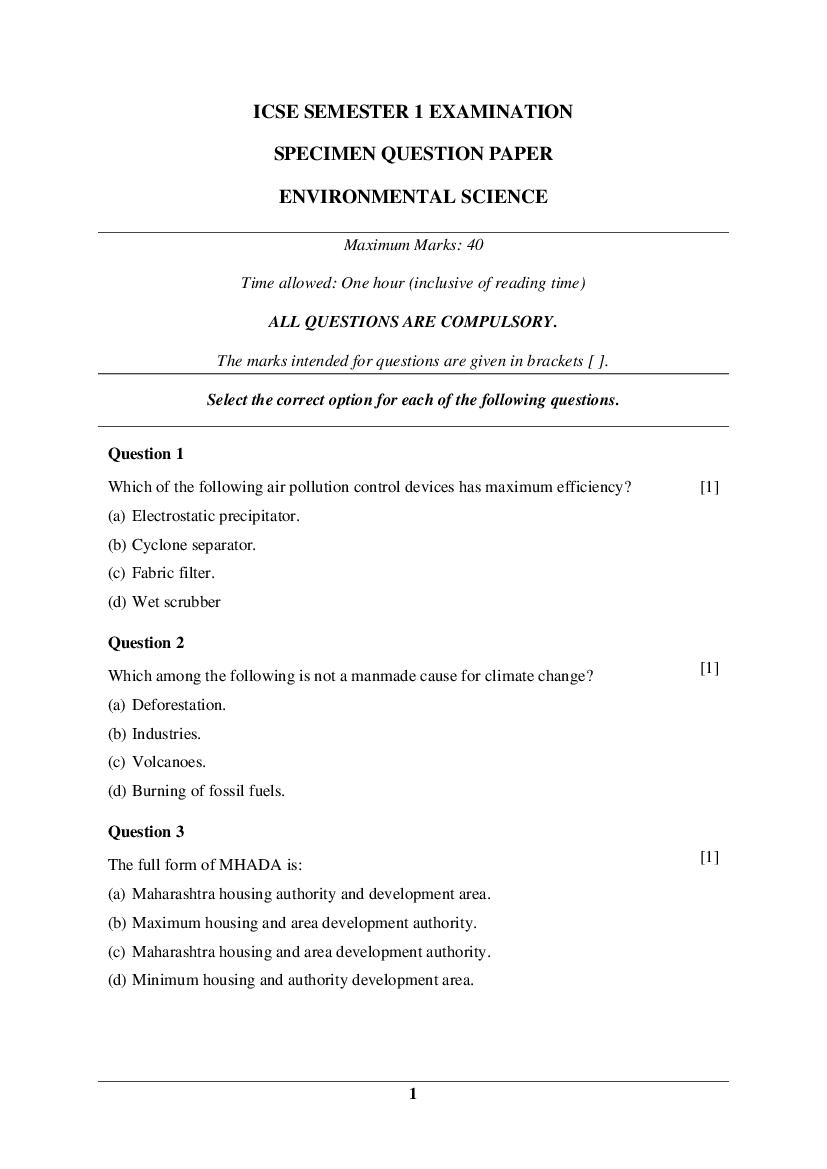
SPECIMEN QUESTION PAPER
ENVIRONMENTAL SCIENCE
Maximum Marks: 40
Time allowed: One hour (inclusive of reading time)
ALL QUESTIONS ARE COMPULSORY.
The marks intended for questions are given in brackets [ ].
Select the correct option for each of the following questions.
Question 1
Which of the following air pollution control devices has maximum efficiency? [1]
(a) Electrostatic precipitator.
(b) Cyclone separator.
(c) Fabric filter.
(d) Wet scrubber
Question 2
[1]
Which among the following is not a manmade cause for climate change?
(a) Deforestation.
(b) Industries.
(c) Volcanoes.
(d) Burning of fossil fuels.
Question 3
[1]
The full form of MHADA is:
(a) Maharashtra housing authority and development area.
(b) Maximum housing and area development authority.
(c) Maharashtra housing and area development authority.
(d) Minimum housing and authority development area.
1
Page 2
[1]
The direct effects of soil erosion are:
(a) Reduction of electricity generation.
(b) Reduces productivity of the soil.
(c) Reduces irrigation.
(d) Reduces navigability.
Question 5
[1]
An example of bio fertilizer is:
(a) Bacillus thuringiensis.
(b) Bio neem.
(c) Praying mantis.
(d) Rhizobium.
Question 6
[1]
Satellite cities are also called:
(a) Primary cities.
(b) Sustainable cities.
(c) Eco cities.
(d) Secondary cities.
Question 7
[1]
Which of the following is not a cause of soil erosion?
(a) Deforestation.
(b) Terracing.
(c) Overgrazing.
(d) Heavy rainfall.
Question 8
[1]
Which of the following gases is responsible for yellowing of the Taj Mahal?
(a) Sulphur dioxide.
(b) Chlorine.
(c) Sulphur.
(d) Nitrogen dioxide.
2
Page 3
Which one of the following is not a regenerative farming practice? [1]
(a) Intercropping.
(b) Agroforestry.
(c) Use of chemical pesticides.
(d) Crop rotation
Question 10
[1]
The medium population projections for 2020 made by the UN. Are:
(a) 10 million
(b) 12.5 billion
(c) 10 billion
(d) 7.8 million
Question 11
[1]
Sericulture is the practice of rearing
(a) Fish.
(b) Goats.
(c) Sheep.
(d) Silkworms.
Question 12
[1]
Biomass refers to:
(a) Plant waste
(b) Animal waste
(c) Agricultural residue
(d) All of the above
Question 13
[1]
PNG stands for:
(a) Portable Natural Gas.
(b) Piped Natural Gas.
(c) Piped nitrogen gas.
(d) Piped nature gas.
3
Page 4
[1]
Counter urbanization is the movement of:
(a) People from major cities to less urban and rural areas.
(b) People from secondary cities to a Metropolitan.
(c) People from one urban city to another.
(d) None of the above
Question 15
[1]
An example of a secondary city in India.
(a) Mumbai.
(b) Noida.
(c) Gujarat.
(d) Mysore.
Question 16
[1]
The effects of urbanization are:
(a) Increased levels of carbon- dioxide.
(b) Water pollution.
(c) Proliferation of slums.
(d) All of the above.
Question 17
[1]
Which among the following is not an ecological impact of population growth:
(a) Decrease in ground water.
(b) Reduction in forest cover.
(c) Loss of biodiversity.
(d) Increase in informal sector.
Question 18
[1]
Which strategy among the following is used to control population is:
(a) Illiteracy.
(b) Education.
(c) Superstition.
(d) Desire for a male child.
4
Page 5
[1]
The leader for the Ralegaon story is:
(a) Parasu Ram Mishra.
(b) Gaura Devi.
(c) Anna Hazare.
(d) Medha Patkar.
Question 20
[1]
Silviculture means:
(a) Cultivating forest crops.
(b) Cultivating ornamental plants
(c) Cultivating fruit crops.
(d) Cultivating cereals.
Question 21
[1]
SPCB stands for _______.
(a) State pollution control board.
(b) State pollutant control board
(c) Special pollution control board.
(d) State preservation control board.
Question 22
[1]
Taj Mahal is losing its shine due to ________.
(a) Water pollution.
(b) Air pollution.
(c) Sound pollution.
(d) Radiation pollution.
5
Page 6
An eco-city is also called a _________city.
(a) Sustainable.
(b) Secondary.
(c) Satellite.
(d) None of the above
Question 24
[1]
Extensive planting of trees on barren land to increase forest cover is called ______.
(a) Reforestation.
(b) Afforestation.
(c) Deforestation.
(d) Energy plantations.
Question 25
[1]
The aim of Chipko movement was _______.
(a) Forest conservation.
(b) Human rights.
(c) Providing employment.
(d) All of the above.
Question 26
[5]
Match the correct options with the columns questions:
Column A Column B
1. Beej Bacchao Andolan (i) Shorter Life Cycle
2. Trickle Drip Irrigation (ii) Save the indigenous Seeds
3. Strip Cropping (iii) Integrated Pest Management
4. HYV’S (iv) Initial Cost very High
5. Sustainable Agriculture (v) Effective Against Wind Erosion
6
Page 7
(b) (ii)
(c) (iv)
(d) (v)
2. (a) (v)
(b) (iii)
(c) (i)
(d) (iv)
3. (a) (i)
(b) (iii)
(c) (v)
(d) (iv)
4. (a) (iv)
(b) (v)
(c) (i)
(d) (ii)
5. (a) (i)
(b) (ii)
(c) (iii)
(d) (iv)
Question 27
[1]
Organic food is not healthier since it is not contaminated by harmful pesticides.
(a) True
(b) False
Question 28
[1]
Natality is the number of live births per 100 people of population per year.
(a) True
(b) False
7
Page 8
CNG is an alternate fuel.
(a) True
(b) False
Question 30
[1]
Green buildings are made using eco-friendly material.
(a) True
(b) False
Question 31
[1]
In developed countries the major problem is overconsumption.
(a) True
(b) False
Question 32
[1]
Social forestry is planting of trees on unused and fallow land without the
involvement of local communities.
(a) True
(b) False
Question 33
[1]
Gasohol is a mixture of ethanol and diesel.
(a) True
(b) False
Question 34
[1]
Entry of heavy commercial vehicles is restricted to 8.00 am to10.00 pm.
(a) True
(b) False
8
Page 9
Concrete sleepers can replace the wooden sleepers in railways.
(a) True
(b) False
Question 36
[1]
Conservation tillage is defined as any tillage and planting systems that leaves at
least half of the soil surface covered by residue after planting.
(a) True
(b) False
9
Document Details
| Board / Org | CISCE |
| Exam | Class 10 |
| Type | Sample Paper |
| Pages | 9 |
| Language | english |
| Updated | 22 Jul 2026 |