UGC NET Syllabus for Linguistics 2020
Finished viewing? Save it for later —
Download UGC NET Syllabus for Linguistics 2020 (PDF · 22 pages)About UGC NET Syllabus for Linguistics 2020
UGC NET Syllabus for Linguistics 2020 is available here for free download. Published by NTA for UGC National Eligibility Test, this syllabus can be viewed online or downloaded as a PDF (22 pages). Candidates preparing for UGC National Eligibility Test can use UGC NET Syllabus for Linguistics 2020 to understand the exam pattern, the type of questions asked, and the overall difficulty level.
Frequently Asked Questions
How can I download UGC NET Syllabus for Linguistics 2020?
Open this page and click the Download button to save UGC NET Syllabus for Linguistics 2020 as a PDF. It is completely free on AglaSem Docs.
Is UGC NET Syllabus for Linguistics 2020 free to download?
Yes. UGC NET Syllabus for Linguistics 2020 can be viewed online and downloaded as a PDF free of cost on AglaSem Docs.
How many pages does UGC NET Syllabus for Linguistics 2020 have?
UGC NET Syllabus for Linguistics 2020 contains 22 pages, which you can read online or download together as a single PDF.
Where can I find more UGC National Eligibility Test study material?
You can find more UGC National Eligibility Test question papers, sample papers, syllabus, and answer keys on AglaSem Docs.
UGC NET Syllabus for Linguistics 2020 – Text
Read the full text of this syllabus below — useful to quickly search, copy and reference the content online without downloading the PDF.
📄 View text version (22 pages)
Page 1
UGC NET
Syllabus ·
Linguistics
EXAM YEAR TYPE SUBJECT
UGC NET — Syllabus Linguistics
Notes · Sample Papers · Previous Year Papers · Mock Tests
Page 2
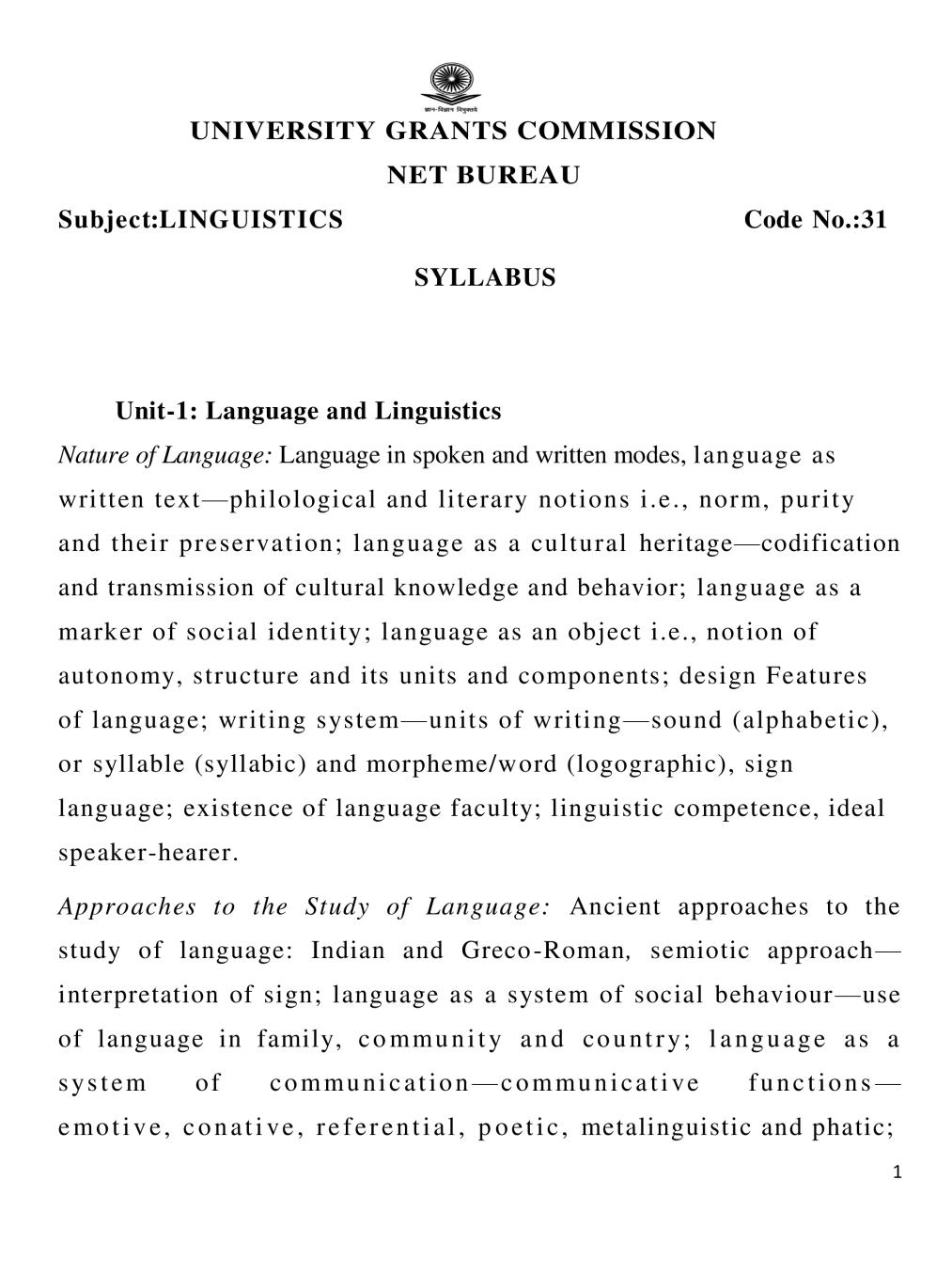
UNIVERSITY GRANTS COMMISSION
NET BUREAU
m
Subject:LINGUISTICS Code No.:31
.co s e m
m a
se l
SYLLABUS
g la ag
a
Unit-1: Language and Linguistics
Nature of Language: Language in spoken and written modes, language as
written text—philological and literary notions i.e., nor m, purity
m
and their preservation; language as a cultural heritage—codification
c. o
and transmission of cultural knowledge and behavior; language as a
s emas an object i.e., not ion of
la and components; design Features
marker of social identity; language
a g
autonomy, structure and its units
of language; writing system—units of writing —sound (alphabetic),
or syllable (syllabic) and morpheme/w ord (logographic), sign
language; existence of language faculty; linguistic competence, ideal
speaker-hearer.
o m
om of language: Indian and Greco -Roman, semiotic c
.approach—
Approaches to the Study of Language: Ancient approaches to the
c. study e m
m s
la behaviour —use
se interpretation of sign; language as a system of social g
of language in family, c o m m u n i t y a n d c o u n tar y ; l a n g u a g e a s a
system of communication —communicative functions—
e m o t i v e , c o n a t i v e , r e f e r e n t i a l , p o e t i c , metalinguistic and phatic;
1
For more Question Papers, Sample Papers, Notes & Syllabus visit Page 1 of 21
Page 3
(Linguistic Relativity); Saussurean dichotomies: signifier and
signified, langue and parole, synchronic and diachronic, syntagmatic
and paradigmatic.
Language Analysis: Levels and their hierarchy—
phonetic/phonological, morphological, syntactic and semantic/pragmatic;
their interrelations; linguistic units and their distribution at different levels;
notions of contrast and complementation; -emic and -etic categorisation; notion of
rule at different levels; description vs. explanation of grammatical facts.
Linguistics and other Fields: Relevance of Linguistics to other fields of
enquiry—Philosophy, Anthropology, Sociology, Neurology, Speech Sciences,
Geography, Psychology, Education, Computer Science and Literature.
Unit 2. Phonetics and Phonology
Phonetics
Phonetics as a study of speech sounds: articulatory, auditory, and
acoustic phonetics.
Articulatory Phonetics: Processes of speech production: airstream
process, oro-nasal process, phonation process, and articulatory process;
classification of speech sounds: vowels and consonants, cardinal vowels (primary
and secondary); complex articulation: secondary articulation, coarticulation;
syllable; suprasegmentals—length, stress, tone, intonation and juncture;
phonetic transcription: International Phonetic Alphabet (IPA).
2
For more Question Papers, Sample Papers, Notes & Syllabus visit Page 2 of 21
Page 4
Acoustic Phonetics: Sound waves— simple and complex, periodic and
aperiodic; harmonics; frequency and fundamental frequency, amplitude,
duration; resonance, filters, spectrum, spectrogram; formants, transition,
m
burst; voice onset time; aspiration; noise spectra; cues for speech sounds: vowel
c. o s e m
em of consonants.
(monophthong and diphthong), semivowel, stop, fricative, nasal, lateral, glide,
s l a
la ag
places of articulation
ag
Phonology
Descriptive Phonology: Phonetics vs. phonology; concept of phoneme, phone and
allophone; principles of phonemic analysis— phonetic similarity, contrastive
o m
c
. archiphoneme.
distribution, complementary distribution, free variation, pattern congruity;
notions of biuniqueness, neutralization m
s e and
l a
ag non-linear approaches: levels of phonological
Generative Phonology: Linear and
representation; phonological rules; distinctive features (major class, manner,
place, etc.); abstractness controversy; rule ordering and types of rule ordering,
markedness; principles of lexical phonology; principles of optimality theory.
o m
c
Unit 3. Morphology
om Concepts: Scope and nature of morphology; conceptsemof. morpheme,
c. Basic
em morph, allomorph, zero allomorph, conditions on allomorphs;
l a slexeme and word;
s agsuffix, infix, prefix,
Types of morphemes—free and bound; root, stem, base,
portmanteau morpheme, suppletive, replacive; affixes vs. clitics; grammatical
categories – tense, aspect, mood, person, gender, number, case; case markers and
3
For more Question Papers, Sample Papers, Notes & Syllabus visit Page 3 of 21
Page 5
and arrangement, item and process, word and paradigm;
Morphological Analysis: Identification of morphemes; morphological
alternation; morphophonemic processes; internal and external sandhi; inflection
vs. derivation; conjugation and declension.
Word-Formation Processes: Derivation (primary vs. secondary derivation,
nominalization, verbalization, etc.), compounding (types of compounds:
endocentric, exocentric, etc.), reduplication, back-formation, conversion,
clipping, blending, acronyms, folk etymology, creativity and productivity,
blocking, bracketing paradoxes, constraints on affix ordering.
Morpho-syntax: Nominalization and lexicalist hypothesis; grammatical
function changing rules: causatives, passives.
Unit 4. Syntax
Traditional and Structural Syntax: parts of speech: Indian classification (naama,
aakhyaata, upasarga, nipaata); basic syntactic units and their types: word,
phrase, clause, sentence, karaka relations; grammatical relations and case
relations; construction types (exocentric, endocentric, etc.), immediate
constituent analysis.
Generative Syntax: Parameters and universal grammar, null subject
parameter, innateness hypothesis, meaning of the term 'generative',
4
For more Question Papers, Sample Papers, Notes & Syllabus visit Page 4 of 21
Page 6
transformational generative grammar , structure and structure-
dependence, diagnostics for structure; complements and adjuncts,
principles and parameters theory, X-bar theory, theta theory, binding
m
theory; pro-drop, NP-movement, wh-movement, head movement,
c. o s e m
m proper government, small clauses, topicalization;la
adjunction and substitution, constraints on movement, subjacency,
governmentseand
la a g
ag and unaccusatives, VP -internal subject hypothesis; split
unergatives
VP and VP-shell hypothesis, cross-over phenomena; checking theory
of case, copy theory of movement, inclusiveness principle.
Some Key Concepts in the Minimalist Programme: Spell-out, greed,
m interpretable and non-
procrastination, last resort, AGR-based case theory, multiple-spec
. co
em
hypothesis, strong and weak features;
interpretable features.
l a s
a g
Transformational Components: The copy theory of movement, its
properties, checking devices and features of convergence.
m
Unit 5. Semantics and Pragmatics
c o
om
c. reference, m .
Semantics: Types of meaning; descriptive, emotive and phatic; sense and
e hyponymy,
m la s
se antonymy, synonymy, etc.); types of opposition (taxonomic,
connotation and denotation, sense relations (homonymy,
a g polar, etc.);
ambiguity, sentence meaning and truth conditions, contradictions, entailment;
‘abhidha’, ‘laksana’, ‘vyanjana’; Notions of membership, union, intersection,
5
For more Question Papers, Sample Papers, Notes & Syllabus visit Page 5 of 21
Page 7
connectives; arguments, predicates, quantifiers, variables; componential
analysis; definiteness, mood and modality, specific vs. generic; definite and
indefinite; compositionality and its limitations.
Pragmatics: Language use in context; communication: message model
and inferential model of communication, sentence meaning and utterance
meaning; speech acts; deixis; presupposition and implicature: Gricean
maxims; information structure; indexicals, politeness, power and solidarity,
discourse analysis.
Unit 6. Historical Linguistics
Sound Change: Neogrammarian laws of phonetic change: Grimm’s, Verner’s,
Grassmann’s Laws; genesis and spread of sound change; split and merger;
conditioned vs. unconditioned change; types of changes—phonetic vs.
phonemic changes; assimilation and dissimilation, coalescence, metathesis,
deletion, epenthesis; lexical diffusion of sound change; analogy and its
relationship to sound change; reconstructing the proto-stages of languages; tree
and wave models; relative chronology of different changes. Sociolinguistic
approach to language change: social motivation of language change; study of
sound change in progress.
Morphosyntactic and Semantic Change: Phonological change leading to
changes in morphology and syntax; syncretism, grammaticalisation and
lexicalisation; principles of recovering grammatical categories and
6
For more Question Papers, Sample Papers, Notes & Syllabus visit Page 6 of 21
Page 8
contrasts; semantic change and processes of semantic change —extension,
narrowing, figurative speech.
m
Linguistic Reconstruction: External vs. internal reconstruction: comparative
c. o s e m
eofmthe phonemes of the proto-language based on contrast and
method, collection of cognates, establishing phonological correspondences;
s g l a
la a
reconstruction
ag
complementation; morphophonemic alternations as the source for
reconstruction; recovering historical contrasts by comparing, alternating and
non-alternating paradigms; accounting for exceptions to sound change—
analogy, borrowing, onomatopoeia, the interplay of analogy and sound change;
lexicostatistics.
m
c. o
Language Contact and Dialect Geography: Linguistic borrowing, lexical and
e m loan blend, calque, assimilated and
a statsama; different types of borrowing--
structural; motivations, loan translation,
l
ag
unassimilated loans: tadbhava and
cultural, intimate and dialect; classification of loanwords; impact of
borrowing on language; pidgins and creoles; bilingualism as the source for
borrowing; dialect geography: dialect atlas; isogloss; focal area, transition area
and relic area.
m
m .co
c. o m
Unit 7. Sociolinguistics
m la micro-and macro se
se Basic Concepts: Sociolinguistics and sociology of language;
g
a language, dialect,
approaches to language in society; linguistic repertoire:
sociolect, idiolect; diglossia, taboo, slang; elaborated and restricted codes; speech
community, communicative competence, ethnography of speaking; language of
7
For more Question Papers, Sample Papers, Notes & Syllabus visit Page 7 of 21
Page 9
diaspora; new linguistic world orders.
Linguistic Variability: Patterns in linguistic variation, linguistic variables and
their co-variation with linguistic dimensions, social class / social network / age /
gender/ ethnicity; language loyalty, social identity and social attitudes,
stereotypes.
Language Contact: Bilingualism, multilingualism; code-mixing and code-
switching; outcomes of language contact: language maintenance, borrowing,
convergence, substratum effect, pidginization and creolization; language loss.
Language Development: Language planning, corpus and status planning,
standardisation and modernisation; language movements – state and societal
interventions; script development and modifications; linguistic minorities and
their problems.
Language Ecology and Endangerment: Superdiversity; linguistic landscaping,
linguistic vitality, language endangerment, parameters of endangerment,
documentation of endangered languages, revitalisation.
Sociolinguistic Methodology: Sampling and tools; identification of sociolinguistic
variables and their variants; data processing and interpretation; quantitative
analysis of data; variable rules; ethnomethodology; participant observation.
8
For more Question Papers, Sample Papers, Notes & Syllabus visit Page 8 of 21
Page 10
Unit 8. Areal Typology and South Asian Language Families
Language Typology, Universals and Linguistic Relatedness: Language
m
c. o m
typology and language universals; morphological types of languages—
s e
empolysynthetic (incorporating) languages. for mal and l a
agglutinative, analytical (isolating), synthetic fusional (inflecting),
la s a g
g
infixing and
a
substantive universals, absolute and statistical universals;
implicational and n on-implicational universals; linguistic
relatedness—genetic, typological and areal classification of
languages.
o m
c
Approaches for Study: Inductive vs deductive approaches; universals
m. ation; word order typology;
e final and verb medial languages
of language and p ar a me tri c v a ri
Greenberg's characteristics for a
l s
ag of South Asian Languages.
verb
and related features in the context
Salient Features of South Asian Languages: Phonetic, phonological,
morphological, and syntactic features of Indo-Aryan, Dravidian, Austro-
Asiatic, and Tibeto-Burman language families of South Asia;
m
co
Linguistic Survey of India as a source of information; contact induced
m .
c. o se
m
typological change; convergence and syntactic change.
m laarea; language
se India as a Linguistc Area: The notion of linguistic
a g
contact and convergence with special reference to the concept of
'India as a Linguistic Area'; features of retroflexion, vowel harmony,
aspiration, reduplication, echo formation, onomatopoeia, explicator
9
For more Question Papers, Sample Papers, Notes & Syllabus visit Page 9 of 21
Page 11
semantic area; notion of microlinguistic area.
Unit 9. Interdisciplinary and Applied Linguistics—I
(Psycholinguistics, Language Learning and Language Teaching )
Psycholinguistics
Basic Concepts: Basic issues in psycholinguistics, brain language relationship, the
d i f f e r e n t t h e o r e t i c a l o r i e n t a t i o n s : e mpiricist-behaviourist, biological-
nativist, and cognitive-interactionalist, biological foundations of language;
language acquisition and stages; critical pe r i o d h y p o t h e s i s .
Language Processing: The processes of perception, comprehension and
production; evidence of language production; steps in comprehension; mental
representation of language and lexicon; relationship between comprehension and
production.
Clinical Psycholinguistics: Normal and pathological language;
aphasia; dyslexia; stuttering; language in the hearing-impaired; language in
mental retardation.
Language Learning and Language Teaching:
Language Teaching and Language Learning: First and second language
learning; behaviouristic and cognitive theories of language learning; social and
10
For more Question Papers, Sample Papers, Notes & Syllabus visit Page 10 of 21
Page 12
psychological aspects of second language acquisition; methods of language
teaching; materials and teaching-aids in language teaching; computer assisted
language teaching (CALT); language testing: types of tests; validity, reliability
m
and standardization of tests; Interlanguage.
.c o m
Analysis: Goals of language teaching; factors in the se
em la
s
Language Teaching
preparationa of a language teaching syllabus: linguistic theory, socialag
g l and
a
psychological factors, needs analysis, class-room presentation; text-book
evaluation; types of syllabus: structural, communicative, notional; the role of the
teacher and teacher training; role of self-access packages; socio-linguistic and
psychological aspects of language teaching and learning.
o m
c
. and interlanguage; basic
m
e and cognitive advanced language
s
Contrastive Analysis: Error analysis
interpersonal communicative skillsa(BICS)
g l
proficiency (CALP); a
Unit 10. Interdisciplinary and Applied Linguistics—II (Translation,
Lexicography, Computational Linguistics, Stylistics, Language and Media)
o m
m .c
c. oParaphrase, translation and transcreation; translation of sliterary
Translation
e m
m la affinity and
se technical text; use of linguistics in translation; linguistic
text and
a g
translatability; untranslatability; units of translation; equivalence of meaning and
style; translation loss and gain; problems of cultural terms; scientific terms; idioms,
metaphors and proverbs; false friends and translation shifts; evaluation of
11
For more Question Papers, Sample Papers, Notes & Syllabus visit Page 11 of 21
Page 13
interpretation, machine aided translation, media translation (dubbing, copy-
editing, advertisement, slogans, jingles, etc.)
Lexicography
Making of a Dictionary: Linguistics and lexicography, dictionary entries—
arrangement of information; meaning descriptions—synonymy, polysemy,
homonymy, antonymy and hyponymy; treatment of technical terms vs. general
words.
Types of Dictionaries: Literary, scientific and technical; comprehensive and
concise, monolingual and bilingual; general and learner's. historical and
etymological, dictionary of idioms and phrases, encyclopaedic dictionary,
electronic dictionary, reverse dictionary, thesaurus and other distinguishing
purposes and features of various types; computational lexicography.
Computational Linguistics
Artificial intelligence and language; natural language processing (NLP);
computational linguistics and its relation to allied disciplines; machine
language; parsing and generation; parsers; compilers; interpreters—information
processing, structuring and manipulating data; corpus building; attempts of
NLP and corpus work in India: Anusāraka parsing: morphological recognizers,
analyzers and generators for Indian languages; designing code, building of
machine translation systems (MTS); hyper grammars, building of word nets,
The Kolhapur Corpus of Indian English, the TDIL Corpus Project.
12
For more Question Papers, Sample Papers, Notes & Syllabus visit Page 12 of 21
Page 14
Stylistics
Style— individual style, period style; style as choice, style as deviation, style
as ‘rīti’, style as ‘alankāra’; style as ‘vyanjanā’ (‘vakrokti’); Foregrounding;
m
c. o
Parallelism; Text as grammar: structure and texture, cohesion and coherence;
e m
em a s
lexical, syntactic and semantic; stylistic devicesglin
semiotic aspects of a literary text; stylistics of discourse; levels of stylistic
la s a
g
analysis—phonological,
literaryatexts.
Language and Media
Mass media: print and electronic, types of language used in mass media: news,
editorials, advertising, writing and editing for print and electronic media, impact
m
co
of mass media on language.
.
s em
g l a
a
m
m .co
c. o se
m
m la
se a g
13
For more Question Papers, Sample Papers, Notes & Syllabus visit Page 13 of 21
Page 15
Page 16
. e
em las
as ag
m
om . co
.c e m
e m l a s
l a s a g
ag
m
. co
s em
g l a
a
m
m c. o
c. o s e m
s em la
gla ag
a
m . c
c. o s e m
m a
se
For more Question Papers, Sample Papers, Notes & Syllabus visit
g l
Page 15 of 21
Page 17
Page 18
. e
em las
as ag
m
om . co
.c e m
e m l a s
l a s a g
ag
m
. co
s em
g l a
a
m
m c. o
c. o s e m
s em la
gla ag
a
m . c
c. o s e m
m a
se
For more Question Papers, Sample Papers, Notes & Syllabus visit
g l
Page 17 of 21
Page 19
Page 20
. e
em las
as ag
m
om . co
.c e m
e m l a s
l a s a g
ag
m
. co
s em
g l a
a
m
m c. o
c. o s e m
s em la
gla ag
a
m . c
c. o s e m
m a
se
For more Question Papers, Sample Papers, Notes & Syllabus visit
g l
Page 19 of 21
Page 21
Page 22
. e
em las
as ag
m
om . co
.c e m
e m l a s
l a s a g
ag
m
. co
s em
g l a
a
m
m c. o
c. o s e m
s em la
gla ag
a
m . c
c. o s e m
m a
se
For more Question Papers, Sample Papers, Notes & Syllabus visit
g l
Page 21 of 21
Document Details
| Board / Org | NTA |
| Exam | UGC National Eligibility Test |
| Type | Syllabus |
| Pages | 22 |
| Updated | 15 Jul 2026 |