Goa Board Class 10 Sample Paper 2026 Drawing & Painting
Finished viewing? Save it for later —
Download Goa Board Class 10 Sample Paper 2026 Drawing & Painting (PDF · 41 pages)About Goa Board Class 10 Sample Paper 2026 Drawing & Painting
Goa Board Class 10 Sample Paper 2026 Drawing & Painting is available here for free download. Published by Goa Board for Class 10, this sample paper can be viewed online or downloaded as a PDF (41 pages). Candidates preparing for Class 10 can use Goa Board Class 10 Sample Paper 2026 Drawing & Painting to understand the exam pattern, the type of questions asked, and the overall difficulty level.
Frequently Asked Questions
How can I download Goa Board Class 10 Sample Paper 2026 Drawing & Painting?
Open this page and click the Download button to save Goa Board Class 10 Sample Paper 2026 Drawing & Painting as a PDF. It is completely free on AglaSem Docs.
Is Goa Board Class 10 Sample Paper 2026 Drawing & Painting free to download?
Yes. Goa Board Class 10 Sample Paper 2026 Drawing & Painting can be viewed online and downloaded as a PDF free of cost on AglaSem Docs.
How many pages does Goa Board Class 10 Sample Paper 2026 Drawing & Painting have?
Goa Board Class 10 Sample Paper 2026 Drawing & Painting contains 41 pages, which you can read online or download together as a single PDF.
Where can I find more Class 10 study material?
You can find more Class 10 question papers, sample papers, syllabus, and answer keys on AglaSem Docs.
Goa Board Class 10 Sample Paper 2026 Drawing & Painting – Text
Read the full text of this sample paper below — useful to quickly search, copy and reference the content online without downloading the PDF.
📄 View text version (41 pages)
Page 1
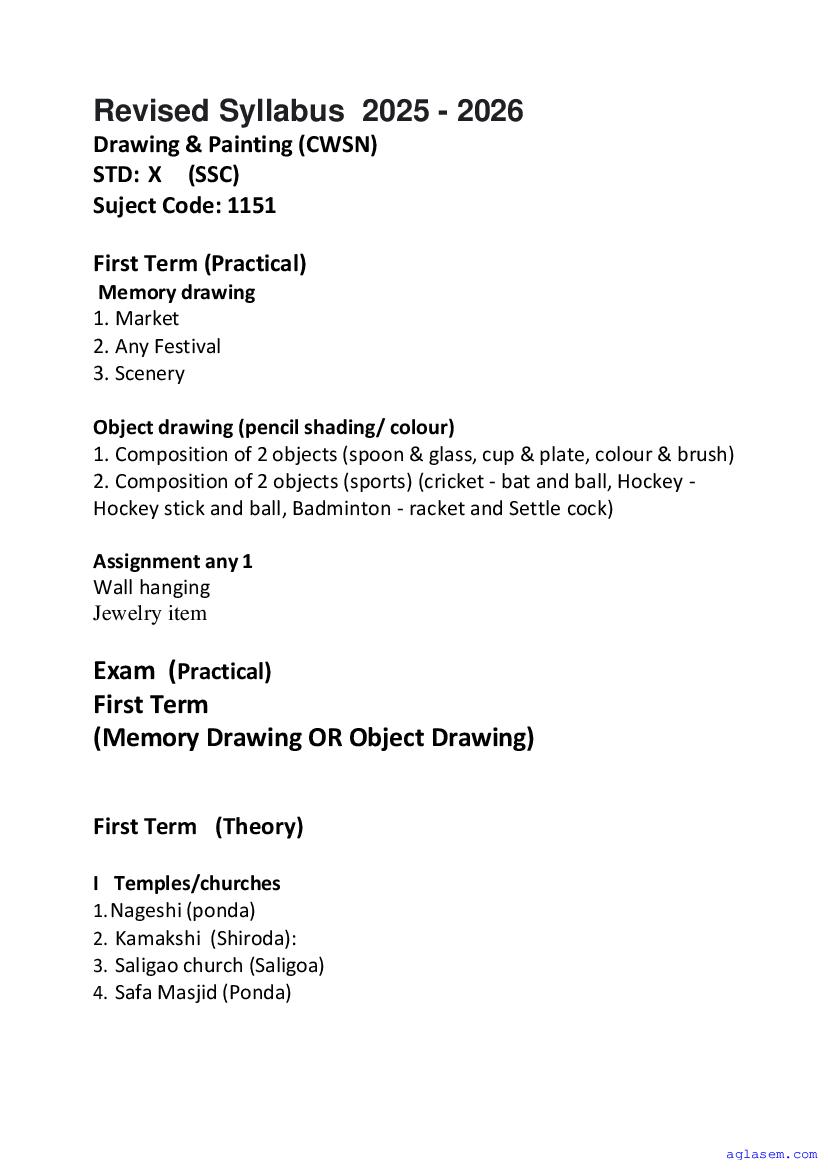
Drawing & Painting (CWSN)
STD: X (SSC)
Suject Code: 1151
First Term (Practical)
Memory drawing
1. Market
2. Any Festival
3. Scenery
Object drawing (pencil shading/ colour)
1. Composition of 2 objects (spoon & glass, cup & plate, colour & brush)
2. Composition of 2 objects (sports) (cricket - bat and ball, Hockey -
Hockey stick and ball, Badminton - racket and Settle cock)
Assignment any 1
Wall hanging
Jewelry item
Exam (Practical)
First Term
(Memory Drawing OR Object Drawing)
First Term (Theory)
I Temples/churches
1. Nageshi (ponda)
2. Kamakshi (Shiroda):
3. Saligao church (Saligoa)
4. Safa Masjid (Ponda)
Page 2
1. Antonio Xavier Trinidad
2. Prafulla Dahanukar
Exam (Theory)
First Term
Second Term (Practical)
Nature Drawing.
1. Study of Flowers (lotus, sunflower,)
2. Study of vegetables in groups
Design (Monochromatic & Polychromatic)
1. Geometrical design in circle (primary and secondary color scheme)
2. Freehand design with natural forms ( warm and cool color scheme)
3. Geometrical design in semi circle
Exam (Practical)
Second Term
(Nature Drawing OR Design)
Second Term (Theory)
I. Indian Artist
1. Amrita Shergil
2. Satish Gujral
3. Days of groly Meerabai
Page 3
1. Madhubani
2. Dekhni
3. Goph
Exam (Theory) Second Term
Syllabus for Exam
Drawing & Painting (CWSN)
STD: X (SSC) 2025 -26
(Theory)
st
First Mid Exam ( 20 Marks 1 Midterm Test July/August)
I Temples/churches
1. Mangeshi (ponda)
2. Kamakshi (Shiroda):
3. Saligao church (Saligoa)
4. Safa Masjid (Ponda)
Paper pattern
Choose the correct alternative (3 Marks, 1 Mark each)
Answer in one word (3 Marks, 1 Mark each)
Match the column ‘A’ with ‘B’ (4 Marks, 1 Mark each)
Think, Visualize & Write (3Marks, 1 Mark each)
True or False (4 Marks, 1 Mark each)
Identify the picture (3 Marks, 1 Mark each)
Total: 20
nd
Second Mid Exam ( 20 Marks 2 Midterm Test Oct)
II. Goa Artist
1. Antonio Xavier Trinidad
2. Prafulla Dahanukar
Page 4
1. Amrita Shergil
2. Satish Gujral
II Folk Art (lndian/Goan)
1. Madhubani
2. Dekhni
3. Goph
Paper pattern
Choose the correct alternative (3 Marks, 1 Mark each)
Answer in one word (3 Marks, 1 Mark each)
Match the column ‘A’ with ‘B’ (4 Marks, 1 Mark each)
Think, Visualize & Write (3Marks, 1 Mark each)
True or False (4 Marks, 1 Mark each)
Identify the picture (3 Marks, 1 Mark each)
Total: 20
(20 Marks Assignment)
(40 Marks Theory Goa Board Final Exam On full Portion)
Paper pattern
Choose the correct alternative (6 Marks, 1 Mark each)
Answer in one word (8 Marks, 1 Mark each)
Match the column ‘A’ with ‘B’ (8Marks, 1 Mark each)
Think, Visualize & Write (6Marks, 1 Mark each)
True or False (6 Marks, 1 Mark each)
Identify the picture (6 Marks, 1 Mark each)
Total: 40
(40 Marks Goa Board Practical Exam)
Page 5
2025-2026
Subject:C.W.S.N.
STD:X (SSC) Suject Code : 1151
First Term
Temples/Churches: Nageshi Temple, Kamakshi Temple, Saligao Church,
Safa Masjid (Ponda)
Nageshi Temple (Ponda)
Shri Nageshi temple is situated in North Goa. Shri Nageshi temple is an ancient
Hindu temple located at Donshiwado of Ponda Taluka. This temple is dedicated to
Lord Nagesh an incarnation of Lord Shiva. Nageshi or Nagesh is a form of Lord
Shiva worshiped by Hindu Goans in India. Shri Nageshi temple is considered to be
“Swayambhu” shrine of Lord Shiva popularly known for its miraculous powers. The
environs known as Nagzar had in the past a grove of Shami trees. A cowherd noticed
a cow from his herd regularly showering milk on a stone in the forest. Thus the
Shiva Linga was discovered by the people. The Nageshi temple was built in 1413,
when the region was under the rule of King Veer Pratap Devaraya of the mighty
Vijay nagara Empire. The temple under went an extensive renovation process in the
days of Chatrapati Shahu the Maratha ruler of Satara. This beautiful temple stands
where it was originally built and not on restored grounds.
Page 6
Deepstambha and the historic old water tank (Tali). It is built in such a way that
standing at a certain point around the tank one can view the reflection of the idol of
Lord Nagesh and the lighted lamps in the inner sanctum. The Sabha mandap of Shri
Nageshi temple has a gallery on both the sides which contains exquisite wooden
carvings depicting the scenes of the great Ramayana and Mahabharata on one side
and the wooden images of Astadikpalaka and Gandharva on the other.
A stone sculpture of the Nani Bull – the vehicle of Lord Shiva is set at the entrance
of the main shrine. On either side of the sanctum are ancillary shrines of Laxmi
Narayan and Lord Ganesh. The most important festival celebrated at this temple
during the month of November is the Anguish Satrap. Also the 8 day Kartik
Poornima, Chaitra Poornima and Maha shivratri are celebrated at this temple.
Page 7
The temple of Shri Kamakshi is located in the middle of hills in the attractive
village of Shiroda. This was built in the late16thcentury.The village of Shiroda is
situated in South Goa, 12 Kms from Ponda town and 22Kms from the city of
Margao.
A huge temple gate leads to the Kamakshi Temple Complex. The Temple is crowned
by an octagonal, two-storied tower, with a golden Kalash perched on its Shikhar. The
temple of Shr i Kamakshi faces east wards and has a large Sabha Mandap or the
traditional open entrance hall. In front of the temple, one can see a tall Deepa sthambh
or the lamp tower. The complex also includes a holy watertank further infront of the
temple.Inside the temple, there is a square shaped chowk, used for conducting the
Prasad ritual, and the Gabhara or the Sanctum Sanctorum with the deity,
ShriKamakshi.
The Kamakshi temple also has protector deities (god or goddess) like Shri Vetal
Page 8
Rayeshwar or Lord Shiva, Shri Lakshmi Narayana or Lord Vishnu with his
consort, GoddessLaxmi, and ShriShantadurga.
Annual celebrations are held at the temple during the Navratri/ Dussehra period
and at the time of Jatra in spring.The idol of Shri Kamakshi at Shiroda is
believed to have come from Guwahati in Assam and the original temple of the
diety was in Raia village in the Salcete taluka.The goddess, however, was
shifted to Shiroda village in Ponda Taluka between 1564and1568. It is believe
that a potter from the Ria village accompanied by some worshippers of the
goddess smuggled the Idol of deity Goddess Kamakshi was brought across
River Kushavati to safety in the Shiroda village.
Church
SaligaoChurch :
Church o Mae de Deus(Saligao)
Stark, stern and yet with a glamorous charm all its own, the Mae de Deus or
Mother of God Church has Gothic spires (triangular shape pyramid) and
pristine (clean fresh) white walls. It reminds one of a fairy tale Castle. It is
situated amidst picturesque(in the middle of old buildings) surroundings of the
typical Goan country side at Saligao in the Bardez taluka and it is attractively
illuminated at night. The Church dedicated to the Mother of God or Our Lady
came to be built at Bardez in 19th century.
Page 9
was inaugurated on November 26,1873.It is the finest example of Gothic style.
The Church building shows hallmark of Gothic architectural style with its
exterior walls supported by massive buttresses and belfry (very big structure
of stone and bell tower in which bell is hanged). The Church building is
stunningly distinctive with its jutting spires, each crowned with a cross.
The courtyard of the Church contains another miraculous statue of the Mae
de Deus (Mother of God),this one is made of black stone, which was brought
from the ruins of the convent of Mae de Deus at Old Goa. The main portal of
the church is almost a full story high with a beautiful domed shape and above
this there is a niche (suitable place) in the façade ( front of the building
facing the street) in which has a statue of OurLady.
Masjid: Safa Masjid (Ponda)
The Safa Masjid is a prominent Islamic shrine in Ponda. Built in 1560 by
Ibrahim Adil Shah, the Sultan of Bijapur, the Safa Mosque survived the havoc
wreaked bythe Portuguese colonizers. Also known as the Shahouri Masjid, the
Page 10
decorating the walls. Themosque has a complex consisting of gardens and
fountains. The rectangular prayer hall of the mosque rests above a high base and is
capped (covered)with a pointed terracotta tile roof. It is an ASI protected
Monument of National Importance in Goa.
The massive water tank within the mosque premises is another attraction. Featuring
small chambers decorated with 'Miharab' designs,the tank is located to the south of
the prayer hall unlike most mosques where it is located outside the main entrance.
The Masonary tank measuring 30 x 30 meters with Miharab designs. This mosque
is a venue of celebration during festivals of Id-Ul-FitrandId-Ul-Zuha.
Page 11
Antonio Xavier Trindade
Trindade was an important painter of the BombaySchoolintheearly20thcentury. He
was born in Portuguese Goa in 1870 in Sanguem and died on16March1935. He
studied art at the Sir J.J. School of Art in Bombay and later taught at the same
institution as a teacher of Drawing and Painting in1898. Later in 1914 took over as
Superintendent of the Reay Workshop of Art at the same institution, position he
held till retirement in1926.The work of António Xavier Trindade skillfully inter
weaves the Cultural Universes of the Indian Sub continent and Western Europe
He received several awards, Such as Mayo Silver Medal for artistic merit in Art. In
1920, the Bombay Art Society honored the artist with its gold medal - the highest
award in India for artists at that time. He did paint portraits, landscapes and still-
life. Trindade excelled in his work and became famous as a portrait painter. Art
critics called him as the „Rembrandt of the East‟. Suffering from diabetes, both his
legs were amputated, none the less, he continued painting with the assistance of his
talented daughter Angela.
24th Maharashtra State Art Exhibition at the Jehangir Arts Gallery, Bombay in
1984, showed more than 33 of his paintings from 1887 to1935 in aspecial
curated Section. Since 2012, António Xavier Trindade‟s work has been
permanently exhibited at Fundação Oriente, Goa. In 2021, the same institution
presented a new permanent exhibition as a celebration of the artist‟s150th
birthday (2020)Trindade‟s paintings are part of collections such as National
Gallery of Modern Art, New Delhi and other private collectors.
Some of his paintings are Miss Ferns, Family by lamplight, The Armenian sisters etc
Page 12
The Armenian Sisters (1932)
This is one of Trindade‟s striking paintings. He has painted a refuges
but doesn‟t paint victimhood, or poverty, but simply focuses on the
sisters. The human figures are proportionately larger than the
environment they are in indirectly introducing you to their reality.
This portraitwaspaintedin1932.The sense of intimacy and realism probably
stems from Trindade‟s useo f layered, multiple glazes of color. The style of
their dress and the pattern on the younger girls frock resembles those worn
by women from neighboring countries, indeed many Armenian muslims left
their homeland. The sisters hardship is symbolized by their bare feet. The
loving closeness of the women is tender and reassuring a key to survival I an
alien society.
Page 13
Prafulla was born Prafulla Joshi in Bandora, Mumbai - Goa on 1stJanuary
1934. She studied fine art at the Sir J. J. School of Art, Mumbai and
graduated with Gold Medalin1955.She had a studio in the seminal Bulabhai
Desai Institute in Mumbai and shared it with V. S. Gaitonde, joining the
Indian Progressives Group orartistsfrom1956-1960.The Government of
France awarded her a scholarship to study fine art inParisin1961.
Prafulla was a committee member of the Lalit Kala Academy in New
Delhi from 1974 to 1979, and the President of Bombay Art Society for
6yearsfrom1993to1998.She was the trustee of the Jehangir Art Gallery
for over 40 years and committee member of Kala Academy,
Page 14
India and the Chairperson of The Artists 'Centre, Mumbai.
Prafulla was one of the founder members of Sangit Kala Kendra with late
Shri Aditya Birla. She was on the Board of Trustees of the Indian National
Theatre. She received Sir J. J. School of Arts Gold Medal in 1955 and the
Bombay Art Society Silver Medal in1955.She painted abstract landscapes in
generally one vivid and dominant color, with myriad shades and subtlety.
She called her paintings" Eternal Space". She had solo exhibitions regularly
from 1956. While in Paris she held an exhibition of her paintings in 1961
and has since then participated in many international exhibitions in England,
Hungary, Switzerland, Germany, Australia, Japan, Portugal, Iceland, and
France.Shehasexhibitedsolo3timesin London.
She has had several independent shows in Mumbai, Delhi, Calcutta, and
Chennai. Jehangir Art gallery, Mumbai honored her by sponsoring a
Retrospective show of Prafulla‟s works on completion of fifty years of
fruitful career. Prafulla's paintings have been offered on Sotheby‟s and
Osean art auctions.
Page 15
glass. These murals adorn prominent buildings in Mumbai, Pilani,
Kolkataand Muscat(Oman).Her paintings are in the collections of the
National Gallery of Modern Artand Lalit Kala Academy in New Delhi,
the Central Museum in Nagpur ,the Prince of Wales Museum in Mumbai,
and many institutional and private collections in India and overseas.
Recently in November 2008 sponsored her exhibition in Dubai, which was
opened by the famous painter M. F. Husain.
The Prafulla Dahanukar Art Foundation (PDAF) was started by Dilip
Dahanukar to keep her memories alive.
Page 16
IndianArtist
Amrita Sher Gil
Amrita was born on 30 January 1913 and passed away on 5 December
1941, at a very young age of 28. She was a Hungarian-Indian Painter. She
has been called "one of the greatest avant-garde women artists of the early
20th century" and a "pioneer" in modern Indian art.
Sher-Gil started getting formal lessons in the art, at the age of eight. She
first gained recognition at the age of 19, for her Painting titled Young
Girls (1932). Sher-Gil depicted everyday life of the people in her
paintings.
Sher-Gil traveled throughout her life to various countries including
Turkey, France, and India, deriving heavily from pre colonial Indian art
styles and its current culture. Sher Gil is considered an
importantpainterof20th-century India. She was also an avid reader and a
pianist. Sher-Gil's paintings are among the most expensive by Indian
women painters today. Many of her works were influenced by the works
of “Rabindranath Tagore”. Her best known painting were Siesta, Village
scene and in the ladies enclosure The Bride, Tahitian, Red brick house
and the hill scene.
Page 17
Treasures, and most of them are housed in the National Gallery of
Modern Art in New Delhi. Some of her paintings also hang at the
Lahore Museum.
A postage stamp depicting her painting 'Hill Women' was released in 1978
by India Post, and the Amrita Sher-Gil Margisa roadin Lutyen‟s Delhi
named after her.
Sher-Gil was able to prove to western societies that Indians were able to
make fine art. Her work is deemed to be so important to Indian culture
that when it is sold in India, the Indian government has stipulated that the
art must stay in the country – fewer than ten of her works have been sold
globally. The Indian cultural center in Budapest is named the Amrita
Sher-Gil Cultural Center. Contemporary. AmritaSher-Gil(1969)is a
documentary film about the artist produced by the GoI‟s Film Division.
UNESCO announced 2013, the 100th anniversary of Sher-Gil's birth,
to be the international year of Amrita Sher-Gil.
Paintings:
Self Portrait, Hungarian Gypsy Girl, Group of Three Girls, Bride‟s Toilet
and Village Scene are few ones to mention.
Page 18
1. Satish Gujral
Satish Gujral was born in Jhelum in undivided Punjab on 25 December 1925 and
passed away on 26 March 2020.
He was a Indian painter, sculptor, muralist and writer of the post-independent
era.
He was awarded India‟s second highest civilian honour by the Republic of India
the Padma Vibhushan in 1999. In April 2014 he was honoured with NDTV
India of the year award.
In 1939, he joined the Mayo School of Arts in Lahore, to study applied arts. He
moved to Mumbai in 1944 and enrolled in the Sir J J School of Art.
In 1947, due to a recurring sickness, he was forced to drop out of school and
leave Mumbai.
In 1952, Gujral received a scholarship to study at the Palacio de Bellas Artes in
Mexico City, where he was apprenticed to the renowned artists Diego Rivera
and David Alfaro Siqueiros.
Page 19
the river and got injured badly. Head was hurt, leg fracture and due to fever he
lost his hearing, so could not go to school .Satish was not accepted at the new
school because he was a deaf and he was not able to speak correctly as he had
hearing problem
From 1952 to 1974, Gujral organised shows of his sculptures, paintings and
graphics in many cities across the world such as New York City, New Delhi,
Montreal, Berlin and Tokyo, among others..
Gujral was also an architect and his design of the Belgium Embassy in New
Delhi was selected by the international forum of architects as one of the finest
buildings built in the 20th century. He designed Goa University.
Works:
Days of Glory, Mourning En Masse, Tree of Life, Meera Bai
Page 20
are unidentified and restrained ( without visual auditory or tactile sense)but the
complete depth of space conveys a solid depth of space convey a solidarity that
speaks to the power of collective experience .It is oil painting on fibre board
Mirabai: It is a famous painting painted by Indian artist Satish Gujral. This
painting was painted in 1999 on Canvas in oil and marble grains. It portrays the
divine devotee of Lord Krishna
Page 21
Madhubani painting
History and techniques
Madhubani art (or Mithilla painting) is a style of Indian painting, practiced in the
Mithilla region of the Indian subcontinent .Traditionally this painting is done with
a variety of tools, including fingers, twigs, brushes, nib-pens, matchsticks. The
paint is created using natural dyes and pigments . Madhubani painting is
characterized by eye catching geometrical pattern colours by bright colours and
Page 22
and festivals. Madhubani painting use two dimensional imagery and the colours
used are from plants.
The background is totally covered by flower and leaf motifs. Forms are defined
with two parallel outlines which is a typical characteristic of this style. In this
paintings generally no space is left empty, the gaps are filled by flowers, animals,
birds and even geometrical designs. Red, yellow and blue are harmoniously used in
these paintings. The striking feature of this painting style is big eyes and long chin.
These paintings are popular because of their tribal motifs and use of bright earthy
colours.
Mithila art has five distinctive styles [Madhubani]
They are as follows:
1) Bharni 2) Katchni 3) Tantrik 4) Godna 5) Kohbar
1. Bharni: This style of Madhubani painting is characterised for its portrayal of
Hindu deities from the Hindu Mythology in a very colourful form .The
canvas of this painting is filled with art from all corners hence the name
Bharni is given.
Page 23
Kayastha community. The images are filled with closely drawn parallel
lines or small dots. This art form has a unique individual style, mainly made
using a monochrome or only two colours.
3. Tantrik: This styles are mainly done by Brahman women in India and Nepal.
Their thing were mainly religious and they depicted Gods and Goddesses
paintings.
4. Godna: It is instantly recognizable for its cow dung based backgrounds and
black outlined drawings, reimagining the original practice of tattooing. This
Godna work is in the form of a Mandala done in concentric circles. The
shapes and figures are outlined with black paint using nib-pens.
5. Kohbar:The subjects of Kohbar‟s paintings are generally fertility, male-
female relations The Kohbar paintings draw and decorate the moon, sun,
tortoise, snake, as symbol of female and male genitalia. This painting is
supposed to have started when the palace of Mithila at Janakpur was
painted with this artwork to herald a blissful, conjugal life for bride Sita and
groom Ram.
Page 24
Dekhni is a semi classical Goan folk dance. It is one of the oldest folk dance
of Goa. Dekhni means beauty. This dance is a mixture of Indian and western
music. Hanv Saiba Poltodi Vetais one of the most famous Dekhni song by
Carlos Eugenio Ferreirathat was initially published in Paris in 1895 and in
Goa in the year 1926.
The story that is depicted in this song is about temple dancers (Devdasi
girls)who want to go for Damu‟s wedding and they approach the boat man for
a favour to ferry them across the river but the boatman says „No‟ the river is
rough. The dancers offer the boat man their gold Jwellery but still he refuses
to take them so the dancers dance for the boat man till he is ready to take them
across the river.
Being one of the best and oldest forms of dance, Dekhni
continuestobeaheart-
stirringdanceform,thebeautyofwhichcontinuestocharmmillions.Thetraditio
Page 25
India.
Whenever you get a chance of paying a visit to this majestic country, just
have a look at this terrific dance form that would definitely thrill your heart
with grace and exquisiteness. In the end, it will not be wrong to say that if
ever feel life colorless, just go for Dekni. So do ensure to witness this dance
form of Dekhni at least once in you rentire life time
A nother form of popular folk dance, the dekhni represents an attractive
mixture offolk culture and Western music, danced mostly by Christian girls
in fully Indian dress.
The gestures in the dance appear to have been borrowed from the
Kathak and Bharata Natyam. Dekhni in Konkani language means
“delightful beauty”. This song-cum-dance performed only by women to
the accompaniment of folk drum “Ghumat”, displays are blend of Indian
and Western cultures. The dance enacts the life of a “Devdasi”(literally
meaning servant of God) girl whose job is to perform dance in temples
and social ceremonies like weddings. The dance set to western rhythms
and Indian melody, is livened up by the conversation between the girl
and the boatman in the fom of a lilting song, which lingers in the mind
for along time.
The dancers carry pantis (diya) orartis.Only two orthree dekhni songs,
composed and scored longtime ago, are extant. It is surmised that the
dance form owes its birth to devdasis singing and dancing for their visitors.
The song Hanv sayaba pailtadi vaita, popular for its attractive tune, is
perhaps the most well known dekhni song.
Page 26
Goph : It is performed in the Phalgun month during the Shigmo Festival which
is a popular dance in South Goa in which colorful cloth plaits hang from a point
in the ceiling and dancers holding a plait each dancer dance in such a way that a
beautiful braid is formed
Golf dance also called "ribbon dance" is one of the popular folk dances of
Goa. Goan peasants mainly practice this dance after the harvest as a
manifestation of their enjoyment. This dance has an affinity with tribal dance
forms of Gujarat State. The dance is a major attraction during the festive
season and it attracts audiences from various parts of the country.
Page 27
Generally, this folk dance is performed in a group. The dance can be performed
by a group of males or females. Each dancer holds a colorful cord which hangs
at the center point of the 'mand', which is the place of dance performance. It is a
skilled dance form where cords are used by dancers to form artistic pattern.
Colorful cloth plaits hang from a point in ceiling and dancers holding a plait.
The dancers start dancing intricately forminga beautiful, colorful, intricate braid
at the end of the first movement. The music begins once again and the dancers
reverse the pattern of dancing in such a skillful manner that at the end ofthe
second movement, the braid gets unrevealed and all the cords are loose and
single once again.
There are four different braids of Goff dance. The songs that are sung during the
dance performance are mostly devoted to Lord Krishna.
MusicalInstrumentsofGolfdance
Ghumat, Samael and Surta Shansi or melodic musical instruments
accompany the dance performance.
Costume of Golfdance
The costume of this folk dance is varied however all the attires are traditional.
Some male groups prefer to wear kurta - pajamaand some kurta dhoti. One
the other hand, some female dance groups clad themselves sing hagra-choli
while some sari.
***************************************************************
Page 28
Subject: Drawing and Painting (cwsn)
Class: Xth Subject code: 1151
TOPICS AND MARKS DISTRIBUTION (2025-2026)
FIRST TERM (THEORY)
I. Temples/ Church.
June Nageshi (Ponda) 4 Marks
June Kamakshi (Shiroda) 4 Marks
July Saligao Church (Saligao) 3 Marks
August Safa Masjid (Ponda) 3 Marks
September Antonio Xavier Trinidad 3 Marks
October Prafulla Dahanukar 3 Marks
SECOND TERM (THEORY)
I. Indian Artist.
November Amrita Shergil 4 Marks
November Satish Gujral 5 Marks
Days of Glory Meerabai
II. Folk Art (Indian/Goan)
December Madhubani 4 Marks
December Dekhni 4 Marks
December goph 3 Marks
FIRST TERM (Practical)
I. Memory Drawing.
June Market
July Any festival
August Scenery
II. Object Drawing.
September Composition of 2objects (spoon & glass, cup & plate, Colour & brush.
October Composition of 2objects (sports) cricket- bat & ball, hockey stick &
ball, Badminton- racket & settle cock.
FIRST TERM EXAM (Practical)
(Memory Drawing OR Object Drawing)
Page 29
I. Nature Drawing.
November Study of Flowers (lotus, sunflower)
Study of Vegetables in group.
II. Design (Monochromatic & Polychromatic)
December Geometrical Design in circle, semi-circle (Primary and Secondary
color scheme)
Freehand design with natural forms (Warm and Cool color scheme)
SECOND TERM EXAM (Practical)
(Nature Drawing OR Design)
Assignment: (Any one)
Wall hanging
Jewellery item
Theory Goa Board Final Exam on Full Portion 40 Marks
Practical Goa Board Final Exam 40 Marks
Assignment 20 Marks
______________________________________________________________
TOTAL: 100 Marks
______________________________________________________________
Paper Pattern: Theory- 40 Marks
Choose the correct alternative (6 Marks, 1 Mark each)
Answer in one word (8 Marks, 1 Mark each)
Match the column ‘A’ with ‘B’. (8 Marks, 1 Mark each)
Think, Visualize & Write (6 Marks, 1 Mark each)
State whether the following statement is True or False. (6 Marks, 1 Mark each)
Name the Pictures. (6 Marks, 1 Mark each)
___________________________________________________________________________
TOTAL: 40 Marks
___________________________________________________________________________
Page 30
Subject: Drawing and Painting (cwsn)
Class: Xth Subject code: 1151
Exam (Theory)
(Assessment through Paper pen test)
Exam (Practical)
(Assessment through Rubric Method)
Memory Drawing
Object Drawing
Nature Drawing / Design
Assignment: (Any One)
(Assessment through Rubric Method)
Theory Board Exam 40 Marks
Practical Board Exam 40 marks (Assessment through Rubric Method)
Assignment 20 Marks (Assessment through Rubric Method)
Total: 100 Marks
Page 31
Std: X Sub: Drawing & Painting- CWSN (1151)
*The following rubric is a teacher’s guideline for assessing students' practical Exam. It can be used for
teacher assessment.
Needs _/4
Excellent Good Satisfactory Improvement
Criteria
04 03 02 01
Good
Excellent drawing Basic drawing Poor drawing
Drawing drawing skill skill skill skill
Good used of
Excellent use of different Limited used Very simple use
Form different form form of form of form
Contains a
strong Shows a basic Display poor
Masterful composition understanding composition
composition with with good of composition with little
excellent use of use of with adequate understanding
Composition elements elements use of elements of elements
Good
Outstanding texture
texture used used with Basic or plain
with different different texture Hardly use of
Texture idea idea applied any texture
Good use of
Excellent use of Perspective Basic Poor use of
Perspective in in artwork Perspective in Perspective in
Perspective artwork artwork artwork
Excellent space Good space Limited space No space
managed in work managed in managed in managed in
space work work work
Good skill Limited skill
Outstanding skill and control Basic skill and and control in
and control in in the use of control in the the use of
the use of media media and use of media media and
Medium/Tools and tools tools and tools tools
Shows a
Displays good level of Demonstrates
outstanding originality/cr some
originality/ eativity originality/ The artwork is
Creative creativity creativity less creative
Page 32
scheme with
some tints Basic colour
Excellent colour and shades scheme with Monotones
scheme with tints limited with no tints
Colour Scheme and shades colours and shade
Excellent overall Good Normal,
effect in artwork effect in satisfactory Need more
Overall artwork artwork effects
Total: 40
Guidelines for Use:
1 Teachers use the rubric to evaluate each student’s practical exam, providing detailed feedback
based on the criteria.
2 Can be customized as per need.
Page 33
Std: X Sub: Drawing & Painting- CWSN (1151)
*The following rubric is a teacher guideline for assessing students' Assignment/Project. It can be used
for teacher assessment.
Needs /2
Excellent Good Satisfactory Improvement
Criteria 02 1.5 1.0 0.5
Outstanding skill Good skill
and control in and control in Basic skill and Limited skill and
the use of the use of control in the control in the use
Material and Material and use of Material of Material and
Material used tools tools and tools tools
Satisfactory
Excellent Good neatness Poor neatness and
Neatness neatness and neatness and and finishing
finishing finishing finishing
Originality Displays Shows a good
outstanding level of Demonstrates The art work
originality originality some lacks originality
originality
Displays Shows a good Demonstrates
outstanding level of some originality/
originality/ originality/ creativity The artwork is not
Creative/Innovative creativity creativity creative
Excellent overall Good effect Normal
effect in the in the satisfactory
Overall artwork artwork artwork Need more affects
Total: 20
Suggestions for Teachers:
1. Can be customized as per need.
2. Add other relevant criteria based on the specific requirements of the Subject.
Page 34
Subject: Drawing and Painting (cwsn)
Class: Xth Subject code: 1151
Objective Remembering Understanding Application Creative Total
Content Areas MCQ VSA SA LA MCQ VSA SA LA MCQ VSA SA LA MCQ VSA SA LA
1(1) 1(1)
Nageshi Temple 1(1) 1(1) 4
1(1)
Kamakshi Temple 1(1) 1(1) 1(1) 4
1(1) 1(1)
Saligao Church 1(1) 3
1(1) 1(1)
Safa Masjid 3
1(1)
1(1)
Antonio Xavier 1(1) 1(1) 3
Trinidad
1(1) 1(1)
Prafulla Dhanukar 1(1) 3
1(1)
Amrita Shergill 1(1) 1(1) 1(1) 4
1(1) 1(1) 1(1)
Satish Gujral 1(1) 4
1(1) 1(1) 1(1)
Madhubani 1(1) 4
1(1) 1(1)
Dekhnni 1(1) 1(1) 4
1(1) 1(1)
Goph 1(1) 1(1) 4
40
Page 35
(2025 – 2026)
th
Class: X Subject: Drawing and Painting Theory (cwsn)
Subject code: 1151 Time: 2 HRS MARKS: 40
__________________________________________________
Q. Choose the correct alternative from those given below and
complete the sentence. (6 Marks)
1. The temple of shri Kamakshi is located in village of ________
a) Ponda
b) Old Goa
c) Shiroda
d) Verna
2. Lord Nagesh an incarnation of _________________________
a) Lord Ganesh
b) Lord Vishnu
c) Lord Krishna
d) Lord Shiva
3. Satish Gujral, a renowned Indian artist is known for his
Contributions to which field of art____________________
a) Sculpture & Painting
b) Music & Dance
c) Poetry & Literature
d) Photography & Filmaking
4. The Mae De Deus church in saligao, Goa is dedicated to which
deity__________________
a) St. Francis Xavier
b) Our lady of the Rosary
c) Mother of God
d) Our lady of Immaculate Conception
5. Madhubani paintings originated in which Indian state _______________
a) Rajasthan
b) Bihar
c) West Bengal
d) Uttar Pradesh
Page 36
a) Torch
b) Pantis (Diyas)
c) Divli
d) Candels
Q. Answer in one word. (8 Marks)
7. Where is Safa Masjid Located?
Ans: _______________________________________________
8. Which is the famous painting of Antonio Xavier Trindade?
Ans: _______________________________________________
9. Which artist painted the painting “Days of Glory”?
Ans: _______________________________________________
10. Madhubani art is also known as?
Ans: _______________________________________________
11. Which dance is performed in the phalgun month during the
shigmo festival?
Ans: _______________________________________________
12. Godess Kamakshi was bought across which river?
Ans: _______________________________________________
13. Which temple is an ancient Hindu temple located at
Donshiwado,Ponda taluka?
Ans: _______________________________________________
14. Who was an Hungarian- Indian painter?
Ans: _______________________________________________
Page 37
‘A’ Answer ‘B’
15. satish Gujral ____________________ North Goa
16. Madhubani ____________________ Family by lamp light
17. Dekhni ____________________ Islamic shrine
18. Amrita shergill ___________________ Folk dance
19. Nageshi Temple __________________ creating murals
20. safa Masjid ____________________ Meera Bai
21. Antonio Xavier Trinaded ___________ Bharni
22. Prafulla Dhanukar _______________ Indian artist
Q. Think, Visualize & Write. (6 Marks)
23. Dekhni is performed by- Groups of women’s.
Goph is performed by- _______________________________
24. Nageshi temple- Lord shiva
Kamakashi- _______________________________________
25. satish Gujral- Indian artist
Antonio Xavier Trinadade - ___________________________
26. Prafulla Dhanukar- Painting Eternal space
Amrita shergill- _____________________________________
27. Safa Masjid- Ponda
Church of Mae de Deus- ____________________________
28. Goph dancer’s holds a- Colourful cord
Dekhni dancer’s carries- _____________________________
Page 38
29. Dekhni is a semi classical Indian folk dance _____________
30. Goph dance has an affinity with tribal dance forms of
Gujarat_________
31. Amrita shergill is a famous Goan artist __________________
32. Prafulla Dhanukar was the committee member of Kala
Academy ______________
33. Saligao church reminds one of a fairy tale castel __________
34. The temple of shri. Kamakshi is located at Panjim _________
Q. Name the Pictures. (6 Marks)
35. Identify the picture _________________________________
Page 39
37. Identify the picture _______________________________________
38. Identify the picture _______________________________________
Page 40
40. Identify the picture _______________________________________
+++++++++++++++++++++++++ BEST OF LUCK ++++++++++++++++++++++++++++
Page 41
(2025 – 2026)
th
Class: X Subject: Drawing and Painting Practical
(cwsn) Subject code: 1151 Time: 2 HRS
MARKS: 40
__________________________________________________
TOTAL NO. OF QUESTIONS: 2
Q.1 Draw and colour in mix media colour scheme.
Topic- Geometrical design in Square or circle
Circle radius- 6cms
Square- 15cms X 15cms
OR
Q.2 Draw and do Pencil Shading, showing proper light and shade.
Topic- Any Vegetabels
Circle radius- 6cms
+++++++++++++++++++++++++ BEST OF LUCK ++++++++++++++++++++++++++++
Document Details
| Board / Org | Goa Board |
| Exam | Class 10 |
| Type | Sample Paper |
| Pages | 41 |
| Updated | 24 Sep 2026 |