Goa Board Class 10 Sample Paper 2026 Bharatnatyam
Finished viewing? Save it for later —
Download Goa Board Class 10 Sample Paper 2026 Bharatnatyam (PDF · 17 pages)About Goa Board Class 10 Sample Paper 2026 Bharatnatyam
Goa Board Class 10 Sample Paper 2026 Bharatnatyam is available here for free download. Published by Goa Board for Class 10, this sample paper can be viewed online or downloaded as a PDF (17 pages). Candidates preparing for Class 10 can use Goa Board Class 10 Sample Paper 2026 Bharatnatyam to understand the exam pattern, the type of questions asked, and the overall difficulty level.
Frequently Asked Questions
How can I download Goa Board Class 10 Sample Paper 2026 Bharatnatyam?
Open this page and click the Download button to save Goa Board Class 10 Sample Paper 2026 Bharatnatyam as a PDF. It is completely free on AglaSem Docs.
Is Goa Board Class 10 Sample Paper 2026 Bharatnatyam free to download?
Yes. Goa Board Class 10 Sample Paper 2026 Bharatnatyam can be viewed online and downloaded as a PDF free of cost on AglaSem Docs.
How many pages does Goa Board Class 10 Sample Paper 2026 Bharatnatyam have?
Goa Board Class 10 Sample Paper 2026 Bharatnatyam contains 17 pages, which you can read online or download together as a single PDF.
Where can I find more Class 10 study material?
You can find more Class 10 question papers, sample papers, syllabus, and answer keys on AglaSem Docs.
Goa Board Class 10 Sample Paper 2026 Bharatnatyam – Text
Read the full text of this sample paper below — useful to quickly search, copy and reference the content online without downloading the PDF.
📄 View text version (17 pages)
Page 1
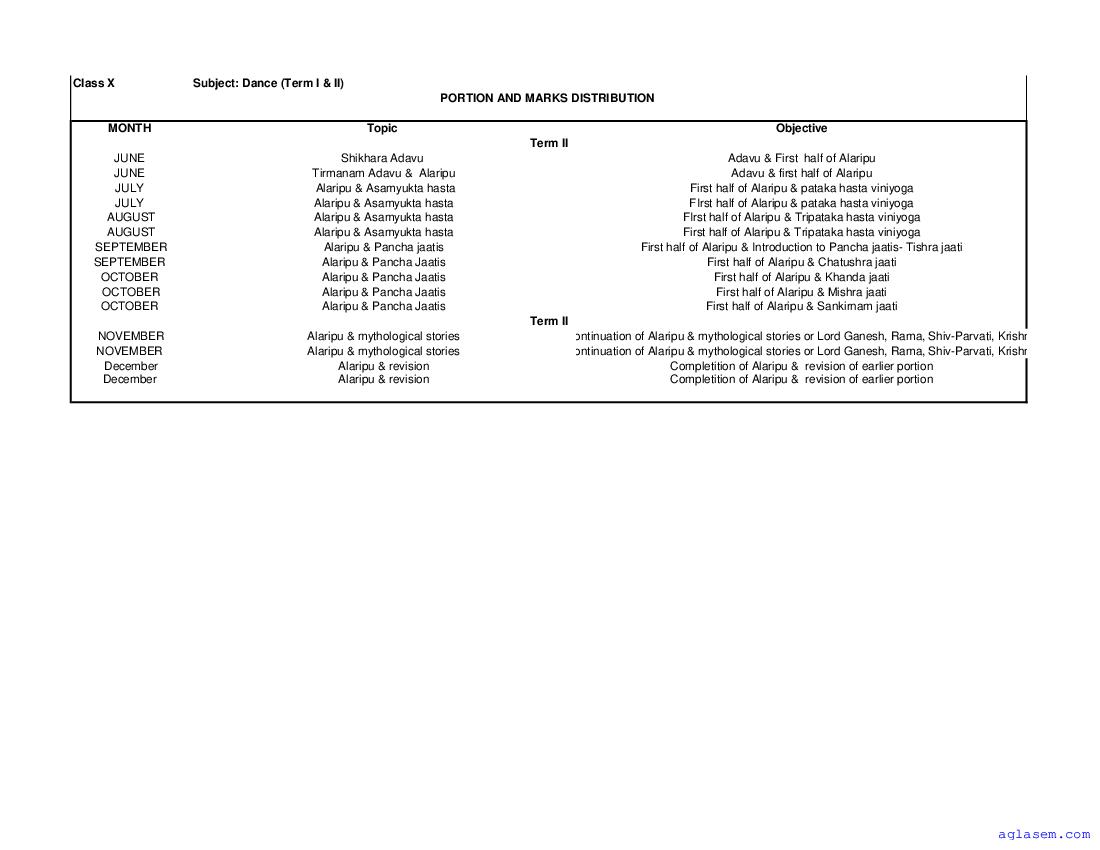
PORTION AND MARKS DISTRIBUTION
MONTH Topic Objective
Term II
JUNE Shikhara Adavu Adavu & First half of Alaripu
JUNE Tirmanam Adavu & Alaripu Adavu & first half of Alaripu
JULY Alaripu & Asamyukta hasta First half of Alaripu & pataka hasta viniyoga
JULY Alaripu & Asamyukta hasta FIrst half of Alaripu & pataka hasta viniyoga
AUGUST Alaripu & Asamyukta hasta FIrst half of Alaripu & Tripataka hasta viniyoga
AUGUST Alaripu & Asamyukta hasta First half of Alaripu & Tripataka hasta viniyoga
SEPTEMBER Alaripu & Pancha jaatis First half of Alaripu & Introduction to Pancha jaatis- Tishra jaati
SEPTEMBER Alaripu & Pancha Jaatis First half of Alaripu & Chatushra jaati
OCTOBER Alaripu & Pancha Jaatis First half of Alaripu & Khanda jaati
OCTOBER Alaripu & Pancha Jaatis First half of Alaripu & Mishra jaati
OCTOBER Alaripu & Pancha Jaatis First half of Alaripu & Sankirnam jaati
Term II
NOVEMBER Alaripu & mythological stories Continuation of Alaripu & mythological stories or Lord Ganesh, Rama, Shiv-Parvati, Krishna
NOVEMBER Alaripu & mythological stories Continuation of Alaripu & mythological stories or Lord Ganesh, Rama, Shiv-Parvati, Krishna
December Alaripu & revision Completition of Alaripu & revision of earlier portion
December Alaripu & revision Completition of Alaripu & revision of earlier portion
Page 2
(Rubric evaluation)
Criteria Excellent Very Good Good Needs
(8) (6) (4 ) Improvement
(2)
1. Technical Skills Dance Dance performed Dance Although
( Ang shuddhi, performed with with attention to performed with remembers some
Araimandi) great attention details of attention to of the dance
to quality of technique, has most details of steps, little
movement, attained technique but attention is paid
body position & proficiency in hasn’t attained to how
other details of dance style. proficiency, movements are
dance. Also some technical done or other
demonstrates errors. details of the
an excellent dance.
understanding
of dance style.
2. Knowledge of Demonstrates Demonstrates Demonstrates Remembers a few
basic steps learnt excellent good knowledge of knowledge of of
& the knowledge of steps and steps & steps/movements
choreography of steps and choreography, few choreography, and tries but fails
the items. choreography errors however it some errors (3-5 to deliver the
( Based on Adavus and does it well. doesn’t interfere errors) causing good.
& items) with performance. brief pause in
performance.
3. Rhythm/Tempo Shows a Accurate in beat, Generally Attempts to keep
(Understanding of complete tempo, rhythms of accurate in beat, a rhytm, but gets
tala, dancing on understanding dance sequences tempo, rhythms off beat and
tala, of tempo & throughout the of dance speeds up or fails
understanding , beat and stays dance and good in sequences most behind often,
music) on rhythm reciting of tala. of the time and doesn’t follow
throughout the is good in beat in music,
dance and reciting tala with student has failed
excellent minimum errors. to understand
recitation of the tala.
tala.
4. Orals & Recitation The student is The student is able The student is The student
(Based on able to recite to recite Shlokas able to recite hasn’t learnt & is
Mudras, Bhedas & Shlokas and and other theory Shlokas and unable to recite
Shlokas) other theory related notes in a other theory Shlokas and other
related notes very good manner. related notes in theory related
perfectly. a good manner notes .
but lacks fluency.
5. Performance Skills The Student is The student is able The student is The student is not
(Based on able to perform to perform generally very focused in
performing with excellently with decently with good focussed on performance and
confidence, excellent confidence, with performance but is delivering very
attentiveness, confidence, good facial is bit low on minimum
glances, perfect facial expressions and is showing expressions and
Page 3
is attentive in attention with expressions. confidence.
drawing body expressions.
attention with
body
expressions.
I) Assignment (topics)
Project – 20 marks (Related to Dance) (Any one)
1. Making chart papers on renowned classical dances /folk dances of
Goa.(To gather knowledge and information)
2. Choreography of small episodes from the mythological stories.(To show
creativity level)
3. Interviewing local/professional artistes by preparing a questionnaire (To
get inspiration) in the field of dance, classical as well as folk dance
artistes.
Page 4
BLUE-PRINT S.S.C./H.S.S.C. Eamination
Duration 1.30 hours
Subject :- Bharatanatyam Maximum Marks :- 40
Objectives Remembering Understanding Application Creativity
MCQ VSA SA LA MCQ VSA SA LA MCQ VSA SA LA MCQ VSA SA LA Total
Asamyukta hasta 1 4 5
Pancha jaatis 1 2 3
Mythological stories 1 5 6
Bhedas 2 2
Brief knowledge of Bharatanatyam 4 3 7
Types of Abhinaya 2 5 7
Folk dances of Goa 3 4 7
Previous year portion 1 2 3
Total - 40 marks
Page 5
Practical – 40 marks
1. Adavus –
Shikhara Adavu – 1 variation - 5 marks
Tirmanam – (Kita taka tari kita tom) - 5 marks
2. First half of Alaripu in tishra jaati – Eka talam. – 13 marks
Theory – 40 marks
1. Asamyukta hasta viniyogas (Uses of Pataka & Tripataka hastas)
Recitation & presentation– 5 marks
2. Reciting Pancha jaatis in 3 speeds. -3 marks
3. Mythological stories on Lord Krishna, Rama, Ganesh, Shiv & Parvati. –
6 marks
2nd Term
Practical – 40 marks
1. Second half of Alaripu in tishra jaati – Eka talam. – 12 marks
2. Knowledge of the previous year portion is compulsory – 5 marks
Theory – 40 marks
1. Bhedas- Mandala & Drishti bhedas – 2 marks
2. Brief knowledge of Bharatanatyam. – 7 marks
3. Meaning of Abhinaya and 4 types of Abhinaya (Angika, Aharya, Vaachika,
Satvika ) – 7 marks
4. Knowledge of folk dances of Goa. – 7 marks
Knowledge of the previous year portion is compulsory – 3 marks
Sr. Syllabus topics Learning Outcome
Page 6
1. Shikhara & Tirmanam Students will be able to learn the basic postures,
Adavus footwork and steps.
2. Alaripu Students will be able to learn nritta item (pure
dance) which includes basic adavus, eyes, neck,
head & various body movements.
3. Asamyukta Hastas Students will be able to learn 28 single hand
mudras shlokas which can be used while
performing practically.
4. Pancha jaatis Students will be able to learn the basic 5 talas in
3 speeds.
5. Bhedas Students will be able to learn various shlokas
and present it practically using various moments.
6. Mythological stories Students will be able to learn various
mythological stories of Lord Ganesh, Rama,
Shiv-Parvati, Krishna etc.
7. Brief information on Students will be able to learn the ancient history
Bharatanatyam of the classical form.
8. Types of Abhinaya Students will be able to learn different types of
abhinaya & use the theory knowledge in their
perfromances.
9. Folk dances of Goa Students will be able to learn the various forms
of folk dances of Goa & understand it existence
and stories of vrious folk culture.
10. Revision of portion Students will be able to revise previous years
syllabus as it will help in the recollecting all the
previous years portion.
Project – 20 marks (Related to Dance) (Any one)
1. Making chart papers on renowned classical dances /folk dances of
Goa.(To gather knowledge and information)
2. Choreography of small episodes from the mythological stories.(To show
creativity level)
3. Interviewing local/professional artistes by preparing a questionnaire (To
get inspiration) in the field of dance, classical as well as folk dance
artistes.
Page 7
1. Making chart papers on renowned classical dances /folk dances of
Goa.(To gather knowledge and information)
2. Choreography of small episodes from the mythological stories.(To show
creativity level)
3. Interviewing local/professional artistes by preparing a questionnaire (To
get inspiration) in the field of dance, classical as well as folk dance
artistes.
Page 8
Syllabus for Dance for Semester 1 & 2
Std- X (SSC)
Brief information of Bharatanatyam and its history.
Bharatanatyam is a composite art, which corresponds not merely to the senses, but
to the souls of the dancer and the Perceiver. Bharatanatyam may be defined as an
art that conveys spiritual expression. This dance form cannot be adequately
performed without reverence for technique and spiritual life. Bharatanatyam lifts one
from temporal to eternal values. The intimate association of dance with religion and
ritual (a form of worship in the temples) is well established. The institution of the
Devadasis (servants of the God) contributed in perpetuating and preserving the art.
In ancient times, the system of dedicating young girls to the temples as Devadasis
seems to have prevailed.
Bharatanatyam is one of the oldest classical dance forms of the South Indian state of
Tamil Nadu. Both - female and male dancers now practice Bharatanatyam. Its
inspirations come from the sculptures of the Nataraja temple of Chidambaram.
In ancient times, Devadasis performed Bharatanatyam, which was earlier known as
'Sadir' in the temple. Many of the ancient sculptures in Hindu temples are Karanas or
dance postures. In the most essential sense, a Hindu deity is revered as a royal
guest in his temple and offered the 'Shodashopacharam' (the sixteen hospitalities) -
among which music and dance are to please the senses. Thus, many Hindu Indian
rulers and the temples maintained a complement of trained musicians and dancers.
Place of origin: Bharatanatyam is a form of dance prevalent in South India in
Tamilnadu.
Salient features of Bharatanatyam
a. Bharatanatyam is an art of temples in this form the dancer offers herself and soul
at the feet of the Divine Lord.
b. Bharatanatyam is a harmonious blending of Bhava, Raga & Tala.
c. In Bharatanatyam the dancer is a storyteller.
d. Bharatanatyam has many vehicles of expression, the movement of the limbs, the
language of gesture or hastas, rhythm.
Style of music: The style of music is Carnatic.
Page 9
Nattuvangam (Cymbals) played by the Nattuvanar (Guru),
Mridangam, (Percussion instrument),
Vocals (Carnatic),
Violin (string instrument),
Flute (wind instrument).
ABHINAYA
The expressions which are shown to express poetic meanings is Abhinaya. Here the
emphasis is more on facial expressions than rhythmic movements. The Abhinaya is
divided as
Angikabhinaya
Vachikabhinaya
Aharyabhinaya
Satvikabhinaya
Angikabhinaya- Expressing the meanings of lyrics using the body parts like Head,
Hands, Legs etc. is Angikabhinaya. The Bhedas which are explained above come
under Angikabhinaya.
Vachikabhinaya- Expressing the Story using narrations in the dance drama is
Vachikabhinaya.
Aharyabhinaya- Imitating the Costumes, Jewellry, Make-up etc. in a dance comes
under Aharyabhinaya.
Satvikabhinaya - Showing the Bhava (moods) come under Satvikabhinaya.
Page 10
1. Pataka Hasta Viniyoga
2. Tripataka hasta Viniyoga
Page 11
Drishti means ”eyes” in sanskrit. The 8 eye movements refer to the eye positions
when expressing a particular bhava.
1. Samam: Keep eyes still
2. Alokitam: Roll eye balls in a circular pattern
3. Saachi: Look through the corner of the eyes
4. Pralokitam: Move your eyes side to side.
5. Nimilitam: It looks like a half shut eye, try to focus the eye ball towards
the heart
6. Ullokitam: Look upwards
7. Anuvrittam: Move eyes up and down rapidly
8. Avalokitam: Look down
Sloka:
Samam Alokitam Saachi pralokita Nimility Ullokita-anuvritte cha tatha chaiva-
avalokitam Ithyashtho drishthi bhedaha syu kirtitah purvasuribhi
Mandala bheda
Sthaanakam Cha Aayatha Aalidham Prenkhana Prerithaani Cha
Prathayaalidham Svasthikam Cha Motitham Samasuchikaa
Paarshvasuchithi Cha Dhasha Mandalaani Rithaaniha
Page 12
Adavu is a rhythmic movement of the hands, legs, and head in Indian classical
dance. It is a basic step that forms the foundation of Bharatanatyam and Kuchipudi.
Laya
Laya is a term that refers to rhythm, tempo, or the separation of sounds by time. It is
a fundamental concept in Indian music and dance. There are 3 speeds in laya
1. Vilambit kaal (Slow)
2. Madhya kaal (Medium)
3. Dhrut kaal (Fast)
Nritta, Nritya, and Natya are the basic fundamentals of dance.They are often used to
describe the elements of classical Indian dances like Bharatanatyam.
Nritta
• Is a pure dance void of abhinaya (expressions)
• Abstract dance movements that follow the rhythm of the music
• Emphasizes footwork and graceful body movements
Nritya
• Is an expressive dance
• Uses facial expressions, hand gestures, and body movements to
convey the meaning
• Relates to the psychological state and rasa of the song being sung
• Interpretive dance that conveys themes and emotions
Natya
• The dramatic aspect of a stage performance
• Includes spoken dialogue and mime to convey meaning and enact
narrative
• Can also be considered a combination of literature, music, and drama
Page 13
The five Pancha Jaatis are as follows
* Tishra: 3 beats - Ta ki ta
* Chatushra: 4 beats - Ta ka di mi
* Khandam: 5 beats - Ta ka ta ki ta
* Mishram: 7 beats - Ta ka di mi ta ki ta
* Sankeernam: 9 beats - Ta ka di mi ta ka ta ki ta
Folk dances of Goa
Goa has a rich cultural heritage and beautiful tradition of folk dances.The Goan folk
dances and music are performed for both religious festivals as well as cheerful
events. Goan folk dances are a vibrant part of the state’s cultural heritage, blending
Indian and Portuguese influences. Dances like Dekhni, Fugdi, Dhalo, and Ghode
Modni are performed during festivals and community events, showcasing themes of
daily life, spirituality, and historical valour. Each dance features traditional attire, and
energetic movements, and is accompanied by local instruments like the ghumot.
These dances offer a glimpse into Goa’s unique history and community spirit,
celebrating its cultural diversity.
Different folk dances of Goa.
1. Kunbi
2. Dekhni
3. Dhalo
4. Dhangar
5. Fugdi
6. Ghodemoni
7. Divli dance
8. Veerbhadra
9. Mando
10. Morullo
11. Zagor
12. Musal
Page 14
Hanuman), Tiny tots – Best of mythological tales, The churning of the ocean (Vishnu
saves creation Vol 538.
Page 15
Sub- Bharatanatyam theory paper Total - 40 marks
Q. I Fill in the blanks with appropriate answers – 7 marks
1) Uses of pataka hand gesture ____________ and ____________
a. denote clouds and forest
b. Tishra and Mishra
c. denote pot and strings
d. denote crown and tree
2) Lord Krishna is the incarnation of lord _________________
a. Shiva
b. Vishnu
c. Brahma
d. Ganesh
3) There are _____________ number of jaatis in the tala system.
a. 3
b. 5
c. 4
d. 7
4) Bharatanatyam originates from the _______________ state.
a. Tamilnadu
b. Kerala
c. Andhra Pradesh
d. Uttar Pradesh
Page 16
a. Kalbeliya
b. Garba
c. Bihu
d. Morullo
6) Carnatic music belongs to which form of dance ____________
a. Western
b. Bharatanatyam
c. Kathak
d. Dhangar
7. ‘Bha’ in Bharatanatyam stands for ________________
a. Taal
b. Expressions
c. dance
d. Nritta
Q. II. Match the following 6 marks
1. Kathakali a. Dekhni
2. Abhinaya b. Sadir
3. Goa c. Makeup
4. Bharatanatyam d. Kerala
5. Aharya e. Satvika
6. Goff f. Colourful Cords
Page 17
1) Write down the matras of sankeerna jaati.
2) Write down Drishti or Mandala bheda shlokas.
3) Name any 4 folk dances of Goa.
4) Name any 4 classical dance styles of India and the states they originate from.
5) Write brief information on any one folk dance of Goa.
Q. IV. Brief knowledge of Bharatanatyam 3 marks
Q. V.
A) Write down the shlok of Tripataka Viniyoga and its meaning. 4 marks
OR
B) Write down the shlok of Pataka viniyoga and its meaning
Q.VI.
A) Give brief information on Aharya abhinaya and its application in Goan folk
dances. 5 marks
OR
B) Give brief information on Vachika abhinaya and its application in Bharatanatyam.
Q.VII. Write down any one life episode from the life of any one of the below
mentioned dieties. 5 marks
A) Lord Krishna
B) Lord Rama
C) Ganesh
D) Shiva
THE END
Document Details
| Board / Org | Goa Board |
| Exam | Class 10 |
| Type | Sample Paper |
| Pages | 17 |
| Updated | 24 Sep 2026 |