UGC NET Syllabus for Population Studies 2020
Finished viewing? Save it for later —
Download UGC NET Syllabus for Population Studies 2020 (PDF · 26 pages)About UGC NET Syllabus for Population Studies 2020
UGC NET Syllabus for Population Studies 2020 is available here for free download. Published by NTA for UGC National Eligibility Test, this syllabus can be viewed online or downloaded as a PDF (26 pages). Candidates preparing for UGC National Eligibility Test can use UGC NET Syllabus for Population Studies 2020 to understand the exam pattern, the type of questions asked, and the overall difficulty level.
Frequently Asked Questions
How can I download UGC NET Syllabus for Population Studies 2020?
Open this page and click the Download button to save UGC NET Syllabus for Population Studies 2020 as a PDF. It is completely free on AglaSem Docs.
Is UGC NET Syllabus for Population Studies 2020 free to download?
Yes. UGC NET Syllabus for Population Studies 2020 can be viewed online and downloaded as a PDF free of cost on AglaSem Docs.
How many pages does UGC NET Syllabus for Population Studies 2020 have?
UGC NET Syllabus for Population Studies 2020 contains 26 pages, which you can read online or download together as a single PDF.
Where can I find more UGC National Eligibility Test study material?
You can find more UGC National Eligibility Test question papers, sample papers, syllabus, and answer keys on AglaSem Docs.
UGC NET Syllabus for Population Studies 2020 – Text
Read the full text of this syllabus below — useful to quickly search, copy and reference the content online without downloading the PDF.
📄 View text version (26 pages)
Page 1
UGC NET
Syllabus · Population
Studies
EXAM YEAR TYPE SUBJECT
UGC NET — Syllabus Population Studies
Notes · Sample Papers · Previous Year Papers · Mock Tests
Page 2
m .co
c. o
e m
em l a s
s a g
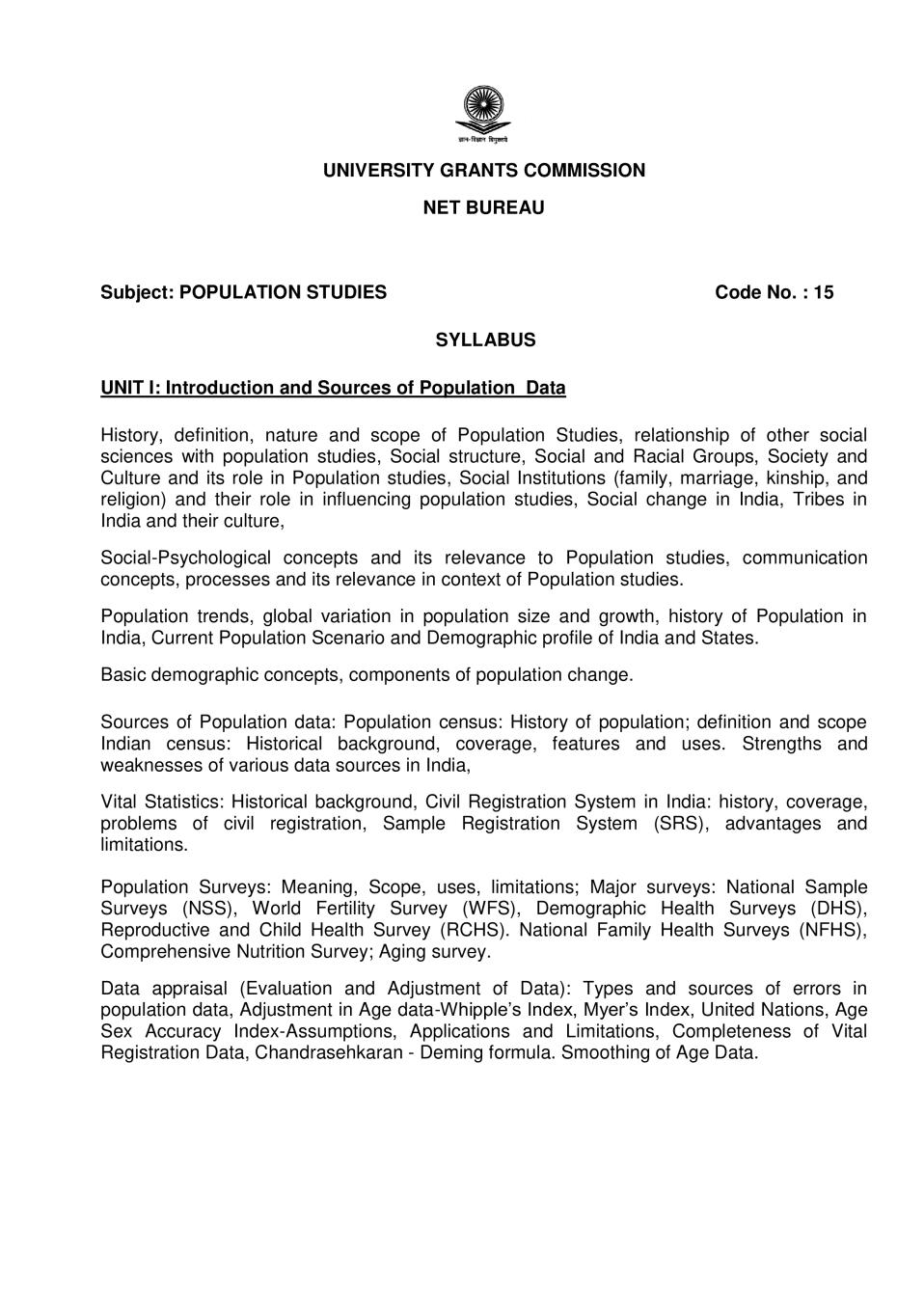
UNIVERSITY GRANTS COMMISSION
NET BUREAU
m
m c. o
Subject: POPULATION STUDIES Code No. : 15
.co s e m
m la
SYLLABUS
s e g
gl a
UNIT I: Introduction and Sources of Population Data
a
a
History, definition, nature and scope of Population Studies, relationship of other social
sciences with population studies, Social structure, Social and Racial Groups, Society and
Culture and its role in Population studies, Social Institutions (family, marriage, kinship, and
religion) and their role in influencing population studies, Social change in India, Tribes in
India and their culture,
Social-Psychological concepts and its relevance to Population studies, communication
m
concepts, processes and its relevance in context of Population studies.
. co
em
Population trends, global variation in population size and growth, history of Population in
s
India, Current Population Scenario and Demographic profile of India and States.
g l a
a
Basic demographic concepts, components of population change.
Sources of Population data: Population census: History of population; definition and scope
Indian census: Historical background, coverage, features and uses. Strengths and
weaknesses of various data sources in India,
Vital Statistics: Historical background, Civil Registration System in India: history, coverage,
problems of civil registration, Sample Registration System (SRS), advantages and
limitations.
m
m .co
Population Surveys: Meaning, Scope, uses, limitations; Major surveys: National Sample
c. o se
m
Surveys (NSS), World Fertility Survey (WFS), Demographic Health Surveys (DHS),
em a
Reproductive and Child Health Survey (RCHS). National Family Health Surveys (NFHS),
s g l
la Data appraisal (Evaluation and Adjustment of Data): Types
Comprehensive Nutrition Survey; Aging survey.
g a and sources of errors in
a population data, Adjustment in Age data-Whipple’s Index, Myer’s Index, United Nations, Age
Sex Accuracy Index-Assumptions, Applications and Limitations, Completeness of Vital
Registration Data, Chandrasehkaran - Deming formula. Smoothing of Age Data.
m .
.co s e m
e m l a
l a s a g
ag For more Question Papers, Sample Papers, Notes & Syllabus visit Page 1 of 25
Page 3
Rates, Ratio, Proportion, percentages, density, incidence and prevalence, person-years
Rate of Population Growth: Arithmetic, Geometric and Exponential growth rates, Decadal
growth rate Doubling time, concept of population stabilization and net reproduction rate unity
Crude and Standardized methods for fertility and mortality estimates.
Location of event in time and the Lexis diagram.
Method of Population Projection: Mathematical methods of population projection (Linera,
Exponential, Polymonial, Gompertz and Logistic Growth Curves for Population Projection);
Component method of Population projection; Sub-national population projection; Projection
methods of labour force, school enrolment, workforce and households etc.
Population Projections by United Nations, World Bank and Expert Committee of Government
of India,
Population estimates: Inter censual/Post-censual estimates of population, population
pyramid.
Population and sample parameters, sampling distribution of mean and standard error.
Statistical Methods: Frequency distribution, descriptive and inductive statistics, measures of
central tendency (mean, median, mode); measures of dispersion (range, variance and
standard deviation); correlation and linear regression, introduction to testing of statistical
hypothesis and test of significance, interpolation and extrapolation.
UNIT III: Population Composition and Change
Spatial and temporal changes in the size and distribution of population-global perspective
with focus on India
Age and sex structure of population in developed and developing countries
Composition of India’s population: Demographic, social, economic and Cultural factors
affecting age-sex structure of population and its relevance in population dynamics: global
and India perspectives; Spatial distribution of population: measures of concentration of
population: density, distribution-dissimilarity index, tempo of urbanization, Rank-size rule,
Gini’s concentration ratio, Lorenz curve, etc. ; Factors affecting spatial distribution, density
and concentration of population-global, national, regional patterns.
Population Ageing: Concepts and measures of population ageing, components of population
ageing. Trends and pattern of ageing in India and States.
Demographic dividend, Sex-ratio, Sex-ratio at birth, Child-Women ratio, Median Age, Age-
Sex Pyramid, Dependency Ratio (Child Dependency Ratio, Old Dependence Ratio, Total
Dependency Ratio).
For more Question Papers, Sample Papers, Notes & Syllabus visit Page 2 of 25
Page 4
m .co
c. o
e m
m a s
se Social, economic and health aspects of Ageings;
dependency; Emerging issues related to elderly. a g l
Living arrangements, family support,
UNIT IV: Nuptiality and Fertility
Nuptiality: Concepts and sources of data; Measures- crude marriage rate, age specific
m
c. o
marriage rates, order specific marriage rates, singulate mean age at marriage (SMAM); -
m
.co e m
a. Singulate Mean Age at Marriage (SMAM) - Synthetic Cohort and Decadal
em
Synthetic Cohort Method.
la s
s g
b. Indices of Nuptiality (Coale’s Indices)
l a a
ag
Marriage patterns in India: levels, trends and differentials in age at marriage, divorce,
widowhood, widow remarriage
Levels and trends in widowhood in India and States, Impact of changes in widowhood/
divorce on fertility, mean age of widowhood/divorce from Census data.
Fertility:
o m
c
Basic concepts and terms used in study of fertility.
m . computation, Cross-sectional or Period
s e Fertility Rate (GFR), Age Specific Fertility Rate
Fertility Indicators: sources of data and their
(ASFR), Age Specific Marital Fertility a
l
indicators: Crude Birth Rate (CBR), General
a g
Rate (ASMFR), Total Marital Fertility Rate (TMFR),
Total Fertility Rate (TFR),Gross Reproduction Rate (GRR), Net Reproduction Rate (NRR),
Replacement level Fertility, Birth order statistics, Child Women ratio, Order Specific Fertility
Measures.
Cohort Indicators: Children ever born, completed family size.
Age Standardization or Adjustment, Direct and Indirect Standardized Birth Rates, Sex-Age
Adjusted Birth Rate.
m
Levels, Trends and Differentials of Fertility in India, Determinants of Fertility: Post-Partum
c o
om of fertility analysis: Davis and Blake Intermediate VariableeFramework,
m.
Amenorrhoea (PPA), Breast feeding, Sterility, Fecundity and other factors.
c.Framework
em Bongaart’s Proximate Determinants, Lee and Bulatoo FrameworklaofsFertility.
l as a g for Age Pattern of Fertility,
ag
Indirect Methods of Estimation of Fertility : Coale-Trussell’s Model
Reverse Survival Technique of Fertility Estimation, Rele Technique, P/F Ratio Technique,
Brass P1/F1Ratio Technique.
Fertility transition in developed and developing countries with special reference to India,
Implications of below replacement level of fertility
m .
.co s e m
e m l a
l a s a g
ag For more Question Papers, Sample Papers, Notes & Syllabus visit Page 3 of 25
Page 5
Mortality: Basic concept, definitions and measures of pregnancy wastage (miscarriage,
abortion, fetal death, still birth), live birth; early, late and post neo-natal deaths; infant and
child death.
Mortality Indicators: Crude Death Rate (CDR), Age Specific Death Rate (ASDR), Infant
Mortality Rate (IMR), Under-five mortality Rate, Neo-natal mortality rate, Post-natal mortality
rate; Maternal Mortality Rate (MMR).
Infant Mortality: Levels and determinants of Infant and Child mortality in India, causes of
Infant mortality (Endogenous and Exogenous). Mosley and Chen’s Framework for Child
Survival
Sources of Mortality Data and its Quality: Measures of mortality, need and importance of the
study of mortality for policy and public interventions; relative merits and demerits of mortality
measures.
Levels and Trends in mortality by developed and developing regions with special reference
to India, age and sex specific mortality, differentials in mortality by place of residence and
socio-economic characteristics, factors responsible for high mortality in the past and reasons
for mortality decline in developing countries.
Indirect method of estimation of Infant and Child mortality rates
Direct and Indirect standardization of mortality rates,
Life Table: Basic concepts, types and forms of life tables and Model Life Table, need of
Model Life Table (MLT), UN Model Life Table, computation of life table, construction of life
table based on age-specific deaths rates (ASDR), underlying assumptions of life table
construction using ASDRs of community during specified period, use of life table application
of life table in demographic analysis.
Morbidity: Concepts and definitions of health and morbidity; sources of data and measures
of morbidity.
Morbidity Indicators: Incidence, Prevalence and Case-fatality ratio.
Overview of epidemiological transition in developed and developing countries with special
reference to India
Health: Reproductive Health:- Definition, rationale, approach, evolution of ideas about reproductive
health; Maternal morbidity, Emergency obstetric care, Adolescent reproductive morbidity, Strategies
to reduce maternal morbidity and mortality in India, Abortion related issues.
Reproductive Tract Infection (RTI)/Sexually Transmitted Infection (STI), HIV/AIDS and their
implications.
Reproductive Rights and Ethical Issues
For more Question Papers, Sample Papers, Notes & Syllabus visit Page 4 of 25
Page 6
m .co
c. o
e m
m a s
se Causes of Deaths Statistics: Definition and sources of
a g l Global
causes
to International Classification of Diseases (ICD – X (1990),
of death statistics, Introduction
leading causes of death
with special reference to Asia and India; Distribution of deaths by main causes and by age,
life expectancy.
Burden of Disease Estimates: Need for the study of burden of disease; Basic concepts;
Measures of Burden of Disease; and current scenario of burden of disease in India by
States/UTs.
m
Ageing and Burden of Diseases, Life expectancy and disability free life expectancy,
o m c. o
c
. and Migration e m
e m la s
s g
Unit VI-Urbanization
g l a a
a
Urbanization:
Concept and definition of ‘Urban’ in India and other countries.
Process of urbanization, measures and sources of data.
Inter-relationship between urbanization and migration in developed and developing countries.
m
Trends, patterns, characteristics and differentials of Urbanization in India.
. co
em
Classification of settlements, characteristic, evolution and growth, morphology, land use
s
patterns and functions, spatial organisations, principles of centrality and hierarchy, methods
l a
of measuring centrality, central place region, contribution of Christaller and Losch.
Urbanisation and Urban Changeag – changing distribution of world’s urban population,
principles and causes of urban growth, urban hierarchy (rank size rule), characteristics of
primate city, cycle of urbanization, economic and social theories of formation of urban
centres, stages of urban development models, demographic and social change in post World
War-II urban system in developed and developing countries.
Socioeconomic and environmental consequences of urbanization and urban growth in
developed and developing countries:– employment, urban informal sector, basic amenities,
o m
housing, health, education, elderly population, environment, sustainability, smart cities and
urban future.
.c
om Cities:– hierarchy of world cities, growth and activities of theeminstitutions
c.World s
em a
of global
s
capital.
g l
gla Migration: a
a
Basic concepts and definitions - circulation, mobility, commutation and migration.
Sources of data - nature, coverage and limitations of the available data.
Types of migration: internal and international
m .
.co s e m
e m l a
l a s a g
ag For more Question Papers, Sample Papers, Notes & Syllabus visit Page 5 of 25
Page 7
Determinants and consequences of Internal and International migrations.
Refugees – issues and implications.
Direct and indirect measures of migration - estimation of lifetime and inter-censal migration
rates from census data, indirect measures of net internal migration using Vital Statistics
Method, National Growth Rate Method, Census and Life Table Survival Ratio methods,
Methods of estimating international migration
Theories of Internal and International Migration - Ravenstein, Everett Lee, Lewis-Fei-Ranis
model, Todaro, Stouffer, Zelinsky, Neoclassical Economic Theory, New Household
Economic Theory, Duel Labour Market Theory, World System Theory, Social Network
Theory, Cumulative Causation Theory.
Unit VII-Population, Development and Environment
Environment in the context of development, interrelationship between population growth,
environment and development
Concepts of Development and its Measures: Limitations of per capita income as an indicator
of development, human centered development-welfare approach, investment in human-
capital approach, Human Development Index (HDI), Physical Quality of Life Index (PQLI),
Concepts of Social Development, Social capital and Social change; Social Development
Index (SDI), Gender Development Index (GDI), Millennium Development Goals (MDG),
Concept of Sustainable Development, Sustainable Development Goals (SDG),Concepts and
Measures of Poverty, Human Poverty Index (HPI).
Effect of development on population dynamics, age structure transition, demographic
transition, demographic dividends and population ageing.
Views regarding the relationship between population and development:
(i) Views of different religions on pro-natalist and prosperity argument: Greek philosophers’
views, Chinese philosopher Confucius writings on optimum population, Classical
Mercantilist and Physiocrats views, Socialist and Marxist views etc.
(ii) Pessimistic perspective: Population growth viewed as an obstacle to development,
Malthus theory, Coale and Hoover study, Tragedy of commons, Limits to growth study
and Enke's investment model etc.
(iii) Optimistic perspective: Population growth is conducive to development – Mercantilist
views, Colin and Condorcet views, views of Colin Clark, Ester Boserup and Julian Simon
etc.
(iv) Neutralist/revisionist perspective: Need to study linkages between population change
and development- views of Simon Kuznets, Allan Kelly and Robert Schmidt, Bloom and
Williamson etc.
Population and Resources:
Natural resources: types of natural resources, renewable and non-renewable resources,
resources scarcity and resource depletion.
For more Question Papers, Sample Papers, Notes & Syllabus visit Page 6 of 25
Page 8
m .co
c. o
e m
m a s
se Capital resources: effect of demographic factors on
a g lproductivity
savings
and development; importance of technology to improve the
and investments, technology
of physical assets.
Human resources: quantitative aspects:- concepts of labour force, economically active
population, unemployment, types of unemployment; disguised, seasonal, frictional and
chronic. Factors affecting demand and supply of labour, effect of population growth and
development on structure of employment.
Implications of population growth: on food supply, water, sanitation, housing,
m
c. o
employment, health, education , energy, etc; environmental degradation - air pollution,
m
greenhouse effect – global warming, climate change; pressure of population growth on land
c. o e m
use:- soil erosion, desertification, deforestation, and soil salinity etc.
e a s
m ecological imbalance caused by natural and human factors andltheir
a s
Human Eco-systems:-
l a g
ag
impacts on human ecological systems, human perception and adjustment to imbalance,
sustainable human eco-systems.
Guidelines for environmental protection, international protocols
Developmental plans, polices and strategies in India in the context of Population and
environment.
Unit VIII-Population Issues: Gender and Special Groups
o m
c
Gender:
m . in historical perspective,
s e of population: Age-sex structure, Fertility,
Concept and meaning of gender; evolution of gender
la
Gender and its relationship with components
Mortality, Migration.
a g
Major morbidity and mortality burden in the developing world with major focus on India, Sex
ratio at births, major health problems experienced by women and men, reproductive health of
women and men in developing world, differentials in use of male and female methods of
contraception
Health and Nutrition issues of adolescent boys and girls , abuse and maltreatment, puberty,
sexual debut, adolescent pregnancy, abortion, women and family planning programs,
o m
contraceptive technology, Major risk factors of men’s health: masculinity, alcoholism, tobacco
om dimension of economic development: women’s access toemeconomic
and drug consumption, accident etc.
.c
c.Gender s
m
e work, profiling women’s work, informal sector involvement, gworking a
resources,
as entitlements, land ownership, inheritance laws, access to credit,
l measurements of women’s
l a
ag
condition, maternity
benefits, wage differentials, gender and poverty
Globalization: changing pattern of economic activity, issues of marginalization and
vulnerability along with agency, negotiation and spaces of power, gender divisions in urban
labor markets, gender and migration
m .
.co s e m
e m l a
l a s a g
ag For more Question Papers, Sample Papers, Notes & Syllabus visit Page 7 of 25
Page 9
Environmental degradation: changes in climate, water table and land use and their
differential impact on men and women
The Concept of gender mainstreaming: gender mainstreaming in various health and
development sectors- e.g. Agriculture, Health, Education, gender in work place (public &
private) etc.
Gender inequality and status of women:- social, economic, cultural, health and domestic
violence, women autonomy and empowerment and its demographic implications, gender
empowerment measure (GEM).
Scheduled Castes (SC) and Scheduled Tribes (ST): size, growth, composition and
distribution in India, development plans and programmes for SC and ST and their impact on
population.
Disabled / Physically challenged population: size, growth and distribution in India,
classification of physically challenged population.
Development Plans and Programmes for physically challenged population in India.
Unit –IX-Population & Health Policies and Programmes
National Policies: Evolution and Development of Population, Health and related Policies
viz., National Population Policy 1977, National Health Policy 1983, National Population Policy
2000, National Health Policy 2002, National Health policy 2017, National Nutrition Policy,
National Policy on Older Persons, Social Security for Elderly, Legislations to protect Elderly
in India, Protect National Youth Policy, National Policy on HIV/AIDS, National Environment
Policy etc., its Purpose, Goals & Objectives, Thematic areas and Strategies.
Population and Policies on special groups, Ageing and Disabilities, Ageing and Quality of
Life, Ageing and Mental Health problems, Social Gradients of health for Ageing Population,
Healthy Ageing, WHO Frame Work for Healthy Ageing. Geriatric care in India
Role of NITI Ayog in Health and Population related policies and programme
Population, Health and related Policies and Programme at State levels.
Evolution of Family Welfare Programme in India since 1952, Population control strategies
under different Five Year Plans till current period.
Recommendations of various Experts Committee viz., Bhore Committee, Mudaliar
Committee, Chadha Committee, Mukherjee Committee, Jungalwalla Committee, Kartar
Singh Committee, Shrivastav Committee, Bajaj Committee etc.
National Heath Mission (NHM): History and Evolution, various schemes under NHM:
Reproductive, Maternal, Newborn, Child Health and Adolescent (RMNCHA) Programme etc.
For more Question Papers, Sample Papers, Notes & Syllabus visit Page 8 of 25
Page 10
m .co
c. o
e m
m a s
se Policies, Programmes and Legislations in India:
a g l AgeAct),at Marriage,
related
Termination of Pregnancy, Sex Selected Abortion (PCPNDT
to Medical
COTPA Act-2003
(Tobacco Control Act), Policies and Programme related to Reproductive and Child Health.
Adolescent Health, Child Health, Ante Natal, Natal and Post Natal Care, Immunization,
Vitamin Deficiency, Diarrhoea and Acute Respiratory Infection, Family Planning, RTIs/STDs;
HIV/AIDS, Public Health Nutrition; Causes of Infertility and its Treatment in government
programme, Social and Psychological consequences of Infertility, Socio-Psychological and
Health problems of menopausal women.
m
Family Planning Methods-Traditional vs Modern Methods, Advantages/Disadvantages,
m c. o
Effectiveness of various methods,
.co s e m
m
Achievements of various components of RMNCH+A Programme
a s e g la
l a
National Programme for Health care of Elderly, Communicable and Non Communicable
ag
Diseases, programme.
Methods and approaches of impact assessment of different policies and programme on
Population and Health of people.
Health Infrastructure and Delivery System in India: Health System functioning in India,
Organizational Structure- Sub Heath Center, Primary Health Center, Community Health
Center, Health System of District ,State and Center levels, Role and Responsibilities of
various categories of health personnel in Family Welfare Programme, Concept and
m
Implementation of Universal Health Care in India.
. co
Decentralization Strategies in Health, Role of Panchayati Raj Institutions (PRIs) in Health,
em
Health Systems Reforms in India, Public-Private Partnership in Health and Family Welfare
l a s
services, Role of ICDS in reducing malnutrition and coordination with health sectors, Inter-
a g
sectoral Coordination for improving hygiene, water and Sanitation etc .
Basic Concepts in Public Financing in Health: equity, efficiency and effectiveness of health
care delivery, basic concept of investment in health, public goods and private goods,
externalities, public sector spending on health, Basic Concepts in National Health
Accounting, Need & Concepts in Social Health Insurance, Schemes in Social Health
Schemes, principles and methods of economic evaluation of population & health
programmes.
m
Global Issues and Challenges in Population and Health: Concept of global health, global
co
demographic, health and epidemiological Transition, Role of United Nations and Other
m .
c. o m
International Agencies like UNFPA, Population Council,WHO etc in Health and Population;
em se
UN World Population Conferences: Bucharest (1974), Mexico (1984), Cairo (1994)
s l a
Conferences, Alma Ata Declaration (1978)-Health for all by 2000, Components of Primary
g
la a
Health Care, Millennium Development Goals (2000), Sustainable Development Goals (2016).
ag Health Policies and Health System in developed and developing countries.
Unit 10 - Research Methodology and Programme Evaluation
Principle and methods of Social Science Research,
Scientific Research-conceptual, empirical and analytical framework of research,
m .
.co s e m
e m l a
l a s a g
ag For more Question Papers, Sample Papers, Notes & Syllabus visit Page 9 of 25
Page 11
evaluation research
Research Design: Observational Study (Descriptive and Exploratory Study) and
Experimental Studies (Quasi Experimental and True Experimental Study, Longitudinal and
Panel Study Design, Issues relates to reliability and validity in research design.
Method of Data Collection and Analysis: Quantitative and Qualitative methods of data
collection, quality of data in evaluation research. concept and application of odds ratio and
relative risks, concept and application of probability in analysis of population data, laws of
probability and concept of Baye’s Theorem, Concept and application of Binomial,
Exponential and Normal Distributions in population data analysis. concept of statistical
hypothesis, concept and application of correlation, association and regression, concept of p-
value (level of significance),concept of confidence interval, concept and application of
logistics regression analysis.
Sampling: Sampling concept, concept of sampling unit, sampling frame and sampling design,
sampling and non-sampling errors, standard error, sample size determination
Sampling Methods and Techniques: Simple random sampling, stratified random sampling,
systematic random sampling, cluster sampling, purposive sampling, multi-stage sampling,
Design effect in sampling.
Research Problem and Formulation of Research Hypotheses: defining the research
problem; components of the research problem; Formulating the research hypothesis.
Research Report Writing and Ethics in Research: Types of research reports – Brief
reports and Detailed reports; Report writing: Structure of the research report,
Interpretations of Results and suggested recommendations;
Ethics in Research; Client’s Ethical code; Researcher’s Ethical code; Ethical Codes
related to respondents;
Monitoring and Evaluation of Programme: Basic concept of monitoring and evaluation,
difference between monitoring and evaluation, monitoring of health Programme:- data
requirements and Indicators, Health Management Information System (HMIS) as tool of
programme monitoring, Indicators based on service statistics based on:- Input, Process,
Output; acceptance/utilization rate of various services, strength and limitations of HMIS data,
Evaluation of accessibility, availability, equity, quality and gender perspectives in RMNCH+A
Services.
Types of Evaluation-Formative and summative evaluation, concurrent evaluation, Framework
for the evaluation of the programme, Types and levels of indicators in programme
evaluation- (Input process, output, outcome, and impact indicators), role of service statistics
and surveys in programme evaluation.
Concepts and applications of GIS in Population Studies
Spatial Concepts: Spatial parameters- site and location, scale, plane and spherical
coordinate; Map projections, types of maps, digital representations of spatial and non spatial
data.
For more Question Papers, Sample Papers, Notes & Syllabus visit Page 10 of 25
Page 12
m .co
c. o
e m
m a s
se Introduction to GIS: Types of data, discrete and
a g l preparation.
continuous
Geo-referencing/Geo-coding and basics of digitization, layouts
data, raster and vector data,
Spatial Data Representations and Analysis: Bar and line diagram, frequency polygon,
frequency curve; spatial uni-variate and multivariate statistics: spatial correlation and
regression, Matrix algebra; auto-correlation; spatial interpolations, kriging, Moran’s I index.
m
m c. o
.co s e m
em la
l a s a g
ag
m
. co
s em
g l a
a
m
m .co
c. o se
m
s em g la
gla a
a
m .
.co s e m
e m l a
l a s a g
ag For more Question Papers, Sample Papers, Notes & Syllabus visit Page 11 of 25
Page 13
Page 14
. e
em las
as ag
m
om . co
.c e m
e m l a s
l a s a g
ag
m
. co
s em
g l a
a
m
m c. o
c. o s e m
s em la
gla ag
a
m . c
c. o s e m
m a
se
For more Question Papers, Sample Papers, Notes & Syllabus visit
g l
Page 13 of 25
Page 15
Page 16
. e
em las
as ag
m
om . co
.c e m
e m l a s
l a s a g
ag
m
. co
s em
g l a
a
m
m c. o
c. o s e m
s em la
gla ag
a
m . c
c. o s e m
m a
se
For more Question Papers, Sample Papers, Notes & Syllabus visit
g l
Page 15 of 25
Page 17
Page 18
. e
em las
as ag
m
om . co
.c e m
e m l a s
l a s a g
ag
m
. co
s em
g l a
a
m
m c. o
c. o s e m
s em la
gla ag
a
m . c
c. o s e m
m a
se
For more Question Papers, Sample Papers, Notes & Syllabus visit
g l
Page 17 of 25
Page 19
Page 20
. e
em las
as ag
m
om . co
.c e m
e m l a s
l a s a g
ag
m
. co
s em
g l a
a
m
m c. o
c. o s e m
s em la
gla ag
a
m . c
c. o s e m
m a
se
For more Question Papers, Sample Papers, Notes & Syllabus visit
g l
Page 19 of 25
Page 21
Page 22
. e
em las
as ag
m
om . co
.c e m
e m l a s
l a s a g
ag
m
. co
s em
g l a
a
m
m c. o
c. o s e m
s em la
gla ag
a
m . c
c. o s e m
m a
se
For more Question Papers, Sample Papers, Notes & Syllabus visit
g l
Page 21 of 25
Page 23
Page 24
. e
em las
as ag
m
om . co
.c e m
e m l a s
l a s a g
ag
m
. co
s em
g l a
a
m
m c. o
c. o s e m
s em la
gla ag
a
m . c
c. o s e m
m a
se
For more Question Papers, Sample Papers, Notes & Syllabus visit
g l
Page 23 of 25
Page 25
Page 26
. e
em las
as ag
m
om . co
.c e m
e m l a s
l a s a g
ag
m
. co
s em
g l a
a
m
m c. o
c. o s e m
s em la
gla ag
a
m . c
c. o s e m
m a
se
For more Question Papers, Sample Papers, Notes & Syllabus visit
g l
Page 25 of 25
Document Details
| Board / Org | NTA |
| Exam | UGC National Eligibility Test |
| Type | Syllabus |
| Pages | 26 |
| Updated | 15 Jul 2026 |