Delhi Forest Guard Recruitment 2020 Syllabus
Finished viewing? Save it for later —
Download Delhi Forest Guard Recruitment 2020 Syllabus (PDF · 5 pages)About Delhi Forest Guard Recruitment 2020 Syllabus
Delhi Forest Guard Recruitment 2020 Syllabus is available here for free download. Published by Default for Govt Jobs Exams, this syllabus can be viewed online or downloaded as a PDF (5 pages). Candidates preparing for Govt Jobs Exams can use Delhi Forest Guard Recruitment 2020 Syllabus to understand the exam pattern, the type of questions asked, and the overall difficulty level.
Frequently Asked Questions
How can I download Delhi Forest Guard Recruitment 2020 Syllabus?
Open this page and click the Download button to save Delhi Forest Guard Recruitment 2020 Syllabus as a PDF. It is completely free on AglaSem Docs.
Is Delhi Forest Guard Recruitment 2020 Syllabus free to download?
Yes. Delhi Forest Guard Recruitment 2020 Syllabus can be viewed online and downloaded as a PDF free of cost on AglaSem Docs.
How many pages does Delhi Forest Guard Recruitment 2020 Syllabus have?
Delhi Forest Guard Recruitment 2020 Syllabus contains 5 pages, which you can read online or download together as a single PDF.
Where can I find more Govt Jobs Exams study material?
You can find more Govt Jobs Exams question papers, sample papers, syllabus, and answer keys on AglaSem Docs.
Delhi Forest Guard Recruitment 2020 Syllabus – Text
Read the full text of this syllabus below — useful to quickly search, copy and reference the content online without downloading the PDF.
📄 View text version (5 pages)
Page 1
SC/ST/OBC must ensure that they are entitled to such reservation/ relaxation
as per eligibility prescribed in the rules/notice. They should also be in
possession of all the requisite certificates in the prescribed format in support
of their claim as stipulated in the rules/ notice for such benefits, and these
certificates should be dated earlier than the due date (closing date) of the
application for Examination.
13. Withdrawal of applications:
No request for withdrawal of candidature received from a candidate after
he/she has submitted his/her application will be entertained under any
circumstances.
14. Other Instructions:
(i)Department of Forests & Wildlife reserves the right to
cancel/restrict/enlarge/modify/alter the recruitment process, if needed, without
issuing any notice.
(ii) Legal jurisdiction will be Delhi in case of any dispute.
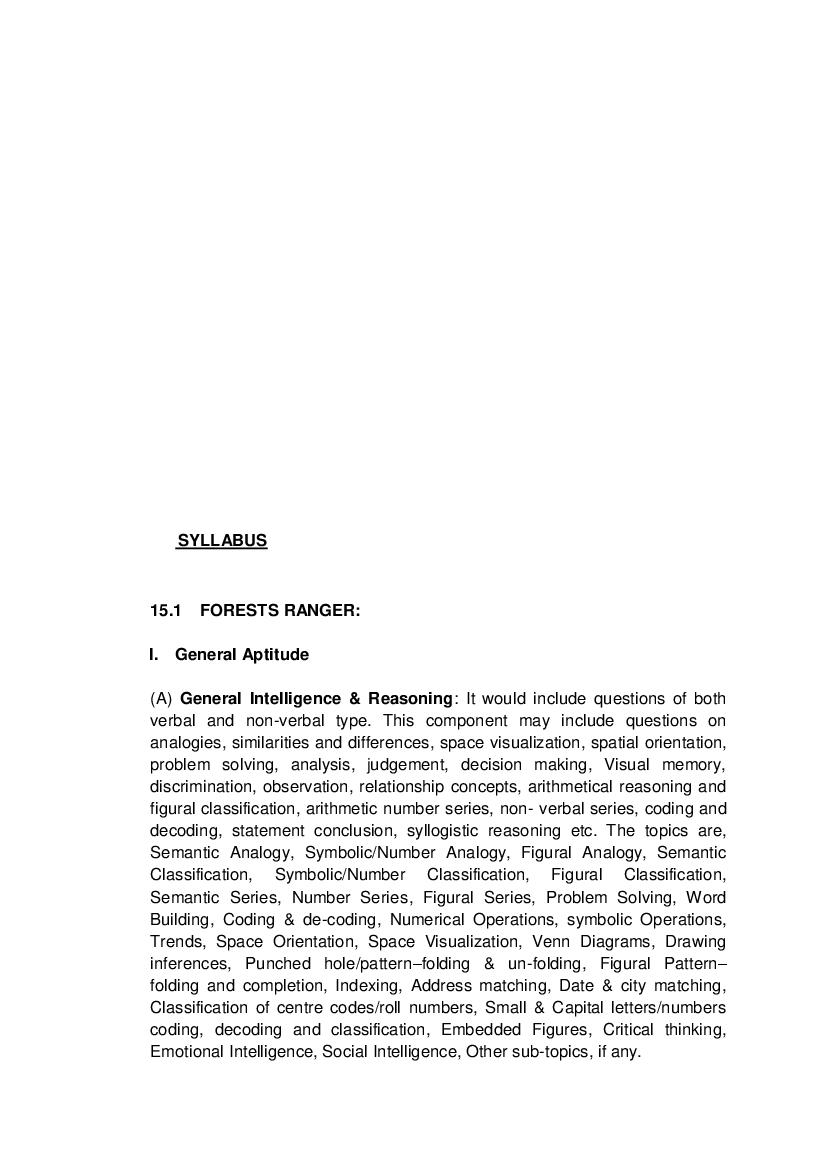
15. SYLLABUS
15.1 FORESTS RANGER:
I. General Aptitude
(A) General Intelligence & Reasoning: It would include questions of both
verbal and non-verbal type. This component may include questions on
analogies, similarities and differences, space visualization, spatial orientation,
problem solving, analysis, judgement, decision making, Visual memory,
discrimination, observation, relationship concepts, arithmetical reasoning and
figural classification, arithmetic number series, non- verbal series, coding and
decoding, statement conclusion, syllogistic reasoning etc. The topics are,
Semantic Analogy, Symbolic/Number Analogy, Figural Analogy, Semantic
Classification, Symbolic/Number Classification, Figural Classification,
Semantic Series, Number Series, Figural Series, Problem Solving, Word
Building, Coding & de-coding, Numerical Operations, symbolic Operations,
Trends, Space Orientation, Space Visualization, Venn Diagrams, Drawing
inferences, Punched hole/pattern–folding & un-folding, Figural Pattern–
folding and completion, Indexing, Address matching, Date & city matching,
Classification of centre codes/roll numbers, Small & Capital letters/numbers
coding, decoding and classification, Embedded Figures, Critical thinking,
Emotional Intelligence, Social Intelligence, Other sub-topics, if any.
16
Page 2
the candidates general awareness of the environment around him and its
application to society. Questions will also be designed to test knowledge of
current events and of such matters of every day observations and experience
in their scientific aspect as may be expected of any educated person. The test
will also include questions relating to India and its neighbouring countries
especially pertaining History, Culture, Geography, Economic Scene, General
Policy & Scientific Research.
(C)Quantitative Aptitude: The questions will be designed to test the ability of
appropriate use of numbers and number sense of the candidate. The scope of
the test will be computation of whole numbers, decimals , fractions and
relationships between numbers, Percentage. Ratio & Proportion, Square
roots, Averages, Interest, Profit and Loss, Discount, Partnership Business,
Mixture and Allegation, Time and distance, Time & Work, Basic algebraic
identities of School Algebra, Graphs of Linear Equations, Triangle and its
various kinds of centres, Congruence and similarity of triangles, Circle and its
chords, tangents, angles subtended by chords of a circle, common tangents
to two or more circles, Triangle, Quadrilaterals, Heights and Distances,
Histogram, Bar diagram & Pie chart.
(D)English Language & Comprehension: Questions in this components will
be designed to test the candidate’s understanding and knowledge of English
Language and will be based on spot the error, fill in the blanks, synonyms,
antonyms, spelling/detecting mis-spelt words, idioms & phrases, one word
substitution, improvement of sentences, active/passive voice of verbs,
conversion into direct/indirect narration, shuffling of sentence parts, shuffling
of sentences in a passage, cloze passage & comprehension passage.
II. Science, Technology & Environment
1. Physics
Units & Dimension, Motion, Work, Energy, and Power, Gravitation, Pressure,
Floatation, Surface Tension, Viscosity, Elasticity, Simple Harmonic Motion,
Wave, Sound Wave, Heat & Thermodynamics, Light, Static Electricity,
Current Electricity, Magnetism, Atomic and Nuclear Physics, Scientific
Instruments, Inventions, Radioactivity, Nuclear fission and fusion,
Electromagnetism, The four fundamental forces, The kinetic theory of matter,
Magnetic effect of electric current, The Human eye and Defects.
17
Page 3
Matter and its state, Atomic Structure, Chemical Bonding, Periodic
Classification of Element, Oxidation and Reduction, Acids, Base and Salts;
Behavior of Gases, Electrolysis, Carbon and its Compound, Fuels,
Metallurgy, Metals and Non-metals, Chemical Reactions, Radioactivity,
Electrochemistry, Catalyst, Hydrocarbons, List of important Drugs and
Chemicals, Fertilizers, Concepts of pH scale.
3 (i): Biology (Optional)
Introduction, Classification of Organisms, Cytology, Genetic, Structure of
Plant and Animal Cell, Classification of Plant Kingdom, Plant Morphology,
Plant tissue, Photosynthesis, Plant Hormones, Plant Diseases, Mode of
Nutrition in Plant, Control and Coordination in Plant, Sexual Reproduction in
Flowering Plant, Asexual Reproduction in Plant, Transport system in Plant,
Respiration and Excretion in plants, The Cell: The foundation of all living
things, Cell: Structure and Functions, Control and Coordination in Human,
Human Reproductive system, Excretory system in Humans, Respiratory
system in Humans, Human Circulatory system, The Heart, Composition of
Blood, Functions of Blood, Human Digestive system, Cell Division, Food and
Nutrition, Human Diseases, Nuclear fission and nuclear fusion, Classification
of Animal Kingdom, The five kingdoms of life, Mode of Nutrition in Animal,
Nutrition in Animal, Sexual Reproduction in Animal, Respiration in Animals.
3 (ii): Mathematics: (Optional)
Real Numbers, Polynomials, Pair of Linear Equations in Two Variables,
Quadratic expressions & Equations, Progressions, Triangles, Coordinate
Geometry, Trigonometry, Circles, Constructions, Areas, Surface Areas,
Volumes, Statistics, Probability, Graphs.
4. Technology
1. Role/impact of Science & Technology in Indian Development
2. Advancements in Life Sciences, Natural Sciences, Agriculture Science,
and Energy sector
3. Issues/challenges of development on Ecology and Environment
4. Infrastructure: Energy, Ports, Roads, Airports, Railways etc.
5. Energy resources: Growing energy needs, renewable and non-renewable
energy sources, use of alternate energy sources.
6. Biotechnology: Definition and explanation, Transgenic and Cryogenic
Organisms, Types, Bt Brinjal, Bt Cotton, Genetic Pollution, Concerns
about GM food
7. Information Technology: Important terms in computers and IT
18
Page 4
9. Space Technology: Space Research, Types of Orbits, Types of Satellites
10. Electromagnetic Spectrum: Important Terms,Types of EM Spectrum,
Different generations in Wireless Telephony , 3G v/s 4G
11. Food and Nutrition: Important Terms, Hunger and Malnutrition, food
resources and food problems, changes caused by agriculture and over-
grazing, effects of modern agriculture, fertilizer-pesticide problems, water
logging, salinity, organic agriculture.
5. Environment:
1. Conservation, environmental pollution and degradation, environmental
impact assessment
2. Biodiversity – importance for human survival, International Union for
Conservation of Nature and Natural Resources, biodiversity hot spots, Red
Data Book.
3. Basic components of an ecosystem-structure and functional aspects of an
Ecosystem-Tropic structure-Ecological Niche-Ecological Dominance-
Stability, Diversity rule. Homeostasis, aquatic Ecosystem-physico-
chemical nature of lentic and lotic ecosystems. Types of aquatic
ecosystem-structure and organization with examples of fresh water
Ecosystem. Marine water ecosystem, estuarine water Ecosystem-
Mangroves. Terrestrial Ecosystem: Tundra forest, Grassland, Desert
ecosystem. Energy flow in ecosystems-Laws of Thermodynamics.
Productivity-Biomass production, primary productivity and net productivity.
Food Chain – Types of food chain with examples, Foodweb, Ecological
pyramid of biomes.
4. Environmental ecology – terms, effects of environmental degradation
5. Pollution – types, impacts, solutions, acid rain, smog, greenhouse gases,
algal bloom, ozone layer.
6. Waste management: Biochemical wastes, Municipal solid wastes, plastic
wastes
7. Sustainable Development – concept, technologies, renewable energy
sources, bio-fertilizers, bio-pesticides, biomass gasification.
8. Conservation – conservation of natural resources, wildlife conservation,
national parks, wetlands, biosphere reserves.
9. Climate change – Kyoto Protocol, Montreal Protocol, climate change
summits held.
10. Ecologically sensitive areas in India – Western Ghats, Himalayas, Aravallis
etc.
11. Laws, regulatory bodies and policies at national and international level –
Environment Protection Act, National Biodiversity Authority, Forest Right
Act, protocols and summits like Nagoya Protocol, Cartagena Protocol and
Lima Conference, etc.
19
Page 5
13. Ramsar Convention, Montreux Record, the three Rio Conventions—
Convention on Biological Diversity (CoB), United Nations Framework
Convention on Climate Change (UNFCCC) and United Nations
Convention to Combat Desertification – from the 1992 Earth Summit, etc.
14. Carbon trading and leakage issues, Kyoto mechanism, emission trading,
etc.
15.2 FORESTS GUARD & WILDLIFE GUARD:
i) General Awareness: Questions will be designed to test the ability of the
candidate’s General Awareness of the environment around him/her and its
application to society. The questions will be designed to test knowledge of
Current Events and of such matter of everyday observation as may be
expected of an educated person. The test will also include questions relating
to History, Polity, Constitution, Sports, Art & Culture, Geography, Economics,
Everyday Science, Scientific Research, National/International Organizations
/Institutions etc.
(ii) General Intelligence & Reasoning Ability: The syllabus of General
Intelligence & Reasoning Ability includes questions of both verbal and non-
verbal types. Test may include questions on analogies, similarities,
differences, space visualization, problem solving, analysis, judgment, decision
making, visual memory, discrimination, observation, relationship, concepts,
arithmetical reasoning, verbal and figure classification, arithmetical number
series etc
.
(iii) Arithmetical & Numerical Ability : The test of Arithmetical and
Numerical Abilities will cover Number Systems including questions on
Simplification, Decimals, Fractions, L.C.M., H.C.F., Ratio & Proportion,
Percentage, Average, Profit & Loss, Discount, Simple & Compound Interest,
Menstruation, Time & Work, Time & Distance, Tables & Graphs etc. of 10th
level.
(iv) & (v) Hindi Language & Comprehension and English Language &
Comprehension: In addition to the testing of candidate’s understanding and
comprehension of the English and Hindi Languages, questions on its
Vocabulary, Grammar, Sentence Structure, Synonyms, Antonyms and its
correct usage etc. would also be covered. Reasoning Ability
***
20
Document Details
| Board / Org | Default |
| Exam | Govt Jobs Exams |
| Type | Syllabus |
| Pages | 5 |
| Updated | 15 Jul 2026 |