Goa Board Class 12 Question Paper June 2018 Accountancy (New Pattern)
Finished viewing? Save it for later —
Download Goa Board Class 12 Question Paper June 2018 Accountancy (New Pattern) (PDF · 8 pages)About Goa Board Class 12 Question Paper June 2018 Accountancy (New Pattern)
Goa Board Class 12 Question Paper June 2018 Accountancy (New Pattern) is available here for free download. Published by Goa Board for Class 12, this question paper can be viewed online or downloaded as a PDF (8 pages). Candidates preparing for Class 12 can use Goa Board Class 12 Question Paper June 2018 Accountancy (New Pattern) to understand the exam pattern, the type of questions asked, and the overall difficulty level.
Frequently Asked Questions
How can I download Goa Board Class 12 Question Paper June 2018 Accountancy (New Pattern)?
Open this page and click the Download button to save Goa Board Class 12 Question Paper June 2018 Accountancy (New Pattern) as a PDF. It is completely free on AglaSem Docs.
Is Goa Board Class 12 Question Paper June 2018 Accountancy (New Pattern) free to download?
Yes. Goa Board Class 12 Question Paper June 2018 Accountancy (New Pattern) can be viewed online and downloaded as a PDF free of cost on AglaSem Docs.
How many pages does Goa Board Class 12 Question Paper June 2018 Accountancy (New Pattern) have?
Goa Board Class 12 Question Paper June 2018 Accountancy (New Pattern) contains 8 pages, which you can read online or download together as a single PDF.
Where can I find more Class 12 study material?
You can find more Class 12 question papers, sample papers, syllabus, and answer keys on AglaSem Docs.
Goa Board Class 12 Question Paper June 2018 Accountancy (New Pattern) – Text
Read the full text of this question paper below — useful to quickly search, copy and reference the content online without downloading the PDF.
📄 View text version (8 pages)
Page 1
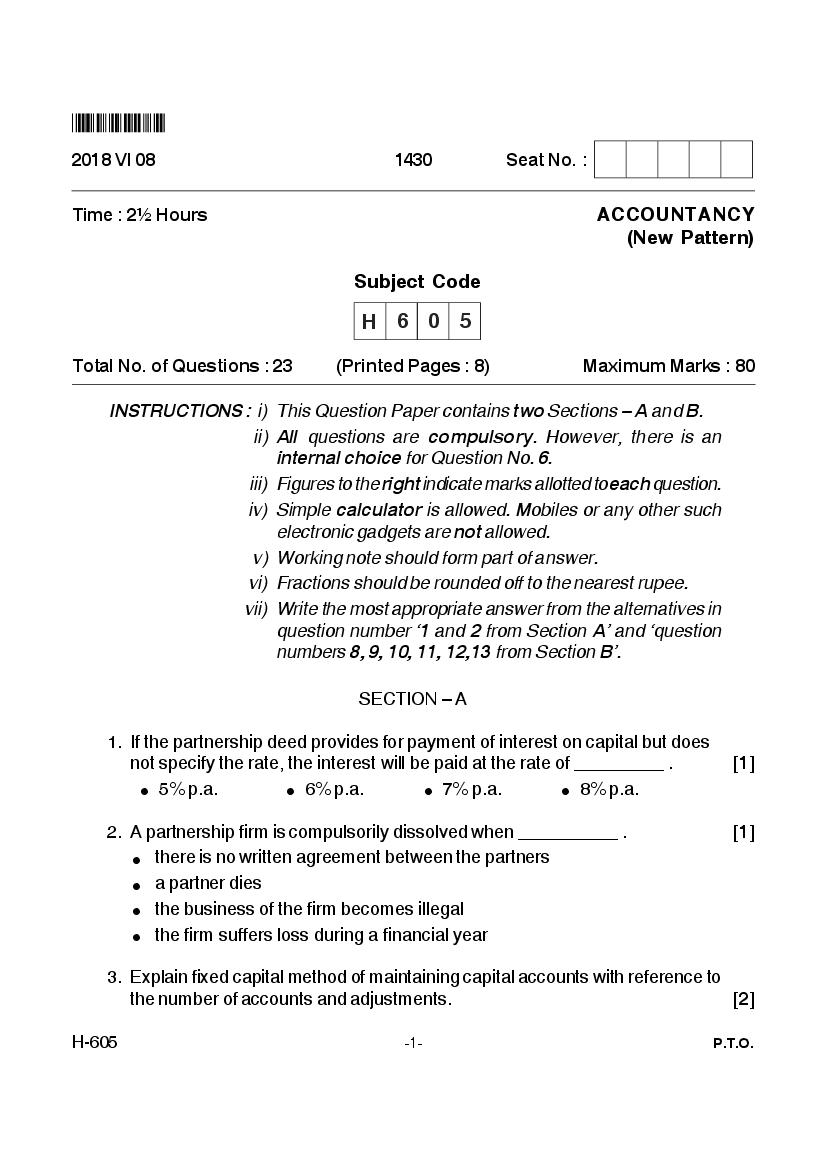
2018 VI 08 1430 Seat No. :
Time : 2½ Hours ACCOUNTANCY
(New Pattern)
Subject Code
H 6 0 5
Total No. of Questions : 23 (Printed Pages : 8) Maximum Marks : 80
INSTRUCTIONS : i) This Question Paper contains two Sections – A and B.
ii) All questions are compulsory. However, there is an
internal choice for Question No. 6.
iii) Figures to the right indicate marks allotted to each question.
iv) Simple calculator is allowed. Mobiles or any other such
electronic gadgets are not allowed.
v) Working note should form part of answer.
vi) Fractions should be rounded off to the nearest rupee.
vii) Write the most appropriate answer from the alternatives in
question number ‘1 and 2 from Section A’ and ‘question
numbers 8, 9, 10, 11, 12,13 from Section B’.
SECTION – A
1. If the partnership deed provides for payment of interest on capital but does
not specify the rate, the interest will be paid at the rate of _________ . [1]
• 5% p.a. • 6% p.a. • 7% p.a. • 8% p.a.
2. A partnership firm is compulsorily dissolved when __________ . [1]
• there is no written agreement between the partners
• a partner dies
• the business of the firm becomes illegal
• the firm suffers loss during a financial year
3. Explain fixed capital method of maintaining capital accounts with reference to
the number of accounts and adjustments. [2]
H-605 -1- P.T.O.
Page 2
Sania was admitted for 1/4 share in the future profits of which 1/8 was sacrificed
by Shubham and the balance by Sakshi.
Find the new profit sharing ratio between Shubham, Sakshi and Sania. [2]
5. Rohit and Salman are partners in a firm, with capitals of Rs. 5,20,000 and
Rs. 3,60,000 respectively as on 1st April 2016. During the year Rohit had
withdrawn Rs. 16,000 and Salman Rs. 7,800 from the business for their
personal use. The net profit of the firm for the year ended 31st March 2017
before making any adjustment was Rs. 1,12,000.
The partnership deed provides for the following :
i) Interest on capital is allowed @ 8% p.a.
ii) Interest on drawings is charged @ 6% p.a.
iii) Salary to Salman Rs. 1,900 p.m.
iv) They share profits and losses equally.
Prepare Profit and Loss Appropriation account for the year ending 31-03-2017. [4]
6. Anant and Nehal are partners sharing profits and losses in the ratio of 3 : 1.
Their Balance Sheet as on 31-03-2017 is as follows :
Balance Sheet as on 31-03-2017
Liabilities Amount (Rs.) Assets Amount (Rs.)
Capital Accounts : Land and Building 5,80,000
Anant 5,60,000 Plant and Machinery 2,20,000
Nehal 3,20,000 8,80,000 Office Furniture 2,04,000
General Reserve 2,40,000 Debtors 1,36,000
Sundry Creditors 1,83,000 Less : P.B.D.D. 6,000 1,30,000
Cash in hand 1,69,000
13,03,000 13,03,000
st
They admitted Aman into partnership on 1 April 2017 on the following terms :
i) Aman is to bring Rs. 2,50,000 as his capital and Rs. 1,20,000 as his
share of goodwill in cash for 1/5th share in the future profits of the firm.
ii) Land and Building is to be appreciated by 15%, Plant and Machinery to be
decreased by 5% and Office Furniture is valued at Rs. 1,86,000.
iii) Provision for bad and doubtful debts is no longer necessary.
a) Revaluation account. [3]
b) Partners’ capital accounts [3]
c) Balance Sheet of the new firm [4]
OR
H-605 -2-
Page 3
in the ratio of 2 : 2 : 1 respectively. Their Balance Sheet as on 31-03-2017
was as follows :
Balance Sheet as on 31-03-2017
Liabilities Amount (Rs.) Assets Amount (Rs.)
Capital Accounts : Premises 10,50,000
Swara 7,00,000 Machinery 4,20,000
Kashvi 6,20,000 Stock 3,60,000
Kanak 5,80,000 19,00,000 Debtors 3,50,000
Sundry Creditors 3,22,000 Less : P.B.D.D. 25,000 3,25,000
Outstanding Rent 38,000 Cash account 1,05,000
22,60,000 22,60,000
st
Swara retired on 1 April 2017 and the following was agreed upon between
Swara and the continuing partners :
1) The new profit sharing ratio between Kashvi and Kanak is to be 4 : 1.
2) Goodwill of the firm was valued at Rs. 88,000.
3) Assets were revalued as under :
Premises were valued at Rs. 11,75,000, Machinery to be depreciated by
Rs. 80,000 and PBDD is to be maintained at 5% on Debtors.
4) Swara to be paid Rs. 56,200 in cash immediately on her retirement and
the balance on her account to be transferred to her loan account.
a) Revaluation account. [3]
b) Partners’ capital accounts [3]
c) Balance Sheet of the new firm as on 1-4-2017 [4]
7. Sharmad, Elton and Sairaj were partners sharing profits and losses in the
ratio of 2 : 2 : 1 respectively. Their Balance Sheet as on 31-03-2017 is as
follows :
Balance Sheet as on 31-03-2017
Liabilities Amount (Rs.) Assets Amount (Rs.)
Capital Accounts : Factory Building 3,90,000
Sharmad 2,70,000 Machinery 2,10,000
Elton 1,80,000 Stock 1,06,000
Sairaj 1,60,000 6,10,000 Debtors 1,10,000
Reserve fund 1,50,000 Less : P.B.D.D. 13,500 96,500
Mrs. Sairaj’s loan account 80,000 Bills Receivable 38,500
Sundry Creditors 68,000 Bank balance 67,000
9,08,000 9,08,000
H-605 -3- P.T.O.
Page 4
available :
1) Assets realized as follows :
Factory Building realized at a profit of 15%, Machinery was sold at a loss
of Rs. 18,000, stock realized Rs. 92,000, Debtors realized 10% less after
discount and B/R realized nothing.
2) Sundry Creditors were settled earning a discount of 10% and Sharmad
agreed to settle Mrs. Sairaj’s loan along with an interest of Rs. 5,000.
3) Elton paid the realization expenses of Rs. 16,500.
a) Realization account. [4½]
b) Partners’ capital accounts [3½]
c) Bank account [2]
SECTION – B
8. When shareholder pays the amount not yet called upon his shares, it
is called __________ [1]
• Calls-in-arrears • Uncalled capital
• Called up capital • Calls in advance
9. The debentures with no maturity date are called as ________ [1]
• Redeemable Debentures • Perpetual Debentures
• Secured Debentures • Bearer Debentures
10. In a common size income statement, the items of expenditure are shown as a
percentage of the __________ . [1]
• Net Revenue from Operations
• Total Revenue from Operations
• Cost of Revenue from Operations
• Gross Profit
11. The materials consumed for the year ending 31-3-2017 were Rs. 3,00,000,
which were more than the previous year’s figure by Rs. 60,000. The
percentage increase in materials consumed is _________ . [1]
• 20 • (20)
• 25 • (25)
H-605 -4-
Page 5
example of __________ . [1]
• Cash inflow from operating activity
• Cash inflow from financing activity
• Cash outflow from operating activity
• Cash outflow from financing activity
13. An example of cash outflow from investing activity would be ______ . [1]
• Purchase of Inventory
• Sale of Inventory
• Purchase of property
• Sale of property
14. Distinguish between Equity shares and Preference shares with respect to [2]
a) Payment of dividend b) Repayment of capital
15. Following balances are taken from the books of Tata Steels Ltd. for the year
ending 31-3-2017. [2]
Rs.
Cash Revenue from Operations 5,80,000
Credit Revenue from Operations 6,10,000
Returns outward 80,000
Revenue from Operation returns 65,000
Opening Inventory 76,000
Excise duty 15,800
Calculate the amount of ‘Revenue from operations’ of Tata Steels Ltd.
16. Calculate the amount appearing under the head “Employee Benefit Expenses”
from the balances of Renault India Ltd. [2]
Rs.
Canteen expenses 18,000
P.F. contribution by Renault India Ltd. 35,700
Gratuity fund 6,00,000
Salaries to office staff 1,21,000
Bonus to employees 17,800
Directors remuneration 86,500
H-605 -5- P.T.O.
Page 6
Rs.
Trade Receivables 1,56,200
Cash in hand 51,800
Prepaid expenses 8,000
Non-current Investments 1,15,000
Inventories 92,000
Trade Payables 2,50,000
Cash at Bank 22,000
Note : Fractions, if any must be rounded off to the second digit after decimal
points.
18. Castle India Ltd. forfeited 700 Equity Shares of Rs. 200 each issued at par,
for non-payment of first call money of Rs. 45 per share and final call money of
Rs. 40 per share.
These shares were reissued by the company at Rs. 220 per share credited
as fully paid share of Rs. 200 each.
Pass necessary Journal Entries for the forfeiture and reissue of forfeited shares
in the books of Castle India Ltd. [4]
19. Amazon Ltd. purchased machinery worth Rs. 12,60,000 and Furniture worth
Rs. 5,00,000 from Ashoka Ltd. It was agreed that the purchase consideration
be settled partly by issue of a cheque amounting to Rs. 5,00,000 and the
balance by issuing 8% debentures of Rs. 100 each at a discount of 10%.
Pass necessary Journal Entries in the books of Amazon Ltd. [4]
20. The following are the statements of Profit and Loss of Damson India Ltd.
Statement of Profit and Loss of Damson India Ltd. [4]
Particulars 31-03-2016 31-03-2017
1) Revenue from Operations 5,30,000 6,80,000
2) Other Income 2,000 12,000
3) Total Revenue 5,32,000 6,92,000
4) Expenses :
a) Material consumed
b) Purchases 1,69,000 1,63,300
c) Changes in Inventories
d) Employees benefits expenses 22,500 29,000
H-605 -6-
Page 7
f) Depreciation and Amortization expenses
g) Other expenses
Total Expenses : 2,07,200 1,92,300
5) Profit and Loss before Tax (3-4) 3,24,800 4,99,700
Prepare comparative statement of Profit and Loss for the year ended
31-3-2016 and 31-03-2017.
Note : Fractions, if any must be rounded off to the second digit after decimal
points.
21. a) Calculate Inventory Turnover Ratio from the given information : [2]
Rs.
Excess of closing inventory over opening inventory 96,000
Average Inventory 1,68,000
Revenue from Operations 3,90,000
Purchases 6,80,000
Freight on Purchases 10,600
Salaries to staff 48,000
Depreciation 56,000
Note : Fractions, if any must be rounded off to the second digit after
decimal points.
b) Calculate Net Profit Ratio from the given information : [2]
Rs.
Revenue from Operations 22,00,000
Octroi duty 15,000
Selling Expenses 21,000
Office Salaries 96,400
Motive Power 24,500
Royalty paid 32,000
Gross Profit 25% of Revenue from Operations.
Note : Fractions, if any must be rounded off to the second digit after
decimal points.
22. The following ledger balances are extracted from the books of Silver Star Co. Ltd.
for the year ended 31-03-2017.
Particulars Amount (Rs.)
Equity share capital 9,00,000
General Reserve 2,56,000
Land and Building 13,29,800
8% Debentures 3,50,000
Bank Overdraft 28,000
H-605 -7- P.T.O.
Page 8
Advance to employees 80,000
Preliminary expenses (unwritten off) 20,500
Trade Debtors 1,56,000
Stores and Spares 2,16,000
Profit and Loss Account (Cr.) 98,300
Sundry Creditors 1,22,000
Goodwill 97,000
Provision for Taxation 30,000
Gratuity fund 5,10,000
Mortgage Loan 2,80,000
Prepare the Balance Sheet of Silver Star Co. Ltd. as on 31-03-2017 as per
Schedule III of the Companies Act 2013. [10]
23. The following are the Balance Sheets of Goa Ispat Ltd.
Balance Sheet
Liabilities 31-03-2016 31-03-2017 Assets 31-03-2016 31-03-2017
Equity share capital 6,03,000 8,06,000 Goodwill 62,000 62,000
Profit and Loss Account1,98,000 2,56,000 Land and Building 6,60,000 8,70,000
Debentures 99,000 99,000 Inventory 1,48,000 1,48,500
Trade payables 82,000 96,000 Discount on issue
Provision for Taxation 36,000 45,000 of shares 8,000 23,500
Cash 1,40,000 1,98,000
10,18,000 13,02,000 10,18,000 13,02,000
Additional information :
a) Income tax paid during the year was Rs. 28,400.
b) Provision for depreciation on Land and Building during the year was Rs. 42,000.
1) Cash flow statement (as per As-3 revised) for the year ended 31-03-2017. [8]
2) Provision for Taxation account. [1]
3) Land and Building account [1]
______________
H-605 -8-
Document Details
| Board / Org | Goa Board |
| Exam | Class 12 |
| Type | Question Paper |
| Pages | 8 |
| Updated | 30 Apr 2026 |