CTET 2012 (Nov) Question Paper 1
Finished viewing? Save it for later —
Download CTET 2012 (Nov) Question Paper 1 (PDF · 56 pages)About CTET 2012 (Nov) Question Paper 1
CTET 2012 (Nov) Question Paper 1 is available here for free download. Published by CBSE for CTET, this question paper can be viewed online or downloaded as a PDF (56 pages). Candidates preparing for CTET can use CTET 2012 (Nov) Question Paper 1 to understand the exam pattern, the type of questions asked, and the overall difficulty level.
Frequently Asked Questions
How can I download CTET 2012 (Nov) Question Paper 1?
Open this page and click the Download button to save CTET 2012 (Nov) Question Paper 1 as a PDF. It is completely free on AglaSem Docs.
Is CTET 2012 (Nov) Question Paper 1 free to download?
Yes. CTET 2012 (Nov) Question Paper 1 can be viewed online and downloaded as a PDF free of cost on AglaSem Docs.
How many pages does CTET 2012 (Nov) Question Paper 1 have?
CTET 2012 (Nov) Question Paper 1 contains 56 pages, which you can read online or download together as a single PDF.
Where can I find more CTET study material?
You can find more CTET question papers, sample papers, syllabus, and answer keys on AglaSem Docs.
CTET 2012 (Nov) Question Paper 1 – Text
Read the full text of this question paper below — useful to quickly search, copy and reference the content online without downloading the PDF.
📄 View text version (56 pages)
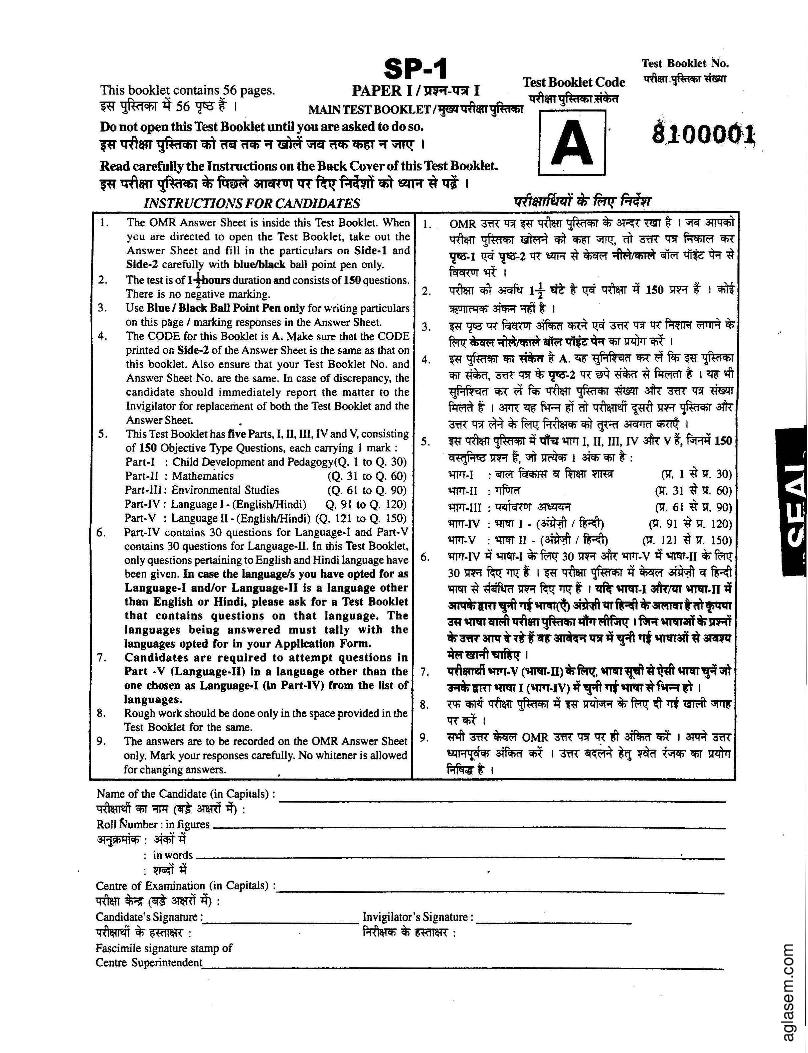
Page 1
Test Booklet No.
SP-1 W&zrr ~llff .~
This booklet contains 56 pages. PAPER I /~-WI T:Booklet;::e
"I'! 'lf\<m" 56 % t I
llf 'Q"{Tau ~ CliT 'ffil' Wlfi ';f &
MAINTESTBOOKLET/'J""~
Do not open this Test Booklet until you are asked to do so. .
, ..
'\iiV Wlfi Cf)'gT ';f ;;mr 1
A ' . '
Read carefully the Instructions on the Back Cover of this Test Booklet.
llJ 'Q"{Tau ~ ctr ~ amrorT ~ mr
~ lfiT ezrr-:r ~ -qf I
INSTRUCTIONS FOR CANDIDATES
1. The OMR Answer Sheet is inside this Test Booklet. When I. OMR ~~~~~cfi3R\rmt I~~
ycu are directed to open the Test Booklet, take out the ~~~ q;f ~~. of'3"ffi"'q";iR<fm;rq;t
Answer Sheet and fill in the particulars on Side-1 and
"l"'-1 ~ "l"'-2 'If{ 'QJR ~ ~ ;:ftt;f~ 015 ~ 'Q;f ~
Side-2 carefully with blue/black ball point pen only.
~~I
2. The test is of 1-fhours duration and consists of 150 questions.
There is no negative marking. 2. ~ cit ~ 1+ lft t' ~ ~ ll 150 ~ t I C!ilt
3. Use Blue I Black Ball Point Pen only for writing particulars ~~~%'1
on this page I marking responses in the Answer Sheet. 3. ~~'If{~ atfcl;o ~ ~ ~~'If{ f.:mR wrR c);
4. The CODE for this Booklet is A. Make sure that the CODE
printed on Side-2 of the Answer Sheet is the same as that on
fffit ~~g 1fll=f~q.q. <.f;T m 'lit 1
this booklet. Also ensure that your Test Booklet No. and 4· ~~<.f;Tli$ntA . ~~q;r~fci;~~
Answer Sheet No. are the same. In case of discrepancy, the <.f;T ~. ~ ~ cf> "l"'-2 'IR ~ ~ ~ fi:«;rnT t I ~ ~
candidate should immediately report the matter to the ~ 'fi\~fci;~ ~ ~ 3fu'~~~
Invigilator for replacement of both the Test Booklet and the ~t 13ll'R~fiFnrm~~'Rv.r~•
Answer Sheet. • ~~~c);~~q;f~~~ I
5. This Test Booklet has five Parts, I, n, Ill, IV andY, consisting
5 ~. ~ # 'QN \Wl I, II, III, IV 3fu' Y t, ~ 150
of 150 Objective Type Questions, each carrying I mark : ·
Part-I : Child Development and Pedagogy(Q. I to Q. 30) ~'Rv.rt.~~1 atcf;<.f;Tt' :
Part-II : Mathematics (Q. 31 to Q. 60) \Wl-1 : '01'Wr fcrcf;m q ~ -mq (!i. 1 ~ 'll'. 30)
Part-III: Environmental Studies (Q. 61 to Q. 90) \Wl-11 : 1'1ftrRr (!i. 31 ~ 'll'. 60)
Part-IY : Language I- (English/Hindi) Q. 91 to Q. 120) \Wl-lll : ~ ~ (!i. 61 ~ 'll'. 90)
Part-Y : Languageii-(English/Hindi) (Q. 121 to Q. 150)
'IWT-IV : ~ I - (~I~ (!i. 91 ~ 'll'. 120)
6. Part-IY contains 30 questions for Language-! and Part-Y
contains 30 questions for Language-11. In this Test Booklet, 'IWT-Y : ~II - (~I~ (!i. 121 ~ 'll'. 150)
only questions pertaining to English and Hindi language have 6. 'IWT·IV ll ~-1 c); fffit 30 'Rv.r 3fu' \Wl-V ll ~-II c); fffit
been given. In case the language/s you have opted ror as 30 'Rv.r~Til{f I ~·~ll~ ~<ifRT
Language-1 and/or Language-11 is a language other ~~~'Rv.r~Til{f 1·~-~~~-Dli
than English or Hindi, please ask ror a Test Booklet ~tm~llf~ aiHt1nH'irammhT~
that contains questions on that language. The
~~~lfifiRT~·~ lilR~'i;~
languages being answered must tally with the
languages opted ror in your Application Form. 'ir~3TNtltf-q-~wli~TTt~an"~
7. Candidates are required to attempt questions in ~~~I
Part -V (Language-II) in a language other than the 7. lfifd 'WT·V ('qNT.fi)'i;~, qm~"~ qm~~
one chosen as Language-1 (in Part-IV) rrom the list or ~'lm~l ('WT-IV)lt~llf~"f'Ffll I
languages. 8. \\li Cfil<f ~ ~ -q ~ ~ -$ fffit ~ rrt ~ ~
8. Rough work should be done only in the space provided in the
'!R'litl
Test Booklet for the same.
9. The answers are to be recorded on the OMR Answer Sheet 9. ~ ~ ~ OMR ~ ~ '1R tf affi!m 'lit I ~ ~
only. Mark your responses carefully. No whitener is allowed ~aifclm'lit ~~~tti~~<.f;Tm
for changing answers. f.im'f I
Name of the Candidate (in C a p i t a l s ) : - - - - - - - - - - - - - - - - - - - - - - - - - - - -
~ <.f;T PfTl1 (Oft 3lW ~ :
Roll~umber: in f i g u r e s - - - - - - - - - - - - - - - - - - - - - - - - - - - - - - - -
~:am#
: inworos---------------------------------~---
:~#
Centre of Examination (in Capitals) :______________________________________
~oR-~ arunll>:
Candidate's Signature :._ _ _ _ _ _ _ _ _ _ Invigilator's S i g n a t u r e : - - - - - - - - - -
~<);~: ~cfimmt:
Fascimile signature stamp of
Centre S u p e r i n t e n d e n t ' - - - - - - - - - - - - - - - - - - - - - - - - - - - - - - - - - -
Page 2
PART-1/~-I .
CHILD DEVELOPMENT AND PEDAGOGY/~ f~4'il<ti ctftnm'~
Directions : Answer the following
questions by selecting the most
f.rffl .. AAfMfigH m c1; ~ # c~;- FMrr 'RiRt
31Vrr~~ .
appropriate option.
1. Which one of the following is most 1. f\:Fi ~ ~ ~ ~ ~ ft;:m: f"1X41f('lftsH'1
crucial factor for a differently abled #~~m~ J:~t~tc~'{o1 ~~?
child?
( 1) ~ ~ cp1 f.:r<ffiffi ~
( 1) Controlling his/her behaviour
(2) Improving his/her grades (2) ~~#wm-~
(3) Enhancing his/her skills (3) ~~q;r~~
(4) Reducing his/her suffering (4) ~ ~ CfiT Cf)l1 Cf;BT
2. Which one of the following could 2. f.:tX41f(1fulo # ~- ~ m ~ f.:t41a~HI
cause learning disability ? m- w.tiffi ~ ?
q;r 'Cfi'RUT
' ( 1) Cultural variation (1) ~i*¥f('\Cf') ~
(2) Prenatal drug use . (2) ~im'T~~~~~
(3) Aptitude of teacher wr $«1"11<1 ~
(4) Apathy shown by peers (3) ~cit~
(4) ~J:~Cl<H4)l imT ~ a~ltfl"im
3. Which is the incorrect way to support 3. ~ fqq;m R ~ ~ q;r ~ m
the language development ? ~TR1'0~?
( 1) Letting the child talk (1) ~ cn1 TtCf'i" ~ ~ ~ m-
uninterruptedly on a topic. Gffif ~ "t.rr I
(2) Disapproving the use of their (2) ~awit~~wm"CfiT~
own language. ~I
(3) Supporting initiation taken by (3) ~ imT qft llt ~ CfiT ~
children. "t.rrl
(4) Providing opportunities for (4) ~ q;r wm ~ ~ ~
using language. ~'Cf'iWIT I
4. · For most of the right-handed people, 4. ~~~~~~~
the left hemisphere of the brain &lfcffl41 ~ ft;:m: J:~f-Ri&fi q;r ~ ~
handles - - cp1 R<ffiffi Cfi«'fT ~ I
( 1) spatial-visual information (1) ~-~~
(2) language-processing (2) ~-~
(3) emotions (3) ~
(4) movement of left arm (4) ~~qft11fi;
Page 3
5. Which one of the following is an 5. f.:t'"'1f(1f@('1 1l ~ ~ m ~ ~ ~
issue related to development ? ~t?
(1) Congenital - Acquired (1) ~ - ~
(2) Natural - Nutritional (2) ~-~-m-
(3) Nature - Nurture (3) ~ - "llWR
(4) Scholastic - Co-scholastic
(4) ~ -~
6. Which one of ~e following is not a 6. ~ m R'"'1f(1f@('1 1l ~ ~
part of Piaget' s pre-operational stage m ~ Cfft ~-fifsi64t(i'(C6 ~ 'C6T
except ~~t?
( 1) Egocentricism (1)
(2) Animism (2) ;;;flqqj~
(3) Irreversibility 3H4<1lt61Ml (irreversibility)
(3)
(4) Conservation
(4) ~
7. Which on~ of the following is a part 7~ ~ m F.:t'"'1f(1f{Sj('1 1l ~ ~
of Piaget' s concrete operational stage m ~ Cfft ~ fifsi64t(iiC6 ~ q;r
except imrt?
( 1) Reversibility ( 1) 4<1l1Citffl
(2) Inductive reasoning (2) ~lli1Hi(iiC6 ~
(3) Spatial thinking (3) ~f¥rc:A
(4) Lack of conservation
(4) ~ 'C6T 3NICI'
8. Which one of the following is not a 8. F.:t'"'1f(1f&('1 1l ~ ~ m ~ ~ ~ ~
part of Sternberg's triarchic theory of f:ffi;r~q;rimf~t?
intelligence ?
(1) f61l(I#IISIOi4(C6 ~
(1) Analytical intelligence
(2) C41Cil\IRC6 ~
(2) Practical intelligence
(3) ~~
(3) Spatial intelligence
(4) ~\if"''i(iiC6 ~.
(4) Creative intelligence
9. All of the following are examples of 9. ~m f.:t""'f(1f&('1 1f ~ ~
.intelligence tests excluding ~ ~ d~i(\(Uj f I
(1) ~"'14'1H ~
(1) StanfordBinet
(2) ~-~
(2) Welchsler- Binet
(3) ~~
(3) Baylay Scales
(4) ~~
(4) Rorschach test
Page 4
10. The achievement motivation of 1o. ~~~~em __ ~
children may be strengthened by ~\iff~t I
( 1) Telling them moral stories (1) ~~Cfi~if"14i ~ I
(2) Praising them regardless of
their perfomiance (2) ~ f"11941~"'1 'tR" '&fA" ~ ~ .
~~m'
(3) Assigning them responsibility
to handle (3) ~~ ~ffitt d'd~~lfil~ ~ I
(4) Telling them that it is only the (4) -a;:t~~~~~~
scores that matter in getting ~~ aF.t;tf 'i~'fq'{oi ~ f I
decent job
11. Students are naturally motivated to 11. fun~: ~~~
~tl
(1) seek simple tasks
(2) explore novelty
o> ~m~
(2) ~~
(3) seek continuous struggle
(3) f.:mR~~
(4) commit mistakes (4) '1<'1fl14i ~
12. The most important factor for 12. ~.q~~~em~q;r
improving the quality of education in ~ iif.\'fq'{Oi 'Cf)RCf)"'gf ~ f
India may be
(1) ~~~-~mr~
(1) upgrading the professional
~ 04icHilf4Cfi ~em~ I
capacity of teachers by training
and supervising. (2) ~ d,.iH~fl4 ~ ~ 'tR" it
(2) focusing assessments ~q;)~~l
exclusively on higher order
thinking skills. (3) ~ ~ ~ ~ .gr 4i~C04T.l41 q;r
~~I
(3) following a pan - India
curriculum throughout the (4) ~~~~em~~
country.
~~ll~GlR'~ I
(4) increasing the frequency of
external examination to twice a
year.
13. Formative Assessment may be a 13. '(i!i411:GCfi ~ 'gf ~ t-
(1) pretest .(1) ~-~
(2) post test (2) ~-~
m
(3) both (1) and (2) (3) (1) afu" (2)
(4) only either (1) or only (2) (4) '41'~ (1) '41'~ (2)
Page 5
14. The following categories affect 14. cf? ~ f-1¥=1fMf~o ~
'Gender' except ·~ ~~qm:ftt I
(1) ethnicity (1 ) i ;;m=tlll (11
(2) religion (2) ~
(3) aptitude (3) ~
(4) language (4) -~
15. Seema may be more _ _ _ than 15. ~~*~--m~t 1
· Devika.. (1) ;nit.~
( 1) feminine
(2) ~-~
....,. (2) masculine (3) (1) ~ (2) ~
(3) both (1) and (2)
(4) "liT~ (1) 'liT~ (2)
(4) either (1) or (2)
16. Schools while dealing with poverty 16. ~ *tftWr
Wfl!' fq~li.'14l·cm
~ c)? m'lf ~ qmf
stricken children must
(1) ~&JRcf?R1tt~~~~
( 1) attach greater importance to
curricular activities by ~~cffi~~
segregating them for better t.=ITI
attention. (2) ~ c)? ~ 1i'RCJil 1R ~
mq; ~ c)?
R1tt ~ ~
· (2) expect them to possess high
~I
standards of behaviour.
(3) ~ "{C\tf "ff fCI~IMl! ll ~ 3lR cf?
·(3) have a zero tolerance of ~ cffi fGI~i."l cqr ~-.:rtf~
excuses for not attending
~I
schools regularly.
(4) ~ cffi ~ ~
(4) provide students appropriate
training to develop skills to
~~·~~~
~ em ~ ~ cit ¥'t'IW11
strengthen their self-esteem. fqcnffto q;r~ 1
17. The term "disabled children" refers 17. ·~ ~· 0\'IGG:iCIR\ - - Cfft .3l)r
to ~~tl
(1) all children with sensory,
physical impairments (1) ~,0\'II~Rcn&mi~~~
(2) all children with emotional (2) '('li~rlcn cnfo"11~ ~ ~ &Wr
difficulties and intellectual
~~~
impairments
(3) both (1) and (2) (3) (1) ~ (2) ~
(4) either (1) or (2) (4) "liT~ (1) "liT~ (2)
Page 6
18. Which of the following Article of the 18. f.:r:~ ~ ~ ~ ~ 2009
Constitution has been affected after cit~~~~q;r
notification of the Right to Free and f.;p::jf<1f€H1 -q ~ ~ m ~ ~
Compulsory Education Act-2009? '[31T?
(1) Article-51 (1) ~-51
. (2) Article-46
(2) ~-46
(3) Article-22
(3) ~-22
(4) Article-20
(4) ~-20
19. The use of teacher made tests may be 19. ~ err ~ ~ ~ r-1&11~'1 q;r
preferred over standardised tests for ~-m- ~Wrct 'i1'1Cf)lft1 ~ ~
~ lR ~ Rtiffi ~ q;l
assessing the performance of
l'ltl4f~Cfiol ~\itT~~~
disadvantaged students as
(1) ~ ~ ~
41'1Cf)lft1
(1) standardised tests are given to
~q;l~\iiTm~~
only those students who come
~~~~~~~'
from higher strata of society.
• (2) 'ii'1Cf)lfo ~ ~ err
cit
(2) standardised tests do not take ~ 31161~4Cfiot31T q;t ~ -q
into account the special needs ~~I
of disadvantaged group.
(3) 'iHCf)lfo ~ -q "l'J'CFf cit ~
(3) standardised tests have large ~mffi~ I
errors of measurement.
(4) iiHc:hlfo ~~lRm-~
(4) standardised tests are focussed ~I
on rote memory.
20. The early identification of special 20. ~~citm-qit~m
children is important to 'i~f€lq;:o1 ~
(1) rftur f"1~•4ot31T ~ ~ ~fu:rct
(1) prevent secondary disabilities
(2) ap;r ~ ~ ~ ~ GFR
(2) discourage their self-efforts to ~ ~ ~-~ q;t f"1'6ffi1Wo
be at par with normal children "CfiB~fu:rct
(3) persuade them to attend special (3) ~ fqat(\14 -q \ifR ~ ~ ~
schools 'tAR~~
(4) help them to cope with their (4) ~~~~~-q~
special status ~~14ol "CfiB ~~
Page 7
21. Which one of the following 21. f.:t¥:ifMfuJ(1 # ~ ~ m ~ ~J'li<hfl
principles facilitates inclusive fu@ CfiT Wfl1 GRffiT t ?
education?
(1) 80 ~~~~<"!f<l\'tf~
(1) Children with IQ 80 and above
~ ~ ~ f a:ftt mtfRi fu@
can learn and benefit from
normal education. ~~m~f1
(2) Special children if included in (2) ~~~CfilmtlRi~-~
normal classroom further lag #~~~tm~ftfitw
behind as performance of the ~ ~ ~ a:r;<:f ~ CfiT
other students will frustrate R&41G"1 ~f.Rm~~ I
them.
(3) ~ # ~4fcmcti ~ ~
(3) Individual differences in
~~cf;~~~tl
students is a major problem for
a general teacher. (4) ~ *" fcRmT CfiT ~ ~
(4) The views of students should \i'fRT~ I
be given due importance.
22. The following are the instructional 22. *" ~ f"1J:P1f<1f€t('1
strategies except 31~~Hif"!Cfi {OJ;:ftf('14j f I
( 1) Contextualizing instruction (1) ~~I
(2) Providing learner control of (2) ~ CfiT mwrr-~ ~
instruction m1
(3) Observing patiently the (3) ~cf;~~IDU"cit\i1T
activities of students done by m~Cf)T$t*"~
them during learning ;:}101<'1lcti"1 ~ I
(4) Assessing learning (4) '{<'4icti"1 ~ I
23. Misbehaviour at school · may reflect 23. fCl'€11€14 # 3Ttl-~ CfiT
the to · Cfil~~~t I --
( 1) urge; wield power (1) ~Cfilam-qm~;~
(2) need; establish social identity (2) ~IJ'llf"1Cfi ~ ~ ~-,
31icH4Cfi('11
(3) desire; leave school
(3) fCI'€11€14 ~ ; ~
(4) pressure; relieve the bottled up
feelings (4) ~ cqyqT CfiT CZfCffi ~ ; ~
24. Problem Solving is not
( 1) goal directed
(2) a skill that can be learned and
practiced
(3) about numerical ability
(4) based on the understanding and
use of sequenced steps
Page 8
25. The doininant element of emotion is 25. -m CfiT l'lljj@~IIMJ 'ffi'Cf t"
( 1) · feeling (1) 'qTq
(2) motive (2) ~
(3) goal (3) ~
(4) success ( 4) '8 \fli?H'1 I
26. Which of the following statements 26. M c); ~ .q f~¥0;ff~f&cl .q ~ ~ m
about emotions is incorrect ? ~~t-?
( 1) Emotional development is an (1) ~~ljj(-JOjCf) ~ ~ ~ ~
orderly process in which t- f;m1l mR ~ .q ~ ~
complex emotions unfold from -m~~tl
simpler ones.
(2) Because emotions are
(2) ¥ -m &lf<ffif'"lt56 ~ t ~
~ ~ ~ 'Cflfu;; m-m t ,
subjective, they are difficult to
study. (3) -m~lRf.r4t~t I
(3) Emotions depend on (4) ~-f.('t<&iclctl~ ~cit~~
consciousness. .q "&l'1"&IT ~ t fen ~ ~ c);
(4) Learning theorists explain ~a:ftt~-q~~
emotions in terms of how they ~tl
serve people's survival and
well-being.
27. Abhimanyu, a student from 27. ~"ll~~~~crt~t
economically weaker section takes Mm CfiT ~ ~ c); <mf ~
1 admission in class IV of a public OOq; ~ cit ~ IV .q ~ mrr
school under RTE-Act. After some t"l~~~~c);~~
time co-students of Abhimanyu start ~~~c);~~~
bullying him for his poor ~t ~~~c);~.q:mq-~
background. As a teacher what
should you do in this situation if you
~ .q ~ "CfltrT
~~c);~Cfif~~
*
:am Cf)ll(~a!ll c);
are following the Kohlberg Theory of
Moral Development ?
t?
(1) ~~~fen*cf~
( 1) Convey it to students that they
will be punished if they
'CflT ~ ~ \il1"ft ~ ~ tor
continue bullying Abhimanyu. ~~~I
(2) ~ 'CflT arcR ~c);~ .q
(2) Counsel students about
~~c);~ .q ~ 'CflT
accepting Abhimanyu as their
fellow students. ~~I
(3) Ask Abhimanyu to avoid the (3) ~ ~ ~ fen \ill ~ ~
students who bully him. ~cnmt~•Cfitl
(4) Request principal to arrange a (4) ~ ~ · ~ ~ · fen cf
· decent dress and pair of shoes ~c);~ ~ ~ a:ftt
· for Abhimanyu. ~~~CfiT~cR I
Page 9
28. Which of the following skills should 28. liHf~Cfi ~ ~ 3lCR" fc:tct1f~(1 ~ ~ ~·
be stressed more for mentally f•p•"1fc-tf&(1 ~ ~ ~ ~ -awr ~
underdeveloped children ? \ifF1T ~ ?
(1) Communicative skills (1) ~~~
(2) Numerical skills (2) ~~~
(3) Adaptation skills (3) 3iftW1~
(4) Life skills (4) ~~
29. Visually challenged students will get 29. ~ ~ ~ 'i:j;fiffi<{oi ~ Cfi1
maximum support if ~~~m~
(1) their learning takes place 0) ~~~nnw~
through talks delivered by ~ lOfiUJll' ~ m1
teachers.
(2) ~ ~ ~ em {Dioftfoqj
(2) their survival strategies are ~m-1
strengthened.
(3) 'EiliCfq'(4)j ~ ~ ~ ~
(3) their social skills are enhanced
~ ~ ~ ~ «llilf"fCfl ~
to get maximum support from
peers.
~Cf~(1 m 1
(4) software assisted Braille script
(4) <Eii4'G~4< <Eit<4llfl m ft;W:r ~
~~I
is taught.
30. Special education 30. ~~-
( 1) caters to the need of all (1) ~ ~ q;l 3iiCf}(lqCf)(1j31f Cfi1
students. "<IUm-t I
(2) caters to the need of general
(2) ~~ em 3ilc4}(1qCf)(1j311 Cfi1
teachers.
'I{Um-t I
(3) ~ ~ f"1'j0j(1j ~ ~ ~ ~
(3) helps differently abled students
~~~~~em
to master a skill.
~m-tl
(4) helps differently abled students
(4) ~~~~~~~~
to relate with others in a better
~~~~~~cit
way.
r
~m-tl
- - - - - - - - - - - - - - - - - - - - - - - - - - - - - - - - - - - -
Page 10
PART- II I cqrrr- II
MATHEMATICS /*lfUIH
31. Ten thousands + ten ones + ten tens 31. ~ 'lWfR" + ~ ~ + ~ ~
equals ~t":
(1) 10110 (1) 10110
(2) 11010 (2) 11010
(3) 10011 (3) 10011
(4) 101010 (4) 101010
32. Which one of the following is not. 32. Fr~Pl ~ ~ m ~ -::m t-?
correct? (1) 7 ~ 10 ~-il'll2~
(1) 7 metres 10 centimetres =710 ~=c14l2~
=710 centimetres (2) ~~Cf;T~
(2) Hili of one half
=one-third of three quarters ="ffi;r ~ C6T ~ mmt
(3) 2 kg 112 g =2112 g (3) 2 kg 112 g =2112 g
(4) 3 L 60 mL =360 mL (4) 3 L 60 mL =360 mL
33. Number of minutes in 10 days is 33. 10 ·~ .q f1:RGT cit mr ~ t ~
equal to the number of seconds in ~l{~qft~~
(1) 2 hours (1) 2tit
(2) 3 hours (2) 3tit
(3) 4 hours (3) 4'Eit
(4) 5 hours (4) 5tit
SPACE FOR ROUGH WORK /~mcf;'fi;nr~
Page 11
34. Perimeter of a square and a rectangle 34. "ttCfl crt cr ~ .aw«i <fi ~ ~ t 1
are equal. If the perimeter of the ~ crt q;r ~ 40 W:ft ~ .aw«i ctr
square is 40 em and length of ~ crt ctr ~ ~ 2 W:IT ~ m. m
rectangle is 2 em more than the side .aw«i q;r ~. crt W:ft #, ~
of the square, then the area, in square
em, of the rectangle is (1) 48
(1) 48 (2) 72
(2) 72
(3) 96
(3) 96
(4) 100
(4) 100
35. Sania bought a battery. She read on it 35. ~~~~~f-imTR~~'
"Life : 4200 hours". She uses it "'1fiCI"''cfiR''I : 4200 ~· I ~ ~ ~-mf
throughout day and night. How many m'Sfmft~ '~WR~~
weeks will the battery run ? ~?
(1) 28
(1) 28
(2) 25
(2) 25
(3) 24
(3) 24
(4) 21
(4) 21
36. Internal length, breadth and height of 36. ~ 3il4dlcf)l( ~ Cf>1 ~ ~.
a rectangular box are 15 em, 9 em ~ ~ ~ ~: 15 W:ft 9 ~
and 10 em respectively. How many ~ 10 W:fl' ~ I 6750 ~"'21412:< ri q;f
such boxes are needed to pack 6750 ~ ~ <);- ~ ~ ~ arcml ctr
centimetre cubes? 3iiCI~4Cfidl ~ ?
(1) 6 (1) 6
(2) 5 (2) 5
(3) 4 (3) 4
(4) 3 (4) 3
Page 12
37. The weight of 18 gulabjamun is one 37. 18 'JMICSI\111lf1 CfiT ~ ~ fq;c1h;uq t" I
kilogram. If 16 gulabjamun can be ~ ~ ~ * 16 1F'tl<ll\111lf1 ~ m
packed in one box, then the number ~ ~. m40 fc:fim 'lMI<ll\11tlf11 em~
of boxes needed to pack 40 kg ~ cl;-~ ~ICII(Il!Cf5 ~ Cfft ~ ~
gulabjamun is
(1) 40
(1) 40
(2) 42
(2) 42
(3) 45
(3) 45
(4) 48
(4) 48
38. In a hockey match between School 38. fcttiiMll A~ fcttik1ll B cl;-~ ~ ~
A and School B, School A scored 11 ~ "4:q *· fCitJIMll A -:l 11 llTt:1" ~
goals and School B scored 3 goals. fcttJIMll B -:l 3 llTt:1" mtff ~ I ~ l1Tffi
What fraction of the total goals did CfiT ~ ~ ('lWT) fcttliMll A -:l mt('f
School A score ?
~?
3
(1)
14
3
(1)
14
8
(2) 8
11 (2)
11
11
(3) 11
14 (3)
14
11
(4) 11
3 (4)
3
39. Number of degrees in five and two- 39. ~ ~ ~-fumt fl'i~)ot if fufW:tT cit
third of a right angle is ~t-
(1) 510 (1) 510
(2) 490 (2) 490
(3) 486 (3) 486
(4) 480 (4) 480
SPACE FOR ROUGH WORK ~~~c);~~
Page 13
40. Rohan of Class II can do the skip 40. ~ II CfiT ~ W ~ ~ ~ fTRffi
counting correctly. In which I
~~~~~-mr~~
developmental phase of number is
fC4Ct71*iklO!Cfl «'f{ lR ~? I
he?
I
(1) Emergent phase
I
(2) Matching phase
I
(3) qf{lOjjOiffiiCfl «'f{
(3) Quantifying phase I
( 4) ~l\i1"11C'iiCfl «'f{
(4) Partitioning phase I
I
I
41. A Class IV Maths Test has a question 41. ~ IV Cfft Tfftm:f ~ 'J:l ~ t -
I
"Convert the f ractton
. 65 into •'N;;; ~ 'CflT q:VIl'IMq 'J:l <(C\qj('1f{('1 ~ I"
I
decimal." The question aims to test ~ ~ CfiT -m ~ t-/Cfft - - I
the students' qft ~ 'Cflr.IT ~ I
I
(1) knowledge of decimal facts. (1) q:VIl'IMq ~t"~ I
I
(2) understanding of concepts of (2) ~ 3fu" q'\'Jl011;1q Cfft 'EiCfl@'f"11 Cfft
I
fraction and decimal. ~I
I
(3) procedural skill of converting (3) ~ 'CflT q:VIl'IMq ll <(C'4ioRo 'Cfl'R
I
fraction into decimal. Cfft l'lfstit!JlJ('1 ~0\'IMol I
I
(4) skill of exploring the decimal (4) 10 x 10 ~ ~ m- CfiT ~
q;ffl ~ ~ ~ ~ ~ q'\'ll'IMq I
equivalent of given fraction by
drawing paper grid of 10 x 10. ~~~~0\'11:1('111 I
I
I
I
Page 14
42.. It is observed that children use 42. · ~ ~ lfl1T t fct; ~ ~-~
various methods of problem-solving (Uioftf<'1~ Cf>1 ~ ~ CfiT m ~
strategies like t.~
(a) Counting (a) f7Frffi" ~
(b) Direct Modelling
(b) ~ qj:gfJ13j
(c) Number facts
(c) mszrr~
Sequence from which children pass
through while developing problem ~-~-(Oi=flf<'1~ CfiT fcfq;m ~
solving strategies is · ~~-~~~tl
(1) (a)~ (b)~ (c) (1) (a)~ (b)~ (c)
(2) (b)~ (c)~ (a) (2) (b)~ (c)~ (a)
(3) (c)~ (a)~ (b) (3) (c)~ (a)~ (b)
. (4) (b)~ (a)~ (c) (4) (b)~ (a)~ (c)
43. Number sense in the primary school 43. ~1\!lf'lcti fCit~R'14 .q ~an Cf>1 ~ ~
is always accompanied with ~-~ ctr fc:lcf;m ctr ~ mffl t I ~
developing operation sense. Which ~ ~ ~ q;f ~-~ ctr ~ ctr
o.f. the following statement cannot be ~.q~~'ffl'~?
referred ~s component of operation
sense? (1) ~ lTt ~ .q ~ q:,1 '\ii'R ~
( 1) Determining the operation to ~q;f~~l
be used in given situation. (2) ~~fct;~~~f'R
(2) Recognizing that the same ~~.q~.q~\ffl'
operation can be applied in ~tl
different problem situations.
(3) mszrran "qt ~an -ctr ~ ct;T
(3) Realizing the operations' effect
\1fFAT I
on numbers.
(4) ~an -31'k qfhnon Cfft <FRT
(4) Comparing the numbers and
~I
quantities.
I
l'
Page 15
44. Mr. Jain draws the following figure 44. .m ~ ~ mt -qr f.o1Af~f<sH'1 ~
on the blackboard : ~ t:
1
2lt.
Wall
Then he posed a problem to the
~~~·~~~~~
students "If~ It. paint is required to
~ q;ffl t- ·~~~t CfiT ~
paint t of a wall, how much paint
would be require? to paint complete ~~k ~tR:ctrr~mrrt, m
wall?" ~~ctrr~~~~~~
Mr. Jain wants to expose the students ~?"
to problems based on
(1) product of fractions.
(2) division of whole number by a
(1) f\:F:t"cfiPJOi"14lM I
fraction.
(2) ~~q;ff\r-r~~~ I
(3) division of fraction by a
fraction. (3) f1R q;f f1R ~ ~ CfiVrr I
(4) fraction divided by a whole (4) f\r-r q;f ~ ~ ~ fcMrfJ!o ~ 1
number.
Page 16
45. A child studying in Class IV exhibits 45. ~ IV .q ~ CITffi ~ ~ q;f ~.
difficulty in sorting, recognizing w q;1 4(\'€11'1~. mszrrm afu- 6ll<fif(141
patterns, orientating numbers and ~ d~Cf)(OI; ~ ~. lfTtA ~ .q
shapes, telling time, measuring etc. ~moT t I Cffl' ~ #qcffi:
The child may be (1) f,s&lfcm4r ~ H- 't\1 1
( 1) suffering from dyslexia
(2) f-S~<"''!if('141 ~ H- 't\1 I
(2) suffering from dyscalculia
(3) f,s:m1f\t;41 ~ H- ~ 1
(3) suffering from dysgraphia
(4) suffering from attention deficit (4) ~ ..q Cfilft ~ ~ ~ Jrim:r
disorder mr
46. A teacher introduced the concept of 46. ~ ~ ~ v .q -qftqrq Cfft ;HCf){"q"'fl
perimeter in Class V. She used lots of Cf;T ~ tfl' t I Cffl' ~ mt \Jiflf"'ffi4
.... 'Cf)T w:m ctmft t afu- ~ ~
"Cf)G-~
geometrical cut-outs and asked the
children to measure all around. To ~ ~-~ Cfft ~ 'Cf)f l1f'CFJ ~ ~
. assess the understanding of concept ~ ~ t' I Cffl' ;HCf){"q"'fl Cfft ~ Cf;T
she asked the following question :
~ ~ ~ ~ f'"f"'1f("''f<iM ~
Ravi is running on footpath of a
squ~e shaped park of length
~t- .
UEr 10 ~ ~ ~ q~liCf)R ~ ~
10 metres. How much distance Ravi
covered in one round ? ~~~-m~ IUEr~~~.q
Children were not able to respond to ~¢04'Cfft?
this question. The reason may be ~~~q;r~~. ~~ I~
(l) children have not understood at ~ cmur ~ Wf;ffl t ~
all the concept of perimeter. ( l) ~ q;f -qftqrq Cfft ;H Cf){"q"'fl
(2.) there is gap in instructional f<ll<"''!i<"~ ~ ~ ""~' ant m- 1
objective and assessment (2) 61¥-~Hif'iCf) ~ afu- ~ ~
objective.
am1l~t 1
(3) children were not able to
(3) ~ q;f ~ cit ~ ~ ~
understand the language of
ant1
question.
(4) children of Class V are too (4) ~v~~~~Cfft~
young to understand this type q;f~~~~~~
of problem. ~I
SPACE FOR ROUGH WORK/l'li'~cfr~~
Page 17
47. Students struggle with estimation as 47. ~tfil~WTR~w~~
( 1) they are not able to measure ~t.~
accurately. (1) ct 4Rli'}'!H'II ~ ~ ~ ~ ~
(2) they are not able to ~I
differentiate between two units. (2) ct~- ~~~ - ~~~
(3) they are not having much ~~I
experience with different units. (3) ~ ~ ~ q;r ~
(4) they are not skilled enough to ~· ~trrffll
use ruler. (4) ~ 'tR:it (ruler) H<1Xilf1 q;B ~
~ i:fl~lt:"f~l ~miT I
48. Teacher conducted an oral 48. ~q;m~~~q;r~
assessment in class and found that ~ t afu" 'llTffi t F.f; ~ ~ ~ ~
Harish can speak definition of all
~an-~.~ ~ afu"~ ~ ..
type of numbers - odd, even, prime
~ CfiT GffiT ~ t ~ ~·~
and composite accurately but not
able to identify the numbers
~an r.m ~ fGGrr \iffi'IT t m~ ~
-m1 ~ ~ ~~ I ~Gffflffi' t
accurately, when given a set of
F.f;
· numbers. Teacher reports that Harish
(1) has good memory, but lacks
(1) ~~~·~t~
practice. ~r.m~t .l
(2) has·good memory, but lacks
(2) ~~~·~t~
concentration. Qij;ltl<'ll 1.fiT ~ t I
(3) has good memory, but lacks (3) ~~~·~t~
conceptual understanding. ~ij;<"<!"11fliij; ~ 1.fiT ~ tI
(4) has good memory, but lacks (4) ~~~·~t~
analytical ability: fq~(il1:4UII(i01Cfi ~ 1.fiT ~ tI
Page 18
49. Rubrics of assessment to check the 49. ~II .q ~ltfo41 ctt fiq,("q"''laU ctt ~
concept of shapes in Class II, shall be ~~~~~~~~
(1) can draw shapes accurately, 'Mt
knows the number of sides in (1) qf{~J4ol ~ ~ 3ilff('14i CfiT
each polygon. ~CR~t.~~l{
1pffaU ctl" ~ \ifRffi t I ·
(2) can draw shapes accurately and
(2) qf{{!c;,;m ~ ~ ~ltf('141 ctir
can name them correctly.
~CR~taTR-~~
(3) can draw the right shape, can ""'ll1~~t I
sort out the shape, can tell its (3) ~~ctil~CR~t.
number of sides, edges and •cm~~t.~
vertices accurately. 1prran, fcfRm 3lR ~ em
(4) can tell the name of given qf{~J4ol "« iR'TT ~ t 1
shape, differentiate between a (4) ~ 7ft ~ ctiT "11l1 iR'TT ~ t,
circle and a polygon, can ~~3TR~l{~CR
identify its parallel or non- ~ t, ~ ~"'HH'I( alR
parallel sides. 3i~"'HHH 1pffaU ctl" TWtlR CR
~tl
50. Major aspect of inquiry based lesson
plan is
(1) ~
(1). Exposition
(2) Exploratory tasks
(3) Extended learning tasks
(4) Cross-curricular integration
Page 19
51. Following ICT tool can be 51. ~ ~ -rro: ~ 311r ~ t1CfHlCfll
effectively used for exploratory tasks (ICT) 34Cf'l<un 'Cf'lT '*4ifqfo em ~ #
in geometry class @1;jjq(Cf') ~ ~ Wrtt ~ ~ ~ ~
~'iiT~t
(1) Geo-gebra software
(2) Calculator
(3) Video links
(3) ~~
(4) Cartoon strip software
52. 'Algebra Tiles' are used to teach 52. 'csO;jjlifUictl4 ~· (Algebra Tiles)
em~ ~ W!1t ~ em ~
(1) Factorisation of quadratic
tl
expressions
(1) mtllffl4 ~ 'Cf')1' 'JOHQO:S'1
(2) Exponents
(2) ~
(3) Square roots and cube roots
(3) ~311r~
(4) Graphing of linear equation (4) ~ 'aqlCf')(Oj 'Cf')1' ~
SPACE FOR ROUGH WORK /~q;N cf;~\iP16
Page 20
53. Teacher gave · following sorting
activity in class :
Classify the following triangles f1¥01f(1f(SIH ~ ~ m
according to their angles :
~ *
3l'N'R"'Qt ~ ~ :
~~~
(1) (2) (3) ~~~
(1) (2) (3)
~~tz~ ~~tz~
This sorting activity is
( 1) closed ·ended task
(2) open ended task
(2) 1fffi-3lo ~
(3) creative task
(4) reflectiye task
SPACE FOR ROUGH WORK/'fCf)~<f;fi;nr~
Page 21
54. To remove the error committed by 54. (x + y)2 = ~ + y2 + 2xy c);~ 'tlt
students in writing (x + y)2 = ~ + y2 (x+y)2=x2+y2~~~
instead of (x + y) 2 = ~ + y2 + 2xy, a iiTU eir 11t We -ca ~~c);~~
teacher used the algebra tiles ~ cs0'l'1llfUio ~ CfiT m Cfi{ffi t
followed by square completion ~ ~ ~ C1lJ 1! ~ ~ ct>I44::1Cfl
worksheet: t=rr t:
X X X X
Teacher is perceiving that error is
due to
( 1) reading disability
(2) writing disability
(3) poor concept formation
(4) psycho-motor disability
Page 22
55. What should be subtracted from the 55. ljDi'1q)~'1101 X 101 #~~~~
product' 101 x 101 to get 10101 ? ~ fcll 10101 ~ m-?
(1) 102 (1) 102
(2) 101 (2) 101
(3) 100 (3) 100
(4) 99 (4) 99
56. The number of factors of 18 is 56. 18 ~ ljDH(S o:gl 'Cfft mr ~
(I) 4 (1) 4
(2) 5 (2) 5
(3) 6 (3) 6
(4) 7 (4) 7
57. The sum of place values of 4 in 6403 57. 6403 .at)r 3640 # 4 ~ ~ ~ Cf;T
and 3640 is mrr~
(1) 8 (1) 8
(2) 404 (2) 404
(3) 443 (3) 443
(4) 440 (4) 440
Page 23
58. (Smallest common multiple of 6, 9, 12) 58. (6, 9, 12 ~~m-er~)-
- (Smallest common multiple of 4, 6, 8)
(4, 6, _ 8~~-mci~)~t
is equal to I
(1) 6 (1) 6 I
I
(2) 12 (2) 12
I
(3) 18 (3) 18
I
(4) 24 (4) 24 I
I
I
59. How many 10 are there in~ ?
1
59. ~ -q110 ~t?. I
.. r
I
(1) 8 (1) 8
I
(2) 6 (2) 6 I
(3) 4 (3) 4
I
I
(4) 2
(4) 2 I
I
60. When 71777 is divided by 7, the 60. ~ 71777 ~ 7 ~ 'lPT ~ 'R' ~ t I
remainder is I
(1) 1
(1) 1 I
(2) 3 I
(2) 3
(3) 5 I
(3) 5 I
(4) 6
(4) 6 I
SPACEFORROUGHWORKI~iil1f$'~~
- - - -------~ - -
Page 24
PART- 111/'qltf -III
ENVIRONMENTAL STUDIES I Q<:tieHol 3lW<'I91
61. Select the true characteristics of 61. m ~ w fq~lte<'11tt ~ :
tigers. (A) ~ ~ cnR ~ ~ cor ~
(A) The ears of a tiger can move in ~~~~~*#~
different directions to catch the ~tl
sounds from all around. (B) ~"Uftr~~~,:ft~~
(B) A tiger cannot see at all at ~t"l
night. (C) ~$~~~W'f;R'~
(C) A tiger makes different sounds ~~~t"l
for different purposes. (D) ~~~~ ~~ 500
(D) The roar of a tiger can be heard ~~wnt~~t"l
only upto 500 metres.
(1) A, C, D
(1) A, C, D
(2) A, C
(2) A, C
(3) B, C
(3) B, C
(4) A, B, D
(4) A, B, D
62. In our country there is a law on child 62. ~~#~~~~~~
marriage. This law has strictly fixed t ~~~~~~~Cfjl:f~
the minimum age of marriage which Cfil1 3ll<l m
~ ~ ~ Cfit ~ rrt t
is \illt
( 1) 18 years for girls and 21 years (1) ~~~18"0m~~~
for boys 21 ~
(2) 18 years for both (2) ~-~~~~1scrtt
(3) 21 years for both (3) ~-~~~~21~
(4) 16 years for girls and 19 years (4) ~~~16"0m~~~
for boys 19~
63. Pitcher plant (Nepenthese) is a 63. ~ (4lctf"'Qfl) ~ q;r ~~ ~
special kind of plants which trap and W'f;R' t, \ill ~\ ~ :a:ht ~ ~
eat frogs, insects and even mice. Thi.s ~~mt ~~~~~fcWf
plant has a special smell that attracts t
~ r~iiMtffi \ill ~ ~ cor 3ltFft 31R
these organisms. In our country this
~mt1~~#~~
plant is found in
'ql(:ff~ t
(1) Manipur
(1) ~#
(2) Mizoram (2) r~~l('i .q
(3) Assam (3) alW1#
(4) Meghalaya ~#
(4)
Page 25
64. Select from the f91lowing a list of 64. f-1C1f<1f&o ll ~ ~ ctt ~ ~ ~ ·
animals which live in our houses. \ill~mlll~t:
(1) Spider, rat, cockroach, lizard (1) ~. ~. Cf)fCf)'llil, f~qCf)Ml
(2) Spider, lizard, cockroach, (2) ~. fGqCfiJI, Cf)fCf)'llil, ~
pigeon
(3) CfifCfi'llil, "€ftit, ~. ilJOIIIII'H5
(3) Cockroach, ant, rat, bat
(4) ~. ~. f~qCf)(1l, ~
(4) Rat, spider, lizard, squirrel
65. Select a group containing products 65. q~lf<1llli ~~~~~coT~:
obtained from petroleum. (1) ~. ~. Gti4l~~'(Oi
( 1) Petrol, diesel, biogas
(2) ~. q,)('1el<, &-
(2) Wax, coal tar, grease
(3) ~. ~Hlf~H, ili<(CfllM
(3) Petrol, kerosene, charcoal
(4) ~.ft.~.. ~. iilllll~'(Oi
(4) L.P.G., petrol, biogas
66. A portion of railway time table for 66. ~ ~ \(Cffi~'(Oi ~ ~ ~-~ ~
the route of an express train is given ~a:m~~t:
below:
P. ~ ~ ~ ti\ ~
s. Station Arrival Depar- Distance Day
~ lfrr ';f1q' $1" ~ (km)
No. Name Time ture k.m. ~ $1"
Time
~
5 Valsad 17.23 17.25 598 1
5 q('1'(0ii:S 17.23 17.25 598 1
6 Bhiwandi
Road 21.10 21.20 772 1 6 ~
7 Madgaon 7.35 7.45 1509 2 m- 21.10 21.20 772 1
As per above information the 7 ~ 7.35 7.45 1509 2
distance between Bhiwandi Road and
aq<~.)cm ~ ~ amtR"'tR'~ -m- •
Madgaon and the time taken to cover
1Wfiq ~ aftT.f qft ¢ ~ ~CR'f~'(Oi ~ mT
this distance by the express train
respectively are
¢coT~ 'CflB ll ~ ~ lfilm: t
(1) 1509~; 10~30~
(1) 1509 km; 10 hours 30 minutes
(2) 1509 km; 10 hours 25 minutes (2) 1509~; 10~25~
(3) 911 km; 10 hours 20 minutes (3) 911 ~; 10~20~
(4) .· 911 km; 10 hours 15 minutes (4) 911 ~; 10~15~
_______________________________ _ !
Page 26
67. Most rice grows in Kalahandi 67. cfm'11~i:s1 ~ # ~ ~ ~ ~
district. This district is a part of ~ '\1l'ffiT ~ I ~ fm;rr 'qffif ~ ~ 'qJlT
CfiT ~?
( 1) West Bengal
(1) ~~
(2) Orissa·
(2) ~
, (3) Jammu and Kashmir (3) ~q~
(4) Andhra Pradesh (4) ~~
68. King Ghadsi of Jaisalmer got a lake 68. ~'('H"til« ~ 'U'irr ~ ;)' 650 ~ lei
Ghadsisar made 650 years ago. It . EI:Sfflfl( ~ ~ CSI"i€1141 I ~ ~
was spread over many kilometres and fq;("')"'')(!( m.q ~ -s.arr err ~ ~ ~
made in such a way that the water WfiT(" ~ Tf4T err fct; Cf15lt CfiT ~ ~
collected in rainy season could be ~~~~~~~err 1
used throughout the year. Ghadsisar EI:S:rufl( ~ ~ ~ ~ ~ 'm
is no more in use but its structure can ~~~~CfiT~\ifT~t
be seen in
(1) ~R41011 #
(1) Haryana
(2) 1pRRf .q
(2) Gujarat
(3) Rajasthan
(4) ~.q
(4) Madhya Pradesh
69. After break while teaching EVS, if 69. ~ ~ ~ 44lq(Oj ~ ~
students are not taking interest what ~~~m~~'d'-m 3Wf
will you do? ~~?
(1) Take the children to (1) ~~~~~.q~~'
playground.
(2) WfROT~~~~ I
(2) Change the topic immediately.
(3) ~*~~·~fm"
(3) Change their seats and put their CfiT-m-~~~~ I
head down on desk.
(4) ~-~ w:nft CfiT ~ ~ I
(4) Use audio-visual aids
Page 27
70. At primary stage assessment should 70. !Ottl!4fi4Cfl '«R" Tff ~ 1l ~ ~
consist of
(1) half-yearly and annual
examination
(2) 'all('11TgCfl ~ ~ ~ ~
(2) · weekly home and class
assignments (3) ~~~c);~Gllt
(3) continuous and unstructured ~ ~ ~ c); -mffi aTR-
teacher observations to be ~~~f-i:lo ~C4<11Cfl'1
shared with learners and
parents. (4) ~ ~ 1l ~ ~ aflq~tRCfl
(4) formal tests and games done ~a:ht~
every week.
71. The skills required to read a map 71. 'IHf-i:l~ 'Cflt ~ c);~ C4i€9:ftll ~ ll
includes ~t
( 1) excellent communication skills
( 1) 31MCX4*11f"'Cfl ~ 'Cflt ~
to draw out the expressive
ability ~c);~ ~~(1~'1 ~ ~
(2) ability to understand relative (2) ~. ~~tmanqft~~
position of places, distances ~qft<ITnrffi
and directions.
(3) excellent drawing and painting (3) ~t<o<ft"'' ~ aTR-~ 1'~1Mot~
skills. (4) T11JRT ~~~em m~
(4) ability to use calculations and qft <ITnrm
sketch positions.
72. Which of the following is considered 72. · R'"'1R1f~o 1l ~ ~ ~ .44~eHut
a motivated EVS class ? ~ qft ~ 11RT \ijffif t?
( 1) Maximum attendance in the (1) ~ll~aqW"
class.
(2) ~ m fcr:rr ~ aq~t'<tt'i'1Cfl
(2) Remedial work given by the
teacher.
m
(3) Questioning, experimenting (3) ~ 1f ~ ~ em-IT l01~41tH,
and brain storming done in the ~ ~ 9);r ~ (¥1~&fi
class. 311<"11~"'1)
(4) Pin drop silence in the class. (4) ~ -q ~ @t41~n
- - - - ---
Page 28
73. After being taught about the diversity 73. 'qT«f ll ~ ctil ~ ~ ~ ll ~ ~
of animals in India the students
~ ml!lf~q:; ~.an-~~ em~
of primary class were taken to zoo by
a school. This would help the mT f.qf$41 EH ~ '\ij"j(ff . \3ffiiT t I ~
· students
- - #~ctil~~l
(1) to co-relate classroom learning
(1) ~-~ ~ em C41'Rifqq:;
to real life situations.
~f~f(14f~~~
(2) to develop respect for animals.
(3) to develop skills for
(3) 4l!lq{Uflq ~ ~-~ ~
environment and animal
¥~1<'1(11Q fC4q:;f~o ~
protection.
(4) have fun and for recreation.
74. Student of fifth grade with visual
deficiency should be
(l) ~ «'R ~ qWt q;R .q ~ ~
( l) excused to do a high level t.:rT~I
work.
(2) ~mem~ll ~
(2) 1 helped with his/her routine-
~~mr~~ctil
work by parents and friends.
\71Fft~ I
(3)
1
treated normally in the
(3) ~-~ll~~~~
classroom and provided strong
qw;r ~ ~ ~ m."il. ~
support through Audio CDs.
~ ~ ~ ~~lllol ~
(4) Given special treatment in the 'Cfl<RT~ I
class.
Page 29
75. Learning can be enriched if 75. ~ 't'iotWH'l m~ t ~
( 1) situations from the real world (1) ~ ll Oll~fCIC6 ~ ctft' ff\!lf<'1J0!1
are brought into the class in "C6T ~ \ffllt ~ ~ ~-¢
which students interact with c);~ affi:A q;tff t 3lR ~
each other and teacher ·-~ WTlr o/fffiT t I
facilitates.
(2) ~#~~em am~
(2) more and more teaching aids
are used in the class.
amm ~ \fflffl t 1
(3) ~ fctf1r-nrcPR' c); &II&~ HI 3lR
(3) teachers use different types of
lectures and explanations.
~tilet;<on em m q;tff t I
(4) due attention is paid to periodic (4) ~ll~~"CR'~
tests in the class. ~\illffit I
76. Kritika who does not talk much at 76. ~~r.Rll am~~qm:fr. ~
home, talks a lot at school. She fC~aiH4 ll ~ ~ t I ~ ~-~ ll
actively takes part in discussions in T.JT.IT3TI ll ~~~~miTt I~
the class room. It shows that ~qmutfi:f;
(1) a school is the place where her (1) P;jaiM4 ~~~t~~
thoughts gets acknowledged. fcrrmT "C6f ~ f11M'ffi t I
(2) teachers demand that children (2) ~ ~ Tflrr qmu t fi:f; ~ "C6T
should talk a lot at school. fc:nJIM4llam~~ 1
(3) she does not like her home at all. (3) ~ 3llRT CR. ~ ~ ~
(4) the school is not able to qmft'
maintain discipline in Kritika's (4) ft4'#J1(14 ~ q,1 ~ ll3i"jli'11~"1
class ~ll~tl
77. Which of the following factors is not 77. f-1Af!?1f(9<'1 ll ~ Cfft;; m ·~· m
considered the sign of 'being gifted' ? em ~ ~-'tfRT 'fflffl ?
(1) Having creative ideas o) '!;!"'1'1k4C6 foRm" m::u
(2) Novelty in expressions (2) ~ll~
(3) Curiosity (3) Pmmr
(4) Memorize a lot of material
(4) ~ m~. fir ~ ~ ~
quickly
~
- - - - - - - - - - - - - - - - - - - - - - - -
Page 30
78. Education of children with special 78. m- ~·llcP(Il!q)(il cm;l ~ q:>)- ~
needs should be provided . ~qm;ft~
(1) along with normal children. (1) ~~cf;m'lf
(2) in special schools in presence (2) ~ fqflj("t~ # moT-Nor qft
of parents. aqf~fd #
(3) by general teachers in special
(3) ~ fqflj("t~ # ~ ~
school.
am
(4) by special teachers in special
schools.
79. A child in a class responds to new 79. ~ # ~ ~ 31tR mfm qft ~
situations on the basis of the W!lffl~t # qft TTt ~fdf5fllll c); 3lrtm' tR' ;yt
response made by him/her in a ~fo4i cf; ~ ~fdf5fllll Cfmrr t 1~
similar situation as in the past. This
- - - ~~tl
is related to
(1) 'Law of Analogy' of learning
(2) ~ CifiT ·~ CifiT ~·
(2) 'Law of Effect' of learning
(3) ~ qft ~ CifiT ·~ CifiT
(3) 'Law of Attitude' of learning
process ~·
(4) 'Law of Readiness' of learning (4) ~ CifiT ''ffi'tm'IT CifiT ~·
80. A teacher can identify a stressed 80. '\1fii ~ ~ f.:tAfc;"'f«t(i ~ ~
child when the child shows the Cfmrr t 'ffi ~ ti"'llcU:FRt ~ qft ~
following behaviour : ~~t:
(1) Aggressive behaviour (1) ~lstll"'q) ~
(2) Mistakes in learning (2) ~#~
(3) Excessive talking (3) ~~
(4) Hyperactivity (4) ~fof5fllll~n('1(ij .
Page 31
81. In a class about five students are not 8t. ·~ .q ~ ~ mn 44lct~OI
doing well in EVS. Which of the . ~cit~ .q ~ CfiT't · ~ m-
I
following strategy should a teacher ~ q;f f"1'"1fHftSif1 .q ~ ~ ~ CfiT
apply to help them understand the ~CfWIT~·~~q;f
subject and develop interest in it ? ~31R-~w.r~.q~~
· (1) Make them sit in the first row Cf;t~?
and supervise their work (1) ~~1l~~ll~31R
con~tantly. ~ CfiT't CfiT H'llf1H ~
CfWrr I
(2) Ensure that they attend the
school regularly.
(2) w ~"1~if('1 CfWrr ~ ~ ~ ~
~f6J~IM4 ~I
(3) Give them additional (3) ~ t'l"{ '4t ~ ~ ~ aif<'1Ri.ffi
assignments to do at home. ~t.tr I
(4) Make them do hands on (4) fiCfi{"(HiaTI q;f ~ ~ 'Jl ~
activities and small activities or ~ ~ ~ m -mtt.mtt
experiments on their own to ~~~~~~
cit~ c;rn;ft ~ ~ t.tr I
understand the concept better.
82. Motivation, in the process of learning 82. ~cit~'Jl·~·
(1) sharpens the memory of (1) ~cit~ q;f ~ 'q;«ff t I
learners (2) ~~~~ ~~ 3i'HTT
(2) differentiates new learning ~tl
from old learning (3) ~q;f~mrrll~~
(3) makes learners think ~ar-mTTt I
unidirectionally (4) mt~ll~~~w.r
(4) creates interest for learning ~~tl.
among young learners
83. Which one of the following would be 83. ~ 44ibi(Oj ~ cit ~ ~ ~
the most suitable pedagogical ~~~~Wft
method for an EVS class ? ~
(l) Based only on experiments (1) -m wtrrr 'tf{ ~
(2) Based only on lecturers (2) -m- &II&:!Hl '4t ~
(3) Examination oriented
(3) ~-~
(4) Participative and discussion
(4) 'i'ii'~~IRf114(cn ~ "il'i!T-~
based
Page 32
84. Which among the following can find 84. f-1""1f<'1f@t1 ll ~ ~ ~ '\5'll 3ltFIT ~
his female from many kilometers CfiT ~ ~ *r ~ q;{ f~Rlti'R:t ~ .
away by her smell ? ~itq;(mt?
(1) Ants (1) "'€!lit
(2) Mosquitoes (2) ~
(3) Silkworms
(3) . ~CfiT~
(4) Honeybees
(4) ~
85. Study each set of terms and identify 85. ~ ~li"e€14 ~ w CfiT ~ ~
the odd set. .a:ftt fc;r1srq ~ ~ll"e€14 cor ql(ijlf-'ltt 1
(1) Goat, milk, meat (1) ~.~.~
(2) Hen, meat, egg
(2) 1flt, ~. ~
(3) Cow, milk, butter
(3) lll<f,~. ~
(4) Plants, vegetable, buttermilk
(4) $n, Cl"''ttlf", . .
86. Oii the map of India, with regard to 86. ~ ~ ~·"Jl ~ ~ ~ "Jl $li((SIO:S
Delhi the directions of Jharkhand and • (1\il~loot lnlm: ~ f<mr ll am)' t?
Rajasthan respectively are
(1) ~.~
(1) East, West
(2) ~.~
(2) East, South
(3) ~.~
(3) West, East
(4) ~.~
(4) West, South
87. Select the correct statement about 87. ~f~lll~~ll~~~:
honeybees.
(1) ~~~~tfl't I
(1) Queen bee does not lay eggs.
(2) ~ ~ # lfroaTI cffi ~ ~
(2) In a hive there are more males
than the females. ~~tl
(3) The worker-bees work all the (3) (f;Tl1 ~ cm;fT 101fct& ~i W1' 'q'{ CfiT"f
day. ~tl
(4) The main role in the hive as a
worker is performed by the (4) w -q ~~OR 4rct&~1 rnr
male bees. ~~tl
Page 33
88. The demand of cabbage and pea for 88. ~~.q~~Wrlt~~~
food is increasing day-by-day in our ctrl1lrrf€Rl-~~\ifrm~ , ~~
country. · These two came to our
~.q~~~~~~?
country from
(1) Europe (1) <{Uq
(2) South Africa (2) ~~
(3) South America (3) ~~
(4) Egypt (4) ilm'
89. Select the one which is different 89. ~~\ifl~~f\R~:
from others.
(1) ~·
(1) Petrol
(2) ~
(2) Diesel
(3) ~:~:ft.~.
(3) L.P.G.
(4) ~
(4) Coal
90. Today most of us cannot think of 90. ~ ~ fi:r~tfcfj ~ ~ ~ GITt .q ~
food without chillies. Chillies were ,ft ~ m- I ~ ~ .q &fTCI'Tit ~ ~
brought by traders to our country f,im~~~~~-;:rmt
from
(1) Afghanistan
(2) ilm'
(2) Egypt
(3) South America
(4) Indonesia
Page 34
Candidates should answer questions
from the following Part only if they
have opted for ENGLISH as
LANGUAGE - I.
~ r~~r(1r~rt cqm ~ m ~ aft(
cf>01 H ~ ~ ~ d~l~ "'I Ell - I :cffi"
fq cn@OI at U\tft TfiT ~ I
Page 35
PART-IV
LANGUAGE-I
ENGLISH
Directions : Read the given passage and 91. A word from the article which means
answer the . questions that follow
'startling effect'
(Q. No. 91 to 99) by selecting the
most appropriate option. (1) rich
(2) multimedia
E-leaming is sensational for a good
(3) sensational
reason. If done right, it can decrease
costs and improve performance. (4) design
Also, the e-leaming course is
available for others. This includes the 92. Fixed production costs here refer to
static e-leaming course as well as any the
ongoing conversations in networked (1)' conduct of e-learning classes
commuruties. Producing learning
(2) cost of developing special
content is time consuming. With
e-learning, each time the course is software
accessed your ret1;Jrn on investment (3) not to spend on running e-
improves because you are dividing leaming classes
the fixed production costs by the (4) the fee chargeable to the learner
number of users. You also have
savings through decreased travel, 93. E-learning lets you fail without fear
reduced material, and hopefully because
improved performance.
(1) thereis no feedback
(2) the assignments are very easy
The course can be accessed anytime,
anywhere, even without Internet (3) the activities are personalised
access. Real learning requires some (4) the programmes allow for
failure. E-learning lets you fail student improvement and
without fear. This encourages repetition
exploration and testing of ideas. With
the right feedback, the combination 94. In the given ·context, encouraging
of multimedia and instructional exploration results in
design with good practice activities (1) access to a great deal of
can produce a very rich learning regulated information
experience that is repeatable.
(2) self motivated study and
E-learning allows you to create a
seeking of related information
standardized process and consistency
in the delivery of content. Besides, it (3) motivation to be influenced by
allows you a stand3!'dized process in all internet based information
a way that classroom learning (4) motivated to try out traditional
doesn't. and technology based study
Page 36
95. A standardized process pertains to Directions: Read the given poem and
the answer the questions that follow
(1) e-leaming benefits are equally (Q. No. 100 to 105) by selecting the
available to whoever wishes to most appropriate option.
use it
(2) availability of the same content Mother Nature
to all students Our world is always changil)g,
(3) there is no compromise in the Constantly re-arranging.
mode of delivery of lessons From ocean depths to mountain peaks,
(4) a fixed cost of all e-learning
Mother Nature moves and speaks.
programmes
While telling stories of our past
96. Classroom learning She tries to teach us how to last.
(1) is not as individualized as Mankind, so smart, sometimes blind
e-learning programmes. Leaves common sense far behind.
(2) always acknowledges all levels We're moving fast and living large,
of learning. Forgetting she's the one in charge.
(3) is where failure is avoided Amazed when she rings our bell,
while e-Jearning disencourages Sending us through living hell.
it. She can twist our steel, shake any city,
(4) does not allow weaker students If her wrath you feel, we shall pity.
to express themselves. Yet some who speak on her behalf,
I fear just seek the golden calf.
97.. A word which is the antonym of
It's true, we must treat her right.
standardized
Or we will incur a deadly plight.
( 1) Assimilated
Treat her with distinction
(2) Differentiated
Or surely face extinction !
(3) Systematized
Edith A. Phinazee
(4) Stereotyped
100. 'If her wrath you feel'. Here 'wrath'
98. Ongoing conversations are
means
( 1) agreeing to reduce cost for the
( 1) Pleasure (2) Tolerance
use of the software
(3) Vengeance (4) Suffering
(2) integration of changes on a
regular basis 101. When she 'rings our bell' it is
(3) taking into account public nature's way of
opinion or feedback (1) expressing her discontentment
(4) developing materials according (2) warning mankind against his
to students needs based on actions
feedback. (3) showing her generosity
99. The return on investment would refer to (4) seeking compensation from
( 1) the need for more financial humans
input. 102. 'I fear just seek the golden calf
(2) profits got by sale of the
means Mankind's
programmes to organisations.
( 1) showing his protective instinct
(3) response of · users from
economically weaker sections. (2) indulging his exploitive greed
(4) benefits out weigh the cost of (3) recognizing the value of nature
developing and running the (4) conserving natural resources to
programme. an extreme
Page 37
103. 'Rhyme-Time Riddles' where the 107. 'By far, the grammar issue I am most
question is a riddle and the answer is a consistently challenged by is the
rhyme, is an activity where students dreaded dangling modifier. I'm not
practise and study the sure why, but this is an error I make
with alarming regularity. I've
( 1) poet's message
learned to catch them, but I'm
(2) central theme certain some manage to sneak
(3) mechanics through in my corrections. '
(4) superficial meanings Which sentence has this error ?
( 1) Hoping to excuse my lateness,
I wrote a note and gave it to my
104. The poetic device used in the line teacher.
'Mother Nature moves and speaks' is (2) After reading the new book,
( 1) Personification (2) Hyperbole Sara thought the movie based
(3) Simile (4) Analogy on it will be exciting.
(3) Having finished the
assignment, Rahul turned on
105. The line 'Moving fast and living
the TV.
large' means that
(4) Upon entering the doctor's
(1) nature has become self office, a skeleton approached
destructive. me.
(2) man has become a victim of
natural forces. 108. The principle of discovery implies
(3) nature continues to support that in a grammar class students.
(1) engage in activities that require
man inspite of his greed.
them to think about
(4) man is ruthlessly exploiting his collaborating.
environment. (2) formulate certain rules by
working through a number of
examples.
Directions : Answer the following (3) think consciously of grammar
rules while completing an
questions by selecting the most
activity.
appropriate option :
(4) are facilitated by the teacher to
avoid grammatical errors. ·
106. While writing a diary, the learner
must take into account its features 109. When teaching the pronunciation of
such as the word 'penchant' you would
(1) brevity, personal, use ( 1) encourage students to use an
abbreviations 'English' word as an option
(2) find it's meaning and give it to
(2) impersonality, brevity, use
your class
abbreviations (3) use a pronunciation dictionary
(3) should be clear to others, use and say the word for the class
abbreviations, brevity to listen
(4) draw student's attention to the
(4) personal, no abbreviations,
clarity fact that it is a French word
Page 38
110. '/ decided to use this song for a 116. Micro-teaching is a technique used
lesson today. Learners will read by teacher-educators when trainees
through the lyrics and see if they can (1) watch a live demonstration
guess which words complete the (2) watch an audio-visual
spaces. Then listen to check if they presentation
were right'. (3) received individualized, ·
·This is an activity. programmed instruction
( 1) information transfer · (4) use the simulation technique to
(2) information exchange develop their skills.
(3) error correction
(4) information gap 117.. Which is a reading comprehension
question?
111. 'To answer the true or false (1) Why did Emma dislike Darcy ?
questions below, you only need to (2) Check the pronunciation of
listen to the first five minutes, but feel 'Hotel'
free to listen to the whole lecture and
(3) Use 'take up' in a sentence of
let us know what you think'
your own.
This is an/a listening (4) Have you read another book by
activity.
Jane Austen ?
· (1) extensive (2) pre-
(3) while- (4) post-
'118. While reading, of one of these help
112. A core teaching skill is students understand relations
(1) demonstrating between different parts ?
(2) illustrating (1) Adverbs
(3) performing (2) Pronouns
(4) instructing (3) Proper nouns
(4) Phrasal verbs
113. 'Kinesthetic' learning involves
(1) identifying sounds 119. The sequence of a writing process
(2) having a sharp, clear mental would be in the following order :
picture ( 1) reviewing, monitoring , translating
(3) developing a strong feeling (2) planning, translating, reviewing
towards an experience (3) translating, reviewing, monitoring
(4) relate to people I objects (4) planning, monitoring, reviewing
impersonally
120. An anecdote is a
114. A student response management
(1) narrative that relates the details
requires the teacher to
of some real or imaginary
(1) prompt (2) illustrate
event, incident
(3) reinforce (4) remediate
(2) short account of a particular
115. A teacher's gestures and movement incident or event
during teaching is a constituent of the (3) non-historical or unverifiable
skill of story handed down by tradition
(1) reinforcement (4) daily record, usually private,
(2) stimulus variation especially of the writer's own
(3) questioning experiences, observations,
(4) demonstrating feelings, attitudes
Page 39
Candidates should answer questions
from the following Part only if they
have · opted for HINDI as
LANGUAGE - I.
~ f;p:-=tf(1f(SJ(1 cqrrr ~~~3ft(
~qt:'f ·~ ~ ~ 3~~~ \ii'SU - I onT
fqSh~ ~ ~ m- I
Page 40
A (~)
'Wf-IV
'tNT -I
fR\
f#'lr: ~w~!WIT#mnt~~ 91. Gf&'t t"ft;tt; ~ q~fCI'{ol t
~I. o> -m m ~CfiRit"'Cf) ttffeq>1ot
~ cf; 'HCfit<lf"'Cfi 3m"{ ~ cf;
.ft;tt; w ~ t fcf; ~ 'HCfil(lf"'Cf) ~
<2> mm~
(3)
q;T "3'1TU ~ I antr ~ tf f fci; ~
(4) ~
ctt, ~.
'HCfil<lf"'Cfi ~ cf; ar-R .q ~
~ ~ ~ '3;f ~ qft ~ Grtt
92. ~ qft ~311 ~ ~311 .q fet~C41'('1
~M"t I cf~~q;T~~
~ ~ t - w Gf&'t
'tth'CI'{ol ffl t
* ft;tt; ~
I 'HCfiRif"'Cfi ~ l:fR
~~~~Cfi~~~~
(1) Gf&'t oq;- -m ~ 'Cf)T ~ m
'qlffitl
'HCfil(lf"'Cfi ~ ~ "''Cfil(lf"'Cfi ~ 11R
"''Cfil<lf"'Cfi ~ 1 ~ ctt @fffi311, (2) fiC41~~"1t11 q5f n- ~ m~ t I
~311 .q fq~C41'H ~ ~ ~ fq~ql'('l (3) ifCEITll 3i'F'II'('I'1 H~~t I
q;T ~ oq;- ~ ~ ~ d('Rl' ~ (4) ~'Cfil'~fflt I
~ t Pffi;:rr ~~ ~ fC4~C41'('1 ~ I
~ lffiU-m 3ltR ~ ~ ~ ~ 93. ~ ~ ~ ll fiC41Gf.\l'1f.ll ctft
~t~~WR:~~ IW ~'CfiGr~M't?
~.q~oq;-~~'Cf)T~~ (1) ~~"a-flR"~~·~f I
m'qlffi ~~~~~cf; (2) ~ 3ltR fq~ql'('l 'Cf)T ~
~ fiqji~f.\l"''t'11 3lTRT ~ ~ ~ ~ ('fCf)" ;ffll Cfi'<" ~ f I
t I 310: W ~ t, lffiU-m 3ltf.l ~ (3) "3"'1ll~m~ 1
cf; ~ iillt1T.Ilt1 ~ ~ aft<" ~ (4) ~ q;t fC4c.t~f~t'1 ~ cf; arcmr
~311 q;t f01Cfif'('lt'1 ~ cf; arcmr ~ ~~~I
~w ~~cf;~~t-ft;tt;
~ q"f)fq~H, q;fl~~tf-1Cfi fq:nt!H'11311 q;l
94. ~ Gf&'t ~ qft chld"''l~<ii "Cf)T m"'RT
~~t · l~.~qft·~
~4'i~c.tl ~ .q m ;ffll ~ t ?
~ -q ~Cfiltlt'11, 3ilf"'fq~qj'('l, ~ 1JUIT 'Cf)T
(1) ~lf"'fq~qj:m
~~.q~q;trft I
(2) ~~RI<"iCfi ~ ~
~ ~Cfil'(if"!Cf) ~-~lf'lfq~qj~ t
~ ~ ctft CfikH~~ 'CfiT m"'RT ~q'{~Cfi (3) ~CfitJJfT.lo ~
~1lm~t1 (4) ~ cfil 'qTCRf qft ~ ~
Page 41
95. 'fqq;f~d' .q ~ t f.mT : ~ q;1 ~ f-1¥001f~f(g(1 m .q ~
(1) m ~~~I
(2) ~ awrwrm, m<i~~. ~q;r~!
(3) ~
~~.q~~qftm'
(4) ('f
~ ~ q;l ,ftfi; ~ t,
96. ·~· ~ 'EiC61~i('iiC6 3il(iiai)~ ~ ~ ~ 3Fftfu ~ m ~ t,
~ t ~ ~ 'EiC61<i(iiC6 ~ ctn.
"3'lTU ~ '1;p1lfT.It1 fifo ~ t,
\ifl'lt I' ~ ~ 3l1mr ~ cncp;J qq t
\iR1lm~~t'
(1) ~ cncp;J
~~q;r~m.
(2) ~cncp;J
orci q J"16ktl .q t ~.
(3) ~ d4CII+l
~~.q~qft
(4) ~ aqcfief<4
~citm,
97. ·~ ~ qft q;f&il~~1 q;r m11=IT ~ 100. '\iFf ~mfi;---.ti.~
~ _ _ _ .,QI ~.q _ _
~.q~~f I' ~lTA ~t1
~ q;r d~I(HDI t (1) ~~
(1) q;fd"11~4i
(2) ~~
(2) ~ (3) · ~~
(3) ~ (4) '3'4"'1T ~
(4) m11=IT
101. ·~ "'tfflfT.Id fifo ~ t I' ~ lT ~
·98. ~ qft 'EiC61~i(iiC6 ~ q;l ~ ~ q;r 31Wit-
t- (l) Wr .q fq"'C41'Ei ·"'1' ~ ~ ~ ~
(1) ~~~ ~~t1
(2) ~c);~ (2) ~m~~~~t 1
(3) 't4\ct;i~i(iiC6 ~ ~ ~ (3) ~· ~"Cittqw:rr~'3lf~lR
(4) ~~~ ~~~t1
(4) ~ltf~"'C4RPA'~~~t I
99. 'EiC61~J('q(f; . ~ «RR .q qft~
~~mmtr
(1) ~~qft (1) '11"1ctl4
(2) m~~ (2) ltT"1'Cf
(3) ~ qft, ~. ~ a:ftt~ qft '11"'fqlef;~Uj
(3)
(4) '"l;:fjfq~J"1 ~ m"1'
(4) ~
Page 42
103." ·~~·~~- 108. "J:fR '4(R 'CfiT ~ t
(1) fqqf11~1 Cf;T (1) lWoi ~lW1T~ I
(2) ~Cf;T (2) faA!' <¥~Itt ~cit~ tfiT fcJcmf I
(3) ~~q;r (3) wr"llfu~~~ 1
(4) ~Cf;T (4) ~m JtHCf;l{l ~~ I
104. ·~ Cfft ~:~T' m-t- 109. miff"!Cfi ~ Cfft rom
-q ~ q;r ~
(1) ~~ ~it~~~-
(2) ~Cfft~ (1) Cffl" ~ 'l\Tffi tI
(3) ~q;r (2) cnft~~'l\Tffif I
(4) ~~ . (3) -am -q ~ 'CfiT 'lffi:16Sfl ~ ~
. fsti~l~n{"' ~ t 1
lOS. ''Tml 31R" lill\ICfil< ~ t ~ ~ ~ ~ (4) ~~~-q~f I
~ ~ ~ Cffi fm9T t I" ~ \lTCf ~
r.mo
1:(fcm -q t? 110. ~~Cfft~ mtt I
(1) ~ '11"11f;:m ftfu ~ t (1) ~
(2) ~~-q~Cfft~Cfft~ (2) ~
(3) at1Tf(1'1T~, mff~~ ~q;r~ (3) ~3lfq-q~
c4) ~ -q ~ftftnrcftfu ~ t 1 (4) 31tR anq-q~
f;rbr:~~q;r~~: 111. ~ Cfft '4Ta'ir-~ -q ~ 'CfiT ~
106. ~. 'fmT. ~\11'11\'iiCfidl q Cf*q'11ovll{"'t1f- ~~llt~-
(1) ri~~ I (1) ~ ~ -q '4Ta'ir-~ ~
(2) ri·-q TTro m t 1 mffi' t I
(3) ~~cit~~~cil'cmjt I (2) ct~"ctil~tft~~~
c4) <~;cr~•P.m'IT Cfft ~ -q ~ t 1 ~ ('fCfj" 'Cfjf(:f ~ t I
(3) cf ~ "CfiT ~-w:WT ~ ~
107. ~ Cfft 'CffiN-~ -q fll~fft4Cfi ~.an ~~ 'Cfi'ml f I
~ ~-Wf fcmr-:f, ~i;'!Cfi~. ~ ~ <4) c1 ~ q;r ~-'4'5l GAR 'CfiT ~
aR" ~ Cfft m'lliT - aww~ 1
(1) ~~~. · ~~Cfft~
112. ~~'CfiT~~t~~-
~tl
(1) ~ "CfiT &IICfi(UI ~f.:rqq ~ I
(2) ~ ~ ~ ~ ~ q;r
~~-aWTT I (2) ~ Cfft ~.an 'CfiT ~ ~
~"Cfit I
(3) ~~. ffifq;~~~
Cfft ~IGGI€1Ml ~ ~ 'l\T ~ I (3) ~ ~ 'Eft c6t ~ • ~ qft
~~~~<t~~
-~ll~m~'
(4)
(4) ~q;f 3if-1ecl4ct: ~~~ 1
~m~1
Page 43
113. -qm c); ~ "# lR ~ 117. -qm ,c);~-~ # 31(q' ~ ~ 'Cfll ~
·~~\ii'RT~ I
~?
(1) C41Cfl(f01Cfl ~ . .
(1) mrrcit~~ 1
(2) ~-qm
.(3) ~cqro (2) ~~~q;rqut.;~\j{Gf
(4) ~ ~ "# -qm_m cit ~ ~ 11\ffi' 31TllT ~ I
1'~1('1(11
(3) ·~mr#~~ ~lR
•
114. fCiiUIM4 m ~ ~- ~~I
(1) ~c); 'Qm ~~c); C41Cfl(OI
cit~ w:m mffl t I
(2) ~ c); 'Qm ~ ~ c); C41Cfl(OI
CflT ~ w:m ~ mffl I 118. ~cit~#~ ii(<tq'{Ol f-
(3) ~~cqro~m1l~:~ (1) 3WRft ~ 1(1 tlld
m~1
(4) ~ ~ -qm c); m "# ~
~-m~l
(1) wnq_~ cit GA1'CI'G
119. ~~cmm-
(2) +fRq;' cffl;:ft lR ~
(1) C41Cfl(Uj ~ ~ ~ ~ f I
(3) ~cit¥1Mt11
(2) cqro~c);-~~~t I
(4) ~~
\ (3) ~ cit &IF<.lfCfl4i ~ ~ i!N'' cit
@ffiTCf;T~~t I
116. ~ ~ ~ &lldtlld 'Cfl'ffl ~ 'Cfl"ft- (4) ~ 'Cfll ~
'Cfl"ft .m ~c);~ cm m m- fqiffMt1 ~ tI
t-~~~am-m~t-?
(1) ~ 'Cfll-qm cit f~M1'H "1HCfllfl 120. ~-Mlq,1fcfu41' cm m-
~tl ( 1) -qm 'Cfll ~ GRTt'1T f I
(2) ~~-~~Cfii1t I (2) -qmcitm~t- 1
(3) ~-qm~cit~"#t I (3) 1NiCft cqm CfiT ~ q;tm t I
~~.m-qmm~t- 1 ~tl
(4) (4)
Page 44
Candidates should answer questions
from the following Part only if they
have opted for ENGLISH as
LANGUAGE - II.
~ f~CifHf@ti mrr ~· ~ ~ a:n{
$61(1 .~ ~ ~ a~~~ 'iltSif - II CfiT
rC4 Cf)~ ai u\til TfiT m1
Page 45
PART-V
LANGUAGE- II
ENGLISH
Directions : Read the given passage and The programme has focused
answer the questions that follow environmental conservation
(Q. No. 121 to 130) by selecting the education on school children. The
most appropriate option. education to school children covers
the following areas: the importance
of forest biodiversity, its
Many of the threats facing Kakamega conservation, consequences of its
Forest arise from inadequate destruction and alternative activities
knowledge and understanding among that could reduce the pressure on the
stakeholders about the importance of forest. Members also show television
and video conservation
forest biodiversity, its conservation
documentaries to the community at
and the consequences of its the resource center. Local extension
destruction. Education on these workers di'awn from the membership
issues to the stakeholders who focus on educating the adult
include local communities near the community. Environmental
forest, other forest u~ers,
conservation education to adults
includes lectures on the significance
manufacturers and consumers of
of Kakamega Forest, sustainable
timber produce, decision-makers, exploitation of forest products and
administrators, politicians and how the local communities could
lawmakers is critical for the survival best conserve the forest by adopting
of the forest. alternative energy and economic
activities that this project has
In the longer term, creating introduced into the area.
awareness about forest conservation
among children will pay off when 121. Education to Stakeholders
they become decision-makers, forest (1) creates limited opinions.
managers and users. Awareness is (2) strong opinions for or against
also being created about alternative the activities conducted.
economic activities that can reduce (3) no opinions as they are the
pressure on the forest. The program employers.
is working in collaboration with and (4) awareness which is critical to
strengthening a local initiative, the existence of the forest.
Kakamega Environmental Education
122. 'Critical' in the given context means
Program. The project facilitates being
training of its members on (1) Uninformed
conservation related topics and (2) Judgemental
provided bicycles to transport them (3) Urgent
to distant schools around the forest. (4) Making negative comments
Page 46
123. To reduce the pressure on the forest 128. 'forest biodiversity' is necessary for
(1) all locals have to migrate from ( 1) local inhabitants
that area
(2) animals living in forests
(2) Government has to have a
strong, aggressive presence (3) animals and people
there (4) big businesses
(3) everyone has to extract and
utilise its resources judiciously
(4) people need to enforce 129. The sustainable exploitation of forest
traditional laws relating to products would mean that
forestry (1) only the locals have access to
its resources
124. Documentaries are (2) continually exploit the forest
(1) educational and informative wealth
audio-video materials (3) gtvmg up the local, natural
(2) written reports of conservation resources to exploiters
efforts (4) use forest resources with
(3) documents taken away from particular care for replacing
illegal wood cutters and them
poachers
(4) a semi fictional films based on 130. A word which is· the opposite of
the location 'distracted' is
(1) created (2) focused
125. The resource center would be a place
(3) related (4) drawn
where
( 1) people can watch movies
Directions : Read the given passage and
(2) members hold regular meetings
answer the questions that follow
(3) prepare ·and display publicity
(Q. No. 131 to 136) by selecting the
materials
most appropriate option.
(4) confiscated forest produce is
stored for locals to see
The Interview
126. Local extension workers are Staple was close to running late for
(1) the local leaders who are the interview, and as he ducked into
members of KEEP the elevator, some fool stuck his foot
(2) youths who are volunteers from into the gap between the closing
outside doors, and the doors bounced off,
(3) the female population . time was running, "Sorry," said the
(4) the adults of the community other guy, and Staple wanted to hit
who are supporting KEEP · him, so hit, punched his fist into the
button for floor nine, giving it that
127. Educating the adult community is lethal one-knuckle punch, and then
necessary to ensure greater they were rising, and then the other
participation of the guy reached across and pushed the
(1) localcommunities button for floor five, and that. was
(2) visitors another delay, and Staple had to
(3) governments restrain himself from killing the
(4) foreign businesses mutant intruder.
- - - - - - - - - - -·
Page 47
The interview room. A minute late. 131. The 'doors bounced off wh~m
He was seated, and they were doing someone put a foot between the
some preliminaries, and he had his doors. The door were consequently
hands in his lap, knuckles down on (1) separated themselves
the fabric of his pants, and then he (2) broke away from the lift
saw it, .... (3) started rattling
A skin flap hanging loose from the (4) closed violently
knuckle with which he had punched
the elevator button, and the 132. A 'lethal one-knuckle punch'
man across the table was saying, expresses the writer's
"Mr. Staple ?" ( 1) disappointment that he was late
"Pardon me," said Staple, and fished already
his handkerchief out of his pocket, (2) frustration that he couldn't hit
awkwardly, using his left hand- the back·
handkerchief was in the right-hand (3) repressed anger for what was
pocket. Wiped his nose with it. happening that day
"Touch of allergy," he said, with a (4) surprise at his own intolerant
smile. Then secretly wrapped it temper
round his bleeding hand, which he
would have to keep in his lap. 133. 'Mutant' in the story would be
And it was so difficult ! He gestured ( 1) a new species formed by
when he talked, that was habit, chromosomal change
unbreakable, arid the left hand just (2) a wild animal
didn't do it for him, he needed the (3) a strange creature
right, but the right was embargoed, (4) a rude person
evidence of exactly why he'd lost his
last job. 134. 'Right was embargoed.' The writer
"We'll be contacting you within the wishes to convey an impression that
next week or so," said Derwent at the his hand was
end . of the interview, giving him a (1) legitimately non-functional
professional smile. (2) was heavily bandaged
And Staple, walking out of the room, (3) covered up and hidden away in
felt sure he was doomed, that he had his left pocket
failed the interview totally. (4) looking awkward as a finger
was covered with blood stains
The truth was the reverse. Although
he didn't know it yet, Staple had the 135. To 'duck into' means to
job. As a member of an embattled (1) rush in
minority in a cruel and unfeeling
(2) walk like a duck
world, Derwent was always ready to
(3) bend suddenly
tip the scales in favour of a fellow
left-bander. (4) sneak into
Page 48
136. The narrator got the job because 140. 'Colloquial' means a form that is
Derwent unsuitable for
(1) noticed his injured hand
(1) informal conversation
(2) sympathized with a fellow left
hander (2) formal conversation
(3) took pity on left handed persons (3) informal writing
(4) understood the narrator's (4) scanning during reading
emotional state.
Directions : Select the most appropriate 141. When the relationship between two
option (Q. No. 137 to 150) :
successive sentences are in terms of
137. 'To live a life half-dead, a living time, the relationship is
death' is a statement using a literary
device called (1) temporal (2) causative
( 1) transferred epithet (3) additive - (4) appositive
(2) oxymoron
(3) metaphor
(4) personification 142. 'Critical reading' requires learners to
read
138. An example for using an idiom is ( 1) for understanding the
(1) 'Make hay while the sun information directly in the text
shines'
(2) 'Her speech at the assembly .(2) to recognize ideas and
had hit the nail on the head' information not directly stated
(3) 'Sweet are the uses of (3) in a manner that requires
adversity' judgements about the accuracy
(4) 'The rainbow has seven shades of the text and validity of
of three basic colours' conclusions drawn
139. 'Divide your class into two groups (4) for the generation of new and
and have one person from each more relevant ideas, and
group come to the front board. Read proposing alternative ideas
a sentence which uses one of a pair
of homophones. The first student to 143. The activity that requires an
correctly write that homophone on
understanding of text organization is
the board scores a point for his
team. ' In this speaking game, where the student
students learn by (1) states the main idea or finds the
(1) consciously focusing on the topic sentence
meanings and usage of words. (2) makes a prediction or
(2) collaboratively playing the
hypothesis about what the text
game, where the teacher
facilitates. is likely to be about
(3) ensuring no one is the winner, (3) shows through interlinking the
with everyone getting an relationship between details
opportunity to excel. and main points
(4) being active as they practise the (4) makes notes on the text
sounds.
Page 49
144. In the writing process, 'translating' 149. According to research quoted by
means to NCF2005
( 1) the rendering of one language (1) Education in the mother tongue
text to another enhances levels of cognitive
(2) use the right words and sentences growth and scholastic
to express your thoughts
achievement.
(3) review a written text or
comparing two or more versions (2) An English medium education
of the text ensures social tolerance and
(4) re-formulate based on feedback divergent thinking.
from other readers (3) Bilingual or multilingual
proficiency raises the levels of
145. We use to talk about
cognitive growth and scholastic
something that happened within a
definite time span. achievement.
(1) description (2) narration (4) The three-language formula
(3) reflection (4) dialogue ensures a focused growth of
India's primary languages of
146. In the word 'tale', the phonetic communication.
transcription for the word is
(1) /teV (2) /te:V
150. A 'schemata' is a
(3) /teiV (4) /taU
(1) personalized method of
147. The media that offer a vicarious advancement through a
experience to learners are program of study that provides
(1) real objects and specimens individualized attention to
(2) abstract words, case study students according to their own
(3) display boards, film clips pace.
(4) field trips, observations (2) statement about the behaviour
to be expected of a person with
148. The 'interactional routine' during
that score or their relationship
speaking assessment includes
to a specified subject matter.
(1) negotlatmg meanings, taking
turns and allowing others to (3) ment~l model of aspects of the
take turns world or of the self that is
(2) describing one's school or its structured to facilitate the
environs informally processes of cognition and
(3) 'telephone' conversation with perception.
another (4) teacher's detailed description
(4) comparing two or more of the course of instruction for
objects/places/events to the
an individual lesson.
assessor
Page 50
C~~pidates should answer questions
frQ$ the following Part only if they
hay~ .~opted for HINDI as
LANGUAGE - II.
j ,"' ~:·
~·r~J;jf(1ftstf1 ~ t-m t-aft(
~~€! ~ ~ ~ d~l~
r<f4~·~ ~ Tf1T mI
Page 51
'q11'f-V
~-II
~
tmT : -rmm q;f ~ ~ ~ .~ c1; ~
~~~:
~ ~ ~ ~fcfim \11 Wtilrq;f ~ I
~~~~~~cl;~
\11 <tHif'iCfl ~ c1;" .at=rrRi m~ ~ I
(3)
~~ rom
(fliT Oi4Cf:al~ Cfft iffi'f q;«l t
&jjq'(iiRlCfl(ii
'(fcq iffi'f ~ ~-~ lR" ~
~mol ~ ~ I 'Hi4'Hii4f4Cfl ~ Cfft
~ 311Cfl\'~Cflm31l Cfft ~ c1; ~ ~
mm ~ ~ ~
~ Cfft 311Cfl\'4Cfl('11
q;f ~~ cl;~~-~ am
I
i 123. ·m-· q;r 31Yf ~ :
Oi4Cf <a I~ c1;" -:q<R -q ~ \11 lfCflR" Cfft
(1) ~ '1llfctlR" CfiT ~
~q;r ~~"Cflt I ~Cfft~
wrm;ft -q ~ ~ lR" ~ ~ :asli41"'4 ~ (2) ~ fc:n:u<:>141 ~·
fcf; ~ ~ 'i41';f 'j«1Cfll4 ~ oq;
~ f. ~ ~ \11 ~ lR" (oq'"iif'iCfl
Oi41C4t\IRCfl ~~m-~~'llffif I
(1) •
(2) '4'
(3) m.~
(4) ~
Page 52
125. ~ ~ICI:(I4Cfi<'11aTI # · {lSiifChd ·~ ~ = -rmm 'CfiT ~ ~ 'l'ltr m # ~
fCll(lliSIOit ~~~~I ~~~I
(1) lJUictliiCfi ~ mmR-~~qrr~~cm1Tt 1
(2) 4Riil01ctli1Cfi ~ ~ ~ ~ tt mR- ~ 1."f1 q;f ~
(3) '('i(§Qjqj'tjCfi ~ ~t ~~~~t,"(CR'f'CfiT
~t~aml:RfRr~t 1m
(4) 'HI~"'llf~q:; ~
~ :(llfCffi:(IIIMl qqT t I ~ ~ ~
~ m ~ q;llflit qcrr t 1 3lftq
126. ·~ ~qrr~t
~ ~~ cm:I ~~lim~
(1) ~ ~ t I CfiiU11~~ ~ (i\11c:fi34R ~ I ~
(2) "'FAT ~t~~~~~t~~~
(3) '4'UCrr ~m-m ~~~m.wt~~ 1
(4) ~
:am m 'CfiT ~an. ~ am m:Fl
m ~~'CfiTman, ~~wrrr~ 1
~~'CfiTmm, WfW~~ I
127 ~ 'l'ltr ~ # -mT cffi;:ft ~ :
0
~ 'CfiT man. ~ ~ "ER:rrr 1~
(1) ~ ~'CfiT~an. ~~#~
(2) ~ mrft I ~ m:Fl afu" 't£I'RT ~ ~ I
~# afu"~an#~~m. ~
(3) ~
't2ITU cm:l ~ -;l-eJ t I
(4) ~
129. m~~~t?
128. ~('!'liT &lct'HI£1 q;l GOO ~ ~ (1) mR- afu" 1."f1 q;f m:Fl
~'qt~~"ffi~t~ (2) ~·#~
(1) ~~~~tl (3) ~.q~
(4) ~#~
(2) ~ ·~-~ q;f &lctfll£1 'ii<Fr
# 'H~I4Cfi t I 130. ~~lirn~~cm:It:
(3) 1.ffl" ~-<jjctfo<ii 'CfiT &Jctfll£1 ~ (1) ~
(2) ~
# fi~I4Cfi ~ t ·1
(3) Mt
(4) ~ 'l:'tl"'liCi'iCfidl w~W:rr~t 1 (4) ~
Page 53
131. ·m· ~ ~ a:Rrrr : ~ : ~~q;r~~-
(1) m 136. ~ :f:R", ~ ~
(2) M (1) ~~tl
(3) ~· (2) ~ am<Rfft 1
(3) ~q;r~tf~~t I
(4) ~
(4) ~tf~~t I
132. m:Fr, ~ ~ ~t I ~ 'iiCICIItiCfi 137. ~~t-~~t-~llw8cit
~t: q;'ffi q;r fcfq;m cit ~ ~ fct;<rr
(1) SH'i~41tt, ~ ~~tl .
(1) ~ a@illt'l
(2) ~~"'H'11 , ~
(2) ••
(3) ~~"'H'11, ~
(4) Sf~;:;H'11'{~Cfi, d~I~'{Ol
(3) ~·
(4) ··~·
t33. ·~ ~ .q ~ m I' ~ .q 138. ~-~ t- at; .q ~ -rro: ~ ~
{<gjfCf)t'l ~ Cf;T 'CfiRCti" ~ I ~\iff-
(1) ~~qHCfii<Cfi ( 1) OQICfi(UJ Cf;T ~ ~ ~ I
(2) ~ cit ~ • ~ q;t
(2) ~'CfiRCti"
dC(~Ifct'l CRff ~ I
(3) ~ (3) ~ cit ~ q;r ~ ~
(4) ~NI~HCfii'(Cfi ~~I
(4) ~t-~-~'GRA'll~'Cfit I
134. •lfuft• ~ \1JqqJf.jCfi ~ ~
139. ~ <iW ~ .q ~ CffiP1T ~-
(1) -;flit
(1) ~~cit~~t-~
(2) fircm:r
amrrt 1
(3) lftor (2) ~ t- ~ • m ~~
(4) f1:falt ~mmt1
(3) ~ attRT"Gffii~~t I
t3s. ~
~t:
* m31T .q '$t m, ~ ~ (4) ~-m cit ~ 1Jii(R'1t11an .q
~~~~mmt1
(1) ~ ~ • m31T q;t ~ ~ 140. w-rr~#.am~~~~?
tift I
(1) ~q;r~
(2) ~ 'Cfi0 • t¥reran .q ~ cn«ft t 1 (2) ~~~q;tlWlf~
<3> m ~ ~ • m31T .q q;){ (3) ~ q;r alit
qf{qd'1 "1tf 3Tiffl I
(4) ~llRf~~
(4) ~ ~ q;){"1tf
Page 54
141. ~c);-~~f- 146. ·~~c);~ .q ~ q;q ~
(1) ~.~.~.~ f-
(2) ~.~.~.~ (1) r~~ic:tl"1
(3) ~.~.~.~ (2) ~
(3) 1R q;'t Glffi ~
(4) ~.~.~.~
(4) ~an.~ CliT ~ Cf1lR
142. 'l111SIT-~ .q ~-~ ~ CliT
m- 147. 'l111SIT c);~#~ "'~fCitul t-
(1) 'l111SIT q;'t ~-~c); ~
o) 'l111SIT ~em~ GRTffi t 1
(2) ~-~~~
(2) '!:iCfl("''Him~ em ~ "CflB .q
~~tl (3) ~ Wqfolll # 'l111SIT-m "Cfll
(3) ~ atiCI:('4Cflm ~ ~ em ~ 'lll\'R"'nl
(4) 641Cfl(UI-qr~
'l111SIT ~ # ~ ~ 'CflmiT t I
(4) ~~
148. ~~c);-~#~mCfi'lR~t?
( 1) ~ # 'l111SIT ~ "Cfll "1"4JIIn
143. 'l111SIT q;'t ~ .q 3lJtr ~ Glffi -qr ~
GWI'~? ~miTt I
(2) 64 ICfl'(U I CliT ~ 'l111SIT-wWT "Cfll
(1) 'l111SIT ctt ~
¥W1nl q;r ~ ~R~T.In ~
(2) 'l111SIT-m ~ ~ .q ~
tl
~ "Cfll ~ ~ill fl~ 1fh•u
(3) 'l111SIT ~ 'l111SIT "Cfll ~ .q it m
(3) ~ .~ rnr 'l111SIT "Cfll ~ #
tl
~3iq;~
c4) ~ 'l111SIT c); m -qr ~ ~
c4) ~ 'l111SIT CliT m
t-:IT~ I
144. 'l111SIT "Cfll ~ ~~ m- ~ _ 149. 'l111SIT c);~~~ .q ~~~ljj&
(1) CflfCinl~ mI ~ t~-qr3R~Clil
~f.:ro/~t I
(2) Cflttlf::t4i m1
(1) ~
(3) ~m 1
(2) ~
c4) ~ afu' 'l111SIT c);~ ttT m1 (3) ~
(4) WRT
145. 'l111SIT-~ CliT ltCfi "'itfCI'{ui ~ t-
(1) 'l111SIT c); 641Cfl'(UI -qr ~ 150. ~ ~ CiiB CliT q;y'(1'f'(' ~ t-
(1) W!fq_~q;r~
(2) "{Ct ~ ~ ~ CliT d=ti<l"€1'<
(2) ~-fq;:qm -qr ~
~
(3) ~ m ~ Tilt ~ q;r
(3) ~ ~ .q ~ ~-«R' ~
~afu'~rnr~~~
CliT cnT.Ff
(4) taRT~~~. ~em~
Page 55
SPACE FOR ROUGH WORK
ttn'CfiN. ~~~
Page 56
READ CAREFULLY THE FOLLOWJNG
INSTRUCilONS:
1. Out of the four alternatives for each question, only 1. ~~ t-ft;rt;~~Tm"~'ll~ll'tt~t"ft;rt;
one circle for the correct answer is to be darkened OMR ~~t"~21R~~~q;f~~~
completely with Blue/Black Ball Point Pen on Side-2
m~Gffi;r~~~~ ~~~~alfcm~
of the OMR Answer Sheet. The answer once marked
is not liable to be changed~ ,.. .. . t"~~~~"'T~~ I
2 The candidates should ensure that the Answer Sheet '2 ~ '{{f.l~f:lf! Cfitfcf;~~~qsf~';f~~ ~
is not folded. Do not make any stray marks on the 1R 'filt ~ f.mFr ';f ~ I ~ ~ 31"j1Mi4l
Answer Sheet. Do not write your Roll No. anywhere
else except in the specified space in the Answer Sheet. ~~if~~t"~3Fr-f';f~ I
3. Handle the T~st_ Booklet and Answer Sheet with care, 3. ·~~~~CfiTt4H'{d~~cR. ~
as under no circumstances (except for discrepancy ~,;IT qf{f~fct .q ~- . ~ ~ ~ ~ t-
in Test Booklet Code or Num~r and Answer S~eet
Code or Numt>er), anoth_e r set will be provided. ·
m<u~'ll~Cfl'T~<ffi~~·
4. ~~~~;;mMTI
The candidates will write the correct Test BC?Qklet
Code and Number as given in the Test Booklet I 4. ·~~~~.q~~·~~q
Answer Sheet in the Attendance Sheet. ~<ffi~m~~~-~'!lft;nf 1
5. Candidates are not allowed to carry any textual
material, pJinted or written, bits of papers, p~er, 5. ~ wr • m~ -q ~ ctrrt t- fucmf ~
mobile, phone; electronic device or any other material llCffl'{~~mqtft, ~<if tH<1{fifijji1, ~Cfl'T~,
except the Admit Card inside the examinatio~ ~U ~.~~.$~~lf-=14l~<u~~~
room.
Cfl'T~q;f~~<u~~Cfl'T~~t I
6. Each candid_!lte must show on demand his I her
Admission Card to the Invigilator. 6. ~~- lR~~. ~<.til ~m-m
7. No candidate, without special permission of the ~I
Superintendent or Invigilator, should leave his I her
seat.
7. ~<if ~Cfl'TfcWi ~t-W-rr ?ifllt~
~ ~~';fmtl
8. The candidate,s should not leave the Examination Hall
without han,diog over their Answer Sheet to the 8. ~~q;f ~~~rotW-rr~~-~
Invigilator on· duty and sign the Attendance Sbe~t
twice. Cases where a candidate has not signed the
lR~mtW~W-rr~·~~~ I
Attend~ce Sheet a second time wiil be qeemed not ~~~~~~~-~lR~;rtf
to have handed ov~r the Answer Sheet and dealt; ~m~l{RT~fcnm~~~~t3ltt
with as an unfair means case. TJie,candidates are ~ ~ ~- CfiT ~ l{RT ~ I 'lfftamft 3I1R
alsQ requireci; to put th-e ir left -hancl~ THU~
impressiOn·mihe sPI,lce ~vided in the Attendance ~1M$ ~wf;mR~-wll~tnr~
Sheet lff~-~1
9. Use of Electronic I Manua} Calculator is prohibited. 9. $(il~f-=ICI? I ~«''tllf(Ylfl 4R~i!'1Cfi CfiT ~. t I
10. The candidat~s are. governed by,. all Rules and
Regull!~ions of.!JreBQM<l w.~th rega,R:!to theircond1;1ct
10. ·-~lf ~~ft;rt;~i!Ttt-w:ft~~
in_theExamina_tion~.i,\ll'cases ofunfair·means ~ill ~mr~t 1 ~~t-w:ft~CfiT
be dealt with as per Rules and Regulations of the . ~G~Ttt-~~~t-~m 1
Board.
11. ~~.q·~ ·~~Cfil'Ci'ilt'WT 3ffitT
11. No part of the Test Booklet and Answer Sheet shall
be detached under any circumstances. ';feR I
12 On completion of the. test, the candi~must rumd 12 m~~~lR', mamft~ tmm~~
- . •. . I
over the Answer Sheet ro the lnvigilator, in tile
'3Wf 1f5l' $(f-f;ril!Pi '${ ~ ~. t I WtBTdf
Room I Hall. The candidates are allowed If). tali•
away this Test Booklet with them. ~ 'R'IPI prllftm ~- 'it t=r ~ t , m
A
Document Details
| Board / Org | CBSE |
| Exam | CTET |
| Type | Question Paper |
| Pages | 56 |
| Updated | 30 Apr 2026 |