UGC NET Syllabus for Public Administration 2020
Finished viewing? Save it for later —
Download UGC NET Syllabus for Public Administration 2020 (PDF · 9 pages)About UGC NET Syllabus for Public Administration 2020
UGC NET Syllabus for Public Administration 2020 is available here for free download. Published by NTA for UGC National Eligibility Test, this syllabus can be viewed online or downloaded as a PDF (9 pages). Candidates preparing for UGC National Eligibility Test can use UGC NET Syllabus for Public Administration 2020 to understand the exam pattern, the type of questions asked, and the overall difficulty level.
Frequently Asked Questions
How can I download UGC NET Syllabus for Public Administration 2020?
Open this page and click the Download button to save UGC NET Syllabus for Public Administration 2020 as a PDF. It is completely free on AglaSem Docs.
Is UGC NET Syllabus for Public Administration 2020 free to download?
Yes. UGC NET Syllabus for Public Administration 2020 can be viewed online and downloaded as a PDF free of cost on AglaSem Docs.
How many pages does UGC NET Syllabus for Public Administration 2020 have?
UGC NET Syllabus for Public Administration 2020 contains 9 pages, which you can read online or download together as a single PDF.
Where can I find more UGC National Eligibility Test study material?
You can find more UGC National Eligibility Test question papers, sample papers, syllabus, and answer keys on AglaSem Docs.
UGC NET Syllabus for Public Administration 2020 – Text
Read the full text of this syllabus below — useful to quickly search, copy and reference the content online without downloading the PDF.
📄 View text version (9 pages)
Page 1
UGC NET
Syllabus · Public
Administration
EXAM YEAR TYPE SUBJECT
UGC NET — Syllabus Public Administration
Notes · Sample Papers · Previous Year Papers · Mock Tests
Page 2
m .co
c. o
e m
em l a s
s a g
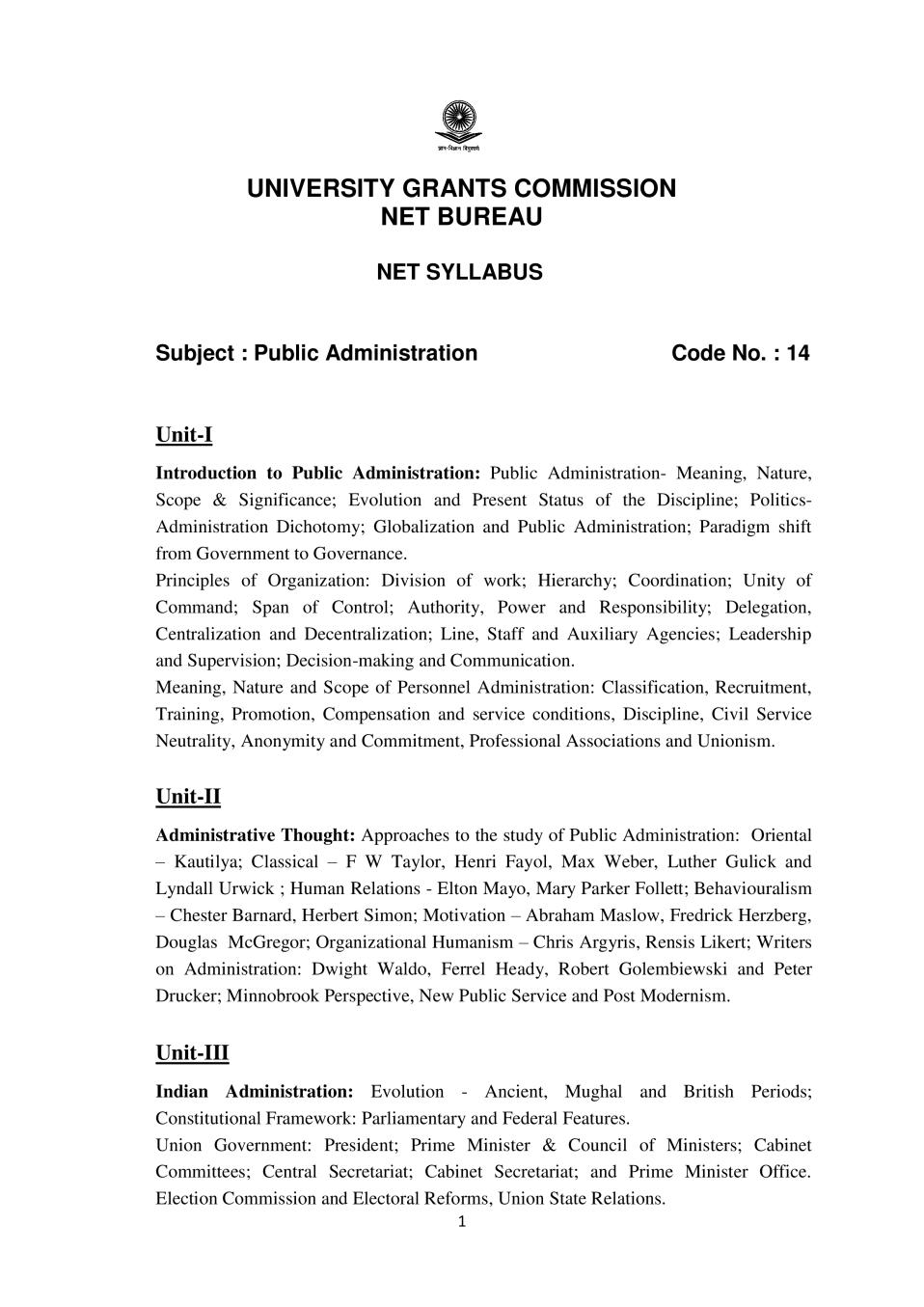
UNIVERSITY GRANTS COMMISSION
NET BUREAU
m
NET SYLLABUS
o m c. o
c
. Administration e m
e m la s
s
Subject : Public Code No. : 14
l a a g
ag
Unit-I
Introduction to Public Administration: Public Administration- Meaning, Nature,
Scope & Significance; Evolution and Present Status of the Discipline; Politics-
Administration Dichotomy; Globalization and Public Administration; Paradigm shift
from Government to Governance.
m
Principles of Organization: Division of work; Hierarchy; Coordination; Unity of
. co
Command; Span of Control; Authority, Power and Responsibility; Delegation,
s em
Centralization and Decentralization; Line, Staff and Auxiliary Agencies; Leadership
g l a
and Supervision; Decision-making and Communication.
a
Meaning, Nature and Scope of Personnel Administration: Classification, Recruitment,
Training, Promotion, Compensation and service conditions, Discipline, Civil Service
Neutrality, Anonymity and Commitment, Professional Associations and Unionism.
Unit-II
Administrative Thought: Approaches to the study of Public Administration: Oriental
m
– Kautilya; Classical – F W Taylor, Henri Fayol, Max Weber, Luther Gulick and
m .co
c. o
Lyndall Urwick ; Human Relations - Elton Mayo, Mary Parker Follett; Behaviouralism
m
se
– Chester Barnard, Herbert Simon; Motivation – Abraham Maslow, Fredrick Herzberg,
em la
Douglas McGregor; Organizational Humanism – Chris Argyris, Rensis Likert; Writers
las a g
g
on Administration: Dwight Waldo, Ferrel Heady, Robert Golembiewski and Peter
a Drucker; Minnobrook Perspective, New Public Service and Post Modernism.
Unit-III
Indian Administration: Evolution - Ancient, Mughal and British Periods;
Constitutional Framework: Parliamentary and Federal Features.
Union Government: President; Prime Minister & Council of Ministers; Cabinet
m .
co
Committees; Central Secretariat; Cabinet Secretariat; and Prime Minister Office.
. e m
s
Election Commission and Electoral Reforms, Union State Relations.
e m l a
s
1
l a a g
ag For more Question Papers, Sample Papers, Notes & Syllabus visit Page 1 of 8
Page 3
Citizen Grievance Redressal Mechanism: Lok Pal; Lok Ayukta; Central Vigilance
Commission and Regulatory Authorities. Issue Areas: Politician and Civil Servant
relations, Generalists and Specialists debate and Combating Corruption.
Civil Services: Classification – All India Services, Central Services and State Services;
Recruitment Agencies – Union Public Service Commission, State Public Service
Commissions and other Commissions and Boards: Capacity Building of Civil Servants
and Civil Service Reforms.
Planning: Planning Commission, National Development Council, NITI Aayog, State
Planning Commissions / Boards and Planning Departments.
Judiciary: Indian Constitution and Independence of Judiciary: Supreme Court; High
Courts; Judicial Review and Public Interest Litigation and Judicial Reforms. Police
Administration and Reforms. E- Governance Initiatives in Indian administration.
Unit-IV
State & Local Administration: Constitutional Framework of State Administration –
State Legislature; Governor – Role and Functions; Chief Minister – Powers and
Functions; Council of Ministers; Role and Functions of Chief Secretary; State
Secretariat ; Directorates and Commissionerate; District Administration – Concept and
Evolution, District Collector - Power, Functions and Changing role; Autonomous
District Councils - Structure, Powers and Functions, District Rural Development
Agency; Evolution of Local Governance in India.
Local Governance: 73rd & 74th Constitutional Amendment Acts: State Election
Commission ; State Finance Commission; District Planning Committee; Rural
Governance - Gram Sabha, Gram Panchayats, Panchayat Samitis and Zila Parishads,
Finance in PRIs, Personnel administration at local level; Policies and Programmes of
Rural Development – MGNAREGA.
Growth of Urbanization, Urban Governance - Structure, Composition, Functions of
Municipal Corporations, Municipal Councils, Nagar Panchayats and Metropolitan
Governance - Sources of Finance; Personnel Administration. Reforms in Urban
Governance -Solid Waste Management, Smart and AMRUT cities
Unit-V
Comparative and Development Administration: Comparative Public Administration:
Concept, Nature, Scope and Significance of Comparative Public Administration; Public
Administration and its Environment. Approaches and Methods to the study of
Comparative Administration: Institutional, Behavioural, Structural-Functional,
Ecological and Systems Approaches.Fred Riggs’s Typology of Societies and Features;
Problems of Comparative Research; Comparative Studies –Influence of Globalization;
Salient Features of the administrative systems of UK, USA, France and Japan.
2
For more Question Papers, Sample Papers, Notes & Syllabus visit Page 2 of 8
Page 4
m .co
c. o
e m
em l a s
s a g
Development Administration: Development and its Dimensions. Development and
Modernization; Approaches to Development - Sustainable Development and Anti-
Development; Sustainable Development Goals (SDGs).
Development Administration: Concept, Nature, Scope, Objectives, Features and
Significance; Ecology of Development Administration, Contribution of Fred Riggs,
Dwight Waldo and Edward Widener; Role of Bureaucracy in Development.
Globalization and Development Administration; Emergence of Non-State actors in
m
m c. o
Development Administration; Public-Private Partnerships; Corporate Social
.co e m
Responsibility, Human Development Indicators and Social Audit.
em l a s
s
la and Financial Administration: Economic Policies - Mixed Economya to
Unit-VI
g
a g
Economic
Liberalization, Privatization and Globalization (LPG); New Economic Policy (NEP);
Industrial Policy since Independence; Government in Business - Public Enterprises-
Concept, Growth and Forms of Public Enterprises; Management, Problem of
Accountability and Autonomy; Disinvestment Policies.
Financial Administration: Public Finance – Revenue and Expenditure: Nature, Scope
and Significance of Financial Administration; Budget – Meaning, Purpose and
m
co
Significance; Budgetary Process – preparation, enactment and execution; Types of
.
Budget – PPBS, Performance Budget, Zero-Based Budget and Gender Budget; Fiscal
s em
a
Responsibility and Budget Management Act (FRBMA) and Sunset legislation. Fiscal
g l
Federalism – Union-State Financial Relations, Finance Commission. Financial Control-
a
Legislature and Executive; Parliamentary Committees and Comptroller and Auditor
General of India. Taxation policies – Principles of Taxation –Progressive and
Proportional taxation – Reforms in Taxation policies.
Unit-VII
Social Welfare Administration: Concept of Social Welfare, Social Justice and Social
m
Change; Concept of Equity and Inclusiveness in Social Justice; Concept of Affirmative
m .co
c. o
action-Reservations; Institutional arrangement for Social Welfare & Social Justice
m
se
Administration; NGOs, Civil Societies and Voluntary Agencies; Policies, Programmes
s em la
and Institutional Framework for the Protection and Welfare of SCs/ STs / OBCs/
la a g
Women/ Children, Aged, Differently-abled (Divyang) and Minorities Commissions –
ag Women, SC/ST, Minority- Role and Functions.
Disaster Management - Nature and Types of Disaster; Institutional Arrangements for
Disaster Management; Role of State and Non-State actors.
Unit-VIII
m .
Public Policy: Nature, Scope and Importance of Public Policy; Evolution of Public
.co e m
Policy and Policy Sciences; Public Policy and Public Administration. Approaches to
e m l as
s
3
l a a g
ag For more Question Papers, Sample Papers, Notes & Syllabus visit Page 3 of 8
Page 5
Participatory and Normative Approaches.
Theories and Models of Policy Making – Harold Lasswell, Charles Lindblom,
Yehezkel Dror .
Institutions of Policy Making - Legislature, Executive and Judiciary. Types of Policy
Analysis - Empirical, Normative, Retrospective and Prospective, Prescriptive and
Descriptive. Policy Implementation, Outcomes and Evaluation.
Constraints on Public Policy – Socio-economic, Political, Institutional and Cultural.
Role of Media, Public Opinion, Civil Society and Pressure Groups on Policy Making.
Unit-IX
Governance and Good Governance: Ancient Discourse – Kautilya, Plato and
Aristotle on Good Governance; Elements and Forms of Good Governance; Theories
and Concepts of Governance – World Bank and UNDP; State, Market and Civil
Society, Public Choice Theory, New Public Management, Public Value Theory,
Governance as Theory, Governance and Public Governance.
Networking and Collaborative Governance, Business Process Re-engineering, ICT and
Governance – e-Government and e-Governance, e-Readiness and Digital Divide.
Accountability, Openness and Transparency; Gender and Governance.
Citizen and Governance: Civil Society – Role and Limitations, Citizen Participation,
Right to Information – RTI Act and Administrative Reforms, National Information
Commission, Citizen Charter – Concept, Objectives and Significance.
Ethics and Public Accountability in Governance: Rule of Law and Administrative Law,
Delegated Legislation and Administrative Adjudication. Ethical Foundations of
Governance: Constitutional Values, Family, Society and Education.
Unit-X
Research Methodology: Social Science Research- Meaning and Significance;
Distinction between Methodology and Method; Facts and Values in Research; Role of
Research in Theory-Building; Scientific Method; Objectivity in Social Research;
Types of Research; Identification of Research Problem; Hypotheses and Null-
Hypotheses; Validation of Hypothesis; Research Design; Methods of Data
Collection- Primary and Secondary sources- ( Observation; Questionnaire and
Interview, Use of Library and Internet);Sampling and Sampling Techniques; Scales of
Measurement; Analysis of Data and Use of Computers in Social Science Research-
SPSS; Citation patterns and Ethics of Research ; Bibliography; Report Writing.
4
For more Question Papers, Sample Papers, Notes & Syllabus visit Page 4 of 8
Page 6
m .co
c. o
e m
em l a s
s a g
m
m c. o
.co s e m
em la
l a s a g
ag
m
. co
s em
g l a
a
m
m .co
c. o se
m
s em g la
gla a
a
m .
.co s e m
e m l a
l a s a g
ag For more Question Papers, Sample Papers, Notes & Syllabus visit Page 5 of 8
Page 7
Page 8
m .co
c. o
e m
em l a s
s a g
m
m c. o
.co s e m
em la
l a s a g
ag
m
. co
s em
g l a
a
m
m .co
c. o se
m
s em g la
gla a
a
m .
.co s e m
e m l a
l a s a g
ag For more Question Papers, Sample Papers, Notes & Syllabus visit Page 7 of 8
Page 9
Document Details
| Board / Org | NTA |
| Exam | UGC National Eligibility Test |
| Type | Syllabus |
| Pages | 9 |
| Updated | 15 Jul 2026 |