Page 1
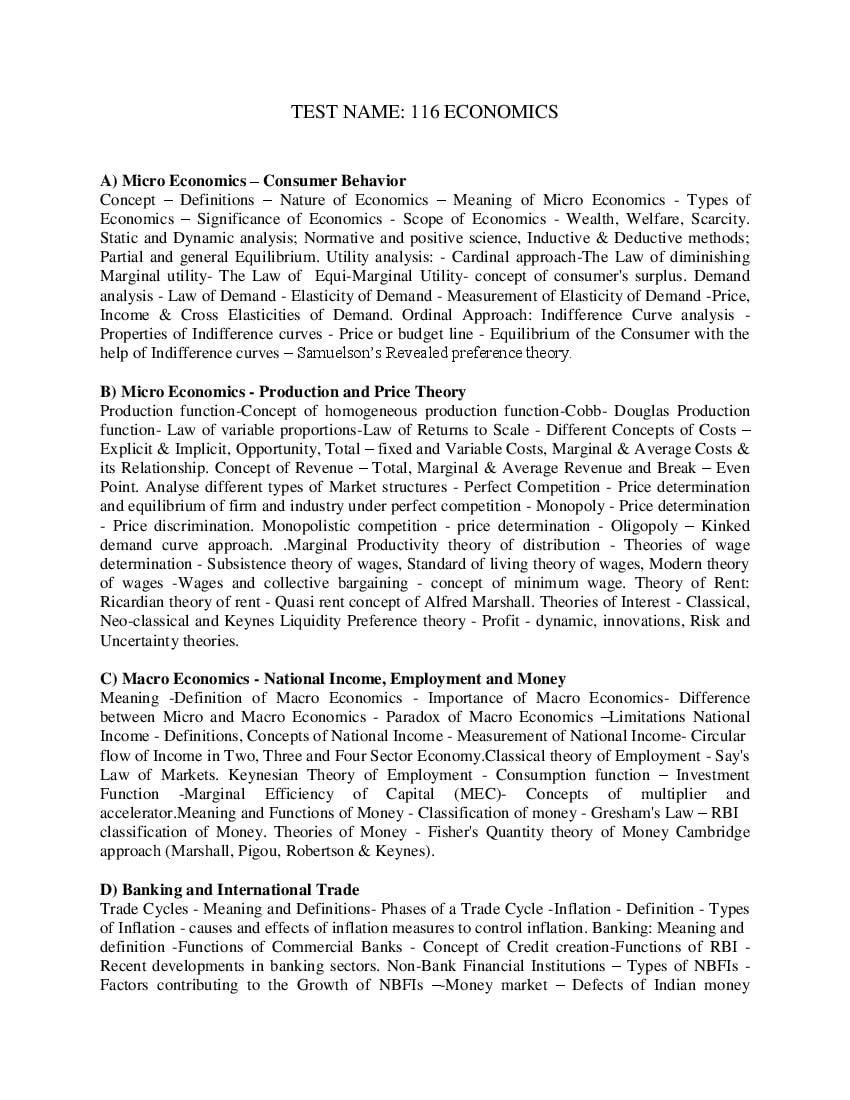
TEST NAME: 116 ECONOMICS A) Micro Economics – Consumer Behavior Concept – Definitions – Nature of Economics – Meaning of Micro Economics - Types of Economics – Significance of Economics - Scope of Economics - Wealth, Welfare, Scarcity. Static and Dynamic analysis; Normative and positive science, Inductive & Deductive methods; Partial and general Equilibrium. Utility analysis: - Cardinal approach-The Law of diminishing Marginal utility- The Law of Equi-Marginal Utility- concept of consumer's surplus. Demand analysis - Law of Demand - Elasticity of Demand - Measurement of Elasticity of Demand -Price, Income & Cross Elasticities of Demand. Ordinal Approach: Indifference Curve analysis - Properties of Indifference curves - Price or budget line - Equilibrium of the Consumer with the help of Indifference curves – Samuelson’s Revealed preference theory. B) Micro Economics - Production and Price Theory Production function-Concept of homogeneous production function-Cobb- Douglas Production function- Law of variable proportions-Law of Returns to Scale - Different Concepts of Costs – Explicit & Implicit, Opportunity, Total – fixed and Variable Costs, Marginal & Average Costs & its Relationship. Concept of Revenue – Total, Marginal & Average Revenue and Break – Even Point. Analyse different types of Market structures - Perfect Competition - Price determination and equilibrium of firm and industry under perfect competition - Monopoly - Price determination - Price discrimination. Monopolistic competition - price determination - Oligopoly – Kinked demand curve approach. .Marginal Productivity theory of distribution - Theories of wage determination - Subsistence theory of wages, Standard of living theory of wages, Modern theory of wages -Wages and collective bargaining - concept of minimum wage. Theory of Rent: Ricardian theory of rent - Quasi rent concept of Alfred Marshall. Theories of Interest - Classical, Neo-classical and Keynes Liquidity Preference theory - Profit - dynamic, innovations, Risk and Uncertainty theories. C) Macro Economics - National Income, Employment and Money Meaning -Definition of Macro Economics - Importance of Macro Economics- Difference between Micro and Macro Economics - Paradox of Macro Economics –Limitations National Income - Definitions, Concepts of National Income - Measurement of National Income- Circular flow of Income in Two, Three and Four Sector Economy.Classical theory of Employment - Say's Law of Markets. Keynesian Theory of Employment - Consumption function – Investment Function -Marginal Efficiency of Capital (MEC)- Concepts of multiplier and accelerator.Meaning and Functions of Money - Classification of money - Gresham's Law – RBI classification of Money. Theories of Money - Fisher's Quantity theory of Money Cambridge approach (Marshall, Pigou, Robertson & Keynes). D) Banking and International Trade Trade Cycles - Meaning and Definitions- Phases of a Trade Cycle -Inflation - Definition - Types of Inflation - causes and effects of inflation measures to control inflation. Banking: Meaning and definition -Functions of Commercial Banks - Concept of Credit creation-Functions of RBI - Recent developments in banking sectors. Non-Bank Financial Institutions – Types of NBFIs - Factors contributing to the Growth of NBFIs –-Money market – Defects of Indian money
Page 2
market. Concepts of Shares-Debentures - Stock Market - Functions - Primary and Secondary Markets - SEBI - Insurance - Life Insurance and General Insurance. Macro Economic Policy - Fiscal, Monetary and Exchange rate policies Objectives and Significance - Importance of International Trade - Regional and International Trade – Defining Balance of Trade and Balance of Payment. E) Economic Development and Indian Economy Concept of Economic Growth - Distinction between Economic Growth and Development - Measurement of Economic Development -Theories of Economic Growth: Adam Smith, Rostow, Karl Marx and Harrod&Domar Models.Sustainable development - Balanced and unbalanced growth-choice of techniques Labour intensive and capital-intensive methods.Basic features of the Indian Economy - Natural Resources - Important Demographic features- Concept of Population Dividend - Population Policy. National Income in India - trends and compositionpoverty, inequalities and Unemployment - Measures taken by the Government. – MGNREGS Economic reforms - liberalization, privatization and globalisation - concept of inclusive growth. F) Indian and Andhra Pradesh Economy Indian Agriculture - Importance of Agriculture in India - Agrarian structure and relations- Factors determining Productivity- Agricultural Infrastructure - Rural credit - Micro Finance - Self Help Groups (SHGs) - Agricultural Price policy- concept of Crop Insurance - Food Security. Structure and growth of Indian Industry - Industrial policies of 1956 & 1991 Meaning of Micro small and Medium Enterprises (MSMEs)- Problems and Prospects of small scale Industries in India. Disinvestment in India - FEMA - Foreign direct investment - Services Sector in India – Reforms in Banking and Insurance -, IT, Education and Health. Planning in India Economy - Objectives of Five-year plans - Review of Five-year Plans - Current Five-year plan- NITI Aayog. Andhra Pradesh Economy - Population - GSDP - Sector Contribution and trends - IT – Small Scale Industry - SEZs. ************