AHSEC 1st Year Syllabus 2024-25 Sociology
Finished viewing? Save it for later —
Download AHSEC 1st Year Syllabus 2024-25 Sociology (PDF · 5 pages)About AHSEC 1st Year Syllabus 2024-25 Sociology
AHSEC 1st Year Syllabus 2024-25 Sociology is available here for free download. Published by Assam Board for Class 11, this syllabus can be viewed online or downloaded as a PDF (5 pages). Candidates preparing for Class 11 can use AHSEC 1st Year Syllabus 2024-25 Sociology to understand the exam pattern, the type of questions asked, and the overall difficulty level.
Frequently Asked Questions
How can I download AHSEC 1st Year Syllabus 2024-25 Sociology?
Open this page and click the Download button to save AHSEC 1st Year Syllabus 2024-25 Sociology as a PDF. It is completely free on AglaSem Docs.
Is AHSEC 1st Year Syllabus 2024-25 Sociology free to download?
Yes. AHSEC 1st Year Syllabus 2024-25 Sociology can be viewed online and downloaded as a PDF free of cost on AglaSem Docs.
How many pages does AHSEC 1st Year Syllabus 2024-25 Sociology have?
AHSEC 1st Year Syllabus 2024-25 Sociology contains 5 pages, which you can read online or download together as a single PDF.
Where can I find more Class 11 study material?
You can find more Class 11 question papers, sample papers, syllabus, and answer keys on AglaSem Docs.
AHSEC 1st Year Syllabus 2024-25 Sociology – Text
Read the full text of this syllabus below — useful to quickly search, copy and reference the content online without downloading the PDF.
📄 View text version (5 pages)
Page 1
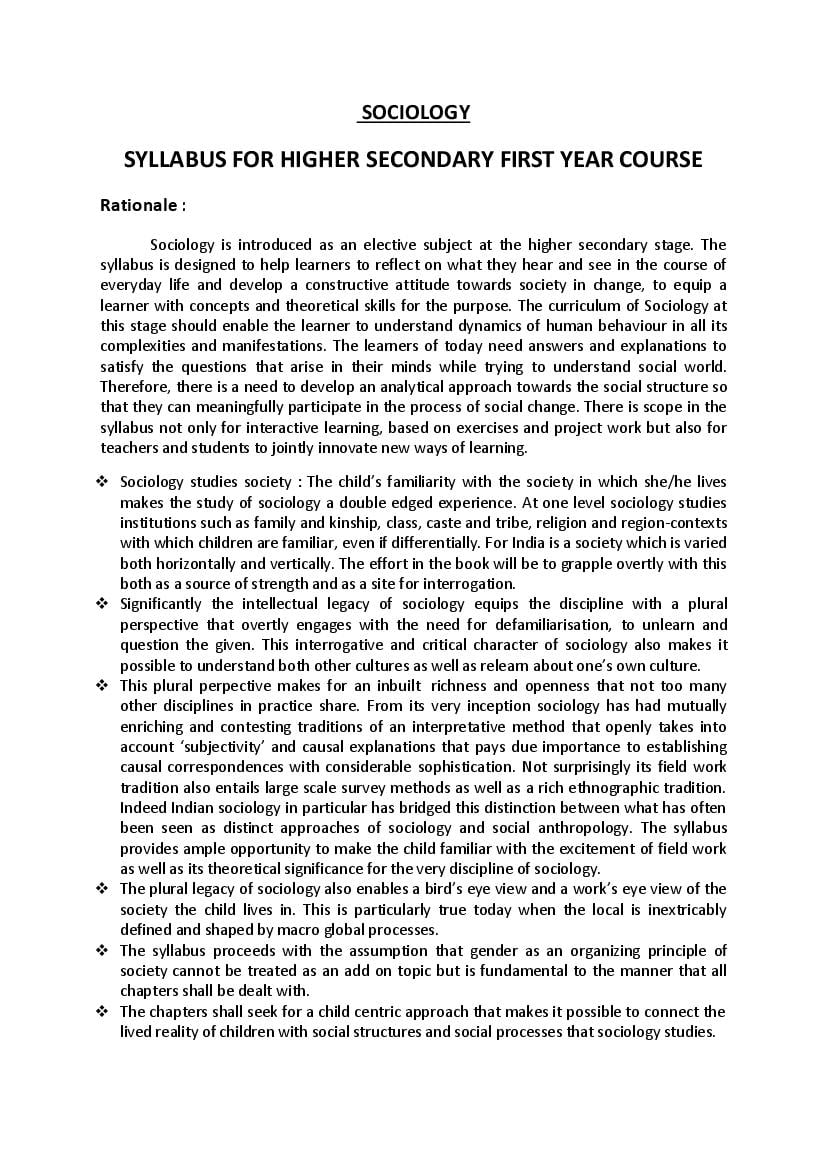
SYLLABUS FOR HIGHER SECONDARY FIRST YEAR COURSE
Rationale :
Sociology is introduced as an elective subject at the higher secondary stage. The
syllabus is designed to help learners to reflect on what they hear and see in the course of
everyday life and develop a constructive attitude towards society in change, to equip a
learner with concepts and theoretical skills for the purpose. The curriculum of Sociology at
this stage should enable the learner to understand dynamics of human behaviour in all its
complexities and manifestations. The learners of today need answers and explanations to
satisfy the questions that arise in their minds while trying to understand social world.
Therefore, there is a need to develop an analytical approach towards the social structure so
that they can meaningfully participate in the process of social change. There is scope in the
syllabus not only for interactive learning, based on exercises and project work but also for
teachers and students to jointly innovate new ways of learning.
Sociology studies society : The child’s familiarity with the society in which she/he lives
makes the study of sociology a double edged experience. At one level sociology studies
institutions such as family and kinship, class, caste and tribe, religion and region-contexts
with which children are familiar, even if differentially. For India is a society which is varied
both horizontally and vertically. The effort in the book will be to grapple overtly with this
both as a source of strength and as a site for interrogation.
Significantly the intellectual legacy of sociology equips the discipline with a plural
perspective that overtly engages with the need for defamiliarisation, to unlearn and
question the given. This interrogative and critical character of sociology also makes it
possible to understand both other cultures as well as relearn about one’s own culture.
This plural perpective makes for an inbuilt richness and openness that not too many
other disciplines in practice share. From its very inception sociology has had mutually
enriching and contesting traditions of an interpretative method that openly takes into
account ‘subjectivity’ and causal explanations that pays due importance to establishing
causal correspondences with considerable sophistication. Not surprisingly its field work
tradition also entails large scale survey methods as well as a rich ethnographic tradition.
Indeed Indian sociology in particular has bridged this distinction between what has often
been seen as distinct approaches of sociology and social anthropology. The syllabus
provides ample opportunity to make the child familiar with the excitement of field work
as well as its theoretical significance for the very discipline of sociology.
The plural legacy of sociology also enables a bird’s eye view and a work’s eye view of the
society the child lives in. This is particularly true today when the local is inextricably
defined and shaped by macro global processes.
The syllabus proceeds with the assumption that gender as an organizing principle of
society cannot be treated as an add on topic but is fundamental to the manner that all
chapters shall be dealt with.
The chapters shall seek for a child centric approach that makes it possible to connect the
lived reality of children with social structures and social processes that sociology studies.
Page 2
society that makes learning a process of discovery. A way towards this is to deal with
sociological concepts not as given but a product of societal actions, humanly constructed
and therefore open to questioning.
Objectives :
To enable learners to relate classroom teaching to their outside environment.
To introduce them to the basic concepts of sociology that would enable them to
observe and interpret social life.
To be aware of the complexity of social processes.
To appreciate diversity in society in India and the world at large.
To build the capacity of students to understand and analyse the changes in
contemporary Indian society.
One Paper Time : Three Hours Total Marks 100(80+20)
Unitwise Distribution of Marks and Periods :
Unit No. Title Marks Periods
Part-A : INTRODUCING SOCIOLOGY
Unit-I Sociology and Society 10 20
Unit-II Terms, Concepts and their use in Sociology 10 20
Unit-III Understanding Social Institutions 12 24
Unit-IV Culture and Socialisation 12 24
Total 44
Part-B : UNDERSTANDING SOCIETY
Unit-V Social change and Social order in 12 24
Rural and Urban Society
Unit-VI Introducing western Sociologists 12 24
Unit-VII Indian Sociologists 12 24
Total 36
Grand Total 80 160
Project work Total Marks: 20
Page 3
H.S. 1st year
Implementation from the Academic Session 2023-24 for onwards
Unitwise Distribution of Course Contents :
PART -A INTRODUCING SOCIOLOGY [44 marks] ( Periods) Marks
Unit- I SOCIOLOGY AND SOCIETY 20 10
Introducing Society: Individual Collectivities,
Pluralities and Inequalities among societies
Introducing Sociology: Emergence ,Nature and Scope,
Relationship with other social Sciences.
Unit -II TERMS, CONCEPTS AND THEIR USE IN SOCIOLOGY 20 10
Social Groups and Society
Status and Role
Social Stratification: Caste and Class
Social Control
Unit- III UNDERSTANDING SOCIAL INSTITUTIONS 24 12
Family, Marriage and Kinship
Work and Economic Life
Political Institutions
Religion as a Social Institution
Education as a Social Institution
Unit –IV CULTURE AND SOCIALISATION 24 12
Defining Culture
Dimensions of Culture
Socialization
Agencies of Socialization
Page 4
Unit –V SOCIAL CHANGE AND SOCIAL ORDER IN RURAL 24 12
AND URBAN SOCIETY
Social Change : Type and Dimensions; Causes and Consequences
Social Order: Domination ,Authority and Law ;Contestation, Crime and Violence
Village, Town and City: Social Changes in Rural and Urban Society
Social Order and Social Change in Rural and Urban Areas.
Unit – VI INTRODUCING WESTERN SOCIOLOGISTS 24 12
The Context of Sociology
Karl Marx on Class Conflict
Emile Durkheim on Division of Labour
Max Weber on Interpretive Sociology, Ideal types and Bureaucracy
Unit –VII INDIAN SOCIOLOGISTS 24 12
G.S. Ghurye on Caste and Race
D.P.Mukherjee on Tradition and Change
A.R.Desai on the State
M.N.Srinivas on Village Studies
PROJECT WORK (MARKS-20)
As part of the curriculum, the students are required to submit project work on
contemporary social problems relevant to their local area (For example, environment,
education and Social change, Health and well-being, women empowerment, poverty and
unemployment, etc) The framework to be followed for the project work is as follows.
1. Introduction Marks- 02
2. Statement of purpose Marks- 02
3. Research Question Marks- 02
4. Methodology Marks- 03
5. Data Analysis Marks- 02
6. Conclusion Marks- 02
7. Viva (Based on the project work) Marks- 05
This Pattern would be followed by students.
Page 5
2. সমাজব াধ্, অসম উচ্চতি মাধ্যৰমক ৰিক্ষা সংসদি দ্বািা প্ৰকাৰিত
3. Introducing Sociology by NCERT
4. Understanding Society by NCERT
Document Details
| Board / Org | Assam Board |
| Exam | Class 11 |
| Type | Syllabus |
| Pages | 5 |
| Updated | 22 Jul 2026 |