Page 1
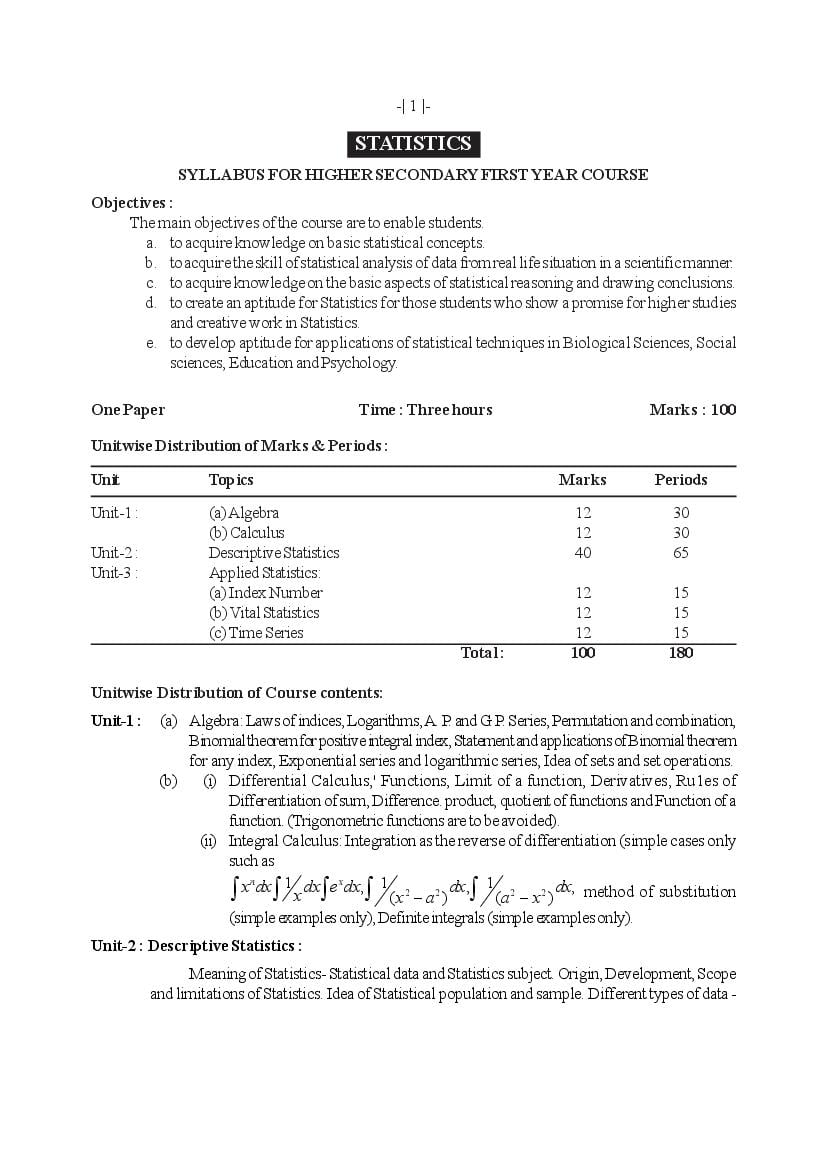
-| 1 |- STATISTICS SYLLABUS FOR HIGHER SECONDARY FIRST YEAR COURSE Objectives : The main objectives of the course are to enable students. a. to acquire knowledge on basic statistical concepts. b. to acquire the skill of statistical analysis of data from real life situation in a scientific manner. c. to acquire knowledge on the basic aspects of statistical reasoning and drawing conclusions. d. to create an aptitude for Statistics for those students who show a promise for higher studies and creative work in Statistics. e. to develop aptitude for applications of statistical techniques in Biological Sciences, Social sciences, Education and Psychology. One Paper Time : Three hours Marks : 100 Unitwise Distribution of Marks & Periods : Unit Topics Marks Periods Unit-1 : (a) Algebra 12 30 (b) Calculus 12 30 Unit-2 : Descriptive Statistics 40 65 Unit-3 : Applied Statistics: (a) Index Number 12 15 (b) Vital Statistics 12 15 (c) Time Series 12 15 Total : 100 180 Unitwise Distribution of Course contents: Unit-1 : (a) Algebra: Laws of indices, Logarithms, A. P. and G. P. Series, Permutation and combination, Binomial theorem for positive integral index, Statement and applications of Binomial theorem for any index, Exponential series and logarithmic series, Idea of sets and set operations. (b) (i) Differential Calculus,' Functions, Limit of a function, Derivatives, Ru1es of Differentiation of sum, Difference. product, quotient of functions and Function of a function. (Trigonometric functions are to be avoided). (ii) Integral Calculus: Integration as the reverse of differentiation (simple cases only such as x dx 1 x dx e dx, 1( x 2 a 2 ) dx, 1(a 2 x 2 ) dx, method of substitution n x (simple examples only), Definite integrals (simple examples only). Unit-2 : Descriptive Statistics : Meaning of Statistics- Statistical data and Statistics subject. Origin, Development, Scope and limitations of Statistics. Idea of Statistical population and sample. Different types of data -
Page 2
-| 2 |- primary and secondary data and methods of their collection. Time series data, Spatial data, Attribute (qualitative) data and Variable (quantitative) data. Frequency distribution, Graphical representation of frequency distribution Histogram, Frequency polygon, Frequency curve, Ogive. Measures of location- Arithmetic mean, Geometric mean, Harmonic mean, Median, Mode and their properties. Partition Values- Quartiles, Deciles, Percentiles. Graphical location of Mode, Quartiles, Deciles and Percentiles. Measures of Dispersion - Range, Inter-quartile Range, Quartile deviation, Mean Deviation, Standard Deviation, Coefficient of variation. Ideal measures of Dispersion. Idea of Skewness and kurtosis (without moments). Bi - variate distribution, Scalier diagram, Correlation and regression, Karl Pearson's Correlation coefficient and its properties. Two regression lines (without derivation), Relation between correlation coefficient and regression coefficients. Unit - 3 : Applied Statistics : (a) Index Numbers : Idea and uses of index numbers, problems in the construction of index numbers, simple and weighted index numbers, Laspeyre's, Paasche's MarshallEdgeworth and Fisher's 'ideal' index numbers, Tests for a good index number - Time reversal and Factor reversal tests only, Consumer price index number - their construction and use. (b) Vital Statistics : Vital rates and ratios. Mortality rates - Crude death rate, Age specific death rate and standardized death rates. Fertility rate and total fertility rate. Reproduction rates - Gross reproduction rate and Net reproduction rate. (c) Time Series : Meaning, Components and uses of time series. Determination of trend by the methods of graphic, semi-averages, moving averages and least squares.